Michael S. Bell, PhD, and Robert Greenway
When analyzing conflict, disproportionate focus is often placed on the employment of forces and their immediate causes and effects. A less appreciated aspect of war studies is the role of logistics and resources in sustaining forces and enabling national military power. Forces in the field require at least a minimum threshold of food, fuel, and ammunition, among other critical materials, for the success of sustained operations.1
When supply chains fracture, production lags, or transportation networks collapse, military power erodes, no matter how advanced the weaponry or how skilled the commanders. From antiquity to WWII, history has demonstrated that the capacity to feed armies, fuel aircraft and tanks, and produce ammunition at scale reveals economic, logistical, and operational patterns. Cumulative disruptions to sustainment and resources inevitably cascade into paralysis and, ultimately, strategic defeat.
The construction of the Allison Center’s TIDALWAVE simulation draws from patterns and precedents made apparent by the blockades, strategic targeting campaigns, and economic warfare efforts of historic conflicts. This section illuminates the utility of identifying systemic critical vulnerabilities in adversaries’ sustainment capacity and resources, alongside setting forth lessons for modern warfare in strategic targeting. It also illustrates the criticality of protecting our partners’ resources, transportation networks, and production capacity from disruption and attack.
Logistical Limitations and the Use of Blockades
The idea that wars can be won by starving an enemy of resources long predates the 20th century. For thousands of years, logistics and resource constraints have dictated how armies are raised, organized, and deployed, alongside determining the capacity of populations to hold out.
Greek Armies and the Peloponnesian War
The circumstances that led to the start of the Peloponnesian War most certainly warrant reflection. The catalyst occurred on the small island of Epidamnus in 435 BCE along the vital trade route connecting Greece and Italy. The struggle began between the competing powers of Corcyra and Corinth supporting competing sides of the internal conflict. Yet, what began as a peripheral quarrel soon drew in the two leading powers of the Greek world: Athens, aligning with Corcyra, and Sparta, siding with Corinth. Notably, Athens initially confined its involvement to limited, defensive support—dispatching a small, largely symbolic naval force to assist the Corcyrans, whose subsequent defeat at the Battle of Sybota in 433 BCE only deepened hostilities. The loss initiated a series of escalatory actions that culminated in direct and extended conflict between the two superpowers—Sparta, dominant on land, and Athens, dominant at sea.2 While both city-states increasingly saw conflict as inevitable, neither sought out the confrontation. Rather, what transpired was a series of misjudgments immortalized centuries later in Shakespeare’s Comedy of Errors.3 In this sense, the Peloponnesian War offers enduring parallels to the present and serves as a valuable foundation for evaluating conflict and strategic planning.
In the 30 years of war between Athens and Sparta and their respective alliances, most of the Greek city–states could not support standing professional armies given their fragmented economies. Citizen soldiers, rather, served on a part-time basis, called up only during the campaigning season.4 Armies marched along limited lines of advance, constrained by the availability of food and water. Thus, military commanders often planned routes that maximized access to sustainment resources or allowed for local foraging. The tradition of laying waste to the enemy’s countryside, however, precluded any long-duration foraging, and campaigns typically ended in time for citizens to return and harvest their crops.
In Hoplite warfare, ravaging the local countryside was the traditional method of forcing the enemy into battle, which the Athenians had been reluctant to oblige.5 In these ways, constrained resources, namely food, influenced or dictated the composition and options of militaries, even before enemy action. When enemy action can successfully target logistics, the forces that can be fielded shrink further, and options become even more constrained. Throughout the Peloponnesian War, the Athenians, a dominant naval power, relied on exploiting the resources of their empire. In contrast, the Spartan alliance had been a major land power. Hence, when Athens lost its fleet to Sparta at the Battle of Aegospotami, the Peloponnesian War—fought for nearly 30 years—ended because Athens could no longer import grain.6
In the third and, ultimately, decisive phase of the Peloponnesian War, known as the Decelean War (413–404 BCE), Sparta took a different strategic and operational approach. Following the disastrous Athenian expedition to Sicily, the Spartans occupied and fortified the town of Decelea in 413 BCE.7 Decelea, located in Attica, was 14 miles from Athens and dominated the trade routes to Boeotia. From Decelea, the Spartans could raid Athenian territory continuously, rather than only during campaign seasons. The Spartan base at Decelea crippled the Athenian economy, cut off silver from the mines at Laurium, and prevented the land of Attica from being farmed.8 As a result, Athenian food supplies had to be brought by sea and became more expensive.
Compounding those hardships, the Spartans encouraged rebellions among the cities that were part of Athens’ Delian League, negatively impacting these cities’ tribute payments to Athens. Sparta aimed to recover Greek cities in Asia Minor that had been incorporated into Athens’ Delian League four decades earlier at the end of the Persian Wars. As such, Sparta sought to deny the valuable resources, particularly grain shipments, of those cities to Athens. To achieve these strategic aims, the Spartans also developed new capabilities, and, with Persian support, built a fleet of 170 ships.9
After a defeat of the Spartan fleet at the hands of the Athenians at the Battle of Arginusae in 406 BCE, Athens rejected Spartan peace entreaties.10 Additionally, the Spartan Admiral Lysander prevailed over his political opponents and once again took command of the Spartan fleet. Seeking decisive action, Lysander evaded the Athenian fleet and moved his fleet to the Hellespont, critical straits controlling the trade routes to the Black Sea region that supplied most of the grain to Athens. Lysander believed these efforts would draw the Athenian fleet, and in a ruse, he managed to surprise and destroy it at Aegospotami. Only nine of 180 Athenian ships escaped—one of which brought news of the disaster to Athens.11
Afterward, Lysander’s fleet sailed toward Athens, capturing cities along the way, further weakening Athenian resources. Although Athens resolved to hold out and feared Spartan retribution, the Athenians quickly recognized that their cause was hopeless. The Spartan army at Decelea cut off land-based resupply routes in Attica.12 Without the Athenian fleet, grain could not be imported, and the Athenians began to starve. Lysander’s fleet arrived and closed the harbor at Piraeus. Without resources and with little hope of foreseeable relief, Athens capitulated.
The Thirty Years’ War and 18th-Century Conflict
The Reformation and rise of nation-states marked a transition from ancient and feudal warfare. What emerged in Europe by the 1600s was a new reliance on professional, national armies that were well-equipped, disciplined, and tactically employed. As the religious fervor of the Reformation enmeshed Europe in a series of bitter wars, improvements in hand-held firearms and artillery, new fortification methods, and methodical engineering and siege capabilities changed the character of combat and drove logistical and administrative requirements. Initially in this period, while there were more sieges and fewer pitched battles, wars were conducted with ferocity and little restraint.
Armies in this era required supply bases and drew food and fodder from the local countryside. Consequently, the Thirty Years’ War witnessed ruthless treatment of civilian populations by campaigning troops to extract resources and deny those resources to opposing forces. In parts of central Germany, the civilian population dropped by one third due to military activities, disease, and famine. The 1632 Battle of Lutzen provides several insights into the impact of operations against logistics. The leader of the northern Protestant forces, Swedish King Gustavus Adolphus, seized the northern German ports in Pomerania in 1630, dominating commerce in the Baltic. In 1632, Gustavus attempted to strike Imperial forces in Saxony and defeat them piecemeal. The resulting battle was indecisive, and the Swedish king was killed. Beyond the tactical action, however, Lutzen is instructive at the strategic and operational level in that Gustavus’s action was intended to counter the Imperial strategy of Count Albrecht von Wallenstein, which, according to historian David Chandler, “was to drive a corridor between the Swedish field forces and their Baltic bases.”13
Following the excesses of the Thirty Years’ War, 18th-century advances in military science, fortifications, and firepower encouraged a form of limited warfare in Europe characterized by sieges, maneuvers, and small engagements. During this period, several commanders rose above their colleagues and opponents. In addition to their attention to military professionalism and discipline, innovative and combined-arms tactics, and firepower, a handful of leaders could achieve decisive results. Disrupting an adversary’s lines of communications, while protecting their own, enabled resourceful commanders to force battle on favorable terms, even when outnumbered. One of these was Captain-General John Churchill, the Duke of Marlborough.
In 1704, aided by superior logistical preparations, Marlborough marched his Anglo-Dutch army 250 miles from the Spanish Netherlands to the Upper Danube. The maneuver was intended to counter a Franco-Bavarian move to capture Vienna and break up the alliance against France, but along the route Marlborough masked his final objective. In contrast, the French lacked similar agility and struggled to maintain their forces in the field. Their lines of communication and supply ran through passes in the Black Forest, where supply wagons had difficulty moving and the peasantry were hostile after being victimized by French plundering. Marlborough captured the fortress of Schellenberg and the town of Donauwörth on the Danube.14
After those actions failed to compel Maximilian II, the Elector of Bavaria, to give up, Marlborough directed a scorched-earth campaign to bring Maximilian to terms or force a decisive battle. Marlborough also reasoned that laying waste to Bavaria would eliminate its utility as a base from which his enemies could attack Vienna or from which Franco-Bavarian armies could pursue him if he elected to withdraw north. In laying waste to Bavaria, his forces reportedly burned or destroyed over 400 towns and villages in three weeks. Hoping to bring Maximilian to terms, Marlborough observed “if he will ever think of terms, it must be now, for we shall do our outmost to ruin his country.”15 The British measures forced the Bavarians to disperse their forces to protect their towns and estates. With news of French reinforcements approaching, however, Maximilian broke off negotiations.
When the slow-moving French Marshal Camille d’Hostun, the duc de Tallard, arrived with reinforcements through the Black Forest to bolster Franco-Bavarian forces, his forces were already in rough shape. Tallard had lost more than one-third of his force due to sickness and desertion, and part of his precious cavalry was ineffective due to diseased horses. They found foraging difficult in Bavaria. At the onset of the ensuing Battle of Blenheim, Tallard believed Marlborough would withdraw, and upon learning his mistake, had to fire signal guns to recall his army’s foraging parties. At Blenheim, Marlborough decisively defeated Franco-Bavarian forces and destroyed what had been the prevailing myth of French invincibility.
The American Civil War
The Union’s strategic targeting and blockade of the Confederacy serves as a key precedent for economic warfare. The Union forces sought to exploit the Confederacy’s reliance on European trade, both for manufactured goods needed to sustain its war effort and for the cash generated by exporting cotton and tobacco.16
When the Civil War broke out in 1861, many assumed that the war would be short and decisive. Taking a longer view, Union Lieutenant General Winfield Scott devised a strategic plan for the cumulative defeat of the Confederacy, targeting its strategic vulnerabilities. Known as the “Anaconda Plan,” it called for strengthening the defenses of Washington, DC, a blockade of the Confederacy’s Atlantic and Gulf ports, and a major campaign along the Mississippi River to cut the Confederacy in two. President Abraham Lincoln instituted the blockade, but the remainder of Scott’s plan was discarded—a victim of impatient demands for an immediate victory.
The strategic foundation for Union victory in the Civil War was achieved through a series of campaigns that established three blockade zones: 1) the Atlantic coast from Virginia to Florida, 2) the Gulf Coast from Florida to Texas, and 3) the Mississippi River. Two key effects followed.
First, the blockade physically split the South’s economy—food production west of the Mississippi was cut off from financial centers in the east. Second, it stressed the South’s transportation system, producing cascading shortages of food and causing severe inflation.17 The blockade also denied the Confederacy—which lacked robust weapons manufacturing capabilities—the arms, ammunition, and cash from Europe it needed to equip and sustain its military forces. The blockade by itself, however, was not sufficient to defeat the Confederacy.
When Major General Ulysses S. Grant took command of U.S. forces after his victorious Vicksburg Campaign secured the Mississippi for the Union, he instituted aims consistent with Scott’s broader strategic formulation. Grant envisioned simultaneous campaigns increasing pressure on the Confederacy’s scarce resources, already strained by the blockade. The remaining ports open to the Confederacy were actively assaulted and closed. Recognizing that the Confederacy had insufficient resources to respond to simultaneous pressures, Grant approved Major General William T. Sherman’s “march to the sea.” The plan was designed to further fracture the Confederacy and its railroads, factories, and farms, essentially destroying its predominant sustainment systems.18
Grant also recognized that this drive from Atlanta would deny the resources of the Deep South to the Army of Northern Virginia, which was poised to protect Richmond, the Confederate capital, from the Union Army of the Potomac on its outskirts. Complementing those actions, the Union’s scorched-earth campaign in the Shenandoah Valley denied important foodstuffs supplying the remaining Confederate forces in the field.
The success of Grant’s version of the “Anaconda Plan” shows that a comprehensive approach targeting resources and supply chains, distribution capabilities, and transportation systems can effectively limit economic capacity and operational responsiveness, driving the collapse of force sustainment and combat capability.
World War I
World War I demonstrated the difficulty of execution on an even larger scale. When British and French forces established a blockade on Germany in 1914, the effect was almost immediate. Within a week of the outbreak of war, the German merchant fleet had been all but denied free access to the oceans. Out of a prewar merchant fleet of about 1,500 vessels, Germany lost 245 to capture, had more than 1,000 detained in neutral harbors, and saw the rest confined to Baltic waters.19
The German economy, however, adjusted rather quickly. Germany relied on its neighboring neutral states and made use of their ships and merchants to purchase necessary goods. Imports from Scandinavian countries and the Netherlands provided returns proportional to the trade that otherwise would have been lost.20 The blockade was, thus, largely unsuccessful until mid-1915.
It was not until the Allies applied pressure on neutral powers that Germany began to finally feel the pressure of lost trade. This initially took the form of persuading the neutral countries to accept prewar limits on contraband exports to Germany in 1915. They also imposed financial and commercial blacklists to deny German businesses access to international credit and financial markets, alongside pressuring firms in neutral countries to avoid trade with Germany or risk being blacklisted as well. In 1917, those measures were reinforced by an unrestricted blockade.
The Allied blockade involved official collaboration and high-level coordination meetings in London and Paris, as well as between Allied diplomats and business executives in places such as Shanghai and Buenos Aires, where there had been strong German commercial interests. Categorizing food, fuel, and explosive materials as contraband left the German economy with notable losses. German imports were only 20 percent of their prewar volume by 1918, while their exports fell to about 25 percent.21 In the face of shortages, desperate German leaders pursued unrestricted submarine warfare against the neutral United States in early 1917—believing that they could secure military victory before the U.S. could mobilize and apply its potential resources.
Overall, the Allied use of blockades and economic and commercial measures in WWI reinforced an important lesson for modern warfare: unless embargoes are sustained and comprehensive, adversaries will find ways to adapt—whether by turning to neutral intermediaries, developing material substitutes, or resorting to rationing. Consequently, the Allied effort accelerated the quest for actionable alternatives to costly trench warfare in future wars.
Strategic Targeting in World War II
Across both the European and Pacific theaters, WWII ultimately became a contest of logistics, as Allied air, naval, and ground campaigns converged to dismantle the fuel, transportation, and munitions networks sustaining Axis war machines. Japan entered WWII, in part, to secure key resources critical to its war effort in China. Germany engaged in unrestricted submarine warfare to cut Great Britain off from its empire and overseas trade, alongside denying them the resources outlying territories and neutrals provided. Likewise, the Allies made logistical targeting a priority to deny Germany and Japan the resources needed to continue the war—making WWII the prime case study for modern planning, and specifically, for Heritage’s TIDALWAVE.
For Anglo-American leaders in WWII, targeting enemy economies and warmaking capabilities became an important component of Allied wartime strategy. The First Washington Conference in December 1941 and January 1942 established a framework for the Anglo-American war effort. One aspect included “tightening the ring” around Germany through peripheral operations, blockades, and air attacks to set the conditions for the Cross Channel assault. The Casablanca Conference in early 1943 approved the concept of a Combined Anglo-American bomber offensive, with the British bombing area targets at night and the Americans building up forces for daylight attacks on critical German war industries and resources.
The First Quebec Conference in May 1943 provided greater high-level strategic direction on the importance of economic warfare against Nazi Germany and Imperial Japan. At Quebec, the Combined U.S.-U.K. Chiefs of Staff endorsed the Combined Bomber Offensive to accomplish “the progressive destruction of the German military, industrial, and economic system,” alongside approving strikes on refineries in Ploesti, Romania, to disrupt the fuel being supplied from there to German operations on the Eastern Front. For the Pacific, the Combined Chiefs of Staff called for accelerating pressure on Japanese air, naval, and shipping resources and an “[i]ntensification of operations against enemy lines of communications.” Ultimately, the cumulative strategic approach recognized that victory would require the Allies “to maintain and extend unremitting pressure against Japan with the purpose of continually reducing her Military power and attaining positions from which her ultimate surrender can be forced.”22
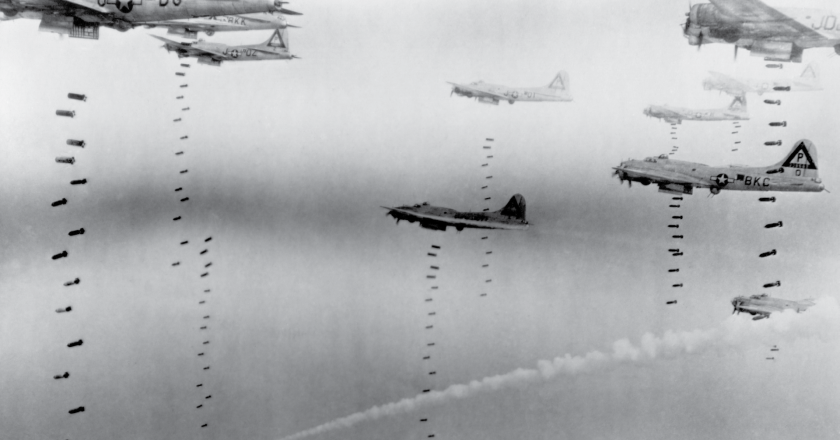
Strategic bombing in WWII rested on the industrial web theory: that modern economies were intricate systems in which destroying key supply and sustainment nodes—oil refineries and distribution centers, manufacturing plants, power stations, and transportation networks—would significantly disrupt prolonged warfare efforts.23 In 1941, the Air War Plan Division (AWPD) in the U.S. identified 154 targets where striking would result in a significant disruption or destruction of German sustainment.24 The targets were prioritized by criticality to German capabilities, with neutralizing the Luftwaffe becoming the primary objective.
Eighteen assembly plants, six aluminum plants, and six magnesium plants were planned for targeting. However, the efficacy of these attacks did not reach the potential given insufficient payloads and delays on secondary or even tertiary strikes. The AWPD first ran a set of hypotheticals in which the American Mid-West was targeted. The results of these tests were then used as the basis for determining the 154 nodes of the Third Reich’s industrial infrastructure.25 Ultimately, the failure to account for the accurate tonnage needed led to reduced impact.26
Soon the Allies realized there existed an even greater vulnerability to German sustainment: its fuel system. A factory deprived of aluminum may shift to copper. A railroad lacking locomotives might use trucks. But an army without fuel cannot move. The Allies determined that Germany exhibited this vulnerability vividly, and soon, a new campaign was underway. Lacking domestic oil production capacity, Nazi Germany depended on Romanian oil fields and synthetic fuel plants in Ploesti for its mechanized forces and Luftwaffe. The Allies took note of this dependence and transitioned focus to the Combined Bomber Offensive, resulting in continuous day and night strikes on refineries, synthetic fuel facilities, and storage depots in a sustained campaign.
Part of this campaign was defined by Operation Tidalwave—the namesake of this project and one of the first strategic strikes on the German oil system. The operation took place on August 1, 1943, when 178 B-24 Liberators flew from Benghazi across the Mediterranean Sea to Ploesti.27 With a cost of 54 planes and 432 Airmen, the participating Army Air Force units disrupted roughly 46 percent of the refineries’ annual output.28 Though such effects were significant, they were not enough on their own. Sustained attacks were still required as much of the infrastructure was recovered after several months.
Throughout 1944, Allied bombers conducted additional raids on Axis oil facilities. It was these follow-on attacks that truly depleted German sustainment capabilities. By September, fuel production had slowed by 90 percent, and transportation nodes—critical for moving coal, oil, and ammunition—had been targeted to the point of total collapse.29 Kinetic strikes on marshalling yards and bridges severed the links between production centers and frontline units. During the Ardennes Offensive, even when fuel or shells were available once more, they often could not reach frontline units—emphasizing the vulnerability of fuel and ammunition systems and the potential impact that could come from exploiting strategic vulnerabilities.
Then, by 1945, oil production in Germany essentially halted, forcing it to depend on remaining, inadequate reserves. Along with Germany’s prior failure to seize Russian oil in the Caucasus, Wehrmacht and SS formations struggled to operate. Tanks became immobile due to a lack of diesel. Pilot training hours collapsed for want of aviation fuel. Ammunition production, dependent on chemical feedstocks from petroleum, faltered as supplies dwindled.30 By the end of WWII, the once-formidable German military machine was paralyzed, robbed of the material means to fight—reflecting the cumulative effect of strategic targeting.
When Japan widened the Pacific War in December 1941, one of its key objectives had been to secure a reliable supply of strategic resources—oil primarily, but also bauxite, iron, and coal. Imperial Japan’s economy was heavily reliant on imports for critical resources—importing 90 percent of its oil, 88 percent of its iron, and 24 percent of its coal.31 Within the first few months of 1942, in addition to securing sources of rubber and bauxite, Japanese offensives secured oil centers in what Japan considered its Southern Resource Area: Brunei and Balikpapan on Borneo, Palembang on Sumatra, and Batavia and Soerabaja (Surabaya) on Java.
The city of Palembang in Sumatra, for instance, was home to two large oil refineries upon which the Japanese depended for 75 percent of their oil. This was a natural target for the Allies—albeit one that was quite distant and initially beyond Allied capabilities to disrupt. Although the Chief of Naval Operations issued orders for unrestricted air and submarine warfare against Japan within hours of the Japanese attack on the American fleet at Pearl Harbor, extended distance, different doctrinal priorities, and ineffective capabilities hampered American efforts.
The campaign to disrupt and deny Imperial Japan oil and strategic materials from the territories it controlled only began to take shape in the later part of 1943. With little dedicated American capability committed to the mission of destroying Japanese maritime transport capabilities, Japan’s shipbuilding industry had been able to replace its losses in oil tankers and even augment its merchant fleet by 1943. Following the strategic emphasis provided by the Quebec Conference, the campaign against Japanese commerce and its wartime economy began in earnest. In the fall of 1943, more submarines were dispatched against Japanese shipping routes in the western Pacific and the waters near the Dutch East Indies.
The shift in Anglo-American strategic direction had been accompanied by more aggressive commanders leading more experienced crews, new fleet submarines with greater range, reliable torpedoes, and revised doctrine that placed a higher priority on the blockade and on merchant ships and tankers. Allied advances in the Marianas also increased the time on station for submarines during their war patrols and allowed for forward refueling and repair. The submarine campaign also benefited from the work of Navy code breakers who were able to discern Japanese convoy details. Similarly, improved communications gear enabled boats to receive American radio transmissions without having to surface.32
The results in 1944 against Japan’s warmaking capabilities were impressive. American submarines operating out of Fremantle and Brisbane, Australia, Pearl Harbor, Hawaiian Territory, and advanced bases at Guam, Eniwetok, and Majuro destroyed over 600 ships that year, a total of 2.7 million tons of Japanese shipping. At the same time, Japan’s overall bulk imports fell by 40 percent.33 At the end of 1943, Japan’s tanker losses had exceeded new construction for the first time.34 The losses in 1944 to Japan’s tanker fleet were particularly impressive; of the 834,000 tons available to Japan in late 1943, over 673,000 tons, or 81 percent of its tanker capacity, would be lost in 1944.35 The highest monthly record of the war was in October 1944 when 68 American submarines sank 320,906 tons of Japanese merchant shipping, of which almost one-third were tankers.36
The targeted efforts resulted in massive Japanese losses, where Japan’s imports of crude and refined oil products dropped by 48 percent from 1943 to 1944.37 While the Southern Resource Area produced nearly 37 million barrels of oil in 1944, less than five million barrels arrived in the Home Islands—the remainder either lost at sea or consumed in the south.38 The fuel resources dedicated to the Japanese fleet also came under American attack, prompting concerns in Tokyo that the fleet would be immobilized due to the lack of fuel.
American submarines operating out of Fremantle sank dozens of tankers en route from Borneo to the Truk Atoll in the final months of 1943, and the unprocessed crude oil in many of those tankers resulted in devastating fires and secondary explosions.39 In February 1944, a 2-day carrier raid on Truk further reduced the fleet’s available oil supply. Those air raids sank 186,000 tons of Japanese shipping, including 52,000 tons of tankers.40 Another carrier raid on Palau followed in March. The carrier raids on Truk and Palau sank a third of the tankers attached to the Japanese Combined Fleet, and the loss was of such magnitude that it affected all subsequent fleet movements.41
In 1944, fuel shortages imposed significant operational stress on Japanese military forces—particularly disrupting Japanese air forces. The last quarter of 1943 marked a turning point in Japan’s aviation fuel supplies, with the demand for aviation fuel exceeding the inventory. Shortages affected Japanese air operations throughout 1944. The aviation fuel shortages reduced aviation programs, available transportation, and defensive air operations against American air raids. In 1944, the number of hours of flight training for pilots was reduced, and some pilots were sent into combat with as few as 30 hours in the air and no air navigation training.42
While the Japanese had hoped for a decisive battle in the Marianas in June 1944, the result was an overwhelming loss of Japanese naval aircraft in what became known as the Marianas “Turkey Shoot.” The Battle of the Philippine Sea identified basic problems with maneuvering and navigation, and the Japanese leaders assessed that the failure of their air operations in the Marianas had been due to the “insufficiency of training and practical flying experience.”43 In addition to the deterioration of Japanese naval aviation, in June 1944, the shortage of fuel also constrained the activities of the Japanese fleet during their campaign in the Marianas and led to disastrous losses in the October Battle of Leyte Gulf.
At the Second Quebec Conference, Octagon, in September 1944, the Combined Chiefs of Staff validated the overall strategic concept in the war against Japan of forcing its unconditional surrender. There were two major elements of the concept. The first was “lowering Japanese ability and will to resist by establishing sea and air blockades, conducting intensive air bombardment, and destroying Japanese air and naval strength.” The second involved “invading and seizing objectives in the industrial heart of Japan.” The Combined Chiefs agreed that “Unremitting submarine warfare against the enemy ships [would] be continued.” Such attacks would be complemented by “very long-range bomber attacks.”44
The aerial component of the blockade started in the summer of 1943 and achieved greater impact in 1944, particularly as Japanese shipping lines and oil facilities came within range of Allied aircraft. Operating out of Australia, the B-24s of the 5th Air Force’s 380th Bomb Group, attached to the Royal Australian Air Force, conducted long-distance raids and harassing attacks. In addition to striking Japanese nickel mines in the Celebes and ports in the Dutch East Indies, they hit Soerabaja in July 1943 and the refinery at Balikpapan in August and October. Starting in August 1943, the Royal Australian Air Force PBY Catalinas dropped aerial mines at the entrance to Soerabaja’s port.45
In late 1943, the Fourteenth Air Force operating out of China began a sustained interdiction campaign against Japanese oil shipments between the Dutch East Indies and the fleet supply base at Singapore and against iron ore shipments between ports on the Yangtze River and the Home Islands. The air attacks consisted of sea sweeps and the bombing of ships and loading and repair facilities from Hainan to Shanghai, as well as bombing, strafing, and mining of the Yangtze River shipping and ports.46 The Yangtze area had been the major source of iron ore for Japan’s war industries.47
The introduction of radar-equipped B-24 LABS, low-altitude heavy bombers called “Snoopers,” in May 1944, allowed low-altitude night attacks on enemy shipping, in addition to daylight skip-bombing attacks and armed reconnaissance missions. Mining of harbors at Haiphong, Canton, Hong Kong, and Shanghai forced merchant ships to cruise further out to sea, where they were more vulnerable to American submarines and effectively blocked the Formosa Straits. The efforts of the 14th Air Force were reinforced by B-29s of XX Bomber Command flying from bases in India and China to sow mines in Singapore, Saigon, Cam Ranh Bay, and the oil complex at Palembang. In August 1944, B-29s from Ceylon also targeted Palembang.48
With the Allied advance along the northern coast of New Guinea, Army B-24s and Navy patrol aircraft covered search sectors 600 to 800 miles from their bases. Navy “Black Cat” seaplanes conducted night operations. Those interdictions exerted continuous pressure on Japanese merchantmen and smaller inter-island shipping in the Celebes, Southern Philippines, and the waters of Borneo and maintained the blockade of bypassed islands and bases.
In February 1944, the Japanese gave up attempts to reinforce Rabaul. Japan’s use of Truk as a fleet base was neutralized. Efforts to reinforce bypassed garrisons in the Marshall and Gilbert Islands by surface ships were effectively blocked by Allied air forces. In June 1944, the last Japanese attempt to resupply Biak by surface ships was interdicted by B-25s, and all supply shipments to New Guinea ended in July.49 In 1944, Allied air and submarine attacks sank 30 percent of all Army supplies shipped from Japan.50
With the seizure of Morotai, prior to the landings at Leyte in the Philippines, the Army Air Forces in the Southwest Pacific Area under General Kenney were able to join the campaign—once their B-24s were within range of Borneo. Among the oil facilities in the Southern Resource Area, Balikpapan was second only to Sumatra’s Palembang in production. The 5th and 13th Air Forces conducted a series of five raids in September and October 1944, striking the oil refinery and storage complexes at Balikpapan and Lutong in Borneo.
In those attacks, B-24s took off from bases over 1,100 nautical miles from their targets, rendezvousing with fighters that had flown more than 700 miles from their bases.51 The air strikes in the Dutch East Indies reduced Japan’s supply of high-octane aviation fuel and important lubricants. In December 1944, the Japanese abandoned their shipping route from Balikpapan to Singapore, and they attempted to shift and maximize output from Lutong in southwest Borneo instead.52 In response, a series of raids by B-24s from the 13th Air Force sealed off Lutong, essentially eliminating Borneo as a source of oil for Japan’s war machine.53 In December 1944, a mere 300,000 barrels of oil reached the Home Islands.54
Allied bomber attacks on the oil refineries in the Dutch East Indies achieved several important results. By eliminating Japan’s capability to supply refined products directly from Borneo and Sumatra to military refueling stations, Japan was forced to increasingly ship crude oil to refineries in the Home Islands and then issue fuel from refineries there. This shift increased Japan’s reliance on tankers and, consequently, tanker losses.55
As tankers attempted to move beyond the reach of submarines into shallow waters, carrier aircraft and long-range B-24s assumed a larger share of the interdiction mission. In January 1945, aircraft destroyed more Japanese shipping than submarines did.56 That month, American carrier task forces covering the Allied landings at Lingayen Gulf entered the South China Sea and attacked any shipping they found. Raids from Saigon to Hong Kong destroyed 260,000 tons of shipping, including 68,000 tons of tankers.57
The campaign in the Philippines placed the sea lines of communication to the Southern Resource Area in jeopardy. Until mid-1944, the remaining Japanese merchant shipping usually sailed behind a screen west of the Philippines, Formosa, and the Ryukyus. Palawan, the westernmost islands in the Philippines, had been used by Japanese sea and air traffic as a stepping-stone to Borneo and the Southern Resource Area. The long coastline of Palawan provided sheltered passage, good harbors, and a chain of airfields. The American campaigns in the Philippines on Leyte and Luzon threatened that route and forced convoys out into the South China Sea or to take longer routes along the coasts of French Indochina and southern China.
American assault landings on Palawan in February 1945 and the Sulu Archipelago in March finally severed that line of communications and enabled American forces to dominate the South China Sea. By February 1945, aircraft based in the Philippines extended their daily missions across the South China Sea to the area covered by the 14th Air Force operating from China.58 Complementing those missions, in January, February, and March, XX Bomber Command, operating from bases in India, mined the harbors of Saigon and Singapore.59 The last tanker convoy bound for Japan’s Home Islands left Singapore on March 19, 1945.60 The isolation of Japan from the Southern Resource Area was complete in March 1945 when Japanese shipping through the South China Sea ceased.61
Through two bombing missions in January 1945, Meridian I and II, the refineries at Palembang were destroyed and only ever reached 35 percent of their initial capacity by the end of the war.62 The Allies also relied on a series of mine blockades.63 In March of 1945, Operation Starvation laid additional aerial mines in Japanese waters, resulting in a throughput decline of 85 percent at critical ports such as Kobe.64
In terms of operational military capabilities, by mid-1944, U.S. submarine warfare and air attacks had devastated Japanese oil imports, causing the Imperial Navy to cease major operations for lack of fuel. Following the conclusion of the war, it was assessed that of 4,112 Japanese merchant ships attacked, U.S. submarines alone sank 1,113—totaling 4,779,902 tons.65 With virtually no fuel sources, the Imperial Navy became stationary, and its aerial forces relied on the little gas remaining. System collapse was then inevitable.
Before the large-scale bombing of Japan in spring 1945, the raw material basis for Japan’s warmaking capability had been effectively undermined. The cumulative effect of the campaign against Japanese oil, strategic materials, and shipping, including the mining of ports, had reduced Japan’s heavy industries to what was essentially “a state bordering on idleness.”66 The campaign against Japanese merchant shipping and tankers was a decisive factor in the collapse of the Japanese wartime economy and ability to support and employ its military power.
Early in 1942, Imperial Japan possessed six million tons of merchant shipping over 500 tons gross weight. During the war, Japan built, captured, or requisitioned an additional 4.1 million tons of merchant shipping. The Allied effort to blockade Japan and interdict Japanese shipping sunk, seriously damaged, or took out of action 8.9 million tons. Of this total, 54.7 percent can be attributed to submarines; 16.3 percent to carrier aircraft, 14.5 percent to Army, Marine, and Navy land-based air; and 9.3 percent to mines. Less than one percent of the shipping losses can be attributed to gunfire, and about four percent were the result of maritime accidents.67 Ultimately, the mutually supporting aspects of the interdiction campaign proved decisive—further complicating Japanese efforts to defend and respond in a timely manner. Thus, the submarine and aerial interdiction campaign against Japan proved a key element of ensuring the defeat of Imperial Japan.
Lessons for Modern Force Sustainment
1. The Strategic Level of War Is Economic
In 1959, with experience in both WWII and the Korean Conflict fresh in his mind, Rear Admiral Henry E. Eccles observed that,
Logistics is the bridge between the economy of the Nation and the tactical operations of its combat forces. Obviously then, the logistics system must be in harmony, both with the economic system of the Nation and with the tactical concepts and environment of the combat forces.68
Recognition of this fact was well established when the Victory Plan and Program were developed by the War Department in 1941, informed by decades of study encompassing both Axis and Allied economies. Modern strategists would do well to emulate their approach if they hope to replicate their success.69
2. Targeting and Interdependence Matter
Attacking fuel, ammunition, and key logistical nodes—such as rail hubs, refineries, and storage depots—erodes combat power as effectively as battlefield attrition. Because logistics are inherently interdependent, destroying one critical link often triggers cascading effects across production, energy, transport, and trade networks.
3. Sustained and Coordinated Pressure Overwhelms Adaptation
Adversaries can absorb single strikes or temporarily adapt through substitution, dispersion, or stockpiling. Yet sustained, system-wide attacks—especially when blockades, strategic bombing, and economic warfare are synchronized under a unified strategy—eventually exhaust options for recovery and force systemic collapse.
4. Economies and Militaries Have Breaking Points
Industrial resilience and creative adaptation can delay the effects of economic warfare, but when fuel and ammunition shortages cross critical thresholds, both military operations and national economies falter. Often, logistical failure can decide the outcome of wars.
5. The Criticality of Economic Power and Sustainment in Conflict
The evolution of conflict has altered the methods of its conduct a great deal since Alexander the Great wryly captured the central importance of logistics during his campaigns over two millennia ago: “My logisticians are a humorless lot…they know if my campaign fails, they are the first ones I will slay.” Some things remain immutable. The scope, scale, and complexity of modern conflict only reinforce his observation and serve to remind us that we must account for the vast systems that encompass the economic center of gravity of opposing forces and their ability to project and sustain forces in conflict.
Conclusion
Modern warfare only heightens the truth of these lessons. The conflicts referenced demonstrate that wars are not won solely on battlefields. They are won, and lost, in refineries, distribution centers, manufacturing plants, and transportation networks—all of which are integral to sustainment. Capitulation does not occur merely from battlefield defeat but through logistical and economic strangulation. Fuel and ammunition, the lifeblood of modern militaries, were central targets for economic warfare, blockades, and strategic bombing in the last world war, and the greater record of war affirms that control over sustainment determines victory or defeat. And it is this conclusion upon which TIDALWAVE was conceived.
Endnotes
- John E. Wissler, “Logistics: The Lifeblood of Military Power,” in 2019 Index of U.S. Military Strength, ed. Dakota L. Wood (Washington: The Heritage Foundation, 2019), pp. 93–104, https://www.heritage.org/military-strength-topical-essays/2019-essays/logistics-the-lifeblood-military-power.↩
- Thucydides, History of the Peloponnesian War, trans. Richard Crawley (London: J.M. Dent & Sons, 1914), https://archive.org/details/pelocrawleyr00thucuoft/mode/2up (accessed December 13, 2025).↩
- George Fredric Franko, “Epidamnus, Thucydides, and ‘The Comedy of Errors,’” International Journal of the Classical Tradition, Vol. 16 (2009), pp. 234–240.↩
- Thucydides, History of the Peloponnesian War. ↩
- Ibid.↩
- Hellenica (Dakyns),by Xenophon, trans. by H. G. Dakyns, Book 2, Chapter 1.↩
- Thucydides, History of the Peloponnesian War. ↩
- Hellenica (Dakyns), by Xenophon, Book 2, Chapter 2↩
- John Hyland, “The Aftermath of Aigospotamoi and the Decline of Spartan Naval Power,” Ancient History Bulletin, Vol. 33, No. 1-2 (2019), pp. 19–41, https://www.academia.edu/39318607/The_Aftermath_of_Aigospotamoi_and_the_Decline_of_Spartan_Naval_Power (accessed December 13, 2025). ↩
- Aristotle, Athenian Constitution, H. Rackham, Ed. (34.1)↩
- Christopher Ehrhardt, “Xenophon and Diodorus on Aegospotami,” Phoenix, Vol. 24, No. 3 (Autumn 1970), Classical Association of Canada, pp. 225–228, https://www.jstor.org/stable/1087242 (accessed December 13, 2025). ↩
- Hellenica (Dakyns), by Xenophon, trans. by H. G. Dakyns, Book 2, Chapter 2.↩
- David G. Chandler, The Art of Warfare on Land (London: Hamlyn, 1974), p. 125.↩
- G. W. L. Nicholson, Marlborough and the War of the Spanish Succession (Ottawa: Queen’s Printer, 1955), pp. 35, 41–46, https://mail.gutenberg.ca/ebooks/nicholsongwl-marlborough/nicholsongwl-marlborough-00-h-dir/nicholsongwl-marlborough-00-h.html (accessed December 13, 2025).↩
- Ibid, p. 49.↩
- Eric Schuck, “Economic Warfare: The Union Blockade in the Civil War,” U.S. Naval Institute Naval History, Vol. 35, No. 5 (October 2021), https://www.usni.org/magazines/naval-history-magazine/2021/october/economic-warfare-union-blockade-civil-war (accessed December 13, 2025). ↩
- Schuck, “Economic Warfare: The Union Blockade in the Civil War.”↩
- Tom S. Gray, “The March to the Sea,” The Georgia Historical Quarterly, Vol. 14, No. 2 (1930), pp. 111–138, https://www.jstor.org/stable/40576041 (accessed December 13, 2025).↩
- Alan Kramer, “Blockade and Economic Warfare,” in The Cambridge History of the First World War, Vol. II, ed. Jay Winter (Cambridge University Press, December 5, 2013), https://www.cambridge.org/core/books/abs/cambridge-history-of-the-first-world-war/blockade-and-economic-warfare/3BCFC94D6C44631F605A16916BA411F0 (accessed December 13, 2025).↩
- Alan Kramer, “Blockade and Economic Warfare.”↩
- Alan Kramer, “Naval Blockade (of Germany),” International Encyclopedia of the First World War, January 22, 2020, https://encyclopedia.1914-1918-online.net/article/naval-blockade-of-germany/.↩
- Combined Chiefs of Staff, “C.C.S. 242/3,” May 24, 1943, in Foreign Relations of the United States: Conferences at Washington and Quebec, 1943 (Washington, DC: Government Printing Office, 1970), pp. 1122, 1126.↩
- Julius Rigole, “The Strategic Bombing Campaign against Germany during World War II,” Master’s thesis, Louisiana State University, 2002, https://repository.lsu.edu/cgi/viewcontent.cgi?article=4267&context=gradschool_theses#:~:text=AWPD-1%20identified%20the%20key,v (accessed December 13, 2025).↩
- Rigole, “The Strategic Bombing Campaign against Germany during World War II.”↩
- Ibid.↩
- Ibid.↩
- Silvano Wueschner, “Operation Tidal Wave: Heroic but Ineffective,” Maxwell Air Force Base, September 6, 2018, https://www.maxwell.af.mil/News/Display/Article/1621912/operation-tidal-wave-heroic-but-ineffective/ (accessed December 13, 2025).↩
- Wueschner, “Operation Tidal Wave: Heroic but Ineffective.↩
- Ibid, and Rigole, “The Strategic Bombing Campaign against Germany during World War II.”↩
- Rigole, “The Strategic Bombing Campaign against Germany during World War II.”↩
- Arnold S. Lott, “Japan’s Nightmare—Mine Blockade,” U.S. Naval Institute Proceedings, Vol. 85, No. 11, Iss. 681 (November 1959), https://www.usni.org/magazines/proceedings/1959/november/japans-nightmare-mine-blockade (accessed December 13, 2025).↩
- Ian W. Toll, Twilight of the Gods: War in the Western Pacific, 1944–1945 (New York: W. W. Norton, 2020), pp. 330-332; Max Hastings, Retribution: The Battle for Japan, 1944-45 (New York: Vintage Books, 2007), pp. 268-269; Samuel Eliot Morison, The Two-Ocean War: A Short History of the United States Navy in the Second World War (Boston: Little, Brown and Company, 1963), pp. 502-504.↩
- Hastings, Retribution: The Battle for Japan, p. 269.↩
- United States Strategic Bombing Survey, Oil in Japan’s War (Washington, DC: Oil and Chemical Division, 1946), p. 5.↩
- USSBS, Oil in Japan’s War, p. 57.↩
- Morison, The Two-Ocean War, p. 505.↩
- United States Strategic Bombing Survey, Oil in Japan’s War: Appendix to the Report of the Oil and Chemical Division (Washington, DC: Oil and Chemical Division, 1946), p. 19.↩
- USSBS, Oil in Japan’s War, pp. 5-6.↩
- Toll, Twilight of the Gods, p. 331.↩
- United States Strategic Bombing Survey, The Campaigns of the Pacific War (Washington, DC: Government Printing Office, 1946), p. 5.↩
- USSBS, Oil in Japan’s War, p. 52.↩
- Ibid.↩
- USSBS, The Campaigns of the Pacific War, p. 264.↩
- Combined Chiefs of Staff to President Roosevelt and Prime Minister Churchill, “Report to the President and Prime Minister of the Agreed Summary of Conclusions Reached by the Combined Chiefs of Staff at the ‘Octagon’ Conference,” enclosure to C.C.S. 680/2, September 16, 1944, in Foreign Relations of the United States: Conference at Quebec, 1944 (Washington, DC: Government Printing Office, 1972), pp. 469–477, https://history.state.gov/historicaldocuments/frus1944Quebec/d287 (accessed December 13, 2025).↩
- United States Strategic Bombing Survey, The Fifth Air Force in the War Against Japan (Washington, DC: Government Printing Office, 1947), pp. 21, 29, and 102.↩
- United States Strategic Bombing Survey, The Effects of Strategic Bombing on Japan’s War Economy (Washington DC: Government Printing Office, 1947), p. 36.↩
- USSBS, The Campaigns of the Pacific War, p. 281.↩
- USSBS, The Effects of Strategic Bombing on Japan’s War Economy, pp. 37-39.↩
- USSBS, The Campaigns of the Pacific War, p. 380.↩
- The United States Strategic Bombing Survey: Summary Report (Pacific War), July 1, 1946, p. 11, reprinted in The United States Strategic Bombing Surveys (European War) (Pacific War) (Maxwell Air Force Base, AL: Air University Press, October 1987), https://apps.dtic.mil/sti/pdfs/ADA421958.pdf (accessed December 13, 2025). ↩
- United States Strategic Bombing Survey, The Thirteenth Air Force in the War Against Japan (Washington, DC: Government Printing Office, 1946), pp. 12-13, and USSBS, The Fifth Air Force in the War Against Japan, pp. 34, 105.↩
- George C. Kenney, General Kenney Reports: A Personal History of the Pacific War (New York: Duell, Sloan and Pearce, 1949). pp. 378, 426, 432-439), https://dn790000.ca.archive.org/0/items/GeneralKenneyReports/GeneralKenneyReports.pdf (accessed December 13, 2025).↩
- USSBS, The Thirteenth Air Force in the War Against Japan, p. 14.↩
- Hastings, Retribution: The Battle for Japan, p. 278.↩
- USSBS, Oil in Japan’s War, p. 29.↩
- Hastings, Retribution: The Battle for Japan, pp. 278-279.↩
- USSBS, The Campaigns of the Pacific War, p. 381.↩
- USSBS, The Campaigns of the Pacific War, p. 381.↩
- USSBS, The Effects of Strategic Bombing on Japan’s War Economy, p. 37.↩
- USSBS, Oil in Japan’s War, p. 57.↩
- USSBS, The Campaigns of the Pacific War, p. 382.↩
- D.A. Hobbs, “Operation ‘Meridian’—Palembang Oil Refineries, 1945,” Naval Historical Society of Australia, September 2000, https://navyhistory.au/operation-meridian-palembang-oil-refineries-1945/ (accessed December 13, 2025).↩
- Christopher Clary, “The Starvation Myth: The U.S. Blockade of Japan in World War II,” Fairmont Folio: Journal of History, Vol. 4 (2000), pp. 125-137, https://journals.wichita.edu/index.php/ff/article/download/62/69/75 (accessed December 13, 2025).↩
- Bat-Erdene Altankhuyag, Brandan P. Buck, Matthew DiRisio, and John Sheehan, “Unrestricted: The Campaign to Sink the Japanese Merchant Fleet During World War II: May-August 1945: Starvation Grows,” https://unrestricted.omeka.net/exhibits/show/abstract/june-august-1945 (accessed December 13, 2025).↩
- James M. Scott, “America’s Undersea War on Shipping,” U.S. Naval Institute Naval History, Vol. 28, No. 6 (December 2014), https://www.usni.org/magazines/naval-history-magazine/2014/december/americas-undersea-war-shipping (accessed December 13, 2025).↩
- United States Strategic Bombing Survey, Coal and Metals in Japan’s War Economy (Washington, DC: Basic Materials Division, 1947), p. 3.↩
- The United States Strategic Bombing Survey: Summary Report (Pacific War), p. 45.↩
- U.S. Department of War, “Joint Logistics,” October 16, 2013, https://edocs.nps.edu/2012/December/jp4_0.pdf (accessed December 13, 2025).↩
- Charles E. Kirkpatrick, Unknown Future and a Doubtful Present: Writing the Victory Plan of 1941 (U.S. Government Printing Office, 1992).↩