The People’s Republic of China (PRC) poses the most significant threat that the U.S. has faced in decades, but despite such a broadly recognized fact, we remain dangerously unprepared to counter this adversary. Critical gaps persist in American infrastructure, transport, supply, and operational platforms as Chinese aggression becomes increasingly likely. The urgency of the hour cannot be overstated.
General Wu Qian, China’s Defense Ministry spokesperson, warned Taiwan in February that “[w]e will come and get you, sooner or later,” in response to Taiwan’s expanded annual Han Kuang military exercise.1 Two months later, Admiral Samuel Paparo, Commander of U.S. Indo-Pacific Command (INDOPACOM), testified before the Senate Armed Services Committee that “Beijing’s aggressive maneuvers around Taiwan are not just exercises—they are dress rehearsals for forced unification” and noted that the People’s Liberation Army (PLA) “escalated military pressure against Taiwan by 300% in 2024.”2 Most recently, the Chinese embassy posted a New Year Message from President Xi Jinping stating that “reunification of our motherland, a trend of the times, is unstoppable.”3
According to our own 2024 Index of U.S. Military Strength, the U.S. military lacks both the capabilities and the capacity required for it to be confident that it can deter and prevail in combat4—a conclusion corroborated by the July 2024 report of the congressionally mandated Commission on the National Defense Strategy.5 The threat of imminent Chinese aggression, the corresponding risk to American military and economic interests,6 and the diminished capacity of our military to deter—much less prevail in—a protracted conflict contributed a sense of urgency to the project that resulted in this report.
This effort was specifically conceived to resolve anticipated shortfalls in America’s ability to project and sustain forces and to exploit adversary vulnerabilities in a protracted conflict with the PRC. The scope and scale of preA2/AD demanded a novel approach that resulted in a progressive, Artificial Intelligence (AI)–enabled simulation designed to identify gaps and deficiencies as well as corresponding solutions to address U.S. challenges and exploit our adversaries’ vulnerabilities. Unfortunately, existing programs of record do not adequately address shortfalls in the resources required to combat the PRC effectively, despite the increasing risk of confrontation. But while the effort is unprecedented in its methodology, the circumstances are anything but that.
Before the outbreak of World War II, a series of plans were developed and refined to anticipate a future conflict, inform force development and employment, and determine resource requirements. A great many lessons were derived, and those early efforts exposed severe deficiencies in mobilization, sustainment, and distributed operations—lessons that remain as relevant today as they were 80 years ago. During the conflict, targeting sustainment systems quickly became the means to achieving victory. Without fuel, the adversary’s ability to produce, distribute, and transport equipment was reduced to marginal effectiveness.
Such impact was demonstrated in August 1943 when the U.S. Army Air Corps conducted a surprise raid, codenamed Operation Tidalwave, on the German oil refineries in Ploesti, Romania, to hasten the war’s end by denying the Wehrmacht the fuel required to sustain its operations.7 It is this operation and its recognition that an adversary’s capacity for sustainment constitutes its most critical vulnerability that inspired the name and purpose of this project.
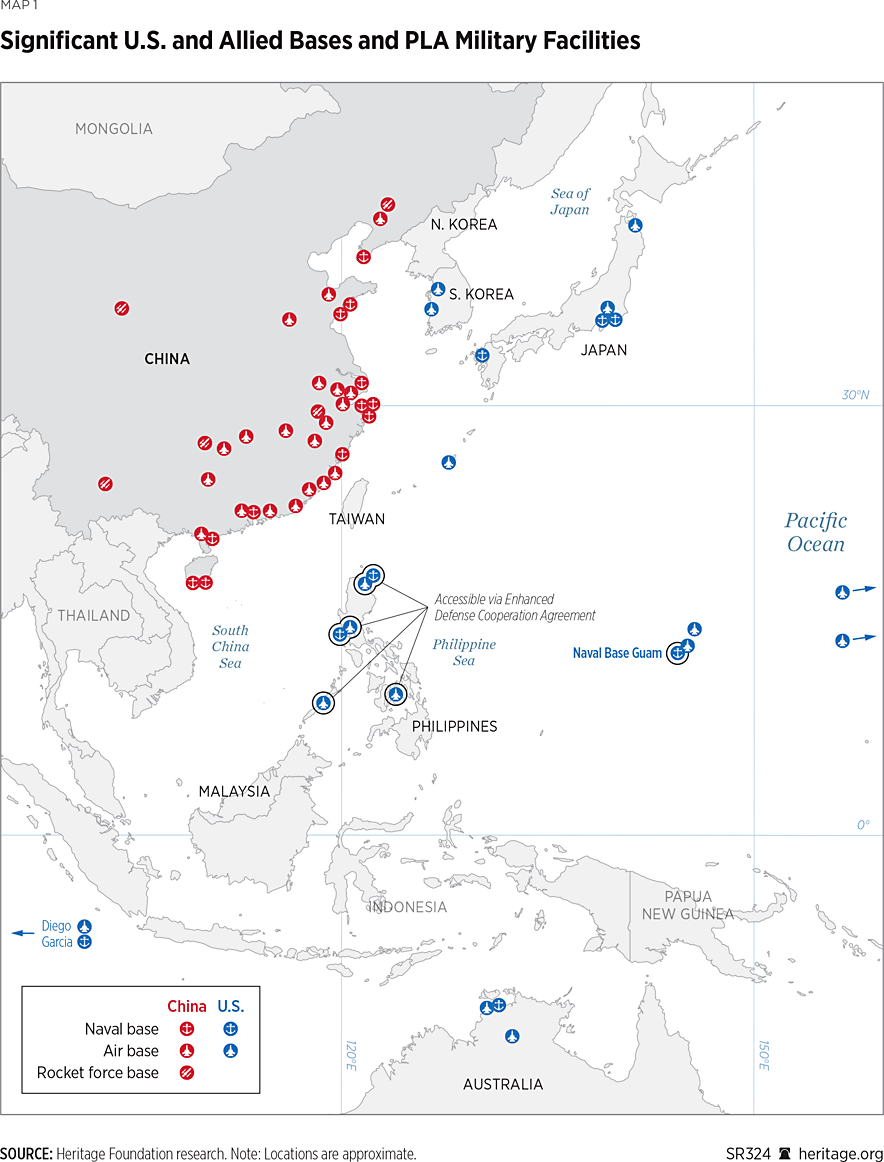
Today, we face yet another adversary. Under the leadership of President Xi Jinping, the PRC has become our most capable and determined competitor and seeks to position itself as a leading power on the world stage.8 China is expanding its military capabilities in part to secure advantage should a dispute over Taiwan escalate into armed conflict. Its growing Anti-Access/Area-Denial (A2/AD) systems and cyber capabilities, designed to limit U.S. presence and project PRC power across the region, compound that threat. U.S. intelligence assessments even indicate that Xi has directed the Chinese military to be prepared to invade Taiwan by 2027.9
Much has been done both in and out of the Department of War (DOW) and the Intelligence Community (IC) to assess the alarming growth in the capability and capacity of the PRC to achieve its stated objectives, challenge the existing balance of power, and threaten U.S. vital national security interests.10 However, focus has largely centered on the opposing militaries with little attention paid to the systems that sustain both the U.S. and the PRC—and that historically have been the foundation for the development of strategy.
TIDALWAVE was therefore launched to address this gap and to inform the formulation of a successful strategy based on a comprehensive understanding of our vulnerabilities and those of our adversary and then to guide the allocation of finite resources accordingly. To this end, we sought to answer five fundamental questions:
- When would the U.S. be incapable of sustaining conflict (defined as the ability to generate and deliver fuel and critical ammunition) with the PRC?
- When would the PRC be incapable of sustaining its military operations against the U.S.?
- What changes are required for existing programs and appropriations to ensure that the U.S. military can prevail in extended escalation scenarios with the PRC?
- What new programs and appropriations will ensure that the U.S. military can prevail in extended escalation scenarios with the PRC?
- What PRC deficiencies exist in fuel and ammunition systems, and how can we exploit these critical vulnerabilities most effectively?
To answer these questions, we modeled in their entirety the U.S. and PRC military fuel and ammunition systems. Using these systems as the foundation, we then incorporated both the forces and the supporting infrastructure that would be employed in a protracted conflict. It was at this point that we constructed a simulation capable of modeling systemwide interactions that replicated possible conditions in which our competing forces would engage, and we modeled the resulting attrition necessary to evaluate the consumption of critical commodities—fuel and ammunition. We enlisted the support of a broad array of technical and subject-matter expertise to develop and validate a methodology and resulting capability that was sufficient to undertake the task. We had neither the ability nor the requirement to develop a simulation that would accurately model the performance of classified systems or the operational maneuver of either force, but we are sufficiently confident in the projected outcomes and our ability to address the identified research questions with unclassified data
Our findings confirm that significant challenges persist in the projection of power within INDOPACOM because of the vastness of the region. Its scattered islands and long distances pose a major obstacle to logistical operations, and the production, transport, storage, and distribution of fuel and ammunition are likely insufficient to effectively project and sustain the forces required to prevail in potential escalation scenarios against China. Moreover, the region often lacks the necessary infrastructure for large-scale military operations, including ports, airfields, and communication networks.
However, the PRC is not without its own vulnerabilities. China’s dependence on oil imports could substantially constrain military operations. Imports currently constitute nearly 70 percent of China’s overall oil consumption.11 Of these imports, 43 percent come from the Gulf region, and it is estimated that China’s oil imports will continue to grow to nearly 80 percent of its total consumption by 2030.12 The exogenic nature of China’s economy and military created a growing dependence that resulted in the development of the Belt and Road Initiative (BRI) to obtain necessary resources and ensure access to supply chains.
Many vulnerabilities exist within the fuel system, and it was the goal of this effort to expose these vulnerabilities. While China’s relationship with Russia may alleviate some constraints, it will take considerable time to expand the current pipeline. Meanwhile, Iran’s oil exports to China reached a seven-year high in 2024.13 In fact, Iran reportedly exported 1.5 million barrels of crude oil per day to China in August 2024, the highest figure since 2013.14 Disruption of those imports would immediately restrict the PRC’s capacity for sustained combat—an insight that has direct policy implications.
It is our judgment that Chinese military aggression that extends control and influence over U.S. partners and allies and that threaten our reciprocal trade constitutes a grave threat to our vital national security interests—a threat that is grave enough to warrant the use of force to deter or reverse its imposition. Between dominating roughly 90 percent of the world’s advanced semiconductor chips, being situated along vital shipping lanes, and maintaining many substantial trade relationships, it has been estimated that the immediate cost of a Taiwan invasion will likely total around $10 trillion—nearly a tenth of the world’s GDP.15 Additionally, geography makes evident Taiwan’s strategic importance as a barrier to Beijing’s expansion and a safeguard for freedom of navigation in the Taiwan Strait, South China Sea, Philippine Sea, and even the wider Western Pacific. Taiwan’s security is therefore linked to ours and to our ability to operate and prosper freely in the region.
Our ultimate aim is to guide national deliberations—within both the executive and legislative branches—on how best to project and sustain U.S. and allied forces in a protracted conflict, resolve existing deficiencies, and exploit adversary weaknesses. The platform we have created allows policymakers, practitioners, and the public to engage directly with the data and make better-informed decisions to safeguard American interests.
Endnotes
- Helen Davidson, “China’s Defence Ministry Warns Taiwan ‘We Will Get You, Sooner or Later,’” The Guardian, February 28, 2025, https://www.theguardian.com/world/2025/feb/28/china-defence-ministry-taiwan-threat (accessed January 6, 2026).↩
- Admiral Samuel J. Paparo, U.S. Navy, Commander, U.S. Indo-Pacific Command, statement on “U.S. Indo-Pacific Command Posture” before the Committee on Armed Services, U.S. Senate, April 2025, p. 3, https://www.armed-services.senate.gov/imo/media/doc/testimony_of_adm_paparo.pdf (accessed January 6, 2026).↩
- Chinese Embassy in US (@ChineseEmbinUS), “We Chinese on both sides of the Taiwan Strait share a bond of blood and kinship. The reunification of our motherland, a trend of the times, is unstoppable. — President Xi Jinping’s 2026 New Year Message,” X, December 31, 2025, https://x.com/chineseembinus/status/2006467362636312781?s=46 (accessed January 8, 2026).↩
- See Dakota L. Wood, ed., 2024 Index of U.S. Military Strength (Washington: The Heritage Foundation, 2024), https://www.heritage.org/military.↩
- See final report of the Commission on the National Defense Strategy, July 2024, https://www.globalsecurity.org/military/library/report/2024/commission-on-the-national-defense-strategy-report_rand_20240730.pdf for the United States (accessed January 6, 2026).↩
- James J. Carafano, Michael Pillsbury, Jeff M. Smith, and Andrew J. Harding, eds., “Winning the New Cold War: A Plan for Countering China,” Heritage Foundation Special Report No. 270, March 28, 2023, https://www.heritage.org/china/report/winning-the-new-cold-war-plan-countering-china.↩
- Roger Miller, Historian, AFHSO [Air Force History Support Office], “1943—Operation Tidalwave, the Low-Level Bombing of the Ploesti Oil Refineries, 1 August 1943,” U.S. Air Force Historical Support Division, https://www.afhistory.af.mil/FAQs/Fact-Sheets/Article/459003/1943-operation-tidalwave-the-low-level-bombing-of-the-ploesti-oil-refineries-1/ (accessed January 6, 2026).↩
- Carafano et al., “Winning the New Cold War: A Plan for Countering China.”↩
- Greg Norman, “China’s Xi Ordered Military Ready for Taiwan Invasion by 2027, CIA Director Burns Says,” Fox News, February 3, 2023, https://www.foxnews.com/world/china-xi-ordered-military-ready-taiwan-invasion-2027-cia-director-burns-says (accessed January 6, 2026).↩
- Michael Cunningham, “The American Case for Taiwan,” Heritage Foundation Special Report No. 280, March 27, 2024, https://www.heritage.org/china/report/the-american-case-taiwan.↩
- U.S. Department of Energy, U.S. Energy Information Administration, “Today in Energy: China’s Crude Oil Imports Decreased from a Record as Refinery Activity Slowed,” February 11, 2025, https://www.eia.gov/todayinenergy/detail.php?id=64544 (accessed January 6, 2026).↩
- Erica Downs, “China’s Oil Demand, Imports and Supply Security,” testimony before the U.S.–China Economic and Security Review Commission, Hearing on “China’s Domestic Energy Challenges and Growing Influence over International Energy Markets,” April 24, 2025, https://www.energypolicy.columbia.edu/wp-content/uploads/2025/04/USCC-Testimony_04.23.2025_for-posting.pdf (accessed January 6, 2026); Qiang Wang, Shuyu Li, and Rongrong Li, “China’s Dependency on Foreign Oil Will Exceed 80% by 2030: Developing a Novel NMGM-ARIMA to Forecast China’s Foreign Oil Dependence from Two Dimensions,” Energy, Vol 163 (2018), pp. 151–167, https:// daneshyari.com/article/preview/8948726.pdf (accessed January 6, 2026).↩
- U.S. Department of Energy, U.S. Energy Information Administration, Report on Iranian Petroleum and Petroleum Products Exports, August 2025, p. 1, https://www.eia.gov/international/content/analysis/special_topics/SHIP_Act/SHIP-Act_2025.pdf (accessed January 6, 2026).↩
- U.S. Department of Energy, U.S. Energy Information Administration, Country Analysis Brief: Iran, October 2024, pp. 1–4, https://www.eia.gov/international/content/analysis/countries_long/Iran/pdf/Iran%20CAB%202024.pdf (accessed January 6, 2026).↩
- Jennifer Welch, Jenny Leonard, Maeva Cousin, Gerard DiPippo, and Tom Orlik Xi, Biden and the $10 Trillion Cost of War over Taiwan, “Xi, Biden and the $10 Trillion Cost of War over Taiwan,” Bloomberg, January 8, 2024, https://www.bloomberg.com/news/features/2024-01-09/if-china-invades-taiwan-it-would-cost-world-economy-10-trillion?utm_source=chatgpt.com&embedded-checkout=true (accessed January 8, 2026).↩