

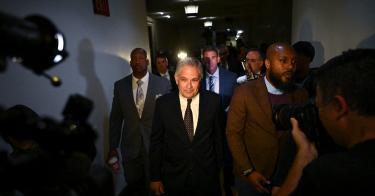
Last month, the remains of 23-year-old Kada Scott were discovered in a shallow grave behind an abandoned Philadelphia school.
It was the latest example of the failures of District Attorney Larry Krasner’s pro-crime, anti-police policies. Thanks to Mr. Krasner, the once-proud and safe city has become a crime hellhole, making it the obvious next target for a federal crime crackdown.
Scott’s alleged killer, Keon King, had a recent history of violent behavior, but Mr. Krasner’s office failed to take that seriously.
Earlier this year, Mr. King was caught on video stalking a woman at her North Philadelphia home before allegedly kidnapping and assaulting her. He was arrested and charged. When his case came before a bail commissioner, Mr. Krasner’s office requested bail of just under $1 million, a symbolic move signaling Mr. Krasner’s overall objection to bail.
>>> California’s Crime Crisis: Voters Took Action, Newsom Took His Football and Went Home
Recognizing that signal, the judge set bail even lower—at $200,000. Mr. Krasner’s office did not file an appeal, and Mr. King posted the required amount. The victim, understandably traumatized by her attacker’s freedom, did not appear at the first court hearing. After she failed to appear a second time, Mr. Krasner’s office dismissed all charges.
Mr. King walked out with a clean slate—free to stalk, kidnap and kill.
Months later, Kada Scott paid for that decision with her life.
Allowing violent criminals out on bail is Mr. Krasner’s trademark, so much so that criminals have nicknamed him “Uncle Larry.” When he took office, Mr. Krasner implemented a cynical bail scheme that allows him to reduce the number of people in jail pending charges and deflect blame when career criminals who get out on low bail commit new crimes.
His scheme works like this: Prosecutors are banned from seeking cash bail for certain “low-level” offenses, including some burglaries. For more serious offenses, the office asks for bail to be set at $999,999, knowing that in most cases, judges will set bail even lower than his ask.
Mr. Krasner can feign outrage when bail is set below what his office requested (even though he could appeal), and the defendant can pay 10% of the bail set by a judge, get out of jail and commit another crime.
That was exactly what Mr. Krasner did in Mr. King’s case, and the result was Scott’s murder.
In that case, Mr. Krasner blamed judges who “don’t want you calling them in the middle of the night” for his decision not to appeal Mr. King’s low bail. “If you do, they lower the bail. They don’t raise it,” Mr. Krasner insisted.
His “middle of the night” claim is contradicted by the timing of the bail decision itself. Multiple reports indicated that Mr. King’s bail was set midafternoon, raising questions about why the district attorney’s office couldn’t have appealed during normal business hours.
Even if the decision had to be made late at night, which is doubtful, Martin O’Rourke, a spokesperson for the court system, told The Philadelphia Inquirer that judges are on call 24/7 for emergencies.
Ever since Mr. Krasner was hoisted into office in 2017 (thanks to $1.7 million from Soros-funded groups) and reelected in 2021 (thanks to another $1.25 million), crime rates have exploded.
In a 2023 amicus brief, professor Paul Cassell detailed how Krasner prosecutors abruptly stopped contesting the appeal of Robert Wharton, who brutally murdered Philadelphia couple Bradley and Ferne Hart in 1984 and left their infant daughter to freeze and starve. After decades of prosecutors seeking justice, Mr. Krasner’s office suddenly reversed course without explanation.
When a federal judge questioned this reversal, the district attorney’s office claimed it had consulted with the victims’ family.
That was false.
Prosecutors merely informed one family member that they were “considering” the concession. The family was unanimously opposed to the concession and asked Mr. Krasner to “do all he can to maintain the death penalty.”
Ultimately, a federal judge sanctioned Mr. Krasner’s office for its misleading representations.
>>> Trump’s D.C. Crime Success Puts Spotlight on Chicago’s Deadly “War Zone”
The King and Wharton cases aren’t anomalies. Rather, they are symptoms of a systemic collapse that began when Mr. Krasner took office. In the three years before his tenure began, Philadelphia averaged 290 homicides annually. Under his leadership, that figure surged to 428 homicides annually from 2018 through 2024.
At the same time, auto thefts increased by 28%, commercial burglaries by 130% and aggravated assaults by 42%.
At Mr. Krasner’s election night victory party, supporters chanted profanities at the Fraternal Order of Police while Mr. Krasner smiled approvingly. Within days of taking office, Mr. Krasner fired 31 career prosecutors, many from the homicide division, and ordered his staff to decline charging entire categories of crimes.
In 2022, the Pennsylvania House impeached Mr. Krasner and labeled his office “purposefully ineffective” in combating violent crime. Even Gov. Josh Shapiro, a Democrat, supported legislation establishing a special prosecutor to handle crimes in an area that included Philadelphia.
Under Mr. Krasner, Philadelphians are no longer safe, which means the Trump administration has a mandate to intervene by deploying federal resources to restore order.
This piece originally appeared in The Washington Times


