
Following U.S.–Israeli airstrikes on Iran’s nuclear weapons project in the June 2025 “12-Day War,” U.S. intelligence agencies warned the American public that risk of retaliation against the United States would substantially increase “if Iranian leadership issued a religious ruling calling for retaliatory violence against targets in the Homeland.”[REF]
That ruling has come to pass amid this year’s renewed hostilities, obliging the U.S. intelligence and homeland defense establishments to devise preemptive measures to protect U.S. citizens, business interests, and perhaps close allies like Israel.
On July 9, Iran’s Supreme Leader Ayatollah Mojtaba Khamenei unveiled a top national policy priority during the Tehran funeral of his father, killed in the first renewed U.S.–Israeli airstrikes on February 28, 2026: Every instrument of Iranian state power, he declared, now serves a sacred religious duty to exact “blood vengeance” on the United States and its leaders.[REF]
Millions attending the funeral understood Khamenei had just invoked the “Ya Latharat al-Hussein” religious vengeance doctrine as regime supporters mourned under a sea of highly symbolic red flags—reflecting the doctrine’s obligation to avenge assassinated Shiite leaders.[REF] Iran’s state councils, influential regional government bodies that carry out religious policies, declared a “divine mission” and “strategic religious obligation” to attack.[REF] The regime’s Friday Prayer Policy Council has recast its weekly nationwide prayer services as “Fridays of blood vengeance and revenge” to go on until the required revenge is exacted at clerical standards.[REF]
U.S. homeland security and its Intelligence Community agencies are now obliged to contemplate which nations Khamenei had in mind when he promised that “[s]oon, individuals among the freedom-seekers across the world will each carry out part of this divine mission.”[REF] (Emphasis added.)
In updating their defense posture under President Donald Trump to detect terror plots in the Western Hemisphere, the State Department and intelligence agencies have launched diplomatic pressure campaigns on every Latin American country that maintains diplomatic ties with Iran.[REF] The United States is pressuring these countries to end their relationships with Iran, and also to help the United States to hunt down associates of Iran’s proxy Hezbollah—which has a strong presence in Latin America—as well as members of the Islamic Revolutionary Guard Corps (IRGC) and the Quds Force, all three of which the United States has declared Foreign Terrorist Organizations. There is one exception: The United States is putting no known pressure on Nicaragua.
This Backgrounder argues that the U.S. campaign against Iran and its proxies in Latin America must encompass the communist regime of President Daniel Ortega and his nearly two-decade relationship with Iran. Iran and Nicaragua’s Ortega established diplomatic relations and traded embassy openings in 2007.
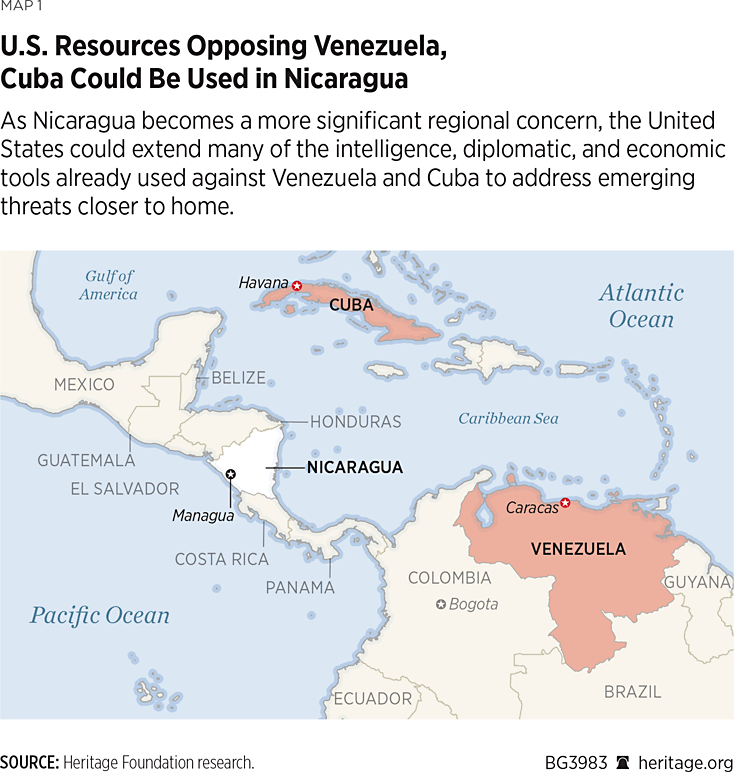
Nicaragua: Iran’s Last Outpost in Latin America. Nicaragua may have emerged as the region’s last relatively unhindered redoubt for Hezbollah, the IRGC, and the Quds Force to operate after a “conservative wave” of voting from 2023 to 2026 that swept out Iran-allied leftist regimes in favor of pro-U.S. governments. The other major contributing factor for Nicaragua’s apparent emergence as a comparatively unfettered Iranian redoubt is an ongoing U.S. militarized pressure campaign against Cuba, and one that removed Venezuela’s dictator Nicolás Maduro from power, at least forcing extensive Hezbollah and IRGC operations to go underground in those two key countries.[REF]
According to regional security experts, Nicaragua is Tehran’s next best strategic rear base from which it might project a retaliation threat to U.S. interests and expatriate citizens,[REF] although the extent to which U.S. security agencies and the Department of State have adjusted to this new reality is unclear. At issue are indications that Nicaragua has become a U.S. national security blind spot—contrasting with Latin American countries where new conservative governments have taken root and mounted crackdowns on Iranian activity or where the United States has demanded removal of Iranian presence amid enhanced spying in, for instance, Venezuela, Cuba, and Bolivia (described in more detail below).
In its public dealings with Nicaragua, for instance, the Treasury Department has appropriately punished the Ortega–Murillo regime’s increasingly despotic domestic oppression policies, leveling targeted financial sanctions against individuals tied to the regime. (Ortega’s wife, Rosario Murillo, is co-president of Nicaragua.) But neither the Treasury Department nor the State Department’s public communiqués mention Nicaragua’s ongoing embrace of Iran as a problem, even after hostilities between the United States and Iran broke out in 2025, or again in 2026.[REF] The Trump Administration has not updated a 2022 Biden Administration State Department webpage on Nicaragua describing the U.S.–Nicaragua relationship, which also only took issue with domestic oppression, not the Iran relationship.[REF]
Perhaps newer clandestine diplomatic or operational initiatives are underway but have somehow escaped any public reporting of the sort that has become common in all other countries of Latin America known for their Iran or Hezbollah presence.
But if clandestine U.S. initiatives are not underway for Nicaragua, obsolete pre-war thinking apparently prevails despite reporting that U.S.-sanctioned Iranian officials, Hezbollah members, and IRGC operatives can and still do travel visa-free round trip from Iran to Nicaragua on state and diplomatic aircraft. Nicaragua waives entry requirements and tracking for Iranian government officials, military delegations, and state-backed business operatives.[REF] Even with the active U.S.–Iran war, U.S. and regional security experts attest that Iran uses Nicaraguan territory, logistical facilities, and engagement with Nicaragua’s military and political elite to further a strategy of espionage, sanctions evasion, and to project a counter-threat to the United States in its backyard.[REF] Prior to the U.S.–Iran war, Nicaragua and Iran were holding clandestine discussions about establishing bilateral military cooperation as a deterrent to the United States.[REF]
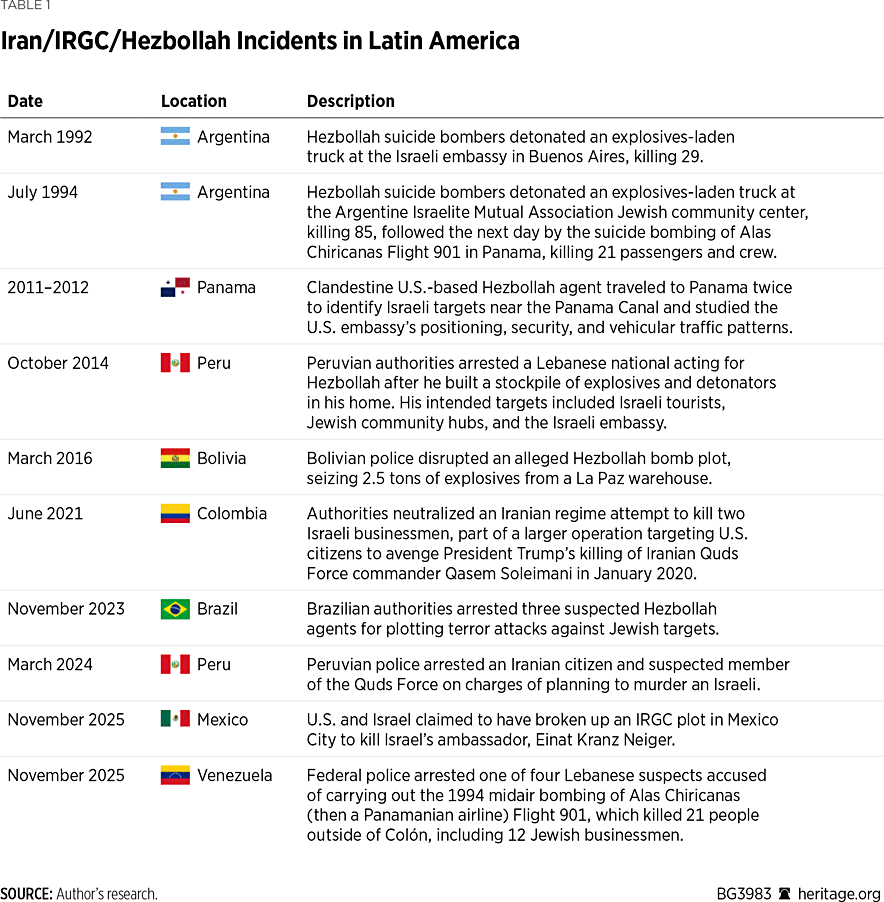
The broader Iran and Hezbollah presence in Latin America has received much attention in the past, such as in Venezuela and the “Tri-Border Region” of Argentina, Paraguay, and Brazil, home to some 30,000 Lebanese expatriates, among them sympathizers who channel some $200 million annually to Hezbollah.[REF] To date, however, U.S. media and policy institutes have yet to catch up to recent Spanish-language media reporting typified by a headline in Nicaragua’s conservative La Prensa newspaper that “Nicaragua Emerges as Iran’s Key Foothold in the Western Hemisphere.”[REF] “Nicaragua has become a functional gateway for Iran in the Western Hemisphere,” the report states. “Its value lies in the conditions it offers: territorial access, institutional opacity, and a foreign policy aligned with anti-American extra-regional actors.”
While Tehran might prefer direct attacks on the U.S. homeland, its leadership knows that U.S. soil is a better guarded target than are the vast U.S. interests and American-citizen populations throughout Latin America. If Nicaragua is indeed the last safe, close, and permissive space for Iran, the neighborhood brims with U.S. military facilities, business enterprises, law enforcement personnel, diplomats, and at least 1.6 million expatriates in just Central America and Mexico.[REF] Israeli and Jewish business and diplomatic interests also pervade the region.[REF]
“Although robust U.S. homeland security measures may better contain such threats domestically, Hezbollah’s illicit activities in Latin America—where security infrastructure may be less developed—pose a distinct risk to U.S. interests throughout the region,” a 2025 Rand analysis concluded.[REF]
Underscoring the elevated significance of Nicaragua for Iran, considering recent U.S.–Iran warfare and the supreme leader’s revenge decree, is the history that the Iranian regime has already used its Latin American diplomatic infrastructure and cultural centers to deploy Hezbollah and the IRGC for kinetic attacks.
In 2025, the United States and Israel publicly thanked Mexico for foiling an IRGC plot to assassinate Israel’s ambassador to Mexico, Einat Kranz Neiger, although Tehran and Mexico City both later denied this.[REF]
In November 2025, Venezuelan authorities working with the FBI arrested one of four Lebanese suspects accused of carrying out the 1994 midair bombing of Alas Chiricanas (then a Panamanian airline) Flight 901, which killed 21 people, including 12 Jewish businessmen, outside Colón.[REF]
From Iran’s more limited diplomatic infrastructure in Latin America at that time, high-level Iranian officials funded and planned the 1992 Hezbollah suicide truck bombing against the Israeli embassy that killed 29 in Buenos Aires, and then the 1994 Argentine Israelite Mutual Association (AMIA) Jewish community center bombing that killed 85, according to an Argentine investigation and indictments.[REF]
Considering these historical events and Ayatollah Mojtaba Khamenei’s vow of blood vengeance for U.S. attacks on Iran, the Trump Administration should elevate elimination of the Iran–Nicaragua relationship to a high priority. It should use sticks, if necessary, to induce Ortega and Murillo to sever ties with Iran, end immigration privileges to Iranian officials and deport them, and shutter Iran’s embassy in Managua.
Iran/Hezbollah Finds Permissive Playing Fields in Latin America Shrinking to Nicaragua
Dating from 2007, Venezuela’s leftist President Hugo Chávez helped Iran to embark on a diplomatic expansion throughout Latin America to project an ambiguous counterthreat as leverage against the United States’ Middle East presence and its Iran sanctions policies.
Until recently, Iran and, presumptively, Lebanese Hezbollah and the IRGC, had enjoyed access to 11 embassies and 36 Iran-linked Shiite “cultural centers” in tolerant or outright friendly Latin American nations governed by leftist leaders openly antithetical to the United States, such as Bolivia, Brazil, Cuba, Ecuador, and Uruguay.[REF]
Iran’s commitment to its Latin America strategy was strong enough that Islamic Republic of Iran Broadcasting established a supporting Spanish-language media company in 2012, HispanTV, that produces anti-U.S. and anti-Israel propaganda to this day.[REF]
The Iranian outreach to Nicaragua was typical of this period. When Ortega won a presidential election in 2006, Iranian President Mahmoud Ahmadinejad appeared as a special guest of honor shortly after Ortega’s inauguration.[REF] The two cemented an enduring diplomatic relationship steeped in anti-American “resistance” ideology, trade agreements (though Iran has so far not followed through on its promises), and mutual support at the United Nations.
The regime’s strategic aims synced well with Ortega’s own communist Sandinista movement, which staged an armed coup against a U.S.-backed government in 1979 and prompted President Ronald Reagan to create the “Contra” rebel group in the 1980s. In those years, the Iranian regime used an embassy in Managua to support the Ortega government’s military defense against President Reagan’s Contra insurgency until Ortega left office in 1990.
Arguably, the U.S. security establishment and media focused most intensely on countering the infrastructure, financial networks, and diplomatic cover that Iran built over 20 years in countries other than Nicaragua, such as Argentina, Bolivia, Brazil, Cuba, Paraguay, and Venezuela.
It remains a mystery why Nicaragua, with its similarly anti-U.S. regime, seems to have long escaped the same intensity of U.S. interest and action. There is little public evidence of an inaugural U.S. pressure campaign against Nicaragua like the recent ones opened against many other Latin American nations with a longstanding Hezbollah presence. Notably, many media outlets and private-sector policy and analytical briefs about Latin America’s Hezbollah presence entirely omit Nicaragua or, if they do mention the country, do so only as a passing nod.
Since President Trump’s second term began, a mix of heightened U.S. engagement in Latin America and a wave of conservative leaders coming to power in regional elections initially rolled back the regime’s operating space and freedom of unseen movement mainly in Bolivia, Brazil, Cuba, and Venezuela. In 2025 and 2026, the United States exerted enormous diplomatic, economic, and even military pressure on those countries to cut their Iran ties or to exert law enforcement pressure on Iranian proxies and military branches.
The United States was substantially aided in this campaign by newly elected pro-U.S. allies who proved far less willing than their predecessors to entertain Iranian presences. These countries, among them Colombia, Honduras, and Paraguay, declared Hezbollah an outlawed terrorist organization and instituted militarized surveillance operations against the terror group, sharply reducing previous maneuverability.[REF]
One visible turning point was the decision by the Argentine government, in April 2026, to designate the IRGC as a terrorist organization.[REF] Chile, Ecuador, El Salvador, Peru, and Uruguay joined Colombia, Honduras, and Paraguay in either blacklisting Iran or designating its military and intelligence branches as terrorist organizations.[REF]
In Brazil, the leftist government of President Luiz Inácio Lula da Silva has defied recent U.S. demands to declare Hezbollah a terrorist group and maintains diplomatic and trade ties with Iran.[REF] But intense foreign intelligence surveillance and U.S. sanctions have long curtailed Hezbollah’s maneuverability, particularly on Brazil’s part of the tri-border region. The U.S. Treasury Department, for instance, over the years has imposed numerous financial sanctions against suspected Hezbollah-affiliated criminals in the tri-border region.
Moreover, in 2023 and 2024, the Lula government proved itself willing to act on Israeli and American intelligence to conduct wide-ranging law enforcement operations that arrested Hezbollah-affiliated terrorists plotting to attack Jewish targets elsewhere in the country.[REF] In 2026, federal police launched Operation Hawala to target Hezbollah’s black-market terrorist financial pipelines from the tri-border region to Lebanon.[REF] The United States has heightened the pressure on that area by offering a $10 million reward for any help disrupting Hezbollah’s money-laundering mechanisms.[REF]
According to the State Department’s most recent Country Reports on Terrorism, in 2023, “Brazil and the United States maintained strong counterterrorism cooperation” including with law enforcement entities of “other nations.”[REF]
Iran’s permissive environments shrank even more once President Trump targeted Venezuela and Cuba as part of pressure campaigns backed by a naval flotilla, spy flights, intense intelligence surveillance operations, economic blockades, and threats of military action. The American government has demanded that Venezuela and Cuba dismantle their relationships with Iran and, while both countries have defied these demands, the United States has fractured the previously permissive environments and illuminated Iranian activities with highly intrusive intelligence operations.[REF]
After the January 2026 capture of Venezuela’s socialist dictator Nicolás Maduro, President Trump wielded a naval flotilla to ensure continued mitigation of threats to the United States from Venezuela. The Trump Administration soon demanded that the successor government of Interim President Delcy Rodríguez sever the country’s extensive financial, intelligence, military, and trading ties with Iran.[REF] Rodríguez has refused, but Washington’s flotilla reinforces Washington’s displeasure about the relationship, and both she and Iran have gone quiet there while shifting to low-visibility relationship maintenance.[REF]
President Trump then mounted an economic, military, and psychological pressure campaign that has economically damaged Cuba. The Administration has demanded that Cuba sever its decade-long relationship with Iran, which includes a reported Iranian program to provision Cuba with drones that can reach Florida, remove Iranian military advisers on the island, and neutralize anti-U.S. Iranian espionage operations from the island.[REF] The governments of Cuba and Iran have defied these demands. However, the United States has sharply escalated spy flights and high-altitude drones to illuminate and monitor these alleged Iranian activities.[REF]
In Bolivia, Iran lost high-level state protection for its operations when voters in October 2025 replaced a socialist Bolivarian, President Luis Arce, with the pro-Trump Rodrigo Paz. Within weeks, the Paz government broke off its strategic relationship with Iran and restored full diplomatic channels with Israel.[REF] In April 2026, Bolivia formally ended a range of previous military and diplomatic agreements with Iran, and regional security experts believe that Iran’s loss of high-level permission to operate has reduced its previous efficacy.[REF]
In Mexico, Iran has maintained a minimal diplomatic relationship with successive Mexican governments since about 2009, despite U.S. sanctions, and maintains consulate offices in Mexico City. (Mexico had cut ties with Iran when the revolution overthrew the Shah in 1979 but resumed ties in 1992.)[REF] Current leftist President Claudia Sheinbaum has maintained a relationship with the Islamic Republic and refused to declare Hezbollah a terrorist organization despite the U.S. war, in order to, for domestic political purposes, assert Mexico’s independence from the United States. But Mexico has also kept Iran at arm’s length to avoid drawing U.S. ire in the form of tariffs or sanctions.[REF] As of July 2026, Mexico’s exports to Iran, for instance, were at zero, while its imports from Iran stood at just $17,500 as the two sides discussed an expansion.[REF]
But Mexico does not qualify as an under-surveilled permissive environment like Nicaragua. As with Latin American countries other than the untended Nicaragua, the intelligence services of the United States, Israel, and Mexico have studied the Iranian presence and searched for evidence of its proxies as part of post-9/11 joint counterterrorism programs.[REF]
For good reason. These agencies for years have, for example, searched for—and discovered—suspected Hezbollah operatives within cross-border migration flows through Mexico and hunted for proxy associates collaborating with Mexico’s drug cartels.[REF] Mexican and American authorities dismantled a Hezbollah smuggling ring in 2010 and discovered Hezbollah affiliates entering the United States in 2006 and in 2024, according to the 2025 Rand report.[REF]
In early 2025, the surveillance regimen apparently paid off again: The United States and Israel claimed to have worked with Mexican intelligence to foil an IRGC plot to assassinate the Israeli ambassador to Mexico, the assassination allegedly having been planned from faraway Venezuela.[REF]
Following this plot and the ensuing U.S. war with Iran that summer, there should be no doubt that the surveillance work has continued, if not intensified.
Inexplicably, no comparable U.S. pressure campaign targeting the Nicaragua–Iran relationship is publicly reported, potentially leaving it as a last location for under-surveilled Iranian activity.
The Nicaragua–Iran Threat Question
The 2025 Rand report judged that the U.S. Intelligence Community suffers from significant gaps in knowledge about the extent of covert Hezbollah and IRGC activities in Latin America, generally, although “Iranian diplomatic missions in Latin America may operate beyond their conventional roles” and “function as hubs for covert activities.”[REF]
In any case, U.S. intelligence and security community beliefs about Iranian activity in Nicaragua before the U.S. bombing campaigns are no longer applicable. The Intelligence Community should presume that Iran would increase its clandestine activity in overlooked, comparatively under-surveilled Nicaragua, given Iran’s retaliation policy and the tougher operating environment elsewhere in Latin America.
What is publicly known about how Iran has used its Nicaragua station argues for U.S. countermeasures to plug this remaining intelligence gap sooner rather than later.
When Iran returned to Nicaragua in 2007, it came bearing offers to fund a Caribbean Sea-to-Pacific Ocean “dry canal,” 10,000 new homes, hydroelectric plants, and port infrastructure investments while establishing an embassy compound in Managua.[REF]
Iran never followed through, but those promises were used to justify an Iranian embassy that has bustled with reportedly clandestine activity ever since. From the time Iran opened its Managua embassy in 2007, military-aged single Iranian men reportedly began coming and going through it as recently as 2025 and 2026. The public record is unclear about their purpose in the region. Later came disputed reports that Nicaragua’s government had allowed a Hezbollah training camp on its territory.
The country’s largest-circulation newspaper, La Prensa, in 2007 published leaked government documents showing that Nicaragua’s chief immigration minister authorized 21 Iranian men to enter the country without visas (which would have left a record).[REF] A different news report said several IRGC operatives accompanied the Iranian envoy to Managua. A Honduran newspaper that year reported that several Iranian men had entered its country without permission from Nicaragua.[REF]
In 2012, Israeli media published a much-denied report that Iran established and supplied a Hezbollah training camp inside Nicaragua on the Honduran border for 30 fighters who would plot attacks on Israeli targets if Israel struck Iran’s nuclear facilities.[REF]
U.S.-sanctioned Iranian officials have continued provocative visits to Nicaragua. At the swearing-in for Ortega’s fourth consecutive term in 2022, ex-IRGC commander Iranian Vice President Mohsen Rezaei appeared at the dictator’s side despite international arrest warrants for allegedly masterminding the 1994 AMIA bombing. Nicaraguan regime and Iranian embassy staff escorted Rezaei through the country with full state protection, shielding his movements from global law enforcement before flying him out of the country.[REF]
Classified U.S. intelligence documents leaked in recent years profiled suspicious movements of high-level clandestine military and electronic operations hidden behind public narratives about trade deals that never reached fruition, as The New York Times and other publications reported in 2023.[REF] Intercepted communications surrounding a visit by Iranian Foreign Minister Hossein Amir-Abdollahian and a cadre of military advisers to Managua showed they were secretly negotiating military cooperation, drone integration, and networks to bypass sanctions, deals aimed at countering U.S. influence in Latin America.[REF]
In 2025 and 2026, Iran’s embassy remained a logistical terminal for clandestine operations between the two countries, according to the Nicaraguan opposition newspaper La Prensa.[REF]
Following the outbreak of the U.S.–Iran conflict in June 2025, Iran and Nicaragua continued overt diplomacy.[REF] The Ortega–Murillo government has vocally supported Iran and sent dignitaries to Tehran. Joint visits have continued, including one in early July 2026 when Nicaragua’s minister of foreign affairs and other dignitaries honored assassinated Supreme Leader Ali Khamenei in Tehran.[REF]
The U.S. security establishment has indeed tried to track Iranian government operative activity in Nicaragua, according to The New York Times and other open-source reporting.[REF] But while the State Department—under several U.S. Presidents—often expressed displeasure about the relationship, none ever applied serious pressure to end it.
Key U.S. Leverage Points
The Trump Administration holds significant leverage to induce Nicaragua to end its Iran relationship. For starters, the United States is Nicaragua’s largest trading partner, accounting for about 50 percent of all Nicaraguan exports.[REF] Nicaraguan trade has also come to depend on its membership in the Dominican Republic–Central America Free Trade Agreement (CAFTA-DR), which eliminates tariffs and opens markets among member countries that include Costa Rica, the Dominican Republic, El Salvador, Guatemala, Honduras, Nicaragua, and the United States.
Nicaragua is critically reliant on refined petroleum imports from the United States, which serve as the backbone of its domestic fuel supply.[REF]
One of the poorest nations in Latin America, Nicaragua is the most remittance-dependent country in the Western Hemisphere, is the third-most-dependent in the world, and receives 83 percent of those remittances from the United States ($4.3 billion).[REF] Currently, there are no unique additional U.S. taxes on remittances to Nicaragua beyond the 1 percent cash remittance tax that the One Big Beautiful Bill Act imposed equally on all foreign countries in January 2026.[REF]
The Ortega regime indirectly captures remittance money by taxing certain goods and depends on the revenue to invest in public works enterprises controlled by the family’s circle of power.[REF] The regime also uses this revenue to fund paramilitary police and state intelligence networks that suppress political opposition.[REF]
What the U.S. Should Do
The Trump Administration should use its considerable leverage to induce the Ortega–Murillo regime to reverse its undemocratic consolidation of power in service of its corrupt, anti-American government and demand that the regime:
- Sever the diplomatic relationship with Iran on benchmarked timelines;
- Close the Iranian embassy, end visa-free travel for Iranians to and from Nicaragua, and expel all Iranian nationals associated with their government’s agencies; and
- Offer significant improvements in trade terms if expectations are met.
The United States should let the regime know that, until it meets expectations, the United States will:
- Work to indict top Nicaraguan regime officials on material support for terrorism charges;
- Mount enhanced intelligence-gathering operations inside, above, and around Nicaragua to identify Iranian proxy operators with intent to prosecute and to enforce Iran’s banishment or, in the case of noncompliance, to reduce permissiveness;
- Impose trade reductions or sanctions, such as tariffs, on Nicaraguan exports to the United States;
- Withhold U.S. petroleum exports to Nicaragua;
- Organize an exclusion of Nicaragua from CAFTA-DR; and
- Restrict the flow of remittances to Nicaragua in line with the Cuba model by restricting financial channels and intermediary organizations that process the funds.
Conclusion
Prior to the conflict with Iran, the U.S. diplomatic and intelligence communities may have correctly viewed the Iran–Nicaragua relationship as a lower threat to U.S. citizens and interests than Iranian ties elsewhere in Latin America. That judgment merits urgent reconsideration, given the ongoing war between the United States and Iran, Iran’s new national policy to retaliate from all over the world, and Nicaragua’s elevated strategic importance to Iran as one of the more permissive forward operating bases in Latin America since 2025.
The U.S. government is obliged to build a new threat picture that would illuminate the Nicaragua blind spot and assess the extent to which Iran and its proxies may have retreated to it from other newly hostile regional governments.
But the Trump Administration need not delay threat-reduction initiatives in the meantime. The United States can preemptively reduce risk by instituting the diplomatic and surveillance approach toward the Ortega–Murillo regime outlined in this Backgrounder. It can do so quickly by employing in Nicaragua the strategy already in use against Cuba and Venezuela.
Todd Bensman is Senior Research Fellow in the Border Security and Immigration Center at The Heritage Foundation.



