

On August 6, 2026, U.S. Deputy Secretary of State Christopher Landau personally responded to, on social media, a Foreign Policy article[REF] critiquing the Trump Administration’s approach to the Pacific Islands.[REF] Deputy Secretary Landau is correct: Contrary to the claims that the Trump Administration has “sorely neglected” the Pacific Islands,[REF] the Trump Administration has been active in the Pacific, has a strong vision for the region, and has registered multiple successes. As Deputy Secretary Landau’s social media fact-checking indicates, however, more work is needed to publicly articulate the Administration’s approach, and this Backgrounder seeks to do so. In the words of Deputy Secretary Landau: “Aloha and stay tuned.”[REF]
The America First Vision
Currently, the Trump Administration has yet to publish a dedicated strategy document for the Pacific Islands. Although this departs from the Biden Administration, which published the first-ever U.S. government strategy dedicated to the Pacific Islands, the lack of a published and tailored strategy document follows precedent rather than breaking it.[REF] To understand what the Trump Administration seeks with the Pacific Islands, it is important to review its two most important strategy documents that lay the foundation for regional engagement and assess their implications.
The National Security Strategy. Fundamentally, the National Security Strategy (NSS) describes a clear emphasis on largely realist interpretations of international relations. The document defines the purpose of U.S. foreign policy as “the protection of core national interests,” which is the “sole focus” of U.S. strategy.[REF] Ultimately, the Administration seeks the “continued survival and safety of the United States as an independent, sovereign republic whose government secures the God-given natural rights of its citizens and prioritizes their well-being and interests.”[REF] This declaration represents the Administration’s view of its pre-eminent interest, which in turn drives other policy decisions.
The NSS also critiques “American foreign policy elites” that supported globalism, free trade, and a “welfare-regulatory-administrative state” that included a “foreign aid complex.” Furthermore, these elites allowed allies, partners, and international institutions to “suck” the United States into “conflicts and controversies central to their interests but peripheral or irrelevant” to U.S. interests.[REF]
In addition to seeking the world’s strongest military, economy, and technology, the NSS aspires to maintain U.S. soft power to “exercise positive influence throughout the world that furthers our interests” that is “respectful” of other countries’ systems.[REF] In other words, the Trump Administration views soft power as a means to achieving its desired end states of security, safety, and prosperity. The NSS states that maintaining a “free and open” Indo–Pacific that preserves “freedom of navigation in all crucial sea lanes” and access to critical minerals and supply chains is a “core, vital” U.S. interest.[REF]
Regionally, the NSS seeks to “win the economic future [and] prevent military confrontation” in Asia.[REF] The “Asia” section focuses on supporting U.S. economic strength, primarily vis-à-vis China, and deterrence across the Taiwan Strait, the First Island Chain, and within the South China Sea.[REF] References to allies and partners include a mix of cooperative approaches along with expectations that they rebalance trade relations and increase burden-sharing for defense matters.[REF] The strategy notes, however, that it is “building alliances and strengthening partnerships in the Indo–Pacific that will be the bedrock of security and prosperity long into the future.”[REF] The section—and the full strategy, for that matter—does not have any specific mentions of the Pacific Islands.
The National Defense Strategy. Similar to the NSS, the National Defense Strategy (NDS) supports “flexible, practical realism” that “is essential for serving Americans’ interests.”[REF] The NDS identifies four core lines of effort: defending the U.S. homeland, deterring China, increasing burden-sharing, and supercharging the defense industrial base.[REF] The NDS consistently seeks “strategic stability” with China through “a wider range of military-to-military communications” with the Chinese military, emphasizes “a stable peace, fair trade, and respectful relations” with China, and “a favorable balance of military power” in the Indo–Pacific.[REF] As with the NSS, the NDS does not include any specific mentions of the Pacific Islands, though it does state that the United States “will erect a strong denial defense along the First Island Chain” while supporting allies and partners “to do more for our collective defense” through a “deterrence by denial” doctrine.[REF]
Practical Implications. Following are key implications from the two primary strategy documents:
- The NSS and NDS are consistent in their overarching pursuit of advancing U.S. interests. Every element of statecraft is to be used to pursue U.S. interests that, ultimately, result in a safer, more secure, and more prosperous America. In other words, if something cannot be firmly articulated to be relevant for U.S. interests, then it is unlikely to be considered by the Trump Administration. Some frame this as transactional, others as a natural orientation toward prioritizing core interests. Regardless, the practical effect is the same.
- The Trump Administration gladly and openly engages with the Pacific Islands across multiple policy issues. The key nuance is that the Administration’s willingness to engage is driven by U.S. interests rather than by “laundry lists of wishes or desired end states.”[REF] This would explain why the Trump Administration might be less inclined to proactively discuss some issues that may be comparatively more important to the Pacific Islands, such as climate policy. While one could argue that Pacific activity does not equate to a Pacific strategy, the NSS and NDS establish the strategic framework, and the forthcoming Pacific Policy Inventory demonstrates how that framework translates into policy actions.
Combined, these foundational documents and policy decisions demonstrate that the Trump Administration has identifiable interests in the Pacific Islands, even if it has not articulated them through a dedicated regional strategy. There are clear interests that the Administration is pursuing, though they may be tailored and articulated differently than some would prefer.[REF]
The Pacific Policy Inventory
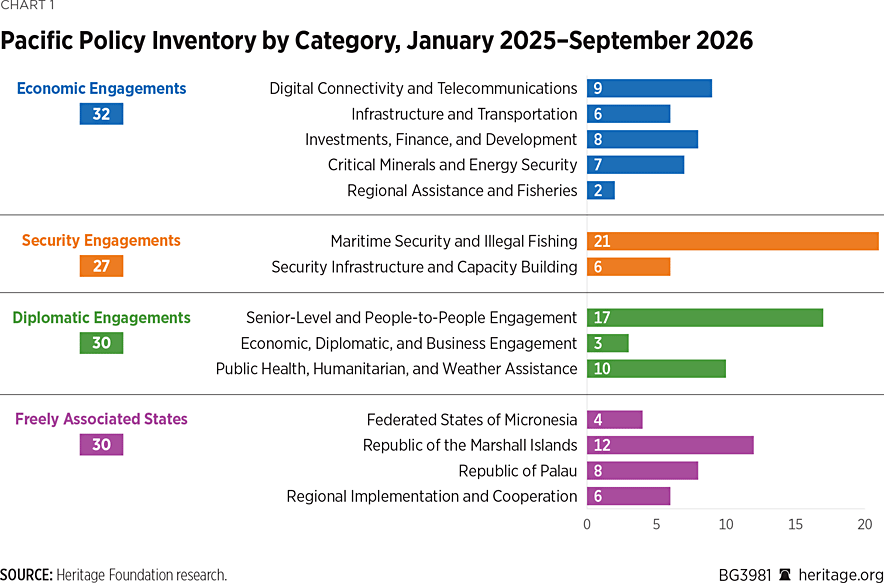
The Trump Administration has taken multiple steps to turn its national security vision into practical regional policy. The Pacific Policy Inventory serves as one of the most comprehensive publicly available inventories of the Trump Administration’s engagements and announcements since January 2025. (See the appendix.)[REF] The purpose of this inventory is not merely to catalogue activities but to demonstrate how the Administration’s policy has translated strategic objectives into action with Pacific Island countries. The appendix includes details on the inventory’s methodology and acknowledgements.
Inventory Findings. Contrary to claims that the Trump Administration has “sorely neglected” the Pacific Islands,[REF] the United States has been very active in the Pacific and has introduced and committed to multiple new initiatives. Key findings from the inventory include:
- More than 100 publicly reported Pacific-related actions and initiatives have been announced, implemented, or expanded across multiple domains since January 2025.
- More than $2 billion in projected infrastructure activity in Yap, one of the four states of the Federated States of Micronesia (FSM).
- More than $700 million in publicly announced assistance, infrastructure support, investments, grants, and other initiatives, excluding projects without disclosed values, the projected Yap infrastructure figure, broader Compact of Free Association (COFA) assistance funds, and financing authorities.
- At least 15 maritime security initiatives.
- At least 15 digital connectivity, transportation, and infrastructure initiatives.
- At least seven critical mineral and energy security initiatives.
- More than 25 Freely Associated States (FAS)–related initiatives and engagements, representing roughly one-quarter of all identified Pacific-related actions and initiatives.
- More than 15 senior-level engagements, official visits, forums, summits, and related events.
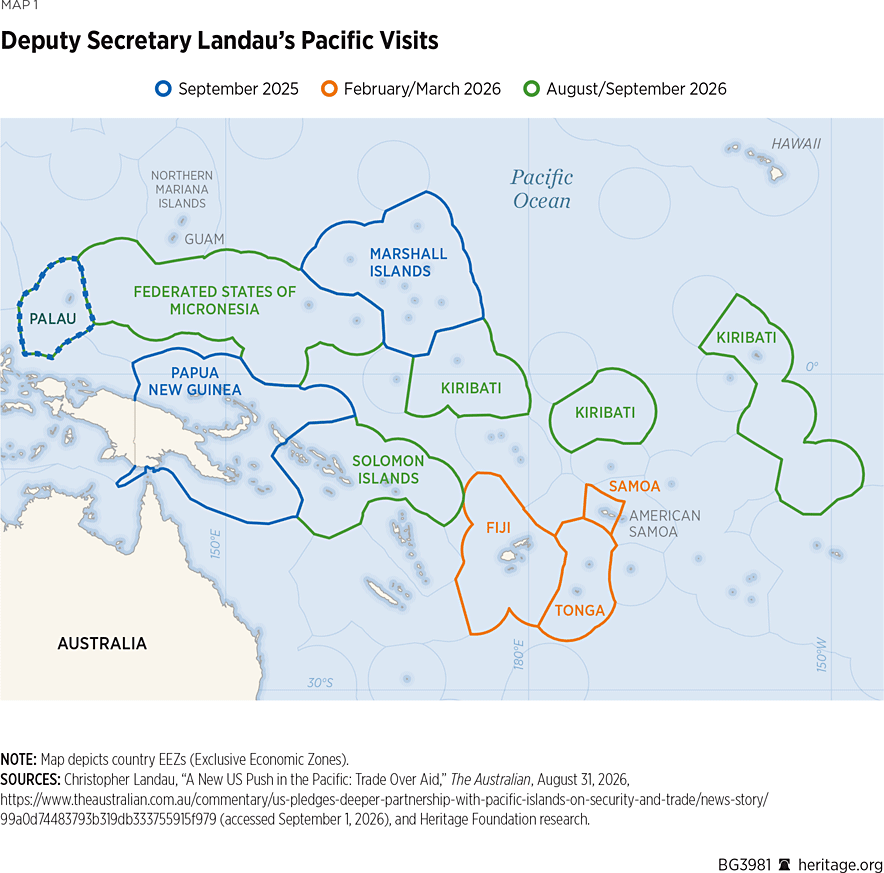
- Deputy Secretary Landau has traveled to nine Pacific Island countries, including all three FAS, hosted the 2026 U.S.–Pacific Islands Investment Summit, and represented the United States at the 2026 Pacific Islands Forum Leaders Meeting.
Economics. Economic engagement represents one of the clearest areas of new activity. The Trump Administration, through its Trade Over Aid agenda, has prioritized various economic projects and private-sector opportunities over more traditional foreign assistance programs.[REF] The Administration is expanding regional undersea cable networks, including Pacific Connect, East Micronesia Cable, and Central Pacific Connect, with more than $20 million pledged for cable projects that already have more than $200 million committed by the United States and its allies and partners.[REF]
Infrastructure is also a key theme. A notable example is the Trump Administration’s commitment of $50 million, in partnership with New Zealand, to upgrade a major port in Penrhyn, Cook Islands.[REF] The United States also committed to providing Papua New Guinea with $30 million for satellite Internet connectivity.[REF] On transportation, key examples include the signing of an Open Skies agreement with Samoa and multiple feasibility projects designed to support fuel storage, airport security, and mail delivery.[REF] Digitally, the Trump Administration is supporting multiple data-center, network-modernization, cloud-migration, and telecommunications programs.[REF]
Investments in Pacific Island economies are also increasing. For example, the Millennium Challenge Corporation (MCC) and Fiji announced an agreement for a $12 million grant for feasibility studies in advance of a compact program for the MCC board’s consideration.[REF] The MCC also identified Tonga as a potential grant recipient in digital technology and energy areas.[REF] The Trump Administration has also signed agreements with the Solomon Islands and Vanuatu that establish frameworks for the U.S. Development Finance Corporation to operate within these two countries, which could result in nearly $1 billion in economic and financial support.[REF] The Trump Administration also allocated $1.5 million to the World Bank’s Pacific Strengthening Correspondent Banking Relationships Project to support the Pacific Islands’ access to the U.S.-backed financial system.[REF]
Energy security has become a focal point of U.S. economic engagement in the Pacific. Following President Trump’s executive order “Unleashing America’s Offshore Critical Minerals and Resources,”[REF] the Trump Administration declared its intent to provide more than $3 million to support capacity building, investments, and exploratory projects for deep-sea mining projects within the Cook Islands.[REF] These projects will likely be closely tied with the Penrhyn port renovation project. Additionally, the Trump Administration declared its intent to provide $60 million to Pacific Island countries to alleviate economic pressures caused by global energy prices and upgrade Pacific fuel-storage capacities.[REF]
At the same time, the Trump Administration has continued to support foreign assistance programs that serve shared interests. The primary example is, following an in-depth review of U.S. foreign assistance programs, the Administration’s release of “$60 million to the Pacific Islands Forum Fisheries Agency as part of a 10-year Economic Assistance Agreement associated with the South Pacific Tuna Treaty.”[REF] This agreement generates “hundreds of millions per year in gross revenue for the U.S. economy.”[REF]
Security. Security engagements and announcements largely focus on supporting Pacific sovereignty, maritime security, and strong infrastructure. The Trump Administration is expanding its U.S. Coast Guard (USCG) partnerships across the Pacific, having entered an enhanced shiprider agreement with Tonga[REF] and signed shiprider agreements with the Republic of the Marshall Islands (RMI)[REF] and the Solomon Islands.[REF] Furthermore, the Administration provided or intends to provide more than $14 million to support Pacific maritime security, domain awareness, and disaster relief,[REF] as well as $17 million to support efforts that counter illegal, unreported, and unregulated (IUU) fishing.[REF]
The USCG has been very active in the Pacific. Since January 2025, the USCG has conducted at least five multi-month Operation Blue Pacific patrols, resulting in thousands of nautical miles covered, dozens of vessels boarded, and various humanitarian and community-based engagements.[REF] These patrols underscore the Administration’s continued commitment to preserving a free and open Indo–Pacific that directly supports the needs of the region.
The Trump Administration has also continued and supported security exercises and operations in the region. U.S. forces have participated in Exercise Tamiok Strike 2025 and Exercise Tamiok Strike 2026 with Papua New Guinea, as well as Exercise Tenacious Archer 2026 in Palau. In the summer of 2025, the Pacific Quadrilateral Defense Coordination Group, which includes the United States, Australia, France, and New Zealand, conducted Operation Nasse to combat illegal fishing.[REF] In support of regional law enforcement and capacity building, the Administration has also provided and pledged to provide millions of dollars for communications equipment, vests, helmets, cybersecurity, legal, and unexploded ordnance programs.[REF]
Diplomacy. The Trump Administration has demonstrated its commitment to high-level diplomatic and innovative engagements that bolster U.S.–Pacific relations. Deputy Secretary Landau has taken U.S.–Pacific engagement seriously and should be applauded for his enduring interest in shaping and strengthening U.S.–Pacific relations. He has traveled to the region three times, visited nine Pacific Island countries, including all three Freely Associated States, and represented the United States at the 2026 Pacific Islands Forum (PIF) Leaders Meeting.[REF] In 2025, he held a U.S.–Pacific Forum Roundtable in Papua New Guinea and, in 2026, hosted the Trump Administration’s inaugural U.S.–Pacific Islands Investment Summit in Honolulu.[REF] At the PIF Leaders Meeting, Deputy Secretary Landau announced that a second investment summit is expected to commence in early 2027 and an inaugural U.S.–Pacific Islands Conference of Police Ministers will address maritime security, drug trafficking, cybercrime, and illicit finance—all important topics of shared interest between the United States and the Pacific.[REF]
Other senior officials across the Trump Administration have made frequent visits to the Pacific, including Assistant Secretary of State for East Asian and Pacific Affairs Michael DeSombre,[REF] Department of the Interior Assistant Secretary for Insular, International, and Ocean Affairs Bill Hague,[REF] Deputy Assistant Secretary for Australia, New Zealand, and the Pacific Islands Matthew Murray,[REF] and Commander of U.S. Pacific Command Admiral Samuel J. Paparo.[REF]
The Trump Administration is also providing assistance that supports regional health, sustainability, and resilience. The Administration has provided or intends to provide more than $40 million to support initiatives that counter life-threatening disease outbreaks, develop early warning systems, and treat diseases and infections, including approximately $27 million through the U.S. President’s Emergency Plan for AIDS Relief (PEPFAR) to support Papua New Guinea in treating HIV/AIDS.[REF] Furthermore, the Trump Administration signed a five-year memorandum of understanding with Papua New Guinea to expand its “America First Global Health Strategy into the Pacific region” with the intention to provide “up to $15 million” to support Papua New Guinea’s ability to address and respond to health threats and challenges.[REF]
Freely Associated States (FAS). Of all its Pacific engagements, the Trump Administration has prioritized the U.S. special relationship with the FAS, including the FSM, the Marshall Islands, and Palau. The Administration has participated in annual meetings on Compact of Free Association assistance oversight,[REF] allocated funds to support auditing requirements,[REF] and conducted security exercises across the FAS.[REF] Notably, the Trump Administration is supporting a key FAS need by “[leveraging] a U.S. Department of Justice prosecutor based in Honolulu to work in partnership with the [FAS] to address transnational criminal cases.”[REF] The Trump Administration has also announced that the Peace Corps intends to establish a North Pacific program serving the FAS.[REF]
Overall, U.S.–FSM relations have experienced good progress. Notably, early on in the Administration, Secretary of War Pete Hegseth held a bilateral meeting with FSM President Wesley Simina, leading to the announcement that the Department of War would “begin planning and construction on key infrastructure projects in the State of Yap” that are “estimated to exceed two billion dollars.”[REF] Negotiations have encountered some problems, however, with U.S. Pacific Command rejecting the FSM’s request for an additional $1.3 billion compensation package related to the infrastructure investment.[REF] The United States is also supporting FSM law enforcement training and technical assistance programs and delivering humanitarian supplies.[REF]
Additionally, the Administration has expanded engagements with the Marshall Islands. In addition to implementing the COFA agreement,[REF] the United States has provided more than $20 million in assistance to support rebuilding the Marshall Islands’ parliament building, following its tragic burning down in 2025, and modernization of the Air Marshall Islands (government-owned airline) fleet, among other purposes.[REF] Notably, the Trump Administration has also engaged the Marshall Islands on nuclear legacy matters, which includes a Department of Energy (DOE) delegation visit committed to “reestablishing a more permanent DOE presence to support economic growth and the science necessary to provide safety assurances to residents and visitors.”[REF] The Administration and the Marshall Islands also convened the first Annual Nuclear Legacy Meeting since 2019.[REF]
Furthermore, the Trump Administration has demonstrated strong support for Palau. The Administration has provided or announced intentions to provide approximately $60 million in finance support to Palau. The funds are designed to support a new hospital, deploy new advanced medical equipment, combat drug trafficking, preserve Palau’s civil-service pension plan system, transfer third-country nationals from the United States, stabilize Palau’s budget and economic resilience, and modernize docks and ports.[REF]
Thematic Implications. Taken together, the entries in the Pacific Policy Inventory reveal several recurring characteristics of the Trump Administration’s Pacific engagement and broader strategy. Although individual initiatives vary greatly in purpose and scale, they consistently emphasize three primary themes:
- Partnership Over Dependence. The Trump Administration fundamentally views Pacific engagement as a partnership among sovereign states rather than as a donor-recipient relationship. Agreements and statements uniformly mention shared interests, reciprocal benefits, and practical cooperation on policy issues that relate to security and prosperity. Key examples include expanding commercial investments and activities, maritime security and exercise cooperation, infrastructure partnerships, COFA implementation, and critical minerals cooperation.
- Prosperity Over Assistance. Through the Trade Over Aid initiative, the Trump Administration places a strong emphasis on economic prosperity rather than prioritizing public assistance programs that are better designed to sustain rather than to expand economies. Much attention has been paid to the Trump Administration’s decisions to curtail significant portions of foreign assistance. What the evidence shows, however, is that, far from pulling away from the Pacific, the Administration is prioritizing economic growth, commercial engagement, and investments in dual-use infrastructure or strategically significant resources. Regional announcements repeatedly emphasize trade, private investments, digital connectivity, critical minerals, transportation, financial connectivity, and infrastructure. The Pacific Islands have long sought ways to expand their economic opportunities, given their limited resources and geography, and the Trump Administration’s engagement is a strong effort to support these aspirations. To be clear, however, many examples of ongoing foreign assistance programs remain, showing that foreign assistance still has a (limited) role in U.S. policymaking under this Administration.
- Deliverables Over Declarations. Despite the absence of a public Pacific Islands strategy document, the Trump Administration has produced a strong record of practical outcomes in the Pacific. With multiple senior-level visits, military exercises, maritime programs, digital connectivity initiatives, disaster relief, and breaking ground on new infrastructure, there is a clear preference for measurable results over policy declarations or frameworks. Significantly, despite a lack of emphasis on environmental or foreign assistance issues, the Trump Administration has still found numerous areas of cooperation and shared interests that directly impact the security and prosperity of the region.
Pressure Points
Clearly, the Trump Administration is directly engaged with the Pacific Islands. At the same time, it is important to recognize that not every policy decision has been welcomed by the region. The primary example is the decision to restructure and realign the U.S. Agency for International Development (USAID). The Trump Administration’s decision to restructure USAID operations has been met with criticism and opposition from some Pacific Island leaders and countries, negatively affecting some perceptions of the United States.[REF] Other issues include disagreements over U.S. policy on climate change, tariffs, and international organizations.[REF] As sovereign states, the Pacific Islands have a right to voice their disagreements with the United States—and Washington should respect the concerns of its Pacific partners.
These disagreements, however, showcase why it is important to understand the Trump Administration’s thinking rather than purely oppose it. For example, President Trump’s executive order on foreign assistance, signed on the first day of his second term, stated that the “foreign aid industry and bureaucracy are not aligned with American interests” and that foreign assistance will not be disbursed if it “is not fully aligned with the foreign policy of the President of the United States.”[REF]
Secretary of State Marco Rubio later elaborated: “Every dollar we spend, every program we fund, and every policy we pursue must be justified” as making America safer, stronger, and more prosperous to “advance our national interest.”[REF] The executive order on critical minerals declares that “[t]he United States faces unprecedented economic and national security challenges in securing reliable supplies of critical minerals independent of foreign adversary control,” thereby requiring “immediate action to accelerate the responsible development of seabed mineral resources.”[REF]
The President justified withdrawing from international environmental agreements because they “do not reflect our country’s values or our contributions to the pursuit of economic and environmental objectives.”[REF] Tariffs have been imposed “to address fundamental international payments problems and continue the Administration’s work to rebalance our trade relationships to benefit American workers, farmers, and manufacturers.”[REF]
In practice, this means that the Trump Administration is open—even eager—to engage the Pacific Islands, but its engagements must have a clear, direct linkage to supporting the security and prosperity of the American people. The evidence also shows that the Administration is not purely operating from a “transactional” mentality, as it places an emphasis on supporting shared interests and meeting the region’s humanitarian needs.
To illustrate this point, the Department of State hosted the Indo–Pacific Foreign Assistance Conference on December 15, 2025, which highlighted U.S. foreign assistance provided during the first year of the second Trump Administration, which included highlights for the Marshall Islands, Palau, Papua New Guinea, and the PIF’s Fisheries Agency.[REF] Jeremy Lewin, current Director of Policy Planning at the State Department and then-Under Secretary for Foreign Assistance, Humanitarian Affairs and Religious Freedom, directly pushed back against the “narrative that the United States is out of the foreign assistance business,” declaring that “nothing could be further from the truth” and arguing that the United States will “spend much more in the Indo-Pacific over the coming year than we ever have before.”[REF] In line with the NSS, Lewin noted that foreign assistance will be spent “in different ways” and focused on “private sector growth” and “catalytic investment.”[REF]
At the same forum, Assistant Secretary DeSombre argued that
U.S. foreign assistance will support clearly-defined foreign policy objectives for the benefit of the American people, including strategic themes outlined in the National Security Strategy and our Indo-Pacific policy priorities of investing in our alliances, advancing U.S. commercial engagement, and combating transnational crime.[REF] (Emphasis added).
Analysts can debate the merits of the Trump Administration’s approach, but Administration officials have indeed outlined a vision for how foreign assistance will support U.S. interests.
At the same time, the Trump Administration would be wise to mitigate Pacific concerns as much as possible. The listed policy items are good examples of how the Trump Administration has demonstrated care for regional interests and priorities, but it must continue to take these steps to reassure those concerned that the United States is withdrawing from or reducing its role in the region. Additionally, just as the Administration seeks to advance U.S. interests, the Pacific Islands naturally and understandably will pursue theirs, which may require some forms of engagement on less politically attractive topics to the Administration, such as climate policy.
Recommendations for the United States
To optimize U.S. engagement with the Pacific Islands, the President of the United States should:
Host a U.S.–Pacific Islands Summit. President Trump has not held a formal meeting with any Pacific Island leader during his second Administration. This contrasts with his first Administration, when he met with the three FAS presidents.[REF] The most recent large gathering of Pacific Island leaders with a U.S. President occurred in 2023 during the second U.S.–Pacific Islands Forum Summit.[REF] These engagements are valuable because they allow the President and senior staff to build relationships with Pacific leaders and advance initiatives that serve shared interests. Given the President’s extremely busy schedule and logistical hurdles, the most efficient approach is for all leaders to meet with President Trump in a single setting. This would allow the President to discuss new ideas and initiatives of interest—perhaps including tourism, real estate development, and energy; to develop personalized relationships with Pacific leaders; and to reassure Pacific leaders of America’s intentions and commitment to long-term engagement. Additionally, this summit would counter perceptions that the Administration is neglecting the region.
Should the summit be hosted in Washington, DC, an ideal time could be September 2027, as many Pacific Island leaders generally plan on attending the United Nations General Assembly and will already be in the United States. Separately, it could also be of interest to host the summit on a U.S. Pacific territory or Freely Associated State, thereby allowing the President and senior leadership to visit and signal commitment to the region. Smaller events can also be scheduled, such as a Department of Commerce event featuring venture capital and private-sector firms seeking to support Department of State and Development Finance Corporation initiatives with Pacific Islanders and interests.
Visit a Freely Associated State or U.S. Pacific Territory. No sitting U.S. President has ever visited a Pacific Island country. The last time a sitting U.S. President visited a U.S. Pacific territory was President Bill Clinton’s visit to Guam in 1998.[REF] Therefore, President Trump would make history as the first sitting U.S. President to visit a Pacific Island country and the first in the 21st century to visit a U.S. Pacific territory. Of the United States’ formal treaty allies in the Indo–Pacific, only three have never been visited by a President: the FSM, the Marshall Islands, and Palau. It is worth President Trump’s time and resources to conduct a visit to a Freely Associated State because it would have enormous symbolic value to the U.S.–FAS relationship that is essential for America’s defense of the Second Island Chain, would serve as a legacy-building event, and could have a relatively low cost by attaching the trip as a “stopover” to a different end destination in Asia. The trip would also serve as a significant reassurance to the FAS that the United States is firmly committed to the relationship and, ideally, would come with additional deliverables that support U.S. and FAS interests. If it is ultimately determined that it is best for President Trump not to conduct such a visit, Secretary of State Marco Rubio should consider the same request; the last Cabinet official to visit the FAS was then-Secretary of State Mike Pompeo in 2019, who also happens to be the first Secretary of State ever to visit the FSM.[REF]
The Deputy Secretary of State should:
Give a Speech About the Trump Administration’s Pacific Islands Policy. In the absence of a strategy document, the next best way to articulate a vision is through a speech. Deputy Secretary Landau has been the highest-profile and most consistent voice within the Administration on Pacific Island engagement. A public address focused on the Trump Administration’s vision and track record would be welcomed by both domestic and international audiences seeking to better understand the Administration’s approach to the region. This speech would articulate the U.S. vision on the Pacific, outline policy initiatives, and communicate to domestic and foreign audiences the U.S. policy engagements in the region.
The Trump Administration as a whole should:
Continue Pursuing Shared Interests and Delivering Results in Policy Engagements. The policy track record shows that the Administration is highly engaged in the region and in advancing shared interests. This tempo should continue because it is the best way to support U.S. interests, justify U.S. resources allocated to the region, and meet the needs of the Pacific. A particular emphasis should be put on rapidly implementing major infrastructure projects across the FAS, particularly projects related to transportation, logistics, and security.
Institutionalize the U.S.-Pacific Islands Investment Summit. By making the summit an annual event, the United States can regularly bring together Pacific governments, U.S. businesses, development organizations, financial institutions, and investors to develop U.S.–Pacific economic prosperity. This approach reinforces the Administration’s Trade Over Aid agenda, expands a signature initiative across Administrations, and focuses on tangible deliverables that support shared interests. Deputy Secretary Landau’s announcement that a second investment summit is expected to commence in early 2027 is a good step in this direction.
Support Humanitarian Efforts as Reasonably as Possible. A core critique of the Trump Administration’s approach is that some of its priority policy issues, such as restructuring foreign assistance and reducing emphasis on climate-related policy, are actually hurting U.S. interests—namely vis-à-vis China by allowing it to frame the United States as not present or reliable.[REF] Although the track record shows strong Administration successes, it would be helpful to provide humanitarian assistance when possible to reassure the region that it is engaged and ready to support in times of need. This should include natural disaster relief, medical assistance, selective economic assistance, and emergency infrastructure repairs. The Administration should continue identifying areas of support for the Pacific Islands that are in line with U.S. interests, through both hard and soft power, that can support existing commitments and contribute to new priorities.[REF]
The Department of State should:
Publish an Annual Pacific Islands Fact Sheet. This fact sheet would summarize major U.S. initiatives, funding commitments, visits, and deliverables in one location on a yearly basis. This solves the problem of observers assuming that the United States is doing little work in and with the Pacific. As the Pacific Policy Inventory shows, the United States has conducted substantial activity across the region—but there is a communications gap in broadcasting these activities to the public in one unified format.
Conclusion
The absence of a strategy document does not indicate an absence of strategy. The evidence shows that the Trump Administration has, within one and a half years, produced a strong list of deliverables, engagements, and initiatives that bolster U.S. and Pacific Island interests—and more are on the way. By reorienting the understanding of how the Trump Administration seeks to engage the Pacific Islands, Americans and Pacific Islanders alike can appreciate progress made and have many reasons to be excited for the future relationship.
Andrew J. Harding is Policy Analyst for National Security and Indo–Pacific Affairs in the Asian Studies Center at The Heritage Foundation.
Appendix: Inventory of Publicly Reported Trump Administration Engagements with the Pacific Islands
The Pacific Policy Inventory presented here lists publicly reported Trump Administration actions involving Pacific Island countries from January 2025 through September 2026. Each separately reported agreement, funding announcement, project, exercise, deployment, visit, or other action is counted as one entry. Each entry is listed based on its content at the time of its reporting. The inventory measures engagement, not outcomes, and may omit some activities. Intentions and implementation status may change. (This Pacific Policy Inventory is also available as a stand-alone piece: “A Pacific Policy Inventory for the Trump Administration,” Heritage Foundation Factsheet No. 286, September 15, 2026.)
Economic Engagements
U.S. economic engagements with the Pacific Islands include:
Digital Connectivity and Telecommunications
- Declared intent to provide $6 million to connect Tonga and Samoa to Pacific Connect.[REF]
- Declared intent to provide $1 million for trusted cloud infrastructure in Tonga.[REF]
- Funded two Pacific digital-transformation reverse trade missions.[REF]
- Expanded Pacific Connect to the Marshall Islands and American Samoa with $132 million.[REF]
- Supported the more than $95 million East Micronesia Cable.[REF]
- Provided $7.5 million for Central Pacific Connect branches serving the FSM, the Marshall Islands, and Kiribati.[REF]
- Provided $5 million for Tuvalu’s Central Pacific Connect spur.[REF]
- Proposed $4.5 million for terrestrial cable infrastructure.[REF]
- Proposed $30 million for satellite Internet in Papua New Guinea.[REF]
Infrastructure and Transportation
- Signed an Open Skies agreement with Samoa.[REF]
- Funded scoping for Tonga fuel infrastructure.[REF]
- Funded infrastructure feasibility studies in Kiribati, Tonga, the RMI, and Fiji.[REF]
- Announced a U.S. Trade and Development Agency (USTDA) project to modernize Tonga’s data center infrastructure.[REF]
- Declared intent to expand the Cloud Global Pacific Program across the Pacific.[REF]
- Funded telecommunications and digital transformation programs and matched U.S. technology companies with Pacific governments.[REF]
Investments, Finance, and Development
- Declared intent to provide $50 million to upgrade a port in Penrhyn, Cook Islands.[REF]
- Announced a $12 million MCC grant for Fiji compact studies.[REF]
- Set digital technology and energy as Tonga MCC priorities.[REF]
- Selected Fiji to develop an MCC compact program.[REF]
- Approved Tonga to develop an MCC threshold program.[REF]
- Provided $1.5 million for Pacific correspondent-banking connectivity.[REF]
- Signed a U.S.–Solomon Islands Investment Incentive Agreement enabling U.S. International Development Finance Corporation (DFC) engagement.[REF]
- Signed a U.S.–Vanuatu Investment Incentive Agreement enabling DFC engagement.[REF]
Critical Minerals and Energy Security
- Cooperated with Tonga on seabed-minerals research.[REF]
- Declared intent to provide $3.3 million for Cook Islands deep-sea research.[REF]
- Declared intent to provide $250,000 in seabed-minerals assistance to the Cook Islands.[REF]
- Declared intent to conduct joint critical-minerals surveys with Papua New Guinea.[REF]
- Deployed NOAA ship Okeanos Explorer to map Cook Islands waters.[REF]
- Declared intent to provide $60 million to address global energy costs.[REF]
- Announced a USTDA project to upgrade Tonga’s fuel-supply reliability.[REF]
Regional Assistance and Fisheries
- Released $60 million in 2025 for the Pacific Islands Forum Fisheries Agency.[REF]
- Released $60 million in 2026 for the Pacific Islands Forum Fisheries Agency.[REF]
Security Engagements
U.S. security engagements with the Pacific Islands include:
Maritime Security and Illegal Fishing
- Joined Operation Ika Moana against illegal fishing and transnational crime.[REF]
- Declared intent to provide $2.5 million for coastal-fisheries compliance.[REF]
- Declared intent to provide $540,000 for maritime identification systems in Tonga and Samoa.[REF]
- Signed an enhanced shiprider agreement with Tonga.[REF]
- Reaffirmed shiprider agreements and Coast Guard homeporting in Oceania.[REF]
- Conducted joint U.S.–Tuvalu maritime law enforcement operations.[REF]
- Transferred a boat ramp and three patrol boats to Fiji; announced two more.[REF]
- Completed a record 32 boardings during a joint U.S.–Fiji patrol.[REF]
- Conducted 2025 Operation Blue Pacific patrol by U.S. Coast Guard Cutter (USCGC) William Hart.[REF]
- Conducted 2026 Operation Blue Pacific patrol by USCGC William Hart.[REF]
- Conducted 2025 Operation Blue Pacific deployment by USCGC Midgett.[REF]
- Conducted 2025 Operation Blue Pacific patrol by USCGC Myrtle Hazard.[REF]
- Conducted the first Operation Blue Pacific patrol by USCGC Hollyhock.[REF]
- Shifted the Coast Guard Expeditionary Cutter Squadron to the Western Pacific.[REF]
- Joined Australia, France, and New Zealand in Operation Nasse against illegal fishing.[REF]
- Used $11 million in foreign military financing for Papua New Guinea security and disaster response.[REF]
- Conducted Exercise Tamiok Strike 2025 with Papua New Guinea.[REF]
- Signed a Framework for Strategic Cooperation with Papua New Guinea.[REF]
- Conducted Exercise Tamiok Strike 2026 with Papua New Guinea.[REF]
- Conducted Exercise Tenacious Archer 2026 in Palau.[REF]
- Declared intent to provide $17 million to counter IUU fishing.[REF]
Security Infrastructure and Capacity Building
- Declared intent to provide $500,000 for Fiji naval communications.[REF]
- Provided $138,000 in protective equipment for Samoan law enforcement.[REF]
- Declared intent to provide $5 million for Palau airport infrastructure and Fiji cyber assistance.[REF]
- Programmed Papua New Guinea port and airport military construction.[REF]
- Declared intent to provide a U.S. law enforcement resident adviser to Papua New Guinea.[REF]
- Expanded Papua New Guinea’s unexploded-ordnance program to $4.25 million.[REF]
Diplomatic Engagements
U.S. diplomatic engagements with the Pacific Islands include:
Senior-Level and People-to-People Engagement
- Deputy Secretary Christopher Landau met representatives of 10 Pacific countries.[REF]
- Awarded Young Pacific Leaders grants to 13 teams.[REF]
- Deputy Secretary Landau held a Papua New Guinea PIF roundtable and visited Palau and the RMI.[REF]
- Admiral Samuel Paparo and Deputy Secretary Landau visited the RMI.[REF]
- Hosted a Young Pacific Leaders workshop on maritime, cyber, and health security.[REF]
- Admiral Steve Koehler visited Samoa and Vanuatu for Pacific Partnership 2025.[REF]
- Assistant Secretary Michael DeSombre and Assistant Secretary Bill Hague visited the RMI and the FSM.[REF]
- Deputy Secretary Landau visited Tonga, Fiji, and Samoa.[REF]
- Conducted the second U.S.–Papua New Guinea Strategic Partnership Dialogue and signed a law enforcement cooperation agreement.[REF]
- Assistant Secretary DeSombre visited Papua New Guinea.[REF]
- Admiral Paparo visited Palau.[REF]
- Deputy Assistant Secretary Matthew Murray visited Vanuatu and the Solomon Islands.[REF]
- Signed a U.S.–Solomon Islands memorandum of understanding (MOU) to recover missing U.S. personnel.[REF]
- Deputy Secretary Landau met Prime Minister Matthew Wale and announced new Peace Corps, DFC, and MCC initiatives, as well as an expansion of the U.S. unexploded-ordnance removal program.[REF]
- Ambassador Jared Novelly presented credentials and made his first Samoa visit.[REF]
- Deputy Secretary Landau, along with interagency partners, traveled to Palau for the PIF Leaders Meeting, as well as the FSM, the Solomon Islands, and Kiribati.[REF]
- Announced the inaugural U.S.–Pacific Islands Conference of Police Ministers.[REF]
Economic, Diplomatic, and Business Engagement
- Deputy Secretary Landau addressed the U.S.–Pacific Islands Business Forum.[REF]
- Hosted the 2026 U.S.–Pacific Islands Investment Summit in Honolulu.[REF]
- Declared intent to host a second U.S.–Pacific Islands Investment Summit in 2027.[REF]
Public Health, Humanitarian, and Weather Assistance
- Declared intent to provide $5.14 million for Fiji disease surveillance.[REF]
- Provided regional dengue-surveillance assistance, including to Naoero (Nauru).[REF]
- Supported the launch of the Pacific Vector Network.[REF]
- Supported Fiji, Papua New Guinea, and regional health-security partnerships.[REF]
- Provided $26.95 million through PEPFAR for HIV programs in Papua New Guinea.[REF]
- Provided disaster assistance to the Solomon Islands after Tropical Cyclone Maila.[REF]
- Signed a five-year, up-to-$15 million U.S.–Papua New Guinea health MOU.[REF]
- Supported Fiji training on low-cost 3D-printed weather stations.[REF]
- Conducted Pacific Partnership 2025 in seven Pacific countries and the Philippines.[REF]
- Conducted disaster-response training in Lae, Papua New Guinea.[REF]
Freely Associated States (FAS) Engagements
U.S. engagement with the FAS includes:
Federated States of Micronesia (FSM)
- Held the 2025 semiannual U.S.–FSM security meeting.[REF]
- Awarded $1.58 million for FSM technical and service assistance.[REF]
- Secretary of War Pete Hegseth met President Wesley Simina and agreed to advance planning for $2 billion infrastructure projects in Yap.[REF]
- Conducted Operation Rematau supporting FSM maritime enforcement, humanitarian supply deliveries, and restoration of a tsunami early-warning station.[REF]
Republic of the Marshall Islands (RMI)
- Provided $13 million with Taiwan to rebuild the RMI’s parliament.[REF]
- Paired the RMI with the Guam and Nebraska National Guards through the State Partnership Program.[REF]
- Signed an enhanced shiprider agreement with the RMI.[REF]
- Announced fire safety and Delap Dock improvements for the RMI.[REF]
- Provided $8.3 million with Taiwan for the RMI’s Air Marshall Islands aircraft.[REF]
- Continued U.S.–RMI COFA implementation and planning for approximately $100 million.[REF]
- Conducted a March 2026 five-day Oil Spill Response Workshop with the RMI. [REF]
- Provided drug-testing kits and unexploded-ordnance training to the RMI police.[REF]
- Sent a Department of Energy delegation to the RMI to discuss nuclear-legacy issues.[REF]
- Convened the first U.S.–RMI Annual Nuclear Legacy Meeting since 2019.[REF]
- Approved USTDA funding to modernize the RMI’s Majuro and Ebeye ports.[REF]
- Announced a USTDA project to modernize the RMI’s mobile network.[REF]
Republic of Palau
- Announced a $2.37 million feasibility study for Palau hospital relocation.[REF]
- Provided $2 million for security initiatives.[REF]
- Committed $26 million to preserve Palau’s civil-service pension system.[REF]
- Granted Palau $7.5 million under a third-country national transfer MOU.[REF]
- Provided $20 million in budget support.[REF]
- Advanced a $12 million project to rehabilitate Peleliu’s South Dock.[REF]
- Advanced a project to modernize and expand Malakal Port.[REF]
- Announced a joint Environmental Protection Agency–Taiwan drinking-water-sampling project.[REF]
Regional Implementation and Cooperation
- Held annual U.S.–FSM and U.S.–RMI Compact economic meetings.[REF]
- Awarded $250,000 each to 11 territorial and FAS finance offices.[REF]
- Completed Operation Irensia 2026 with Australia and FAS crews.[REF]
- Announced $3 million for a U.S. Department of Justice prosecutor to support FAS in prosecuting transnational-crime cases.[REF]
- Conducted Koa Moana 25 across Palau and the FSM.[REF]
- Declared intent to establish the Peace Corps North Pacific program.[REF]



