
Morocco is emerging as a regional powerhouse central to the world’s trade network, and it’s easy to see why: its critical minerals and manufacturing have made it indispensable to China, the EU, and the U.S.
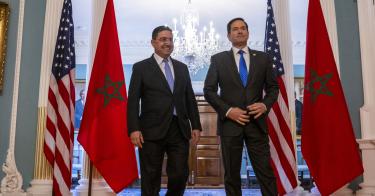
In early February, Moroccan Foreign Minister Nasser Bourita met with Secretary of State Marco Rubio at the Critical Minerals Ministerial in Washington. The conversation centered on building trust, responsible development, and stabilizing investment in Morocco’s critical minerals. The nation controls 70% of the world’s phosphate reserves that are essential to produce fertilizers and lithium phosphate battery chemistries.
Given that Morocco has Africa’s only free-trade agreement with the U.S., it has continued to prudently invest in its basic infrastructure and establish free-trade zones. For example, Midparc, a free-trade zone focusing on aeronautics, defense, security, and space-related industries, operates near a major logistics network of modern rail, ports, and roads.
>>> U.S.-Japan Trade Deal Is a Masterpiece
These free-trade zones are export-oriented in nature, capitalizing on Morocco’s geographical position straddling the Atlantic and Mediterranean trade routes. But policymakers in America and the EU should be aware that Morocco has become a major destination for Chinese activity associated with the electric car and battery industries.
Similar to the Midparc free-trade zone, the Tangier tech hub, focused on EV battery production, and has notably received $10 billion in Chinese investment. China’s Gotion High Tech, a company focusing on electric vehicle battery production, also underwrote $1.3 billion to scale production at a new gigafactory in 2024. Lastly, China’s steel supply chain will also support the $26 billion buildout of the Moroccan-Nigerian gas pipeline.
Because of Morocco’s strategic position, huge natural resource reserves, and free-trade agreements with the U.S, and EU, China has increasingly looked upon the country’s free-trade zones as the solution to Western tariffs. While not meaning that every Chinese investment in Morocco is tariff circumnavigation, the incentive structure is certainly concerning.
According to the World Bank, approximately 9% of the current Moroccan workforce are unemployed as of 2024 and over one in five young workers are unemployed. Thankfully, GDP per capita has been increasing by an average of 2.2% over the past 4 years, necessitating this infrastructure expansion.
>>> A Charter of Pacific Values for a Prosperous Pacific Future
While these investments are a prudent start, The Heritage Foundation’s 2025 Index of Economic Freedomgives Morocco a score of 60.3 (placing it in the “moderately free” category) as the country continues to address issues with judicial effectiveness and government integrity. So, while Morocco’s free-trade zone model is a bright spot for the African continent, the emulation of such a system needs to be evaluated alongside the national security concerns of large Chinese investment.
Both Western and African policymakers need to balance the need for infrastructure development with the realities that China has leveraged the might of its Belt and Road Initiative to its own geopolitical advantage in areas like Sri Lanka. With that said, its free-trade zones can be a model for African industrialization, placing itself in long-term economic conversations.
Morocco seeks to be economically close to the EU while fostering strong relationships with the world’s greatest 21st century superpowers, China and the U.S. With Africa notorious for unpredictability, bureaucracy, and stringent infrastructure regulations, Morocco serves as a shining example for what the continent can become. A discerning assessment is imperative to investigate the competing economic worldviews clashing within Morocco’s free-trade zone.
This piece originally appeared in RealClear World



