
Reviving the American Family
America's Next 250 Years Depends on the Strength of Our Families
Getty Images/ZenShui/Eric Audras
About Reviving the American Family
America is at a crossroads, and the nation’s next 250 years will rise or fall on the strength of its families.
The family is the foundation of civil society, and marriage—the committed union of one man and one woman—is its cornerstone. Children raised by their married, biological parents have better outcomes, including a far lower likelihood of poverty, better psychological well-being, higher educational attainment, and a lower likelihood of experiencing abuse or engaging in delinquent behavior.
A nation that rejects the importance of stable marriages and strong families for its well-being weakens its ability to pass on the blessings of prosperity to future generations. This is the reality that America faces today, and the direction we take now will determine the health and survival of the republic.
Current State of the American Family
In 1950, married couples comprised 78% of all American households. Only 4% of children were born to unmarried parents. The typical life script was consistent irrespective of race, religion, or socioeconomic status. Most Americans married in young adulthood, children were born within marriage, and divorce was rare.
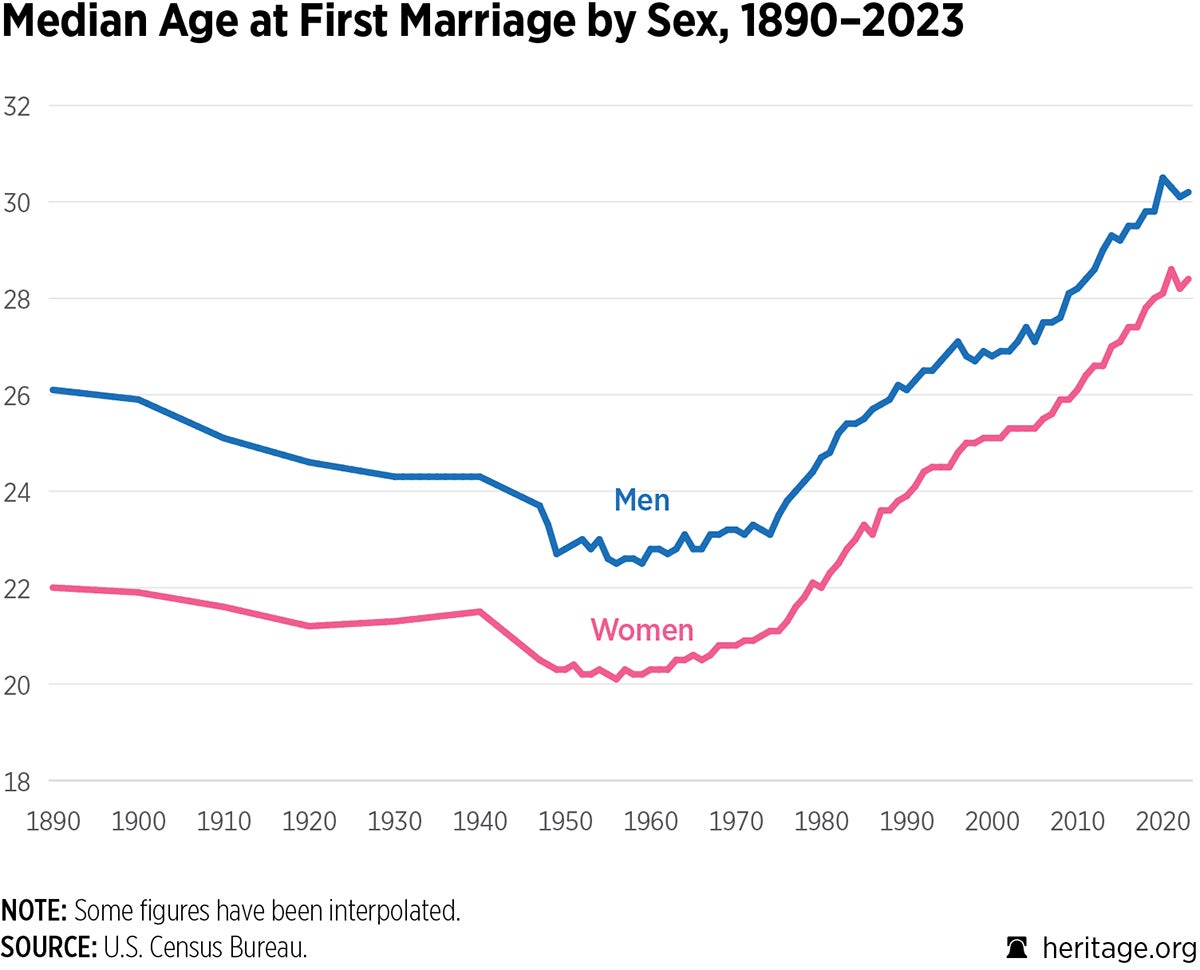
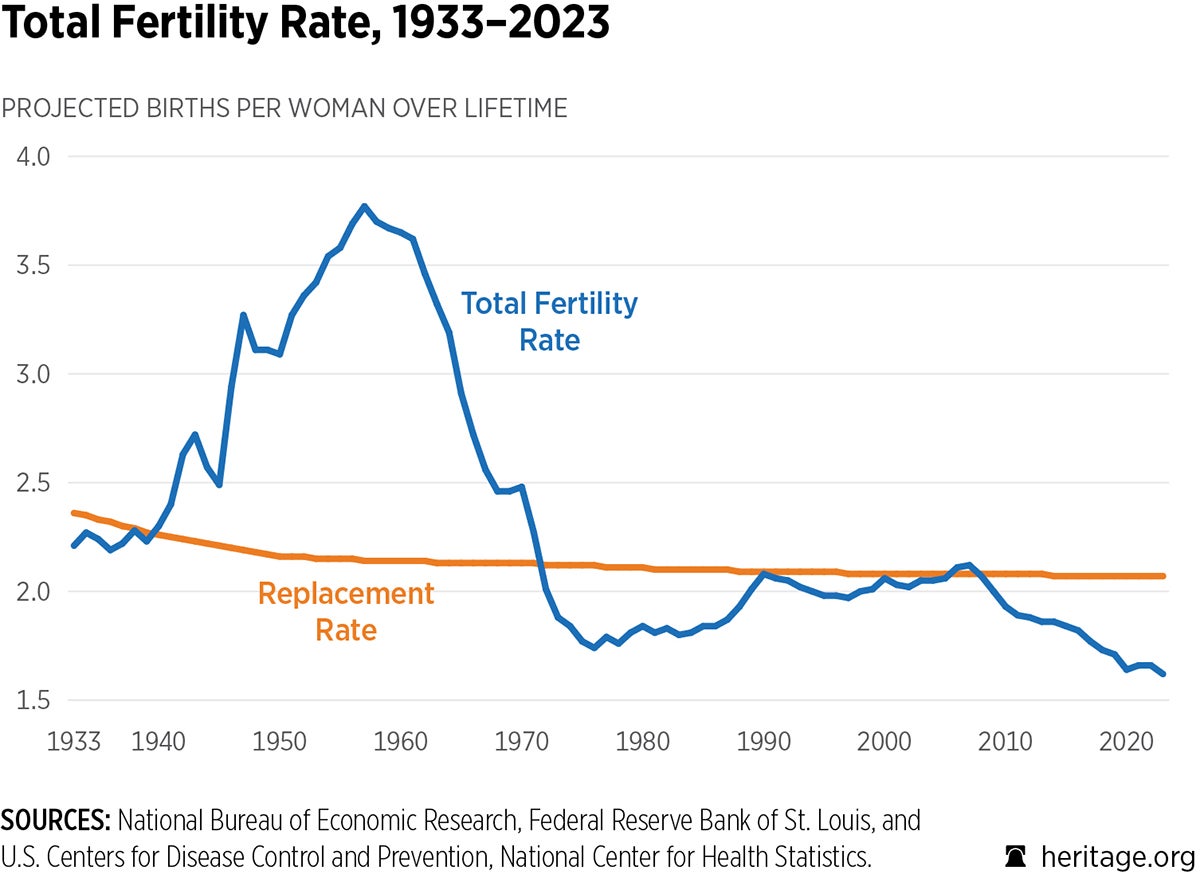
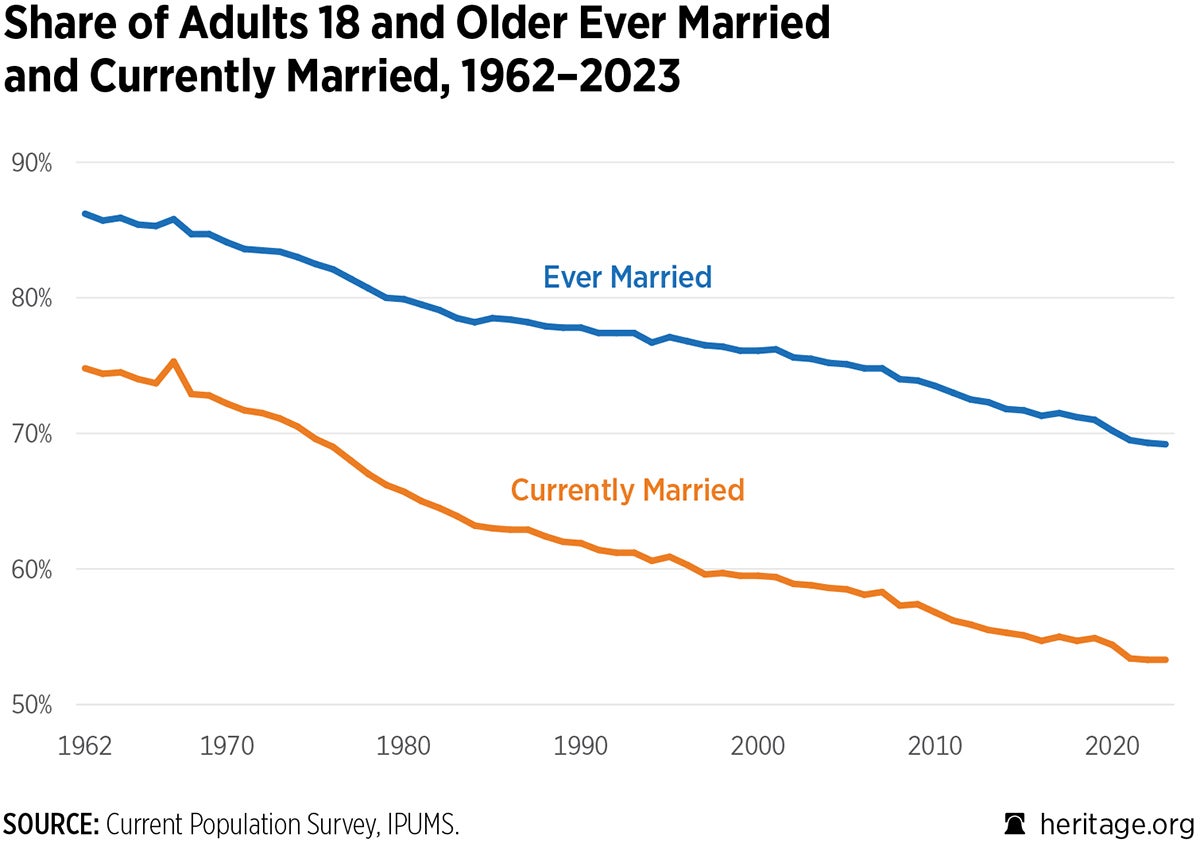
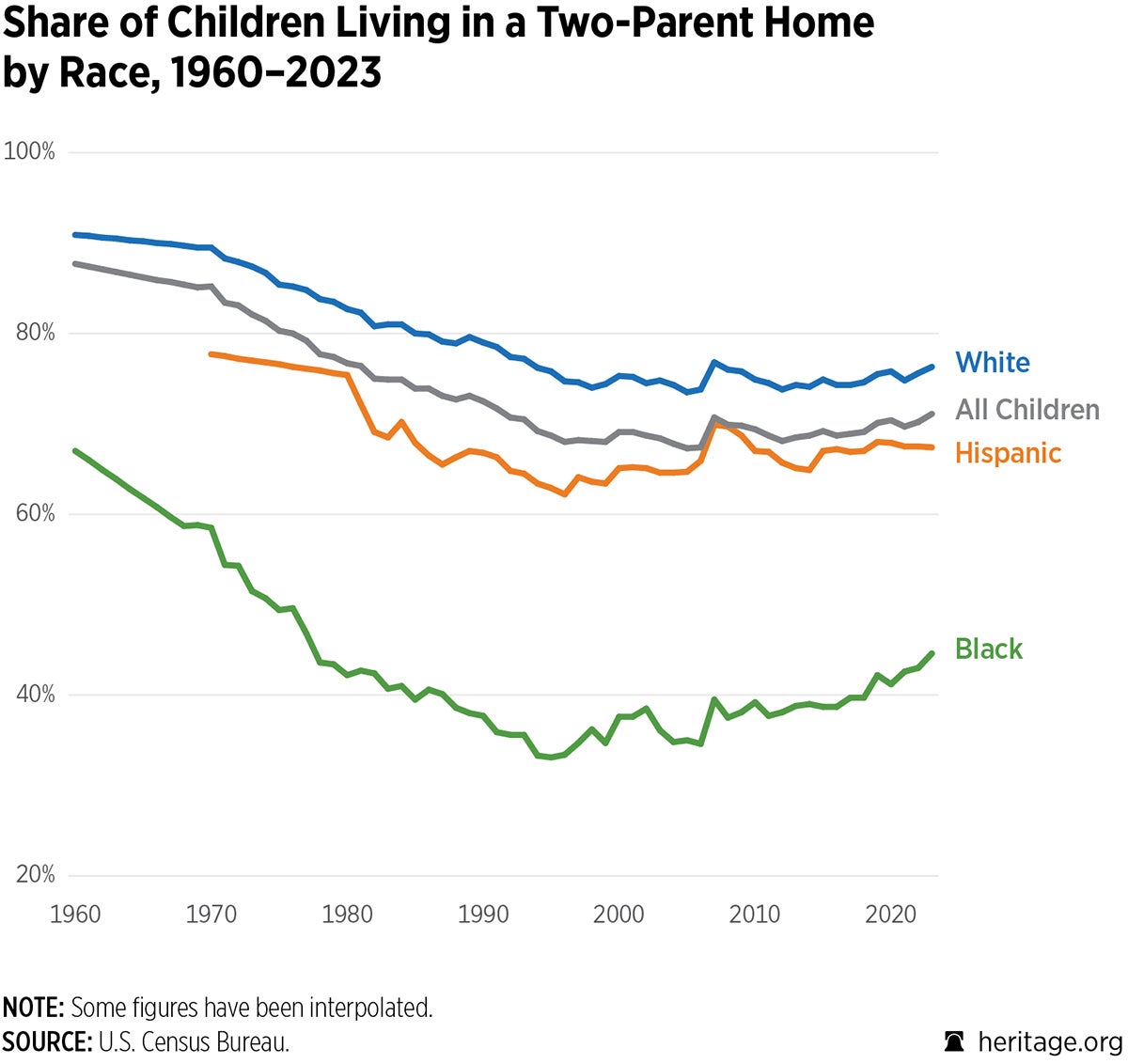
Today, married couples make up less than half (47%) of U.S. households and the age of first marriage has increased by about seven years for both sexes. It is no surprise that the decline in marriage has reshaped family life. Today, 40% of children are born outside marriage, roughly one quarter live with a single parent, and the total fertility rate (TFR) in 2024 (1.59 births per woman) was a record low. If current trends hold, deaths will outpace births within a decade, with the gap widening across the century. Plainly, the future of America will consist of far fewer Americans.
These changes to American family life reflect shifting social norms. A 2019 Pew Research Center survey found that 65% of respondents said society is just as well off if people have priorities other than marriage and children. This included 85% of liberal Democrats as well as 41% of conservative Republicans. To put it simply, America’s national marriage motto has changed from “early and often” to “less and later” over the past 60 years. In fact, marriage itself has been legally redefined nationwide with the Supreme Court’s Obergefell v. Hodges decision in a way that rejects the fundamental link between marriage and childbearing.
These changes matter because decades of social science research confirm what most people intuitively know: Children raised in homes with their married biological parents do better on a host of outcomes than children raised in other family arrangements, particularly single-parent homes. The most basic of these is economic stability.
Consequences of the Breakdown of the Family
In 2024, just 5% of children in married-parent families were living below the poverty line, compared to 31% of children in families headed by a single mother, and 14% of children in families headed by a single father. In 2024, the median income of a married-couple household was $128,000, or more than twice as much as a female-headed household with no spouse present, which was $60,400. The median income for a male-headed household with no spouse present was $83,260.
Besides a greater risk of poverty, children in single-mother families had poorer behavioral outcomes than those in two-parent households. Children living with their married birth parents earn better grades and are less likely to be suspended or expelled. One 2009 study using data from the 1997 National Longitudinal Survey of Youth found that children who grew up without both biological parents in the home were more likely to drop out of high school, to have a child outside of marriage, and to have been incarcerated. Adult children who grew up in a non-intact family also reported lower levels of employment. These outcomes persisted even when the researchers controlled for household income.
To end America’s family crisis, policymakers and civic leaders should treat restoring the family home as a matter of justice driven by two irrefutable truths. The first is that all children have a right to the affection and protection of the man and woman who created them. The second is that the ideal environment in which to exercise this right is in a loving and stable home with their married biological parents.
The default in American culture today, by contrast, is to put the desires of adults over the needs of children. Children are too often called to sacrifice what is their due—the presence of their mom and dad under the same roof for the entirety of their childhood. The two‑parent household is not merely a private good; it is the seedbed of self‑government and the indispensable foundation of social order, prosperity, and human flourishing. Rebuilding a culture of marriage, ending anti‑marriage penalties in public policy, and restoring economic conditions that make family life attainable are therefore matters of justice and national survival.
The Destruction of the American Family
“I have studied US poverty, inequality, and family structure for almost a quarter of a century. I approach these issues as a hardheaded—albeit softhearted—MIT-trained economist. Based on the overwhelming evidence at hand, I can say with the utmost confidence that the decline in marriage and the corresponding rise in the share of children being raised in one-parent homes has contributed to the economic insecurity of American families, has widened the gap in opportunities and outcomes for children from different backgrounds, and today poses economic and social challenges that we cannot afford to ignore—but may not be able to reverse.”“
Melissa Kearney, The Two-Parent Privilege
The first step in rebuilding the family is understanding how it was destroyed by policy decisions and shifting social norms. To judge by its effects, President Lyndon Johnson’s War on Poverty can be thought of as a war on wedlock. The rapid expansion of the welfare state devastated lower-income families first, its most lasting impact has been the idea that men are not needed in the home if the government is willing to play the role of provider.
In 1950, total federal expenditures on public aid programs (a fraction of total social welfare spending) was $1 billion. By 1975, it ballooned to $27 billion. It reached $62 billion by 1985. Most of this spending took the form of cash assistance from Aid to Families with Dependent Children (AFDC), Medicaid, and food stamps. The welfare state not only provided resources to the home, it also literally put a roof over millions of families’ heads. Spending on public housing increased from roughly $15 million in 1950 to over $9 billion by 1985.
This surge in government spending and an ever-growing number of new welfare programs did not stabilize American families. If anything, they had the opposite effect. Beginning in the 1960s, welfare subsidized single parenthood and, over decades, moved from a symptom of family instability to one of its primary causes. It incentivized unwed childbearing, imposed financial penalties on low-income people who got married, and discouraged able-bodied people from working. What followed was a rapid decline in married, two-parent families, a steady increase in nonmarital births, a rise in abortions, and the spread of long-term government dependence.
The disruptions to American family life caused by bad public policy in the 1960s were exacerbated by cultural upheavals that radically changed social norms around sex, sexuality, marriage, children, and gender roles. Second-wave feminism and the sexual revolution encouraged women to view men as “oppressors,” children as a burden, and the home as a prison.
Betty Friedan’s 1963 book The Feminine Mystique is widely credited with sparking the second-wave feminist movement. The author, activist, and co-founder of the National Organization for Women believed that suburban housewives were unhappy with largely domestic lives. She believed women who focused primarily on their families were committing “a kind of suicide” and needed to “break out of their comfortable concentration camps.”
Other feminists held similar views about women, men, marriage, and the home. Gloria Steinem’s Time magazine essay in 1970 titled “What It Would Be Like If Women Win” challenged the social norms that kept women at home playing the role of “housekeeper” and “hostess.” While Steinem explicitly stated, “Women’s Lib is not trying to destroy the American family,” she and some other feminists clearly saw men and marriage as barriers to true female fulfillment.
Instead of celebrating the nuanced expressions of femininity, the feminists of the 1960s and ’70s commanded a crusade that promoted sexual, financial, and familial “freedom” for women. Women were encouraged to “liberate” themselves from a patriarchal culture that insisted they stay at home and raise a family. In their worldview, a husband and children were limitations on a woman’s freedom to truly express her authentic self. Women who participated in traditional gender roles within families were shunned and seen as traitors to the movement. According to contemporary feminists, familial duties are restrictive and demeaning, and marriage and motherhood are traps created by men, not gifts granted by God.
It was drummed into me that being a mother, raising children and running a home were a form of slavery. Having a career, travelling the world and being independent were what really mattered according to her.”“
Rebecca Walker, on the influence of her mother, feminist icon Alice Walker, 2008
Rebecca Walker, daughter of feminist author Alice Walker, shared her experience with becoming a mother in 2008 and noted that being raised by a “rabid feminist” almost made her miss out on having a child. Rebecca, a noted feminist author in her own right, perfectly captured the hostility her mother and her contemporaries had toward the family: “It was drummed into me that being a mother, raising children and running a home were a form of slavery. Having a career, traveling the world and being independent were what really mattered according to her.”
The daughter rejected the views of her iconic mother and said that having a child was the most rewarding experience of her life. She stated: “Feminism has much to answer for denigrating men and encouraging women to seek independence whatever the cost to their families.”
These two forces—big government liberalism and second-wave feminism—combined to radically change how men and women thought about their roles in the home and about their obligations to one another and their children. They help to explain the sharp decline in marriage and increase in nonmarital childbirth among poorer Americans. When President Johnson launched the War on Poverty, 7% of American children were born outside of marriage. Today the number is above 40%, a troubling sign that the two-parent family structure has disappeared in many low-income communities.
Reviving the American Family
The American family is clearly in a state of emergency and there are only two choices about how to respond. The first is to accept the disappearance of stable, committed marriages and intact two-parent homes as the norm, both now and in the future. This path will lead to more children being forced to live with the negative social and emotional outcomes that come with family breakdown. The second is to embark on a culture‑wide Manhattan Project to restore the natural family, with faith communities, civic organizations, and governments each playing their part. This path is needed to revitalize the nation and put it on track for another 250 years of success, but it can only be accomplished through a cultural recommitment to marriage.
There are several steps to restoring a culture of marriage and strong families in America. Religion is certainly a key factor. The messages about marriage and family that are transmitted through the media are another. America’s education institutions are also an important part of the puzzle. There is also a role, albeit limited, that the government can play in strengthening families. The first step should be eliminating all marriage penalties in welfare programs. This can be done without adding costs to taxpayers by eliminating widespread fraud, waste, and excess benefits within the system. Additionally, work requirements for the able-bodied must be strengthened and enforced to ensure that children are raised in the best possible circumstances and not trapped in poverty. There are also new policies that federal lawmakers can enact to strengthen the American family. These include:
Saving America by Saving the Family
-
Newlywed Early Starters Trust (NEST) accounts. Congress should build on “Trump Accounts” (which deposit $1,000 at birth for future milestones) with a $2,500 initial deposit at birth that would be used by couples who marry by or before the age of 30. For example, a young couple who marries at 28 could expect to receive an inflation-adjusted NEST distribution of more than 38,000 over three years. This is the type of financial boost many young couples need in an economy where it has become increasingly difficult to support a family on a single income.
-
-
Newborn tax credit for married parents. Congress should apply the existing $17,280 adoption tax credit to married parents for each of their own newborns, paid out in four equal yearly installments. This credit would have work requirements and be structured to offset marriage penalties in the in the Earned Income Tax Credit (EITC) program. It would also provide a 25% bonus to parents who already have at least two children for each additional child.
-
-
Home Childcare Equalization credit. Because 50–70% of parents prefer arrangements with more parental time at home, yet the federal system disproportionately subsidizes paid outside childcare, the authors propose a $2,000 per child (under five) credit to level the playing field for married households who choose to raise toddlers at home.
These proposals, and the others in Saving America by Saving the Family: A Foundation for the Next 250 Years, are meant to restore the American Dream and support marriage and working families. The country will need all of this, and an accompanying cultural renewal, to secure the blessings of liberty and ensure a future of prosperity for generations to come.
