

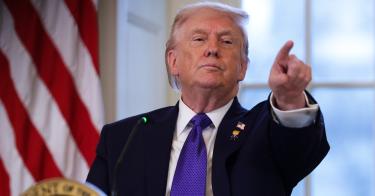
Forget Friedrich Merz, Emmanuel Macron, or Ursula von der Leyen. Donald Trump emerged in 2025 as the real leader of Europe, and 2026 is only likely to cement his position.
In just the first year of his second term, Trump’s administration has shaken Europe’s foundations to the core, with a far more assertive and effective approach towards transatlantic relations compared to the previous Biden administration.
The impact is being felt at every level, not least by European voters. A striking recent story in Politico (“Trump dominates democracy in Europe”) highlighted the results of a 10,000-person poll, showing that he was viewed as “strong and decisive” compared to their own leaders by 74 per cent of Germans, 73 per cent of Frenchmen, and 69 per cent of Britons. The corresponding figures for the leaders of Germany, France and the UK were 26 per cent, 27 per cent and 31 per cent respectively. Trump may not be loved in Europe, but he is increasingly respected as a force to be reckoned with. Europeans evidently view him as a towering presence in shaping their destiny.
Trump is often erroneously accused of being an isolationist. The truth is he has taken a far keener interest in Europe than his predecessors and has been actively involved in helping shape the continent’s future. He is the most transatlanticist American president since Ronald Reagan, and views rescuing Europe as a vital national interest for the United States. His approach toward Europe is nothing short of revolutionary. He is the first U.S. president to challenge the European Project, and his end goal is momentous: saving Western civilization itself.
>>> A Freer, Stronger, Sovereign Europe Is Good for the West
There are four core pillars to the Trump approach to Europe, all aimed at increasing the strength of the West: building military capacity and reviving NATO; ending mass migration and securing Europe’s borders; preserving freedom of speech, thought and expression across the Atlantic; and defending national sovereignty in Europe.
Much of Trump’s focus on Europe in 2025 was on the military dimension, with Washington seeking to ensure that America’s European allies are in a significantly stronger position to defend themselves in the face of the Russian threat. The Hague NATO summit, which I witnessed on the ground in June, was a game-changer for the alliance and an undeniable policy triumph for the Trump administration, with all NATO members committing to spending 5 per cent of GDP on defense and security by 2035. Far from being the destroyer of the alliance, as his critics had predicted, Trump emerged as its savior, a point made on numerous occasions by Mark Rutte, the NATO secretary-general.
I now expect president Trump will be setting his sights increasingly on the other three pillars of his European strategy in 2026, all of which he and his officials have previewed in the past year. The president himself has already weighed in on the vast problem of illegal migration into Europe.
JD Vance’s Munich Security Conference speech in February was the equivalent of a cruise missile strike against the complacent political elites of Western Europe, with a powerful warning against Europe’s current cultural suicide through decades of open borders and mass migration. Vance did not hold back either in condemning what the U.S. sees as the growing censorship and suppression of free speech in Europe, highlighting what is happening in the UK under Sir Keir Starmer’s increasingly authoritarian Labour government.
There were clear echoes of Vance’s remarks in the recently released National Security Strategy (NSS) of the United States, which spoke in crystal clear terms of “the real and more stark prospect of civilizational erasure” in Europe, while recognizing that “Europe remains strategically and culturally vital to the United States”.
In a clear departure from the Euro-federalist approach of presidents Biden and Obama, the NSS struck a markedly Eurosceptic tone, singling out the EU and other transnational bodies “that undermine political liberty and sovereignty, migration policies that are transforming the continent and creating strife, censorship of free speech and suppression of political opposition, cratering birthrates, and loss of national identities and self-confidence.”
>>> Trump Is the First Eurosceptic U.S. President, and That’s a Good Thing
The European establishment’s reaction to the NSS has been defiant and furious. Many European politicians still hold the delusional belief that the continent can go it alone without American security and support. But Eurocrats sitting in Brussels who imagine the European Union can stand up to Russia or China on its own are living in a parallel universe. They are similarly deluded if they think European voters will put up indefinitely with the surrender to mass cultural change in European cities and to big-state, high-tax socialist ideology. Those voters can see that Trump has secured America’s borders, and has exorcised the specter of socialism from the U.S. federal government.
The U.S. has every right to speak out on the EU and the future of Europe. The American people have bankrolled the security of Europe for decades, and the U.S. still provides a massive level of support, including nearly 80,000 troops stationed across the continent. Washington has a clear strategic interest in advancing a Europe of sovereign, cohesive nation states and a stronger transatlantic alliance. The U.S. also has every chance of being as successful on tackling mass migration, protecting free speech and defending sovereignty as it already has been on military spending.
So in 2026, we should expect president Trump and his administration to play an even greater role in shaping the future of Europe, with a clear-cut vision for advancing sovereignty, self-determination, secure borders, freedom of speech and the defense of Western values, culture and heritage. This will involve standing up to the supranationalism of the EU, and a growing collaboration with pro-American conservatives in Europe who share the same principles, including Italian prime minister Giorgia Meloni and Polish president Karol Nawrocki.
This piece originally appeared in The Telegraph



