

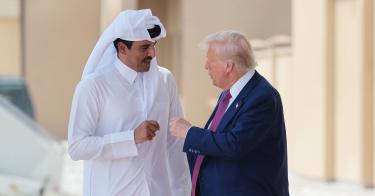
In May 2025, the first foreign trip of President Donald Trump’s second term took him to Saudi Arabia, Qatar and the United Arab Emirates. Widely credited with cementing regional support for the military operation against Iran known as Midnight Hammer, less well recognized is how that trip positioned the United States at the center of a reset of global energy markets.
Three momentous events over the last two months suggest these efforts are bearing fruit: Saudi Arabia’s 20-year natural-gas contract with Louisiana producer Caturus Energy, Qatar’s participation in the opening of the Golden Pass natural gas export facility in Texas, and the UAE’s announcement that it is leaving the Organization of Petroleum Exporting Countries, or OPEC.
On Feb. 24, just days before the conflict with Iran began, Saudi Arabia announced a 20-year contract to import natural gas from the American producer Caturus’s Commonwealth liquefied natural gas (LNG) division. No longer will the U.S. and Saudi Arabia, two of the world’s largest energy producers, have a straightforward—if sometimes fraught—relationship between an importer and exporter, as has been the case for the last eight decades. They are instead embarking on an era of energy coordination that can be of tremendous mutual benefit.
Saudi national identity, not to mention wealth, has flowed from their role as a massive energy exporter with the critical swing capacity to increase production as needed with the turn of a dial.
Historically, the kingdom has fiercely resisted importing any energy. For this reason, the crude-burning electricity generating plants, notably on the Red Sea, have been retained even though converting them to natural gas would not only make them more efficient, but also free up more Saudi oil for export.
Why this change in posture? Largely because the Saudis can see that their energy needs will grow exponentially if they realize their ambitions to become an >artificial-intelligence hub, and they desire to be a tech partner to the United States in this effort.
Now, the world’s two largest energy producers are embarking on a new partnership that can offer plentiful, reliable, reasonably priced flows of energy to partners from Europe to Latin America to Southeast Asia, and even, when desirable, to each other.
Then, on March 30, after a construction process that survived a lead contractor bankruptcy, Golden Pass LNG in Sabine Pass, Texas produced its first cargo—departing for Europe on April 22. Golden Pass is a joint venture in which QatarEnergy holds a 70% stake and ExxonMobil 30%, with Qatar’s trading arm taking the lion’s share of the output. It represents Qatar’s largest foreign energy investment to date, and is a clear signal that Qatar sees the United States as a natural gas partner, not a rival.
The irony could not be sharper: just weeks before Golden Pass opened, Iranian missile strikes devastated Qatar’s home LNG facility at Ras Laffan, knocking out capacity that analysts value at roughly $20 billion in annual revenue—with repairs expected to take up to five years.
Golden Pass Train 1 came online three weeks later, and Qatar now has American-produced gas flowing to its customers at the precise moment its home facilities are dark. A decade of investment in a Texas terminal, pursued over the objections of skeptics who questioned why the world’s largest gas exporter needed an American facility, has been vindicated in a single month.
Finally, after bearing the brunt of the reckless Iranian attacks on its Gulf neighbors, the UAE announced that it would leave OPEC effective May 1. The departure of a longstanding member and one of the cartel’s three largest producers is nothing less than seismic for the organization and will significantly weaken its power.
>>> The Iran Conflict Shows Why America Must Embrace Energy Development
But laboring under OPEC’s rules, the UAE has been held to about 3 million barrels a day despite having the capacity to approach 5 million—a quota designed to regulate prices artificially, stifling the UAE’s output and making new infrastructure investments difficult to justify.
This decision moves the UAE ever closer to the United States and Trump, who has frequently railed against OPEC, accusing it of “ripping off the rest of the world” by controlling prices and supply. Liberated from OPEC’s oversight, the UAE will be free to engage in the sort of energy coordination with the U.S. that we are seeing with Saudi Arabia and Qatar on a level playing field, all of which will result in more product on the market to soften the impact of the Iran energy shock. Other dissatisfied OPEC members should take note of the UAE’s strategic vision.
All of which makes for an extraordinary trifecta of geopolitical energy wins for America in the course of about two months. While clearing the Strait of Hormuz remains a necessary challenge for President Trump, and the world needs that energy to flow freely again, he can approach this action from a position of strength rather than of desperation.
Throughout Operation Epic Fury, the powerful energy might of the United States has been on full display, and we have the potential to come through the conflict in a much stronger position, in coordination with Gulf partners and allies, to continue to supply the global energy needs that Iran has tried to hold hostage.
This piece originally appeared in Fox News



