

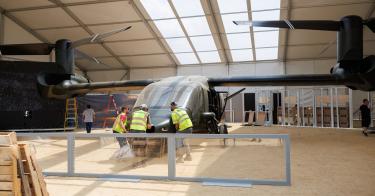
When it comes to U.S. Army modernization, the MV-75 Cheyenne II is hard to beat. Compared to the UH-60 Black Hawk, the new tiltrotor aircraft is a massive leap in speed, range, and reach. The Army says that the MV-75 will fly about twice as far and fast as existing helicopters, blending helicopter flexibility with airplane performance. This is crucial in the Indo-Pacific, where distance and survivability define the battlefield.
But the MV-75’s modular, multi-mission design—the very feature that makes it revolutionary—also poses an immediate and serious risk to arguably its most critical mission set of all: medical evacuation.
MEDEVAC Is Fundamentally Different from All Other Operations
The MV-75’s appeal to the Army is grounded in its versatility. The aircraft functions as a military “Swiss Army knife”; it is a modular aircraft adaptable with mission packages for assault, special operations, or MEDEVAC missions. As a general principle, that flexibility is vital.
But MEDEVAC is fundamentally different from the Army’s other missions. When Americans are wounded on the battlefield, there is no time to reconfigure a multipurpose aircraft to pick them up. A dedicated aircraft must always be on hand—postured for action, staffed by a trained crew, and ready to launch at a moment’s notice. Amid its broader push to de-emphasize “dedicated capabilities” in favor of modular ones, the Army must recognize that some capabilities are dedicated out of necessity.
>>> President Trump’s FY 2027 Defense Budget Request: A Generational Investment
This is why the debate emerging from the 2026 Army Aviation Warfighting Summit in Nashville matters. At the summit, Army Aviation leaders emphasized transformation, modernization, modularity, and broader aviator capabilities for a more flexible force. Those priorities align with the operational demands identified in Heritage’s TIDALWAVE report, which warned that projecting and sustaining combat power in INDOPACOM would strain fuel, munitions, transport, and logistics capacity. But solving the mobility problem does not answer the separate question of how MEDEVAC will be employed. In fact, it makes getting that answer right more urgent.
The Army must prepare for conflict in the modern era. As part of that effort, it must pursue affordable, adaptable, and mission-ready aircraft. For these purposes, modularity offers real advantages: better fleet utility, lower sustainment costs, and more options for commanders. Still, the Army and the Joint Force must also recognize the difference between modular aircraft and dedicated MEDEVAC ones. A modular aircraft can be reconfigured to meet many different mission sets; a dedicated MEDEVAC one must always be ready for the most important mission set of all.
For MEDEVAC Missions, Seconds Count
It should come as no surprise that the Army has long placed a special focus on MEDEVAC missions. As part of that effort, in 2009, Army leaders reaffirmed MEDEVAC as a strategic mission and made patient care the highest priority in aeromedical evacuation operations. That policy reflected something warfighters have long understood: when a soldier is wounded, the confidence that help will be on the way is a force multiplier on the battlefield. No wounded soldier (or ground commander, or worried parent thousands of miles away) should ever have to wonder whether MEDEVAC will be there in a moment of dire need.
The single-minded focus on this has led to outstanding results. Throughout the 20-year wars in Afghanistan and Iraq, Army data showed that about 92 percent of wounded troops ultimately survived—the highest battlefield survival rate of any army in world history. MEDEVAC was only one part of the “Joint Trauma System,” a comprehensive trauma system with rapid point-of-injury care, fast evacuation, en-route treatment, and integration with advanced facilities.
The Joint Trauma System found that most combat deaths occurred before the wounded soldier could reach treatment, and survival rates soared if casualties could reach advanced-care units in time. In other words, seconds count on MEDEVAC missions, and the difference between “available if reconfigured” and “ready now” can be fatal.
With this in mind, force-structure or budget pressures must not quietly erode medical readiness. Efficiency and affordability matter, but trading a dedicated MEDEVAC for general flexibility creates unnecessary risk. If the Army claims that modularity will not jeopardize response times, reliability, and survivability, it must prove it—urgently and transparently, through real-world operational analysis.
The Logistics of an Independent Army Medical Aviation Unit
Medical evacuation is a system requirement. Army Medicine has statutory authority to help shape medical force design, employment, crewing, and readiness, all of which impact patient outcomes. Title 10 creates the Army Medical Department for these responsibilities. MEDEVAC must be a medical readiness decision, not just aviation management.
The Army already has leaders who bridge these worlds in Aeromedical Evacuation Officers, or “67Js”—Medical Service Corps officers trained for tactical, operational, and strategic aeromedical evacuation. These officers have a vital understanding of aviation operations, casualty movement, medical planning, and command relationships. They must be retained as an independent unit, rather than reassigned as a general-purpose manpower offset for aviation billets reduced under the Army Transformation Initiative.
Governance is also grounded in the Army’s Title 10 responsibility to organize, train, and equip forces capable of preserving health, readiness, and combat effectiveness. Title 10 establishes the Army Medical Department and the institutional framework through which those responsibilities are executed. For that reason, MEDEVAC should not be treated solely as an aviation force-management decision, but as a medical readiness requirement.
>>> The U.S. Navy Is Going To Shrink—at the Same Moment China’s Navy Is the Largest on Earth
There are other legal considerations as well. Protected medical missions have historically depended on clear distinctions between medical and combat employment. Future conflicts may blur many lines, the Army should not casually blur this one.
Crucially, none of this means the Army should slow-roll modernization efforts in other areas. The Army should continue fielding the MV-75 Cheyenne II. It should exploit modularity where it adds value. It should build a faster, more survivable, and more relevant aviation force for future war. But it should also dedicate a portion of medically configured MV-75 aircraft to MEDEVAC units, keeping them ready to launch, fully staffed and trained, led by aeromedical evacuation officers, and governed by Joint Medicine standards consistent with the Geneva Conventions and the law of armed conflict.
Failing to do so can be fatal. It also weakens a core ethical principle of American warfare: even in combat, the wounded and sick must be collected, treated, and protected. In the end, the issue is not whether MEDEVAC still exists on a PowerPoint slide at the Pentagon, but whether the wounded soldier, sailor, airman, Marine, or Guardian in the field can trust that it will be there when it matters most. That core element—trust—must be protected at all costs. It shapes morale, reinforces cohesion, and strengthens the will to fight and win. As the Army modernizes, preserving trust at the point of injury is an operational imperative.
Dedicated MEDEVAC is not a relic of past wars. It is a proven combat multiplier for the Joint Force. The Army should modernize it, not modularize it out of existence.
This piece originally appeared in The National Interest



