

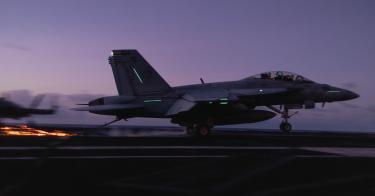
It’s taken over a decade for the Navy to develop and acquire a sixth-generation carrier-based air superiority fighter aircraft to replace the venerable F/A-18—the backbone of the Navy’s fighter-attack fleet for over 30 years. Now comes the real challenge: getting it off the ground.
Known as the “F/A-XX,” the effort includes an analysis of alternatives that examined program requirements, as well as a series of discussions across the Navy on the future of naval combat and which missions the F/A-XX would need to execute.
The Navy has said that the F/A-XX should provide the modern carrier air wing with “range, stealth, advanced sensors, and standoff necessary to access and operate across multiple mission sets in a highly contested environment.” In addition, the F/A-XX ideally will coordinate operations between manned and unmanned combat aircraft.
However, the program seems to have hit a standstill.
To date, the Navy has appropriated at least $2.5 billion for Research, Development, Test, and Evaluation. In 2024, the Navy announced that the program was in source selection and expected the program would enter service in the 2030s. Later in 2024, a Navy official emphasized that the Navy program was independent of the Air Force’s own sixth-generation air dominance fighter and that the Navy was pursuing its own unique solution and technologies.
>>> In Defense of the Aircraft Carrier
Last year, President Trump announced that Boeing would build the Air Force’s next-generation fighter, the F-47. This seemed to indicate that decisions were being made and that the F/A-XX announcement would soon follow.
Indeed, in early 2025, media reported that Lockheed Martin had been eliminated from the competition, leaving only Boeing and Northrop Grumman as possible builders of the aircraft. The “One Big Beautiful Bill” in July included $750 million to accelerate F/A-XX production once the Pentagon decided between Boeing and Northrop.
Later that month, the head of Navy acquisition testified to the House of Representatives that the Navy “has a requirement for sixth-generation aircraft for the future carrier air wing, and the department is committed to getting our warfighters the sixth-gen aircraft they need as soon as possible.” By late summer, Navy leaders suggested they would have a contract with either Boeing or Northrop by 2025.
Unfortunately, 2025 came and went without a decision, meaning that Boeing and Northrop continue to tread water, spending money and keeping engineers waiting.
Why is this delay significant and why must it be addressed—and quickly?
To begin with, China is building a massive fleet of fifth-generation fighter jets and is believed to be working on sixth-generation jets as well. As Admiral Caudle, the current Chief of Naval Operations, said during his confirmation hearing, the Navy “must have an air wing that is comprised of the most advanced strike fighters. Therefore, the ability to maintain air superiority against peer competitors will be put at risk if the Navy is unable to field a 6th Generation strike fighter on a relevant timeline.”
Put another way, the Navy can no longer afford to wait and must begin building the aircraft now.
Some have suggested that the White House itself is trying to prioritize the Air Force’s F-47 over the Navy’s F/A-XX, out of fear that the defense industrial base cannot design and build two sixth-generation fighters simultaneously. However, it should be noted that the best way to strengthen the defense industrial base is for Congress and the Pentagon to provide a demand signal through reliable funding profiles that sustain and support the defense industry.
>>> The U.S. Nuclear Arsenal of 2050: A Proposal for American Survival
Indeed, as House Armed Services Chairman Ken Calvert noted, delaying the F/A-XX program risks further challenges to the industrial base: “We cannot expect to grow the industrial base by undermining aviation programs that rely on highly specialized supply chains and skilled labor that cannot be turned on and off like a switch.”
In addition, the idea that the military aircraft industry lacks the capacity for two simultaneous tactical fighter programs is inconsistent with public evidence. For example, Boeing has invested billions in expanding its fighter aircraft capacity in Missouri to support the F-47, and Northrop Grumman is building a new facility in Florida for military aircraft, including a potential F/A-XX. Presumably, as Northrop’s sixth-generation B-21 bomber program transitions from development to production, the company will have thousands of engineers available to work on the F/A‑XX program.
It is time for the Pentagon to announce who should receive the award—otherwise, the Navy risks losing the program, as contractors are unlikely to invest billions without an award. Further, highly skilled (and therefore sought-after) technical engineers will become increasingly unlikely to remain with Boeing or Northrop while waiting for the Pentagon to award the contract.
They will—as would any normal person—pursue work that is not only financially rewarding but also meaningful.
The Secretary of War should announce whether Boeing or Northrop will get the award as soon as possible—ideally, in the next three months.
This piece originally appeared in 1945.com



