


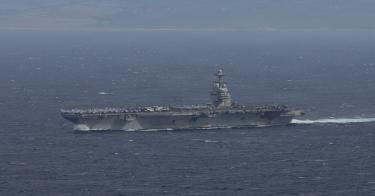
It has become fashionable to argue that aircraft carriers are becoming obsolete. Critics question their value in an era of technological advancement, when new capabilities such as advanced autonomous systems and hypersonic missiles increasingly render the U.S. Navy’s biggest and most prominent ships “too large and too slow” to evade missiles and drones.
They point to the Ukrainian sinking of the Russian missile cruiser Moskva to claim that American carriers would stand little chance of survival during a conflict with China. The U.S. Navy, they insist, should instead invest in various experimental drones and autonomous surface vessels.
These critics, however, are comparing apples to oranges. They’re drawing conclusions far beyond the lessons of the war in Ukraine—conclusions that have no bearing on U.S. military requirements in a potential conflict with China in the Pacific.
Further, they ignore decades of successful U.S. power projection operations, including the recent Operation Midnight Hammer and Operation Absolute Resolve—flawless tactical successes that utilized legacy American military platforms.
First, the war in Ukraine bears little resemblance to a conflict between the United States and China in the Pacific. The Russian Black Sea Fleet, a dilapidated shell of its former self, must operate in a closed environment with NATO forces in Romania, Bulgaria, and Turkey ringing the sea. Moreover, Ukrainian missiles are able to target and destroy the fleet’s home ports in Sevastopol and Novorossiysk with relative ease.
>>> The U.S. Navy Must Build the “Golden Fleet”
Russian ships in the Black Sea now operate with few air defenses and must operate close to the Ukrainian littoral to support Russian ground combat operations in Ukraine. Further, the crowded, close-quarters combat in Ukraine and the Black Sea is a world away from the operating environment of the Pacific, where American and Chinese ships and aircraft would have literally millions of square miles in which to generate force and maneuver.
Of course, unlike the Moskva, an American aircraft carrier does not operate independently. It’s supported by a carrier strike group and air wing, in which American destroyers, submarines, and aircraft not only conduct integrated naval operations but also critically defend aircraft carriers against torpedo, missile, and drone threats.
Now consider the alternatives. If the United States retired the aircraft carrier, what would replace it? What would the operational concept of the replacement be? How would the carrier replacement defend and sustain itself? Where would such a replacement be based? An autonomous surface vessel outfitted with advanced drones or large numbers of missiles, even if operating as part of a surface action group of destroyers and submarines, would not be supported and defended by an aircraft carrier’s air wing. But it would still face the same threats from Chinese ground-based missiles, submarines, and surface ships.
Autonomous air platforms face an even greater operational problem than a manned aircraft carrier, as they likely must be based somewhere within the theater. No drone can fly from San Diego or Honolulu and deliver combat power to the Straits of Taiwan or the South China Sea due to the enormous distances between California or Hawaii and the Western Pacific. If a drone were based in the Philippines or Okinawa, the air base supporting it would be under significant threat from a Chinese missile strike—likely more than an aircraft carrier, as the targeting requirements needed to identify, track, engage, and destroy a moving ship at sea are far more complex than those needed to strike a stationary site on land.
Indeed, a fixed air base that could sustain combat operations by autonomous air platforms would require personnel, fuel, maintenance, and air defenses, like any other fixed installation, and would thus become an obvious (and stationary) target for Chinese missile strikes. This is a problem that currently affects U.S. bases in the theater, such as those on Guam or Okinawa, and is part of the reason why the United States is scrambling to increase ground-based missile defenses in the theater. Additional fixed sites containing autonomous systems would only exacerbate these challenges, not alleviate them.
In addition, a complete shift away from carriers to autonomous systems would reduce our ability to generate combat sorties. A carrier air wing can support five days of sustained air operations over a target 600 miles away with 75 aircraft, and is able to generate supporting aircraft, to include air control, search and recovery, and tankers. Comparatively, air operations generated out of Guam would be essentially double the transit time of an aircraft carrier, thereby requiring three times the aircraft ordinance to deliver the same amount of ordinance.
Indeed, the amount of ordnance a platform can deliver is central to any discussion about autonomous vs. manned systems. Autonomous air and sea platforms must carry sufficient firepower to be combat-relevant. The question of cost effectiveness becomes more relevant when one considers what these systems would need to be as effective as a nuclear aircraft carrier—or if they are to replicate the totality of the combat power of a carrier strike group that integrates the firepower of Arleigh Burke-class destroyers, F-35 fighters, or Virginia-class attack submarines.
Even if one considered autonomous air and sea platforms to replace the aircraft carrier solely, the requirement for rear-echelon personnel would be significant, given the need to operate, maintain, and defend such platforms. But even that would not be the major cost. These ships and air platforms would need to be big enough to carry sufficient munitions to be effective, armored enough or redundant enough to survive missile strikes, long-range enough to operate thousands of miles from their home station, hardened enough that they could not be “hacked” or disabled through a cyber attack, and stealthy enough to evade detection.
>>> The Optimum Pathway for Building Nuclear Submarines With South Korea and Japan
Adding firepower, armor, range, hardening, and stealth to autonomous sea or land platforms will invariably drive-up costs—potentially to the point where they are close to the price point of existing platforms, particularly if they are to match them in capability. Furthermore, autonomous systems, particularly large autonomous sea or air platforms, would be unable to provide on-site or real-time support, maintenance, or repair—a critical function in combat. As stated earlier, the personnel required to operate such systems would not necessarily be much lower, given that most would be stationed ashore at a forward operating base rather than afloat.
In total, replacing the current model of manned carrier strike groups—with the aircraft carrier the centerpiece of such a group—with autonomous air and maritime systems would likely result in less combat power, shorter range, less ability to repair, and greater operational risks to American service personnel forward deployed on a limited number of fixed bases.
This is a dubious proposal, at best.
Instead, the United States should augment the carrier strike group with autonomous systems to increase its capabilities and effectiveness. But it should not scrap the world’s most advanced aircraft carrier.
During the Cold War, the Soviet Navy projected naval power globally and threatened American interests simultaneously in multiple theaters. The U.S. Navy understood these risks and took measures to mitigate them. The fact that the Chinese armed forces are now able to threaten our surface ships does not mean that the United States should pull back from its presence in the Western Pacific, but that it should reinvest in capabilities to counter adversary threats.
This will require increased investment in air defense on land and at sea, as well as distributed basing to mitigate that risk. But that does not mean abandoning our most effective platforms for force projection in the process.
This piece originally appeared in The National Interest



