In the winter of 1801, a defeated Federalist majority, with weeks to go before Thomas Jefferson’s inauguration, created a batch of new federal judgeships. John Adams spent his final hours as president signing the commissions. Posterity named the beneficiaries the “midnight judges.”
Posterity also recorded the sequel: Jefferson’s Congress repealed the new judgeships in 1802, while an undelivered commission to a separate Adams appointee, William Marbury, became the occasion for Marbury v. Madison. The lesson, which the Republic relearns every generation or so, is that the calendar is a constitutional actor.
It’s acting again. When the 120th Congress convenes on Jan. 3, Democrats will hold at least 54 Senate seats (races in Alaska and Mississippi are still being counted as of this writing).
Until then, the outgoing Republican majority holds the gavel, and with it a ledger. As this is written, 22 of President Trump’s nominees to life-tenured Article III judgeships remain pending: nine have yet to receive a Judiciary Committee hearing, while 13 have appeared before the committee but await further action.
Chairman Chuck Grassley has scheduled hearings in consecutive weeks beginning Nov. 10, departing from the committee’s customary every-other-week rhythm, and the White House says it expects every pending nominee to be confirmed before the year is out.
>>> Jurisprudential Approach of the Six Conservative Justices on the U.S. Supreme Court
The stakes are measured in decades, not news cycles. The Constitution’s Article III judiciary comprises 870 authorized judgeships: nine on the Supreme Court, 179 on the courts of appeals, 673 on the district courts and nine on the Court of International Trade. Twenty-eight are vacant.
Trump made 234 Article III appointments in his first term and 56 more since returning to office, for a total of 290 across two terms. Joe Biden made 235 in one.
The Supreme Court itself is a palimpsest of presidencies: three justices appointed by Trump, two each by George W. Bush, Barack Obama, and George H.W. Bush, and one by Joe Biden.
The second-term pace has been, by recent standards, unhurried. Presidents since Bill Clinton averaged 79 Article III confirmations by Nov. 1 of the second year of a second term; Trump had 56, and only 10 to the courts of appeals.
Part of the explanation is arithmetic rather than politics: a first term that fills the shelves leaves fewer empty ones for the second.
What changes in January is not the president’s pen but the Senate’s math. A Democratic House and Senate will be able to pass legislation, but not override vetoes, which requires two-thirds of both chambers. Advise and consent, however, requires only a simple majority, and the majority will belong to the party opposite the president.
The Constitution gives the president the power to nominate and the Senate the power to decline—and the Constitution’s framers, who distrusted concentrated power more than they distrusted gridlock, regarded the second power as a feature.
The practical consequence is that judicial appointments after January will likely depend on negotiation. Appellate confirmations will slow down, and district-court seats will be filled, if at all, through bargained packages in which the White House and home-state senators each get something.
This isn’t novel. It’s how much of the bench was staffed for most of the 20th century, before the Senate’s rules and habits became more majoritarian.
Judges, being human, notice the calendar too. Some of the vacancies that arise in the next two years will come from judges eligible for senior status who weigh, as judges always have, who’s likely to choose their successors. Those decisions are theirs, and they are rarely announced with their reasons attached.
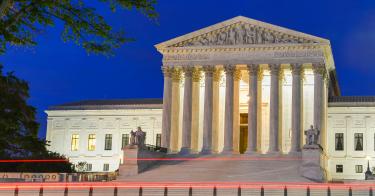
Which brings the matter to the marble building across from the Capitol. Justice Clarence Thomas is 78 and has served since 1991, longer than any current colleague. Justice Samuel Alito is 76 and has served since 2006.
>>> Actuarial Anxiety of American Conservatism
Retirement speculation about Justice Alito has been a cottage industry for a year, complete with an erroneous report in June that he had stepped down. He has since said that he intends to remain through the current term, which ends next June, and that he considers retirement every year. He has also said that political circumstances are too difficult to predict how and when he’ll decide.
Should a seat open after Jan. 3, its filling would require a nominee acceptable to a Senate majority of the other party.
History offers both kinds of precedent. In 1988, a Democratic Senate confirmed President Reagan’s nominee, Anthony Kennedy, 97-0. In 2016, a Republican Senate declined to act on President Obama’s nominee Merrick Garland. Divided government can produce consensus or a vacancy that outlasts a presidency; no one can know in advance which.
Alexander Hamilton called the judiciary the “least dangerous” branch, possessing neither force nor will, but merely judgment. He didn’t say it was the least durable. Senators serve six years, and presidents at most eight; a judge confirmed this December at 45 may still be writing opinions in 2060.
The voters spoke on Tuesday. The calendar speaks until Jan. 3. After that, the actuarial tables have the floor.
This piece originally appeared in 1819 News