

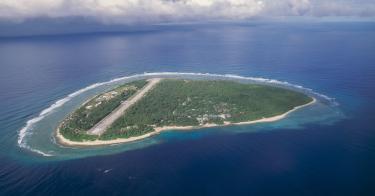
War this decade over the fate of Taiwan looks increasingly likely, making it vital for the U.S. to hold important terrain to increase the odds of victory. China knows this, which is why it’s been waging a positional competition for advantage.
The latest example: an airfield in Yap.
Yap is an island group within the Federated States of Micronesia, which stretches over 1.500 miles across the central Pacific and is tied to the U.S. within the Compact of Free Association (CoFA).
This association is critical, as it affords the U.S. veto privilege over any third-party presence—like, say, a Chinese-built and -managed airfield or casino.
>>> Cancer to Capricorn: A Maritime Showdown for the Global South
Yap is strategically located approximately 450 miles from the U.S. territory of Guam, home to massive naval and air bases critical to deterring and waging any war in East Asia. As such, what happens in Yap is of significant military concern.
That’s why, in a March statement, Secretary of War Pete Hegseth told the President of the Federated States of Micronesia that our military infrastructure there will be increasing.
Yap’s military value is a function of its strategic location. It’s atoll of Ulithi proved vital in World War II for naval operations supporting the invasion of the Philippines, Okinawa and preparations for invasion of Japan’s home islands.
In a modern war these islands will be important again and has attracted senior-level visits—from, for example, the Indo-Pacific Commander—and substantial resourcing through the Pacific Deterrence Initiative ($10 billion planned this fiscal year).
Almost on cue, China secured a deal to refurbish Woleai airfield on Yap in May two months after Secretary Hegseth’s statement. For the U.S. Air Force’s concept of Agile Combat Employment, it will need access to airfields in places like Yap to disperse when under Chinese missile attack.
A Chinese airfield in the middle of the second island chain would seriously complicate these plans, which is why it’s surprising more hasn’t been done to prevent or find alternatives to a Chinese presence there.
So, who is dropping the ball?
The Chinese activities at Woleai, to be clear, are not a surprise. It ranks almost as bad as the 2022 secret security pact the Chinese secured with the Solomon Islands.
>>> To Honor Solomon Islands' Daniel Suidani, Americans Must Counter China’s Coercion
Since Yap is in CoFA, the Department of Interior’s office for insular and international affairs and its troubled deputy—reported on by the Daily Signal—should be at the tip of the spear.
And, the nearby Joint Region Marianas and Joint Task Force—Micronesia should have been aggressively raising alarms.
Given the stakes, an investigation is needed to determine how another Chinese investment in dual-use military facilities has proceeded unimpeded for so long.
Questions need to be asked about why regional legal counsels failed to contest this Chinese investment and to represent and ensure that U.S. interests were met through CoFA.
Left unaddressed, U.S. leadership responsible for the region will continue to fail in identifying and addressing problematic Chinese encroachment and influence in Micronesia.
The consequence of continued inaction will render years of effort and billions of dollars in military investment and planning useless.
This piece originally appeared in the National Security Journal



