

On Sept. 2, the United States really stepped up its decades-long war on drugs by sinking a boat in international waters filled with narcotics, killing 11 members of the Tren de Aragua gang. This attack, which the current administration has been hinting at for a while, opens a chance for a fresh look at how America approaches Latin America and Africa and rolling back China’s dangerous march across the region.
Bounded by the two tropics, Cancer and Capricorn, is a region that faces similar threats and significant opportunity. In the same area, China has been waging a nearly 20-year campaign to win over the so-called “global south.” For China, the global south is a fancy way of saying former colonies in the southern hemisphere, with all sorts of different histories, national interests and aspirations. By taking a maritime approach in a maritime corridor between the Tropics of Cancer and Capricorn, the United States has a chance to beat China and unite the region around shared interests like security and trade.
Both African and Latin American countries are well aware of great power games and their not-so-distant colonial past. But unlike the wider global south, the nations of Latin America and Atlantic coastal Africa are connected by language, culture and shipping routes. That’s why an offshore approach focusing on common maritime interests will work, providing real benefits for the people of this region and American citizens without triggering memories of the past.
On the other hand, China’s strategy has centered around massive infrastructure projects, elite capture through graft and lopsided trade deals. But this approach alienates the local community, which too rarely benefits from Chinese presence, while local political leaders bow for short-term Chinese favors. As it stands, Africa has seen many such efforts fail, has suffered under debt diplomacy and seen its natural resources exploited. One notable example is Uganda’s renegotiating the tough terms of a 2015 deal with China to expand and modernize its Entebbe Airport for $200 million.
>>> The U.S. Should Open a “School of the Philippines” To Deter China
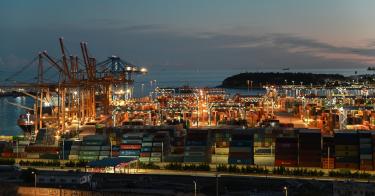
Latin America is not far behind. In June 2025, China’s state-owned COSCO started operations at Chancay Port in Peru, a $3 billion Chinese project to build a modern, highly automated shipping hub. Construction continues despite local concerns about labor and environmental impacts. These ports projects have long been suspected of being used for nefarious purposes. CSIS’ Christopher Hernandez-Roy raises this concern in a September 2023 article titled, “Are Chinese Ports in Latin America Preferred by Organized Crime?”
China’s influence in Africa goes beyond trade and big infrastructure projects. Their distant fishing fleets often poach in places like the Gulf of Guinea, around the Galapagos Islands and recently off Argentina’s coast. In June, Argentine forces blocked about 300 Chinese fishing boats from entering their exclusive economic zone, where coastal states retain the right to all natural resources within it, including the seabed. This ongoing standoff has become a regular occurrence, leading to the sinking of a Chinese trawler in 2016 and warning shots fired again in 2019 by Argentine forces. Africa has also faced challenges from a predatory Chinese fishing fleet in its waters.
To address lawlessness at sea, Gulf of Guinea countries have been working together since 2011 in an annual maritime security exercise called Obangame Express. Led by the U.S., it usually involves over 32 participating nations. This exercise has helped improve regional maritime security against piracy, illegal fishing and other crimes. The investment in regional maritime awareness contributed to the capture of a Chinese fishing vessel, Hai Lu Feng, in 2020. This uncovered some disturbing truths: Chinese fishing fleets used registration and location data for multiple ships to avoid paying licensing fees, duties and limits on fishing. This allowed them to overfish, harming local fishermen. The discovery of this activity was partly due to U.S. maritime capacity-building and skills practiced at Obangame Express. If these skills were applied on a transatlantic scale, they could potentially disrupt the activities of cartels as well—cartels that have been killing almost 100,000 Americans every year.
Africa and Latin America have also been hit hard by drug cartels, causing addiction and chaos. This point has repeatedly been made in United Nations World Drug Reports. The cartels make over $500 billion a year from illegal drugs trade. Cocaine is the cartels’ fastest-growing product, which they sell in near equal volume to both North America and Europe. China helps the cartels by selling them precursor chemicals needed to make fentanyl. This makes the cartels more dangerous and weakens local governments in Latin America. In turn, the cartels and Chinese criminal gangs, like the Bang Group, take advantage of this. Venezuela is a good example, where under economic pressure the Maduro regime has increasingly turned to China, Russia and the cartels.
How to Stop It
We can stop this by attacking the cartels’ business model. We can do this by making it harder for them to ship chemicals and traffic in people, while also cracking down on illegal fishing and smuggling by China. We can also create new trade relationships between the United States and Latin America and Africa.
To start, we should focus on a few countries that are already fighting the cartels and illegal fishing and are seeking to grow their economies.
The Tren de Aragua incident shows the war on the cartels is starting, but America isn’t alone in this fight. To win, we need to destroy the business model the cartels rely on. This will mean working with other countries who are on the same page, such as El Salvador, which has been really aggressive in stopping smugglers at sea. They’ve been coordinating with the Joint Interagency Task Force South (JIATF-South). Likewise, we can enforce maritime rights targeting illegal Chinese fishing with Guinea, Sierra Leone and Guinea-Bissau.
Most pressing is fighting the cartels. To really hit the cartels’ bottom line, we need to stop both shipments of cocaine and the chemicals they use to make fentanyl. This is something many experts have been saying for a while now. In a December 2023 article for the National Interest, James DiPane and I explained the cartels rely on several sea routes to move 90% of their drugs. The most important routes cross the Pacific to Mexico and into the U.S., ferrying precursor chemicals from China to Mexican cartel fentanyl production sites and cocaine from South America. They also rely on stops in other countries before moving into the United States or through Europe’s most porous border, French Guiana. Smugglers are drawn to French Guiana because once they’re inside, they can use local drug mules to fly directly to Europe with fewer customs and immigration checks. This reliance on international shipping or airfreight routes is a weakness for the cartels.
JIATF-S was established in 1989 and has had some success in stopping this illegal trade but haven’t been able to end it completely. Right now, officials say they only stop about 10% of this trade because they don’t have enough Coast Guard cutters and patrol aircraft. To make a real difference, we need to expand JIATF-S and change the law so they can focus on all of the cartels’ illegal trade on the high seas. We also need to be more careful about China’s fishing fleets, which are often suspected of smuggling things like counterfeit cigarettes and worse.
European countries such as the Netherlands, Italy France, and the United Kingdom are also affected by drug trafficking and human smuggling, but there’s more to it than just a threat. There’s also a chance for more economic growth and trade, especially when it comes to offshore energy exploration.
The war in Ukraine has shown that NATO, which is supposed to be a strong alliance, is actually pretty weak. And after three years of war in Ukraine, it’s still relying on Russia for a lot of its energy, making it harder to get Russia to agree to a ceasefire. Erasing this dangerous reliance on Russian energy should lead Europe to look for alternate sources of energy, such as in Western Africa and Latin America. Italy is already looking to trade more energy with North African countries and are also trying to deal with the issue of illegal migration and drug trafficking. Europe needs more deals like this to meet its energy needs.
New Opportunities
There’s a new hotspot for offshore energy reserves off the coast of Guyana, a country that’s still under threat from its neighbor Venezuela. Just last March, a Venezuelan patrol boat threatened vessels working for ExxonMobil in Guyanese waters. And after a years-long military build-up, the danger of war isn’t over with Venezuela claiming Guyana’s Essequibo region. This threat puts Guyana’s estimated 11 billion barrels of untapped offshore crude oil at risk. Guyana is already the third-largest non-OPEC oil producer in the world. According to the U.S. Energy Information Agency, these petroleum reserves offer an alternative to Russian energy.
>>> The Threat of Chinese Investment in the Americas
There’s more to this story than just oil between the Tropics of Cancer and Capricorn. There are also opportunities to reduce our dependence on China, like finding new sources of rare earth minerals, expanding trade and developing new industries. For example, the U.S. helped Congo and Rwanda end a long and bloody war, and a minerals development deal brokered by the White House opens them to American investment in mining their mineral resources, especially copper and cobalt. Moreover, Latin America and Africa could be great alternatives to Chinese manufacturers. According to a July report by ISS Africa Futures, developing energy generation with American investment could unlock the potential of Africa’s vast mineral reserves. In Latin America, Argentina is now shaking off years of currency controls and economic volatility, and it’s booming at an estimated 5.5% GDP growth in 2025, according to the World Bank.
America already has an economic tool and framework that’s proven to work: Prosper Africa. Established by the Trump Administration in late 2018, it has facilitated more than 800 deals with 45 African countries worth a whopping $50 billion. And guess what? This initiative helped connect small and medium enterprises, which create seven out of 10 new jobs, according to the World Bank. This approach is a stark contrast to China’s elite-focused approach and benefits the widest populations in both markets, American and African. We should definitely expand this to include Latin America as a viable alternative to China’s debt diplomacy.
Between the Tropics of Cancer and Capricorn, our people have a common interest in fighting the cartels, protecting our natural resources and making our economies more resilient. As such, it is time to forge a new transatlantic partnership to grow secure and resilient economies that stretch from the Galapagos Islands to the Gulf of Guinea.
China’s debt diplomacy strategy of resource extraction, poaching resources where it can, enabled by elite capture, is inherently flawed. China has teamed with the cartels and unleashed their worst behavior on those too weak to resist, but without any viable alternative. That is, until the U.S. can energize resistance and collaboration for common good.
A maritime Cancer-to-Capricorn strategic economic and security framework can deliver results that viable alternative partners in Africa, Latin America and Europe can support. Success will create a more free and prosperous future for everyone, not just Americans. The first step is to work with our partners in the Cancer-to-Capricorn corridor. Together, we can finally and effectively challenge China’s plan for the global south on terms that are fair and beneficial to everyone.
This piece originally appeared in SeaPower



