

America’s favorite Frenchman, Alexis de Tocqueville, wrote that, “there is nothing more annoying in the habits of life than this irritable patriotism of the Americans.” We are determined to defend anything about our country, “except perhaps the climate and the soil; and still, one finds Americans ready to defend both as if they have helped to form them.” Right you are, Mr. Tocqueville.
With the 250th anniversary of America’s birth looming, now is a good time to talk about the National Park Service. What are the underlying ideologies that animate the NPS? What role does it, and should it, play in preserving the American story and revitalizing the republic?
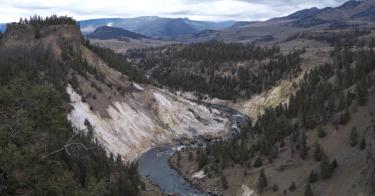
That question can best be answered with an overview of the NPS’s history and philosophical influences. Overall, the NPS is doing a good job of maintaining and preserving natural resources such as Yellowstone, a necessary and relatively straightforward task (and not this piece’s concern). Things become more complicated when it comes to historical sites such as battlefields, where a curator’s task naturally entails the telling of history, which has become a more fraught landscape in recent years. It’s worth having a conversation about those NPS historic sites.
Over time, the NPS has tilted more and more in a progressive direction. That’s unfortunate, because the natural law conservationism of the Founding offers a better guide for how to understand the mission of the NPS.
History of the National Park Service
Most Americans probably assume that the NPS preserves, well, parks: places like Yellowstone National Park and Glacier National Park, which are homes to nature’s wonders and beauties. But the history of the NPS, like that of government in general, shows a steady expansion of realms of authority, which experienced a significant uptick during the Progressive era. In 1872, Yellowstone National Park was created through an act of Congress, and Congress also created the federal bureau known as the NPS in 1916. The Antiquities Act of 1906 gave the president authority to designate national monuments. Even mineral springs, memorials, reservoir-based areas, and parkways fall under the NPS.
>>> Post-Modern Mischief at America’s National Parks and Museums
In 1781, Congress took steps to commemorate American battlefields, and the centennial years of the American Revolution saw an increase in monuments built throughout battlefields. Yet military parks fell under the control of the War Department—that is, until 1933, when President Franklin D. Roosevelt transferred 57 historical sites and battlefields to the National Park Service via executive order.
This altered the NPS in meaningful ways. According to the National Park Service’s own self-published history:
The National Park Service undertook another mission in 1933 as President Franklin D. Roosevelt launched his New Deal: helping to relieve the great economic depression gripping the nation. Under NPS supervision, the new Civilian Conservation Corps (CCC) would employ thousands of jobless young men in a wide range of conservation, rehabilitation, and construction projects in both the national and state parks.
The expansion of the NPS was part of Roosevelt’s broader economic program.
Two years later, through the Historic Sites Act of 1935, “historic preservation became a major responsibility of the National Park Service.” The NPS would no longer simply be in the business of conserving nature, but also in telling the American story and engaging in public education.
Preserving natural wonders and perpetuating the American heritage are quite different, though not necessarily contradictory, tasks. Conservationists and natural scientists, historians, and political philosophers tend to study distinct subjects.
Interpreting Our Heritage
Natural beauties are one thing, and most Americans simply expect reasonable maintenance and access when it comes to those places. However, there is notable disagreement in the current political climate over how to tell the American story. The NPS owns places like the Gateway Arch & Museum of Western Expansion, the Women’s Rights National Historical Park, and the Harriet Tubman National Historical Park. Many such places are doing a terrific and honest job, but some are straying. All of them would be stewarded better if they approached their task with a deep understanding of the civic value of historic sites.
While there is room for a degree of judicious choice about what to emphasize at any given historic site, there are still standards when it comes to history, and turning historic sites into vehicles for activism undermines their unique value. Cherry-picking in either direction is not in the spirit of liberal education, and primary sources offer guidance to discern if history is being presented fairly and accurately.
Places like Frederick Douglass National Historic Site and the Jefferson and Lincoln memorials are places of public education, where Americans can go with their families, classmates, and fellow citizens to learn about heroic figures, the triumphs and failures in American history, and the principles that define us. That experience could be a positive visit that prompts discussion among citizens, a negative one that encourages kids to imagine themselves as aggressors, or simply forgettable. It is a “touch-grass” opportunity that is increasingly precious as classrooms are failing to offer a robust education. A memory of that kind of visit often remains in people’s minds as adults.
The maintenance of the memory of the American story is necessary for preserving the unity of a single people. Harry Jaffa wrote that
every political philosopher has always recognized, that there must be some conviction, usually embodied in the form of a story that can be told, comprehended, and taken to heart by all, which produces a sense of community and unites the hearts of those who call themselves fellow citizens. Without that fellow feeling there is no basis for mutual trust, and where there is no trust there can be no freedom.
The National Park Service seems to be lacking in such philosophical grounding. One illuminating text on this front is Freeman Tilden’s Interpreting Our Heritage. A journalist, playwright, and novelist by trade, Tilden first wrote his seminal book in 1957, and it remains widely used by NPS guides today. Some even consider it the “Bible” of the interpretive profession.
While Tilden sometimes writes about connecting Americans to their past or preserving a history or legacy, his overarching emphasis is on the self and on relating to visitors on a personal level in order to provoke a unique experience. For example, Tilden utilizes Ralph Waldo Emerson’s quote that, “The world exists for the education of each man. There is no age, or state of society, or mode of action in history, to which there is not something corresponding his own life.” He introduces six principles of interpretation, working around this same theme. Interpretation, Tilden explains, should relate to “something within the personality or experience of the visitor.” “Information, as such, is not interpretation.” Also, “the chief aim of interpretation is not instruction but provocation.”
Tilden’s work is not without value, but it’s clear that his primary focus is on the individual, not on preserving the American tradition. As College of Charleston’s Kerry Mitchell writes in “The Soul of Things: Spirituality and Interpretation in National Parks”: “More central to scientific literacy or instilling patriotic values, the evocation of personal spiritual meaning stands at the core of Tilden’s agenda for interpretation.”
It’s fair to question how much Tilden has influenced the minds of NPS leadership and park rangers. Such rangers are often lovely people who care about history and/or nature. But ideas do matter; the ideas of elites have a tendency to trickle down over the years, and it is worth asking these questions before historic sites become even more ideological.
Is the mission of the National Park Service merely, or primarily, to entertain autonomous individuals, and is depicting American history simply a means to that end? Or should its mission be to preserve the American story and the self-governing character of a single people?
Progressivism Post-Tilden
Departing from Tilden, Progressivism (as it does) has expanded its influence over the NPS through the decades. A Progressivism that encourages and offers an ever-expansive definition of rights informs the modern NPS in significant ways.
In its centennial 2016 report “A Call to Action: Preparing for a Second Century of Stewardship and Engagement,” the NPS holds out the need to adopt Progressive causes, like combating climate change and developing a workforce “that values diversity and an inclusive work environment.”
A 2018 report by the George Wright Forum, which publishes work related to parks, protected areas, and cultural sites, indicates that the Stonewall National Monument in New York was designated as a historical monument in 2016 because it played a pivotal role in the “nation’s LGBTQ civil rights movement and inspired generations of activists.” This is quite reminiscent of President Barack Obama’s Second Inaugural Address, during which he stated that, “We, the people, declare today that the most evident of truths—that all of us are created equal—is the star that guides us still; just as it guided our forebears through Seneca Falls, and Selma, and Stonewall.”
The report further contends that:
The 1998 creation of Little Rock Central High School National Historic Site was the foundation for a series of studies that sought to identify, evaluate, and preserve properties associated with the modern Civil Rights Movement, which in turn lent relevance to consideration of places associated with women, Native Americans, Japanese Americans, Latinos, and the LGBTQ communities.
It is, of course, debatable whether it is appropriate or accurate to draw a straight and logical line from the Civil Rights movement to modern-day LGBTQ+ claims.
In terms of historical preservation, the Civil Rights Movement is certainly significant and important, and sites that convey its meaning or that depict central figures like Martin Luther King ought to be commemorated. Such successes as the elimination of slavery and achievement of moral and legal equality are legitimate fulfillments of the “promissory note” that is the Declaration of Independence and the central principle “all men are created equal.” For equality in the Declaration is about the dignity of the human person, rather than sameness.
Analyzing various demographics, such as the driving role Christian women played in charity work and the development of civil society, can also be quite informative and interesting. However, such initiatives are often framed or hijacked by the politically motivated, who group them in with more controversial causes that do not fundamentally center on fair inquiry or demographic considerations. For example, celebrations of LGBTQ+ history rely on conflict theory, which reduces everyone to either oppressor or oppressed categories. Such interpretive grids result in ever-expanding classes of victims.
The result is that norms are altered, and the Sexual Revolution replaces Civil Rights. For example, until recently (the series of articles has now been removed), the NPS identified the Kinsey Institute as a site connected to LGBTQ+ history. The article lauded the perverse work of discredited sex researcher Alfred Kinsey, and claimed that he “conducted pioneering research to challenge ideas of normativity and discriminatory laws regarding sexual behavior” and contributed to a “heterosexual-homosexual rating scale, placing the sexual behavior of individuals along a continuum.”
Clearly the mission and scope of the NPS have expanded considerably, beyond preserving natural rarities to include a cultural activism animated by a Progressive worldview.
Back to the Founding
As we begin a robust conversation ahead of America 250, this same NPS is “reimagining” exhibits at places like the Jefferson and Lincoln Memorials.
A superb paper by Belmont Abbey College’s Rachel Alexander Cambre, “The Conservative Roots of American Conservationism,” offers some guidance on how to consider natural and historic sites. Cambre particularly examines the philosophy of James Madison, Thomas Jefferson, and Teddy Roosevelt to develop a civic understanding of and approach to conservationism, one grounded in man’s relationship with nature and natural law. A thoughtful encounter with nature’s beauty and harsh demands can inherently encourage a connection to and reverence for the transcendent, as well as a hardy resilience respectful of human limitations, so there is good reason to set aside public lands.
>>> The Road to Rediscovering America: Putting Civic Education on the Map
Cambre writes that “the conservation of public lands preserves the ‘common stock’ in part by giving all citizens access to land. … By facilitating man’s reliance on nature and nature’s God, along with the virtues that this reliance fosters, land conservation facilitates republican government.” She continues, “In safeguarding landscapes and species unique to America, the national parks help to endow Americans with an attachment to their fatherland, providing the durability that [Yuval] Levin argues is essential to healthy institutions and societies.”
Societies that foster innovation, as free market republics do, can be characterized by a fair amount of churning, and longstanding institutions and shared principles offer a counterbalancing stability. A republic that disrupts the old ties of hierarchical ancestry and practices like primogeniture and entail must offer binding alternatives—alternatives like civic friendship and the Madisonian recognition that improvements to the land by the dead “form a charge against the living.”
American stewardship of land, through more widespread citizen ownership and reasonable public ownership, reinforces the reality of the principle of sovereignty of the people. The attachment to home, which is both physical and enduring, is a healthy antidote to expressive individualism, and visiting America’s natural wonders and historic sites can encourage such an attachment, conveying that not only do America’s citizens possess the land, they are possessed by it. As long as the NPS adequately maintains natural sites, it achieves those ends.
When it comes to historic sites, the mission of the National Park Service ought to be a civic one: to preserve the American story and foster the republican virtues necessary for self-government.
Accurately and fairly portraying the American heritage at historic sites is crucial to reminding us who we are as a single people. Historic sites are places of public education where Americans have buried our honored dead, gathered to listen to words fitly spoken, and been called to adventure by the animating spirit of enterprise. We continue to visit with our families so that generation upon generation can learn and rediscover the American story. They are physical places that encapsulate the character and principles of a people, and we protect those places to preserve the experiment and the tradition that is America.
This piece originally appeared in Law & Liberty



