
Rachel Sheffield
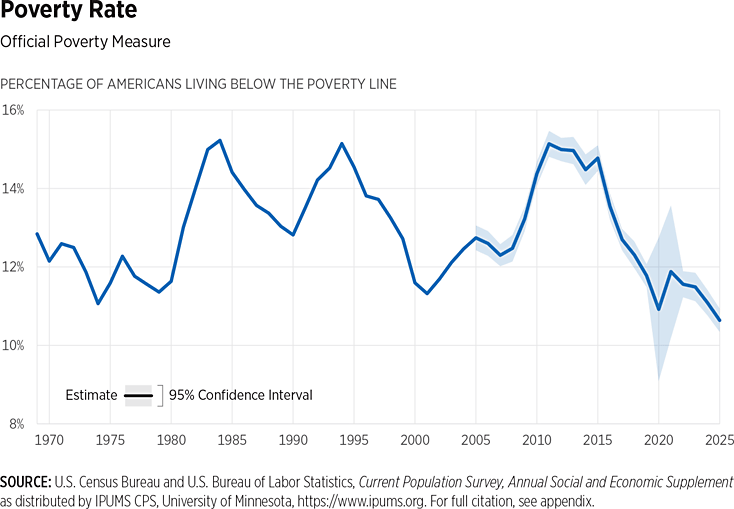
As can be seen in the chart above, for the past 60 years, the poverty rate in the U.S. has fluctuated between approximately 11 percent and 15 percent. Poverty rates typically increase most when the economy is struggling and decline when the economy improves.
The government’s official poverty measure, however, tells us very little about a household’s actual material living conditions: It uses household income to calculate poverty but excludes nearly all government means-tested welfare assistance that a household receives.[REF] This is a significant exclusion when one considers that the government spends more than $1 trillion annually on means-tested welfare programs.[REF] Another problem with the official poverty measure is that the Census Bureau undercounts earnings of the poor by about 40 percent.[REF]
A more accurate way to describe the current U.S. poverty measure would be to call it a measure of self-sufficiency. Instead of measuring a household’s material living conditions, it measures the share of Americans who are unable to get by without government welfare assistance. Sadly, the government has poured more and more money into the welfare system for six decades—and during those six decades, self-sufficiency has not improved.
Our welfare system needs many reforms, and one of the most important is a more accurate assessment of poverty. A poverty measure that looks at household spending rather than income provides a better assessment of household resources. Bruce Meyer of the University of Chicago, for example, has a well-developed “consumption poverty measure.”[REF] Government data regularly show that low-income households spend about two dollars for every dollar of money income they report.[REF] When poverty is measured by household expenditures rather than income, the poverty rate declines by about half.[REF]
Understanding what the poverty measure is really measuring enables us to assess the extent of poverty in the United States more accurately and then, based on that assessment, increase the effectiveness of the nation’s anti-poverty policy. Policymakers should acknowledge the reasons for the welfare system’s decades of failure and reform anti-poverty programs in a way that both improves self-sufficiency rates and promotes true upward mobility.
Endnotes
- Robert Rector and Jamie Bryan Hall, “Largest Welfare Increase in U.S. History Will Boost Government Support to $76,400 per Poor Family,” Heritage Foundation Special Report No. 244, November 8, 2021, https://www.heritage.org/sites/default/files/2021-11/SR244.pdf. ↩
- Robert Rector and Vijay Menon, “Understanding the Hidden $1.1 Trillion Welfare System and How to Reform It,” Heritage Foundation Backgrounder No. 3294, April 5, 2018, https://www.heritage.org/sites/default/files/2018-04/BG3294.pdf; Bruce D. Meyer and James X. Sullivan, “Identifying the Disadvantaged: Official Poverty, Consumption Poverty, and the New Supplemental Poverty Measure,” Journal of Economic Perspectives, Vol. 26, No. 3 (Summer 2012), pp. 111–136, https://harris.uchicago.edu/files/identifythedisadvantaged.pdf (accessed April 1, 2026). ↩
- Jamie Bryan Hall, “Child Poverty Has Been Cut in Half Since 1996 Welfare Reform,” Heritage Foundation Backgrounder No. 3694, March 14, 2022, https://www.heritage.org/welfare/report/child-poverty-has-been-cut-half-1996-welfare-reform. ↩
- Meyer and Sullivan, “Identifying the Disadvantaged: Official Poverty, Consumption Poverty, and the New Supplemental Poverty Measure.” ↩
- Robert Rector and Jamie Bryan Hall, “How Poor, Really, Are America’s Poor?” Heritage Foundation Commentary, March 5, 2020, https://www.heritage.org/poverty-and-inequality/commentary/how-poor-really-are-americas-poor. ↩
- Ibid. ↩
Sources
- U.S. Department of Commerce, Census Bureau, and U.S. Department of Labor, Bureau of Labor Statistics, Current Population Survey, Annual Social and Economic Supplement, as distributed by Sarah Flood, Miriam King, Renae Rodgers, Steven Ruggles, J. Robert Warren, Daniel Backman, Etienne Breton, Grace Cooper, Julia A. Rivera Drew, Stephanie Richards, David Van Riper, and Kari C.W. Williams, IPUMS CPS: Version 13.0 [dataset], Minneapolis, MN: IPUMS, 2025, https://doi.org/10.18128/D030.V13.0 (accessed May 11, 2026).
