

My name is Robert Rector. I am Senior Research Fellow in Welfare and Family Issues at The Heritage Foundation. The views I express in this testimony are my own and should not be construed as representing any official position of The Heritage Foundation.
Ten years ago, President Bill Clinton signed legislation overhauling part of the nation's welfare system. The Personal Responsibility and Work Opportunity Reconciliation Act of 1996 (P.L. 104-193, PRWORA) replaced the failed social program known as Aid to Families with Dependent Children (AFDC) with a new program called Temporary Assistance to Needy Families (TANF). The reform legislation had three goals: (1) to reduce welfare dependence and increase employment; (2) to reduce child poverty; and (3) to reduce illegitimacy and strengthen marriage.
At the time of its enactment, liberal groups passionately denounced the welfare reform legislation, predicting that it would result in substantial increases in poverty, hunger, and other social ills. Contrary to these alarming forecasts, welfare reform has been effective in meeting each of its goals.
-
Child poverty has fallen. Although opponents of reform predicted it would increase child poverty, some 1.6 million fewer children live in poverty today than in 1995.
-
Decreases in poverty have been greatest among black children. In the quarter century prior to welfare reform, the old welfare system failed to reduce poverty among black children. Since welfare reform, the poverty rate among black children has fallen at an unprecedented rate from 41.5 percent in 1995 to 32.9 percent in 2004.
-
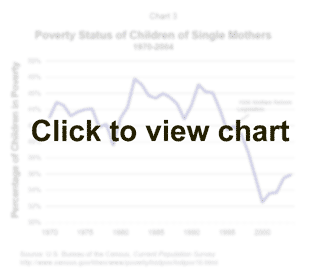
Unprecedented declines in poverty also occurred among children of single mothers. For a quarter-century before welfare reform, there was little net decline in poverty in this group. Povertywas only slightly lower in 1995 (50.3 percent) than it had been in 1971 (53.1 percent). After the enactment of welfare reform, the poverty rate for children of single mothers fell at a dramatic rate, from 50.3 percent in 1995 to 41.9 percent in 2004.
-
Welfare caseloads were cut in half. The AFDC/TANF caseload dropped from 4.3 million families at the time PRWORA was enacted to 1.89 million today.
-
Employment of single mothers has surged. The employment rate of the most disadvantaged single mothers increased from 50 percent to 100 percent.
-
The explosive growth of out-of-wedlock childbearing has come to a near standstill. For thirty years prior to welfare reform, the percentage of births that were out-of-wedlock rose steadily by about one percentage point per year.The out-of-wedlock birthrate was 7.7 percent in 1965 when the War on Poverty started; by 1995 it had reached 32.2 percent.Following welfare reform, the long-term rapid growth in out-of-wedlock birth rate ended.Although the rate has continued to inch up slowly, the increase is far slower than in the pre-reform period.
Some attribute these positive trends to the strong economy in the late 1990s. Although a strong economy contributed to some of these trends, most of the positive changes greatly exceed similar trends that occurred in prior economic expansions. The difference this time is welfare reform.
Predictions of Social Disaster Due to Welfare Reform
Ten years ago, when the welfare reform legislation was signed into law, Senator Daniel Patrick Moynihan (D-NY) proclaimed the new law to be "the most brutal act of social policy since Reconstruction."[1] He predicted, "Those involved will take this disgrace to their graves."[2]
Marian Wright Edelman, president of the Children's Defense Fund, declared the new reform law an "outrage…that will hurt and impoverish millions of American children." The reform, she said, "will leave a moral blot on [Clinton's] presidency and on our nation that will never be forgotten." [3]
The Children's Defense Fund predicted that the reform law would increase "child poverty nationwide by 12 percent…make children hungrier…[and] reduce the incomes of one-fifth of all families with children in the nation." [4]
The Urban Institute issued a widely cited report predicting that the new law would push 2.6 million people, including 1.1 million children, into poverty. In addition, the study announced that the new law would cause one-tenth of all American families, including 8 million families with children, to lose income. [5]
The Center on Budget and Policy Priorities asserted the new law would increase the number of children who are poor and "make many children who are already poor poorer still…. No piece of legislation in U.S. history has increased the severity of poverty so sharply [as the welfare reform will]." [6]
Patricia Ireland, then president of the National Organization for Women, stated that the new welfare law "places 12.8 million people on welfare at risk of sinking further into poverty and homelessness." [7]
Peter Edelman, husband of Marian Wright Edelman and then Assistant Secretary for Planning and Evaluation at the Department of Health and Human Services, resigned from the Clinton Administration in protest over the signing of the new welfare law. In an article entitled "The Worst Thing Bill Clinton Has Done," Edelman dubbed the new law "awful" policy that would do "serious injury to American children." [8]
Peter Edelman believed the reform law would not merely throw millions into poverty, but also would actively worsen virtually every existing social problem. "There will be more malnutrition and more crime, increased infant mortality, and increased drug and alcohol abuse," claimed Edelman. "There will be increased family violence and abuse against children and women." Moreover, the bill would fail even in the simple task of "effectively" promoting work because "there simply are not enough jobs now." [9]
Welfare Reform and Increased Employment
Welfare reform coincided with dramatic increases in the employment of single mothers. Contrary to conventional wisdom, employment has increased most rapidly among the most disadvantaged, least employable groups. During the late 1990s:
-
Employment of never-married mothers increased nearly 50 percent;
-
Employment of single mothers who are high school dropouts rose by two-thirds; and
-
Employment of young single mothers (ages 18 to 24) nearly doubled.[12]
Thus, against conventional wisdom, the effects of welfare reform have been the greatest among the most disadvantaged single parents-those with the greatest barriers to self-sufficiency. Both decreases in dependence and increases in employment have been most dramatic among those who have the greatest tendency to long-term dependence; that is, among the younger never-married mothers with little education.
How important was a strong economy to these employment increases? Dr. June O'Neill, former Director of the Congressional Budget Office, examined changes in welfare caseload and employment from 1983 to 1999. Her analysis showed that in the period after the enactment of welfare reform, policy changes accounted for roughly three-quarters of the increase in employment and decrease in dependence. By contrast, economic conditions explained only about one-quarter of the changes in employment and dependence.[13]
Welfare Reform and Reductions in Child Poverty
Mothers on welfare are automatically poor because in no state are welfare benefits high enough to give a family an income above the official poverty thresholds. Consequently, it should be no surprise that, as families left welfare and the employment of single mothers dramatically increased, poverty decreased. The decrease in poverty among the two groups most affected by reform, black children and children of single mothers, was steep and unprecedented.
-
Less Child Poverty. The child poverty rate has fallen from 20.8 percent in 1995 to 17.8 percent in 2004. Though liberals predicted that welfare reform would throw more than 1 million additional children into poverty, there are some 1.6 million fewer children living in poverty today than there were when welfare reform was enacted.[14]
-
Less Black Child Poverty.The decline in poverty since welfare reform has been particularly dramatic among black children. As Chart 2 shows, for a quarter-century prior to welfare reform, there was little change in black child poverty. Black child poverty was actually higher in 1995 (41.5 percent) than in 1971 (40.4 percent).
With the enactment of welfare reform in 1996, black child poverty plummeted at an unprecedented rate, falling to 30.0 percent in 2001. Over a six-year period after welfare reform, 1.2 million black children were lifted out of poverty. In 2001, despite the recession, the poverty rate for black children was at the lowest point in national history.[15] In the last few years, the recession and its aftermath pushed the black child poverty rate up slightly (to 32.9 percent in 2004), but the rate remains roughly one-fifth lower than in the period prior to reform.
-
Less Poverty Among Children of Single Mothers. Since the enactment of welfare reform, the drop in child poverty among children in single-mother families has been equally dramatic. For a quarter-century before welfare reform, there was little net decline in poverty in this group. Povertywas only slightly lower in 1995 (50.3 percent) than it had been in 1971 (53.1 percent). After the enactment of welfare reform, the poverty rate for children of single mothers fell at a dramatic rate, from 50.3 percent in 1995 to 39.8 percent in 2001. In 2001, the poverty rate for children in single-mother families was at the lowest point in U.S. history.[16] Although the poverty rate for children of single mothers has inched up slightly during the recent recession and its aftermath, reaching 41.9 percent in 2004, it still remains far below the pre-reform levels. (See Chart 3.)

What was the contribution of a strong economy to the dramatic drop on child poverty in the late 1990s? Overall, the health of the economy in the mid and late 1990s did serve as a positive background factor contributing to positive changes in welfare dependence, employment, and poverty. It is very unlikely, for example, that dramatic drops in dependence and increases in employment would have occurred during a prolonged recession. However, it is also certain that good economic conditions alone would not have produced the striking changes that occurred in the late 1990s. It is only when welfare reform was coupled with a growing economy that these dramatic positive changes occurred.
Further Research on Welfare Reform and Child Poverty
An important paper by Dr. Rebecca M. Blank, former member of the Council of Economic Advisers in the Clinton White House, examined the link between welfare reform and child poverty.[17] Professor Blank analyzed the income of families with children from 1992 to 2000 and found that incomes rose for all but the bottom 2 percent of families with children. Moreover, poor families showed greater income gains than higher-income families, "suggesting that most poor families experienced larger income gains than did most middle and upper-middle income families."[18]
Dr. Blank's analysis showed a direct link between state welfare reform policies and rising incomes among poor families. States with welfare reform programs that offered "strong work incentives" showed greater increases in the income of single parents with children than did states with weak work incentives. Moreover,
[A]t the bottom of the distribution, states with strong work incentives have the smallest share of children in families with negative changes in income, while states with the weakest work incentives show the highest share of children with [decreases in income].[19]
In other words, states with strong welfare work incentives had fewer families that lost income than did states with weak welfare work incentives. Blank found that these income differences were the result of state welfare policies rather than differences in state economies.
In addition, Dr. Blank examined the effects of tough welfare reform "penalties" on the incomes of poor single-parent families. Examining the impact of stricter time limits and strong sanction policies that "provide a strong enforcement mechanism for women to participate in welfare-to-work programs," she found that tough welfare policies had a positive effect in raising the incomes of poor families. Overall, states with stricter time limits and stronger sanction policies were more successful in raising the incomes of poor children than were states with lenient policies. Dr. Blank concluded that
[S]tates with strict or moderate penalties for not working consistently show higher income gains among poor children throughout the income distribution than do states with lenient penalties…. [I]t is the more lenient states with softer penalties where children's income seems to have grown least.[20]
Welfare Reform and the Recent Recession
When welfare reform was enacted, liberal opponents predicted that it would yield sharp increases in poverty even in good economic times; the effects of reform during a recession were expected to be disastrous. As noted, liberal predictions about the negative effects of reform during good economic times have been proven completely erroneous. In addition, the disastrous effects expected of welfare reform during an economic downturn failed to materialize during the last recession.
Historically, during a recession, overall child poverty rises by two to three percentage points. For example, during the economic downturn in the early 1990s, the overall child poverty rate rose from 19.6 percent to 22.7 percent. Historically, black child poverty rises more sharply during a recession. During the back-to-back recessions in the early 1980s, for example, black child poverty rose by more than six percentage points, from 40.8 percent in 1979 to 47.3 percent in 1982. During the recession of the early 1990s, black child poverty rose by roughly three percentage points from 43.2 percent to 46.3.
By historic standards the increase in child poverty during the last recession has been fairly modest. Overall child poverty rose by 1.6 percentage points from 16.2 percent in 2000 to 17.8 in 2004. Black child poverty actually declined in the first year of the recession and then rose by almost three percentage points, from 30.0 percent in 2001 to 32.9 percent in 2004.[21]
In terms of its impact on child poverty, we may assess welfare reform as follows:
-
During the period of economic growth in the late 1990s, the post-reform welfare system dramatically out-performed the pre-reform welfare in reducing poverty.
-
During the recent recession and slow recovery, welfare reform did at least as well as, or slightly better than, the pre-reform system in its impact on poverty.

Slowdown in the Rise of Out-of-Wedlock Childbearing
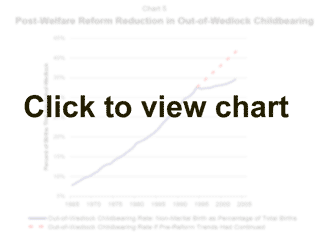
After the beginning of the War on Poverty, the illegitimacy rate (the percentage of births outside of marriage) increased enormously. For nearly three decades, out-of-wedlock births as a share of all births rose steadily at a rate of almost one percentage point per year. Overall, out-of-wedlock births rose from 7.7 percent of all births in 1965 to an astonishing 32.2 percent in 1995.
However, as Chart 4 shows, in the mid-nineties the explosive growth in illegitimacy came to an end. Although the percentage of births that were out-of-wedlock inched slowly upward, the rate of increase in recent years has been only a fraction of the rapid annual increase that occurred routinely in the three decades before welfare reform. Between 1995 and 2003, the overall out-of-wedlock childbearing rate rose slightly from 32.2 percent to 34.6 percent. This was about a fourth of the rate of increase that occurred annually prior to welfare reform. The black out-of-wedlock childbearing rate actually fell from 69.9 percent in 1995 to 68.2 percent in 2003. The white non-Hispanic rate rose modestly from 21.2 percent in 1995 to 23.6 percent in 2003.
As noted, between 1965 and 1995, out-of-wedlock childbearing increased at roughly one percentage point per year. As Chart 5 shows, if this rate of increase had been sustained, out-of-wedlock childbearing would have risen to 41.6 percent by 2003. Due to the slowdown from the mid-1990s on, the actual increase was far lower; 34.6 percent of children were born out-of-wedlock in 2003. The actual rate was thus seven percentage points lower than it would have been if the pre-reform trends had continued.
As a result of the slowdown in the rise of illegitimacy over the last decade, around 1.4 million fewer children were born out-of-wedlock. This has enormous positive implications for child poverty and welfare dependence in the nation.
The shift in the growth rate of out-of-wedlock childbearing is quite dramatic. The onset of welfare reform is the most plausible explanation for this substantial change. Welfare reform affected out-of-wedlock childbearing and marriage in two ways.
First, the public debate about welfare reform sent a strong symbolic message that, in the future, welfare would be time-limited and that single mothers would be expected to work and be self-reliant. This message communicated to potential single mothers that the welfare system would be less supportive of out-of-wedlock childbearing and that raising a child outside of marriage would be more challenging in the future. The reduction in out-of-wedlock births was, at least in part, a response to this message.
Critics might argue that illegitimacy initially slowed in 1994, two years before the enactment of PRWORA. But, as noted, much of the impact of welfare reform on childbearing was driven by strong symbolic messages sent to young women at risk of out-of-wedlock childbearing. These symbolic messages began well before the enactment of legislation. Symbolically, welfare reform began when candidate Bill Clinton promised to "end welfare as we know it" during his 1992 presidential election campaign. As president, Clinton repeated the "end welfare" promise, and he was the first president to speak forcefully about the harm of out-of-wedlock childbearing. The symbolic messages of welfare reform and personal responsibility were amplified as the Republicans took control of the House of Representatives in 1994 and continued loudly as reform was debated in Congress over the next two years. Thus throughout the mid-1990s many young low income women would have been aware that a dramatic change in welfare was "in the air." This is likely to have had a significant effect on child-bearing behavior.
Second, reform indirectly reduced welfare's disincentives to marriage. Traditional welfare stood as an economic alternative to marriage, and mothers on welfare faced very stiff financial penalties if they did marry. As women leave AFDC/TANF as a result of welfare reform, fewer are affected by welfare's financial penalties against marriage. In addition, some women may rely on husbands to provide income that is no longer available from welfare. Thus, as the number of women on welfare shrinks, marriage and cohabitation rates among low-income individuals can be expected to rise.
Future Policies
Welfare reform has been successful; however, that success has been limited by a number of factors. First, although the federal government operates over 50 means-tested welfare programs, reform was largely restricted to one: Aid to Families with Dependent Children. Second, the federal work requirements which pushed state welfare bureaucracies to promote work and reduce dependence were always too lenient. After 2000, most states had met their caseload reduction goals and few faced federal pressure to further reduce dependence or increase work. As a result, most state welfare bureaucracies coasted and began to slip back into a traditional check-mailing mode. Third, while the law set clear goals to reduce out-of-wedlock childbearing and increase marriage, nearly all state bureaucracies simply ignored these goals. In consequence, nearly a decade was lost that should have been spent experimenting with programs to strengthen marriage.
In the future, the following steps should be taken to advance the goals of welfare reform.
-
TANF work requirements should be strengthened. In particular, states should not be permitted to give TANF benefits to recipients who consistently refuse to work or prepare for work.
-
Work requirements should be established in parallel programs such as Food Stamps, public housing, and Medicaid.
-
Marriage must be strengthened. In the TANF reauthorization passed in January of this year, Congress provided $100 million per year in funding for a healthy marriage initiative to strengthen marriage in low-income communities. This sum amounts to about one penny for marriage for every $15.00 spent subsidizing single parents. Future funding for the healthy marriage initiative should be substantially increased to help develop vitally needed programs.
What Actually Happened
In the decade since the welfare reform law was enacted, social conditions have changed in exactly the opposite direction from that predicted by liberal policy organizations. As noted above, child poverty, black child poverty, and poverty of single mothers have declined substantially. Employment of single mothers increased dramatically, and welfare rolls plummeted.
Opponents of reform would like to credit many of these positive changes to a "good economy." However, according to their predictions in 1996 and 1997, liberals expected the welfare reform law to have disastrous results during good economic times. They expected reform to increase poverty substantially even during periods of economic growth; if a recession did occur, they expected that far greater increases in poverty than those mentioned above would follow. Thus, it is disingenuous for opponents to argue in retrospect that the good economy was responsible for the frustration of pessimistic forecasts since the predicted dire outcomes were expected to occur even in a strong economy.
Plummeting Welfare Dependence
The designers of welfare reform were concerned that prolonged welfare dependence had negative effects on the development of children. Their goal was to disrupt inter-generational dependence by moving families with children off the welfare rolls through increased work and marriage. Welfare reform produced unprecedented reductions in welfare dependence.
The caseload in the former AFDC (now TANF) program reached its all time high of 5.04 million families in March of 1994; it fell modestly over the next two years as states experimented with welfare to work programs in anticipation of the federal reform legislation. By the time PRWORA was enacted in August 1996, the caseload had fallen to 4.3 million. Passage of the national reform legislation was followed by a further dramatic plunge in caseloads By June 2005, the caseload had fallen to 1.89 million, less than half the level at the time PRWORA was enacted.
Contrary to conventional wisdom, the decline in welfare dependence was greatest among the most disadvantaged and least employable single mothers-the group with the greatest tendency towards long-term dependence. Specifically, dependence fell most sharply among young never-married mothers who have low levels of education and young children.[10] This is dramatic confirmation that welfare reform affected the whole welfare caseload, not merely the most employable mothers.
Some would argue that the positive effects noted above are the product of the robust economy during the 1990s rather than the results of welfare reform. However, the evidence supporting an economic interpretation of these changes is not strong. Chart 1 shows the AFDC caseload from 1950 to 2004. On the chart, periods of economic recession are shaded, and periods of economic growth are shown in white. Historically, periods of economic growth have not resulted in lower welfare caseloads. The chart shows eight periods of economic expansion prior to the 1990s, and yet none of these periods of growth led to a significant drop in AFDC caseload. Indeed, during two previous economic expansions (the late 1960s and the early 1970s), the welfare caseload grew substantially. Only during the expansion of the 1990s does the caseload drop appreciably.
How was the economic expansion of the 1990s different from the eight prior expansions? The answer is welfare reform.

Chart 1 does show that the national TANF decline has slowed appreciably during and after the last recession, which began in March 2001. Critics of reform might argue that this shows the state of the economy has been the dominant factor in the reduction of dependence. While it is true that the slowdown in the economy has affected the decline in caseload, it is important to note the vast difference in trends before and after welfare reform. Prior to the mid-1990s, the AFDC caseload remained flat or rose during economic expansions and generally rose to a substantial degree during recessions. Since welfare reform, the welfare caseload has plummeted during good economic times and declined slowly during the recession.
Thus, while the state of the economy does have an effect on AFDC/TANF caseloads, irrespective of economic conditions, the difference in caseload trends before and after reform is enormous. This difference is clearly due to the impact of welfare reform policies.
Another way to disentangle the effects of welfare policies and economic factors on declining caseloads is to examine the differences in state performance. The rate of caseload decline varied enormously among the 50 states. If improving economic conditions were the main factor driving down caseloads, the variation in state reduction rates should have been linked to variation in state economic conditions. On the other hand, if welfare polices are the key factor behind falling dependence, the differences in reduction rates would have been linked to specific state welfare policies.
A 1999 Heritage Foundation study, "The Determinants of Welfare Caseload Decline," examined the impact of economic factors and welfare policies on falling caseloads in the states.[11] This analysis showed that differences in state welfare reform policies were highly successful in explaining the rapid rates of caseload decline. By contrast, the relative vigor of state economies, as measured by unemployment rates, changes in unemployment, or state job growth, had no statistically significant effect on caseload decline.
One reason for the reduction in caseload decline after 2001 was the lack of vigor in state work programs in recent years. By 2001, most states had met their federal goals for caseload reduction. In the absence of federal pressure to further reduce dependence and increase work, state welfare bureaucracies slackened their efforts and many began to drift back towards a traditional role of mailing out welfare checks.
The Heritage Foundation is a public policy, research, and educational organization recognized as exempt under section 501(c)(3) of the Internal Revenue Code. It is privately supported and receives no funds from any government at any level, nor does it perform any government or other contract work.
The Heritage Foundation is the most broadly supported think tank in the United States. During 2013, it had nearly 600,000 individual, foundation, and corporate supporters representing every state in the U.S. Its 2013 income came from the following sources:
Individuals 80%
Foundations 17%
Corporations 3%
The top five corporate givers provided The Heritage Foundation with 2% of its 2013 income. The Heritage Foundation’s books are audited annually by the national accounting firm of McGladrey, LLP.
Members of The Heritage Foundation staff testify as individuals discussing their own independent research. The views expressed are their own and do not reflect an institutional position for The Heritage Foundation or its board of trustees.
Endnotes
[1]Cited in Arianna Huffington, "Where Liberals Fear to Tread," August 26, 1996, at http://www.arianaonline.com/columns/files/082696.html.
[2]Cited in "Welfare as They Know It," The Wall Street Journal, August 29, 2001, p. A14.
[3]Children's Defense Fund, "Edelman Decries President's Betrayal of Promise 'Not to Hurt Children,'" July 31, 1996
[4]Children's Defense Fund, "How the Welfare Bill Profoundly Harms Children," July 31, 1996.
[5]Cited in "Urban Institute Study Confirms that Welfare Bills Would Increase Child Poverty," Center on Budget and Policy Priorities, July 26, 1996.
[6]David A. Super, Sharon Parrott, Susan Steinmetz, and Cindy Mann, "The New Welfare Law," Center on Budget and Policy Priorities, August 13, 1996.
[7]Quoted in Lisa Bennet-Haigney, "Welfare Bill Further Endangers Domestic Violence Survivor," National NOW Times, January 1997.
[8]Peter Edelman, "The Worst Thing Bill Clinton Has Done," The Atlantic Monthly, Vol. 279, No. 3 (March 1997), pp. 43-58.
[9]Ibid.
[10]June E. O'Neill and M. Anne Hill, "Gaining Ground? Measuring the Impact of Welfare Reform on Welfare and Work," Manhattan Institute Civic Report No. 17, July 2001, pp. 8, 9.
[11]Robert E. Rector and Sarah E. Youssef, "The Determinants of Welfare Caseload Decline," Heritage Foundation Center for Data Analysis Report No. CDA99-04, May 11, 1999.
[12]O'Neill and Hill, "Gaining Ground? Measuring the Impact of Welfare Reform on Welfare and Work,", pp. 10-14.
[13]Ibid.,Table 4, p. 22.
[14]U.S. Census Bureau, Income, Poverty, and Health Insurance Coverage in the United States: 2004, August, 2005, p. 52.
[15]Ibid., pp. 53, 54. The figures in the text refer to black "related children in families." These figures are used because they are the only figures for black child poverty that are available back to 1970. The poverty rates for black "related" children are nearly identical to the poverty rate figures for all black children but are consistently 0.2 to 0.4 percentage points lower.
[16]Calculated from the Historical Poverty Tables, Table 10, on the U.S. Census Bureau Web site at http://www.census.gov/hhes/poverty/hispov/hstpov10.html.
[17]Rebecca M. Blank and Robert F. Schoeni, "Changes in the Distribution of Children's Family Income over the 1990's," paper prepared for annual meetings of the American Economic Association, Washington, D.C., January 2003.
[18]Ibid., pp. 3, 4.
[19]Ibid., p. 7.
[20]Ibid., pp. 8, 9.
[21] U.S. Census Bureau, op. cit., pp. 52-55. Black poverty figures are for related children in families; the 2004 black child poverty figure is for children identified as black alone or black combined with other races.
