
The Congressional Budget Office (CBO) released a report on effective marginal tax rates for low-income workers.[1]
An effective marginal tax rate as defined by the CBO is the change in taxes and change in government benefits associated with increases in income. Because tax rates and government benefits change as income changes, an individual’s effective marginal tax rate can rise and fall drastically as he works more hours.
While much focus in the past two years has been on the top end of the income scale—the “Buffett Rule,” the “1 percent”—the effects of taxation and government benefits are severe among the bottom 1 percent as well. With marginal effective tax rates exceeding 60 percent in many cases, the tax and benefit structure actively discourages earned success.
There are five lessons from the CBO report that policymakers should learn.
Lesson #1: Unintended Consequences Are Important.
The architects of policies such as Section 8 housing or food stamps never intended to create a poverty trap. But as benefits are added up, the combined effect is to steadily devalue earned income.
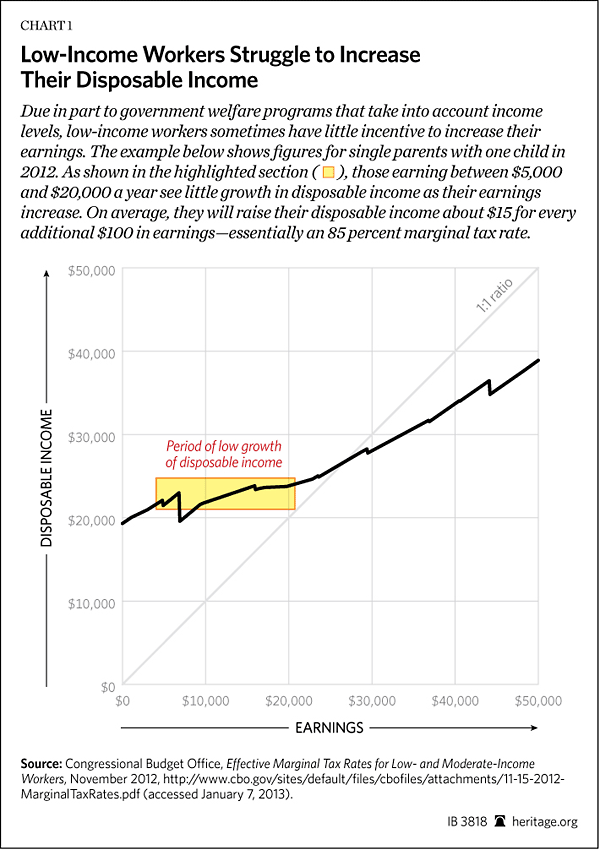
Chart 1, adapted from the CBO report’s Summary Figure 1, shows the futility of work for a single parent with one child. If he does not work at all, he receives $19,300 in government benefits. If he instead earns a salary of $30,000—which is full-time work at $15 per hour—he has disposable income of $28,000. This means that he is working full-time for only $8,700 per year more than if he did not work at all, making his effective take home wage $4.35 per hour ($8,700/2,000 hours per year). Is it rational to expect someone to work hard for such a low wage?
Lesson #2: Policymakers Should Think Dynamically.
Most government benefits aimed at the poor have “static” justifications. That is, a program to provide health care to the poor is predicated on their current poverty. But it may have important prospective effects. Once the program comes into existence, it changes the costs and benefits of staying in school, working, and even marrying. Some of the worst policies of the 20th century were those that penalized responsible fatherhood, as the Moynihan Report[2] famously addressed in 1965.
Lesson #3: The Main Argument in Favor of the Minimum Wage Is Weak.
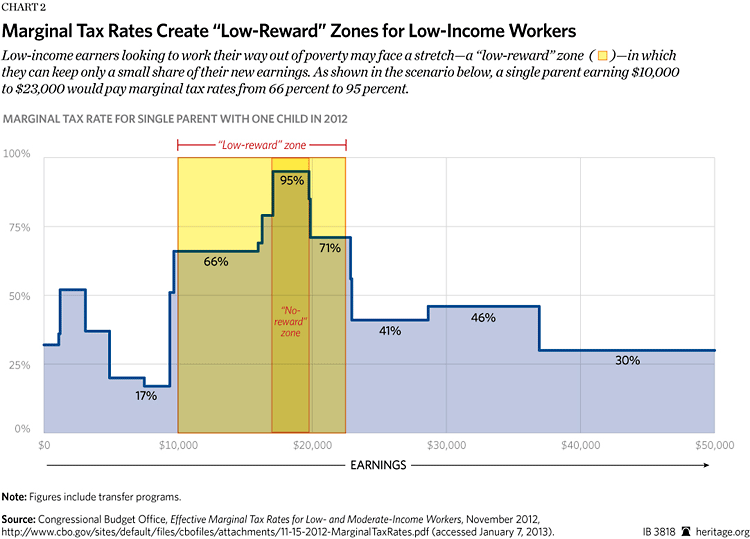
Those who favor raising the minimum wage generally appeal to the idea that those working low-paying jobs need to increase their consumption more than others. But the CBO’s research shows that in the relevant income range, the marginal effective tax rate is above 65 percent for the example single parent (Chart 2, adapted from the CBO report’s Figure 2, page 7). Thus, a minimum wage increase of 10 percent would increase the single parent’s take-home pay by less than 4 percent—if he kept his job, which is no sure thing, since increases in the minimum wage hurt the job prospects of such workers.[3]
Meanwhile, the arguments for lowering the minimum wage are strong: Competitive wages employ more people, keep more businesses open, and employ those in greatest need of a job.
Lesson #4: Obamacare Makes the Problem Worse.
The phase-out of “Premium Assistance Credits” significantly raises the marginal effective tax rate for a single parent earning between $22,000 and $62,000 per year (see CBO, Figure 7, page 26). This is an example of a program that raises marginal tax rates without “raising taxes.” The government collects less revenue than before—in fact, it pays out a handsome benefit—but discourages work even more.
Lesson #5: Poverty Is Poorly Measured.
As The Heritage Foundation has argued elsewhere,[4] poverty statistics that measure only earnings are poorly defined. The CBO report shows that even for some of those with no earnings at all, social programs in the U.S. provide enough disposable income to elevate them above the poverty line. The example single parent, when earning nothing at all, receives benefits worth 128 percent of the federal poverty line.
Technical Insights
Beyond the substantive lessons that can be drawn from the report, note four technical insights:
- This year is even worse than 2012. With the expiration of the temporary payroll tax cut, marginal tax rates rose 2 percentage points for most earners.
- The CBO’s calculation of government benefits overstates the benefit. Many government benefits are distributed by means other than cash: health care, housing, and food stamps, for example. While there are good reasons for doing so, economics shows that people would prefer to receive cash. If they chose to spend the cash in exactly the same way, then they would be no worse off. If they made other choices, they would (by revealed preference) be better off. Thus, the benefits of government programs are less than the total spent on behalf of recipients. That means that the real effective marginal tax rates presented here might also be overstated. At the same time, there are non-monetary costs to government programs and ample non-government costs to work, all of which interact with the costs measured by CBO.
- Income is not the only variable. Tax and benefit policies are extraordinarily complex. The interaction of income, taxes, and benefits can vary by number of children, student status, age, and state, to name a few. Policies can have dynamic effects on choices other than how many hours to work—people may be more (or less) likely to move, marry, or commit crime depending on policies.
- Composition matters. Not everyone who files a tax return on earnings of $10,000 is similar. The CBO report wisely uses the example of a single parent with one child to avoid compositional fallacies when comparing different income ranges. A single adult earning $20,000 may be more affluent than a married couple with children earning $30,000.
Common Sense from the CBO
The high marginal effective tax rates, and their effects on regular people, have long been noted by economists.[5] In the United Kingdom, experts recognized the poverty trap created by government policy and initiated a major reform of the social welfare system, which will begin taking effect in 2013.[6] Casey Mulligan has contrasted the British simplification of welfare with growing complexity in the United States.[7]
With the tax code ripe for reform, policymakers should remember: Marginal tax rates are dangerously high for some on the lower end of the pay scale.
—Salim Furth, PhD, is Senior Policy Analyst in Macroeconomics in the Center for Data Analysis at The Heritage Foundation.



