The Douglas and Sarah Allison Center for National Security
Key Judgments
Heritage judges that China’s munitions system, while capable of mass production and distribution at scale, is very likely vulnerable to targeted disruption across a narrow set of centralized, nonredundant processes and facilities. The disruption of these critical hubs—civilian IT infrastructure, civilian transportation infrastructure, fixed production and storage sites, digital communications systems, and dependence on imported components—would very likely degrade the People’s Liberation Army (PLA’s) ability to replenish precision munitions and sustain operational tempo beyond 60 days to 90 days of conflict.
These vulnerabilities are structurally embedded in China’s Military-Civil Fusion model and magnified by centralized governance, dependence on specific imports, and a brittle mobilization coordination system.
This judgment is made with high confidence, based on a multi-source foundation of official PLA publications, independent reporting, and corroborating think tank analysis. Confidence is further reinforced by the same CARVER-based targeting framework and proprietary modeling of stockpile depletion as for the Chinese fuel system analysis. Still, there is limited visibility into classified PLA redundancy and fallback procedures.
Our analysis indicates that the system’s top vulnerabilities are as follows:
- Civilian IT Infrastructure
- Civilian Transportation Networks
- Fixed Production and Storage Sites
- Digital Communication Systems
- Foreign-Sourced Semiconductors and Parts
Exploitation of these vulnerabilities through export controls, sanctions, cyberattacks, and kinetic strikes would likely impair the PLA’s ability to sustain a moderate to high-intensity conflict over a 60-90-day window, with effects ranging from short-term coordination disruption to degradation of precision strike capacity. Resulting effects could include the rapid exhaustion of long-range, precision-guided munitions while undermining the PLA’s ability to sustain a high operational tempo. Strategically, this offers opportunities to weaken PLA combat sustainment, enhancing U.S. deterrence and operational advantage in the Indo-Pacific.
System Structure: Linking Capabilities and Requirements
Overview
Heritage assesses that the PLA’s centralized structure has deliberately instituted redundancy and dispersal in its munitions system to enable sustainment during medium-to-high-intensity campaigns, such as a conflict over Taiwan. The PLA operates one of the world’s largest and most integrated munitions systems, optimized for high-tempo regional conflict under contested logistics conditions. As a component of China’s broader defense logistics enterprise, the PLA’s munitions system combines state-owned industrial production capacity, centralized military procurement, strategic-level stockpiling, and distribution under a joint logistics command, according to U.S. Department of War assessments.1
This section provides an overview of the PLA’s munitions system with emphasis on institutional structure, production logic, stockpiling posture, transport infrastructure, and command authority. Due to the limited transparency of PLA operational logistics doctrine and architecture, much of this analysis relies on doctrinal publications and inferred modeling rather than direct observation or primary sources, as in the Chinese fuel system analysis.
System Structure
China’s munitions system demonstrates an integrated civil-military model anchored in central planning, dual-use infrastructure, and a top-down command structure. Procurement, production, and distribution functions are coordinated under the Central Military Commission (CMC) and executed via the Joint Logistics Support Force (JLSF) and the Equipment Development Department (EDD), according to congressional testimony by Kevin McCauley in 2018 and experts at RAND Corporation in 2023.2
These military organizations are enabled by a portfolio of state-owned defense conglomerates including China North Industries Group Corporation Limited (NORINCO) (中国兵器工业集团有限公司), China South Industries Group Corporation (CSGC) (中国南方工业集团公司), and China Aerospace Science and Industry Corporation (CASIC) (中国航天科工集团有限公司).3 The Taiwan-based Institute of National Security and Defense Research reports that the JLSF has overseen joint-force supply operations and operational stockpile distribution across five theater commands since major PLA logistics reforms in 2016.4
China’s system combines routine peacetime production with the capacity to mobilize economic and social resources for wartime needs through a national defense mobilization system. Procurement and acquisitions are overseen centrally by the CMC’s EDD, which manages weapons development, procurement management, and signs off on PLA weapons acquisitions. State-owned defense conglomerates dominate sectors and provide weapons and equipment, supported by Military-Civil Fusion industrial parks and clusters aligned with force-modernization priorities.5
The PLA’s adoption of a Military-Civil Fusion strategy further institutionalizes access to civilian supply chains, labor, and transportation networks. Official Chinese sources emphasize the creation of “dual-use national defense corridors” and “wartime transportation reserves” as structural elements of the ammunition logistics architecture.6
Heritage judges that the PLA munitions system is likely structured for centralized control of strategic reserves and decentralized distribution during conflict. This judgment is made with high confidence, based on doctrinal sources, observed reforms, and alignment with broader PLA logistics modernization efforts.
Production Capacity and Surge Potential
China’s munitions production base is dominated by a network of specialized subsidiaries under its state-owned enterprises, including facilities responsible for explosives formulation, casing manufacture, warhead assembly, and guidance integration.7
Examples include NORINCO subsidiaries such as Luzhou North Chemical Industries Co., Ltd. (Luzhou)—which publicly reports producing meteorological rocket propellants—and Inner Mongolia First Machinery Group Co., Ltd. (Baotou), which develops and manufactures main battle tanks, wheeled infantry fighting vehicles, and medium-caliber artillery systems. Open-source technical reporting from the Chinese Academy of Sciences documents intelligent, unmanned ammunition production lines (robotic handling and automated loading/filling) that increase throughput and safety—improvements consistent with surge resilience.8
Automation and “smart factory” conversion are strategic priorities. According to Ordnance Knowledge (兵器知识), a Chinese munitions industry publication, PLA suppliers are deploying automated lines, robotic arms, and intelligent inventory systems to reduce reliance on skilled labor and enable surge output.9 This automation is particularly concentrated in facilities producing precision-guided munitions (PGMs), which are highly dependent on microelectronics, optoelectronics, and embedded navigation components.
Publicly released planning and policy materials emphasize independent controllability (自主可控) and the development of production chains and supply chains “featuring stronger innovation capabilities, higher added value, and greater safety and reliability.”10
Heritage assumes that the PLA maintains peacetime production sufficient for stockpile replenishment and training consumption, with the capacity to surge 150 percent to 250 percent for key munition types under national mobilization. While not explicitly corroborated, this assumption aligns with U.S. surge history as well as China’s dual-use doctrine. This assumption is key because, if it proves false, surge-dependent replenishment projections will overestimate available inventory within the first 30 days to 60 days of conflict.
Stockpiles, Storage, and Distribution
PLA logistics reporting describes a layered stockpiling approach that combines centrally managed reserves with nearby “pre-stored/pre-positioned units” sized by basic loads to support rapid issue, according to China’s Ministry of National Defense, an official government outlet that reports JLSF practices.11
The JLSF and its theater Storage and Supply Bases demonstrate containerized and palletized field storage with timed unload drills using field forklifts and mechanized operations, including underground ammunition depots, according to 81.cn, the PLA’s official military media that publishes exercise features with photo/video evidence.12
China’s national transport framework places rail as the backbone, with highways as the foundation and water/civil aviation in complementary roles, according to the State Council’s 2021 National Comprehensive Three-Dimensional Transport Network Outline, an authoritative government planning document that defines corridors and modal roles through 2035.13
In wartime or special peacetime circumstances, the armed forces receive priority transportation support, and national defense transport is organized under unified plans and centralized command, according to the National Defense Transportation Law, a binding statute enacted by the National People’s Congress that assigns responsibilities to State Council transport departments and county-and-above local defense transportation authorities.14
At the operational level, JLSF nodes coordinate with railway, aviation, and waterway departments and major civilian logistics firms for multimodal transfers and data sharing on carrying capacity. Night “forward-delivery” drills practice low-signature movement and rapid issue under time pressure, according to the PLA Daily newspaper site.15
Heritage judges that the PLA’s logistics structure for munitions distribution is likely dependent on fixed rails and corridors—which may represent single points of failure in contested operations. This judgment is made with moderate confidence based on State Council network plans and multiple JLSF exercise features.
Command, Control, and Digital Integration
The Central Military Commission’s Equipment Development Department sets equipment acquisition policy for the PLA. Logistics planning, allocation, and distribution for munitions is managed by the JLSF through five Joint Logistics Support Centers and their Storage and Supply Bases, according to People’s Daily, an official CCP outlet that publishes unit-level logistics explainers with on-scene details.16
Digitized logistics information systems provide live visibility over inventory locations, receipt times, and quantities at storage bases, according to 81.cn.17 These systems feed broader “smart logistics” efforts where dispatch halls display nationwide rail routes and real-time transport data backed by an intelligent database for scheduling. These functions likely support allocation optimization and reduce battlefield bottlenecks.
Chinese defense journals describe simulation-based forecasting and optimization for ammunition supply, and multiple studies apply deep neural networks or machine learning to predict ammunition consumption, according to core-indexed or peer-reviewed journals widely used in China’s defense research community.18
Heritage assesses that while these digital logistics systems likely enhance responsiveness and precision, they may also introduce vulnerabilities to cyberattacks or deception—particularly during joint-force operations that require real-time interservice coordination.
This judgment is made with moderate confidence. It is based not on direct evidence of cyber defenses or breaches, but on inference from system-wide digital integration described in PLA sources and public reporting. It is plausible that the PLA’s logistics C2 systems could be hardened or isolated in ways that reduce cyberattack vulnerability, though evidence of such defenses is limited.
Critical Capabilities Analysis
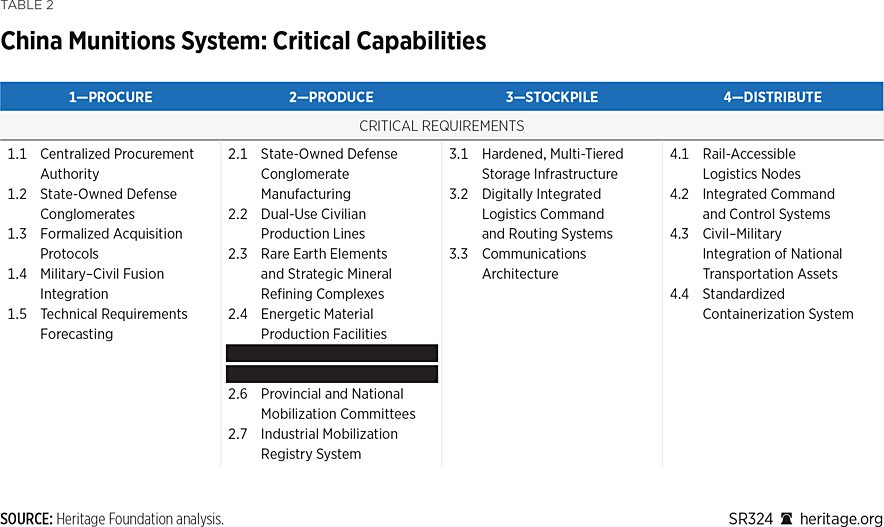
The following represents the top-scoring critical capabilities based on our CARVER framework assessment of the PLA’s munitions system.
Critical Capability 1: Procure (Direct and Centralized)
The EDD is the principal organization responsible for all PLA weapons acquisitions.19 This centralization enables cross-service synchronization and political oversight because the EDD retains “centralized unified management” of the PLA armament system and joint issues.20 However, this structure concentrates procurement authority without redundant service-level backstops.
The PLA’s procurement model follows a Soviet-style legacy in which state-owned enterprises (SOEs) dominate all phases of production. The China Ordnance Industry Yearbook confirms that NORINCO subsidiaries, for instance, handle shell casing fabrication, explosive loading, and fuze assembly, while other SOEs conduct guidance integration and warhead finalization.21
Heritage judges, based on CARVER scoring, ███████████████████████████████████████████████████████████████████████████████████████████████████████████████████████████████████████████████████████████████████████████████████████████████████████████████████████████████████████████████████████████████████████████████████████████████████████████████████████████████████████████████████████████████████████████████████████████████████████████████████████████████████████████████████████████████████████████████████████████████████████████████████████████████████████████
This judgment is offered with moderate confidence, based on a structural assessment of PLA acquisition and Chinese academic evaluations of centralized inefficiencies and transparency gaps.22
Under this Critical Capability, Heritage identified the top-scoring Critical Requirements, based on CARVER framework analysis:
- Critical Requirement 1.1: Centralized Procurement Authority. The EDD operates as the PLA’s enterprise-level procurement manager, overseeing policy, standards, and cross-service testing and acceptance.23 However, each service branch maintains its own Equipment Department responsible for service-specific platforms and weapons programs, with the EDD providing centralized coordination while services retain specialized procurement functions.
- This organizational exclusivity likely creates a single point of failure. Heritage judges that cyber, kinetic, or leadership disruption of the EDD could paralyze system-wide acquisition cycles due to the lack of substitute pathways. This judgment is offered with moderate confidence based on the absence of documented fallback procurement cells and the PLA’s historical centralization tendencies.
- Heritage assumes that the EDD’s monopoly over PLA procurement is institutionally entrenched and unlikely to be diversified in wartime, based on the PRC’s longstanding tendency toward centralization of power. This assumption is key because, if it proves untrue, the PLA’s procurement system would be less vulnerable to strategic disruption.
- Critical Requirement 1.2: State-Owned Defense Conglomerates. Four conglomerates—NORINCO, CSGC, CASIC, and CASC—account for the majority of PLA munitions production. The China Ordnance Industry Yearbook confirms that these SOEs are vertically integrated and geographically concentrated, with facilities covering every step of manufacturing, from metallurgy to packaging.24 These SOEs are also rapidly automating production using unmanned systems and robotic assembly.25 Multiple subsidiaries or affiliates of these conglomerates have been sanctioned by the U.S. Department of Commerce for weapons proliferation and military end-use activities.26
- Heritage assumes that Chinese SOEs will continue to dominate all phases of munitions production. This assumption is key because a shift to private-sector firms would reduce system vulnerability by diffusing production across more diverse and less targetable nodes.
- Critical Requirement 1.3: Formalized Acquisition Protocols. Munitions procurement is governed by a system of multi-year modernization plans, centrally coordinated bidding schedules, and performance-based solicitations across 10-, five-, and one-year Weapon Equipment Construction Plans.27
███████████████████████████████████████████████████████████████████████████████████████████████████████████████████████████████████████████████████████████████████████████████████████████████████████████████████████28████████████████████████████████████████████████████████████████████████████████████████████████████████████████████████████████████████████████████████████████████████████████████29█
- █████████████████████████████████████████████████████████████████████████████████████████████████████████████████████████████████████████████████████████████████████████████████████████████████████████████████████████████████████████████████████████████████████████████████████████████████████████████████████
- Critical Requirement 1.4: Military-Civil Fusion Integration. Under China’s Military-Civil Fusion policy, civilian manufacturers, logistics networks, and IT service providers are directly linked to munitions production pipelines. A State Council policy document describes this integration as extending across national defense corridors and wartime transport reserves.30 China’s government has repeatedly mandated that traffic management departments and civilian logistics providers prioritize military freight under mobilization conditions, allowing the PLA to draw directly on civilian transportation fleets and infrastructure.31
- Heritage assesses that Military-Civil Fusion creates deep interdependence between PLA munitions logistics and civilian infrastructure. This judgment, offered with moderate confidence, is supported by PLA Daily’s description of integrated “national defense corridors and wartime transport reserves.”
- Critical Requirement 1.5: Technical Requirements Forecasting. Chinese bid documents, five-year plans, and acquisition guidelines routinely include detailed subsystem specifications. The 14th Five-Year Plan for Defense Science and Technology Industry Development, issued by China’s State Administration of Science, Technology and Industry for National Defense (SASTIND), emphasizes dependency reduction for imported guidance modules, semiconductors, and precision mechanical components.32
- █████████████████████████████████████████████████████████████████████████████████████████████████████████████████████████████████████████████████████████████████████████████████████████████████████████████████████████████████████████████████████████████████████████████████████████████████████████████████████████████████████████33████████████████████████████████████████████████████████████████████████████████████████████████████████████████████████████████████████████████████████████████████████████████████34█
Critical Capability 1: Linked Vulnerabilities
- EDD Bottleneck. This vulnerability is logically inferred, arising from the PLA’s centralized procurement architecture and the absence of redundant acquisition nodes.35
- ███████████████████████████████████████████████████████████████████████████████████████████████████████████████████████████████████████████████████████████████████████████████████████████████████████████████████████████████████████████████████████████████████████████████████████████████████████████████████████████████████████████36█
- Procurement Signatures. Publicly disclosed Chinese tender cycles and bid specifications serve as strategic warning indicators, logically inferred from consistent patterns in PLA tendering behavior and the correlation with platform fielding timelines. As Georgetown University has demonstrated through analysis of 343 AI-related equipment contracts, analysts can infer stockpiling trends and platform integration timelines from PLA acquisition behavior.37
- Dual-Use Exposure. China’s Military-Civil Fusion policy exposes PLA logistics to civilian sector vulnerabilities. Civilian IT networks, packaging firms, delivery platforms, and transportation infrastructure can be exploited to create bottlenecks in munitions delivery or degrade surge capacity.38
- Subcomponent Traceability. Bid documents and five-year plans routinely identify dependencies on foreign-origin components. These dependencies are exploitable through targeted export control regimes or interdiction of raw material flows.39
Although little evidence indicates that such measures are underway, Heritage judges that PLA acquisition reform efforts and potential wartime improvisations could mitigate some of the vulnerabilities discussed here. However, current structural indicators suggest a high degree of rigidity and an unwillingness to relinquish centralized control under wartime conditions.
Critical Capability 2: Produce (Mass Production and Surge Output)
Manufacturing spans conventional munitions and PGMs within sectors where one or two defense SOEs dominate. Policy directs the fusion of civilian and defense-industrial capacity to increase efficiency, capacity, and flexibility.40 The PLA possesses a uniquely scalable capacity to mass produce munitions across multiple warfare domains. Heritage judges that mass production infrastructure is an essential enabler of the PRC’s strategic depth and endurance. This capacity is particularly critical in the event of a protracted or high-intensity conflict scenario requiring sustained combat power across maritime, aerospace, and conventional strike domains.
This judgment, made with high confidence, is supported by Chinese defense-industrial data, U.S. government production comparisons, and multiple open-source assessments indicating superior PLA munitions throughput.
- PRC munitions production is organized around vertically integrated state-owned conglomerates (NORINCO, CASC, CASIC, AVIC, CSSC) that span research institutes, component fabrication, and final integration, according to RAND’s survey of China’s defense industry.41
- These state-owned defense enterprises are reportedly producing munitions, high-end weapons systems, and other equipment at rates approximately five to six times faster than their U.S. counterparts.42
The foundation for mass production and surge capacity lies in China’s doctrine of Military-Civil Fusion, which the PRC State Council formally elevated to national strategy in the late 2010s.43 Through this strategy, the PLA embeds wartime production potential within civilian industrial assets, enabling rapid conversion of commercial infrastructure—including machine shops, shipyards, transportation depots, and logistics hubs—into munitions manufacturing and transportation centers.44
The 2017 National Defense Transportation Law and the 2010 National Defense Mobilization Law provide the legal authority to requisition civilian production capacity for military use. Provincial mobilization committees maintain detailed registries of pre-designated civilian firms suitable for wartime conversion.45
Heritage judges that this dual-use integration is not aspirational but has been operationalized in several instances. This moderate confidence judgment is supported by PRC exercises and public PLA documentation on dual-use logistics infrastructure.
Multiple exercises—such as civilian ferry-based amphibious drills and automaker line conversions—have been documented in credible Western media sources, although official PLA outlets have not publicly detailed these rapid civil-to-military reconfigurations.46 This assessment is further supported by the PLA’s incorporation of peacetime civilian output into its logistics and transportation architecture, including dual-use rail, air, and sea freight systems designed with modular, war-compatible features such as widened platforms and reinforced runways.47
- Heritage assumes, based on legal instruments, past exercises, and enduring Party-State control over industry, that China’s Military-Civil Fusion policies will remain in effect during wartime and that the state’s control over private industrial capacity will persist even under high-intensity conflict conditions.
- However, this assumption may not hold if severe disruption undermines central control mechanisms or impairs industrial coordination. This assumption is critical to Heritage’s assessment of surge output feasibility because a breakdown in legal or bureaucratic control over civilian assets would undermine wartime conversion and reduce output scalability.
Heritage judges that the PLA could plausibly increase production output of selected munition types—especially precision-guided missiles, naval munitions, and air-delivered ordnance—by approximately 150–250 percent within six to eight months of national mobilization.
Made with moderate confidence, this judgment is based on historical precedents, production modeling, exercise observations, and doctrinal references to latent mobilization capacity.48
- This estimate assumes activation of latent capacity through added labor shifts, machinery reallocation, and civilian line conversion, all of which are explicitly prescribed in PLA logistics doctrine and supported by reporting on provincial and national-level exercises in which elements of these protocols were tested or rehearsed.49
- Alternatively, the PLA’s surge capacity may be lower if civilian line conversion proves slower than assumed or if bottlenecks emerge in skilled labor or precision component manufacturing. Heritage considers this alternative to be less likely, based on PLA exercise history and doctrinal prescriptions for rapid civilian reconfiguration, while also acknowledging that PRC reporting and exercises may overstate conversion speed or misrepresent surge feasibility due to strategic messaging incentives.
Surge production is further enabled by China’s domestic control of key bottleneck inputs, including energetic materials, rare earth elements (REEs), inertial navigation modules, and composite casings.50
Based on logical inference and corroborating documentary evidence, Heritage judges that these combined features make mass production and surge output one of the PLA’s most resilient and strategically significant capabilities. Heritage further judges, based on CARVER scoring, ███████████████████████████████████████████████████████████████████████████████████████████████████████████████████████████████████████████████████████████████████████████████████████████████████████████████████████████████████████████████████████████████████████████████████████████████████████████████████████████████████████████████████████████████████████████████████████████████████████████████████████████████████████████████████████████████████████████████████████████████████████████████████████████████████████████████████████████████████████████████████████████████████████████████████████████████████████████████████████████████████████████████
Heritage has high confidence in these judgments, which are based on U.S. Department of War assessments, legal directives issued by the PRC State Council, multiple open-source PLA mobilization exercises, and industrial analyses.
Under this Critical Capability, we identified the following as top-scoring Critical Requirements, based on CARVER framework analysis:
- Critical Requirement 2.1: State-Owned Defense Conglomerate Manufacturing
Five state-owned defense conglomerates (NORINCO, CASC, CASIC, AVIC, and CSSC) primarily serve as the backbone of China’s high-end munitions manufacturing capability, integrating core components such as guidance packages, warheads, boosters, and missile airframes.
Heritage judges that the PLA’s ability to sustain precision strike capabilities in a protracted war would almost certainly collapse without the coordinated activities and continued viability of these state-owned defense conglomerates.
- Each of the five conglomerates is responsible for distinct elements of China’s strike munition portfolio that, based on available information, appears to have limited substitutability across firms.
- China North Industries Group Corporation (NORINCO) is the primary integrator of ground-based strike munitions and the PLA’s main supplier of conventional bombs and artillery-delivered precision weapons. It also oversees a portion of China’s glide and standoff PGM inventory.51
- China Aerospace Science and Technology Corporation (CASC) and China Aerospace Science and Industry Corporation (CASIC) develop and integrate land-attack cruise missiles, ballistic missiles, and anti-ship missiles—including the DF-10, CJ-20, and YJ-series.52
- Aviation Industry Corporation of China (AVIC) produces guided air-to-ground weapons, air-launched cruise missiles, and supporting subsystems such as avionics, data links, and guidance units.53
- Finally, China State Shipbuilding Corporation (CSSC) supports missile vertical launch systems (VLS), naval munitions packaging, and underwater weapon systems, while also providing critical integration capacity for naval launch platforms.54
These SOEs are vertically integrated entities that control most of their own supply chains—including research institutes, component fabrication shops, and system integration lines. They also share modular subsystems and employ standardized architecture across multiple munition types, allowing for interchangeable production runs based on battlefield demand.55 Modular design permits rapid switching between PGM variants using common booster casings, guidance units, and canister bodies, thereby reducing line changeover time and enabling China’s surge strategy, according to Air University’s China Aerospace Studies Institute.56 Publicly available procurement and promotional materials from CASIC and AVIC regularly emphasize open-system architectures and interchangeability of core components across munitions families.57
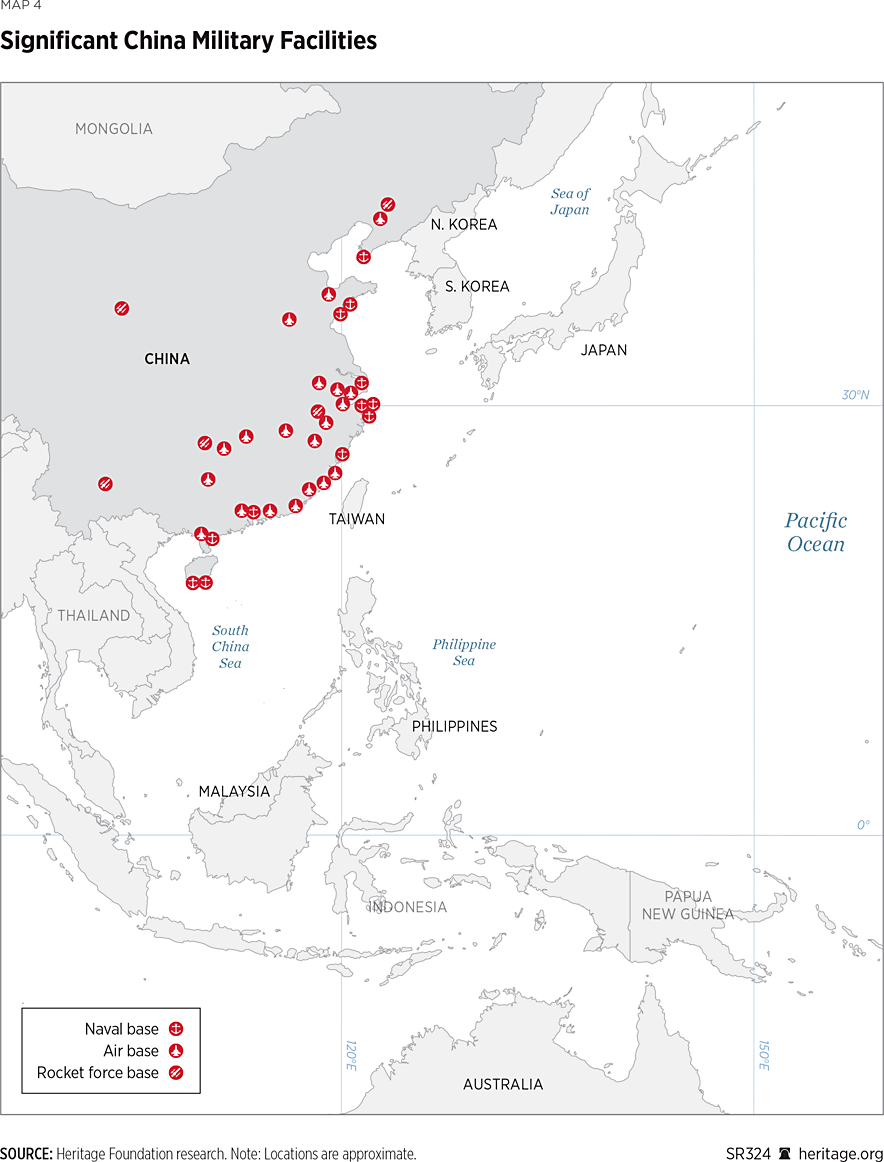
Production occurs across a constellation of fixed plants and research institutes that support final assembly lines for PLA missile and bomb inventories. Analysis of publicly available industrial satellite imagery and open-source databases confirms that many facilities are geographically clustered in inland provinces—especially Shaanxi, Sichuan, Hubei, and Hunan. These locations likely benefit from secure rail access, labor pools, and proximity to supportive defense-industrial infrastructure.58
The most critical of these plants—including those involved in warhead integration and seeker calibration—appear to be unique, with no known substitute lines visible in open-source assessments.59 Because many of these facilities operate at medium-to-high automation levels, any loss of equipment, specialized robotics, or digital production infrastructure would likely cause cascading disruptions to multiple munition types, a conclusion logically inferred from the integration of shared subsystems and high production interdependency.60 CSSC and NORINCO appear to rely heavily on computer-numerical-control machining, automated materials handling systems, and industrial robotics, which introduce both efficiencies and potential points of failure.61
Heritage assumes that PLA planners expect potential adversaries, especially the U.S., to seek to target these SOE facilities in the event of conflict because of their visibility, irreplaceability, and contribution to the PLA’s strike capabilities. This assumption is key because it underpins our understanding of likely PLA efforts to protect these facilities.
While the PLA has instituted basic passive defenses, such as dispersal and civil defense shelters, Heritage judges with high confidence that these manufacturing nodes are both targetable and slow to reconstitute, given their fixed infrastructure and specialized production systems. Heritage further judges with high confidence that denial, degradation, or dislocation of these core SOE integration plants would almost certainly undermine China’s ability to produce PGMs at scale and could plausibly eliminate some production lines during wartime, assuming no hidden reserve capacity exists.
- Each of the five conglomerates is responsible for distinct elements of China’s strike munition portfolio that, based on available information, appears to have limited substitutability across firms.
- Critical Requirement 2.2: Dual-Use Civilian Production Lines
The requirement for contingency military mobilization is embedded in the automotive, shipbuilding, heavy equipment, and electronics sectors, as referenced in Chinese civil-military mobilization directives and supporting logistics preparations.62
Heritage judges with moderate confidence that civilian-owned manufacturing lines capable of rapid reconfiguration for military production represent a core requirement of China’s munitions surge capacity. This judgment is supported by U.S. Department of War analysis indicating that service-level procurement pathways do not exist in parallel with EDD authority.
- Legal authorities under the 2017 National Defense Transportation Law and the 2010 National Defense Mobilization Law empower provincial and municipal governments to coordinate with civilian firms to execute preplanned conversions—with documented exercises demonstrating conversion timelines as short as 72 hours following mobilization orders.63
- Multiple sources, including Chinese state media, official PLA channels, and U.S. media reporting, have documented instances of civil-military exercises in which commercial factories were repurposed to support tracked vehicle production or amphibious transport operations.64 These facilities constitute a geographically distributed reserve of latent production capacity, offering the PRC flexible surge potential across multiple sectors and complicating adversary efforts to target or disrupt wartime manufacturing.
- Heritage assumes that China’s legal authorities and mobilization committees will retain the capacity to compel or coordinate rapid civilian production line conversion during wartime, even under duress, based on enduring Party-State control, past mobilization precedents, and embedded bureaucratic mechanisms. This assumption is key because if it proves untrue—due to systemic sabotage, workforce disruption, or degradation of CCP oversight—the PRC’s surge feasibility would be significantly degraded.
- Critical Requirement 2.3: REEs and Strategic Mineral Refining Complexes
Heritage judges with high confidence that China’s ability to mass produce and surge output of advanced munitions in wartime would almost certainly depend on uninterrupted access to and the continued refining of a defined set of REEs and strategic minerals. This high confidence judgment is based on multiple authoritative sources, including Chinese technical publications and U.S. assessments, which document China’s dependence on specific REEs and alloying metals across high-end munitions, and the systemic fragility introduced by refining concentration. These materials—including neodymium, samarium, dysprosium, tungsten, antimony, and other alloying and semiconductor metals—form critical components in a wide range of missile guidance systems, airframe alloys, flight control actuators, fusing systems, and armor-piercing submunitions. ██████████████████████████████████████████████████████████████████████████████████████████████████████████████████████████████████████████████████████████████████████████████████████████████████████████████████████
The functional role of this requirement is to ensure the sustained availability of upstream material inputs across all stages of China’s munitions production system. Heritage assumes that China’s current level of control over critical mineral refining and its investment in global mining access will allow the PLA to match munitions production with battlefield demands across a range of contingencies.
This assumption is key because if it proves untrue, upstream bottlenecks affecting availability of critical materials could constrain China’s ability to surge production under pressure. Production lines for smart bombs, anti-armor rounds, and long-range missiles would likely encounter throughput degradation due to material shortages.
- REEs for Control Surfaces, Sensors, and Munition Guidance. REEs are essential inputs for the production of modern munitions and associated combat systems. This includes both light REEs (e.g., neodymium, praseodymium, lanthanum) and heavy REEs (e.g., dysprosium, terbium, yttrium, samarium), which are used in:
- High-performance permanent magnets (e.g., NdFeB and SmCo) embedded in missile control fins, flight surface actuators, and seeker head motors.
- Electro-optical and infrared components, including yttrium aluminum garnet (YAG) laser rangefinders, thermal weapon sights, and night vision devices.
- Radars, sensors, and navigation units, requiring REEs with high temperature tolerance and magnetic stability (e.g., dysprosium-enhanced magnets for precision seekers).
Heritage judges that PLA munition designs are heavily reliant on these REE-based components and that no scalable alternatives are currently fielded. This low confidence judgment rests on logical inference from U.S. platform data and functional equivalence between U.S. and Chinese systems, with no evidence indicating that the PLA has fielded substitutes at scale. For example, according to the Department of War, a single U.S. F-35 fighter jet contains over 900 pounds of rare earth materials; a Navy destroyer contains approximately 5,200 pounds; and a Virginia-class submarine contains over 9,000 pounds.65 Based on logical inference and functional equivalence of U.S. and PLA systems, Heritage assumes that similar Chinese platforms and associated munitions likely contain REEs in comparable densities.
China’s ability to meet these REE requirements at scale derives from its dominant position in global supply chains. As of 2024, China produced roughly 70 percent of global REE ore and accounted for more than 85 percent to 90 percent of global REE refining capacity.66 This dominance is not merely a function of domestic resource endowment but reflects sustained investment in the difficult chemical separation and purification processes required for weapons-grade oxides.67
Beyond domestic capabilities, China has secured access to upstream REE resources via foreign partnerships, particularly in Africa and Southeast Asia. This includes near-total importation of Myanmar’s heavy REE feedstock—accounting for 98 percent of China’s heavy rare earth imports in 2023. Separately, eight mines in Tanzania, Angola, Malawi, and South Africa are projected to contribute 9 percent of global REE supply by 2029, with approximately 37 percent of this output destined for Chinese buyers.68
Heritage assumes that China maintains stockpiles of rare earth oxides and magnets but that these stockpiles are likely insufficient to offset multi-year disruption to external supply sources or processing infrastructure. This assumption is key because if it were invalid, external or internal disruptions to the REE supply chain could prove ineffective at limiting munitions production. Open-source estimates that would validate this assumption—notably quantifiable data on China’s REE reserves for wartime usage—are lacking.
- Tungsten for Armor-Piercing Submunitions and High-Density Explosives. Tungsten (W) is a strategic heavy metal used extensively in advanced munitions, owing to its extreme density and heat resistance. Applications include:
- Kinetic energy penetrators for anti-armor munitions.
- Fragmentation enhancers in thermobaric and high-explosive bombs.
- Nozzle linings and casings in solid rocket motors and missile bodies.
According to U.S. Geological Survey (USGS) data, China produced 63,000 of the world’s 78,000 metric tons of tungsten (mine production by content) in 2023—more than 80 percent of global output.69
Tungsten is a critical, hard-to-substitute input in several munition types. Some countries have legally restricted depleted uranium munitions due to health and environmental concerns—Belgium, for example, enacted a national ban on depleted uranium weapons systems in 200770 In February 2025, China imposed dual-use export controls on tungsten, requiring licensing for international sales. Reuters reports that this move was tied to national security concerns, potentially reflecting a need to prioritize domestic military production.71
- Antimony and Alloying Metals for Projectiles, Fuzes, and Optical Glass. Antimony (Sb) is a core input for several PLA munitions and military systems, including:
- Lead-antimony alloys used in hardened bullets and artillery rounds.
- Optical glass components in infrared and thermal imaging lenses.
- Initiators and primers in explosive subcomponents.
Heritage judges that China remains the world’s leading antimony producer but has become increasingly dependent on foreign feedstock.
China reportedly produced 48 percent of global output in 2023 but is now a net importer—Tajikistan, Russia, Thailand, and Australia rank among its top suppliers.72 In 2024, China imposed new export licensing requirements and subsequently banned antimony exports to the United States, citing national security considerations.73 Heritage interprets these actions as evidence that Beijing now regards antimony as a militarily sensitive resource.
- Other strategic minerals—including gallium, germanium, bismuth, tantalum, and cobalt—also support various specialized components, but Heritage judges that their contributions to PLA munitions production are either less direct or more relevant to other critical requirements.
Heritage assesses that REEs and critical minerals—tungsten and antimony—constitute an indispensable class of inputs required for surge production of advanced PLA munitions. These materials are functionally tied to guidance systems, control actuators, ignition components, and enhanced lethality mechanisms, and are not currently known to be replicable at scale without significant performance tradeoffs. China’s sustained control over these upstream supply chains—including global mining access, domestic refining capacity, and integration into final assembly—represents a Critical Requirement for the realization of Critical Capability 2.
This high-confidence judgment is supported by Western industrial assessments, export control designations, and PRC legal directives identifying these materials as strategic bottlenecks.
- REEs for Control Surfaces, Sensors, and Munition Guidance. REEs are essential inputs for the production of modern munitions and associated combat systems. This includes both light REEs (e.g., neodymium, praseodymium, lanthanum) and heavy REEs (e.g., dysprosium, terbium, yttrium, samarium), which are used in:
- Critical Requirement 2.4: Energetic Material Production Facilities
Heritage assesses that China’s ability to mass produce and surge output of advanced air-delivered and naval precision munitions—such as cruise missiles, guided bombs, and ship-launched warheads—almost certainly depends on the uninterrupted production of specialized energetic materials. These chemical compounds—including research department explosive (RDX), high melting explosive (HMX), hexanitrohexaazaisowurtzitane (CL-20), nitrocellulose, and ammonium perchlorate—form the explosive core in a wide range of precision-guided and naval munitions in the PLA’s inventory. Without sustained output of these energetic materials, munitions production lines would face critical constraints at wartime tempo, regardless of available labor, assembly capacity, or launcher inventory.
This high confidence judgment is supported by authoritative Chinese and Western reporting on facility-level production, the persistent role of these compounds in advanced munitions, and the lack of credible substitutes for high-energy explosives at industrial scale.
- The function of this requirement is to supply high-energy explosives and propellants needed for initiating, propelling, or detonating guided munitions, thereby ensuring the operational availability of China’s most destructive and strategically relevant munitions classes. Examples of components that rely on energetic materials include solid rocket motors in naval and air-delivered missiles, warhead fills for cruise and ballistic systems, and impulse charges used in shipboard VLS.
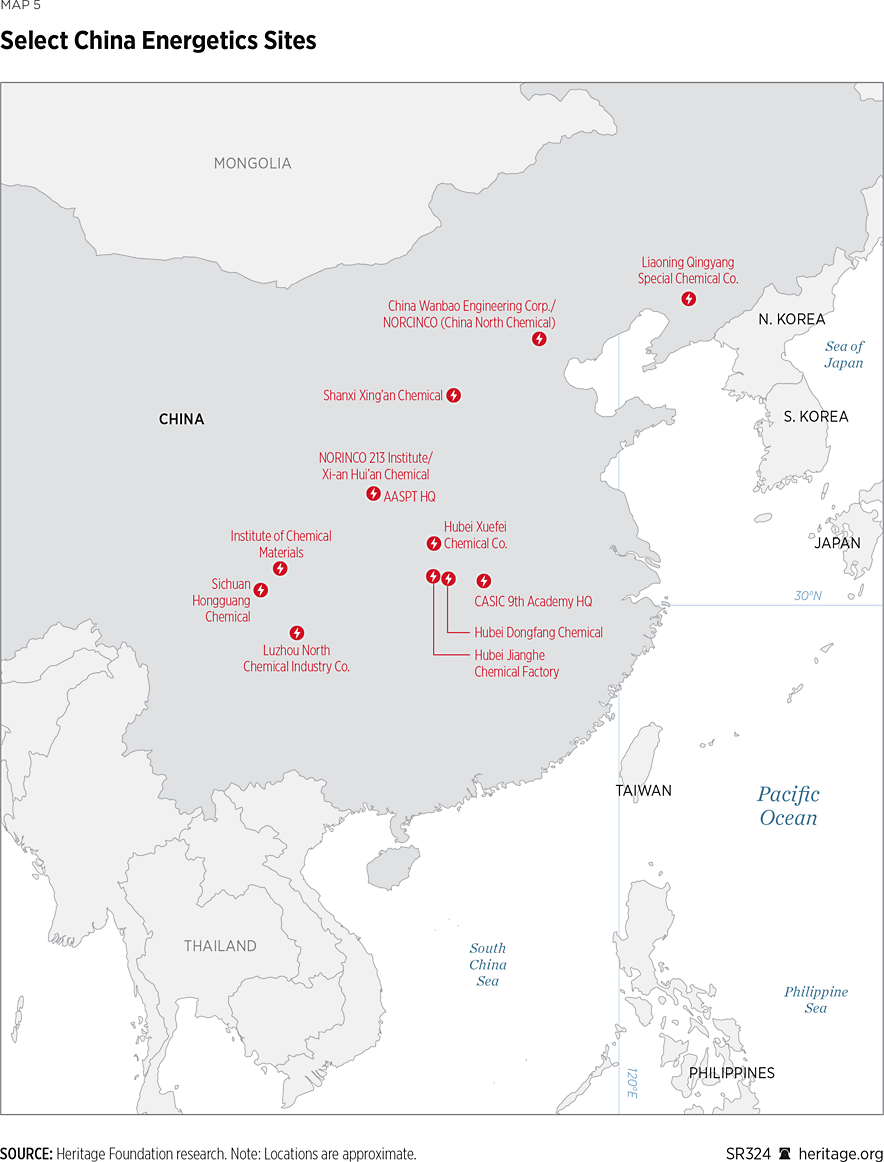
- Liaoning Qingyang Special Chemical, a NORINCO subsidiary, produces civil explosives for industrial blasting with a licensed capacity of 38,000 tons.74 The broader NORINCO complex includes China North Chemical Industries Corporation (NOCINCO), which manufactures military-grade explosives including RDX, HMX, and military propellants.75 Hubei Xuefei Chemical ranks as the second-largest producer of nitrocellulose, a critical feedstock for many air-delivered weapons.76 According to Chinese media, the PLA has begun incorporating CL-20, a high-energy explosive compound more powerful than HMX, into the production of advanced weapons systems. This development follows Chinese researchers’ improvement of its shock stability five-fold in recent years.77
- China’s production of energetics relies on a small number of highly specialized facilities, many of which are state-owned and co-located with high-risk chemical or dual-use research complexes. These state-run energetic material complexes likely supply nearly all of China’s military-grade explosive demand. According to the Energetic Materials Technology Working Group, critical capacity constraints and multi-year production backlogs exist for compounds such as RDX and HMX, with no domestic alternatives at the required scale.78 Moreover, trade data and European defense industry publications from 2025 indicate that China accounts for roughly half the global trade in cotton linters, a key component in the production of gunpowder, and supplies more than 70 percent of the cotton linters used by European munitions producers.79
Heritage judges that the PLA’s nitrocellulose-based feedstock almost certainly depends on these same few facilities for domestic surge output.
Heritage assumes that China’s energetic material production system is neither fully modular nor deeply redundant because no open-source evidence supports the existence of dispersed fallback production sites or modular explosive-fill networks. This assumption is critical because if China maintained a highly dispersed or reserve-based energetic supply strategy, the relationship between these facilities and surge-scale munitions output would be less direct. No open-source documentation currently supports the existence of such reserve production capacity.
- Critical Requirement 2.5: ████████████████████████████████████████████████
██████████████████████████████████████████████████████████████████████████████████████████████████████████████████████████████████████████████████████████████████████████████████████████████████████████████████████████████████████████████████████████████████████████████████████████████████████████████████████████████████████████████████████████████████████████████████████████████████████████████████████████████████████████████████████████████████████████████████████████████████████████████████████████████████████████████80█
██████████████████████████████████████████████████████████████████████████████████████████████████████████████████████████████████████████████████████████████████████████████████████████████████████████████████████████████████████
- ████████████████████████████████████████████████████████████████████████████████████████████████████████████████████████████████████████████████████████████████████████████████████████████████████████████████████████████████████████████████████████████████████████████████████████████████████████████████████████████████████████████████████81███████████████████████████████████████████████████████████████████████████████████████████████████████████████████████████████████████████████████████████████████████████████████████████████████████████████████████████████████████████████████████████████████████████████████████████████████████████████████████████████████████████████████████████████████████████████████████████████████████████████████████████████████████████████████████████████████████████████████████████████████████████████████████████████████████████████████████████████████████████████████████████████████████████████████████████████████████████████████82█
- ███████████████████████████████████████████████████████████████████████████████████████████████████████████████████████████████████████████████████████████████████████████████████████████████████████████████████████████████████████████████████████████████████████████████████████████████████████████████████████████████████████████████████████████████████████████████████████████████████████████83███████████████████████████████████████████████████████████████████████████████████████████████████████████████████████████████████████████████████████████████████████████
- █████████████████████████████████████████████████████████████████████████████████████████████████████████████████████████████████████████████████████████████████████████████████████████████████████████████████████████████████████████████████████████████████████████████████████████████████████████████████████████████████████████████████████████████████████████████████████████████████████████████████████████████████████████████████████████████████████████████████████████████████████████████████████████████████████████████████████████████████████
- Critical Requirement 2.6: Provincial and National Mobilization Committees
Heritage assesses that China’s ability to mass produce and surge output of advanced munitions almost certainly depends on the coordinated functioning of its National Defense Mobilization Commission (NDMC) system.
This high confidence judgment is based on official Chinese government publications, regional NDMC records, and authoritative secondary analysis, which collectively document the depth and institutional role of this mobilization architecture in enabling wartime production surges.
Serving as a coordinating hub, these mobilization committees oversee the administrative and bureaucratic machinery responsible for converting civilian industrial capacity into wartime military production.84 Without this coordination layer, the PRC’s sprawling civilian economy could not coherently mobilize to meet the production demands of large-scale, high-intensity conflict—a logical inference based on its bureaucratic complexity and centralized planning dependencies.
- The function of these mobilization committees is to bridge the peacetime civilian economy with the PLA’s wartime requirements. The national-level NDMC is jointly overseen by the State Council and CMC and is typically chaired by the Chinese premier.85 Beneath it are functional mobilization offices and subordinate committees at the provincial, municipal, and county levels, each staffed by civil-military representatives from relevant local departments.
- These committees operate through mobilization planning, simulation, and emergency exercise cycles, and they coordinate among industrial ministries, SOEs, and PLA units to align procurement and production priorities. Chinese government documents, provincial records, and planning documents from provinces including Hunan and Shandong show that provincial NDMCs are often chaired by local governors and supported by military district commanders and defense mobilization bureaus, ensuring civil-military integration in both planning and execution.86
- Heritage assumes that China’s NDMC system will function effectively under wartime conditions because of its embedded structure and routine exercises. This assumption is key because if it proves untrue—for example, if decentralized or ad hoc coordination mechanisms emerge instead—then the committees would represent less of a bottleneck or high-payoff target. Alternatively, a breakdown in centralized management of the mobilization process could result in debilitating inter-agency friction and coordination failures. This alternative is plausible given authoritative evidence from Chinese government sources that the NDMC system is the sole mechanism for orchestrating whole-of-nation resource integration for national defense.87 However, Heritage acknowledges that the opacity of provincial-level implementation creates uncertainty about the degree to which plans are executable under actual wartime conditions.
- Critical Requirement 2.7: Industrial Mobilization Registry System
Heritage assesses that China’s capacity to mass produce and surge output of advanced munitions almost certainly depends on the pre-established registry systems used to track and coordinate wartime resource conversion. These registry systems—known in official terminology as “national defense potential resource surveys” (国防动员潜力调查)—catalog civilian industrial assets, production equipment, skilled personnel, transport fleets, and supply chain dependencies that could be leveraged for national defense under emergency conditions.88 Without this visibility, PLA-affiliated mobilization committees would lack the data foundation required to synchronize dual-use conversion at scale.
This high-confidence judgment is supported by statutory requirements under national mobilization law, public reporting from provincial governments confirming the deployment of digital mobilization registries, and expert testimony describing their operational use by the CMC.
- This registry architecture is codified under the 2010 National Defense Mobilization Law, which requires provincial and municipal authorities to conduct regular surveys and maintain detailed digital databases of industrial mobilization resources.89 Multiple provincial governments have confirmed the deployment of dynamic data systems that incorporate equipment schematics, production timelines, and geolocated layout information for dual-use production lines.90
- China’s CMC National Defense Mobilization Department introduced an updated indexing system cataloging more than 4,000 types of civilian resources the PLA and party-state might seek to leverage or requisition during a conflict. These resources included “foodstuffs, medical equipment, construction materials, engineering equipment, transportation support specialists, legal services, broadcast infrastructure, cyberspace and artificial intelligence technologies, and overseas ports.”91
- Heritage assumes that, despite Beijing’s direction and the efforts of various agencies within the bureaucracy, the national registry system remains insufficient to fully support centralized management of and access to the full scope of civilian resources intended for wartime mobilization. This assumption is key because if the registry system is more viable than we assume, China’s ability to reconfigure industrial production and access critical civilian resources on wartime timelines would likely mean greater resilience for its munitions production system. Conversely, if the registry system is even less functional than we assume, its disruption via cyberattack or other means would produce limited effects.
Critical Capability 2: Linked Vulnerabilities
- Fragility of SOE Integration Plants. The SOE final assembly plants that support seeker calibration, warhead integration, and missile casing assembly are fixed, highly specialized, and geolocatable. Many of these facilities—especially those in Shaanxi, Hubei, and Sichuan—lack known substitutes and house medium-to-high automation infrastructure that cannot be rapidly restored following physical strikes, sabotage, cyber disruption, or industrial accidents. For example, Chinese defense-relevant manufacturers widely employ industrial robotics—such as arc/spot welding, handling and palletizing systems—across sectors that support aerospace and defense.92 This vulnerability is further supported by Project 2049 Institute and CASI Aerospace Studies Institute assessments of unique integration lines and confirmed by the U.S.-China Economic and Security Review Commission (USCC) reporting on production interdependency.93
- Vertically Integrated SOEs Dominate the Munitions Industry. RAND and the China Aerospace Studies Institute (CASI) both document this vertical integration model. Given that SOE research institutes function as self-contained R&D ecosystems managing the complete production chain, disruption of a bottleneck subsystem (e.g., guidance modules or rocket casings) could cascade across multiple munition variants—though this vulnerability assessment represents analytical inference rather than explicit source claims.94
- Geographic Clustering of Critical Infrastructure. Many critical manufacturing facilities are clustered in inland provinces for security and efficiency, but this geographic concentration creates the risk of regional disruption (e.g., via sabotage, missile strikes, or infrastructure failure). CASI reporting identifies specific cities and facilities where subsystem integration occurs, with key production bases concentrated in Xi’an (Shaanxi), Yuan’an (Hubei), and satellite facilities in Jiangsu—locations established during the Third Front Construction movement for strategic depth.95
- Fragility in Processes to Convert Civilian Production Lines. While PLA exercises have demonstrated civilian manufacturing line conversions—such as automobile factories shifting to combat vehicle production during Chongqing mobilization drills—such transitions rely on peacetime conditions, full bureaucratic coordination, and workforce availability. In wartime, labor disruptions, cyber interference, or degraded communications could delay or prevent these transitions. This vulnerability is an analytical inference based on the centrally coordinated nature of China’s national defense mobilization system.96
- Civilian Infrastructure Exposure. Commercial automotive plants, shipyards, and logistics hubs earmarked for military conversion are designed for peacetime commercial operations and likely lack hardened defenses against missile strikes, cyberattacks, or electromagnetic disruption. PLA mobilization exercises have demonstrated the ability to convert civilian facilities for military use under peacetime conditions, but these facilities’ vulnerability to preemptive targeting remains an analytical inference based on their standard civilian construction and the absence of documented passive defense measures.97
- Command-and-Control Latency. Provincial authorities are responsible for executing mobilization orders under both the 2010 Mobilization Law and the 2017 Transportation Law. In a contested information environment, bureaucratic coordination between municipal governments and PLA units could be delayed or degraded. This vulnerability is grounded in the legal architecture and past precedent, which demonstrate that provincial execution is essential to line conversion but remains potentially brittle.98
- REE Refinement Chokepoints. China’s global dominance in REE processing depends on a limited number of high-purity refining complexes. These facilities are heavily concentrated in Inner Mongolia, Sichuan, and Jiangxi provinces. Their geographic clustering, specialized equipment, and extreme environmental handling requirements render them highly vulnerable to disruption by kinetic strike, cyberattack, or supply contamination. This vulnerability is logically inferred from USGS and Center for Strategic and International Studies (CSIS) data on refining concentration and the complex chemistry of REE separation processes.99
- Dependence on Foreign Import of Heavy REE and Antimony Feedstock. Despite dominance in domestic refining, China imports significant quantities of upstream feedstocks for heavy REEs and antimony. Myanmar exports nearly all of its heavy REE concentrates to China, and anticipated imports from Africa could also become essential to China’s future supply.100 Similarly, China is the world’s leading producer of antimony yet remains a net importer of antimony concentrates, with significant supplies coming from Thailand, Myanmar, and Russia.101 This reliance introduces geostrategic exposure to supply disruption from politically unstable or adversarial states.
- Non-Substitutability of Key Munition Inputs. Several high-impact munitions rely on inputs that lack scalable substitutes. Tungsten, for example, possesses density, heat resistance, and structural properties that make it uniquely suited for penetrators, warhead casings, and high-performance rocket components. Department of Energy technical studies confirm that penetrators rely on depleted uranium (DU) and tungsten as base materials, with tungsten serving as the primary non-radioactive alternative—though it lacks DU’s self-sharpening properties.102 Similarly, modern guided munitions cannot be manufactured without access to specific energetic compounds, such as RDX, HMX, and ammonium perchlorate.103 The absence of commercially viable substitutes at scale amplifies the criticality of these inputs for China’s munitions production system.
- Concentrated Production Nodes for Critical Munitions Enablers. High-value production facilities for inertial navigation modules, high-energy explosives, and advanced compounds like CL-20 are centralized in a few specialized sites. According to Chinese state media, high-precision inertial modules (e.g., fiber-optic and ring-laser gyros) are concentrated in a small set of defense-linked institutes and SOE subsidiaries, ██████████████████████████████████████████████████████████████████████████104 The majority of RDX, HMX, and nitrocellulose feedstocks originate from a limited number of state-linked plants.105 The sensitive, multi-stage chemical processes and tightly controlled precursor materials required for CL-20 synthesis suggest a similarly concentrated production system, logically inferred. This concentration introduces single-point failure risks, in which a strike, cyberattack, or industrial accident at one location could simultaneously impede production of multiple munition classes.
- Supply Chain Exposure via Dependence on Cotton Linters. Production of nitrocellulose—the base compound for many air- and sea-delivered munitions—depends on high-grade cotton linters. According to the Financial Times, China accounts for roughly half (49 percent) of global cotton-linter pulp trade, and Europe relies on China for more than 70 percent of its cotton linters supply, per Rheinmetall CEO Armin Papperger.106 Rheinmetall’s subsequent acquisition of German nitrocellulose producer Hagedorn-NC was explicitly framed as closing “a strategic bottleneck in propellant production.”107 While this acquisition indicates strong vertical control, it also introduces a dependency on agricultural and trade logistics that could be disrupted by embargo, crop disease, or targeted denial operations.
- Hazardous Co-Location of Energetic Production Facilities with High-Risk Chemical Plants. China’s chemical industrial parks concentrate hundreds of adjacent chemical installations, creating compounding vulnerabilities where industrial accidents can trigger domino effects across neighboring enterprises. The 2024 Hubei Xuefei explosion illustrates how a single incident at a major nitrocellulose producer can disrupt supply chains. Historical precedent demonstrates that such accidents can disable entire industrial parks for extended periods—the 2019 Xiangshui explosion resulted in the permanent closure of the entire chemical park and triggered shutdowns at nearly 20 major chemical groups. This risk is systemic and not easily mitigated given safety and regulatory practices in China’s chemical sector and persistent gaps in China’s chemical safety enforcement, including understaffing, weak regulatory deterrence, and poor process safety culture.108
- ███████████████████████████████████████████████████████████████████████████████████████████████████████████████████████████████████████████████████████████████████████████████████████████████████████████████████████████████████████████████████████████████████████████████████████████████████████████████████████████████████████████109███████████████████████████████████████████████████████████████████████████████████████████████████████████████████████████████████████████████████████████████████████████████████████████████████████████████████████████████████████████████████████████110██████████████████████████████████████████████████████████████████████████████████████████████████████████████████████████████████████████████████████████████████████████████████████████████████████████████████████████████████████████████████████████████████████111█
- Reliance on Imports for Munitions. China’s production of high-end munitions—especially those requiring precise inertial navigation and sensor packages—relies on imported microchips, optical components, and gyroscopic modules. Despite domestic R&D progress, the PLA continues to acquire foreign components through legal and illicit means—with CSIS documenting persistent export-control evasion for advanced chips and DOW’s Defense Counterintelligence Security detailing targeting of high-end inertial components. The fragility of these import channels constitutes a core vulnerability: Targeted export denial or supply interdiction could directly impede integration of precision guidance units into long-range strike munitions.
- ██████████████████████████████████████████████████████████████████████████████████████████████████████████████████████████████████████████████████████████████████████████████████████████████████████████████████████████████████████████████████████████████████████████████████████████████████████████████████████████████████████████████████████████████████████████████████████████████████████████████████████████████████████████████████████████████████████████████████████████████████████████████████████████████████████████████████████████████████████████████████████████████████████████████████████████████████████████████████████████████████████████████████████████████████████████████████████████████████████████████████████████████████████████████████████████████████████████████████████████████████████████████████████████████████████████████████████████████████████████████████████████████████████████████████████████████████████112█
- Command Layer Bottleneck in National Mobilization System. China’s national mobilization system operates through a complex, multi-layered command architecture, with the NDMC as its principal coordinating body. According to USCC testimony, the NDMC is a “deliberative and coordinating” organization responsible for organizing nationwide mobilization efforts. However, the system faces documented challenges including “uncertain chains of command,” “bureaucratic infighting,” and coordination gaps between military and civilian elements—vulnerabilities that could either compound or mitigate the effects of disruption at the top.113
- National Mobilization System Dependence on Chinese Communist Party (CCP) Governance Apparatus. NDMC structures are established at each level of government from the county to the state, chaired by civilian and military leaders at each administrative level.114 At the provincial level, the governor concurrently serves as director of the provincial NDMC, while the provincial military district commander and political commissar serve as deputy directors; the provincial party secretary typically serves as first political commissar of the military district.115 This dual leadership arrangement embeds NDMC nodes within the broader CCP governance apparatus, increasing system coherence under normal conditions but also exposing mobilization infrastructure to wider political or social disruption. In scenarios involving mass unrest, leadership decapitation, or information warfare, the personnel and governance infrastructure of NDMCs could be degraded or rendered uncoordinated.116
- Potential for Civil-Military Friction at Various Levels. The dual leadership system under the State Council and CMC, while ensuring political control, could generate inter-agency friction under high-pressure wartime conditions.117 If bureaucratic breakdowns or communication delays arise between civil and military mobilization offices, resource allocation and task synchronization across regions could suffer.118 Heritage considers this risk plausible given the high centralization of authority within the two tracks (civil and military).
- Digital Integration Gaps in the National Defense Mobilization Registry. Despite official efforts to modernize the registry system, open-source reporting indicates that many regions continue to rely on manual data collection and infrequent updates—typically once per year—using offline methods such as CDs and paper forms.119 This introduces time lags, accuracy problems, and limited real-time usability. Additionally, the scale of the registry—cataloging more than 4,000 distinct types of civilian resources—implies significant challenges in data validation and audit fidelity.120 These gaps likely reduce the system’s responsiveness to rapidly changing wartime conditions and create opportunities for disinformation, spoofing, or targeted degradation of legacy data processes.
- National Defense Mobilization (NDM) Registry Creates a Centralized Targeting Opportunity. Because several provinces have begun integrating NDM registries with smart-city platforms and broader digital-government infrastructure, the reliance on centralized databases creates a wider cyberattack surface and corruption risk.121 As the data backbone for China’s dual-use surge capacity, the disruption of this subsystem—whether through technical sabotage, cognitive manipulation, or electromagnetic effects—could paralyze coordination between mobilization committees and civilian entities.122 This centrality introduces a strategic vulnerability: A single-point failure could derail time-sensitive mobilization efforts across multiple sectors simultaneously.
Heritage assesses that recent PLA mobilization reforms and modest improvements in industrial decentralization may mitigate a subset of vulnerabilities related to production coordination and dual-use activation. This moderate confidence judgment is supported by limited evidence of provincial-level mobilization exercises, pilot integration of civil-military freight systems, and select investments in regional industrial redundancy.
Heritage further assesses that China’s defense-industrial layout remains heavily centralized, with persistent concentration of high-end munitions production in discrete geographic nodes. This high confidence judgment is supported by official PRC legal frameworks, facility clustering data, and publicly available mappings of China’s defense supply chains, which indicate continued exposure to disruption at key integration, guidance, and energetic material nodes.
Critical Capability 3: Stockpile (Echeloned Reserves)
Ammunition is stored across a tiered network of strategic, operational, and tactical reserves, supported by hardened facilities and modular container systems. This structure likely enhances survivability and flexibility, but Chinese logistics doctrine acknowledges that multi-echelon distribution imposes increased redistributive complexity during high-tempo operations.
Heritage judges that the PLA’s munition sustainment capability almost certainly depends on a layered stockpiling and echeloned reserve system that supports strategic, operational, and tactical storage nodes. This architecture—shaped by Military-Civil Fusion policy and increasingly digitized logistics management—aims to enhance both munition survivability and redistributive flexibility in a Taiwan conflict scenario, according to the Center for Strategic and Budgetary Assessments (CSBA).
This high-confidence judgment is supported by Chinese doctrinal texts, official logistics manuals, and analytic assessments by nonpartisan U.S. defense institutions that describe the integration of echeloned reserves into PLA warfighting plans.123
- Chinese military doctrine has long emphasized echeloned support and “depth logistics” (纵深后勤) as central to wartime sustainment, a concept that encompasses multi-tiered stockpiling and dispersed forward movement of supplies. PLA doctrinal translations discuss deep operations alongside logistics responsibilities distributed across strategic, operational, and tactical levels.124
- Official PLA texts, including Science of Military Strategy and internal logistics publications, describe munitions as requiring rapid redistribution from national strategic reserves to operational and tactical units via theater command depots.125 The PLA’s internal Operational Logistics Support (2017) details wartime redistribution of ammunition and materiel from higher-echelon depots to forward logistics bases supporting combat operations.126 The 2020 Science of Military Strategy further notes that the JLSF manages a national network of supply depots and can “dynamically handle multiple directions” to direct resource flows across theater boundaries.127 This structure implies that PLA logistics planners expect to maintain redistribution continuity through operational depots—potentially introducing pressure points vulnerable to interdiction or dislocation in the early phases of high-intensity conflict.
- A January 2021 PLA Daily report on Strategic Support Force training described exercises to “temper the troops” in their ability for fast connection and fast communication in complex electromagnetic environments (在复杂电磁环境中锤炼部队快联快通能力), with the explicit goal of “realizing the transformation from peacetime connectivity to wartime connectivity” (由’平时通’向’战时通’的转变), underscoring the intention to integrate hardened infrastructure and resilient routing.128
China’s layered munition stockpiling system is underpinned by permanent national-level depots, theater-level operational reserves, and mobile or modular tactical stocks.
- The PLA Rocket Force (PLARF) maintains munitions storage and distribution capabilities through a tiered organizational structure. Each of the six operational bases (Bases 61–66) includes Equipment Inspection Regiments responsible for storage, management, and distribution of nuclear warheads, with limited numbers of warheads forward-deployed to each base.129 The majority of China’s nuclear warhead stockpile is held at Base 67, a dedicated support base headquartered in Baoji, Shaanxi, which oversees the subterranean nuclear weapons storage complex at Taibai in the Qin Mountains.130 Separately, the PLA Air Force (PLAAF) maintains nuclear-capable bomber units—notably the 106th Air Brigade at Neixiang—with dedicated underground infrastructure for its H-6N strategic bombers.131 This distributed architecture—combining centralized PLARF stockpile management with forward-positioned handling units and separate PLAAF nuclear capabilities—creates both redundancy and potential interdiction nodes across multiple services.
- China’s distributed reserve model also relies, in part, on containerized munitions and mobile modular storage, enabling forward positioning without permanent basing signatures. PLA modernization requirements solicit bids for “ammunition logistics containers with temperature and humidity control and remote telemetry,” supporting modularized, relocatable supply options for diverse munition types.132
Despite survivability gains, the layered stockpiling model still depends on echelon coordination, pre-planned routing, and synchronized command flows, which can become inefficient during high-tempo operations. PLA doctrinal sources acknowledge that repeated echeloning increases routing burdens and logistical friction, especially under communications denial.133
- The PLA’s current joint logistics system remains “highly process-dependent in battlefield distribution and insufficiently flexible, requiring multi-level orders to execute ammunition resupply or adjustments,” which could limit responsiveness in fluid combat situations.134
- In response to these challenges, the PLA has emphasized digitization of battlefield logistics and its integration with joint C2 systems. PLA publications in 2023 described trials of networked ammunition delivery nodes connected to operational planning software.135
Heritage acknowledges moderate uncertainty due to limited transparency in unit-level logistics and the classified nature of operational depot infrastructure. This uncertainty is compounded by PLA restrictions on field reporting and the concealment of mobile or modular storage systems.
Nevertheless, Heritage assesses that measures to improve system flexibility and responsiveness through digital integration remain limited, logically inferred from the scale of the requirement to implement these solutions across the force. This assumption is key because if such systems are already broadly deployed, the PLA’s logistics resilience and responsiveness would likely be greater than currently assessed.
Heritage judges, based on CARVER scoring, ██████████████████████████████████████████████████████████████████████████████████████████████████████████████████████████████████████████████████████████████████████████████████████████████████████████████████████████████████████████████████████████████████████████████████████████████████████████████████████████████████████████████████████████████████████████████████████████████████████████████████████████████████████████████████████████████████████████████████████████████████████████████████████████████████████████████████████████████████████████████████████████████████████████████████████████████████████████████████████████████████████████████████████████████████████████████████████████████████████████████████████████████████████████████████████████████████████████████████████████████████████████████████████████████████████████████████████████████████████████████████████████████████████████████████████████
These judgments are supported by infrastructure assessments, authoritative PLA doctrinal texts, published procurement notices, and analysis from various bipartisan think tanks.
Under this Critical Capability, we identified the following as top-scoring Critical Requirements, based on CARVER framework analysis:
- Critical Requirement 3.1: Hardened, Multi-Tiered Storage Infrastructure
Heritage judges that China’s echeloned stockpiling system relies heavily on a tiered infrastructure of hardened, permanent munitions depots at the strategic, operational, and tactical levels.
This judgment is made with high confidence based on cross-validated satellite analysis and sourcing. These storage nodes—many of which are co-located with other logistical or command facilities—enable the PLA to maintain dispersed, resilient access to ammunition reserves across theaters. The 2023 CSBA report Beyond Precision examined munitions requirements across five Indo-Pacific conflict scenarios, including campaigns against PLA conventional bases and force regeneration assets. The report’s target analysis methodology incorporated aimpoint estimates for airbases, harbors, and fixed-point targets across the Eastern and Southern Theater Command areas.136 According to the CSBA analysis, these facilities likely include both conventional storage depots and hardened underground bunkers that provide protection from kinetic strike and surveillance.
- In the Eastern Theater, the CSBA identified more than 100 PLA logistics and munitions-related sites, including hardened ammunition depots; petroleum, oil, and lubricants (POL) storage sites; and underground bunkers concentrated in Zhejiang, Fujian, and Jiangxi provinces, where mountainous terrain supports hardened underground storage.137 These provinces lie inland from the Taiwan Strait embarkation areas, forming part of the logistics depth from which forces and materiel flow to coastal staging points via rail and road networks.138 The region has served as a priority military zone since the Mao era—hosting Small Third Front defense-industrial projects in the 1960s and 1970s—and today remains home to PLARF Base 61 missile brigades positioned in the complex terrain of Jiangxi and Anhui.139
- At the strategic level, open-source research has documented PLA efforts to enhance the survivability of its nuclear forces through hardened infrastructure. The PLARF maintains its central nuclear warhead stockpile at a hardened storage complex in Taibai County in the Qin Mountains, overseen by Base 67, with limited numbers of warheads forward-deployed to operational bases and managed by Equipment Inspection Regiments.140 Base 68, the PLARF’s engineering base, is responsible for construction of physical infrastructure including tunnels.141 Separately, the PLA has conducted extensive hardening of basing infrastructure, including a 240 percent increase in hardened aircraft shelters between 2000 and 2014.142 These passive defense measures enhance survivability against long-range precision strike, although no public source directly confirms whether they also complicate adversary intelligence, surveillance and reconnaissance (ISR) assessment of force readiness.
- Heritage assumes that this multi-tiered infrastructure includes modular and mobile reserve components at the tactical level, although specific locations are not publicly mapped. This assumption is key because if such flexibility is absent or limited, the PLA’s forward logistics posture would be more fragile and susceptible to attrition.
- Critical Requirement 3.2: Digitally Integrated Logistics Command and Routing Systems
Heritage judges that China’s echeloned stockpiling architecture requires a robust, digitally integrated command and routing system to manage ammunition flows across strategic, operational, and tactical levels. This system functions as the control layer of PLA logistics, enabling rapid issuance of movement tasking, inventory reconciliation, and inter-echelon redistribution in response to shifting operational demands. Without such integration, the PLA’s reserve system would likely experience delays, routing conflicts, and depot-level bottlenecks during high-tempo operations.
- Chinese military sources describe an ambitious effort to transform the PLA’s logistics enterprise into a “smart joint logistics” (智慧联勤) system. The JLSF has introduced automated inventorying and rapid sorting in its warehouse system, with dispatch command centers displaying real-time military transport plans across national railway networks—promoting a shift from “scale accumulation” to “precise release” and from manual safety reminders to automatic prompts.143 The JLSF is developing multi-node inventory distribution and cross-regional automatic resupply tracking capabilities, combined with sensor networks and digital platforms to enhance joint operations support.144
- Elements of this system include battlefield telemetry, RFID-tracked inventory, and automated software workflows that allow logistics commands to dynamically adjust movement tasking. PLA sources describe exercises involving unmanned ground vehicles and mechanical exoskeletons for ammunition transport, with the Shenyang JLSF Center reporting that small, unmanned vehicles can deliver ammunition across complex terrain with “strong horsepower, quick acceleration, and the ability to climb slopes.”145 Some reporting suggests that these capabilities are expanding across logistics nodes, although no public data confirms depot-level automation timelines.
Heritage judges that this system dramatically increases the PLA’s ability to reprioritize stockpiles, conceal movements, and respond to contested or degraded environments. PLA writings emphasize that smart logistics systems require “peacetime security monitoring and wartime interference protection” for the support chain, alongside mechanisms for data sharing between logistics and delivery chains and intelligent interfacing between medical evacuation and transport chains.146
Heritage further assesses—based on open-source reporting and PLA technical writings—that this digital architecture is in partial but not full implementation across the force. Modernized systems are likely fielded in the JLSF’s five joint logistics centers and a subset of high-readiness units. However, as of late 2023, reports indicate that legacy manual workflows persisted in many depots, although the precise distribution of modernized versus legacy systems was not publicly disclosed.147 This unevenness introduces a plausible vulnerability: If commanders cannot rely on dynamic digital routing force-wide, the redistribution of munitions may stall under high operational stress, leading to depletion in front-line units and underutilized stockpiles elsewhere.
- Heritage assumes that force-wide integration of the PLA’s digitized logistical system remains aspirational, based on the complexity, cost, and magnitude of this modernization initiative. This assumption is key because if the PLA has succeeded in fully fielding interoperable logistics command and routing systems across all echelons, the resilience of its munitions system under fire would be substantially greater than currently assessed.
- Critical Requirement 3.3: Communications Architecture
Heritage judges that the digital logistics capabilities described above hinge on communications infrastructure that is robust, resilient, and secure.
This judgment, made with moderate confidence, is based on PLA technical journals and doctrine emphasizing networked information systems. Chinese military researchers explicitly argue that the construction of a “smart” logistics system must center on robust, networked information infrastructure, noting that logistics command and support must be “intelligent, rapid, and precise”—goals that hinge on an integrated digital network architecture.148 PLA sources describe efforts to build a logistics information transmission platform that would overlay national and military networks. China is understood to be working to “rely on national and military information networks” to link logistics units, combat forces, and command authorities to enable an integrated command system.149
- The ultimate objective is full integration of the PLA’s logistics system with China’s broader defense information infrastructure—including strategic delivery communications, battlefield C4ISR, and supporting civilian networks—creating seamless data exchange for logistics command and control.150 The effort aims to produce a protected logistics network linking warehouses, nodes, and units, enabling near-real-time data exchange, according to PLA descriptions. Heritage infers this capability from descriptions of logistics network integration and information chain construction found in PLA and CCP publications, which stress seamless vertical and horizontal connectivity within the force.
- This architecture has been tested during PLA logistics operations in recent years. During a 2022 force projection exercise, logistics officers reportedly established an information link between theater logistics centers, PLA headquarters, and national civilian transport agencies, including rail and port authorities, to coordinate troop and materiel movement monitoring in real time.151 PLA sources describe the ongoing development of a joint logistics support model based on “integrated command, integrated operations, and integrated support,” with efforts to integrate platform data to achieve element linkage, process connectivity, and operational collaboration.152
PLA technical literature describes plans and ongoing efforts to integrate command displays for multimodal coordination. Multiple journal articles and official guidance documents highlight the need for real-time telemetry, high-bandwidth data throughput, and embedded AI tools to support automated decision-making under time-sensitive conditions.153 At the same time, PLA analysts recognize that digitized logistics systems face inherent vulnerabilities. Logistics networks, if not adequately secured, can become liabilities rather than assets.154
- PLA technical studies emphasize the need for military network information systems to possess anti-interference, anti-damage, and anti-paralysis capabilities in complex electromagnetic and cyber environments.155 It is also plausible—based on broader PLA information warfare doctrine—that physical isolation of sensitive nodes may be employed as an additional safeguard, though this practice cannot be confirmed through available open-source literature.
- In November 2021, President Xi Jinping directed the PLA to “accelerate the building of a modern military logistics system” and emphasized that “in a certain sense, fighting a war means fighting for logistics support”—underscoring the need to build “logistics entirely for combat.”156
- Xi Jinping’s statement and PLA technical publications’ emphasis on survivability and redundancy over cost or simplicity lead Heritage to assume that China’s leadership considers logistics resilience a strategic warfighting enabler that supersedes efficiency and cost. This assumption is key because if the PLA leadership instead prioritizes efficiency over resilience, these communications security measures may be under-resourced or inconsistently enforced, weakening the logistics system’s robustness under fire.
PLA writings depict communication networks as the logistics “nervous system,” providing specialized information links to connect command nodes, warehouses, and transport units, enabling synchronized support operations and precise delivery.157
Heritage judges that this requirement is not merely technical—it is strategic. The communications backbone is almost certainly critical to the PLA’s broader logistics reform effort, affecting its ability to sustain ammunition flows, respond to dynamic operational conditions, and reallocate resources across theaters.
Heritage has moderate confidence in this judgment. While official PLA doctrine and senior leadership speeches emphasize the importance of secure communications, the actual implementation quality and field conditions remain difficult to verify from open sources.
Critical Capability 3: Linked Vulnerabilities
- Fixed Depots. The PLA’s logistics infrastructure includes ammunition depots, fuel depots, and warehouses organized under Joint Logistics Support Centers supporting each theater command. Defense analyses identify key logistics nodes within the Eastern and Southern Theater Commands as components of U.S. precision strike campaign target sets. One study estimated that a conventional strike campaign against PLA basing infrastructure in eastern and southern China would require between 5,700 and 23,000 or more PGMs for initial strikes, with PLA sources acknowledging that “the threat of precision strikes will necessitate protection and concealment of logistics forces and infrastructure.”158
- Transfer Node Vulnerabilities. PLA logistics doctrine emphasizes extending joint logistics connectivity through echeloned nodes and forward support elements, according to a detailed analysis of PLA reforms by the National Defense University Press, the U.S. military’s academic publisher for joint strategic studies.159 Public sources provide limited detail on redundancy and parallel routing at transfer nodes. The presence or absence of such redundancies cannot be confirmed. Disruption of key railway and road intersections—particularly near coastal marshaling areas—could isolate entire PLA units by severing downstream supply flows.
- Systemic Digitization Gaps. The PLA’s digitized logistics architecture remains unevenly implemented across logistics echelons and base types. These gaps increase the likelihood of depot-level routing errors and limit the PLA’s ability to track and reroute munitions dynamically under operational stress or in the face of electromagnetic disruption.160
- Digital Reversion Risk. In the absence of full redundancy or manual fallback procedures, degradation or corruption of digitized routing and command systems could trigger cascading failures across the ammunition distribution system. A plausible alternative is that local fallback systems would contain disruption within individual units, but this outcome is less likely given existing PLA assessments of software fragility under duress. The PLA’s maintenance practices remain organizationally stovepiped across services, which could constrain cross-unit interoperability and slow operational tempo during high-intensity contingencies, according to RAND analysis of PLA logistics capabilities.161
- Dependence on Communications Architecture. PLA logistics digitization presumes a functioning, resilient, and hardened communications backbone linking logistics command nodes. PLA logistics communications typically establish dedicated radio networks combined with wired and fiber-optic communications networks, while tactical communications integrate fiber-optic cables, microwave relay lines, and satellite links to form interconnected grid networks supporting logistics elements.162 However, reliance on high-bandwidth transmission paths—particularly fiber-optic infrastructure—renders these systems susceptible to disruption from kinetic strikes, electromagnetic interference, or cyber sabotage. Severing or degrading these physical links could delay resupply tasking, scramble inventory synchronization, or blind forward logistics nodes, thereby fragmenting sustainment efforts across dispersed theaters.
- Cyber Penetration Exposure. The PLA’s Smart Logistics initiative mandates integration of military logistics platforms and civilian transport and information systems, exposing the network to cyber penetration through commercial rail, port, and IT networks. PLA cyber research cautions that inadequately secured logistics networks become targets that can harm operations. Heritage therefore assesses that integration with civilian systems increases exposure to exploitation.163
Critical Capability 4: Distribute (Theater Mobility)
China employs a multimodal transport architecture in which, during wartime or special circumstances, the armed forces receive priority support across rail, road, water, and air and the state organizes strategic projection forces relying on large and medium transport enterprises. This system leverages dual-use civilian logistics but likely remains reliant on identifiable trunk corridors and regional depots.
The PLA’s intertheater munitions distribution capability relies on a nationalized logistics backbone comprising civilian-military transport corridors, including preplanned transfer routes, echeloned transfer nodes, and containerized throughput modes. This system enables horizontal movement from inland production and storage centers to coastal forward-operating areas. Based on PLA doctrinal publications and military exercise reporting from the past five years, this capability appears to integrate civilian freight channels, JLSF command elements, and fixed routing logic with few observable redundancies.
- PLA logistics doctrine divides transport responsibilities across “strategic, campaign, and tactical levels,” with Joint Theater Commands directing cross-regional transfers from inland industrial bases to forward deployment areas.164 Major material assembly hubs facilitate wartime mobilization, confirming PLA reliance on state-owned infrastructure for large-scale distribution tasks.165
- The PLA’s 2022 and 2023 JLSF exercises demonstrated key attributes of this system, including rapid rail-based deployment of containerized ammunition and fuel to a maritime-strike detachment using commercial trains under military control.166
- A 2022 JLSF scheduling center drill on a railway trunk line demonstrated coordination between military and civilian railway departments, with significantly improved response times at each node. The same reporting highlighted innovations in rail-water intermodal transport, including “direct-to-dock, zero-distance transfer” models enabling heavy equipment to move seamlessly between ships and port-dedicated rail lines. Although these exercise reports may be skewed to reflect positively on PLA capabilities, they suggest that China’s multimodal mobility architecture supports large-scale peacetime force movements.167
- Observable reforms since 2022 suggest that logistics command is evolving into a hybrid model in which the JLSF provides strategic-level coordination while Theater Commands increasingly manage operational-level distribution and sustainment. This shift is most visible in the Eastern and Southern Theaters, where regional autonomy over throughput nodes and resupply routing appears to be increasing. This development may mitigate, but likely does not eliminate, the vulnerability posed by centralized, fixed distribution hubs.
Despite these demonstrated capabilities, Heritage judges that the PLA’s munitions distribution system is likely vulnerable owing to its structural limitations, a conclusion reasonably inferred from its command-driven model. Notably, although no explicit source confirms the absence of parallel routing plans, the PLA’s centralized logistics system likely relies on a small set of transportation hubs rather than on a resilient routing network with multiple routing options. A plausible alternative judgment is that the PLA’s system includes redundant pathways, which would increase resilience, but this is less likely given the centralized logistics model described in doctrinal sources.
- PLA logistics doctrine structures transport responsibilities across “strategic, campaign, and tactical levels,” with Joint Logistic Support Centers managing material integration and transfer within each theater’s campaign area.168 The centralized JLSF architecture enables resources to be “quickly deployed across theater boundaries” when required, while state transportation infrastructure is prepared for wartime mobilization to “ensure traffic and communications remain unimpeded in wartime and special situations.”169
- The PLA’s logistics system prioritizes vertical coordination over adaptive rerouting. Wartime logistics distribution is centralized and command-driven, with Joint Theater Logistics Coordination Centers issuing movement orders via integrated information systems.170 This structure suggests a focus on throughput and standardization rather than on the capacity to dynamically reroute logistics when needed.
Based on analysis of publicly available maps, satellite imagery, and PLA logistics reports, rail and expressway routes likely serve as primary movement routes.
Critical Requirements
Under this Critical Capability, we identified the following as top-scoring Critical Requirements, based on CARVER framework analysis:
- Critical Requirement 4.1: Rail-Accessible Logistics Nodes
Heritage judges with moderate confidence that rail-accessible logistics nodes are central to the PLA’s intertheater distribution and mobility capability, enabling rapid munitions transfers from inland depots to coastal areas for a Taiwan contingency. China’s military rail logistics network includes dedicated military spur lines capable of loading and unloading weapons and ammunition—21 such lines were shared across the JLSF and service branches as of 2021, addressing previous “nowhere to load/unload” bottlenecks. A December 2024 CMC-China Railway joint directive formalized military-civilian rail cooperation, incorporating military delivery into railway performance assessments. Separately, intermodal innovations demonstrated in 2022 included “direct-to-dock, zero-distance transfer” models enabling heavy equipment to move seamlessly between ships and port-dedicated rail lines. These developments suggest that China is systematically building integrated logistics infrastructure with dual-use military potential, though specific throughput capacities at individual nodes remain difficult to verify from open sources.171
- JLSF centers have established digital supply storage systems as part of logistics modernization efforts, according to the South China Morning Post.172 JLSF dispatch centers conduct coordinated railway loading and unloading exercises with service units to test emergency support capabilities under contested conditions, according to China’s Ministry of National Defense.173 Chinese defense publications have noted the development of containerized ammunition transfer infrastructure at inland logistics nodes, though specific operational workflows remain opaque to outside observers.174
- Heritage assumes that the integration of digital infrastructure, civil-military mobilization architecture, and containers for military cargo occurs most prominently within a small set of rail-accessible transportation nodes, making these physical locations vulnerable to highly disruptive kinetic attacks or cyberattacks. This assumption is key because if redundant nodes and integration platforms exist, system resilience would increase, reducing the likely impact of efforts to disrupt it. A plausible alternative judgment is that additional nodes with redundant rail links exist, which would enhance resilience; however, this is less likely given China’s demonstrated efforts to centralize logistics.
- Critical Requirement 4.2: Integrated Command and Control Systems
Heritage judges that the PLA’s intertheater munitions distribution system relies on national trunk transport routes and major material assembly hubs that are formally incorporated into China’s wartime mobilization system.
This judgment, made with high confidence, rests on authoritative language from multiple sources. JLSF officers use these digital systems to manage logistics nodes and transport schedules, according to the 2025 book Modernising the People’s Liberation Army.175
- The Wuxi Joint Logistics Support Center coordinates transportation and logistics support for the Eastern Theater Command, according to Taiwan’s Ministry of National Defense, an authoritative source with potential adversarial bias.176
- All five JLSF logistics support centers have established digital supply storage systems designed to support joint operations, according to the South China Morning Post. Separately, the JLSF has signed Military-Civil Fusion agreements with civilian logistics firms to develop integrated warehousing and information systems for military supply distribution, according to the Ministry of National Defense.177
Heritage judges that PLA logistics command and control (C2) systems would likely function with only moderate effectiveness in wartime, but this remains unproven under contested conditions.
This judgment is made with low confidence. It is based on observable performance during 2022 peacetime exercises, with no public source confirming C2 system resilience under conditions of kinetic, cyber, or electromagnetic disruption.178
- In making this judgment, Heritage assumes that the digital infrastructure supporting JLSF C2 systems will remain operational. This assumption is critical because the logistics C2 network relies on network reliability. If the network were to fail or suffer extensive disruption, munitions delivery would likely be delayed by days or weeks, crippling PLA operations.
- A plausible alternative judgment is that PLA logistics officers are adaptable and proficient in analog processes, in which case disruptions to C2 systems would have a less significant effect than this assessment suggests. This is less likely, however, given the PLA’s concerted effort to centralize, modernize, and implement “smart” logistics architecture.179
- Critical Requirement 4.3: Civil-Military Integration of National Transportation Assets
PLA defense plans depend on the reliable mobilization of civilian transportation networks—air, rail, road, and maritime—for military logistics purposes. Heritage judges that the PLA’s capacity to surge and distribute munitions at scale is very likely severely constrained without preplanned and highly integrated access to these national transport systems.
- Military-Civil Fusion across the national transportation sector is not a passive contingency plan but an active and rehearsed component of PLA logistics strategy. Official PRC and PLA sources have described a multilevel system—codified in Chinese law—in which civilian transport infrastructure is mapped, inventoried, and placed under contingency command by the military through JLSF coordination with SOEs and transportation bureaus. Under the National Defense Transportation Law (2016) and the National Defense Mobilization Law (2010), county-level and higher governments are charged with mobilization planning, and civilian transportation units may be requisitioned to meet wartime needs.180
- The PLA executes this system via embedded Military Representative Offices (MROs) stationed at major transportation enterprises, state-owned rail and shipping companies, and regional logistics hubs. These offices plan, coordinate, and oversee the conversion of commercial lines to military use, including dedicated trainsets for materiel transport, shipping lanes for sealed container movement, and rerouting protocols for priority munitions shipments.181 Chinese-language reporting from China Military Online (Zhongguo Junwang), an official outlet of the CMC, describes a June 2020 exercise in which a civilian freight train was repurposed to transport PLA materiel under wartime conditions, with JLSF personnel supervising loading, escorting, and convoy planning.182
- The JLSF oversees a network of ammunition depots, fuel depots, and logistics infrastructure positioned at strategic rail intersections to support cross-theater sustainment operations.183 Commercial high-speed rail infrastructure is largely unsuitable for heavy logistics, but conventional freight rail lines have been configured in wartime plans to handle bulk resupply of raw materials, heavy ordnance, and containerized munitions. Provincial-level planning documents and PLA logistics manuals identify rail hubs and logistics nodes in provinces such as Jiangxi as having been incorporated into PLA and local government logistics planning.184
- At sea, the PRC relies on container ports and “roll-on, roll-off” (Ro-Ro) ferries to supplement military sealift. A November 2022 report by the U.S. Naval War College’s China Maritime Studies Institute documented PLA amphibious exercises using civilian Ro-Ro ferries from the Bohai Ferry Group, with satellite imagery confirming landing craft embarkation drills from modified civilian vessels near the Taiwan Strait in August 2022.185 Chinese media and official military outlets regularly highlight logistics drills to demonstrate wartime readiness and the joint coordination between civilian and military networks.186
Heritage assumes that the PLA will retain the capability to assert command over national transportation infrastructure and prioritize munitions-related traffic during wartime, given the strength of Party-State control in China. However, these systems depend heavily on known, centralized MRO locations, fixed rail hubs, and predictable maritime lanes—many of which are vulnerable to cyber, kinetic, or psychological disruption. The degradation of these logistics pathways, whether through disruption of coordination mechanisms or physical interdiction of transport nodes, could delay or interrupt the distribution of both finished munitions and raw inputs.
- Critical Requirement 4.4: Standardized Containerization System
Heritage judges with moderate confidence that standardized containerization systems, using International Organization for Standardization (ISO)-compatible containers -compatible containers, enable efficient munitions packaging, transport, and transfer across rail, road, and maritime modes, enhancing the PLA’s munitions distribution capability. Managed by JLSF units, these systems ensure that munitions are pre-packed for rapid deployment, as evidenced by containerized ammunition at Wuxi Joint Logistics Support Center.187 Containers interact with logistics nodes for handling, transport infrastructure for movement, and C2 systems for tracking, demonstrating the interconnectedness of this subsystem.188
- The JLSF leverages container tracking databases to streamline munitions distribution.189 According to expert testimony before the U.S.-China Economic and Security Review Commission, the JLSF uses logistics networks and databases to monitor supply levels and unit requirements as part of precision logistics modernization. PLA Daily reporting confirms that the PLA is developing container multimodal transport with standardized, palletized systems to achieve seamless rail, road, and waterway connections.190
Heritage judges that these systems are likely adequate to sustain wartime throughput, based on their use during logistics exercises, but no source confirms their effectiveness under contested conditions.
- Heritage assumes that containers are widely adopted across PLA logistics, based on procurement trends, but their standardization level is unconfirmed. If this assumption were false, inconsistent ammunition packaging could complicate load planning and delay munitions delivery by hours or days. A plausible alternative is that standardization is, indeed, limited, which would reduce efficiency notwithstanding centralized JLSF oversight.
Critical Capability 4: Linked Vulnerabilities
- Fixed Logistics Nodes. The PLA’s munitions distribution relies on fixed nodes such as the Wuxi Joint Logistics Support Center, where munitions containers are stored and handled in static bunkers linked to rail access points.191 PLA logistics modernization efforts emphasize the Internet of Things (IoT), cloud computing, and 5G integration. Western analysts assess that such dependence on civilian-derived technologies may create vulnerabilities to precision strikes targeting fixed infrastructure and cyber attacks disrupting inventory management systems.192
- Centralized Transport Hubs. The integration of civilian rail, road, and port hubs (e.g., the Jiangxi rail node) for munitions transport exposes the system to disruptive kinetic strikes, sabotage, or cyberattacks. 193 Coastal ports, in particular, are vulnerable to missile attacks. Disrupting key nodes could delay munitions for weeks, isolating units from critical resupply, while cyberattacks on coordination systems could disrupt centralized resupply processes, preventing operational forces from accessing ammunition.
- Digital C2 Gaps. Logistics C2 systems coordinate munitions via “smart” digital platforms, but partial digitization leaves some depots reliant on legacy manual workflows.194 This unevenness, coupled with insufficient interoperability, risks routing errors under operational stress.195 Electromagnetic interference (EMI) or cyberattacks could disrupt digital communications, crippling coordination. Overloaded manual fallbacks could stall resupply, depleting front-line stocks within hours, while corrupted databases could delay or misroute munitions across theaters.
- Container Standardization Uncertainty. ISO-compatible containers enable intermodal munitions transfers, but unconfirmed standardization risks equipment mismatches, delaying intramodal shifts.196 Dependence on digital tracking exposes container accountability and movements to cyber disruption.197 Misdirected or lost shipments could strand munitions or create delays, impeding operational forces’ access to munitions for days or weeks.
- Civilian Network Exposure. Reliance on civilian rail, port, and IT networks for transport and “smart logistics” integration exposes munitions distribution to cyber penetration.198 Civilian IT systems, lacking military-grade security, are vulnerable to sabotage or cyberattacks that could disrupt the coordination of munitions transfers.199 Such attacks could scramble logistics data, delay tasking by hours, or blind nodes, thereby fragmenting theater supply chains and reducing PLA operational tempo.
- Communications Dependency. C2 and logistics networks rely on fiber-optic and microwave relays for real-time data.200 These relays are susceptible to kinetic strikes or EMI, with limited offline protocols. Coastal relay stations are particularly exposed. Disrupting communications could delay tasking, fragment resupply, and blind nodes, potentially halting munitions flow for days and desynchronizing theater operations.
Critical Vulnerability Analysis
The following represent the top-scoring critical vulnerabilities, based on the CARVER framework assessment:
Critical Vulnerability 1: Civilian IT Infrastructure
Score 29/30
Description: The PLA relies on civilian IT infrastructure and systems such as rail and port databases and container tracking for logistics management and coordination during the production, storage, stockpiling, and distribution of munitions. Weak civilian security coupled with PLA dependence on these networks creates opportunities to blind JLSF and disrupt or halt munitions flow.
Opportunity Analysis: Heritage judges that the PLA’s reliance on civilian IT infrastructure for logistics coordination creates a critical vulnerability that could be exploited by cyberattacks (such as with ransomware or DDoS attacks) to delay or disrupt munitions distribution during wartime. If initiated early in a conflict, such attacks would likely have system-wide consequences, including impeding the distribution of munitions to operational units, which Heritage assesses could lead to shortages within days, based on the time sensitivity of munitions flows and the centrality of digital coordination platforms.
This is a high confidence judgment based on PLA Daily and Guofang reporting that confirms the use of civilian IT systems in military logistics workflows and highlights their limited cyber protection, lack of physical isolation, and absence of hardened backup protocols
Target Elements
- ███████████████████████████████████████████████████████████████████████
- █████████████████████████████████████████████████████████████████████
- ███████████████████████████████████████
CARVER Score Justifications
██████████████████████████████████████████████████████████████████████████████████████████████████████████████████████████████████
████████████████████████████████████████████████████████████████████████████████████████████████████████████████████████
████████████████████████████████████████████████████████████████████████████████████████████████████████████████████████████████████████████████████████████████████████████████████
█████████████████████████████████████████████████████████████████████████████████████████████████████████████████████████████████████████████████████████████████████████████████████████████████████████████████
█████████████████████████████████████████████████████████████████████████████████████████████████████████████████████████
██████████████████████████████████████████████████████████████████████████████████████████
Critical Vulnerability 2: Civilian Transportation Infrastructure
Score 27/30
Description: Civilian rail lines, ports, and road networks are critical to the PLA’s multimodal transport of munitions and material during the production, storage, stockpiling, and distribution stages. These fixed assets, such as the civilian factories and storage facilities on which the PLA also relies, are vulnerable to kinetic strikes that could halt the production and movement of munitions to units in contact.
Opportunity Analysis: Heritage judges that kinetic strikes on high-throughput rail or port hubs such as Yufang, Jiangxi, and Ningbo could critically disrupt the flow of munitions to operational units. If timed to magnify the effect of cyberattacks on civilian IT infrastructure, attacks on physical infrastructure could lead to months-long shortages for units in contact. Disruption of these targets could reduce throughput by 40 percent to 60 percent and trigger distribution backlogs within three to five days, degrading time-sensitive ordnance flows.
This judgment, made with moderate confidence, rests on PLA Daily and China Military Online reporting confirming civil-military integration of transport infrastructure, as well as assessments of key logistics hubs vulnerable to precision strikes.
Target Elements
- █████████████████████████████████████████████████████████
- ████████████████████████████████████████████████
- ███████████████████████████████████████
CARVER Score Justifications
███████████████████████████████████████████████████████████████████████████████████████████████████████████
██████████████████████████████████████████████████████████████████████████████████████████████████████████
████████████████████████████████████████████████████████████████████████████████████████████████████████████████████████████████████████████████████████████████████████████████████████████████████████████████████████████████████████████████████████████████████████████████████████████████████████████████████████████████████████████████████████████████████████████████████████████████████████████████████████████████████████████████████████████████████████████████████████████████████████████████████████████████████████
██████████████████████████████████████████████████████████████████████████████████████████████████████████████████████████████████████████████
█████████████████████████████████████████████████████████████████████████████████████████████████████████████████████████████████████████████████
██████████████████████████████████████████████████████████████████
Critical Vulnerability 3: Fixed Production and Storage Sites
Score 27/30
Description: Fixed production facilities, storage sites, depots, and logistics nodes form critical choke points in the PLA munitions system. These geolocatable assets are essential for producing, storing, stockpiling, and distributing munitions. The destruction of certain key facilities, for which there may be no redundancy, would create bottlenecks or, in some cases, halt the production of multiple munition types that depend on highly technical components.
Opportunity Analysis: Heritage judges that a targeted campaign of strikes against key production, storage, and logistics facilities—such as REE refineries, chemical plants, and military depots in coastal provinces—could eliminate the PLA’s ability to sustain a moderate to high-intensity conflict for more than 90 days in the air domain and 120 to 140 days in the naval domain, depending on replenishment and intensity assumptions.
This assessment is made with high confidence in the air domain and moderate confidence in the naval domain, informed by simulation outputs, which modeled air and naval munitions depletion curves under baseline conditions without assuming losses to replenishment capacity.
Without simulating a reduction in replenishment capacity or the destruction of stockpiles, Heritage found that the PLAAF exhausted nearly all air-delivered, long-range, PGM by Day 90. Most precision-guided naval munitions lasted an additional 30 to 50 days, consistent with modeled depletion timelines extending into the day-120-to-day-140 range.
The destruction of critical facilities—some of which likely amount to single points of failure in the production of multiple munition types—would undermine the flow of munitions for months, and the destruction of stockpile locations would logically shorten the timeframe within which munitions would be exhausted. TIDALWAVE modeling suggests that destruction of top-tier sites could reduce replenishment throughput by 50 percent or more for certain munitions families.
Target Elements
- ██████████████████████████████████████████████████████████████████████████████████████████████████████████████████████████████████████████████████████████████████████
- ████████████████████████████████████████████████████████████████████████████████████████████████████████████████████████████████████████████████████████████████████████████████████████████████████████████████████████████████████████████████████████████████████████████████████████████████201█
- ██████████████████████████████████████████████████████████████████████
- ███████████████████████████████████████████████████████████████████████
- ██████████████████████████████████████████████████████████████████████████████202█
CARVER Score Justifications
████████████████████████████████████████████████████████████████████████████████████████████████████████████████████████████████████████████████████
██████████████████████████████████████████████████████████████████████████████████████████████████████████████████████████████████████████████████████████████████████████████████████████
███████████████████████████████████████████████████████████████████████████████████████████████████████████████████████████████████████████████████████████████████████████████████████████████████████████████████████████████████████████████████████████████████████████████████████████████████████████████████████████████████████████████████████████████████████████████████████████████████████████████████████████████████████████████████████████████████████████████████████████████████████████████████████████████████████████████████████████████████████████████████████████████████████████████████████
████████████████████████████████████████████████████████████████████████████████████████████████████████████████████████████████████
██████████████████████████████████████████████████████████████████████████████████████████████████████████████████████████████████████████████████████████████████████████████████████████████████████████████████████████████████████████████████████████████████████████████████████████████████████████████████████████████████████████████████████████████████████████████████████████████████████████
███████████████████████████████████████████████████████████████████████████████████
Critical Vulnerability 4: Digital and Communications Systems
Score 27/30
Description: The PLA relies on digital platforms and communications networks for supply chain management, inventory tracking, logistics coordination, and real-time tasking. Uneven digitization and civilian integration increase susceptibility to cyber attacks and electromagnetic interference (EMI), which could fragment logistics across all capabilities.
Opportunity Analysis: Heritage judges that cyber attacks targeting JLSF C2 and logistics management databases, combined with electronic warfare (EW) targeting of coastal relay stations and civilian communications architecture, would compound the effects of uneven digitization across the PLA logistics system, forcing reliance on less agile, less efficient manual fallbacks. If synchronized with other efforts to disrupt C2 and logistics management systems and processes, the result would almost certainly amplify the lack of persistent, reliable munitions resupply to operational units.
This judgment is made with moderate confidence due to incomplete visibility into system-level redundancy, hardening, and operational fallback procedures. Confidence is moderated by limited visibility into redundancy, EW resilience, and manual reversion capacity
Target Elements
- ███████████████████████████████████████████████████████████████████████████████████████████
- █████████████████████████████████████████████████████████████
- ████████████████████████████████████████████████████████████████████████████████████████████████████████
- █████████████████████████████████████████████████████████████████████████
CARVER Score Justifications
█████████████████████████████████████████████████████████████████████████
██████████████████████████████████████████████████████████████████████████████████████████████████████████████████████████████████████████████████████████████████████████████████████████████████████████████████████████████████████████████
█████████████████████████████████████████████████████████████████████████████████████████████████████████████████████████████████████████████████████████████████████████████████████████████████████████████████████████████████████████████████████████████████████████████████████████████████████████████████████████████████████████████████████████████████████████████████████████████████████████████████████████████████████████████████████████████████████████████████████████████████████████████████████████████████
████████████████████████████████████████████████████████████████████████████████████████████████████████████████████████████████████████████████████████████████████████████████████████████████████
██████████████████████████████████████████████████████████████████████████████████████████████████████████████████████████████████████████████
█████████████████████████████████████████████████████████████████████████████████████████████████████████
Critical Vulnerability 5: Dependence on Imported Components
Score 26/30
Description: The PLA relies on imported components (e.g., semiconductors, specialty chemicals) for the production of its highest-tech munitions. Disruption of this supply chain has the potential to severely limit production of affected munitions, constraining the supply of these munitions in a future conflict.
Opportunity Analysis: Heritage judges that sanctions, export controls, and the interdiction of maritime shipments of controlled items such as semiconductors and specialty chemicals likely represent the most impactful non-kinetic means of impairing PLA high-tech munitions production, based on observable dependencies. While the United States already prohibits the export of certain materials to China and encourages its allies to do the same, strengthening and broadening these efforts—though likely to be interpreted as hostile by the PRC—would force the PLA to rely more heavily on less capable domestic alternatives. Our modeling suggests that denial of vital imports—predominantly semiconductors—could reduce monthly production output of select guided systems by 60 percent to 80 percent, leading to degradation in precision strike capacity within 90 to 120 days.
This is a moderate-confidence judgment rests on publicly available evidence of PLA reliance on foreign-sourced components, known U.S. export controls targeting critical dual-use technologies, and China’s limited short-term substitutability for high-end semiconductors. This judgment assumes that the PLA maintains only limited stockpiles of critical imported inputs and lacks robust domestic substitutes in the near term.
If this assumption proves false—if, for example, China has covertly procured large reserves of key components or developed viable domestic replacements—the expected impact of sanctions or interdiction on munitions production would be significantly reduced. In that case, non-kinetic levers, such as export controls, would likely impose only marginal delays, rather than severely constraining output. A plausible alternative is that illicit procurement channels may allow the PLA to maintain some production continuity, though Heritage assesses this risk as moderate. While 2025 reporting from CSIS and Reuters indicates that PLA supply chains still rely on foreign inputs for some high-end applications, Chinese advances under the “Made in China 2025” initiative are likely to reduce critical vulnerabilities in lower-tier components.
Target Elements
- █████████████████████████████████████████████████████
- ████████████████████████████████████
CARVER Score Justifications
█████████████████████████████████████████████████████████████████████████████████████████████████████████████████████████████████████████████████████████████████████████████████
████████████████████████████████████████████████████████████████████████████████████████████████████████████████████████████████████████████████████████████████████████████████████████████████████
██████████████████████████████████████████████████████████████████████████████████████████████████████████████████████████████████████████████████████████████████████████████████████████████████████████████████████████████████████████████████████████████████████████████████████████████████████████████████████████████████████
████████████████████████████████████████████████████████████████████████████████████████████████████████████████████████████████████████████████████████████████████
█████████████████████████████████████████████████████████████████████████████████████████████████████████████████████████████████████████████████████████████████████████████████████████████████████████████████████████████
████████████████████████████████████████████████████████████████████████████████████████████████████████████████████████████████████████████████████████████████████████████████████████████████████████
Foreign Sourced Chokepoints
████████████████████████████████████████████████████████████████████████████████████████████████████████████████████████████████████████████████████████████████████████████████████████████████████████████████████████████████████████████████████████████████████████████████████████████████████████████████████████████████████████████████████████████████████████████████████████████████████████████████████████████████████████████████████████████████████████████████████████████████████████████████████████████████████████████████████████████████████████████████████████████████████████████████████████████████████████████████████████████████████████████████████████████████████████████████████████████████████████████████████████████████████████████████████████
███████████████████████████████████████
███████████████████████████████████████████████████████████████████████████████████████████████████████████████████████████████████████████████████████████████████████████████████████████████████████████████████████████████████████████████████████████████████████████████████████████████████████████████████████████████████████████████████████████████████████████████████████████████████████████████████████203█
GaN-on-SiC MMICs and SiC Substrates
Monolithic microwave integrated circuits (MMICs) are built using gallium nitride (GaN) semiconductor layers grown on silicon carbide (SiC) substrates. These MMIC chips are required for active electronically scanned array radar seekers, used in modern PRC missiles such as the PL-15 and YJ-91. Dominated by the U.S., EU, and Japan, this chokepoint has already led to confirmed illicit acquisition by the PRC.204
High-Speed ADC/DAC and Precision Timebases (OCXO/USO)
High-speed analog-to-digital converters (ADCs), digital-to-analog converters (DACs), and precision timebases (OCXO/USO) ensure coherent timing, accurate waveform generation, and data conversion critical to advanced missile guidance and radar systems. The supply base for these devices is tightly concentrated among U.S., European, and New Zealand firms.205
Navigation and Tactical Grade IMUs and Accelerometers
Navigation and tactical grade IMUs and accelerometers provide the navigation backbone for virtually all missile classes and enable both midcourse correction and terminal guidance, which are particularly important in GPS-denied or jamming-dense environments. Munitions affected by this chokepoint include the DF-21C/D, HHQ-16/9B, HQ-19, PL-12/15, CJ-10/20, KD-88, YJ-18, and YJ-91. Given the wide reliance on this chokepoint, these devices are a top target for PRC illicit procurement activity. 206
Cooled MWIR and LWIR IR Focal-Plane Arrays
Cooled mid-wave and long-wave infrared (MWIR/LWIR) focal-plane arrays provide the imaging infrared (IIR) seekers that enable high-off-boresight detection, terminal discrimination, and “see-first, shoot-first” capability. The PL-10 and other PRC IIR-seeker munitions rely on these sensors. North America accounts for the largest share of the global infrared detector market, with leading original equipment manufacturers concentrated in the United States, France, and Israel, making it both technologically difficult and geopolitically costly for the PRC to replicate or acquire at scale.207
Thermal (Reserve) Batteries
These batteries activate instantaneously upon launch and must deliver high-current, high-temperature, reliable power across systems such as the PL-12, PL-15, PL-10, HHQ-16, HHQ-9B, HQ-19, YJ-83K, YJ-12, YJ-18, YJ-91, CJ-10/20, KD-88, and DF-21. ASB-Group is a French defense technology company specializing in thermal batteries with sites in France, Scotland, the U.S., and India. The company produces more than 120,000 units, but manufacturing capacity signals are limited.208
Low-Loss Quartz/Fused Silica Radome Fabrics
Advanced missile seekers require low-loss radome materials to protect seeker antennas while minimizing signal distortion. High-purity quartz fiber fabrics, with their exceptional dielectric properties (Dk=3.74, Df=0.0002 at 10 GHz), are traditionally supplied by U.S. and French aerospace manufacturers such as JPS Composite Materials and Saint-Gobain. Their specialized processing, unique electromagnetic properties, and limited supplier base create inherent dependencies that are difficult to replicate or substitute.209
█████████████████████████████████████
████████████████████████████████████████████████████████████████████████████████████████████████████████████████████████████████████████████████████████████████████████████████████████████████████████████████████████████████████████████████████████████████████████████████████████████████████████████████████████████████████████████████████████████████████████████████████████████████████████████████████████████████████████████████████████████████████████████████████████████████████████████████████████████████████████████████████████████████████████████████████████210█
Boron and Boron Oxides
Boron and boron oxides constitute an energy-density chokepoint for PRC ramjet-powered systems, particularly ramjet-powered supersonic anti-ship missiles. China’s boron supply is highly import-dependent and geographically concentrated, with Turkey (66 percent by volume; 83 percent by value), the United States, and Russia serving as the three principal suppliers. This heavy reliance on a few exporters—and the strategic nature of boron in advanced propulsion—creates a notable vulnerability for China’s ability to sustain ramjet production.211
Palladium and Platinum Catalysts (JP-10 Synthesis)
Palladium and platinum catalysts are central to the production of JP-10, the high-energy-density fuel used in cruise missiles, including U.S. systems such as the BGM-109 Tomahawk. Chinese cruise missiles including the CJ-10 and CJ-20 are assessed to be analogous to the Tomahawk, and PRC patent activity confirms domestic JP-10 synthesis research, suggesting similar fuel requirements. The catalytic steps in JP-10 synthesis cannot be performed without substantial quantities of these precious-metal catalysts, which are sourced from a global market overwhelmingly dominated by South Africa and Russia, which together account for the majority of global platinum and palladium mine production. This import reliance and narrow extraction base mean that PRC access to JP-10 precursor catalysts remains structurally exposed to geopolitical risk and commodity-market volatility.212
Propylene Glycol (Otto Fuel II Precursor)
Propylene glycol, a key precursor in the synthesis of Otto Fuel II—the standard monopropellant used in heavyweight torpedoes—is another chokepoint for undersea warfare systems, particularly the Yu-6 torpedo. While propylene glycol is a widely available global commodity, the specialized nitration process to produce propylene glycol dinitrate (PGDN)—the principal explosive component of Otto Fuel II—requires specific industrial capabilities. China’s development of Otto Fuel II technology for the Yu-6 torpedo program required significant reverse-engineering effort after recovering a U.S. MK 48 torpedo in the late 1970s, and the production of PGDN at scale for military applications may represent a more significant capability constraint than the underlying commodity feedstock.213
CL-20 Explosive Technology
CL-20 explosive technology represents one of the most strategically sensitive chokepoints in global energetics. CL-20 is the most powerful conventional explosive in the world, offering a dramatically improved lethality-to-weight ratio. This enables smaller warheads to achieve greater terminal effects across advanced missile families. The foundational CL-20 technology was originally developed in the United States, and the PRC’s successful industrial-scale production of CL-20 indicates either historical technology transfer or extensive replication efforts. Because CL-20 production requires specialized precursor chemistries, sensitive process controls, and high-purity reagents, it remains a domain where technological maturity—not raw production volume—determines capability.214
Ultra-High-Strength PAN-Based Carbon Fiber
This material is essential to structural performance in motor cases, control surfaces, and lightweight airframes across nearly every major PRC missile series—including the DF-21, HHQ-series, PL-series, CJ-series, YJ-series, and KD-88/CJ-20. The global supply of aerospace-grade carbon fiber is dominated by Japan (Toray), the United States (Hexcel), and Germany, with PRC domestic aerospace-grade production estimated at less than 30 percent of total demand. Persistent Department of Justice cases involving attempted illicit procurement further indicate that the PRC continues to experience acute shortages in this category, and that high-modulus PAN-based fiber remains a bottleneck for missile-airframe and motor-case production.215
Optimal Targeting Sequence
████████████████████████████████████████████████████████████████████████████████████████████████████████████████████████████████████████████████████████████████████████████████████████████████████████████████████████████████████████████████████████████████████████████████████████████████████████████████████████████████████████████████████████████████████████████████████████████████████████████████████████████████████████████████████████████████████████████████████████████████████████████████████████████████████████████████████████████████████████████
████████
███████████████████████████████████████████████████████████████████████████████████████████████████████████████████████████████████████████████████████████████████████████████████████████████████████████████████████████████████████████████████████████████████████████████████████████████████████████████████████████████████████████████████████████████████████████████████████████████████████████████████████████████████████████████████████████████████████████████████████████████████████████████████████████████████████████████████████████████████████████████████████████████████████████████████████████████████████████████████████████████████████████████████████████████████████████████216█
████████
███████████████████████████████████████████████████████████████████████████████████████████████████████████████████████████████████████████████████████████████████████████████████████████████████████████████████████████████████████████████████████████████████████████████████████████████████████████████████████████████████████████████████████████████████████████████████████████████████████████████████████████████████████████████████████████████████████████████████████████████217█████████████████████████████████████████████████████████████████████████████████████████████████████████████████████████████████████████████████████████████████████████████████████████████████████████████████████████████████████████████████████████████████████████████████████████████████████████████████████████████████████████████████████████████
████████
███████████████████████████████████████████████████████████████████████████████████████████████████████████████████████████████████████████████████████████████████████████████████████████████████████████████████████████████████████████████████████████████████████████████████████████████████████████████████████████████████████████████████████████████████████████████████████████████████████████████████████████████████████████████████████████████████████████████████████████████████████████████████████████████████████████████████████████████████████████████████████████████████████████████████████████████████████████████████████████████████████████████████████████████████████████████████████████████████████████████████████████████████
████████
████████████████████████████████████████████████████████████████████████████████████████████████████████████████████████████████████████████████████████████████████████████████████████████████████████████████████████████████████████████████████████████████████████████████████████████████████████████████████████████████████████████████████████████████████████████████████████████████████████████████████████████████████████████████████████████████████████████████████████████████████████████████████████████████218███████████████████████████████████████████████████████████████████████████████████████████████████████████████████████████████████████████████████████
███████████████████████
████████████████████████████████████████████████████████████████████████████████████████████████████████████████████████████████████████████████████████████████████████████████████████████████████████████████████████████████████████████████████████████████████████████████████████████████████████████████████████████████████████████████████████████████████████████████████████████219
███████████████████████████████████████████████████████████████████████████████████████████████████████████████████████████████████████████████████████████████████████████████████████████████████████████████████████████████████████████████████████████████████████████████████████220█
███████████████████████████████████████████████████████████████████████████████████████████████████████████████████████████████████████████████████████████████████████████████████████████████████████████████████████████████████████████████████████████████████████████████████████████████████████████221███████████████████████████████████████████████████████████████████████████████████████████████████████████████████████████████████████████████████████████████████████████222█
Key Assumptions
Key Assumption 1: This analysis assumes that at Day 0, U.S. or allied teams hold or can rapidly generate access to PLA logistics IT and key service providers. If this assumption is false, kinetic effects would not compound as expected, reducing overall munitions degradation. Indicators that this assumption holds true include simultaneous, multi-node data integrity outages and the appearance of manual workarounds within 24 to 72 hours; rapid failover to clean systems would invalidate it.
Key Assumption 2: This analysis assumes that a sufficient coalition organizes to tighten controls on energetics precursors, fuzing electronics, specialized tooling, and maritime insurance. If this assumption is false, PLA backfill pathways would remain open, diminishing the no-replenishment condition. Indicators that this assumption holds true include coordinated licensing actions and aligned entity lists; widespread fragmentation or carve-outs would invalidate it.
Key Assumption 3: This analysis assumes that the locations, throughput, and safety arcs of PLA reload/transfer nodes are mapped with sufficient currency to enable surgical, low-collateral strikes. If this assumption is false, strikes could cause unintended escalation or miss key nodes, undermining limited kinetic precision. Indicators that this assumption holds true include multi-source ISR and pre- and post-strike throughput measurements; unexpected redundancy or rapid reroutes would invalidate it.
Analytic Tradecraft Summary
Key Intelligence Question
The key intelligence question is: What are the critical vulnerabilities in the PLA munitions system that, if exploited, would most effectively impair its ability to sustain a moderate to high-intensity conflict?
This report aligns with U.S. strategic objectives by identifying leverage points to counter PLA operational sustainment, enhancing deterrence in the Indo-Pacific. It supports National Security Strategy objectives to maintain a free and open Indo-Pacific by identifying vulnerabilities in potential adversaries’ logistical capabilities. The analysis addresses Department of War priorities, specifically the 2022 National Defense Strategy’s focus on disrupting adversary supply chains to ensure U.S. military advantage. It fulfills congressional mandates under the 2023 National Defense Authorization Act, which requires assessments of adversary logistics vulnerabilities to inform defense planning. The report responds to INDOPACOM’s 2024 posture statement, emphasizing logistics interdiction to counter PLA force projection. Finally, it aligns with the Joint Warfighting Concept’s emphasis on multi-domain operations, integrating cyber, kinetic, and economic actions to degrade adversary capabilities.
Confidence Level and Source Summary
Heritage assigns moderate to high confidence to the key judgments. Specifically, vulnerabilities in civilian IT infrastructure and transportation infrastructure are assessed with high confidence, while vulnerabilities in digital communications systems, fixed production and storage nodes, and imported components are assessed with moderate confidence, reflecting limited visibility into fallback procedures, classified redundancy, and substitution potential.
The assessment rests on a multi-source foundation, including PLA Daily and Guofang for system architecture, cross-confirmed by independent reporting from SCMP, CSIS, Routledge, and China Military Online. Confidence is tempered by limited visibility into classified fallback systems.
The vulnerability set was derived using a CARVER-based targeting framework, enabling systematic prioritization of key nodes by criticality, vulnerability, and expected operational effect. This framework enhances confidence in the expected operational impact of strikes on fixed production and storage sites.
Simulation outputs from proprietary sensitivity analysis substantiate the assessed 60-to-90-day depletion window for PLA air and naval munitions stockpiles following moderate to high-intensity combat, reinforcing the judgment that fixed production and storage facilities are critical single points of failure. These judgments are further supported by RAND assessments of PLA logistics architecture and Theater Command reforms, as well as CSIS and Project 2049 Institute documentation of vertically integrated SOE nodes. The CSBA’s infrastructure mapping and procurement pathway analysis using satellite imagery reinforce the identification of echeloned storage sites as single points of failure.
Factory-level designations (e.g., Factory 375, Hubei Xuefei, Xi’an Aerospace Precision Electromechanical Institute) validated by satellite imagery and defense trade data enhance confidence in geographic and functional vulnerability assessments.
The analysis relies on consistent reporting from official PLA publications, reputable news outlets, and think tank reports, which corroborate vulnerabilities in civilian IT, transportation, fixed sites, digital systems, and imported components. These variances inform the differential confidence levels attached to individual vulnerabilities throughout this assessment. PLA Daily and Guofang provide authoritative insights into civil-military integration and logistics dependencies, with high credibility due to their official status, substantiating IT and digital system vulnerabilities. China Military Online, another official source with strong editorial standards, confirms transportation and fixed infrastructure reliance. The South China Morning Post, a reputable news outlet with consistent regional coverage, validates import dependencies and specific targets like production facilities. CSBA reports, produced by a respected think tank with rigorous methodologies, detail fixed infrastructure and logistics nodes, enhancing reliability through satellite imagery and procurement data analysis. However, uncertainties arise from limited access to classified data on PLA redundancy, manual fallbacks, and domestic substitution capacity. Potential biases include over-reliance on open-source data, which may miss classified mitigations, and the risk of mirror-imaging PLA logistics against Western systems. Strengths include corroborated vulnerabilities across multiple independent sources, while weaknesses stem from unconfirmed reports on stockpile levels and alternate sites, which reduce confidence from high to moderate for certain judgments.
Confidence by Vulnerability Type:
- Civilian IT Infrastructure—High confidence
- Civilian Transportation Infrastructure—High confidence
- Fixed Production and Storage Sites—Moderate confidence
- Digital and Communications Systems—Moderate confidence
- Imported Components—Moderate confidence
Assumptions
The key assumption is that the PLA munitions system has limited redundancy in transportation and fixed infrastructure, increasing the impact of kinetic strikes. If this proves false—e.g., through mobile caching, pre-surveyed alternate corridors, or redundant routing—the expected effect of strikes would shift from operational degradation to localized or short-term disruption.
Indicators include underground depots, hardened bypass routes, or rail infrastructure expansion in inland provinces.
This analysis assumes that civilian IT systems lack military-grade isolation, making them vulnerable to cyber attacks and digital disruption. If this is incorrect—e.g., if PLA systems use hardened segmentation or network compartmentalization—cyber operations would degrade in effectiveness and require physical alternatives.
Indicators include evidence of air-gapping, published PLA doctrine on segmented systems, or demonstrations of isolated JLSF command nodes.
We assumed that digital and communications systems rely on unevenly modernized platforms with limited manual fallbacks. If manual reversion is stronger than assessed, disruption windows could narrow, and coordination degradation might be temporary.
Indicators include training on analog fallback, retention of non-digital logistics workflows, or exercise footage showing manual message routing.
This analysis assumes that imported components—such as semiconductors and specialty chemicals—lack immediate domestic substitutes. If substitution capacity is more mature, sanctions or interdiction would have less production impact, shifting emphasis toward kinetic denial.
Indicators include declining import volumes with stable output, announcements of domestic fab expansions, or publicly listed indigenous alternatives in PLA procurement.
Indicators include PLA disclosures of production surge capacity, evidence of unmodeled storage sites, or replenishment tempo exceeding modeled bounds.
Alternative Judgment
An alternative judgment is that the PLA munitions system possesses greater structural redundancy, adaptive logistics doctrine, and stockpiling resilience than Heritage assesses, reducing the long-term impact of cyber, kinetic, and sanctions actions to localized or short-duration disruptions.
This could be true if the PLA diverges significantly from a generic munitions system model by implementing distributed logistics, hardened infrastructure, and survivable routing alternatives.
It may also be valid if the PLA’s institutional control mechanisms and digital systems are better air-gapped or more resilient to electromagnetic interference than publicly assessed. Additionally, if large-scale stockpiles or redundant production facilities exist outside of open-source visibility, then anticipated exhaustion curves would underestimate PLA endurance.
This alternative becomes more plausible if future intelligence confirms:
- Active use of mobile or containerized ammunition caches,
- Deployment of underground storage or bypass routes, or
- Implementation of manual fallback protocols at scale.
If validated, this would require a shift toward more persistent, layered, and time-synchronized disruption strategies, combining attritional pressure on production and distribution with denial of resupply under contested conditions.
Information Gaps
Significant information gaps include the extent of PLA logistics redundancy, particularly alternate transportation routes and secondary production sites, which could reduce the impact of kinetic strikes.
The degree of military-grade isolation in civilian IT systems remains unclear, potentially lowering cyber attack effectiveness. Data on manual fallbacks for digital systems is limited, hindering assessments of recovery timelines.
The scale of domestic substitution and stockpile levels for imported components is uncertain, affecting the projected impact of sanctions. These gaps exist due to restricted access to classified PLA data and reliance on open-source reporting.
Additional intelligence on PLA infrastructure redundancy, IT security protocols, and stockpile inventories would clarify the system’s resilience. Such data could shift confidence levels or necessitate targeting adjustments if mitigations are stronger than assumed.
Future collection efforts—including signals intelligence and imagery analysis—could address these gaps.
Future Research
Future research should prioritize collection on PLA logistics redundancy, focusing on identifying alternate transportation routes and secondary production facilities to assess mitigation capabilities.
Enhanced imagery analysis of logistics nodes, such as Wuxi and Fuyang, could confirm their criticality and redundancy. Investigation of PLA IT security protocols, particularly military-civilian integration, would clarify cyber vulnerabilities.
Investigating domestic substitution efforts—especially semiconductor and chemical production—could refine estimates of import reliance.
Signals intelligence targeting JLSF communications could reveal manual fallback protocols, improving disruption timeline estimates.
These efforts would support strategic decision-making by verifying assumptions and mitigating risks from current gaps.
Specifically, researching alternate logistics sites directly addresses the key information gap on redundancy, potentially confirming or refuting the assumption of limited alternate infrastructure.
Endnotes
- U.S. Department of Defense, Military and Security Developments Involving the People’s Republic of China 2024 (Washington, DC: Office of the Secretary of Defense, December 18, 2024), https://media.defense.gov/2024/Dec/18/2003615520/-1/-1/0/MILITARY-AND-SECURITY-DEVELOPMENTS-INVOLVING-THE-PEOPLES-REPUBLIC-OF-CHINA-2024.PDF (accessed July 20, 2025).↩
- Christian Curriden, “The Chinese Acquisition Process,” testimony before the U.S.-China Economic and Security Review Commission, April 13, 2023, https://www.rand.org/content/dam/rand/pubs/testimonies/CTA2600/CTA2691-1/RAND_CTA2691-1.pdf (accessed July 20, 2025), and Kevin McCauley, “Modernization of PLA Logistics: Joint Logistic Support Force,” testimony before the U.S.-China Economic and Security Review Commission, February 15, 2018, https://www.uscc.gov/sites/default/files/McCauley_Written%20Testimony.pdf (accessed July 20, 2025).↩
- Curriden, “The Chinese Acquisition Process.”↩
- Institute for National Defense and Security Research, “中共後勤支援力量:聯勤保障部隊 [Logistical Support Forces of the Chinese Communist Party: Joint Logistics Support Forces],” Institute for National Defense and Security Research (Taiwan), December 2022, https://indsr.org.tw/uploads/indsr/files/202212/92755e6a-8165-4892-a6cf-01574838af65.pdf (accessed July 20, 2025).↩
- U.S. Department of Defense, Military and Security Developments Involving the People’s Republic of China 2024. ↩
- Institute of Contemporary China Studies, “党的十八大以来军民融合发展战略的深化与拓展 [The Deepening and Expansion of the Military-Civilian Fusion Development Strategy Since the 18th Party Congress],” Institute of Contemporary China Studies, 2017, http://www.iccs.cn/yjcs/202202/P020220210804624143684.pdf (accessed July 20, 2025).↩
- Defense Industry Information Center, 中国兵器工业年鉴2021年版 [China Ordnance Industry Yearbook 2021] (Beijing: Defense Industry Information Center, 2021), ISBN 978-7-80173-999-8.↩
- International Peace Information Service, “China North Industries Corporation,” April 1, 2017, https://ipisresearch.be/wp-content/uploads/2017/04/201703_publicatie-Norinco.pdf (accessed November 19, 2025).↩
- “智能制造在弹药生产中的应用趋势 [Application Trends of Intelligent Manufacturing in Ammunition Production],” 兵工自动化 [Ordnance Industry Automation], October 2024, http://bgzdh.ijournals.com.cn/bgzdh/article/abstract/202410040728 (accessed July 20, 2025).↩
- State Council General Office, “国务院办公厅关于推动国防科技工业军民融合深度发展的意见 [Opinions of the General Office of the State Council on Promoting Deep Development of Military-Civil Fusion in the National Defense Science and Technology Industry],” State Council of the People’s Republic of China, December 4, 2017, https://www.gov.cn/zhengce/content/2017-12/04/content_5244373.htm (accessed July 20, 2025), and Center for Security and Emerging Technology, trans., “Outline of the People’s Republic of China 14th Five-Year Plan for National Economic and Social Development and Long-Range Objectives for 2035,” Georgetown University, May 13, 2021, https://cset.georgetown.edu/wp-content/uploads/t0284_14th_Five_Year_Plan_EN.pdf (accessed July 20, 2025).↩
- Ministry of National Defense of the People’s Republic of China, “Joint Logistics Support Force Explores Emergency Combat Ammunition Basic Load Reserve Model [联勤保障部队探索应急应战弹药基数化储备模式],” August 25, 2021, https://www.mod.gov.cn/gfbw/wzll/yw_214068/4892948.html (accessed July 20, 2025).↩
- China Military Online, “The Whole Process Is Direct! How Our Army Stores Ammunition and Supplies in the Field [全流程直击!我军如何野外存储弹药物资],” August 21, 2022, https://www.81.cn/lq_208565/jdt_208566/10181559.html (accessed July 20, 2025), and China Central Television, “探秘解放军地下弹药库,” February 17, 2021, https://v.cctv.cn/2021/02/17/VIDEkxiIV9LqmB50qB8QcBur210217.shtml (accessed November 19, 2025).↩
- State Council of the People’s Republic of China, “中共中央 国务院印发《国家综合立体交通网规划纲要》 [National Comprehensive Three-Dimensional Transportation Network Planning Outline],” February 24, 2021, https://www.gov.cn/gongbao/content/2021/content_5593440.htm (accessed November 19, 2025).↩
- National People’s Congress (reprinted by Nankang District People’s Government), “中华人民共和国国防交通法 [National Defense Transportation Law of the People’s Republic of China],” September 3, 2016, https://www.nkjx.gov.cn/nkqxxgk/nk635/202105/cb7d537658094bccb629c59f06b02d9e/files/32ee89e6aad44b91ba5eab01bb4ce3cd.pdf; http://www.npc.gov.cn/zgrdw/npc/xinwen/2016-09/03/content_1996764.htm (accessed November 19, 2025).↩
- PLA Daily, “弹药前送,在寒冬深夜展开 [Ammunition Is Sent Forward, Unfolding Late at Night in the Cold Winter],” December 24, 2021, https://www.81.cn/jfjbmap/content/2021-12/24/content_305935.htm (accessed November 19, 2025).↩
- People’s Daily App, “我军物流什么样?弹药怎么运?画面公开 [What Is Our Military Logistics Like? How Is Ammunition Transported? The Footage Is Released],” May 9, 2022, https://www.peopleapp.com/column/30038777894-500003779215 (accessed November 19, 2025).↩
- China Military Online (81.cn), “沈阳联勤保障中心某基地:数据系统释放保障效能 [A Base of Shenyang Joint Logistics Support Center: The Data System Releases Support Efficiency],” February 1, 2024, http://www.81.cn/lq_208565/16284624.html (accessed July 20, 2025).↩
- U.S. Department of Defense, Military and Security Developments Involving the People’s Republic of China 2024, and Bai Cheng-sen, Feng Dong-yang, and Zhu Jiang, “Prediction of Ammunition Consumption Based on Adaptive Deep Neural Network” [基于自适应深度神经网络的弹药消耗预测], Command Control and Simulation [指挥控制与仿真] Vol. 43, No. 6 (2021), pp. 62–65, https://doi.org/10.3969/j.issn.1673-3819.2021.06.011 (accessed July 20, 2025).↩
- U.S. Department of Defense, Military and Security Developments Involving the People’s Republic of China 2024.↩
- PLA Daily, “深化军民融合发展战略研究 [Deepening Military-Civil Fusion Development Strategy],” November 9, 2020, URL: [blocked, removed for security reasons], and Curriden, “The Chinese Acquisition Process.”↩
- 中国兵器工业年鉴2021年版 [China Ordnance Industry Yearbook 2021].↩
- RAND Corporation, “The Chinese Acquisition Process (Testimony, CTA-2691-1),” April 13, 2023, https://www.rand.org/content/dam/rand/pubs/testimonies/CTA2600/CTA2691-1/RAND_CTA2691-1.pdf (accessed July 20, 2025), and “Research on the Reform and Innovation of China’s Weaponry Procurement System [我国武器装备采购制度改革与创新研究],” Ordnance Knowledge [兵器知识], No. 10 (October 2020), pp. 58–61.↩
- Curriden, “The Chinese Acquisition Process.↩
- 中国兵器工业年鉴2021年版 [China Ordnance Industry Yearbook 2021], and “中国兵器装备集团公司子公司列表 [List of China South Industries Group Subsidiaries],” Baidu Baike, 2024, https://baike.baidu.com/item/中国兵器装备集团有限公司/22312332 (accessed July 20, 2025).↩
- “智能制造在弹药生产中的应用趋势 [Application Trends of Intelligent Manufacturing in Ammunition Production],” 兵器知识 [Ordnance Knowledge], No. 5 (May 2022), pp. 22–27, ISSN 1000-4912.↩
- U.S. Department of Commerce, Bureau of Industry and Security, “Entity List,” https://www.bis.doc.gov/index.php/policy-guidance/lists-of-parties-of-concern/entity-list (accessed July 22, 2025).↩
- Curriden, “The Chinese Acquisition Process.↩
- ██████████████████████████████████████████████████████████████████████████████████████████████████████████████████████████████████████████████████████████████████████████████████████████████████████████████↩
- ████████████████████████████████████████████████████████████████████████████████████████████████████████████████████████████████████████████████████████████████████████████████████████████████████████████████████████████████████████↩
- 中共中央, 国务院, 中央军委 [CCP Central Committee, State Council, Central Military Commission], “关于经济建设和国防建设融合发展的意见 [Opinions on the Integrated Development of Economic Construction and National Defense Construction],” July 21, 2016, https://www.gov.cn/xinwen/2016-07/21/content_5093488.htm (accessed December 22, 2025).↩
- “中华人民共和国国防交通法 [National Defense Transportation Law of the People’s Republic of China].↩
- State Administration for Science, Technology and Industry for National Defense (SASTIND), “国防科技工业’十四五’规划 [14th Five-Year Plan for Defense Science, Technology, and Industry],” 2021. [Internal Chinese government document; excerpts cited in secondary analyses.], and Elsa B. Kania, “The Competitive Challenge of Military-Civil Fusion,” testimony before the U.S.-China Economic and Security Review Commission, April 13, 2023, https://www.uscc.gov/sites/default/files/2023-04/Elsa_Kania_Testimony.pdf (accessed July 20, 2025).↩
- ████████████████████████████████████████████████████████████████████↩
- ███████████████████████████████████████████████████████████████████████████████████████████████████████████████████████████████████████████████████████████████████████████████████████████████████↩
- Bureau of Industry and Security, U.S. Department of Commerce, “Entity List,” Supplement No. 4 to Part 744 of the Export Administration Regulations, updated continuously, https://www.bis.doc.gov/index.php/policy-guidance/ lists-of-parties-of-concern/entity-list (accessed July 20, 2025).↩
- █████████████████████████████████████████████████████████████████████████████████████████████████████████████████████████████████████████████████████████████████████████████████████████████████████████████████████████████████████████████████████████████████████████████████████████████████████████████████████████████████████████████████████████████████████████████████████████████↩
- Fedasiuk, Melot, and Murphy, “Harnessed Lightning,” pp. 1–3, and Ryan Fedasiuk et al., “Pulling Back the Curtain on China’s Military-Civil Fusion” (Washington, DC: Center for Security and Emerging Technology, Georgetown University, September 2025), https://cset.georgetown.edu/ publication/pulling-back-the-curtain-on-chinas-military-civil-fusion (accessed July 20, 2025).↩
- “中华人民共和国国防交通法 [National Defense Transportation Law of the People’s Republic of China].↩
- Jones, Empty Bins in a Wartime Environment; State Council General Office, “国务院办公厅关于推动国防科技工业军民融合深度发展的意见”; and Kania, “The Competitive Challenge of Military-Civil Fusion.”↩
- U.S. Department of Defense, Military and Security Developments Involving the People’s Republic of China 2024.↩
- Cortney Weinbaum et al., Assessing Systemic Strengths and Vulnerabilities of China’s Defense Industrial Base, RB-A930-1 (Santa Monica, CA: RAND Corporation, February 11, 2022), https://www.rand.org/pubs/research_briefs/RBA930-1.html (accessed July 20, 2025).↩
- Seth G. Jones and Alexander Palmer, “China Outpacing U.S. Defense Industrial Base,” Center for Strategic and International Studies, March 6, 2024, https://www.csis.org/analysis/china-outpacing-us-defense-industrial-base (accessed July 20, 2025).↩
- 国务院办公厅 [General Office of the State Council], “国务院办公厅关于推动国防科技工业军民融合深度发展的意见 [Opinions of the General Office of the State Council on Promoting the In-Depth Development of Military-Civil Fusion in the National Defense Science and Technology Industry],” 国办发〔2017〕91号, December 4, 2017, https://www.gov.cn/zhengce/content/2017-12/04/content_5244373.htm (accessed July 20, 2025).↩
- 中共中央, 国务院, 中央军委 [CCP Central Committee, State Council, Central Military Commission], “关于经济建设和国防建设融合发展的意见 [Opinions on the Integrated Development of Economic Construction and National Defense Construction],” July 21, 2016, https://www.gov.cn/xinwen/2016-07/21/content_5093488.htm (accessed July 20, 2025).↩
- “中华人民共和国国防交通法 [National Defense Transportation Law of the People’s Republic of China].↩
- John Feng, “China’s Army Steps Up War Prep with Civilian Mobilization Exercise,” Newsweek, November 18, 2020, https://www.newsweek.com/chinas-army-war-civilian-mobilization-exercise-1548266 (accessed July 20, 2025); H I Sutton and Sam LaGrone, “Chinese Launch Assault Craft from Civilian Car Ferries in Mass Amphibious Invasion Drill, Satellite Photos Show,” USNI News, September 28, 2022, https://news.usni.org/2022/09/28/chinese-launch-assault-craft-from-civilian-car-ferries-in-mass-amphibious-invasion-drill-satellite-photos-show (accessed July 20, 2025); and Suyash Desai, “RO-RO Ferries May Be China’s Route to Reunification,” East Asia Forum, March 20, 2024, https://eastasiaforum.org/2024/03/20/ro-ro-ferries-may-be-chinas-route-to-reunification/ (accessed July 20, 2025).↩
- U.S. Department of Defense, Military and Security Developments Involving the People’s Republic of China 2024.↩
- Devin Thorne, “China’s National Defense Mobilization System,” testimony before the U.S.-China Economic and Security Review Commission, Hearing on China’s Preparations for Competition and Conflict, June 13, 2024, https://www.uscc.gov/sites/default/files/2024-06/Devin_Thorne_Testimony.pdf (accessed July 20, 2025).↩
- U.S. Department of Defense, Military and Security Developments Involving the People’s Republic of China 2024, p. 72.↩
- Karen Kwok and George Hay, “China’s Tightest Rare-Earths Headlock Is Financial,” Reuters, July 17, 2025, https://www.reuters.com/breakingviews/chinas-tightest-rare-earths-headlock-is-financial-2025-07-17/ (accessed July 20, 2025), and Aidan Powers-Riggs et al., “Beyond Rare Earths: China’s Growing Threat to Gallium Supply Chains,” Center for Strategic and International Studies, July 17, 2025, https://www.csis.org/analysis/beyond-rare-earths-chinas-growing-threat-gallium-supply-chains (accessed July 20, 2025).↩
- “NORINCO GB Series of Precision-Guided Bombs,” GlobalSecurity.org, last modified January 8, 2021, https://www.globalsecurity.org/military/world/china/gb.htm (accessed July 20, 2025).↩
- “长剑-10导弹 [CJ-10 Missile],” 维基百科 [Chinese Wikipedia], last modified February 22, 2024, https://zh.wikipedia.org/zh-hans/长剑-10导弹 (accessed July 20, 2025); “东风-10导弹 [Dongfeng-10 Missile],” 百度百科 [Baidu Baike], November 3, 2023, https://baike.baidu.com/item/东风-10导弹(accessed July 20, 2025); and “珠海航展:鹰击-18反舰导弹的技术革新与国际对比 [Zhuhai Air Show: Technological Innovation of the YJ-18 Anti-Ship Missile and International Comparison],” 百家号 [Baijiahao], May 21, 2025, https://baijiahao.baidu.com/s?id=1832705753976898508&wfr=spider&for=pc (accessed July 20, 2025).↩
- “KD-88 (Kongdi-88),” GlobalSecurity.org, last modified January 8, 2021, https://www.globalsecurity.org/military/world/china/kd-88.htm (accessed July 20, 2025); Carlo Kopp, “PLA-AF Precision Guided Munitions,” Air Power Australia, last modified April 2012, http://www.ausairpower.net/APA-PLA-AF-PGM.html (accessed July 20, 2025); and “KD-88 (Kongdi-88).”↩
- “China State Shipbuilding Corporation,” Kitstack, June 24, 2024, https://www.kitstack.xyz/p/china-state-shipbuilding-corporation (accessed July 20, 2025).↩
- Evan S. Medeiros, Roger Cliff, Keith Crane, and James C. Mulvenon, A New Direction for China’s Defense Industry (Santa Monica, CA: RAND Corporation, MG-334-AF, 2005), https://www.rand.org/content/dam/rand/pubs/monographs/2005/RAND_MG334.pdf (accessed July 20, 2025).↩
- Alex Stone and Peter Wood, China’s Ballistic Missile Industry (Montgomery, AL: China Aerospace Studies Institute, May 2021), https://www.airuniversity.af.edu/Portals/10/CASI/documents/Research/PLARF/2021-05-11%20Ballistic%20Missile%20Industry.pdf (accessed July 20, 2025).↩
- U.S. Department of Defense, Military and Security Developments Involving the People’s Republic of China 2024, and Stone and Wood, China’s Ballistic Missile Industry, p. 7.↩
- Stone and Wood, China’s Ballistic Missile Industry, pp. 10–12.↩
- Mark Stokes, China’s Evolving Conventional Strategic Strike Capability: The Anti-Ship Ballistic Missile Challenge to U.S. Maritime Operations in the Western Pacific and Beyond (Arlington, VA: Project 2049 Institute, September 14, 2009), https://project2049.net/wp-content/uploads/2018/06/chinese_anti_ship_ballistic_missile_asbm.pdf (accessed July 20, 2025).↩
- Jonathan Ray et al., China’s Industrial and Military Robotics Development (Washington, DC: U.S.-China Economic and Security Review Commission, October 2016), https://www.uscc.gov/sites/default/files/Research/DGI_China%27s%20Industrial%20and%20Military%20Robotics%20Development.pdf (accessed July 20, 2025), and Yaskawa America, Inc., “Yaskawa Motoman Compact Series Robots: Optimized for Spot Welding Applications,” Automate.org, https://www.automate.org/robotics/news/yaskawa-motoman-compact-series-robots-optimized-for-spot-welding-applications (accessed July 20, 2025).↩
- Matthew P. Funaiole, Brian Hart, and Aidan Powers-Riggs, Ship Wars: Confronting China’s Dual-Use Shipbuilding Empire (Washington, DC: Center for Strategic and International Studies, March 11, 2025), pp. 15–22, https://www.csis.org/analysis/ship-wars-confronting-chinas-dual-use-shipbuilding-empire (accessed July 20, 2025); U.S. Department of Defense, “Entities Identified as Chinese Military Companies Operating in the United States,” January 7, 2025, https://media.defense.gov/2025/Jan/07/2003625471/-1/-1/1/ENTITIES-IDENTIFIED-AS-CHINESE-MILITARY-COMPANIES-OPERATING-IN-THE-UNITED-STATES.PDF (accessed July 20, 2025); and Ray et al., China’s Industrial and Military Robotics Development.↩
- Shanghai Municipal People’s Government General Office, “上海市人民政府办公厅关于 加强本市国防动员潜力资源统计调查管理工作的实施意见” [Implementation Opinions on Strengthening the Statistical Survey and Management of National Defense Mobilization Potential Resources in Shanghai], April 2022, and Thorne, “China’s National Defense Mobilization System,” pp. 8–12.↩
- National People’s Congress of the People’s Republic of China, “中华人民共和国 国防动员法 [National Defense Mobilization Law of the People’s Republic of China],” adopted February 26, 2010, National Laws Database, https://flk.npc.gov.cn/detail2.html?MmM5MDlmZGQ2NzhiZjE3OTAxNjc4YmY3MGFlZTA1N2Q= (accessed July 20, 2025); Sutton and LaGrone, “Chinese Launch Assault Craft from Civilian Car Ferries”; Global Times, “PLA Uses Large Civilian Ferry Ship for Vehicle Transport in Cross-Sea Landing Drills for 1st Time,” August 19, 2021, https://www.globaltimes.cn/page/202108/1231985.shtml (accessed July 20, 2025); and Recorded Future, “Inside China’s National Defense Mobilization Reform: Capacity Surveys, Mobilization Resources, and ‘New-Type’ Militias,” Insikt Group, March 10, 2022, updated October 30, 2024, https://www.recordedfuture.com/research/inside-chinas-national-defense- mobilization-reform (accessed July 20, 2025).↩
- 中国军网 [China Military Online], “民用车企转产演练体现我军动员 能力 [Conversion Drill of Civilian Auto Manufacturers Demonstrates PLA Mobilization Capability],” July 7, 2021, http://www.81.cn/jfjbmap/content/2021-07/07/content_292984.htm (accessed July 23, 2025); Global Times, “PLA Holds Cross-Sea Troop Transport Drill Using Large Ferry Ship,” July 16, 2023, https://www.globaltimes.cn/page/202307/1294896.shtml (accessed July 20, 2025); and Global Times, “PLA Practices Cross-Sea Troop Transport with Large Civilian Ferry,” October 17, 2021, https://www.globaltimes.cn/page/202110/1236527.shtml (accessed July 20, 2025).↩
- C. Todd Lopez, “DOD Looks to Establish ‘Mine-to-Magnet’ Supply Chain for Rare Earth Materials,” DOD News, March 11, 2024, https://www.defense.gov/News/ News-Stories/Article/Article/3700059/dod-looks-to-establish-mine-to-magnet- supply-chain-for-rare-earth-materials/ (accessed January 14, 2026).↩
- “China’s Rare Earths Dominance, and Why the World Is Concerned,” Reuters, December 12, 2023, https://www.reuters.com/markets/commodities/chinas-rare-earths-dominance-why-world-is-concerned-2023-12-12/ (accessed July 20, 2025); U.S. Geological Survey, Mineral Commodity Summaries 2024: Rare Earths (Reston, VA: USGS, January 2024), https://pubs.usgs.gov/periodicals/mcs2024/mcs2024-rare-earths.pdf (accessed July 20, 2025); and Gregory B. Poling, Matthew P. Funaiole, and Brian Hart, “China’s New Rare Earth and Magnet Restrictions Threaten U.S. Defense Supply Chains,” Center for Strategic and International Studies, October 14, 2025, https://www.csis.org/analysis/chinas-new-rare-earth-and-magnet-restrictions-threaten-us-defense-supply-chains (accessed July 20, 2025).↩
- Gracelin Baskaran, “What China’s Ban on Rare Earths Processing Technology Exports Means,” Center for Strategic and International Studies, January 8, 2024, https://www.csis.org/analysis/what-chinas-ban-rare-earths-processing- technology-exports-means (accessed July 20, 2025).↩
- Global Witness, “New Investigation Reveals the Alarming Expansion of Heavy Rare Earth Mining in Myanmar, and the Devastating Cost for Communities and the Environment,” May 23, 2024, https://www.globalwitness.org/en/press-releases/new-investigation-reveals-alarming-expansion-heavy-rare-earth-mining-myanmar-and-devastating-cost-communities-and-environment/ (accessed July 20, 2025), and William Clowes, “Africa’s Rare Earths Could Make Up 9% of Global Supply by 2029,” Mining.com (Bloomberg), July 10, 2024, https://www.mining.com/web/africas-rare-earths-could-make-up-9-of-global-supply-by-2029/ (accessed July 20, 2025).↩
- United States Geological Survey, “Tungsten,” in Mineral Commodity Summaries 2024 (Reston, VA: U.S. Geological Survey, January 2024), pp. 190 and 191, https://pubs.usgs.gov/periodicals/mcs2024/mcs2024-tungsten.pdf (accessed July 20, 2025).↩
- Loi du 11 mai 2007 complétant la loi sur les armes, en ce qui concerne l’interdiction des systèmes d’armement à l’uranium appauvri [Law of May 11, 2007, Supplementing the Law on Arms Regarding the Prohibition of Depleted Uranium Weapon Systems], Moniteur Belge [Belgian Official Gazette], June 20, 2007, https://www.ejustice.just.fgov.be/eli/loi/2007/05/11/2007007156/justel (accessed July 20, 2025).↩
- Reuters, “China Expands Key Mineral Export Controls after US Imposes Tariffs,” February 4, 2025, https://www.reuters.com/world/china-expands-critical- mineral-export-controls-after-us-imposes-tariffs-2025-02-04/ (accessed July 20, 2025), and International Energy Agency, “Decision to Implement Export Controls on Tungsten, Tellurium, Bismuth, Molybdenum and Indium Related Items,” IEA Policies Database, February 4, 2025, https://www.iea.org/policies/26795- decision-to-implement-export-controls-on-tungsten-tellurium-bismuth- molybdenum-and-indium-related-items (accessed July 20, 2025).↩
- Reuters, “Explainer: What is Antimony and Why is China Curbing Its Exports?,” Reuters, August 16, 2024, https://www.reuters.com/markets/commodities/what-is-antimony-why-is-china-curbing-its-exports-2024-08-16 (accessed July 29, 2025), and Matthew P. Funaiole, Aidan Powers-Riggs, and Brian Hart, “China’s Antimony Export Restrictions: The Impact on U.S. National Security,” Center for Strategic and International Studies, December 2, 2024, https://www.csis.org/analysis/chinas-antimony-export-restrictions-impact-us-national-security (accessed July 20, 2025).↩
- Center for Security and Emerging Technology, trans., “Ministry of Commerce Notice 2024 No. 46: Notice Concerning Strengthening Controls on Exports of Relevant Dual-Use Items to the United States,” Georgetown University, December 3, 2024, https://cset.georgetown.edu/publication/china-rare-earth-export-ban/ (accessed July 20, 2025).↩
- “辽宁庆阳特种化工有限公司 [Liaoning Qingyang Special Chemical Co., Ltd.],” https://qytzhg.norincogroup.com.cn/ (accessed July 27, 2025), and “实控人资产注入再下一城:江南化工拟收购辽宁庆阳民爆相关资产 [Jiangnan Chemical to Acquire Liaoning Qingyang Civil Explosives Assets],” 新浪财经 [Sina Finance], December 27, 2023, https://finance.sina.com.cn/roll/2023-12-27/doc-imzznnsu4827724.shtm (accessed July 20, 2025).↩
- “China North Chemical Industries Corporation (NOCINCO),” Iran Watch, https://www.iranwatch.org/suppliers/china-north-chemical-industries-corporation-nocinco (accessed July 20, 2025).↩
- South China Morning Post, “Could China Strangle Europe’s Weapons Output with Cotton?,” June 14, 2024, https://www.scmp.com/economy/global-economy/article/3266505/could-china-strangle-europes-weapons-output-cotton (accessed July 29, 2025).↩
- South China Morning Post, “China Has Tamed the World’s Most Powerful Explosive, Military Scientists Say,” June 2, 2023, https://www.scmp.com/news/china/science/article/3222649/china-has-tamed-worlds-most-powerful-explosive-military-scientists-say (accessed July 27, 2025), and “Improve Safety Performance and Thermal Stability… core–shell CL-20-P@PANI,” Journal of Thermal Analysis and Calorimetry, August 30, 2025, https://link.springer.com/article/10.1007/s10973-025-14599-6 (accessed July 27, 2025).↩
- “European Ammunition Production Depends on Chinese Materials,” Militarnyi, April 9, 2024, https://militarnyi.com/en/news/european-ammunition-production-depends-on-chinese-materials/(accessed July 25, 2025); International Trade Centre, “Trade Map: Cotton Linters (HS 1404.20),” https://www.trademap.org/(accessed July 25, 2025); Sean Carberry, “Community Warns of China’s Edge Developing Explosive Materials,” National Defense Magazine, June 27, 2022, https://www.nationaldefensemagazine.org/articles/2022/6/27/community-warns-of-chinas-edge-developing-explosive-materials (accessed July 23, 2025).↩
- “EU Arms Manufacturers Concern about Dependency on Chinese Raw Materials as Demand Rises Due to War in Ukraine—FT,” Ukrainska Pravda, April 8, 2024, https://www.pravda.com.ua/eng/news/2024/04/8/7450209/ (accessed July 20, 2025), and Rudy Ruitenberg, “Rheinmetall Secures Nitrocellulose Supply amid European Ammo Scramble,” Defense News, April 7, 2025, https://www.defensenews.com/ global/europe/2025/04/07/rheinmetall-secures-nitrocellulose-supply-amid- european-ammo-scramble/ (accessed July 20, 2025).↩
- ████████████████████████████████████████████████████████████████████████████████████████████████████████████████████████████████████████████████████████████████████████████████████████████████████████████████████████████████████████████████████████████████████████████████████████████████████████████████████████████████████████████████████████████████████████████████████████████████████████████████████████████████████████████████████████████████████████████████████████████████████████████████████████████████████████████████████████████████████████████████████████████████████████████████████████████████████████████████████████████████████████████████████████████████████████████████████████████████████↩
- ████████████████████████████████████████████████████████████████████████████████████████████████████████████████████████████████████████████████████████████████████████████████████████████████████████████████████████████████████████████████████████████████████████████████████████████████████████████████████████████████████████████████████████████████████████████████████████████████████████████████████████████████████████████████████████████████████████████████████████████████████████████████████████████████████████████████████████████████████████████████████████████████████████████████████████████████████████████████████████████████████████████████████████████████████████████████████████████████████████████████████████████████████████████████████████████████████████████████████████████████████████████████████↩
- █████████████████████████████████████████████████████████████████████████████████████████████████████████████████████████████████████████████████████████████████████████████████████↩
- ████████████████████████████████████████████████████████████████████████↩
- “中华人民共和国国防动员法 [National Defense Mobilization Law of the People’s Republic of China],” Article 12; “中华人民共和国国防交通法 [National Defense Transportation Law of the People’s Republic of China], Article 4; State Council and Central Military Commission, “国防交通条例 [National Defense Transportation Regulations],” State Council/CMC Order No. 173, February 24, 1995, revised January 8, 2011, Articles 7, 30, 33 and 34, https://www.gov.cn/gongbao/content/2011/content_1860778.htm (accessed July 23, 2025); and State Council and Central Military Commission, “国务院、中央军委关于成立国家国防动员委员会的通知 [Notice on Establishing the National Defense Mobilization Commission],” Guofa [1994] No. 63, November 29, 1994, https://www.gov.cn/zhengce/content/2011-08/12/content_7081.htm (accessed July 23, 2025).↩
- State Council and Central Military Commission, “国务院、中央军委关于成立国家国防动员委员会的通知 [Notice on Establishing the National Defense Mobilization Commission],” and Thorne, “China’s National Defense Mobilization System.”↩
- “湖南省国防动员委员会工作职责 [Responsibilities of the Hunan Provincial Defense Mobilization Committee],” 湖南省人民政府国防动员办公室 [Hunan Provincial Government National Defense Mobilization Office], 2022; and “National Defense Mobilization Department,” GlobalSecurity.org, https://www.globalsecurity.org/military/world/china/ndmd.htm (accessed July 23, 2025); Thorne, “China’s National Defense Mobilization System”; and “山东省国防动员’十四五’规划 [14th Five-Year Plan for Shandong Provincial Defense Mobilization],” 山东省人民政府国防动员办公室 [Shandong Provincial Government National Defense Mobilization Office], 2021.↩
- People’s Republic of China, “中华人民共和国国防动员法 [National Defense Mobilization Law of the People’s Republic of China],” and State Council and Central Military Commission, “国务院、中央军委关于成立国家国防动员委员会的通知 [Notice on Establishing the National Defense Mobilization Commission].”↩
- 周玲 [Zhou Ling], “着力提高潜力调查精准度 [Focus on Improving the Accuracy of Potential Surveys],” 中国国防报 [China National Defense News], April 14, 2025, https://www.huaxia.com/c/2025/04/15/2021594.shtml (accessed July 23, 2025).↩
- People’s Republic of China, “中华人民共和国国防动员法 [National Defense Mobilization Law of the People’s Republic of China].”↩
- “智慧国防动员信息系统体系构建 [Construction of Smart National Defense Mobilization Information System System],” 安全内参 [Security Internal Reference], July 10, 2020, https://www.secrss.com/articles/23774 (accessed August 1, 2025).↩
- Thorne, “China’s National Defense Mobilization System.”↩
- Ray et al., “China’s Industrial and Military Robotics Development,” and U.S. Department of Defense, “Entities Identified as Chinese Military Companies Operating in the United States.”↩
- Stokes, “China’s Evolving Conventional Strategic Strike Capability.”↩
- Medeiros et al., A New Direction for China’s Defense Industry; Stone and Wood, China’s Ballistic Missile Industry; and James Mulvenon and Rebecca Samm Tyroler-Cooper, China’s Defense Industry on the Path of Reform, prepared for the U.S.-China Economic and Security Review Commission, Defense Group Inc., October 2009, pp. 18-19, https://www.uscc.gov/sites/default/files/Research/Chinas_Defense_Industry_on_the_Path_of_Reform.pdf (accessed July 23, 2025).↩
- Stone and Wood, China’s Ballistic Missile Industry. ↩
- “中华人民共和国国防动员法 [National Defense Mobilization Law of the People’s Republic of China]”; “Military-Civilian Mobilization Exercise Shows China Can Quick Switch Industrial Output,” Global Times, November 17, 2020, https://www.globaltimes.cn/content/1207184.shtml (accessed July 28, 2025); and Feng, “China’s Army Steps Up War Prep with Civilian Mobilization Exercise.”↩
- “Military-Civilian Mobilization Exercise Shows China Can Quick Switch Industrial Output,” and Sutton and LaGrone, “Chinese Launch Assault Craft from Civilian Car Ferries.”↩
- “智慧国防动员信息系统体系构建 [Construction of Smart National Defense Mobilization Information System System],” and People’s Republic of China, “中华人民共和国国防交通法 [National Defense Transportation Law of the People’s Republic of China],” September 3, 2016, https://www.gov.cn/zhengce/2016-09/03/content_5111928.htm (accessed July 23, 2025).↩
- Pui-Kwan Tse, China’s Rare-Earth Industry, U.S. Geological Survey Open-File Report 2011-1042, 2011. https://pubs.usgs.gov/of/2011/1042/of2011-1042.pdf (accessed July 23, 2025), and Jake Kwon and Benjamin Jensen, “Deterrence Runs on Rare Earths,” Center for Strategic and International Studies, July 24, 2025, https://www.csis.org/analysis/deterrence-runs-rare-earths (accessed July 29, 2025).↩
- Global Witness, “Fuelling the Future, Poisoning the Present: Myanmar’s Rare Earth Boom,” May 23, 2024, https://www.globalwitness.org/en/campaigns/natural-resource-governance/fuelling-the-future-poisoning-the-present-myanmars-rare-earth-boom/ (accessed July 28, 2025).↩
- “Explainer: What Is Antimony and Why Is China Curbing Its Exports?”↩
- C.R. Kerley, C.E. Easterly, and K.F. Eckerman, Environmental Acceptability of High-Performance Alternatives for Depleted Uranium Penetrators, ORNL/TM-13286, Oak Ridge National Laboratory / U.S. Department of Energy, August 1996, https://www.osti.gov/biblio/464128 (accessed July 28, 2025).↩
- Chris Michienzi, “Energetic Materials in DoD Systems: Transition, Production & Availability,” Energetic Materials Technology Working Group, Oslo Conference, May 15, 2024, https://imemg.org/wp-content/uploads/2024/05/PS2-B-Brief_Michienzi_EMTWG_2024.pdf (accessed July 30, 2025).↩
- █████████████████████████████████████████████████████████████████████████████████████████████████████████████████████████████████████████████████████████████████████████████████████████████████████████████████████████████████████████████████████████████████████████████████████↩
- Deba R. Mohanty, “Defence Industry Conversion in China,” Strategic Analysis, Vol. 22, No. 12 (March 1999), CIAO, https://ciaotest.cc.columbia.edu/olj/sa/sa_99mod01.html (accessed July 29, 2025); “Three Dead in Hubei Chemical Explosion,” China Daily, May 12, 2024 (accessed July 29, 2025); and Iran Watch, “China North Chemical Industries Corporation (NOCINCO).”↩
- Arjun Neil Alim, Patricia Nilsson, and Sylvia Pfeifer, “European Defence Groups Warn Over Reliance on Chinese Cotton Used in Gunpowder,” Financial Times, April 8, 2024, https://www.ft.com/content/23807ef8-fc6b-41c9-ae7b-9c9ad3a27e82 (accessed July 23, 2025).↩
- Ruitenberg, “Rheinmetall Secures Nitrocellulose Supply Amid European Ammo Scramble.”↩
- “China Makes Slow Progress on Safety,” Chemistry World, June 3, 2019, https://www.chemistryworld.com/news/china-makes-slow-progress-on-safety/3010599.article (accessed July 23, 2025); “Three Dead in Hubei Chemical Explosion”; Chao Chen et al., “Current Status, Challenges, and Future Pathways of Chemical Industrial Park Safety in China,” Process Safety and Environmental Protection, Vol. 180 (December 2023), pp. 992–1011, https://doi.org/10.1016/j.psep.2023.10.060 (accessed July 23, 2025); “China’s Latest Chemical Plant Explosion Was Avoidable,” Dialogue Earth, March 25, 2019, https://dialogue.earth/en/pollution/11159-china-s-latest-chemical-plant-explosion-was-avoidable/ (accessed July 23, 2025); and Yao Wang et al., “Why Do Major Chemical Accidents Still Happen in China: Analysis from a Process Safety Management Perspective,” Process Safety Progress, Vol. 42, No. 6 (June 2023), https://doi.org/10.1002/prs.12527 (accessed July 20, 2025).↩
- ████████████████████████████████████████████████████████████████████████████████████████████████████████████████████████████████████████████████████████████↩
- ████████████████████████████████████████████████████████████████████████████████████████████████████████████████████████████████████████████████████████████████████████████████████████████████████████████████████████████████████████████████████████████████████████████████████████████████████████████████████████████████████████████████↩
- ██████████████████████████████████████████████████████████████████████████████████████████████████████████████████████████████████████████████████████████████████████████████████████████████████████████████████████████████████↩
- ██████████████████████████████████████████████████████████████████████████████████████████████████████████████████████████████████████████████████████████████████████↩
- Thorne, “China’s National Defense Mobilization System”; U.S. Department of Homeland Security, “Illicit Procurement of Sensitive Technologies by PRC Entities”; U.S.-China Economic and Security Review Commission, 2023 Annual Report to Congress; and U.S. Department of Justice, “Chinese National Pleads Guilty to Conspiring to Export U.S. Parts to China for Missile Guidance” (U.S. v. Sihai Cheng).↩
- Thorne, “China’s National Defense Mobilization System.”↩
- Nathan Richter and Mark Rosen, China’s National Defense Mobilization System (Carlisle, PA: U.S. Army War College, Strategic Studies Institute, 2024), https://usawc-ssi-media.s3.us-east-1.amazonaws.com/pla-conf/China_National_Defense_Mobilzation_System_Richter_Rosen.pdf (accessed July 23, 2025).↩
- “In-Depth Study of Xi’s Instructions to Strengthen Party Leadership and Party Building in the National Defense Mobilization System,” China Military Online (PLA Daily), January 12, 2024, https://www.81.cn/rmjz_203219/zgmb/2024nd2q/bkyw_247289/16294794.html (accessed July 23, 2025).↩
- Thorne, “China’s National Defense Mobilization System,” and Richter and Rosen, China’s National Defense Mobilization System.↩
- “National Defense Mobilization: Toward A Clear Division of Labor between the PLA and Civilian Bureaucracies.” Jamestown Foundation, July 2025. https://jamestown.org/national-defense-mobilization-toward-a-clear-division-of-labor-between-the-pla-and-civilian-bureaucracies/ (accessed July 23, 2025), and “China’s Transition to a War-Oriented National Defense Mobilization System.” RAND Corporation, May 2025. https://www.rand.org/pubs/external_publications/EP70936.html (accessed July 23, 2025).↩
- “智慧国防动员信息系统体系构建 [Construction of Smart National Defense Mobilization Information System],” 安全内参 [Security Internal Reference], July 10, 2020, https://www.secrss.com/articles/23774 (accessed July 30, 2025).↩
- Thorne, “China’s National Defense Mobilization System,” and Insikt Group (Recorded Future), “Inside China’s National Defense Mobilization Reform,” p. 6.↩
- “智慧国防动员信息系统体系构建 [Construction of Smart National Defense Mobilization Information System].”↩
- “China’s Cybersecurity Sector: Key Players and Future Outlook,” Silent Breach, 2024, https://silentbreach.com/BlogArticles/china-s-cybersecurity-sector-key-players-and-future-outlook/ (accessed July 23, 2025), and “Smart City Cyber Risks: Securing the Future,” Global Cybersecurity Network, July 2023. https://globalcybersecuritynetwork.com/blog/cyber-risks-of-smart-cities/ (accessed July 23, 2025).↩
- Peng Guangqian and Yao Youzhi, eds., The Science of Military Strategy (Beijing: Military Science Publishing House, 2005). See also National Defense University, Science of Military Strategy (2020 ed.), trans. China Aerospace Studies Institute, January 2022, https://www.airuniversity.af.edu/CASI/Display/Article/2913216/in-their-own-words-2020-science-of-military-strategy/ (accessed July 23, 2025), and U.S. Department of Defense, Military and Security Developments Involving the People’s Republic of China 2024, pp. 72–79.↩
- U.S.-China Economic and Security Review Commission, “China’s New Measures for Control, Mobilization, and Resilience,” Chapter 7 in 2024 Annual Report to Congress, November 2024, https://www.uscc.gov/sites/default/files/2024-11/Chapter_7--Chinas_New_Measures_for_Control_Mobilization_and_Resilience.pdf (accessed July 23, 2025); Joel Wuthnow, “Joint Logistics Support to PLA Theater Operations,” U.S. Army War College Strategic Studies Institute, https://usawc-ssi-media.s3.us-east-1.amazonaws.com/pla-conf/Joint_Log_Support_PLA_Ops_Wuthnow.pdf (accessed July 23, 2025); and China Maritime Studies Institute. “Logistics Support for a Cross-Strait Invasion.” U.S. Naval War College. https://digital-commons.usnwc.edu/cgi/viewcontent.cgi?article=1021&context=cmsi-maritime-reports (accessed July 23, 2025).↩
- Academy of Military Science, The Science of Military Strategy [战略学], ed. Peng Guangqian and Yao Youzhi (Beijing: Military Science Press, 2013), trans. China Aerospace Studies Institute, February 8, 2021, https://www.airuniversity.af.edu/CASI/Display/Article/2485204/plas-science-of-military-strategy-2013/ (accessed August 1, 2025), and National Defense University, Science of Military Strategy [战略学] (2020 Ed.), trans. China Aerospace Studies Institute, January 2022, https://www.airuniversity.af.edu/CASI/Display/Article/2913216/in-their-own-words-2020-science-of-military-strategy/ (accessed July 23, 2025).↩
- Kevin McCauley, “Logistics Support for a Cross-Strait Invasion: The View from Beijing,” China Maritime Report No. 22 (Newport, RI: U.S. Naval War College, China Maritime Studies Institute, July 2022), https://digital-commons.usnwc.edu/cmsi-maritime-reports/22/ (accessed July 23, 2025).↩
- Wuthnow, “Joint Logistics Support to PLA Theater Operations.”↩
- Yang Guang and Zhang Shaobo, “全军部队坚决贯彻习主席开训动员令持续掀起练兵备战热潮 [The Whole Army Resolutely Implements Chairman Xi’s Training Mobilization Order, Continuously Raising the Tide of Combat Training and War Preparation],” PLA Daily (Beijing: Ministry of National Defense of the PRC, January 7, 2021), http://www.mod.gov.cn/gfbw/sy/tt_214026/4876664.html (accessed July 30, 2025).↩
- Mark Stokes and Ian Easton, “PLA Rocket Force Organization,” China Aerospace Studies Institute, January 2022, https://www.airuniversity.af.edu/Portals/10/CASI/documents/Research/PLARF/2022-01-05%20PLARF%20Organization%20ExecSum.pdf (accessed July 30, 2025).↩
- Mike Yeo, “Video Reveals Chinese H-6N Bomber Carrying Suspected Hypersonic Weapon,” Defense News, October 19, 2020, https://www.defensenews.com/global/asia-pacific/2020/10/19/video-reveals-chinese-h-6n-bomber-carrying-suspected-hypersonic-weapon/ (accessed July 30, 2025).↩
- U.S.-China Economic and Security Review Commission, “China’s Nuclear Forces: Moving Beyond a Minimal Deterrent,” 2021 Annual Report, https://www.uscc.gov/sites/default/files/2021-11/Chapter_3_Section_2--Chinas_Nuclear_Forces_Moving_beyond_a_Minimal_Deterrent.pdf (accessed July 30, 2025).↩
- TRADOC G2, Office of the Operational Environment and Emerging Threats, “China Accelerates Modernization by Applying Lessons From Russia-Ukraine War” (Fort Leavenworth, KS: U.S. Army Training and Doctrine Command, September 16, 2025), p. 6, https://g2webcontent.z2.web.core.usgovcloudapi.net/OEE/TIP/TiP_China_Accelerates_Modernization_16SEP25_anonymous.pdf (accessed September 16, 2025), and “部队枪械库环境监控解决方案 [Military Armory Environmental Monitoring Solution],” 众平科技 [Zhongping Technology] (Beijing: December 2024), https://zzptech.com/solutions/军需库房环境监测 (accessed July 30, 2025).↩
- Academy of Military Science, The Science of Military Strategy [战略学] (2013), and McCauley, “Logistics Support for a Cross-Strait Invasion.”↩
- China Military Online, “探索联勤保障数字化转型路径 [Exploring Digital Transformation Paths for Joint Logistics Support],” March 20, 2023 (accessed August 1, 2025). URL: [blocked, removed for security reasons] ↩
- “沈阳联勤保障中心某部:科技练兵提升保障效能 [Shenyang JLSF Unit: Technology Training Enhances Support Effectiveness],” 战友网 [Zhanyou Wang] (Beijing: 2023), https://www.zhanywang.com/e/action/ShowInfo.php?classid=116&id=7061 (accessed July 30, 2025), and 孙兴维 and 张彦昕, “联勤保障部队’智慧联勤’推动重构作战保障链 [JLSF “Smart Logistics” Promotes Restructuring of Combat Support Chains],” 解放军报 [PLA Daily] (Beijing: April 2, 2025), https://mil.gmw.cn/2025-04/02/content_37943569.htm (accessed July 30, 2025).↩
- Tyler Hacker, Beyond Precision: Maintaining America’s Strike Advantage in Great Power Conflict (Washington, DC: Center for Strategic and Budgetary Assessments, 2023), Appendix B, 108–125, https://csbaonline.org/uploads/documents/Beyond_Precision_Report_CSBA8355_FINAL_web.pdf (accessed July 31, 2025).↩
- Ibid.↩
- McCauley, “Logistics Support for a Cross-Strait Invasion.”↩
- “Snapshot: China’s Eastern Theater Command,” The News Lens International Edition, April 2017, https://international.thenewslens.com/article/64013 (accessed July 23, 2025).↩
- Hans M. Kristensen, Matt Korda, Eliana Johns, and Mackenzie Knight-Boyle, “Chinese Nuclear Weapons, 2024,” Bulletin of the Atomic Scientists, Vol. 80, No. 1 (January 15, 2024), pp. 49–72, https://thebulletin.org/premium/2024-01/chinese-nuclear-weapons-2024/ (accessed August 1, 2025).↩
- Ma Xiu, PLA Rocket Force Organization, Executive Summary (Maxwell AFB, AL: China Aerospace Studies Institute, January 2022), p. 10, https://www.airuniversity.af.edu/Portals/10/CASI/documents/Research/PLARF/2022-01-05%20PLARF%20Organization%20ExecSum.pdf (accessed August 1, 2025).↩
- Hacker, Beyond Precision. ↩
- “联勤保障部队’智慧联勤’推动重构作战保障链 [The JLSF’s “Smart Joint Logistics” is Restructuring the Combat Support Chain],” Ministry of National Defense of the PRC, April 2, 2025, https://www.mod.gov.cn/gfbw/wzll/yw_214068/16378454.html (accessed October 28, 2025).↩
- “联合作战体系下的智慧后勤建设探索 [Exploring Smart Logistics Construction under the Joint Operations System],” 解放军报 [PLA Daily], March 10, 2023 (accessed August 2, 2025).↩
- “汪学潮, 于浩, 郭冰, and 刘奕麟, “沈阳联勤保障中心:’科技+’嵌入战场保障链条 [Shenyang JLSF Center: “Technology+” Embedded in Battlefield Support Chain],” 解放军报 [PLA Daily], August 5, 2022, http://www.mod.gov.cn/gfbw/wzll/4917373.html (accessed August 2, 2025).↩
- “孙兴维 and 张彦昕, “联勤保障部队’智慧联勤’推动重构作战保障链 [JLSF “Smart Joint Logistics” Drives Reconstruction of Combat Support Chain].”↩
- Ministry of National Defense of the People’s Republic of China, “Learning, Publicity, and Implementation of the Spirit of the 20th Party Congress to Accelerate the Construction of Modern Logistics [学习宣传贯彻党的二十大精神加快建设现代化后勤],” November 1, 2022, https://www.mod.gov.cn/gfbw/wzll/yw_214068/4924775.html (accessed October 28, 2025), and U.S. Department of Defense, Military and Security Developments Involving the People’s Republic of China 2023 (Washington, DC: U.S. Department of Defense, 2023), 164, https://media.defense.gov/2023/Oct/19/2003323409/-1/-1/1/2023-MILITARY-AND-SECURITY-DEVELOPMENTS-INVOLVING-THE-PEOPLES-REPUBLIC-OF-CHINA.PDF (accessed October 28, 2025).↩
- “侯勇, 韩向斌, and 张立军, and “未来的智能后勤会是什么样 [What Will Future Smart Logistics Look Like],” 解放军报 [PLA Daily], June 28, 2018, http://www.mod.gov.cn/gfbw/jmsd/4817872.html (accessed October 28, 2025).↩
- PLA Daily, “加快建设现代军事物流体系 [Accelerate the Construction of a Modern Military Logistics System],” People’s Daily, November 24, 2022, http://military.people.com.cn/n1/2022/1124/c1011-32574011.html (accessed August 2, 2025).↩
- “戴伟, “基于网络信息体系打通联勤’保障链” [Building the Logistics “Support Chain” Based on Network Information System], 人民论坛网 [People’s Forum], August 3, 2021, https://www.rmlt.com.cn/2021/0803/620653.shtml (accessed October 28, 2025).↩
- “一次跨区域战略投送演练的幕后 [Behind the Scenes of a Cross-Regional Strategic Delivery Exercise],” 中国国防报 [China National Defense News], November 15, 2022 (accessed August 2, 2025). URL: [blocked, removed for security reasons] ↩
- “依托信息化平台提升联勤保障效能研究 [Research on Improving Joint Logistics Support Efficiency by Relying on Informatization Platforms],” 国防交通工程与技术 [National Defense Transportation Engineering and Technology], August 2022, Accessed via China Academic Journals Full-text Database (CNKI), https://www.cnki.net (accessed August 2, 2025).↩
- PLA Daily, “Forward-Looking Trends in Intelligent Logistics Support [前瞻智能化后勤保障发展趋势],” PLA Daily, September 19, 2024, http://rmt-static-publish.81.cn/file/20240919/2508f1b4384a5c52a247e971c439cd35.pdf (accessed November 19, 2025).↩
- “Research on the Cybersecurity of Military Logistics under New Operational Conditions [新型作战环境下军事物流网络安全研究],” Cyberspace Security [网络空间安全], May 2023, https://www.cnki.net (accessed August 2, 2025).↩
- “后勤数字指挥系统的抗干扰设计研究 [Research on Anti-Interference Design of Logistics Digital Command Systems],” 指挥控制与仿真 [Command Control and Simulation], June 2021, via CNKI, https://www.cnki.net (accessed August 2, 2025), and 董俊林 [Dong Junlin], “推动军队网信体系建设跨越发展 [Pushing Forward the Leap-Forward Development of Military Network Information System Construction],” 求是网 [Qiushi Theory], June 8, 2025, https://www.qstheory.cn/20250608/e49093a53b56436b8df6f67ef2e67dab/c.html (accessed July 20, 2025).↩
- “习近平对全军后勤工作会议作出重要指示强调 加快推动现代后勤高质量发展 为实现建军一百年奋斗目标提供有力支撑 [Xi Jinping Issues Important Instructions to All-Army Logistics Work Conference],” 央视网 [CCTV], November 23, 2021, https://news.cctv.com/2021/11/23/ARTIllbk4Vy3MD3TOjncMZsP211123.shtml (accessed October 28, 2025), and “习近平对全军后勤工作会议作出重要指示强调 加快推动现代后勤高质量发展 为实现建军一百年奋斗目标提供有力支撑 [Xi Jinping Issues Important Instructions to All-Army Logistics Work Conference, Emphasizing Accelerating High-Quality Development of Modern Logistics].”↩
- 戴伟 [Dai Wei], “基于网络信息体系打通联勤’保障链’ [Building the Joint Logistics “Support Chain” Based on Network Information Systems].”↩
- Hacker, Beyond Precision, and McCauley, “Modernization of PLA Logistics.”↩
- LeighAnn Luce and Erin Richter, “Handling Logistics in a Reformed PLA: The Long March Toward Joint Logistics,” in Chairman Xi Remakes the PLA, ed. Phillip C. Saunders et al. (Washington, DC: National Defense University Press, February 2019), https://ndupress.ndu.edu/Media/News/News-Article-View/Article/1748004/handling-logistics-in-a-reformed-pla-the-long-march-toward-joint-logistics/ (accessed July 23, 2025).↩
- Joel Wuthnow, System Overload: Can China’s Military Be Distracted in a War over Taiwan?, China Strategic Perspectives No. 15 (Washington, DC: National Defense University Press, June 2020), pp. 23 and 24, https://ndupress.ndu.edu/Portals/68/Documents/stratperspective/china/china-perspectives-15.pdf (accessed October 28, 2025), and George R. Shatzer and Roger D. Cliff, eds., PLA Logistics and Sustainment: PLA Conference 2022 (Carlisle Barracks, PA: U.S. Army War College Press, 2023), https://press.armywarcollege.edu/monographs/958/ (accessed October 28, 2025).↩
- Cristina L. Garafola, “Maintaining the Edge? The People’s Liberation Army’s Logistics and Maintenance Lessons Learned and Approaches Relevant for Counterintervention,” testimony before the U.S.-China Economic and Security Review Commission, CT-A3272-1 (Santa Monica, CA: RAND Corporation, March 21, 2024), p. 13, https://www.rand.org/content/dam/rand/pubs/testimonies/CTA3200/CTA3272-1/RAND_CTA3272-1.pdf (accessed October 4, 2025).↩
- 军事通信” [Military Communications], 百度百科 [Baidu Baike], https://baike.baidu.com/item/军事通信/22612913 (accessed July 23, 2025).↩
- 解放军报 [PLA Daily], “联勤保障部队’智慧联勤’推动重构作战保障链,” April 2, 2025, http://www.81.cn/yw_208727/16378395.html (accessed July 25, 2025), 王雪诚, “依托物联网构建联勤保障’智慧之网’” 解放军报 [Building the JLSF ‘Smart Network’ Based on IoT],” [PLA Daily], February 9, 2018, http://www.81.cn/jfjbmap/content/2018-02/09/content_199321.htm (accessed July 25, 2025).↩
- Shatzer and Cliff, PLA Logistics and Sustainment, p. 15.↩
- 湖南省国防动员办公室, “ 交通战备” [Provide Strong Support for Battlefield Transportation Lines], May 2025, https://gdb.hunan.gov.cn/hnsgfb/gdb0gfdy03jtzb/202505/t20250508_33665074.html (accessed October 28, 2025).↩
- Shatzer and Cliff, PLA Logistics and Sustainment: PLA Conference 2022, pp. 25–26, and 北京日报客户端 [Beijing Daily Client], “首次开放!无锡联勤保障中心某基地存储弹药啥样 [First Time Open! What Does Ammunition Storage Look Like at a Wuxi JLSF Base?],” March 11, 2022, https://baijiahao.baidu.com/s?id=1726990225712360251 (accessed July 23, 2025).↩
- 卢海波, 赖瑜鸿, and 张彦昕 [Lu Haibo, Lai Yuhong, Zhang Yanxin et al.], “学习宣传贯彻党的二十大精神 加快建设现代化后勤 [Study, Publicize and Implement the Spirit of the 20th Party Congress, Accelerate Building Modern Logistics],” 解放军报 [PLA Daily], November 1, 2022, http://www.mod.gov.cn/gfbw/wzll/yw_214068/4924775.html (accessed July 23, 2025), and 付凯 and 张红 [Fu Kai, Zhang Hong], “联勤保障部队与军兵种部队共享共用21条铁路军事专用线 [JLSF Shares 21 Military Rail Spur Lines with Service Branches],” 解放军报 [PLA Daily], August 30, 2021, http://www.mod.gov.cn/gfbw/gffw/rdjj_214105/4893448.html (accessed December 23, 2025).↩
- “军队物资储备管理体系建设研究” [Research on the Construction of Military Material Reserve Management Systems], 中国物流与采购 [China Logistics & Procurement], February 2021.↩
- McCauley, “Modernization of PLA Logistics”; Joel Wuthnow, “Joint Logistics Force Support to Theater Commands,” in Shatzer and Cliff, PLA Logistics and Sustainment; and “为战场运输线提供强大支撑 [Provide Strong Support for Battlefield Transportation Lines],” 湖南省国防动员办公室 [Hunan Provincial National Defense Mobilization Office], May 8, 2025, https://gdb.hunan.gov.cn/hnsgfb/gdb0gfdy03jtzb/202505/t20250508_33665074.html (accessed August 1, 2025).↩
- McCauley, “Modernization of PLA Logistics,” and 付凯 and 张红 [Fu Kai and Zhang Hong], “联勤保障部队与军兵种部队共享共用21条铁路军事专用线” [JLSF Shares 21 Military Rail Spur Lines with Service Branches].↩
- 卢海波, 赖瑜鸿, and 张彦昕 [Lu Haibo, Lai Yuhong, Zhang Yanxin et al.], “学习宣传贯彻党的二十大精神 加快建设现代化后勤 [Study, Publicize and Implement the Spirit of the 20th Party Congress, Accelerate Building Modern Logistics],” and Leopold Chen, “China’s People’s Liberation Army Working with Civilian Rail Authorities to Boost Logistics,” South China Morning Post, December 17, 2024, https://www.scmp.com/news/china/military/article/3291026 (accessed July 23, 2025).↩
- Minnie Chan, “Chinese Media Unveils Details of US-Inspired Military Logistics System,” South China Morning Post, May 11, 2022, https://www.scmp.com/news/china/military/article/3177222/chinese-media-unveils-details-us-inspired-military-logistics (accessed August 4, 2025).↩
- “联勤保障部队某调度中心携手军兵种部队开展协同训练——’战保一体’强化联合投送能力 [JLSF Dispatch Center Conducts Joint Training with Service Units—’Combat-Support Integration’ Strengthens Joint Delivery Capability],” 中华人民共和国国防部 [Ministry of National Defense, PRC], June 29, 2025, https://www.mod.gov.cn/gfbw/wzll/yw_214068/16394210.html (accessed October 28, 2025).↩
- “军民融合在后勤保障中的应用” [Application of Civil-Military Integration in Logistics Support], 国防 [Guofang/National Defense], May 10, 2023.↩
- James Char, ed., Modernising the People’s Liberation Army: Aspiring to Be a Global Military Power (London: Routledge, 2024), chap. “Joint Logistic Support Force and China’s Military Logistics in an Era of Reform,” https://doi.org/10.4324/9781003307365 (accessed August 4, 2025).↩
- 蘇振智 and 張旭明 [Su Zhenzhi and Zhang Xuming], “析論中共軍改後東部戰區後勤保障能力及印太戰略下建構國軍後勤維保能量 [Analysis of the PLA’s Eastern Theater Command Logistics Support Capabilities Post-Reform and Building ROC Military Logistics Maintenance Capabilities Under the Indo-Pacific Strategy],” 中華民國國防部 [Taiwan Ministry of National Defense], November 2020, https://www.mnd.gov.tw/NewUpload/202011/4.蘇振智、張旭明-析論中共軍改後東部戰區後勤保障能力及印太戰略下建構國軍後勤維保能量_254159.pdf (accessed August 4, 2025), and Wuthnow, “Joint Logistics Force Support to Theater Commands.”↩
- Chan, “Chinese Media Unveils Details of US-Inspired Military Logistics System,” and 赖瑜鸿 and 王晓伟 [Lai Yuhong, Wang Xiaowei], “联勤保障部队借力军民融合探索被装物资保障新模式 [JLSF Leverages Military-Civil Fusion to Explore New Model for Uniform Supply],” 解放军报 [PLA Daily] via 中华人民共和国国防部 [Ministry of National Defense, PRC], August 29, 2018, http://www.mod.gov.cn/gfbw/wzll/yw_214068/4823508.html (accessed July 25, 2025).↩
- Joel Wuthnow, “Responding to the Epidemic in Wuhan: Insights into Chinese Military Logistics,” China Brief (Jamestown Foundation), April 14, 2020, https://jamestown.org/program/responding-to-the-epidemic-in-wuhan-insights-into-chinese-military-logistics/ (accessed July 28, 2025).↩
- “智能物流在战时后勤中的应用研究” [Research on the Application of Smart Logistics in Wartime Logistics], 军事经济研究 [Military Economics Research], April 15, 2023 (accessed August 1, 2025), and Wuthnow, “Responding to the Epidemic in Wuhan.”↩
- 国务院, “国务院关于印发’十四五’国家应急体系规划的通知 [Notice on the “14th Five-Year Plan” National Emergency System Planning],” 国发〔2021〕36号, February 14, 2022, https://www.gov.cn/zhengce/content/2022-02/14/content_5673424.htm (accessed October 28, 2025); “中华人民共和国国防交通法 [National Defense Transportation Law of the People’s Republic of China]”; and “中华人民共和国国防动员法 [National Defense Mobilization Law of the People’s Republic of China].”↩
- “军地合力乘交通强国建设东风同步推进国防建设 [Military-Civilian Forces Leverage Transportation Power to Advance National Defense],” 解放军报 [PLA Daily], December 11, 2024, http://www.mod.gov.cn/gfbw/gfdy/jtdy/16357569.html (accessed August 18, 2025).↩
- 付凯 and 张红 [Fu Kai, Zhang Hong], “联勤保障部队与军兵种部队共享共用21条铁路军事专用线 [JLSF Shares 21 Military Rail Spur Lines with Service Branches].”↩
- McCauley, “Modernization of PLA Logistics: Joint Logistic Support Force.”↩
- 江西省人民政府办公厅, “江西省’十四五’综合交通运输体系发展规划 [Jiangxi Province 14th Five-Year Comprehensive Transportation System Development Plan],” December 2021, and “联勤保障部队与军兵种部队共享共用21条铁路军事专用线 [JLSF Shares 21 Railway Military Spur Lines],” Ministry of National Defense, August 30, 2021, http://www.mod.gov.cn/gfbw/gffw/rdjj_214105/4893448.html (accessed August 18, 2025).↩
- J. Michael Dahm, “More Chinese Ferry Tales: China’s Use of Civilian Shipping in Military Activities, 2021–2022,” China Maritime Report No. 25 (Newport, RI: Naval War College, China Maritime Studies Institute, January 2023), https://digital-commons.usnwc.edu/cmsi-maritime-reports/ (accessed August 1, 2025).↩
- “强化物流企业的国防担当 [Strengthening the National Defense Role of Logistics Enterprises],” 中国国防报 [China National Defense News], March 26, 2021, http://www.81.cn/gfbmap/content/2021-03/26/content_285681.htm (accessed July 20, 2025).↩
- 蘇振智 and 張旭明, “析論中共軍改後東部戰區後勤保障能力及印太戰略下建構國軍後勤維保能量 [Analysis of the PLA’s Eastern Theater Command Logistics Support Capabilities Post-Reform and Building ROC Military Logistics Maintenance Capabilities Under the Indo-Pacific Strategy].”↩
- 全国集装箱标准化技术委员会, “集装箱标准体系(2023年)[Container Standard System (2023)],” Ministry of Transport, August 2023, https://xxgk.mot.gov.cn/2020/jigou/kjs/202309/P020230922596069481771.pdf (accessed August 1, 2025).↩
- “我军集装箱军事运输实现’门到门’保障 [PLA Container Military Transport Achieves “Door-to-Door” Support],” 中国军网 [China Military Online], November 24, 2015, http://www.81.cn/jskj/2015-11/24/content_6782341.htm (accessed August 1, 2025).↩
- “让军事物流建设紧扣时代脉搏 [Keeping Military Logistics Construction in Step with the Times],” 解放军报 [PLA Daily], November 28, 2019, http://www.81.cn/jfjbmap/content/2019-11/28/content_248592.htm (accessed August 1, 2025).↩
- 蘇振智 and 張旭明, “析論中共軍改後東部戰區後勤保障能力及印太戰略下建構國軍後勤維保能量” [Analysis of the PLA’s Eastern Theater Command Logistics Support Capabilities Post-Reform].↩
- “让军事物流建设紧扣时代脉搏” [Let Military Logistics Construction Keep Pace with the Times], 中华人民共和国国防部 [Ministry of National Defense], March 12, 2019, https://www.mod.gov.cn/gfbw/jmsd/4855765.html (accessed August 11, 2025), and Tyler Hacker, “Money Isn’t Enough: Getting Serious About Precision Munitions,” War on the Rocks, April 21, 2023, https://warontherocks.com/2023/04/money-isnt-enough-getting-serious-about-precision-munitions/ (accessed August 1, 2025).↩
- “中华人民共和国国防交通法 [National Defense Transportation Law of the People’s Republic of China], 国家发展改革委、and 交通运输部 [National Development and Reform Commission, Ministry of Transport], “国家公路网规划 [National Highway Network Plan],” 发改基础〔2022〕1033号, July 4, 2022, https://www.ndrc.gov.cn/xxgk/zcfb/ghwb/202207/t20220712_1330358.html (accessed August 1, 2025).↩
- Garafola, “Maintaining the Edge?”↩
- “联勤保障部队’智慧联勤’推动重构作战保障链 [JLSF “Smart Logistics” Promotes Restructuring of Combat Support Chain].”↩
- 全国集装箱标准化技术委员会, “集装箱标准体系(2024年)” [Container Standard System (2024)], Ministry of Transport, March 2024, https://xxgk.mot.gov.cn/2020/jigou/kjs/202405/P020240507353162099354.pdf (accessed August 1, 2025).↩
- 陆越, “增强忧患意识,时刻绷紧网络安全弦” [Strengthen Crisis Awareness, Always Keep the Cybersecurity String Tight], 解放军报, November 28, 2023, https://www.mod.gov.cn/gfbw/jmsd/16269517.html (accessed August 1, 2025), and “联勤保障部队’智慧联勤’推动重构作战保障链 [JLSF ‘Smart Logistics’ Promotes Restructuring of Combat Support Chain].”↩
- 卢海波等, “学习宣传贯彻党的二十大精神 加快建设现代化后勤” [Accelerating the Construction of Modern Logistics to Implement the Spirit of the 20th National Congress], and “中华人民共和国国防交通法 [National Defense Transportation Law of the People’s Republic of China].↩
- U.S.-China Economic and Security Review Commission, 2023 Annual Report to Congress, Ch. 2, Sec. 3.↩
- “联勤保障部队’智慧联勤’推动重构作战保障链 [JLSF ‘Smart Logistics’ Promotes Restructuring Combat Support Chains]”; “战役战术通信网包含短波、超短波、微波、卫星通信装备,” 百度百科 [Baidu Baike], https://baike.baidu.com/item/军事通信装备/22612913 (accessed August 1, 2025); and Carlo Kopp, “Advances in PLA C4ISR Capabilities,” China Brief Vol. 9, No. 21 (Jamestown Foundation, October 22, 2009), https://jamestown.org/program/advances-in-pla-c4isr-capabilities/ (accessed August 1, 2025).↩
- █████████████████████████████████████████████████████████████████████████████████████████████████████████████████████████████████████████████████████████████████████████████████████████████████████████████████████████████████████████████████████████████████████████████████████████████████████████████████↩
- ███████████████████████████████████████████████████████████████████████████████████████████████████████████████████████████████████████████████████████████████████████████████████████████████████████████████████████↩
- ██████████████████████████████████████████████████████████████████████████████████████████████████████████████████████████████████████████████████████████████████████████████████████████████████████████████████████████████████████████████████████████████████████████████████████████████████████████████████████████████████████████████████████████████████████████████████████████████████████████████████████████████████████████████████████████████████████████████████████████████████████████████████████████████████████████↩
- “Radar Technology & Chipsets,” Qorvo, https://www.qorvo.com/applications/defense-aerospace/radar (accessed August 1, 2025); “Global SiC Substrate Revenue Declines 9% in 2024,” TrendForce, May 12, 2025, https://www.trendforce.com/presscenter/news/20250512-12574.html (accessed August 1, 2025); and U.S. Department of Justice, “Woman Sentenced For Illegally Exporting Electronics Components Used In Military Radar, Electronic Warfare And Missile Systems To China” (U.S. v. Yufeng Wei), December 16, 2014, https://www.justice.gov/usao-ma/pr/woman-sentenced-illegally-exporting-electronics-components-used-military-radar-electronic (accessed August 1, 2025).↩
- Analog Devices, “Aerospace and Defense Radar Systems,” product capability page, 2024, https://www.analog.com/en/solutions/aerospace-and-defense/aerospace-and-defense-radar-systems.html (accessed November 9, 2025); Rakon, “High Reliability Space OCXO,” product page, https://www.rakon.com/products/ocxo-ocso/high-reliability-space-ocxo (accessed November 9, 2025); and Bliley Technologies, “High Performance Oscillators,” product category page, https://www.bliley.com/high-performance-oscillators (accessed November 9, 2025).↩
- U.S. Department of Justice, “Woman Charged in Plot to Illegally Export Military Accelerometers to China” (U.S. v. Qing Li), October 18, 2007, https://www.justice.gov/archive/opa/pr/2007/October/07_nsd_833.html (accessed August 1, 2025); U.S. Department of Justice, “Raleigh Man Pleads Guilty to Attempting to Illegally Export Sensitive Technology to China” (U.S. v. David Bohmerwald), February 28, 2025, https://www.justice.gov/usao-ednc/pr/raleigh-man-pleads-guilty-attempting-illegally-export-sensitive-technology-china (accessed August 1, 2025); and U.S. Department of Justice, “New Zealand Man Convicted of Conspiracy to Export Sensitive Parts to China” (U.S. v. William Ali), December 15, 2016, https://www.justice.gov/usao-wdwa/pr/new-zealand-man-convicted-conspiracy-export-sensitive-parts-china (accessed August 1, 2025).↩
- LYNRED USA, “Defense Applications,” product capability page, https://www.lynred-usa.com/applications/defense/airborne.html (accessed November 9, 2025); Markets and Markets, “Infrared Detector Market by Technology, Wavelength, Application, Vertical, and Region—Global Forecast to 2028,” Market Research Report, 2023, https://www.marketsandmarkets.com/Market-Reports/ir-detector-market-161116561.html (accessed November 9, 2025); L3Harris Technologies, “Missile Seeker Detectors,” capability page, https://www.l3harris.com/all-capabilities/missile-seeker-detectors (accessed November 9, 2025); and Justin Bronk, “It’s Not Your Father’s PLAAF: China’s Push to Develop Domestic Air-to-Air Missiles,” War on the Rocks, February 21, 2018, https://warontherocks.com/2018/02/not-fathers-plaaf-chinas-push-develop-domestic-air-air-missiles/ (accessed August 1, 2025).↩
- ASB Group, “Thermal Battery—Hermetic Seals,” ASB Group, https://www.asb-group.com/ (accessed August 1, 2025), and EaglePicher Technologies, “Defense,” EaglePicher, https://www.eaglepicher.com/industries/defense/ (accessed August 1, 2025).↩
- Saint-Gobain Advanced Ceramic Composites, “Using Quartz Fiber in Aerospace Radomes,” technical blog, https://www.advanced-ceramic-composites.saint-gobain.com/news/using-quartz-fiber-aerospace-radomes (accessed August 1, 2025), and JPS Composite Materials, “Astroquartz® Applications in the Aerospace Industry,” company blog, https://jpscm.com/blog/astroquartz-applications-aerospace/ (accessed November 9, 2025).↩
- ███████████████████████████████████████████████████████████████████████████████████████████████████████████████████████████████████████████████████████████████████████████████████████████████████████████████████████████████████████████████↩
- IndexBox, “China’s Oxides of Boron Market Forecast to Expand with 4.6% CAGR Through 2035,” Market Analysis Blog, October 17, 2025, https://www.indexbox.io/blog/oxides-of-boron-china-market-overview-2024-4/ (accessed November 9, 2025); Republic of Türkiye Ministry of Energy and Natural Resources, “Boron,” information page, December 26, 2024, https://www.enerji.gov.tr/infobank-naturalresources-boron (accessed November 9, 2025); UN Comtrade Database, “HS 2804.50: Boron,” trade data for 2023, https://comtrade.un.org/data/ (accessed November 7, 2025); U.S. Geological Survey, “Boron,” in Mineral Commodity Summaries 2024 (Reston, VA: USGS, February 2024), https://pubs.usgs.gov/periodicals/mcs2024/mcs2024-boron.pdf (accessed August 1, 2025); and Observatory of Economic Complexity (OEC), “Boron Imports to China (2023),” trade data, June 2024, https://oec.world/en/profile/bilateral-product/boron/reporter/chn (accessed November 6, 2025).↩
- Indresh Mathur, Karel Johannes Kriel, and Edward Hirohito Yonemoto, “Process for Producing Exo-Tetrahydrodicyclopentadiene,” WIPO Patent WO2017151286A1, filed February 9, 2017, published September 8, 2017, https://patents.google.com/patent/WO2017151286A1/en (accessed August 1, 2025); Wenke Wang et al., “Highly Efficient Hydroisomerization of Endo-Tetrahydrodicyclopentadiene to Exo-Tetrahydrodicyclopentadiene over Pt/HY,” ACS Omega, Vol. 6, No. 27 (June 30, 2021), pp. 17173–17182, https://pubmed.ncbi.nlm.nih.gov/34278104/ (accessed August 1, 2025); and Anastasia Lyrchikova and Gleb Bryanski, “Nornickel Sees New Technologies Sustaining China’s Palladium Demand,” Reuters, November 28, 2024, https://www.reuters.com/markets/commodities/nornickel-sees-new-technologies-sustaining-chinas-palladium-demand-2024-11-28/ (accessed August 1, 2025).↩
- Agency for Toxic Substances and Disease Registry (ATSDR), “Toxicological Profile for Otto Fuel II and Its Components” (Atlanta: U.S. Department of Health and Human Services, September 1995), https://www.atsdr.cdc.gov/ToxProfiles/tp77.pdf (accessed August 1, 2025), and National Research Council, Emergency and Continuous Exposure Guidance Levels for Selected Submarine Contaminants, Vol. 1 (Washington, DC: National Academies Press, 2007), https://www.ncbi.nlm.nih.gov/books/NBK219911/ (accessed August 1, 2025).↩
- South China Morning Post, “China Has Tamed the World’s Most Powerful Explosive,” and Hudson Institute, “Rocket’s Red Glare: Modernizing America’s Energetics Enterprise,” 2023, https://www.hudson.org/supply-chains/rockets-red-glare-modernizing-americas-energetics-enterprise (accessed August 1, 2025).↩
- Toray Composite Materials America, “T1100G Intermediate Modulus Carbon Fiber,” technical data sheet, January 2018, https://www.toraycma.com/wp-content/uploads/T1100G-Technical-Data-Sheet-1.pdf (accessed August 1, 2025); Toray Composite Materials America, “Standard, Intermediate & High Modulus Carbon Fiber,” product page, accessed November 9, 2025, https://www.toraycma.com/products/carbon-fiber/ (accessed August 1, 2025); and China Composites Industry Association, “Export Controls on Carbon Fiber,” August 6, 2025, https://info.ccia.xin/featured-articles/88.html (accessed August 1, 2025).↩
- ██████████████████████████████████████████████████████████████████████████████████████████████████████████████████████████████████████████████████████████████████████████████↩
- █████████████████████████████████████████████████████████████████████████████████████████████████████████████████████████████████████████████████████████████↩
- ████████████████████████████████████████████████████████████████████████████████████████████████████████████████████████████████████████████████████████████████████████████████████████████████████████████████████████↩
- ████████████████████████████████████████████↩
- █████████████████████████████████████████████████████████████↩
- █████████████████████████████████████████████████████████████████████████████████████████████████████████████████████████████████████████████████████████████████████████████████████████↩
- ███████████████████████████████████████████↩
