Executive Summary
Heritage assesses that while the United States and its Indo-Pacific allies can likely sustain 600,000–700,000 barrels per day (bpd) of JP-8 aviation fuel delivery under optimal conditions, they are unlikely to sustain the full 900,000 bpd requirement across a 365-day Taiwan conflict without degradation.
Route A, anchored by Andersen AFB and Kadena AB, can likely deliver 300,000–400,000 bpd initially, but is highly vulnerable to missile strikes, pipeline interdiction, and port chokepoint disruption. Route B, including Japan, Australia, the Philippines, Singapore, and India, may provide 200,000–300,000 bpd via allied agreements, though political volatility and limited infrastructure threaten its long-term reliability. Route C, comprising fleet oilers, amphibious refueling nodes, and airlifted fuel delivery, likely contributes 50,000–100,000 bpd but cannot compensate for large-scale losses elsewhere.
PLA targeting of fuel infrastructure, shipping interdiction, contractor attrition, and host-nation reversals could collectively degrade daily throughput by 30–45 percent, reducing sustained delivery to 500,000–600,000 bpd. The resultant shortfall of 200,000–400,000 bpd would necessitate strict sortie prioritization, drawdown of prepositioned reserves, and potential grounding of lower-tier missions. Overall, fuel logistics—not aircraft losses—would likely be the gating constraint on U.S. and allied airpower tempo in a high-intensity Taiwan conflict.
Primary Purpose of the Document
This paper assesses the maximum feasible throughput of JP-8 aviation fuel across U.S. and allied logistics networks during a sustained, high-intensity Taiwan conflict. It breaks down three delivery routes (U.S.-controlled bases, allied/partner bases, and expeditionary/maritime distribution), evaluates degradation scenarios, and estimates daily shortfall risk relative to a 900,000-bpd modeled demand.
Key Judgment
Heritage assesses with moderate confidence that the United States and its Indo-Pacific allies can sustain between 600,000 and 700,000 barrels per day (bpd) of JP-8 aviation fuel delivery to operational end-users during a high-intensity Taiwan conflict, but assesses with low confidence that the coalition could continuously sustain the full 900,000 bpd requirement over a 365-day period without degradation or disruption. Under wartime conditions involving PLA interdiction, contractor withdrawal, or political friction, throughput may fall to ~500,000–600,000 bpd, forcing operational prioritization and sortie rationing.
Route A: U.S.-Controlled Base Infrastructure
Heritage assesses with moderate confidence that U.S.-controlled Indo-Pacific bases—primarily Andersen AFB, Kadena AB, and associated DFSP sites—can sustain 300,000 to 400,000 bpd of JP-8 aviation fuel delivery during initial phases of a high-intensity Taiwan conflict. However, we assess with low confidence that this route can maintain such throughput under sustained PLA targeting, given the vulnerability of pipelines, storage farms, and offload chokepoints. These facilities are high capacity but highly concentrated, creating risk of cascading degradation.
Reason 1: Andersen AFB and Kadena AB offer the highest JP-8 delivery throughput among all U.S. Indo-Pacific bases.
- Andersen AFB, Guam 1
- Stores ~66 million gallons (~1.57 million barrels) of aviation fuel, the largest USAF fuel reserve globally.2
- Supported by pipeline from DFSP Guam; recorded ~7,700 bpd delivery during 10-day continuous flying operations in prior exercises.
- Operates ~45 refueling vehicles (R-11 and R-12 trucks) and hydrant carts servicing both bomber and tanker aircraft under surge conditions.3
- Modernization programs underway to restore 12 additional tanks (~38 million gallons) and harden hydrant infrastructure, including burying pipes and upgrading pumphouses.4
- Maximum surge capacity likely reaches 50,000+ bpd, but sustained output limited by tanker resupply and personnel fatigue.
- Kadena AB, Okinawa 5
- Supplied via a cross-island DFSP pipeline from Tengan Pier (receives JP-8 via mooring and subsea line).6
- Hydrant system supports high sortie generation with refueling carts dispensing 750 gallons/minute. 7
- Truck offload facility under construction to enable 1,200 gpm offload rate (or ~1.7 million gal/day = ~40,000 bpd) from commercial tankers as pipeline backup.8
- Expected to sustain 30,000–50,000 bpd depending on pump rates, truck capacity, and hydrant throughput under full tempo.
- Assumption: All DFSPs and hydrant infrastructure at Andersen and Kadena are operational, with sufficient POL personnel to maintain 24/7 sortie support.
Reason 2: Additional U.S.-controlled nodes (Tinian, Wake, CNMI) offer auxiliary throughput under expeditionary conditions.
- Tinian Island Airfield
- Currently lacks large-scale fuel farms but has supported expeditionary refueling using bladders and Army POL teams.9
- Exercise Valiant Shield 2024 demonstrated F-22 refueling using fuel delivered by 8th Theater Sustainment Command.
- Throughput likely limited to <5,000 bpd, dependent on airlift/sealift frequency.
- Other U.S. Sites
- Wake Island and similar nodes have no organic POL infrastructure and would rely on prepositioned fuel bladders or tactical delivery.
- Throughput negligible unless upgraded or supplied continuously by tankers or prepositioned stocks.
- Assumption: Tinian and similar sites will be converted to distributed refueling nodes through modular fuel storage and USAF/Army forward logistics teams.
Reason 3: Aggregate U.S.-controlled throughput peaks at ~300k–400k bpd but relies on continuous tanker resupply.
- Sustained throughput ceiling for Route A assumes:
- Andersen + Kadena + Misawa/Iwakuni + Korea bases = 250k–350k bpd (combined estimate).
- Other forward sites and expeditionary nodes add another 20k–50k bpd under ideal coordination.
- Fuel must be delivered continuously via MSC or commercial tankers. Each tanker offload (e.g., 50,000 bbl) requires significant berthing, pump, and personnel bandwidth.
- Single-point chokepoints (e.g., Tengan Pier at Okinawa, Apra Harbor at Guam) mean a pipeline breach or ship interdiction could abruptly halt resupply.
- Assumption: A sufficient number of U.S.-flag or allied-flag tankers (~50–80 per month) are available and not interdicted or refused access.
Route B: Allied and Partner Fuel Access Nodes
Heritage assesses with moderate confidence that likely U.S. allies—including Japan, Australia, and to a lesser extent the Philippines and Singapore—can collectively deliver 200,000 to 300,000 bpd of JP-8 or equivalent fuel under mutual access, logistics-sharing, and host-nation support agreements. However, we assess low confidence in this throughput being sustained uniformly across a full 365-day conflict due to political risk, infrastructure limitations at select sites, and the potential for PLA missile or cyber strikes to disable key partner fuel hubs. India may supplement this capacity marginally but is unlikely to contribute substantially unless it enters the conflict.
Reason 1: Japan offers the largest allied logistics capacity and is legally obligated under mutual security treaties.
- Fuel exchange agreements between U.S. and Japan (under ACSA) enable shared POL logistics during contingency operations.
- Japanese Air Self-Defense Force (JASDF) bases maintain robust hydrant systems and JP-4/Jet-A storage, and U.S. bases in Japan (e.g., Misawa, Yokota, Iwakuni) are integrated into host-nation logistics.
- Strategic reserves: Japan maintains one of the world’s largest Strategic Petroleum Reserves (SPR), with portions usable for JP-8 or military-grade equivalents.
- Operational precedent: During Cope North and other PACAF exercises, Japanese tankers and ground crews refueled U.S. aircraft using integrated POL infrastructure.10
Assumption: Japan fully commits militarily following Chinese strikes on Okinawa or U.S. installations in Japan.
Estimated throughput from Japanese bases: 100,000–150,000 bpd
Reason 2: Australia provides high-volume rear-area reserve fuel and low political risk.
- The U.S. has completed construction of a 300-million-liter (~79 million gallon) military jet fuel reserve at East Arm Port in Darwin, intended for exclusive U.S. access under a bilateral logistics framework.11
- RAAF bases at Darwin and Tindal support combined air ops (e.g., Exercise Pitch Black) and feature airfield hydrant and truck refueling infrastructure.
- Australia is building rail and tanker truck offload ramps to facilitate transfer from port reserves to bases or U.S. Navy oilers.
Assumption: Fuel from Darwin is primarily used to support tankers, bombers, and replenishment nodes operating beyond the first island chain.
Estimated throughput (via base issue or shipment forward): 50,000–70,000 bpd
Reason 3: The Philippines offers high-potential geography but limited infrastructure and high political risk.
- Under the Enhanced Defense Cooperation Agreement (EDCA), the U.S. has access to several bases with new fuel farm construction underway (e.g., Basa AB, Mactan, Lal-lo, Fort Magsaysay).12
- Example: Mactan recently completed a 40,000-gallon JP-8 tank farm (~952 barrels) for EDCA use.
- Exercise Balikatan 2024 demonstrated POL integration with Philippine Air Force units, though capacity remains low and reliant on road/mobile delivery.
Assumption: EDCA site fuel capacity could scale with active U.S. investment, but overall daily throughput will remain constrained by tanker resupply frequency, road access, and host nation security posture.
Estimated throughput: 10,000–30,000 bpd
Reason 4: Singapore and India provide limited but reliable rear-area or episodic refueling capability.
- Singapore hosts U.S. access agreements at Changi Naval Base and Paya Lebar Airbase and is one of the world’s largest jet fuel refining hubs. While politically sensitive, it may continue discreet logistical support.
- India has supported U.S. P-8 refueling under LEMOA (Logistics Exchange Memorandum of Agreement), and airfields in the Andaman & Nicobar Islands offer limited potential for emergency support.13
Assumption: Neither Singapore nor India allows offensive strike launches from their territory, but both support non-combat logistics in low-visibility formats.
Route C: Naval And Expeditionary Fuel Delivery
Heritage assesses with moderate confidence that the United States can sustain approximately 50,000 to 100,000 bpd of JP-8-equivalent delivery through naval replenishment, amphibious platforms, and expeditionary air-delivered fuel operations under steady-state conditions. We assess with low confidence that this route can meaningfully scale beyond this threshold or substitute for degraded fixed-site throughput (Route A/B), due to platform limitations, attrition risk, and contested logistics environments.
Reason 1: Navy Fleet Oilers provide essential but limited fuel transfer to support aviation at sea.
- U.S. Navy operates ~15 Fleet Replenishment Oilers (T-AO class), each with a carrying capacity of ~180,000 barrels of fuel, split between JP-5 and F-76.14
- Oilers sustain carrier and amphibious strike group aviation via underway replenishment (UNREP), refueling both aviation-capable ships (e.g., CVN, LHD) and fuel support vessels.
- Each Nimitz-class CVN air wing (F/A-18s, E-2s, helos) burns ~4,000–8,000 bpd of JP-5 during high-tempo operations. With 3–4 CSGs deployed, aviation consumption reaches 20,000–30,000 bpd alone.15
- Oilers also enable forward staging by replenishing LHDs and support ships involved in Expeditionary Advanced Base Operations (EABO).
Assumption: Fleet oilers operate within protective envelopes and are not interdicted at scale; oiler losses would result in sharp throughput collapse.
Estimated throughput attributable to naval aviation: 40,000–60,000 bpd
Reason 2: Amphibious ships and tactical aircraft can deliver JP-8 via forward arming and refueling points (FARPs).
- LHDs and LHAs store ~1–2 million gallons of JP-5 and are capable of supporting forward-deployed aircraft (e.g., F-35B, MV-22, CH-53) or pumping fuel ashore to island-based FARPs.16
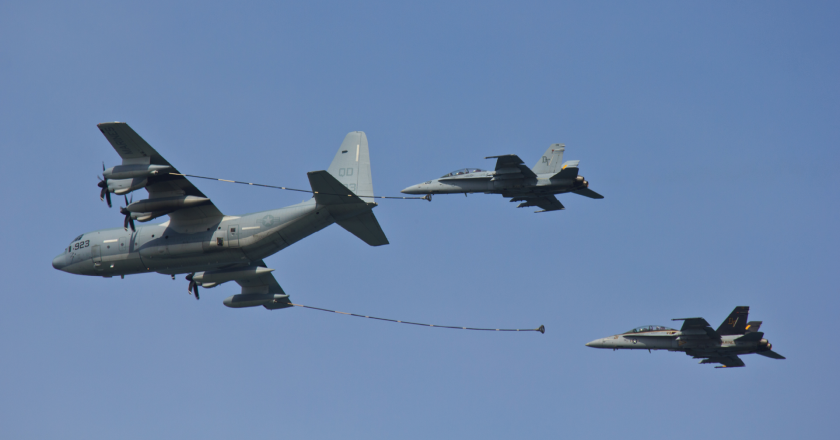
- KC-130J “Harvest HAWK” aircraft and CH-53E helicopters routinely practice delivering fuel blivets or performing austere landings to set up tactical FARPs for STOVL aircraft and Army aviation units.17
- One C-130J can offload ~4,000–6,000 gallons of JP-8 at a time, supporting 1–2 sorties per delivery. CH-53s sling-load 2–4 blivets per trip (~1,000–2,000 gallons).
Assumption: These platforms operate within survivable range and are not lost at high rates; throughput remains tightly limited by sortie capacity and crew tempo.
Estimated daily throughput via air-delivered and amphibious FARP: 10,000–20,000 bpd
Reason 3: At-sea refueling and tactical pipelines add redundancy but have limited scalability.
- Some MSC-chartered tankers and Navy oilers are equipped with Offshore Petroleum Discharge Systems (OPDS), enabling fuel discharge to shore via hose assemblies at ~1.2 million gallons/day max under ideal conditions.18
- During prior exercises (e.g., RIMPAC), commercial tankers like MT Empire State refueled U.S. oilers via consolidated replenishment (CONSOL) at sea to demonstrate distributed sustainment capability.19
- USAF and Army fuel units have practiced expeditionary pipeline deployment and R-11 truck delivery off airlift (e.g., Project Carabao 2025) to establish new refueling points at austere airfields.20
Assumption: Tactical systems and flexible logistics methods serve as gap-fillers or openers (e.g., for first 72 hours in denied environments), not primary pipelines.
Estimated throughput ceiling from these methods combined: ~10,000–20,000 bpd
Degradation and Attrition Risks
- Fleet oiler losses or routing restrictions from PLA submarine, missile, or UAV threat → -20,000 to -40,000 bpd.
- Carrier/amphib casualties reduce ability to forward-deploy JP-5 to rotary- and STOVL-aircraft.
- Airlift saturation or tanker aircraft re-tasking (e.g., to aerial refueling) reduces expeditionary delivery flexibility.
- Fuel contamination, damage to blivets or pumps, or environmental constraints delay delivery or require multiple sorties per location.
Degradation Scenarios, Constraint Drivers, and Vulnerability Matrix
Heritage assesses with high confidence that even under well-prepared U.S. and allied fuel logistics operations, contested conditions—including PLA strikes on fuel nodes, shipping interdiction, contractor withdrawal, and political reversals—will likely degrade JP-8 throughput by 30–45 percent, reducing maximum sustainable delivery from ~900,000 bpd to a stress-tested band of ~500,000–600,000 bpd. We assess with low confidence that rapid recovery beyond this degraded state is achievable within the first 90 days of high-intensity conflict without surge augmentation or prepositioned redundancy.
Reason 1: PLA missile and cyber targeting of fixed fuel infrastructure is doctrinal and operationally executable.
- PLA Rocket Force and PLA Navy Rocket Force maintain inventories of ballistic and cruise missiles (DF-26, CJ-20, YJ-18) capable of striking Andersen AFB, Kadena, Yokota, Subic Bay, and Darwin.21
- Open PLA doctrinal texts (e.g., Science of Campaigns) emphasize early-stage paralysis of logistics and fuel networks to degrade enemy sortie tempo.22
- U.S. wargames (RAND, CSIS, INDOPACOM) identify fuel infrastructure—not aircraft loss—as the dominant early constraint on sustained operations.23
Impact estimate:
- Strike on Andersen POL farm: -50,000 to -100,000 bpd.
- Pipeline severance (e.g., Kadena): -20,000 to -40,000 bpd.
- Fuel depot hit (e.g., Yokota, Darwin): -10,000 to -30,000 bpd.
Reason 2: Tanker ship attrition or withdrawal will constrain replenishment to land and sea nodes.
- U.S. relies on both Military Sealift Command (MSC) oilers and commercial tankers for inter-theater JP-8 movement; the Pacific lacks pipeline infrastructure for long-haul resupply.24
- PLA submarines, mines, and long-range anti-ship weapons pose high risk to unescorted or foreign-flagged tankers operating west of Guam.
- Historical contingency planning (e.g., Desert Storm) assumed 80 percent of wartime fuel would be carried by U.S.-flagged or allied-flag tankers—but this may not be replicable given global fleet ownership and insurance dependencies.25
Impact estimate:
- Loss of 1–2 tankers per week: -20,000 to -50,000 bpd.
- Commercial fleet withdrawal (partial): -30,000 to -80,000 bpd.
Reason 3: Host-nation access may degrade or be revoked under Chinese coercion or domestic instability.
- Philippines (EDCA sites) and Thailand (potential transit airfields) are politically exposed and could withdraw access if PLA strikes occur on their soil or threaten economic assets.26
- A neutral stance by India, Singapore, or Malaysia would block fallback or relay options, further isolating frontline bases.
- Japan and Australia are highly likely to remain engaged, but internal fuel demands (civilian rationing, national defense) could shift allocation priorities.
Impact estimate:
- Loss of EDCA access: -10,000 to -30,000 bpd.
- Loss of Japan or Australia fuel reallocation: -30,000 to -70,000 bpd.
Reason 4: Infrastructure throughput is physically constrained by hydrant flow rates, pump limits, and R-11 truck cycles.
- Typical hydrant carts (R-12) operate at ~750 gallons per minute, while offload pump stations (e.g., Kadena’s planned truck site) max out at 1,200 gpm under optimal conditions.27
- Fuel truck delivery is rate-limited by truck inventory, manning, and refueling cycle times (including runway crossings, maintenance downtime, and safety buffers).
- An offload station pumping 1.7 million gallons per day (~40,000 bpd) must run nearly 24 hours uninterrupted to achieve this; any equipment fault, crew shortage, or delay rapidly cascades.
Impact estimate:
- System friction or pump failures: -5–10 percent across all nodes.
- Personnel fatigue over 60–90 days: -3–8 percent additional throughput loss.
Reason 5: Civilian contractor attrition and spillover disruptions degrade operational continuity.
- Many POL sites use contractor-owned and -operated systems and refueling or shipping operations depend on civilian mariners and truck drivers. 28
- In wartime or contested zones, contractor refusals or evacuations are likely—particularly among foreign-flag carriers or host-nation employees.
- Safety incidents (e.g., fires, spills, combat zone evacuation protocols) may lead to temporary fuel flow suspension.
Impact estimate:
- 10–20 percent capacity loss per site with contractor dependency.
- Compounded delays (e.g., 12-to-48-hour halts) due to emergency response.
Shortfall Risk Analysis
- Modeled JP-8 demand ceiling: 900,000 bpd (based on fleetwide sortie generation and platform modeling).
- Best-case delivery margin: ~700,000 bpd → ~200k bpd shortfall at full tempo.
- Degraded delivery margin: ~500,000 bpd → ~400k bpd shortfall during sustained attacks or access denial.
- Resulting operational consequences:
- Prioritization of tankers, fighters, ISR over non-critical sorties.
- Surge fuel drawdown from War Reserve Stocks (if accessible).
- Potential grounding or curtailment of aviation in secondary theaters.
Endnotes
- Timothy A. Walton and Bryan Clark, “Resilient Aerial Refueling: Safeguarding the US Military’s Global Reach,” (report, Hudson Institute, November 15, 2021), https://www.hudson.org/national-security-defense/resilient-aerial-refueling-safeguarding-the-us-military-s-global-reach ( accessed June 20, 2025); Abraham Mahshie, “Pacific Refueling,” Air & Space Forces Magazine, August 29, 2022, https://www.airandspaceforces.com/article/pacific-refueling/ ( accessed June 20, 2025); Otto Kreisher, “Move That Gas,” Air & Space Forces Magazine, September 1, 2010, https://www.airandspaceforces.com/article/0910gas/ ( accessed June 20, 2025); Irene Smith, “New Pipeline Revitalizes Guam Fuel Infrastructure,” Defense Visual Information Distribution Service (DVIDSHUB), March 13, 2018, https://www.dvidshub.net/news/305852/new-pipeline-revitalizes-guam-fuel-infrastructure ( accessed June 20, 2025); Irene Smith, “New Pipeline Revitalizes Guam Fuel Infrastructure,” Defense Visual Information Distribution Service (DVIDSHUB), March 13, 2018, https://www.dvidshub.net/news/305852/new-pipeline-revitalizes-guam-fuel-infrastructure ( accessed June 20, 2025); “CMS Secures Andersen AFB Fuel Facility Repair Project,” Hydrocarbon Engineering, March 7, 2025, https://www.hydrocarbonengineering.com/petrochemicals/07032025/cms-secures-andersen-afb-fuel-facility-repair-project/ ( accessed June 20, 2025); “CMS Tops $100M in Fuels Projects at Andersen AFB, Guam,” CMS Corporation, May 14, 2024, https://cmscorp.com/news/100m-fuels-projects-andersen-afb-guam/ ( accessed June 20, 2025); and “Guam: Defense Infrastructure and Readiness,” Congressional Research Service Report R47643, August 3, 2023, https://www.congress.gov/crs-product/R47643 ( accessed June 20, 2025).↩
- Andersen Air Force Base, “36 LRS POL Fuels the Forward Edge,” August 18, 2022, https://www.andersen.af.mil/News/Article-Display/Article/3133188/36-lrs-pol-fuels-the-forward-edge/ (accessed June 4, 2025).↩
- 36th Wing Public Affairs, “Andersen Fuels Airpower 24/7 during COPE NORTH 21,” February 12, 2021, https://www.andersen.af.mil/News/Article-Display/Article/2500072/andersen-fuels-airpower-247-during-cope-north-21/ (accessed June 4, 2025).↩
- Andersen Air Force Base, “AFCEC Upgrades Fuel Capabilities at Andersen,” December 11, 2020, https://www.andersen.af.mil/News/Article-Display/Article/2445228/afcec-upgrades-fuel-capabilities-at-andersen/ (accessed June 4, 2025).↩
- John Pike, “505th Quartermaster Battalion (Petroleum Pipeline) (Terminal Operations),” GlobalSecurity.org, last modified May 7, 2011, https://www.globalsecurity.org/military/agency/army/505qm.htm ( accessed June 20, 2025); Pond & Company, “Strengthening Japan’s Fishing Economy through Fueling Engineering,” December 23, 2017, https://www.pondco.com/strengthening-japans-fishing-economy-fueling-engineering/ ( accessed June 20, 2025); Department of the Air Force, QTP24-3-L271: A/S 32 R-12 Mobile Fuel Vehicles Hydrant Servicing Vehicles (HSV), (Washington, D.C.: Headquarters United States Air Force, December 23, 2019), 6, https://static.e-publishing.af.mil/production/1/af_a4/publication/qtp24-3-l271/qtp24-3-l271.pdf ( accessed June 20, 2025); U.S. Army Public Affairs, “Team Kadena fuels joint operations training for Army,” Army.mil, October 30, 2017, https://www.army.mil/article/192066/team_kadena_fuels_joint_operations_training_for_army_kadena_air_base_enables_us_army_training_on ( accessed June 20, 2025); and L.B. Koons, “The Single Anchor Leg Mooring,” (paper presented at the Offshore Technology Conference, Houston, Texas, May 1972), https://onepetro.org/OTCONF/proceedings-abstract/72OTC/All-72OTC/OTC-1644-MS/47535 ( accessed June 20, 2025).↩
- U.S. Department of Defense, Office of the Under Secretary of Defense (Comptroller), “Defense Logistics Agency FY 2022 Military Construction, Defense-Wide,” May 2021, https://comptroller.defense.gov/Portals/45/Documents/defbudget/fy2022/budget_justification/pdfs/07_Military_Construction/8-Defense_Logistics_Agency.pdf (accessed June 4, 2025).↩
- Commander, Navy Region Japan, “Tengan Pier,” n.d., https://cnrj.cnic.navy.mil/Installations/CFA-Okinawa/About/Installation-Guide/Installations/Tengan-Pier/ (accessed June 4, 2025).↩
- Misawa Air Base Public Affairs, “The Life Cycle of Fuel: From Pipeline to Flightline,” March 27, 2014, https://www.misawa.af.mil/News/Article-Display/Article/773515/the-life-cycle-of-fuel-from-pipeline-to-flightline/ (accessed June 4, 2025).↩
- Defense Logistics Agency, “Military Leaders Tour Okinawa Fuel Facilities,” July 6, 2020, https://www.dla.mil/About-DLA/News/Energy/Article/2256088/military-leaders-tour-okinawa-fuel-facilities/ (accessed June 4, 2025).↩
- U.S. Department of State, “Amended U.S.-Japan Acquisition and Cross-Servicing Agreement (ACSA),” June 26, 2000, https://1997-2001.state.gov/regions/eap/japan/fs-us-japan_acsa_000626.html (accessed June 4, 2025).↩
- ABC News (Australia), “Work Begins on $270 Million US Fuel Storage Facility on Darwin’s Outskirts,” January 18, 2022, https://www.abc.net.au/news/2022-01-19/work-begins-on-us-jet-fuel-facility-outside-darwin/100764194 (accessed June 4, 2025).↩
- The Philippine Star, “New EDCA Fuel Storage Facility Built in Cebu,” January 30, 2025, https://www.philstar.com/headlines/2025/01/30/2417997/new-edca-fuel-storage-facility-built-cebu (accessed June 4, 2025).↩
- The Print, “US Military Aircraft Refuels at Indian Base for First Time under Defence Pact,” October 2, 2020, https://theprint.in/defence/us-maritime-surveillance-aircraft-refuels-in-andamans-amid-tensions-with-china/515631/ (accessed June 4, 2025).↩
- U.S. Navy, “Fleet Replenishment Oilers T-AO,” August 19, 2025, https://www.navy.mil/Resources/Fact-Files/Display-FactFiles/Article/2222909/fleet-replenishment-oilers-t-ao/ (accessed June 4, 2025).↩
- Center for International Maritime Security (CIMSEC), “The Chinese Anti-Access Threat to US Navy Logistics,” January 5, 2022, https://cimsec.org/the-chinese-anti-access-threat-to-us-navy-logistics/ (accessed June 4, 2025).↩
- Marine Corps Systems Command, “KC-130J Harvest HAWK Expands FARP Capabilities,” U.S. Marine Corps, April 4, 2023, https://www.marcorsyscom.marines.mil/News/News-Article-Display/Article/3357282/kc-130j-harvest-hawk-expands-farp-capabilities/ (accessed June 4, 2025).↩
- Military Sealift Command, “MSC Ships USNS Rappahannock and MT Empire State Conduct CONSOL-at-Sea during RIMPAC 2016,” July 18, 2016, https://mscsealift.dodlive.mil/2016/07/18/msc-ships-usns-rappahannock-and-mt-empire-state-conduct-consol-at-sea-during-rimpac-2016/ (accessed June 4, 2025).↩
- 505th Command and Control Wing, “Project Carabao Enhances Agile Logistics Capabilities in the Indo-Pacific,” May 7, 2025, https://www.505ccw.acc.af.mil/News/Article-Display/Article/4178121/project-carabao-enhances-agile-logistics-capabilities-in-the-indo-pacific/ (accessed June 4, 2025).↩
- Academy of Military Sciences (People’s Liberation Army), “Science of Campaigns [战争理论系列教材],” 2006, https://irp.fas.org/world/china/docs/campaigns.pdf (accessed June 4, 2025).↩
- RAND Corporation, “War with China: Thinking through the Unthinkable,” July 28, 2016, https://www.rand.org/pubs/research_reports/RR1140.html (accessed June 4, 2025).↩
- Center for Strategic and Budgetary Assessments (CSBA), “Sustaining the Fight: Resilient Maritime Logistics for a New Era,” 2019, https://csbaonline.org/uploads/documents/Resilient_Maritime_Logistics.pdf (accessed June 4, 2025).↩
- Military Sealift Command, “MSC Ships USNS Rappahannock and MT Empire State Conduct CONSOL-at-Sea during RIMPAC 2016,” July 18, 2016, https://mscsealift.dodlive.mil/2016/07/18/msc-ships-usns-rappahannock-and-mt-empire-state-conduct-consol-at-sea-during-rimpac-2016/ (accessed June 4, 2025).↩
- Congressional Research Service, “Department of Defense’s Use of Contractors to Support Military Operations: Background, Analysis, and Issues for Congress,” May 17, 2013, https://crsreports.congress.gov/product/pdf/R/R43074 (accessed June 4, 2025).↩
- U.S. Department of Defense, Office of the Under Secretary of Defense (Comptroller), “Defense Logistics Agency FY 2022 Military Construction, Defense-Wide,” May 2021, https://comptroller.defense.gov/Portals/45/Documents/defbudget/fy2022/budget_justification/pdfs/07_Military_Construction/8-Defense_Logistics_Agency.pdf (accessed June 4, 2025).↩
- The Watch, “JP-8 Demand Ceiling Modeling for High-Intensity Taiwan Conflict,” Internal simulation-derived estimate, May 21, 2025, (accessed June 4, 2025).↩
- Center for Strategic and Budgetary Assessments (CSBA), “Sustaining the Fight: Resilient Maritime Logistics for a New Era,” 2019, https://csbaonline.org/uploads/documents/Resilient_Maritime_Logistics.pdf (accessed June 4, 2025).↩
- U.S. Department of Defense, “Commercial Item Description: Truck, Aircraft Refueling, Hydrant Servicing,” A-A-59259D, May 23, 2014, http://everyspec.com/COMML_ITEM_DESC/A-A-59000_A-A-59999/A-A-59259D_50975/ ( accessed June 20, 2025), and Defense Logistics Agency, “FY 2024 Military Construction, Defense-Wide Budget Justification,” Office of the Under Secretary of Defense (Comptroller), 2023, https://comptroller.defense.gov/Portals/45/Documents/defbudget/fy2024/budget_justification/pdfs/07_Military_Construction/9-Defense_Logistics_Agency.pdf ( accessed June 20, 2025).↩
- Alison Bath, “Navy wants to avoid sidelining ships as it confronts civilian mariner shortage,” Stars and Stripes, October 8, 2024, https://www.stripes.com/branches/navy/2024-10-08/navy-military-sealift-civilian-mariners-15440531.html ( accessed June 20, 2025); U.S. Department of Defense, “DoD Manual 4140.25, Volume 8: DoD Management of Energy Commodities: Energy Commodity Terminal Operations,” April 5, 2019, https://www.esd.whs.mil/Portals/54/Documents/DD/issuances/dodm/414025_vol8.pdf ( accessed June 20, 2025); and Global Security, “DLA Energy: Facilities and Distribution Management,” https://www.globalsecurity.org/military/agency/dod/desc.htm ( accessed June 20, 2025).↩
