

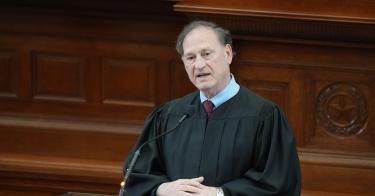
Justice Samuel A. Alito’s new book, So Ordered: An Originalist’s View of the Constitution, the Court, and Our Country, is not a conventional judicial memoir—and that is precisely its strength. It is a carefully curated collection of 19 lectures and speeches delivered between 2007 and 2025 on subjects constitutional and cultural, solemn and unexpectedly personal. Organized around five themes, the volume offers something rarer than autobiography: a sustained encounter with the mind of one of the Supreme Court’s most consequential jurists.
The settings are as varied as the subjects. Alito draws lessons from baseball, examines the globalization of judicial review, revisits the Gettysburg Address, celebrates Italian-American achievement, and reflects upon mankind’s search for meaning. Across these topics, the famously reserved Justice emerges in fuller dimension. The result is not a miscellany, but a portrait of a judge who understands that law does not operate in a vacuum—and that the Constitution is inseparable from the history, habits, and character of the nation it governs. The book’s five themes—originalism and textualism, the role of judges, religious liberty, threats to the Constitution, and the American experience—provide structure and urgency. Each lecture deserves attention. This review examines five of the collection’s most illuminating selections, not as a substitute for the whole, but as an invitation.
Originalist Judging
Chapter One opens with a deceptively simple question: How should a judge interpret the Constitution? Alito’s answer—originalism—is familiar. His treatment is not. Rather than offer another abstract defense of original public meaning, he asks what originalism looks like when practiced by judges who must decide actual cases, respect precedent, secure colleagues’ votes, and live with the consequences of their rulings.
Academic theories enjoy the luxury of coherence, untroubled by circumstance. Judges do not. They operate within an inherited legal system, on multi-member courts, under the discipline of precedent, and with litigants whose liberty, property, and constitutional rights are not classroom hypotheticals. Alito therefore describes himself as a “working judicial originalist.”
His organizing device is an originalist judge traveling down a highway and encountering seven exits. Six are wrong turns; the seventh—the road of academic originalism—is legitimate for scholars but often ill-suited for judges. The metaphor works because Alito’s argument is not that originalism lacks direction. Rather, it is that originalists may lose their way by mistaking rigidity, antiquarianism, or theoretical purity for constitutional fidelity.
Originalism arose amid dissatisfaction with decisions of the Warren and early Burger Courts and against a jurisprudential background shaped by judicial restraint and deference to political actors. Yet originalism is not simply a doctrine of restraint. Sometimes the Constitution requires judges to invalidate the acts of elected officials. Fidelity may demand boldness.
That insight animates Alito’s critique of “insecure originalism.” Originalists should not recoil from considering whether their method generally produces sound results. Nor should they congratulate themselves when originalist analysis yields an absurd outcome, as though an unattractive result proved intellectual purity. The law must be followed where it leads, but the conscientious judge should recheck the map before driving over a cliff.
Alito also rejects “show it to me in black-and-white originalism,” the notion that every constitutional rule must appear expressly in the document’s words. Constitutional structure carries meaning. Federalism, separated powers, and institutional independence may produce necessary implications even when no clause spells them out. Originalism begins with text; it need not end with a refusal to perceive constitutional architecture.
>>> Clarence Thomas Breaks His Silence and Issues a Warning
At opposite extremes stand “Icarian” and “archaeological” originalism. The former rises so high into abstraction that constitutional language becomes a vessel for modern aspirations. If broad principles may be detached from the public understanding at ratification, originalism becomes indistinguishable from the theories it was developed to oppose.
Archaeological originalism makes the inverse mistake. It searches obscure historical materials for a legal relic that mechanically answers a modern question. Alito’s discussions of Torres v. Madrid and United States v. Jones illustrate the danger. A 17th-century rule on civil arrest or an old property tort may illuminate history, but neither necessarily establishes what ordinary Americans understood the Fourth Amendment to mean. Original public meaning is not an esoteric code decipherable only by specialists equipped with pith helmets and trowels.
“Partial originalism” is similarly unsatisfactory. A ruling cannot fairly be called originalist when an originalist premise is bolted onto non-originalist doctrines that determine the outcome. Nor should “philosophical originalism” treat the Constitution as though it secretly incorporated John Locke or another favored thinker. Founding-era ideas matter, but the public ratified the Constitution, not a pantheon of political philosophers.
Academic originalism presents not error but choice. Scholars may reconstruct doctrine from first principles. Judges must contend with stare decisis, institutional stability, and the practical need to assemble a majority. Alito’s discussion of McDonald v. Chicago, a 2010 Second Amendment case, shows why a historically attractive theory may be judicially imprudent if it would unsettle a century of law and open vast doctrinal territory without clear boundaries.
This is the chapter’s central contribution. Alito does not dilute originalism; he disciplines it. Judging requires historical fidelity and judgment, principle and prudence, conviction and collegial compromise. Pretending judgment can be eliminated does not eliminate it. It merely conceals it.
Textualism
Chapter Two is at once a tribute, an intellectual history, and a warning. Its subject is Antonin Scalia—his methods, manner, and continuing influence—but its real concern is the rule of law. Alito argues that Scalia rescued statutory interpretation from an undisciplined search for legislative purpose, restored enacted text to its rightful place, and constrained judges who might otherwise mistake policy preferences for law.
Yet some of Scalia’s heirs, Alito warns, have carried textualism beyond its sound foundations into “hypertextualism,” a cramped method that ignores how language communicates meaning.
Alito wisely begins with the man. Scalia changed the Court’s habits. Oral argument became sharper and more demanding. Judicial prose became clearer, livelier, and less embalmed in professional fog. Alito recounts Scalia’s refusal to join his opinion in Hein v. Freedom From Religion Foundation, where Scalia called his reasoning “meaningless,” inconsistent with the “rule of law,” and not “sane.” The anecdote demonstrates that Scalia’s ferocity was directed at ideas, not persons, while revealing Alito’s own measured temperament.
The chapter is strongest when reconstructing the interpretive disorder of the “BS”—before Scalia—era. Judges treated statutes as invitations to rummage through committee reports, floor statements, statutory purposes, and, when necessary, their imaginations. In Overton Park v. Volpe (1971), the Court effectively treated statutory text as a fallback when legislative history proved unclear. In Griggs v. Duke Power Co. (1971), Title VII’s text was relegated to a footnote while purpose and legislative history did the work. That inversion should trouble anyone who believes Congress legislates by voting on words, not atmospherics.
Alito’s stories from the Solicitor General’s Office make the indictment concrete. A suspiciously convenient Senate colloquy captures legislative history’s theatrical quality: lawmakers may manufacture interpretive ammunition without persuading either chamber to write the desired meaning into law.
Even better is Professor Robert Blakey’s declaration, “I am the legislative history of RICO.” The line is funny because, under the old regime, it was nearly plausible.
Scalia’s corrective was simple: the text is the law. But Alito insists that this maxim begins interpretation; it does not end it. Judges are Congress’s “faithful agents.” Their task is to discern the public meaning conveyed by enacted words in context—not to divine secret motives, but neither to pretend that language consists of dictionary definitions lined up like tin soldiers.
Alito’s examples involving breakfast, banks, and irony explain the difference between semantic and pragmatic meaning. Context resolves ambiguity, supplies what ordinary speakers understand without saying, and sometimes reveals that literal words convey something different from their bare semantic content.
This is not a retreat to purposivism. Alito endorses Scalia’s “objectified intent”—the meaning a reasonable reader, familiar with contemporary usage and the circumstances of enactment, would attach to the text. Unexpressed intentions remain irrelevant; public meaning controls. But public meaning may include sensible inferences about what lawmakers communicated. The canons Scalia championed—noscitur a sociis, expressio unius, and ejusdem generis—work precisely because context permits those inferences.
Alito’s discussion of Bostock v. Clayton County supplies the sharpest edge. He argues that the majority’s reading of Title VII—treating discrimination because of sexual orientation or gender identity as discrimination “because of sex”—was not compelled by the statute’s public meaning in 1964.
His criticism is methodological: the majority treated context that ordinarily illuminates meaning as categorically irrelevant. His Italian-restaurant hypothetical distills the objection: an agent who follows an instruction’s literal words while knowingly defeating the principal’s communicated meaning is not faithful; he is obtuse.
>>> Supreme Court Must Rein in D.C. Court of Appeals
The chapter’s vulnerability also marks its ambition. “Objective intent” is easier to invoke than administer. How much context is enough? Which evidence is reliable? When does context reveal public meaning, and when does it smuggle purpose back into the analysis? Alito does not fully answer these questions. Nevertheless, his central warning persuades. Scalia’s revolution was not a command to read statutes woodenly. It demanded that judges respect enacted law, ordinary language, institutional limits, and democratic accountability.
Baseball’s Lessons for Law and Life
Alito is an unapologetic baseball fanatic, and his loyalties lie firmly with the Philadelphia Phillies. His childhood hero was Richie Ashburn. He played second base and shortstop in Little League, attended Phillies Phantasy Camp while serving on the Third Circuit, and was greeted at his Supreme Court welcome dinner by the Phillie Phanatic. His chambers contain an entire corner of baseball memorabilia.
Chapter Nine opens as a genial meditation on the national pastime but becomes a compact treatise on judging, institutional legitimacy, equality, cultural cohesion, and technological hubris. Alito begins with the concrete—a checked swing, a neighborhood play, an afternoon at Connie Mack Stadium—and works toward first principles.
The organizing device is Chief Justice Roberts’s comparison of judges to umpires calling balls and strikes. Alito neither rejects the analogy nor reduces it to a slogan. Rules matter. Most cases, like most pitches, have a discernible answer. But hard cases require judgment informed by text, precedent, experience, and institutional discipline. The discussion of checked swings and balks exposes a truth often obscured by legal theory: discretion is not the absence of law. Properly exercised, it is judgment bounded by law.
Alito is especially good when he turns from mechanics to character. Judges must not “sell” their calls like theatrical umpires. Their duty is not to win applause or satisfy the loudest faction, but to do justice even when the heavens—or editorial pages—appear ready to fall.
Judge Leonard Garth’s admonition that “it takes courage to be a good judge” supplies the chapter’s moral center. In Alito’s chambers, a photograph of the two bears the inscription Fiat justitia, ruat caelum: “Let justice be done though the heavens fall.” Judicial independence is not a perk for judges; it is a safeguard for litigants and the public.
The discussion of Chase Utley’s notorious slide and baseball’s old “neighborhood play” sharpens the inquiry. What should an official do when settled practice departs from the written rule? Courts routinely confront precedents that have drifted from constitutional or statutory text. Alito offers no easy formula. Instead, he shows why choosing between fidelity to text and fidelity to precedent is consequential, disruptive, and unavoidable. A judge who pretends otherwise is hiding the ball.
The chapter then widens its focus. Baseball once supplied a common vocabulary across regions, classes, and political persuasions. Its diminished status becomes a metaphor for national fragmentation. Alito’s point is not merely nostalgic. A self-governing people need shared institutions and experiences.
His account of baseball’s integration carries the lesson further. Jackie Robinson, Roy Campanella, Willie Mays, Henry Aaron, and others demonstrated that equality is both a moral imperative and a practical advantage. The Phillies’ delay in signing black players was not only unjust; it was self-defeating. Merit ignored exacts a price.
Alito concludes with analytics and artificial intelligence. Baseball’s statistical revolution produced more efficient strategies but a less attractive game: more strikeouts, fewer balls in play, less daring, and less joy. The analogy to law is sobering. A machine may predict outcomes, process authorities, and impose consistency. But efficiency is not the whole of justice. A legal system worthy of confidence must remain intelligible, accountable, and humane.
This is an argument that law, like baseball, depends on rules, judgment, courage, memory, and a willingness to preserve what is essential amid change. Beneath the chapter’s easy cadence lies a serious charge: know the rules, honor the institution, judge people by their merits, and never confuse innovation with wisdom.
Religious Liberty and the American Republic
Chapter 10 is a history lesson, constitutional argument, and warning. Its central claim is unfashionable but straightforward: the American republic did not merely tolerate religion as an eccentric private preference. It recognized religious liberty as a preexisting right, gave it special constitutional protection, and understood religion as an ally of ordered liberty.
Alito begins with the American Catholic experience. From Maryland’s founding as a refuge, through repeal of its Toleration Act, to accusations that Catholics owe their civic allegiance to Rome, he shows that anti-Catholicism is no historical curiosity. Paul Revere’s “Mitred Minuet” and a modern cartoon depicting five Catholic justices in bishops’ miters are separated by two centuries but animated by the same slander: that Catholic reasoning is foreign to constitutional government.
Modern cases give the chapter urgency. The contraceptive mandate, Masterpiece Cakeshop v. Colorado Civil Rights Commission (2018), Catholic Social Services, religious-school employment disputes, pandemic worship restrictions, and requests for spiritual advisers at executions expose a cultural collision. Alito identifies three accelerants: declining attachment to organized religion, the rise of a new moral code on contested social questions, and growing intolerance toward dissent.
His point is not that adherents of the new orthodoxy lack a right to their convictions. It is that constitutional peace becomes impossible when disagreement itself is treated as moral depravity.
Alito’s strongest legal analysis focuses on the Free Exercise Clause. First, the Constitution singles out religion for special protection. Second, it safeguards religious exercise—not merely belief or worship, but conduct flowing from faith: teaching, evangelizing, serving the poor, observing holy days, following dietary rules, and wearing religious dress. Third, the right was historically robust enough to require exemptions from generally applicable laws, bounded by genuine threats to peace and safety. Founding-era accommodations for religious objectors—from oath requirements to militia service—make the point forcefully.
That history underwrites Alito’s criticism of Employment Division v. Smith (1990), authored by Scalia, which reduced free exercise largely to a prohibition against deliberate discrimination. A regime that treats sacramental wine, kosher or halal slaughter, or religious head coverings exactly like secular conduct may be formally neutral while functionally hostile. Equal treatment is not always liberty.
The Establishment Clause discussion is equally important. Alito rejects the notion that the Constitution commands a sterile public square. The First Congress appointed chaplains while drafting the Bill of Rights; legislative prayer is therefore evidence of the constitutional design, not an embarrassing exception. The American settlement is not French laïcité. It prevents governmental establishment and control while preserving a public culture in which faith may speak, organize, educate, and serve.
The chapter’s portraits of John Carroll, John England, Orestes Brownson, Tocqueville, and Washington show why American Catholics came to view the Constitution not as a grudging truce, but as fertile ground for faith. Limited government, federalism, property and speech protections, and respect for voluntary associations embody something akin to subsidiarity.
In America, separation of church and state could liberate the Church from political supervision rather than banish it from public life.
Skeptical readers may want more explanation of how courts should distinguish sincere claims from opportunistic ones, or how exemptions should operate when concrete third-party harms are established. Those questions do not defeat Alito’s thesis, but they mark the difficult terrain on which it must be applied.
Chapter 10 nevertheless succeeds splendidly. The Religion Clauses are not museum pieces; they are articles of civic peace for a pluralistic nation. Their promise is not that Americans will cease disagreeing about ultimate truths, but that government will neither establish a creed nor punish citizens for exercising their faith within the traditional bounds of public order.
The Gettysburg Address
Chapter 15 is a compact meditation on why the Gettysburg Address endures. Alito places Lincoln’s 272 words beside Edward Everett’s two-hour oration and lets the contrast speak. Everett gave the crowd what 19th-century convention demanded: classical allusion, elaborate description, and grand rhetoric. Lincoln gave the nation biblical cadence, moral clarity, and a statement of national purpose.
Alito is especially strong on Lincoln’s word choice. “Four score and seven” and “brought forth” were not ornamental flourishes. They drew upon the King James Bible, the common linguistic inheritance of Lincoln’s audience. Lincoln achieved eloquence without displaying erudition. More importantly, those words framed America not as an accident of geography or power, but as a nation born to test whether self-government rooted in liberty and equality could survive.
The strongest section examines Lincoln’s relationship to the Founding. Speaking amid the terrible consequences of a constitutional order that had tolerated slavery, Lincoln might have repudiated the Founders. He did not. He appealed to their principles while acknowledging their failures. Alito rightly describes this as conservative and progressive: conservative because Lincoln sought to preserve the best of the American inheritance, progressive because he summoned the nation to fulfill promises it had not kept.
Alito also emphasizes what Lincoln omitted. He did not blame the South, boast of battlefield progress, attack opponents, or make a conventional case for reelection. On ground consecrated by sacrifice, partisan rhetoric would have been too small. Lincoln transformed a cemetery dedication into a national recommitment.
This is not a historian’s excavation, and Alito does not pretend otherwise. It is a judge’s close reading of a foundational text. His aim is to recover the argument embedded in the Address: America is exceptional not because it is flawless, but because it remains dedicated to a proposition that judges every generation, including our own.
That theme captures the larger achievement of So Ordered. Across subjects as varied as statutory interpretation, religious liberty, baseball, and Lincoln, Alito returns to a common idea: institutions endure only when citizens understand the principles beneath them and possess the courage to preserve those principles without resisting every necessary change.
The work of Gettysburg—preserving ordered liberty, widening opportunity, and securing equality under law—remains unfinished. It is still ours.
Samuel A. Alito Jr.’s So Ordered is not merely worth reading—it is essential reading for anyone who wants to understand the Constitution, the Supreme Court, and the disciplined judicial temperament required to safeguard the rule of law.
This piece originally appeared in Civitas Outlook



