

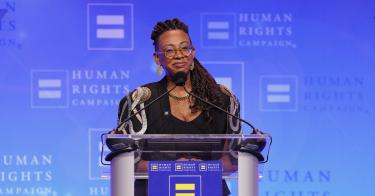
For over a decade, the Human Rights Campaign’s (HRC) Corporate Equality Index (CEI) has operated less like a voluntary survey and more like a protection racket with a glossy annual report. Companies submitted, complied and bragged about their LGBTQ-friendliness. The alternative—public shaming, activist investor pressure, reputational artillery—was too costly to contemplate.
Then, rather suddenly, it wasn’t.
The 2026 CEI data, analyzed in depth by 1792 Exchange, a nonprofit dedicated to returning corporate America to genuine neutrality on ideological questions, reveals something remarkable: the edifice is cracking. Compared to 2025, 65% fewer Fortune 500 companies chose to participate in the index this year. The total number of Fortune 500 participants fell from 377 to 131—not a statistical blip, but a corporate exodus of historic proportions.
The retreat is overdue.
HRC, which describes itself as “the nation’s largest LGBTQ+ civil rights organization,” takes credit for having used precisely these mechanisms to transform “the institutions and systems that shape our everyday lives.” The CEI, launched in 2002, was about pushing the LGBTQ+ agenda through a purported “fairness” benchmark. But over time it metastasized into something considerably more ambitious: a comprehensive ideological compliance scorecard that grades employers not merely on internal hiring and promotion policies, but on whether their vendors, supported charities, and benefits packages conform to an ever-expanding set of ideological and political demands.
>>> Regions Financial’s Reasonable Retreat From Ideology
Until recently, a CEI score of 100 required documentation of insurance coverage for sex-rejecting surgical procedures, gender-ideology-affirming restroom, pronoun, and dress code policies, and mandatory LGBTQ trainings for staff.
Alabama readers will find the local dimensions instructive. Regions Financial Corporation, headquartered in Birmingham and among the state’s most prominent Fortune 500 companies, scored a mere 60 on the 2026 CEI—unverified, no less. Its “unverified” designation suggests Regions didn’t actively participate in the CEI, substantiating its claim that it didn’t. By contrast, Regions had a score of 100 on the 2022 CEI.
Books-A-Million, Burr & Forman, and various healthcare providers with Alabama roots either lack listed scores or register low in recent data. Southern Company, whose Alabama Power subsidiary is woven into the fabric of the state’s economy, carries an unverified 100 from prior cycles that remains unconfirmed in the current report.
The broader pattern is consistent with the national story: even companies once eager to demonstrate ideological solidarity are quietly declining to participate.
The HRC and its defenders will, no doubt, insist that this withdrawal represents corporate retreat in the face of pressure from the Trump administration, which has moved aggressively against DEI contracting preferences as being illegally discriminatory.
There is some truth in that framing, but companies that retreat only when retreat is required by law exhibit not principled neutrality but a different form of opportunism.
The index doesn’t just measure whether corporations are actually practicing DEI internally; it measures whether they are also willing to publicly advertise it. If a company stops filing with the HRC but keeps all the same policies in place, nothing substantive has changed; the pivot simply reflects the decision to be less conspicuous about what it’s already doing.
That caveat registered, the scale of the collapse still warrants notice, and 1792 Exchange deserves credit for the data work that has made its scope visible. Its “Back to Business Tracker” has methodically catalogued which companies are withdrawing from ideological entanglements—not merely the CEI, but DEI architecture more broadly. And the numbers reflect a genuine shift in the cost-benefit calculus corporate executives use.
Consider also that the HRC dramatically reduced its own requirements to preserve its headline numbers in the face of mass withdrawal. Under the 2026 methodology, companies seeking a perfect score needed to demonstrate only one of four policies in the “Workforce Training and Accountability” category. Previously, four out of five were mandatory.
Under “[LGBTQ+] Outreach and Engagement,” one of five trainings sufficed; previously five were required. The result is that the 534 companies achieving a perfect 100 this year—a 30% decline from over 750 the prior year—did so against a substantially lower bar.
>>> Corporations Scoring High on Human Rights Campaign’s Equality Index Might Be Breaching Their Duty
When you can’t maintain participation, you lower standards and claim stability. The HRC also padded its perfect-score rolls with nearly 100 law firms, a category historically underrepresented in the index, to cushion the statistical blow.
Meanwhile, the organization laid off 20% of its staff in 2025.
There’s a lesson here about the nature of institutional power when it depends on manufactured consensus. The CEI’s influence was never organic; it was sustained by the fiction that corporate participation was simply what responsible companies did. Once enough companies declined to play along, the fiction became harder to maintain. The social credit score works only so long as the credits are worth something.
For Alabamians inclined toward action rather than analysis, the mechanism is straightforward: the corporations that still seek perfect CEI scores—and the 534 that achieved one this year despite weakened criteria—have made a deliberate choice to remain in the HRC’s orbit of ideological compliance.
Those corporations have headquarters with switchboards. They have shareholder meetings. They have executives who read their mail. Consumers and investors who object to subsidizing a political agenda dressed as HR policy have recourse that does not require legislation. Consumers can take their business elsewhere. Aggrieved employees passed over for a promotion due to not fitting into a DEI box can sue.
The HRC built its corporate influence through persistent, organized pressure over decades. Durable reform runs in the same direction: sustained, specific and local. Alabama’s business community, with its historically grounded skepticism of ideological capture, is well-positioned to help finish what the 2026 data suggests has already begun, namely, the HRC’s obituary.
This piece originally appeared in 1819 News



