Introduction
Since the 1960s, the Muslim Brotherhood has pursued a strategy of methodical implantation carried out simultaneously on both shores of the Atlantic. In Europe as in the United States, the Brotherhood understood very early that Western societies were not hostile terrain to be circumvented, but spaces to be “improved” from within through Islam, using their own associative, educational, electoral, and economic institutions. This simultaneity proceeds from a single ideological evaluation and a single strategy adapted to each national context.
The global strategy for Islamifying modernity I call Brotherism (frérisme): an ideology coupled with a method.[REF] It is an ideology because it carries a project of politics and society organized around the primacy of the Islamic way of life in the public sphere. Its method favors gradual, nonviolent, patient transformation of the host society: institution-building, the conquest of positions in the educational, media, associative, and political fields, rather than head-on confrontation. Though this enterprise is nonviolent, it is not unrelated to violence: By spreading rigorous, separatist Islam, Brotherism nourishes the soil for ever more radical and even violent forms of Islam. This seeming tension between nonviolent Brotherism and Islamic terrorism obscures how each movement prepares the way for the elevation of the other.
Many in the West today are still tempted to trace the Islam problem to the accidents of the overall strategy or political goals. The problem, we are told, is simply a group within the Muslim Brotherhood or a radical cleric in Paris, France, or Austin, Texas. A narrow political solution follows from this narrow conception of the problem. Western countries muster great energy to dissolve an “anti-social” association here, to designate an organization there, or merely to close a venue for radicalization elsewhere. These measures may be necessary, but they have always proved to be insufficient. Desultory political remedies attack the visible forms rather than the matrix that produces them.
To name the ideology “Brotherism” links the Islamic challenge to the Muslim Brotherhood, founded in 1928. The Brotherhood aims to Islamify modernity—that is, convert a strict reading of Islam into an organized, patient, and transnational political project to make Islam the fundamental law of the land in modern countries. This is different from jihadism. Jihadists embrace the goals of Islamifying modernity, but they do not adopt the Brotherists’ gradual methods.
Brotherism is a project with flexible, identifiable methods. As such, it can survive the disappearance of its accidental structures: If one federation is dissolved, another can reconstitute and achieve the same goals. If one source of funding is closed, others will open up. If one “mastermind” is imprisoned, another, using the same mind, can take his place. The men, the funding, the doctrine, and the aim of Islamifying modernity remain. To investigate and even ban the institutions by themselves is to chase after accidents or ephemera while the project that animates them stays beyond reach.
I approach the problem of Islamifying modernity as an anthropologist. For 30 years, I have studied its actors, discourses, networks, and modes of implantation in the field and over time. This work is now extended by the collective assembled within the center I founded, the European Center for Research and Information on Brotherism. Because of my research, I require 24-hour police protection after many threats to my life.
France is the home of Islamifying modernity. Islam is now France’s second-largest religion.[REF] Brotherism has been implanting and diffusing itself into French institutions for nearly half a century. It has built the same network with the same goals across European countries. Islam has come differently to England, whose multicultural model differs from French laïcité, yet the result is the same. Islamifying modernity is a civilizational goal with a flexible strategy.
What happens in Europe does not stay in Europe. The same Brotherist mechanisms of infiltration, ideological alliances, and multisector strategies are coming to America.[REF] This makes transatlantic cooperation to counter the Islamifying of modernity a practical necessity. Individual nations can meet a transnational, civilizational challenge only after they arrive at a shared understanding of the threat and begin to coordinate on how to meet it.
Brotherism: Vision, Identity, and Plan
“Brotherism” is the ideology spread over a century of the Muslim Brotherhood’s existence as well as the method by which this ideology seeks to transform societies. Liberalism is the vessel to Islamify modernity. Vision, Identity, and Plan (VIP) is a doctrine of peaceful, patient conquest.
The Brotherhood was founded in Egypt in 1928 by Hassan al-Banna. In the Risālat al-Ta‘ālīm (Epistle of the Teachings), al-Banna sets out the five successive stages of his project:
- Forming the Muslim individual,
- Building the Muslim family,
- Constructing a Muslim society with an Islamic government,
- Restoring the caliphate, and ultimately
- Achieving ustādhiyyat al-‘ālam (“mastership of the world”), Islam’s vocation to guide humanity as a whole.[REF]
He frames this objective through the Qur’anic injunction (Qur’an 8:39) to continue the da‘wa “until there is no more fitna and religion belongs entirely to Allah.” Thus, al-Banna articulates a universal objective with a gradual strategy—the very core of the Brotherhood’s method of action.
Al-Banna’s stages, however, mask an almost infinitely flexible approach to achieving larger goals. Someone aiming to master the world must start by owning his own mosque or his own block or even his own local council. Such goals are non-threatening, safe, and tolerable. Advocates seek the next thing, always within the larger game plan.
To grasp Brotherism, one must return to the intuition that presided over its birth. When Hassan al-Banna founded the Brotherhood in 1928, Egypt was under British control. The caliphate had just been abolished. Al-Banna advanced a diagnosis: The Muslim world had become powerless, colonized, fragmented, and subjugated because it had drifted away from the Islam of the origins, that of the pious forebears (al-salaf al-sâlih). Decline, in his eyes, was punishment for forgetting what Islam was. From this diagnosis followed a program to restore the power of the umma by restoring the true, totalizing form of Islam and thereby fulfill the promise made to the believers and the final triumph of Islam in the world. The Muslim Brothers thus conceive of themselves not as one movement among others, but as the vanguard charged with fulfilling a prophecy: to prepare for the promised future: to re-Islamize society and law to restore to Islam the dominion it has lost.
Brotherism draws inspiration from Salafism, but with a twist. Salafists seek to return to the strict practices of the first three generations of Muslims. They emphasize the purity of individual piety and the conformity of mores. They are less concerned with conquering institutions than with saving and controlling souls. The Muslim Brothers adopt the Salafi reference, but not its quietism. For them, Salafism marks the first stage of conquest: the forming of the Muslim individual. They believe that man’s very vocation is to build Muslim families, communities, societies, and governments as a preparation for world mastery. These conquering duties bind every Muslim. Most Muslims pursue them not by the sword but by the patient conquest of institutions. This mission of Vision, Identity, and Plan turns a reading of Islam into an enterprise and attaches its piety to a program.
Brotherism is not violent, military jihadism, which confronts the established order with weapons and terrorism. In some ways, the existence of violent jihadism distracts Western states from even recognizing the threat of Brotherism. Countries organize to parry the visible terrorist threat. They are almost relieved to run up against a law-abiding Islamism, an enterprise that operates chiefly within the law. Brotherism does not produce jihadism, but it does advance a central jihadist idea that Islam is an indivisible whole (dîn wa dawla, religion and state), that the religious norm holds primacy over the secular order. Both Brotherism and jihadism have a universal aim to bring the whole of society under Islamic law so that individual conformity follows from an already transformed collective order.
I use the acronym VIP to describe Brotherism in my book Brotherism and Its Networks.[REF] Brotherism has a Vision of the world, a supremacist Identity, and an adaptable Plan. The VIP method makes for a system in which the vision justifies, the identity mobilizes, and the plan operationalizes.
- First, a Vision of the world: a total Islam, in which the religious orders every sphere of existence and in which the true dividing line runs between belief and unbelief.
- Second, an Identity: the consciousness of belonging to a chosen community, the custodian of truth and destined to prevail—an identity one may call faithful supremacist.
- Finally, a Plan: a gradual and patient method, conceived in stages and advancing in step with the balance of power.
In this view, nothing is beyond Islam’s reach. The Brotherhood’s multisector strategy derives from its universalizing aspiration. Because everything must be conquered, action must unfold everywhere—in the school, in the marketplace, in the association as in the institution. Integralists are remarkably adaptable. Those who would Islamify modernity adapt to national contexts. The Brotherist project has diffused itself worldwide but never the same way twice, so to speak. It is the same project under diverse conditions. Hence the difficulty, and the necessity, of comparison. Different masks disguise the underlying project.
Two notions govern the way Islam has been implanted in modern Europe. The first is tamkīn; that is, consolidation, empowerment, and buildup of strength. Gradual domination comes in phases. In a doctrinal essay published in 2006 on the Muslim Brotherhood’s official website, Rafiq Habib, a Coptic intellectual and former vice president of the Muslim Brotherhood’s Freedom and Justice Party, defines tamkīn as the stage at which the Brotherhood’s doctrines have become so widespread that the movement is able to implement its project across “the public spheres of life.”[REF]
First, the plan must become firmly established in enough people’s minds and hearts that they can push their agenda “in the political sphere and the public and legal system.”[REF] Tamkīn thus refers to the rise of cultural influence, consolidation of a social base, and institutionalization of the Islamic norm. Tamkīn draws on the Qur’anic distinction between the time of weakness and the time of strength to justify tactical patience. One advances when one can, temporizes when one must—even to the point of making strange alliances to destroy opponents—but always pushing in the same direction.
The second notion governing Islamic implantation is da‘wa, or preaching, understood as the construction of an autonomous Islamic frame of reference within Muslim communities. This is a way to fix norms and dispute with host societies what it means to be Muslim. In his epistle To the Youth (Ilā al-Shabāb), Hassan al-Banna explicitly defines the Brotherhood’s ultimate objective: “We want our da‘wa to reach the whole world, to be proclaimed to all mankind, and to extend to the farthest corners of the earth.”[REF]
Strategies: Entryism, Infiltration, Neutralizing Churches
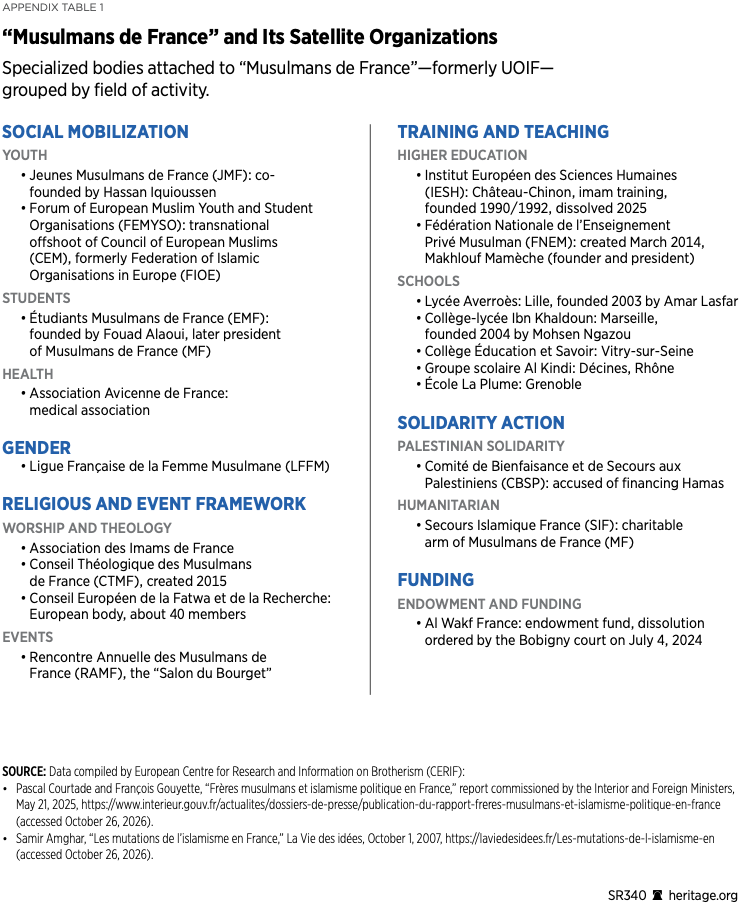
Brotherism’s cardinal strategy is to enter institutions and legitimate spaces to bend them to the Brotherist orientation. The record is the same across Europe. European governments backed Islamic organizations that they believed were moderate, representing an alternative to those that promoted or endorsed terrorism. In fact, the Brotherhood controlled all of these organizations. In Britain, the Jenkins–Farr review found that the Brotherhood “shaped the new Islamic Society of Britain (ISB), dominated the Muslim Association of Britain (MAB), and played an important role in establishing and then running the Muslim Council of Britain (MCB).”[REF] All of these groups present themselves publicly as national and representative of Muslims across the country, but none declare an affiliation with the Brotherhood. The Brotherhood enters and even establishes seemingly legitimate, independent institutions and then orients them from within. In France, the Union of Islamic Organizations of France (UOIF), which recently chose the benign name “Muslims of France,” was recognized as a legitimate interlocutor of the state, entering the French Council of the Muslim Faith and turning a militant enterprise into an official public partner.[REF]
When a group achieves such official recognition by concealing its affiliation, network, or objectives, we should call this what it is: infiltration. Field analysis regularly finds that infiltrators use three devices: the concealment of real ends; double discourse adjusted to the audience; and victimhood, which turns any criticism into proof of persecution.[REF] These strategies are advanced by an avowed legalism: Far from contesting the democratic legal framework, Brotherism uses it as an instrument, appealing to freedoms and rights to roll back neutrality. Where jihadism rejects the Western legal order, Brotherism invests it as a resource to be used and exploited on the civilizational battlefield.
Consider a few examples of how these mechanisms work. Brotherists turn claims to equal treatment into a means of securing accommodations. Freedom of religion and anti-discrimination law are invoked to obtain prayer facilities, halal provisions, dress exemptions, or gender-specific arrangements. When public authorities seek to restrict or investigate Islamist organizations, strategic litigation becomes another instrument of action to prevent or spike investigations or stymie investigators. These strategies allow Brotherist affiliates to gain the needed foothold to compel non-practicing Muslims to adopt Brotherist-preferred practices such as a stricter regimen of halal.[REF]
Psychological pressure complements these legalistic strategies. Brotherists accuse critics of “Islamophobia” and portray dissenting Muslims, reformers, secularists, or ex-Muslims as traitors or “native informants.” Such tactics convert criticism of self-appointed community representatives into an attack on the community itself.
Finally, the occupation spreads to both physical and symbolic spaces. Mosques and Islamic centers function as local hubs for religious, educational, and social activities. Large-scale developments combine housing, worship, education, and commerce. Da‘wa as presented in these venues seeks to shape the definition of what it means to be a Muslim in the modern world. Disputes over public spaces emerge, for example, when a municipal council restricts which flags may be flown on public buildings.[REF] One might refer to this as a form of nonviolent subversion: psychological coercion, normative pressure, and the patient occupation of physical and symbolic ground.
In other cases, Brotherists borrow religious grammar to neutralize Christian opposition. Interreligious dialogue gains official currency, and this in turn blunts theological criticism of Islam. It also serves to present Islamist actors as the natural representatives of Islam, just as a Baptist preacher comes to represent his congregation. Brotherism can thus ally with established religious institutions, presenting Islam as one among many religions, willing to act in solidarity with believers against the materialism and secularism of Western societies.
It also borrows historical grammar from the churches, their manner of articulating the spiritual and the temporal, and their negotiated relationship in the political realm. I witnessed this “borrowing” during my field research on Islamo-Christian dialogue circles. Muslim Brothers learn from the priests themselves the vocabulary that has to be adopted and connect, through them, to networks of influence. Brotherists exploit the vocabulary of dialogue and religious freedom to grow their movement; priests are engaged in good-faith dialogue and so fail to perceive the larger Brotherist political project.[REF]
The Islam that Brotherism presents in public emphasizes the separation of the religious from the political even though Islam in general knows no such separation. Brotherist Islam models itself after the churches with councils, federations, and spokesmen. It uses the legal category of “religion” or “place of worship.” These are associations culturelles under the French law of 1905 and have 501(c)(3) tax-exempt status in the United States.[REF]
In both cases, Brotherists secure the protections and neutrality of such legal status—despite the mismatch with Islam. For instance, Sunni Islam has no clergy, and its adherents pursue a project that fuses law and faith. Brotherists use the Western category of “religion,” which distinguishes between religious faith and political power, but accept the distinction to erase it. Using categories foreign to Islam, they make Islam seem more normal and Western. Using that cover, they slowly transform the nature of religion and political power in the West.
Growth of Brotherism in Europe
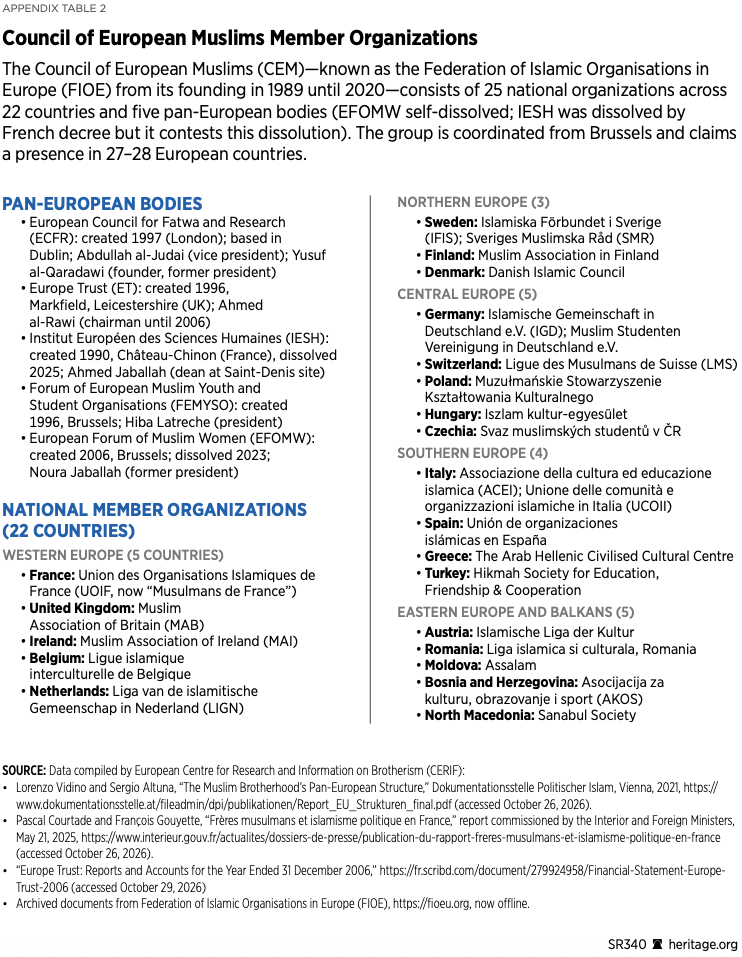
Europe is hardly ignorant of how Brotherism is Islamifying the West. Everywhere in Europe—in Belgium, Germany, the United Kingdom, Austria, the Netherlands, and Italy—Brotherism embeds the same network. However, those wanting to Islamify modernity do not constitute a centralized organization; their movement is a mesh of associations, federations, cultural centers, and training institutes linked by common men, funding, doctrine, and goals.[REF] Members of the European Union and individual countries have taken notice of these patterns at the highest level.
The European Conservatives and Reformists (ECR) Group has described a continental “network of networks” with seemingly autonomous national structures that nonetheless share a common matrix and maintain cross-border relays.[REF] Each country has its own national federation, but each federation is merely the movement’s local “branch.” Each branch uses the same transnational scaffolding of dedicated foundations that pool and move money across borders, such as the Europe Trust, tied to the Federation of Islamic Organisations in Europe. Each branch participates in pan-European religious bodies that issue the rulings that hold the network together. This includes above all the European Council for Fatwa and Research, created in 1997 under Yusuf al-Qaradawi. What looks, from any single capital, like an ordinary national association is in truth one node of a single European architecture.[REF] From Brussels to Vienna and from Paris to London, the strategy combines territorial anchoring through places of worship, educational and media investment, the quest for institutional recognition, alliance with sectors of the Left and of rights-based activism, and the structuring of a communal economy, from halal certification to Islamic finance.[REF]
The security services of several states have documented how the Brotherhood builds a community within a community.
- Germany’s Office for the Protection of the Constitution has long described the Brotherhood’s method as “Islamization from below.”[REF] This begins with the individual’s change of consciousness before working its way into society. In the long run, this “legalistic Islamism” threatens the democratic order more than jihadism does.
- Austria’s Federal Office for the Protection of the Constitution and Counterterrorism (BVT) has described a movement that is a “school of life, cultural association, social idea and economic enterprise in one,” whose hierarchically structured “inner core” hides behind a network of front associations.[REF]
- Belgium’s State Security Service, which has tracked the Brotherist “clandestine structure” since 1982, notes the Brotherhood’s drive to place people it has influenced within representative bodies and to keep alive tensions in which a Muslim can be cast as a victim of Western values. In 2020, it labeled this legalistic Islamic group “an extremist movement.”[REF]
- The Dutch General Intelligence and Security Service (AIVD), describing an outwardly moderate posture “with no violent intent,” concludes that the Brotherhood’s ultimate, unstated aim is “to create, then implant and expand, an ultra-orthodox Muslim bloc inside Western Europe.”[REF]
- Sweden’s Security Service records a European Brotherhood leader’s own words: “we do not want to draw attention to the fact that we are Islamizing the West, because it does not favor our purposes.” Promoting Islam means revolutionizing the continent: “Islam is an indivisible whole; religion, politics, confession, worship, action, ethics and other.”[REF]
Despite being aware of the Brotherist strategy, European countries have not responded with alacrity. Everywhere, the awakening is delayed by the focus on the jihadist threat, the difficulty of characterizing an influence that scrupulously avoids most illegality, and fear of the accusation of Islamophobia.
Two major official documents now frame the European debate about Islamifying modernity. In the United Kingdom, the government’s classified Muslim Brotherhood Review, the “Main Findings” of which were made public in December 2015, was the first governmental report to recognize the Brotherhood’s gradualism, legalism, and opacity, though it did little to awaken the British government from its dogmatic slumber.[REF] In France, a report commissioned by President Emmanuel Macron, The Muslim Brotherhood and Political Islamism in France, was made public in May 2025.[REF] This document was written in the wake of the controversies that followed the publication of my book The Brotherhood and Its Networks, which lays bare the essentials of Brotherism, set against other interpretations from academics across several continents. Many in Paris, London, Berlin, and now Washington recognize the diagnosis.
The European national contexts differ, of course: Brotherism’s infiltration of France looks different from its way of conquering federal Germany or multiculturalist Britain. Demography and colonial histories vary across countries, just as their legal and political institutions differ. Yet these differences merely change the terrain on which Islam operates. Brotherists use a common framework to pursue the same goal. They do so in one legal area with the same circulation of persons and funds. The European network is genuinely transnational as Europe increasingly is.
The French Case: Brotherism and the Assimilation Model. Several factors explain why France is the most advanced field for observing the implantation of Brotherism in a Western democracy. France is uniquely open to Muslim immigration, offers citizenship to many of those from its colonial empire, and is close to the Maghreb. The colonial, then postcolonial, ties with Algeria, Morocco, and Tunisia established massive migratory routes into France. The Republic received Muslim immigrants with a somewhat shared history of dependencies and resentments that the decolonial movements knew how to mobilize in the French context.
As a result, France has long had a larger Muslim population than most other countries in Western Europe have. Estimates suggest that between seven and nine million Muslims live in France. The Institute of Statistics and Economic Studies (INSEE) thinks that roughly 10 percent of adults in France are Muslim.[REF] Islam is already France’s second-largest religion.
This large population makes for a privileged space for Islamist entry and conquest. Brotherists can define the norms, representation, and collective interests for Muslims across the country. Brotherists can weigh in at the ballot box. They can sustain a considerable market—beginning with halal—and feed a network of associations and institutions. Above all, challenging Islam can be very risky in France: To criticize those who speak in the name of this population is to expose oneself to the reproach of targeting the population itself and to charges of violating hate crime laws that are designed to make critiques of the Islamifying of modernity a crime.
Laïcité (secularism), conceived to guarantee freedom of conscience and impose religious neutrality on the state and its agents, has often been turned against itself. The implantation of Islamism has never relied on a single lever. If each encroachment is examined in isolation, fact by fact, individual by individual, sector by sector, it looks small. Its coherence rests largely on the collective, simultaneity, and the articulation of facts and events.
Territorial implantation came first in France during the 1980s. Mosques and cultural centers became business centers and formed anchor points for social, cultural, and economic activities and for the diffusion of Islamic norms. France had about 100 Muslim places of worship around 1970; it had more than a thousand Muslim places of worship by the late 1980s according to the official Interior Ministry survey of 1989 and now has approximately 2,600 according to the most recent government statements.[REF] The building of distinct educational institutions and media came after Brotherists were prepared to undertake long-term conquest. The first Arabic religious program on public television appeared in 1982–1983, and Radio Orient began to broadcast daily prayers and Friday sermons in 1981–1982. Schools, cadre-training institutes such as the European Institute of Human Sciences, websites, and social networks transmitted the goals of Islamifying modernity to a generation born in France, framing French society as Islamophobic and offering a competing identity framework.
Brotherists did not stop at building parallel institutions. Once they achieved a strong base for action, they sought entry into existing French institutions. At first, they sought representation in bodies responsible for dialogue between the state and Muslim organizations, most notably the French Council of the Muslim Faith.[REF] They adopted a low profile during politically sensitive debates such as the one occasioned by the 2004 ban on conspicuous religious symbols in public schools. They presented themselves as indispensable partners in programs aimed at preventing jihadist radicalization and promoting social cohesion.
At the local level, Brotherists sought recognition as the legitimate representatives of Muslim communities, securing positions in consultative bodies, mediation schemes, and municipal partnerships. In Bordeaux, the local UOIF branch (the Association of Muslims of the Gironde) established educational-support partnerships with municipalities as early as 1991 and negotiated agreements on ritual slaughter and Muslim cemetery plots throughout the early 1990s. By 2005, UOIF leaders issued fatwas for calm in the wake of terrorist attacks. Such institutional recognition transformed an activist network into a trusted interlocutor of the public authorities, thereby increasing both its legitimacy and its capacity to influence public policy. Conditions were ripe for increasing demands.[REF]
As part of their entryism, Brotherists sought admission into mainstream politics through alliances with elements of the radical Left. This “red–green” alliance, also known as “Islamo-leftism,” is an enduring marriage of convenience.[REF]
The radical Left finds in Muslim populations an electorate and a figure of the oppressed to renew its activism. Brotherism gains a progressive endorsement, a vocabulary of rights and antiracism that shields its project from criticism. Each believes it is temporarily using the other to destroy common enemies dedicated to national sovereignty or Christian faith. Each thinks it is the dog wagging the tail. Islamists often profit more from these alliances than their left-wing partners do.
The instrument of that alliance was built by the Left itself. Founded in October 1984 by Socialist activists, SOS Racisme appeared in the years immediately following François Mitterrand’s abandonment of the socialist economic program. Having given up the class struggle, the Left needed another ground of mobilization and found it in antiracism. The calculation was double: Antiracism supplied a moral vocabulary that the Right could not contest without appearing to abandon decency, and it fixed public attention on the rise of the National Front, whose progress divided the conservative electorate. In doing so, SOS Racisme supplanted the autonomous movement of the children of North African immigration, which had carried its demands in its own name during the March for Equality and Against Racism from October to December 1983. That movement was absorbed into an antiracism managed by the Socialist Party; thereafter, others spoke in its name.
The instrument outlived the designs of its makers. An antiracism conceived to defend persons against discrimination was gradually redirected toward the defense of a doctrine against criticism. The vocabulary passed from “racism” to “Islamophobia,” carrying with it the presumption of innocence attached to the victim. In that displacement, the struggle against antisemitism tended to fade from activist discourse in favor of the struggle against Islamophobia, erected into the new antiracist priority. What the Socialists had built to divide the Right thus ended by giving Brotherist actors the one asset they could not manufacture for themselves: an antiracist certificate issued by the Left.
This pattern of mutual use first became publicly visible in the late 1980s during the successive “affaires du foulard,” when the antiracist Left defended Islamic markers like schoolgirls wearing Islamic headscarves as a progressive cause. Such links have since hardened into electoral clientelism with parties such as La France Insoumise. Socialist candidate François Hollande received 86 percent of the Muslim vote in the 2012 runoff, and the radical Left candidate Jean-Luc Mélenchon got nearly 70 percent of the Muslim vote in the first round in 2022.[REF]
This “red–green” alliance is an object of national concern. In December 2025, a French National Assembly commission of inquiry penned a several-hundred-page report about the links between political movements and networks propagating Islamist ideology. Chaired by Xavier Breton with Matthieu Bloch as rapporteur, the commission detailed an “electoralist strategy” pursued by part of the radical Left toward the Muslim electorate, intensified since October 2023, and issued 32 recommendations to halt this tendency. Although sharply contested by the parties it named and acknowledging that no structured link between political parties and Islamist movements had been established to date, the report nonetheless marks the institutional measure of France’s “red–green” debate.[REF]
Also crucial has been an expansive Islamic system of financing. Originally intended to allow Muslims to comply with Islamic dietary requirements, the halal market has expanded far beyond food purchases. Today, halal encompasses meat, processed foods, pharmaceuticals, cosmetics, tourism, finance, logistics, fashion, certification services, training, consulting, and a growing range of consumer products and services.[REF]
For Brotherist networks, halal has become both a powerful form of influence and a lucrative source of income. Halal certification fees, audits, licensing, consultancy, training, and accreditation provide recurring sources of income for organizations that control or influence certification schemes. The growth of certification requirements across an ever-expanding range of products and services has transformed halal from a niche religious practice into a highly profitable transnational industry. In 2024, the global Islamic economy—food, finance, cosmetics, fashion, tourism—was worth some $2.6 trillion, $1.53 trillion of which was for halal food alone.
Islamic finance assets, built through halal, approached $6 trillion in 2024.[REF] In France, halal food raises several billion euros per year, and its market size grows faster than the rest of consumption, including in large retail. The Muslim chain HMarket’s revenue jumped by 36 percent in a single year.[REF] Upstream certification levies a rent on each product and concentrates considerable resources in the hands of those who issue it. These market actors may not be religious, but they need a religious endorsement. One way or another, they invest in religious activities.
Halal also installs ritual conformity as a self-evident feature of everyday life in cafeterias, on store shelves, and in fast food, modest-fashion clothing, travel, hotels, tourism, and halal media. The French market has gradually accommodated the Islamic norm, which becomes prescriptive for Muslims. This extension of the Islamic practice is a “jihad through the market,” not because all halal commerce is Brotherhood-driven, but because commercial standardization extends the Brotherist norm beyond activist groups.[REF]
Brotherism has been able to develop for long periods without provoking sustained concern or an effective response in France. At first sight, the French laïcité model seemed to provide a powerful defense against Islamifying the country. By imposing religious neutrality on the state, excluding religious authority from political sovereignty, and restricting conspicuous religious expression in state schools and other public institutions, the Republic sought to contain religion within clearly defined limits. The 2004 law prohibiting conspicuous religious symbols in public schools and the 2010 ban on face coverings in public spaces were intended in part to preserve a common civic sphere against religious pressure.[REF]
Yet laïcité did not neutralize Brotherism. Laïcité was designed to regulate the relationship between the state and established religions, not to confront an ideological movement operating simultaneously through religious, social, legal, economic, educational, and political channels. Brotherist actors learned not to confront the Republic directly but instead to appeal to individual rights, equality, anti-discrimination, freedom of association, and community representation. Instead of openly challenging laïcité as a constitutional principle, they contested its application case by case, portraying restrictions on religious practices as discriminatory or “Islamophobic.” After the Charlie Hebdo murders in 2015, French discourse went from one of sympathy for the satirists to one of condemnation for their Islamophobic provocations. Hate crimes against Islam are not infrequently prosecuted and punished with fines.[REF]
The Brotherists knew how to use the transparency that characterizes French society. During the 2010s, the country was struck by spectacular jihadist violence—violence that issued from currents that Brotherism itself had nourished by spreading a rigorist and separatist reading of Islam. By concentrating the public authorities, the media, and public opinion on the security emergency, Brotherists could advance their efforts in the shadows.
Finally, the French response remained fragmented. Security services focused on violent jihadism, elected officials focused on maintaining social peace, courts examined isolated legal disputes, and public administrations sought representative Muslim partners. Because no institution first considered the entire ecosystem—its doctrine, networks, financing, social services, international connections, and gradual strategy—the movement to Islamify individual countries was repeatedly reduced to separate questions of worship, discrimination, integration, or public order. No one grasped the threat as a whole.[REF]
The British Case: Brotherism and the Community Model. The United Kingdom promotes a multiculturalism that recognizes and institutionalizes identity groups. Where the central French state and its consultative bodies negotiate with Brotherist proxies, the United Kingdom offers communal representation. Muslim leaders must first be recognized as the legitimate spokesmen for “Muslim communities” and then capture funding for community groups through public programs promoting diversity so that they can anchor themselves in local and national governments. The combination of strong protection of some individual liberties, a policy of communal representation, and a pragmatic use of certain Islamist interlocutors creates the uniquely British conditions for Brotherist organizations to put down roots. London was thus able to become a logistical and ideological base for Brotherism and other forms of extremism. The term “Londonistan,” coined by the French services in the 1990s, described what Britain’s tolerance wrought.[REF]
As in France, Brotherists in Britain were elevated as spokesmen for their people. As noted, the Jenkins–Farr report shows how the Brotherhood shaped the Islamic Society of Britain, dominated the Muslim Association of Britain, and helped to create and lead the Muslim Council of Britain.[REF] To the public, these structures appear national and representative, not as affiliates of the Brotherhood. Personal membership in the Brotherhood remains secret. Far from being marginal, these organizations became the state’s privileged partners. Successive British governments—notably under New Labour—treated the MCB as the de facto representative voice of British Muslims, consulted it on policy, and channeled public funds to it and to affiliated bodies while the police partnered with the MAB, including in the takeover of the Finsbury Park mosque.[REF]
The 2014 “Trojan Horse” affair in Birmingham illustrates the challenge of countering Brotherist influence. The city government received an anonymous letter describing a coordinated Islamic plan to take control of several public schools. An official inquiry led by Peter Clarke, a former senior British police officer who was appointed Education Commissioner for Birmingham, found no evidence of terrorism or violent radicalization. It also concluded, however, that there had been “co-ordinated, deliberate and sustained” attempts to introduce an “intolerant and aggressive Islamic ethos” into certain schools. This included segregation of students by sex, restrictions on the curriculum, and the suppression of anything perceived to be hostile to non-Islamic teachings.[REF]
Clarke described a pattern of entryism and infiltration but did not attribute such efforts to the Muslim Brotherhood.[REF] Some deemed the Clarke report an “Islamophobic” overreaction to new citizens merely exercising their rights. Clarke’s appointment was criticized at the time (including by West Midlands Police) because his counterterrorism background seemed to prejudge the nature of the problem. In any event, the prosecutions were dropped because of procedural concerns in 2017.[REF] Subsequent official events, however, broadly confirmed Clarke’s findings.[REF] The most prominent case involved Park View Academy, a non-faith public school where almost 98 percent of pupils were Muslim. The Office for Standards in Education, Children’s Services and Skills placed the school in special measures, and disciplinary proceedings were later brought against several teachers.
Britain was concerned about the problem before France was, but its multiculturalism prevented the country from responding. The Jenkins–Farr review’s “Main Findings” describes a Brotherhood that prefers gradual, nonviolent change but does not rule out violence. According to the report, the Brotherhood has “deliberately, wittingly and openly incubated and sustained” Hamas, whose military wing is proscribed in the United Kingdom. Brotherhood activity in Britain is “sometimes secretive, if not clandestine,” and organizations associated with the Brotherhood retain an influence “disproportionate to their size” over student organizations, charities, and mosques. Certain aspects of the Muslim Brotherhood’s ideology and tactics are, as the report concludes, “contrary to our values” and to national security.[REF] The report confirms the method used everywhere in Europe: gradualism, legalism, opacity, and an ambiguous relationship to violence. Despite this, in the report’s aftermath, the British opened the door to additional Muslim immigration.
The British did not ban the Brotherhood or even seriously consider doing so. Like the French, they could see in certain Brotherhood organizations convenient partners for public dialogue about mutual understanding and treat Brotherists as possible partners against violent radicalization. Is this pragmatism? How does one ban a secret brotherhood? What is certain is that this passivity did not prevent its advance and allowed the highly adaptable Brotherhood method to deploy itself far beyond the European continent.
Warning Signs in America
In the United States, the gradual construction of an institutional ecosystem that helped to organize, represent, and normatively shape American Islam is well documented. Lorenzo Vidino, director of the Program on Extremism at George Washington University and a specialist in Muslim Brotherhood networks in the West, traces its origins to the arrival of students from the Middle East and South Asia on American campuses during the late 1950s and 1960s. In 1963, they founded the country’s first nationwide Muslim student organization, the Muslim Student Association (MSA) at the University of Illinois. The Brotherhood did not exercise complete control of the MSA, but some Brotherhood associates held influential positions, allowing the MSA to be both a recruiting environment and the nucleus of a broader institutional network. Greater control came gradually.[REF]
From this milieu emerged what Vidino calls the Brotherhood’s American “legacy organizations:”
- The North American Islamic Trust, established in 1973 to hold and administer property;[REF]
- The International Institute of Islamic Thought, founded in 1980 as an intellectual and publishing center;[REF]
- The Islamic Society of North America (ISNA), created as a permanent umbrella organization for a community no longer confined to universities;[REF]
- The Muslim American Society, established in 1992;[REF] and
- The Council on American–Islamic Relations (CAIR), which arrived in 1994 to become the Muslim civil rights and advocacy group.[REF]
These bodies were neither identical nor necessarily subject to a single chain of command, but their origins, overlapping leadership, and complementary functions reveal the emergence of a durable institutional ecosystem.
A small group of activists—notably Jamal Barzinji, Ahmad Totonji, and Hisham al-Talib—played a crucial role in building this infrastructure. These three Iraqi Kurds had studied in Britain before moving to North America. They helped to create or lead several of these organizations and helped to connect student activism, religious institutions, property ownership, publishing, and international networks. According to Vidino, Gulf donors provided an estimated $10 million to $20 million per year for these groups.[REF] The result was not a centrally controlled American branch of the Egyptian Brotherhood, but a broad network rooted in a common formative milieu and increasingly capable of influencing how Islam was organized, represented, and publicly understood in the United States.
The American trajectory closely parallels those of Britain and France, although efforts in the U.S. are more desultory. In all three countries, Brotherist networks at first sought legitimacy rather than political power. They presented themselves as national Muslim organizations operating within the ordinary rules of liberal democracy. As such, they were entitled to the same constitutional protections, public recognition, funding opportunities, and consultative status that other religious or civil society organizations received. They did not challenge the state from outside but sought to become its preferred interlocutors on matters concerning Islam.
Once these organizations achieved representative status, governments, local authorities, journalists, universities, philanthropies, and private donors increasingly turned to them as authoritative voices of Muslim communities. Institutional recognition attracted funding; funding professionalized the organizations; professionalization strengthened their status as representatives. In each country, the ecosystem became self-sustaining, especially with monies from foreign sources.
The global war on terrorism accelerated this process. Faced with the threat of jihadist violence, public authorities sought Muslim partners who could condemn terrorism and engage with Muslim communities. Organizations from the Brotherhood milieu were often well positioned to present themselves as the “moderate” religion-of-peace alternative to violent Islamic extremism. The principal criterion for being a good Muslim in America became the rejection of violence rather than adherence to liberal democratic norms or the rejection of totalitarian ideologies. No one scrutinized long-term ideological objectives. As a result, institutions seeking to combat violent Islamism sometimes strengthened nonviolent Islamist actors by granting them access, credibility, funding, and representative status.[REF]
Although the institutional pathways differed, the underlying mechanism is remarkably similar. Public recognition transformed activist networks into recognized representatives, allowing them to shape the normative boundaries of Islam in their respective countries. The Muslim Council of Britain in the United Kingdom, the French Council of the Muslim Faith and local consultative bodies in France, and organizations such as ISNA and CAIR in the United States all serve the same function.
Three recent developments suggest that several defining features of the Brotherist system of action are now becoming visible in the American context.
The emergence of a “red–green” political alliance. The election of Zohran Mamdani as Mayor of New York City is a watershed,[REF] as is the nomination of Abdul el-Sayed as a Democratic Senate candidate in Michigan. There is no evidence that Mamdani belongs to the Muslim Brotherhood or to any Brotherhood-linked organization, and the same cannot yet be said of el-Sayed. The problem, however, is not just affiliation but convergence. Mamdani’s unwavering support for the Palestinian cause and the BDS movement drew strong backing from CAIR Action, which mobilized Muslim voters, urged Democratic leaders to endorse him, and celebrated his victory as a milestone for Muslim political representation. One CAIR official went so far as to describe it as a “referendum” on Palestinian resistance.[REF] Mamdani also campaigned alongside Imam Siraj Wahhaj, a prominent but controversial Muslim leader named as an unindicted co-conspirator in proceedings related to the 1993 World Trade Center bombing—a designation his defenders dispute.[REF] Scratching the surface of a Muslim candidate, one rarely finds more than two degrees of Muslim Brotherhood.[REF]
Together, these developments suggest a coalition in which progressive activists and Islamist actors advance shared objectives and mutually reinforcing narratives. The Islamist side gains access to legitimate political arenas, enjoys elevated status as ordinary coalition partners, and—perhaps most important—can reframe scrutiny of their ideology as “Islamophobia.” Such is the benefit afforded by allies whose antiracist credentials place them beyond suspicion.
Such alliances have a European history. Since the 1990s, sectors of the radical Left and Islamist movements in France and the United Kingdom have cooperated tactically. This allowed Brotherist groups to normalize themselves without requiring either side to abandon its long-term objectives. In Britain, the Respect Party, founded in 2004, united George Galloway and elements of the revolutionary Left with the Muslim Association of Britain. Recall that MAB is the very organization the Jenkins–Farr review would later describe as dominated by the Muslim Brotherhood.[REF] These alliances are not merely local marriages of convenience; they are the fruit of theorists with international ambitions among both reds and greens.
Among the reds on the Left, Chris Harman’s “The Prophet and the Proletariat,” published in 1994, fixed the doctrine in a formula: “with the Islamists sometimes, with the state never.” On the green Islamist side, Yusuf al-Qaradawi and Rached Ghannouchi advised cooperation with non-Islamist forces whenever it served the movement’s strategic objectives.[REF] Brotherists would never abandon the superiority of their doctrines, but they would embrace a temporary alliance when circumstances justified it. Herein lies the asymmetry that defines the “red–green” phenomenon: On the Left, the alliance is a tool to attack the right for racism; on the Brotherhood side, it is a doctrinal tactic.
The significance of the New York case therefore lies less in the personal beliefs of one elected official than in the emergence within American politics of a coalition that plays a known role in normalizing Brotherist actors in parts of Europe. If this reading proves correct, the United States is witnessing not a model imported from abroad, but the domestic adaptation of a dynamic extensively studied elsewhere.
Note that this dynamic carries its own tensions, as the case of Hamtramck, Michigan, illustrates. This small city in the suburbs of Detroit, with some 28,000 inhabitants, elected an all-Muslim city council in 2021—a first in the United States—with the support of progressives who saw it as a victory for inclusion. In 2023, the same council voted for a resolution restricting the flags permitted on public buildings, a measure widely understood as targeting the rainbow flag. It removed members of a commission who had raised the flag. The ensuing controversy, sharpest among the officials’ former progressive allies, exposed the fragility of such alliances of minority solidarity as soon as one side begins to advance Islamic norms. Perhaps the case presages a rupture within a political coalition—or perhaps it demonstrates the cunning of Brotherhood tactics. Machiavelli would be proud.[REF]
- Territorial implantation, which begins with an anchor institution. Consider the so-called EPIC City project in Texas, a real estate development of some 400 acres led by the East Plano Islamic Center near Josephine, about 40 minutes northeast of Dallas. This complex combines more than 1,000 housing units with a mosque, a faith-based school, a community college, and shops. Each investment share amounts to more than $80,000. EPIC City aggregates housing, worship, education, and economic activities—a multisector configuration that resembles certain arrangements in European Islamic centers—without on its own proving a tie to the Brotherhood. Other such enclaves are present in Minneapolis, Minnesota; Dearborn, Michigan; and elsewhere.[REF]
Appeals to laws and norms of religious neutrality and anti-discrimination. The strategic recourse to litigation, already observed in France and the United Kingdom, is also central in the United States. In November 2025, Texas Governor Greg Abbott designated CAIR and the Muslim Brotherhood as terrorist organizations and ordered investigations.[REF] CAIR promptly filed suit, denouncing the governor’s actions as discriminatory and unconstitutional. Litigators simultaneously defend legal rights while advancing a political or reputational goal that could ultimately undermine the foundation of such rights. It should be noted, however, that a federal Department of Justice investigation of EPIC City opened in the spring of 2025 and was closed that June after the developers pledged to comply with federal housing law.[REF] Here we have a textbook case: a project presented by its developers as a residential and communal aspiration but read by the state’s executive as the marker of an organized implantation.
Nevertheless, America differs from the European cases in many respects. The United States counts about 3.5 million Muslims, which is roughly 1 percent of the population,[REF] whereas Muslims account for some 10 percent of the adult population in France[REF] and 6.5 percent in England and Wales.[REF] The base in the U.S. is both more diverse in origin and often better integrated economically. As a result, it has been harder for Islamic groups to form a unified Muslim bloc in the United States. The United States has no historical equivalent to the Franco–Maghrebi colonial tie and its resentment that the Brotherhood can mobilize.
In politics, American law, including the First Amendment, strongly protects the free exercise of religion, freedom of speech, and freedom of association while prohibiting an established national religion. What the French republican model treats as a question of institutional neutrality the United States treats as a question of constitutional liberties. As a result, a judge evaluating a governor who designates a movement as terrorist also requires that the governor exercise strict religious neutrality. British precedent better illuminates the American predicament: The United Kingdom likewise came up against the limits of a culture of free expression and religious neutrality. As a result, any effort to single out Islam as a unique threat runs up against principles of religious liberty. In our French context, Islam is a unique threat; Britain and the West generally have yet to develop tools to recognize that reality.[REF]
The Franco–British experience furnishes three axes and three corresponding questions for judging how Islam comes to America: through institutional infiltration, ideological alliances, and multisector strategies. In short, what has happened in Europe does not necessarily apply mechanically to the United States, but it does apply.
Institutional Infiltration. In France, recognition by the state played a decisive role in normalizing Islam. Once they became legitimate interlocutors of a community, Brotherhood actors transformed from agitators and activists into institutions.[REF] In the United Kingdom, Brotherists took another route, seeking to be representatives of the community and controlling local governance as in schools or boroughs. Yet the central goal is to become the official voice of the Islamic population. American local electoral democracy offers a more direct and even more democratically legitimate route than the French consultative bodies offer. What passes in France through negotiation with the state passes in the United States through the winning of an election, which is a matter of ordinary democratic play. Muslim candidates who can win elections can easily rebut the accusation of entryism. On this point, America resembles the United Kingdom more than it resembles France: In both cases, pluralism rather than secular centralization offers the foothold.
Ideological Alliances. European “Islamo-leftism” reflects a simple exchange: On one side, a radical Left seeks figures of the “oppressed” or the “proletarian;” on the other, the Brotherhood seeks progressive endorsement, state recognition, and money. The movement starts as a coalition but ends as a more unified force. In France, the “red–green” alliance unites on the vocabulary of antiracism and the fight against Islamophobia but without being integrated. In the United Kingdom, the “red–green” electoral coalitions have developed into parties themselves. George Galloway’s Respect Party, for instance, was backed by the Muslim vote of Tower Hamlets and Bradford in the 2000s or the alignments of part of London’s municipal Left, which was backed by figures close to the Brotherhood.[REF]
The situation in New York resembles the United Kingdom: vocabulary of antiracism and social justice, mobilization of a Muslim electorate, convergence between identity-based demands and a left-wing program.[REF] In Europe, the alliance has been forged with identified Brotherhood organizations; in New York, nothing of the sort is yet formally established. The American urban Left has its own genealogy, and the Muslim electorate is still too diverse to be fully assimilated into a unified bloc. In America, the “red–green” alliance is still an electoral coalition between progressives and Muslim voters. This may be common in democracies or an organized effort by elements of the Brotherhood. Research has not yet provided an answer.
Multisector Strategies. The most characteristic trait of European Brotherism is simultaneous action on several terrains—territories, education, media, institutions, economy—whose connections appear only from a distance. An isolated fact proves nothing; it is the convergence of several over time and in the same direction that characterizes a strategy. The American signals are too contaminated by noise. At this stage, they remain scattered facts. As is often said, more research is needed.
Policy Options to Counter the Brotherist VIP Plan
If the Brotherhood networks are transnational in Europe, and if on both sides of the Atlantic they proceed from the same ideological matrix, then the response cannot remain strictly national. A phenomenon that transcends borders requires a resistance with the same scope and ambition. It must also take a concrete form, such as the Transatlantic Institute for the Study of Contemporary Ideologies (TISCI).[REF]
The need for such a structure arises from an asymmetry. Europe has direct experience, accumulated empirical evidence, and several official diagnoses. The reality of the Brotherhood’s methods has been documented by 30 years of field research in France, the United Kingdom, Belgium, the Netherlands, Germany, Austria, and Italy.[REF] However, the countries often lack a durable means to coordinate research and action. Public funding for research on these subjects is politically difficult. Large-scale private philanthropy is nearly absent. Analysis that offers policy action is vehemently denounced and tarred as discriminatory.
The United States, by contrast, possesses an ecosystem of foundations and think tanks that are independent of the state and could conduct research over the long term. It also enjoys a legal and cultural framework that is more favorable to free discussion, and a new political possibility. American knowledge of the European networks remains fragmentary, but while Europe still hesitates to coordinate its diagnoses, Washington has begun to designate branches of the Brotherhood as terrorist organizations. For instance, in January 2026, the State and Treasury Departments did just that to the Lebanese, Egyptian, and Jordanian chapters.[REF]
TISCI could coordinate a transatlantic network of researchers with the grants and fellowships that allow risky or poorly funded work to see the light of day. Regular international conferences, transatlantic gatherings bringing into dialogue researchers, policymakers, magistrates, and civil society, are also needed to develop a body of knowledge for decision-makers. Such a structure responds directly to the challenge of a multifactor enemy. Shared analyses would transcend the jurisdiction and media echo chambers of a single state. The common work of definition—agreeing on what Brotherism is, on what distinguishes it from ordinary religious practice, on the thresholds beyond which influence becomes a democratic problem—would give decision-makers on both shores a shared language that could not easily be dismissed as a narrow creature of Washington, Paris, Brussels, or London.[REF]
Brotherism is first and foremost an ideological and institutional enterprise. National security alone cannot defeat it. Any response should build intellectual, documentary, legal, and psychological resources to name, describe, map, and understand its mechanisms and to inform the public of them. Because the project is adaptive, legalistic, and multisectoral, responses that merely dissolve one federation, close one hostile mosque, or prosecute one terrorist cell leave the enterprise intact. Effective policy must therefore strike at the conditions that allow the enterprise to perpetuate itself. Decision-makers should consider ways to eliminate the asymmetrical applications of law while weakening the demographic and electoral leverage that sustains the enterprise, the parallel systems it seeks to entrench, and the public and private resources that finance it.
The following policies, if implemented effectively, can protect countries from the Brotherist network.
Rigorous and even-handed application of equal protection under the law. European statutes prohibit public insults, provocations to hatred, and discrimination on grounds of religion or origin. In practice, however, these instruments are applied selectively. Criticism of Islamic doctrines, practices, or political projects is routinely treated as “Islamophobia” and prosecuted, but comparable or more explicit statements emerging from Islamist milieus rarely face such scrutiny. This double standard is a structural resource that feeds Brotherism. By raising the reputational and legal cost of scrutiny while shielding its own discourse behind the language of rights and victimhood, Brotherism converts the legal order into an instrument of its own advance.
Restoring equal application of these laws—treating calls for the primacy of Sharia, for the punishment of apostates, or for the subordination of women with the same rigor that is applied to other forms of supremacist speech—would remove a decisive advantage. Critics of Islam face hate crime charges all over the continent, while clerics calling for a metaphorical death to the West or the end of Christianity are beyond the reach of the law. Perhaps equal protection comes from eliminating hate crime statutes. Or perhaps it comes from enforcing such laws equally. Either way, equal protection should ensure that the legal system no longer systematically favors the side that seeks to close the public sphere.[REF]
An immigration policy guided by the long-term capacity of host societies to maintain their own cultures and norms. Brotherism thrives where demographic concentration creates electoral strength and allows for parallel institutions. France’s postcolonial migratory patterns and relatively high naturalization rates produced within a few decades a Muslim population large enough to sustain mosques, schools, media, and political clienteles. Uncontrolled Muslim immigration enlarges the Muslim demographic.
European countries should prioritize cultural and civic compatibility. This should include knowledge of the national language, acceptance of civil law, a willingness to assimilate to the host country’s ways, and repudiation of totalitarian ideologies. Family reunification and asylum procedures that lead to more Muslim immigration are self-defeating because the population is already marked by high degrees of political and social separatism. The British experience after the Jenkins–Farr review shows that diagnosis without demographic restraint leaves the underlying conditions for the growth of Brotherism unchanged. Clearer selection criteria for future immigration would not eliminate Brotherism overnight but would slow the territorial and electoral consolidation on which the long-term Brotherist strategy depends.[REF]
Explicit prohibition of any form of Sharia-based parallel jurisdiction or arbitration that conflicts with the civil and criminal law of the host state. Brotherism grows beyond infancy where Islamic rules governing marriage, divorce, inheritance, apostasy, and sex relations are practiced. Informal Sharia councils, religious arbitration agreements, and community pressure already grow in the spaces provided in Europe and, increasingly, in certain American localities.
Statutory bans on the enforcement powers of such parallel systems, coupled with criminal penalties for those who coerce individuals into submitting to them, would complicate efforts to implant Islamic ways within the host country. The experience of certain German and British localities where parallel family-law practices have produced measurable departures from national standards shows the reality of the problem. American states using their police powers might construct a feasible response. A clear statutory barrier would force the movement to operate openly within the host legal order rather than beneath it.[REF]
Increased transparency and oversight requirements for public funding channeled through nongovernmental organizations. Channeling public funding through private groups has become a favorite policy of the Left. Brotherist networks have mastered the art of presenting themselves as ordinary partners receiving public monies to achieve public goods like day care or education. Once funded, they can funnel money whereever they choose to funnel it.
Mandatory disclosure of foreign funding and institutional affiliations and of downstream recipients of public money—backed by the power to suspend or reclaim funds upon evidence of concealment or ideological capture—would weaken this self-reinforcing cycle. The French and British records of successive governments treating Brotherhood-linked federations as preferred interlocutors show how easily public resources can become instruments of the very project they are meant to contain.[REF]
Conclusion
Taken together, these measures shift the focus from symptoms—individual radicals, single associations, episodic violence—to the structural conditions that encourage efforts to Islamify modernity. None of these steps is sufficient alone. Together they constitute a coherent defense of existing societies against Islam’s civilizational challenge.
Florence Bergeaud-Blackler, PhD, is an anthropologist; Research Fellow at the National Centre for Scientific Research (CNRS); Founding President of the European Centre for Research and Information on Brotherism (CERIF); and Founder of the Transatlantic Institute for the Study of Contemporary Ideologies (TISCI).
Appendix
Below are detailed charts depicting the Muslim Brotherhood’s infiltration of France (Chart A) and of Europe as a whole (Chart B).