I know nothing about automobile racing, and I confess it at the outset, honesty being the virtue my mother prized above all others save punctuality.
Yet racing has a way of finding a person. When I was a boy in the 1980s and 1990s, my father, on the occasional Sunday afternoon, kept the television tuned to NASCAR. The names drifted through our living room like the smell of pot roast: Richard Petty, Dale Earnhardt, Darrell Waltrip, Jeff Gordon.
Once, the athletic director at our Baptist church loaded the youth group into a van and drove us to Atlanta Motor Speedway. There, amid gasoline and thunder, a cluster of drivers signed my cap. Which drivers, I could not tell you; the cap sleeps on the top shelf of my closet. But I remember running into Bobby Cox and Terry Pendleton, of our beloved Braves, and they signed it, too.
I write now from an Indianapolis hotel room, having spent the week with The Mont Pelerin Society. Friedrich Hayek and a few dozen others founded the Society in 1947, gathering beside a Swiss mountain amid the rubble of a world war to keep alive the idea of a free people prospering through free markets. Last year, readers may recall, we were in Morocco. This year, in honor of the nation’s 250th birthday, we came to Indianapolis, home of Liberty Fund, our host and an institution I love.
>>> The Hidden Jewel at Jacksonville State
Mont Pelerin meetings are known for their excursions. I once climbed a volcano in Guatemala. This week we went to the Speedway.
It’s an immense place. On race day, some 350,000 souls fill its grandstands and infield while jets tear open the sky. On an ordinary autumn afternoon, with the stands empty and the wind moving through them, it feels like an unroofed cathedral. One stands in it smaller and grateful.
I was told I would be offered a lap with a professional driver. At the entrance waited a stack of liability waivers thick as a family Bible, and my hand trembled as I signed. Then, as if Providence had a hand in the seating chart, I saw Sam Karnick of the Heartland Institute, who missed the conference entirely but arrived from Chicago just in time for this excursion.
I will say only that Sam has stood beside me in matters both personal and professional, which in my life were never quite separate. Sam was riding, too. We would go together.
But first, let me tell you about the museum.
The Speedway opened in 1909. Two years later, Ray Harroun won the inaugural Indianapolis 500 in the Marmon Wasp, a long yellow needle of a car equipped with what may have been the first rearview mirror fitted to an automobile. In the museum stood its replica, along with machines that marked the successive revolutions of racing: the 1914 Delage, the 1928 Miller Special, Bobby Unser’s 1968 Rislone Eagle, the 1972 Sunoco McLaren associated with Roger Penske’s first Indianapolis 500 victory, and the 1982 STP Wildcat in which Gordon Johncock beat Rick Mears by a mere sixteen-hundredths of a second.
Each car tells a story of ingenuity, rivalry, and the restless dissatisfaction that facilitates progress. After World War II, the track lay neglected, its bricks surrendering to weeds, until Terre Haute businessman Tony Hulman bought it in 1945 and restored it. Racing moved from the front-engine roadsters to rear-engine cars, from one mechanical innovation to another, each generation testing the limits left by its predecessor. The record was never allowed to stand for long; someone always thought he could go faster.
Consider the distance traveled in little more than a century. The automobile was still a novelty when the Speedway opened. Now, machines hurtle around its oval at speeds exceeding 230 miles an hour. No central planner conceived this progression, no committee assembled all the knowledge required to produce it. Mechanics, engineers, inventors, drivers and investors each contributed something, often without knowing what the next man would do with it. Some made fortunes; some lost them. The accumulated result exceeded what any one of them could have imagined.
Hayek had a name for the order that emerges from such dispersed knowledge and individual effort: the extended order. The Speedway offered a particularly American illustration: 100 years of rivalry and experiment, ambition and failure, producing an achievement no single mind could have designed.
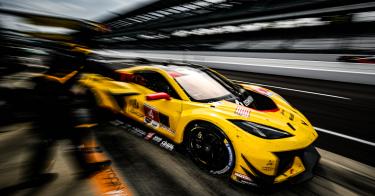
And so, to the car. Sam and I folded ourselves in and drew the belts tight, and I resolved not to utter a sound, lest some small whimper distract the man whose profession it was to keep us alive. The engine woke. We swept down the straight and up the banking toward the wall, the concrete flashing near enough to touch, the world narrowing to a gray blur and a roar.
I was afraid. I was also, I confess, happy, with that doubled feeling Edmund Burke described when he set the beautiful, which pleases, beside the sublime, which terrifies and exalts at once. Indianapolis Speedway is both. The beauty of a thing well made, and the sublimity of a thing just short of control.
Then the lap was over; silence rushed back. Sam looked at me. He laughed; I laughed.
>>> The Great Migration Remaking Higher Ed
Outside the car, the concrete beneath our feet seemed reassuringly solid. My knees were unsteady, and my heart had not yet settled into its usual rhythm. I thought of Harroun with his rearview mirror, Hulman with his ruined track, and the generations of mechanics and entrepreneurs who had risked money, reputation, and sometimes life itself to see whether a new idea might work.
Their stories differ, but they share a certain disposition: a willingness to act without possessing all the answers, to risk failure without a guarantee of success, and to discover through experiment what no amount of speculation could establish in advance.
That disposition has helped make America what it is. The free society does not promise that every venture will succeed or that every wager will pay. It permits people to try, to compete, to learn from failure, and to build on what others have discovered. Its achievements belong not merely to the celebrated winners but also to the countless people whose experiments, including unsuccessful ones, made the next experiment possible.
Sam and I did little more than occupy two seats for what seemed like a few seconds. We weren’t drivers, engineers or entrepreneurs. We’d simply agreed to the ride, signed the waivers, and climbed aboard. But as we walked away from the track, still chuckling, I thought something was fitting about coming to Indianapolis with a society devoted to liberty and leaving with a fresh appreciation for what liberty makes possible.
The car went around in a circle. The country, over the course of two and a half centuries, has traveled considerably farther.
This piece originally appeared in 1819 News