

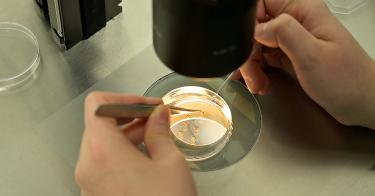
Amid speculation about a 2028 presidential run, Alexandria Ocasio-Cortez continues to make headlines after posting a video of herself injecting hormone stimulation drugs into her stomach as part of her egg freezing journey.
She called the decision “badass” and framed it, alongside her fight for reproductive rights, as a corrective to everything women were never taught about their own bodies. What she didn't mention is what it costs—financially, physically, relationally, and in unrealized dreams for motherhood. A congresswoman can absorb thousands of dollars per cycle, storage fees, and the subsequent cycles of IVF that follow if she ever wants to use her eggs to have a baby. Most of the young women watching her cannot.
The industry has an answer for them. Cofertility's new “Split” program lets women freeze their eggs and store them for 10 years, for free. But there is one caveat: you must donate half of your eggs to another family.
For a generation of women increasingly told that they can delay their fertility, this seems like a no-brainer. But the catch? Your biological children may be walking around in the world before you've knowingly created your first child, and it's the fertility organizations that are profiting. Indeed, Split's offer raises the question its marketing is designed to keep you from asking: Is this generosity, or a transaction? And if it is a transaction, what exactly is being sold?
The appeal is obvious. Egg retrieval costs about $11,000 on average for a single cycle, before annual storage fees. That hefty price tag makes cost one of the biggest barriers for young women hoping to delay childbearing. Cofertility's CEO put it plainly: “the best time to freeze your eggs is often when you can least afford it.”
>>> What The Fertility Industry Doesn’t Want Couples To Hear
That raises an important question: Does egg-sharing empower women, as Cofertility claims, or exploit their financial vulnerability? The answer is, unfortunately, the latter. The fact that women can pay for their future children by giving away their biological parenthood should feel unsettling, to say the least.
Still, the egg-freezing business is booming. The global trade in human eggs is worth nearly $4 billion and projected to reach $4.6 billion by 2030. Elective egg-freezing nearly quadrupled between 2014 and 2021, with nearly 40,000 cycles in 2023 alone. For women who return to use their eggs, live birth rates run roughly 30—45%, especially if women freeze 20 or more eggs before the age of 36.
But just because a woman freezes her eggs doesn't mean she will use them, or that they will work. For example, in one study, only 5.7% of women who froze eggs between 2014 and 2016 returned within seven years. In that same study, of more than 15,000 women who froze their eggs, just 258 live births resulted, which is less than 2% of the women who froze eggs.
Most frozen eggs fail to produce viable human embryos or sit in storage tanks indefinitely, generating storage fees, not children. Indeed, what Cofertility and other companies are selling is merely the possibility of a baby, and an unreliable possibility at that. For women in the “Split” program, imagine finding out that your share of eggs failed while other couples successfully created children biologically related to you. It's a reality too few egg donors consider until it's too late.
So what kind of transaction is this? Traditional egg donations operate under a simple contract: a donor gives her eggs in exchange for monetary payment, usually to the sound of five figures, sometimes even six. This method has long received ethical criticism. To state the obvious, assigning a “market value” to a woman and her eggs is deeply alarming.
Cofertility even agrees that the traditional payment model can “blur the lines between a choice freely made and one influenced by finances” and that “egg donor compensation opens the door for exploitation.” The Split model attempts to remedy these issues by eliminating the fiscal compensation for egg donations. In their own words, “the last thing that you need to feel like is that you're 'shopping' for a human… And we'll never make it feel that way.”
Nor is this “free” benefit free for a woman's body. Egg donors are not patients; they are healthy young women placed on powerful hormones they have no medical need for, risking ovarian hyperstimulation syndrome, blood clots, kidney failure, and hospitalization. Long-term effects, including cancer risks, remain poorly understood because no one systematically tracks egg donors. When the industry promises “no known risks,” the operative word is “known.”
Cofertility claims that egg freezing promotes social justice and equal justice. How? Supposedly, egg freezing reduces the “obstacles women currently face because their reproductive window is smaller than men's.” This framing assumes that motherhood and one's biology are oppressive, a limitation women should overcome. Moreover, such an outlook often prioritizes career at the expense of a woman's ability to naturally have kids.
>>> Turning Children into Commodities
Indeed, as Brigitte Adams, poster woman of the “freeze your eggs, free your career” movement, found, the chances of having a child later are far from certain. After each of her own eggs failed, she eventually used donor egg and donor sperm to create a child. As Natalie Lampert, author of The Big Freeze, found, egg freezing is “a faulty promise” that sells women a dangerous myth: “that any woman who tries hard enough can have whatever she dreams of, whenever she wants.” Unlike Adams, after her own research she declined to freeze her eggs.
In the name of helping another family, or of extending one's biological clock in pursuit of career or Mr. Right, many women have fallen captive to the manipulation of their own bodies. Programs like Split encourage them to sell their biological parenthood to pay for a procedure they cannot afford, all while the company markets their eggs to intended parents.
While eggs are biologically and ethically distinct from human embryos, which are genetically complete and distinct human persons from the earliest stages of development, they do confer 50% of a person's DNA to a child. As one man told a friend of mine, it wasn't until years of donating his sperm that he realized he probably had multiple children alive, a possibility he didn't consider until long after the donations were complete.
Programs such as Split show what happens when childbearing becomes untethered from marriage. For most of history, family formation, and every responsibility it carried, belonged inside an enduring, stable relationship. Only recently did we begin to treat children as a “right,” obtainable apart from marriage, and egg-sharing shows where that logic ends, with women feeling compelled to sell their own eggs in hopes of a future child.
Which brings us back to AOC. The 36-year-old has been with her partner for a decade and engaged for five years. In her video, she named the real problem, that women are never taught to understand their own bodies, and then pointed her followers toward the industry that profits from their ignorance. She could have encouraged them toward marriage and children, something she is free to pursue herself. Instead, she sold them big fertility's own marketing schemes.
This piece originally appeared in Evie Magazine



