Social science research finds that Head Start, a federally funded preschool program for children from low-income families, does not prepare children for K–12 schools, nor does it improve their social skills. Reports on spending and safety also show that Head Start centers waste money and fail to protect children. After more than six decades and more than $240 billion in federal spending, Head Start is a poor option for parents seeking childcare for their preschool-age children.
New findings on the program’s strict rules, along with the second Trump Administration’s budget plans, have brought fresh scrutiny to Head Start. The program is burdened with bureaucratic red tape that does nothing to help children and families. Congress should end Head Start. In the meantime, they should provide parents with their child’s share of Head Start funds so that parents can choose other preschool options. Lawmakers should also cut Head Start regulations and remove burdensome administrative rules.
In 1965, President Lyndon Johnson’s Administration championed the creation of Head Start as a preschool program for children from low-income homes. Head Start began as an eight-week summer program. Congress expanded the program over time. Head Start centers now offer services year-round. In 1995, lawmakers created Early Head Start to serve expectant mothers and their children from birth through age three. By 1998, Early Head Start had become an all-day, all-year service model.
Today, taxpayers spend more than $12 billion annually on Head Start, which enrolled 715,873 children in fiscal year (FY) 2024. Since the program’s inception, 40 million children have attended Head Start centers.[REF]
Taxpayers spend more per child for Head Start than for many other childcare options. A recent report from the Department of Health and Human Services (HHS) found that the median spending per child is $20,294 in Early Head Start and $14,532 in Head Start Preschool, which serves children ages three to five.[REF] These sums match or beat the cost of many private centers. Nationally, center-based childcare averages roughly $15,500 per year for infants and about $12,500 per year for four-year-olds.[REF] In some states, Head Start spending even tops K–12 public school spending per pupil. In Idaho, federal taxpayers spend $20,400 on the average Head Start slot, compared with approximately $13,300 in average public K–12 spending per child.[REF] In Utah, the average Head Start figure is more than $18,600, which is $4,500 more than the state’s average K–12 per-pupil.[REF]
Median federal taxpayer spending varies widely from state to state. Among the 10 states with the highest median spending for each program, all but four spend more per child than the national median for K–12 schools. For example, North Dakota’s median spending figure per slot for Early Head Start is $27,667, while the national median for K–12 schools is $19,583.[REF] Oregon’s median Head Start spending figure per slot is $26,267. That also beats the K–12 median. In Oregon and Washington State, some Early Head Start centers spend more than $40,000 per slot.[REF]
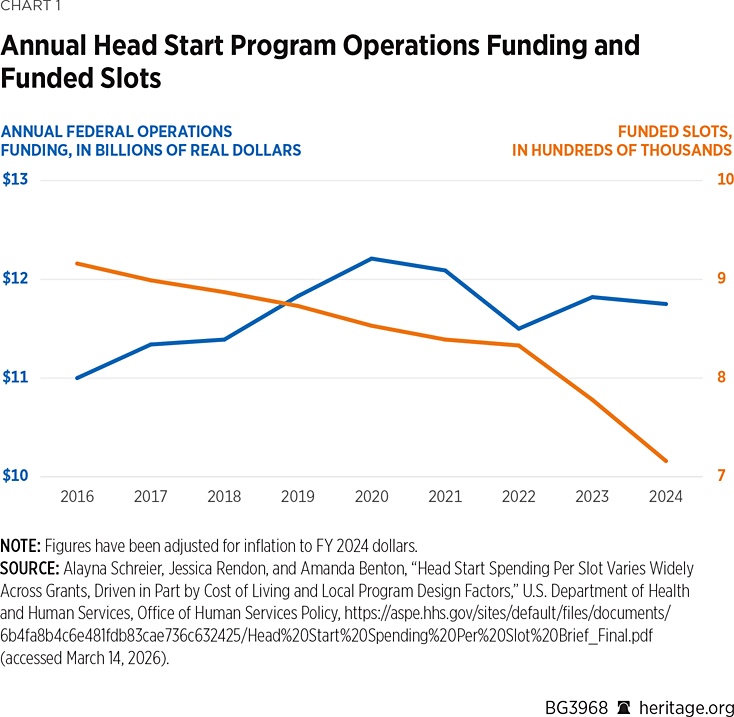
Federal lawmakers kept raising Head Start spending even as enrollment had fallen. From 2016 to 2021, annual funding grew from $11 billion to more than $12 billion.[REF] Funding dipped slightly in 2021, but since 2024, it has stayed above 2016 levels. As funds grew from 2016 to 2021, taxpayer-funded Head Start slots kept shrinking. In 2016, Head Start provided 915,603 slots, but by 2021, that number had dropped to 839,116, and by 2024, it had decreased further to 715,873.
Other comparisons show that Head Start spending outpaces similar learning options. Charter schools and private-school-choice programs generate more savings than traditional public schools. In 2022, the average public funding per student for private school scholarship options, such as school vouchers or education savings accounts, was approximately $6,000.[REF] Researchers find that, on average, public charter schools receive nearly $3,000 less per student than assigned public schools.[REF] This shows that choice saves money for taxpayers and families.
Evaluations of the Effectiveness of Head Start
Given how much is spent annually on Head Start, lawmakers and families should expect a strong return. But the most rigorous study of Head Start finds that the program does not produce long-term positive academic or behavioral outcomes for children.
In 1998, Congress ordered the first comprehensive, scientifically rigorous study of the program. It found no lasting academic gains for children who took part. Researchers began their evaluation in 2002. They released the first results in 2010 (with a subsequent report released in 2012). They used randomized controlled trials, the gold standard in social science research, to assess program effectiveness, and the findings were sobering.
The 2010 study followed students who entered Head Start at ages three or four. It tracked them into kindergarten and first grade. Researchers found that the program “had little to no positive effects,”[REF] for children who participated, and that any initial benefits largely disappeared by first grade.[REF]
The 2012 study, which tracked 5,000 children through third grade, found “little to no impact on cognitive, social-emotional, health, or parenting practices of participants,” and “on a few measures, access to Head Start had harmful effects on children.”[REF]
Researchers at The Heritage Foundation and the Brookings Institution reviewed the social science literature on Head Start participant outcomes. They found the other studies less reliable than the longitudinal study described here.[REF] The two studies used by advocates of expanded preschool to promote early childcare (the Perry Preschool Project and the Carolina Abecedarian Project) are decades old, flawed in design, and have never been replicated.[REF] The Brookings review, written by the former founding director of the Institute for Education Sciences at the U.S. Department of Education, found only “modest positive associations between enrollment levels in state pre-K and later academic achievement once demographic differences among states are taken into account.”[REF]
A more recent study in the American Economic Review found positive long-term outcomes for Head Start participants, though it used a less rigorous design (not random assignment) than the federally mandated longitudinal report.[REF] Other studies have found improved long-term outcomes such as better jobs, higher earnings, and less crime. But these, too, did not use randomized controlled trials, a weaker design than the “Head Start Impact Study.”[REF] Quasi-experimental designs do not void a study’s findings, but the federal study remains the report with the strongest results in the research literature.
Reports Related to Program Conditions and Operations
Beyond effectiveness, concerns about oversight and safety give more reason to end Head Start.
In 2011, the OIG reviewed 24 grantees covering more than 175 centers in nine states. None fully met federal or state rules for protecting children from unsafe materials or equipment.[REF] Almost 90 percent failed to fully follow rules for criminal background checks or child abuse registry checks. Heritage research from 2020 highlighted media reports of abuse at Head Start centers in seven states, five of which were not included in the 2011 report.[REF]
In 2022, the HHS Office of Inspector General (OIG) found widespread abuse and neglect in Head Start programs from 2015 to 2020.[REF] About one in four grant recipients had cases where children were abused, left alone, or sent home with the wrong adult. More recently, a 2025 Government Accountability Office (GAO) report found systemic failures, specifically in centers run by temporary operators.[REF] When the director of a Head Start center leaves, the federal Office of Head Start appoints an “interim” manager to operate the center. The GAO report found at least 15 child-safety violations at centers with interim management. The report found that staff failed to report “significant child safety incidents” to the Office of Head Start, including a case in which “one former center director described witnessing a teacher grab a child by the hood of their coat and slam them to the ground.” Supervisory staff “instructed [the local Head Start center employees] to not report the incident or fire the teacher.”[REF] The GAO also found that the Office of Head Start “has taken limited steps to assess whether Head Start facilities in programs under interim management were safe, as required by the Head Start Act and regulation.”
The GAO discovered that the Office of Head Start failed to track enrollment or claw back funds for children no longer enrolled in the program.[REF] As a result, millions of taxpayer dollars were wasted because no one enforced basic checks. These problems are not new. They reflect years of failure in oversight and safety.
Real Reform Needed Now
Parents and children deserve better from taxpayer-funded programs. Head Start needs real reform now.
Head Start Regulations. Beyond its operational flaws, Head Start sits under a thick, strict set of rules. A recent analysis compared federal Head Start rules with state childcare rules. It found that nearly all Head Start settings are stricter than state settings.[REF] Vermont’s childcare rules beat single-session Head Start centers in strictness, but all other Head Start settings were stricter than every other state’s childcare rules.[REF]
Given high spending and low quality and safety, these findings raise key questions. Do the program’s rules on staffing, group size, and curriculum fit student needs? The report also notes that cutting red tape would likely lower costs and expand access for more children.[REF] As explained below under “Policy Recommendations,” greater access is only valuable to families if it is paired with policies that allow parents to use their child’s portion of Head Start spending to choose between public and private preschools.
Taxpayer Spending on Head Start. The President’s FY 2027 budget request maintains Head Start funding at $12.4 billion. The request also proposes to streamline administrative structures, cut duplicate oversight, and let state childcare standards govern key parts of the program. These include licensing, safety rules, and child-to-staff ratios.[REF] These reforms would give state officials more flexibility and oversight. They could also cut costs and increase access.
The Trump Administration has pushed to cut Head Start red tape before. In 2018, the HHS rolled back an Obama-era rule that required Head Start providers to offer at least 1,020 hours of care per year. The current minimum is 448 hours. The HHS said the old rule was too strict and would shrink the number of children served.[REF]
The Biden Administration also made changes to the Head Start Program Performance Standards and published the final rule on August 21, 2024 (effective on October 21, 2024).[REF] The rule required Head Start teachers to earn pay on par with local public preschool teachers. Where no local preschool teachers exist, the benchmark is 90 percent of a local kindergarten teacher’s pay. The rule stipulates that wages must be comparable across Head Start and Early Head Start. These programs must also offer paid leave, mental health services, and health insurance for full-time staff. Head Start centers must comply with the benefit requirements by 2028 and the wage changes by 2031. In 2024, the Office of Head Start also added new incident reporting rules.[REF]
The GAO later reported that once the rule is fully in force in 2031, it will require about $2.3 billion in new taxpayer spending.[REF] Together, these changes mark an increase in federal rules. The focus on health and safety is welcome. But the cost hikes raise doubts about whether the program is worth the price.
In May 2026, the HHS released a notice of proposed rulemaking (NPRM) to scrap the wage and benefit rules from the Biden Administration’s 2024 final rule. The NPRM said that the “requirements are beyond statutory authority, in addition to being overly prescriptive and costly.”[REF] The HHS noted that repeal would give local operators more freedom. It would also restore 106,000 Head Start slots that the 2024 rule was set to cut.[REF] Department officials also said that the proposed changes should result in approximately $2.1 billion in future annual cost savings.[REF] Rolling back the 2024 wage and benefit rules would also give local officials more freedom, save more money, and shrink the federal role in local policy.
Policy Recommendations
Congress should weigh a range of reforms to boost accountability, efficiency, and results, including:
Sunset the Head Start Program. Congress should sunset Head Start. The federal government runs at least nine early childhood programs (including Head Start). Another 35 programs allow funds to be used for childcare. The current system is fragmented and full of overlap.[REF] Research shows that Head Start does not prepare students for K–12 schools. The centers run with weak oversight. That makes them low-quality, even unsafe, options for families.
Replace Current Funding with Block Grants to the States and Allow Portability of Funds. Federal lawmakers should adopt parts of the Head Start Improvement Act (last introduced in the 118th Congress). One key part would replace the current funding formula with block grants to states.[REF] This change would give state lawmakers more freedom to design programs that fit families’ needs. It would also ease federal red tape. Where state law allows, the bill would also let state lawmakers set up education savings accounts (ESAs) for preschool students. Those would give parents more choices. ESAs already exist in Arizona, Florida, and Texas, among other states. They let parents tap their child’s share of education funds to buy a range of products and services, including private school tuition.
Research suggests that such flexibility could improve both access and efficiency. The Foundation for Research on Equal Opportunity (FREOPP) noted that portable funds would also “significantly increase the hours of care offered to parents.” FREOPP Senior Fellow and former Heritage analyst Dan Lips found that “in all but 13 states and D.C., the per-child Head Start funding is greater than the cost of full-time child care for a four-year-old.”[REF] Policymakers should be cautious when considering block-granting funds because this spending policy may make future efforts to sunset the program more difficult. Block grants may result in state policymakers choosing to embed Head Start spending in state budgets.
The Administration for Children and Families should:
Continue to Deregulate and Streamline Head Start. In May, the Trump Administration announced a set of rules and guidance for federal childcare, including Head Start.[REF] The Administration should continue to reduce regulations, including fewer degree and credit-hour requirements for teachers and changes to staff-to-child ratios and group-size limits. State legislatures and governors should then apply these new regulations and lessen the burdens on Head Start centers.
The Administration for Children and Families should also consider regulatory reforms to lower program costs and improve accountability. The reforms in the White House’s FY 2027 budget request and in the Administration’s most recent NPRM would help to deregulate Head Start and give state officials and Head Start grantees more flexibility.
Conclusion
Policymakers should sunset Head Start and prioritize policy changes that give parents more choices and improve program accountability. While officials work to end the program, policymakers should deregulate Head Start and improve program oversight.
Madison Doan is a Policy Analyst in the Center for Education Policy at The Heritage Foundation. Jonathan Butcher is Acting Director of the Center for Education Policy and Will Skillman Senior Research Fellow in Education Policy.