Created in 2005, the Bush Administration’s Obscenity Prosecution Task Force (OPTF) marked the last national effort to prosecute obscenity cases. The OPTF successfully prosecuted dozens of cases starting in 2006. President Barack Obama disbanded the task force in 2011, which seemed to end prosecution of general obscenity at the national level. States have followed suit, confining obscenity investigations and prosecutions to pornography involving children.
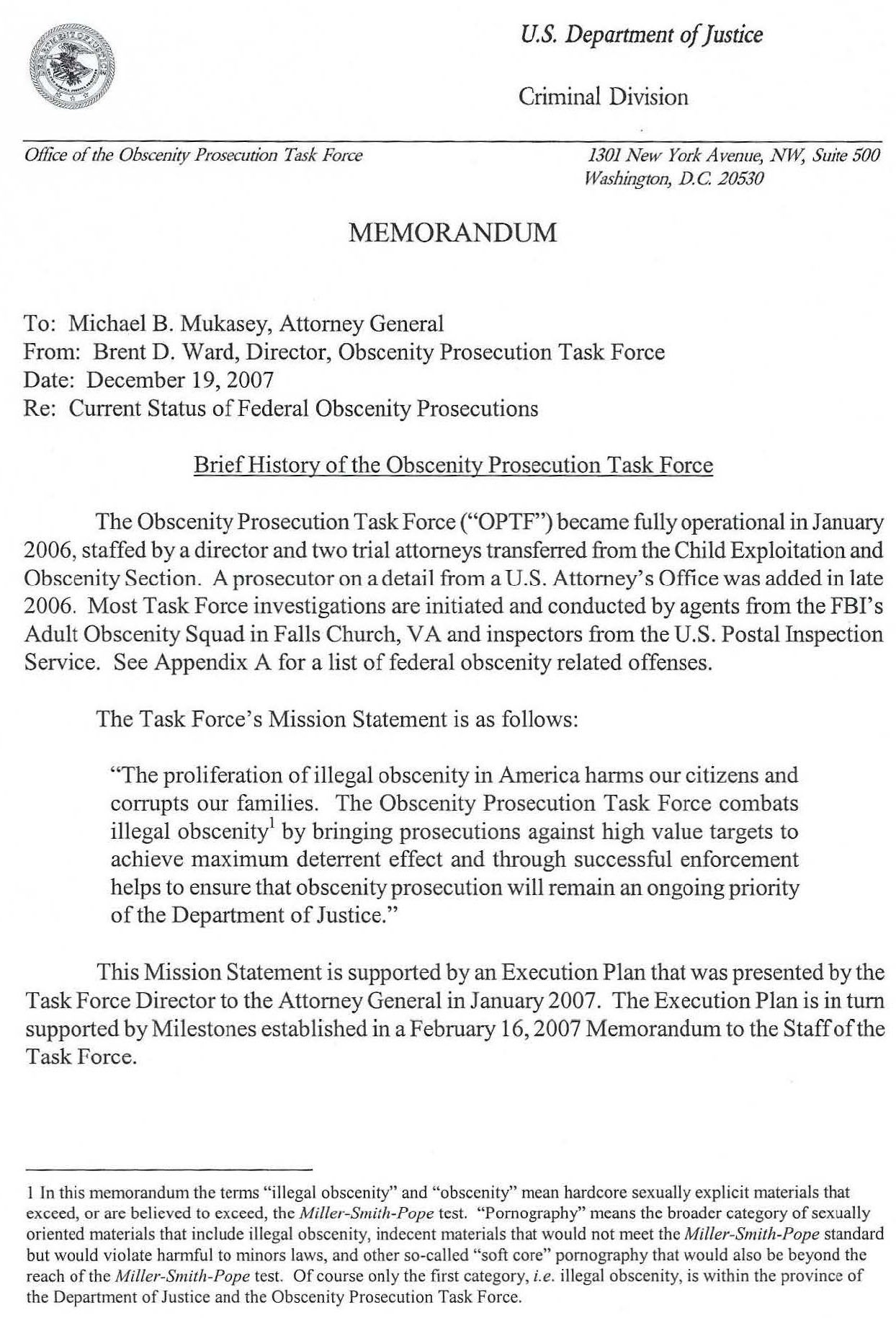
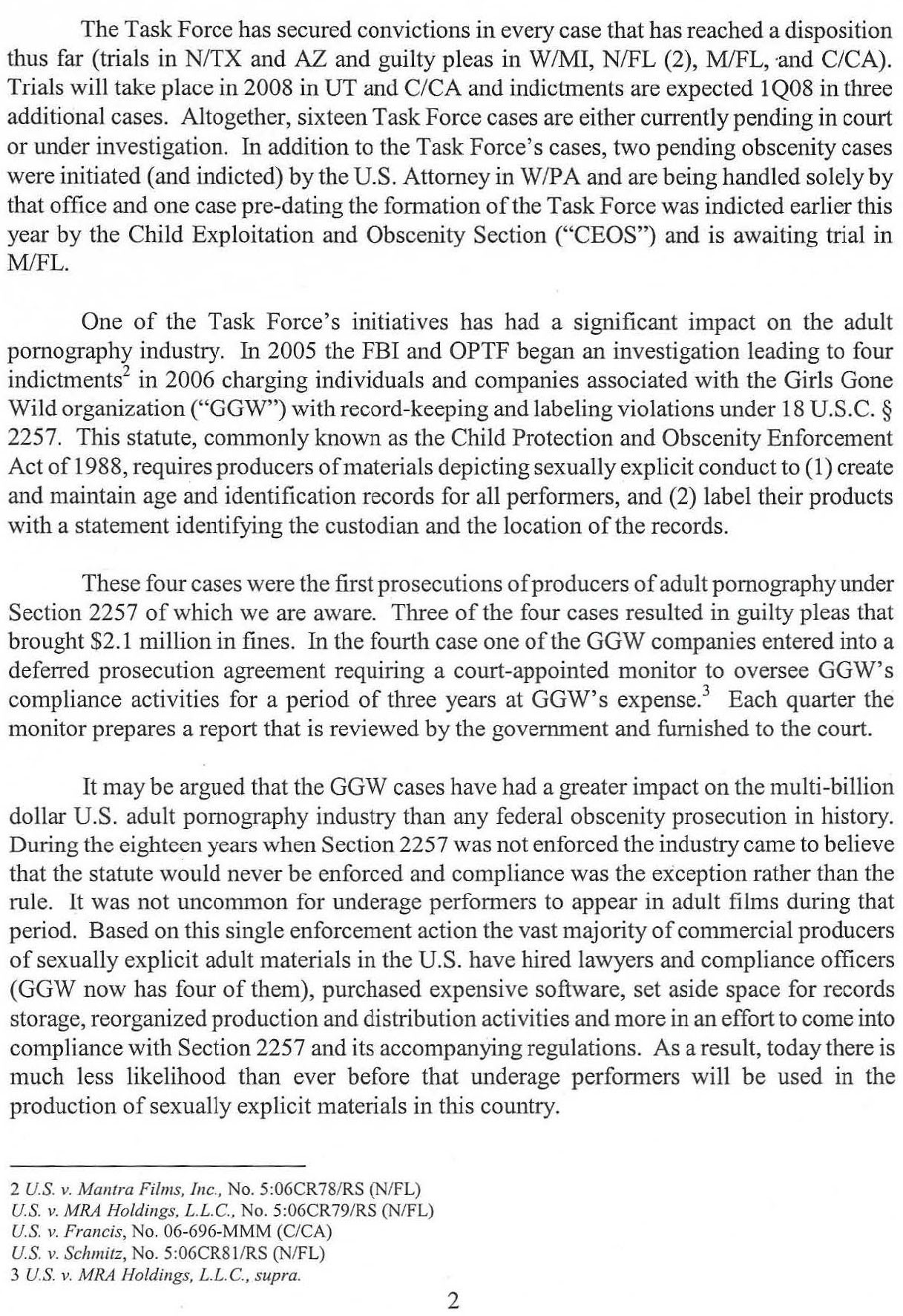
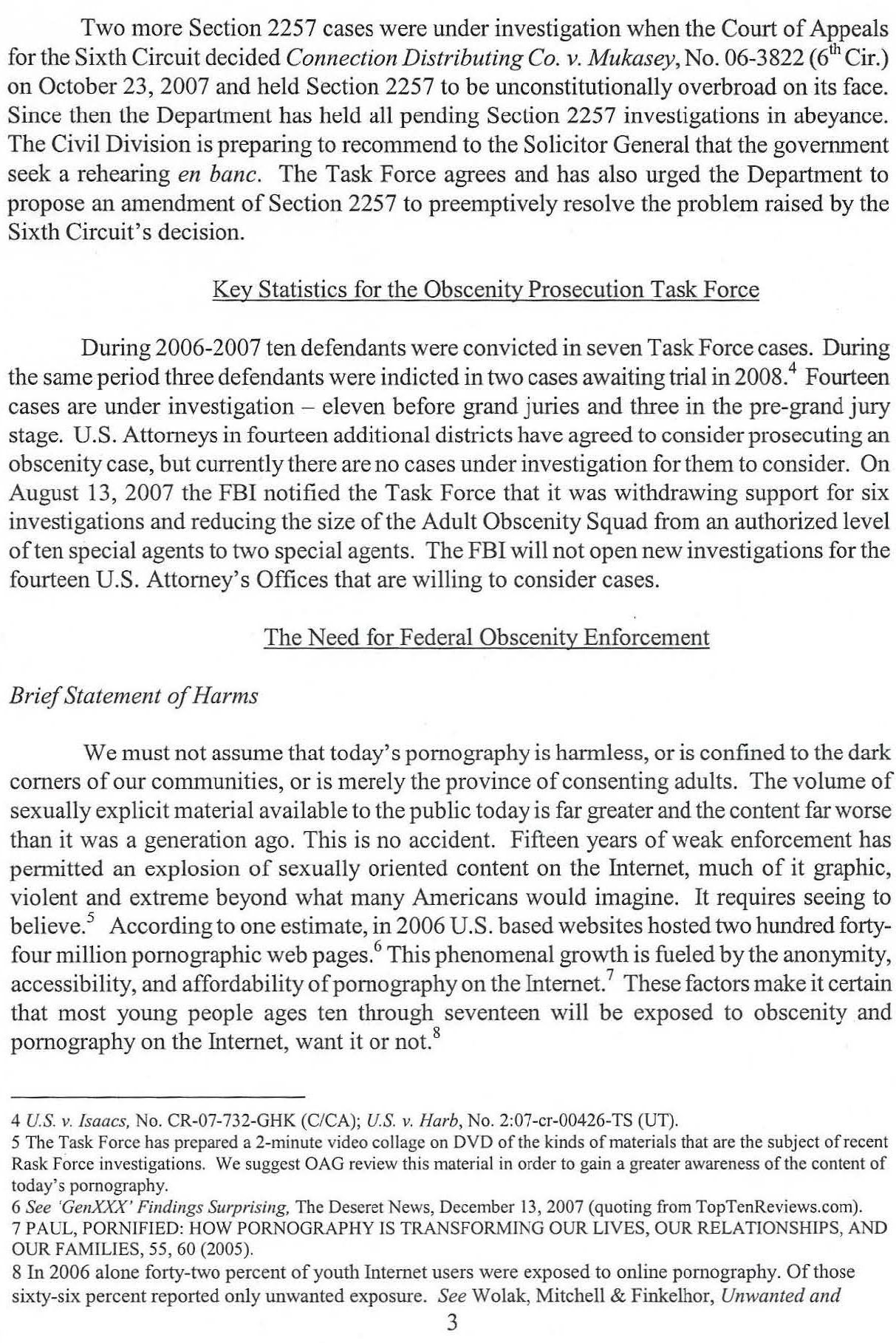
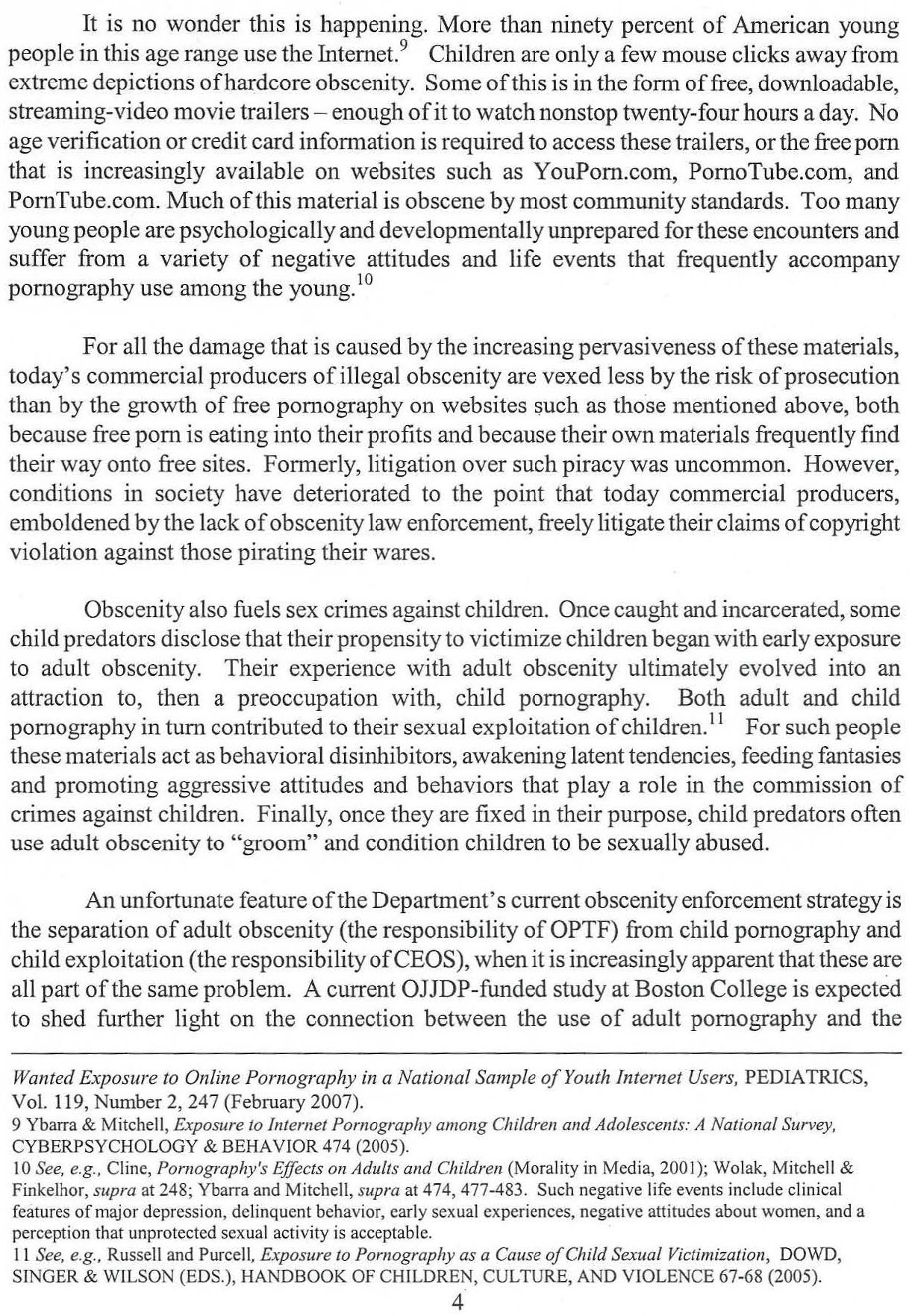
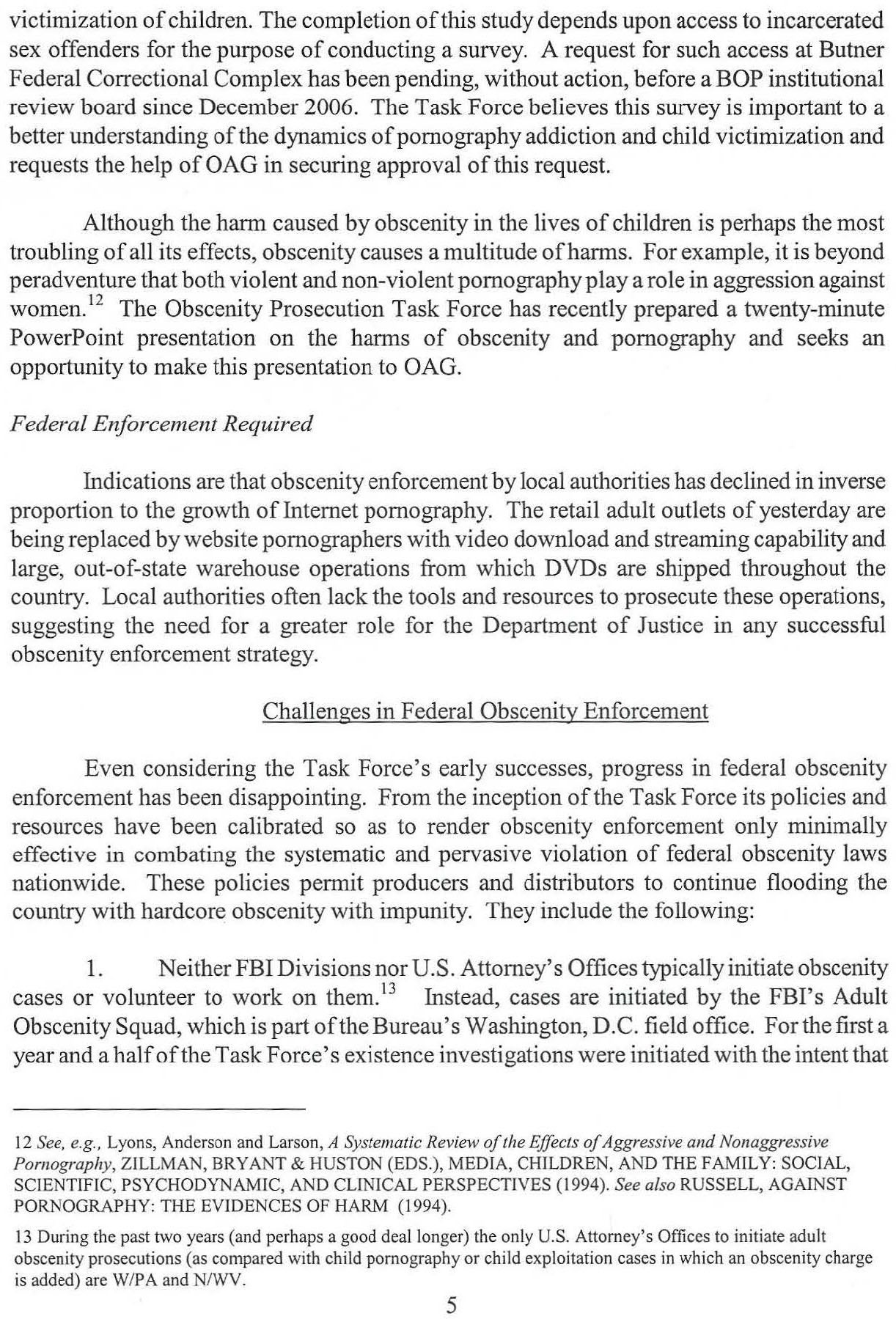
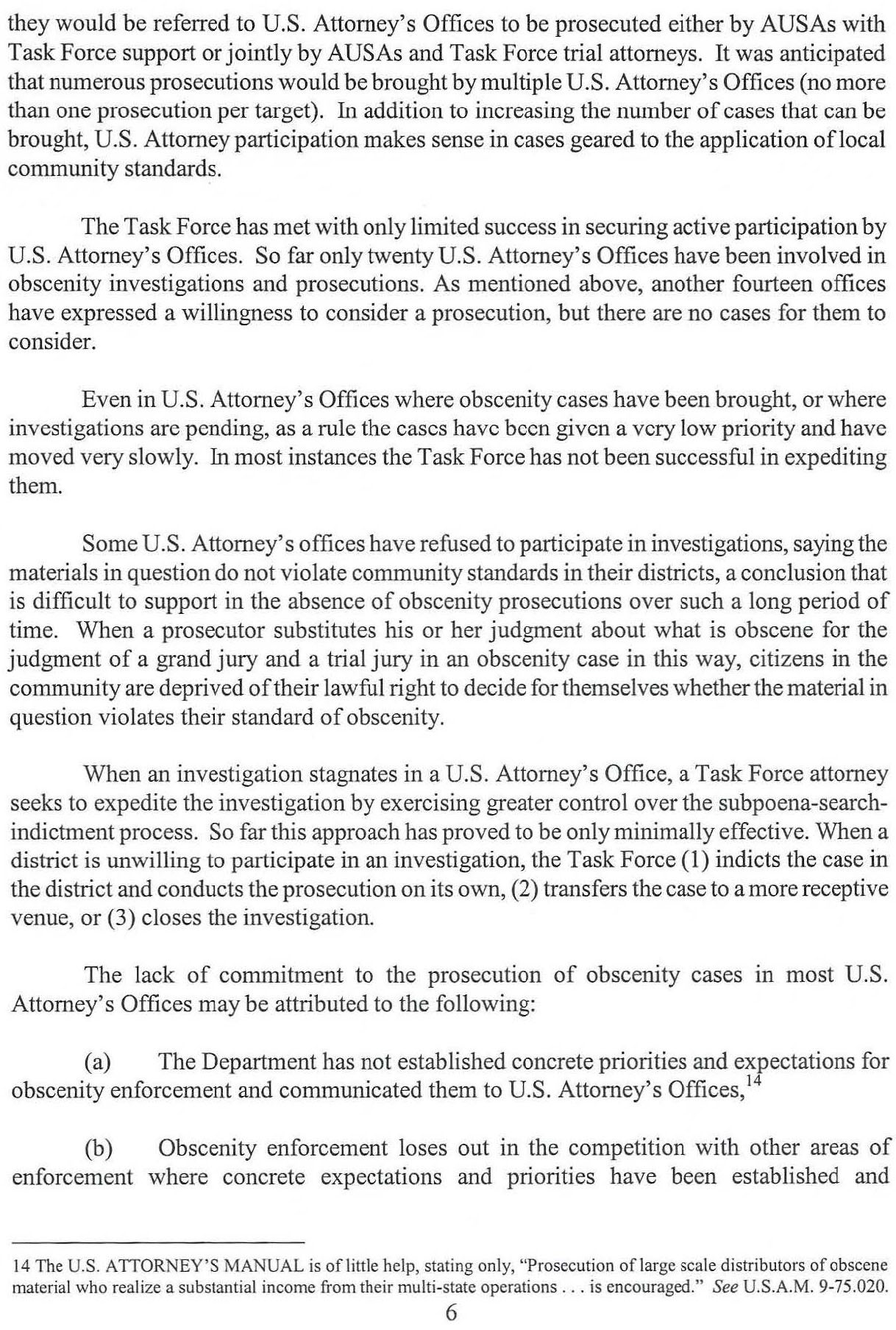
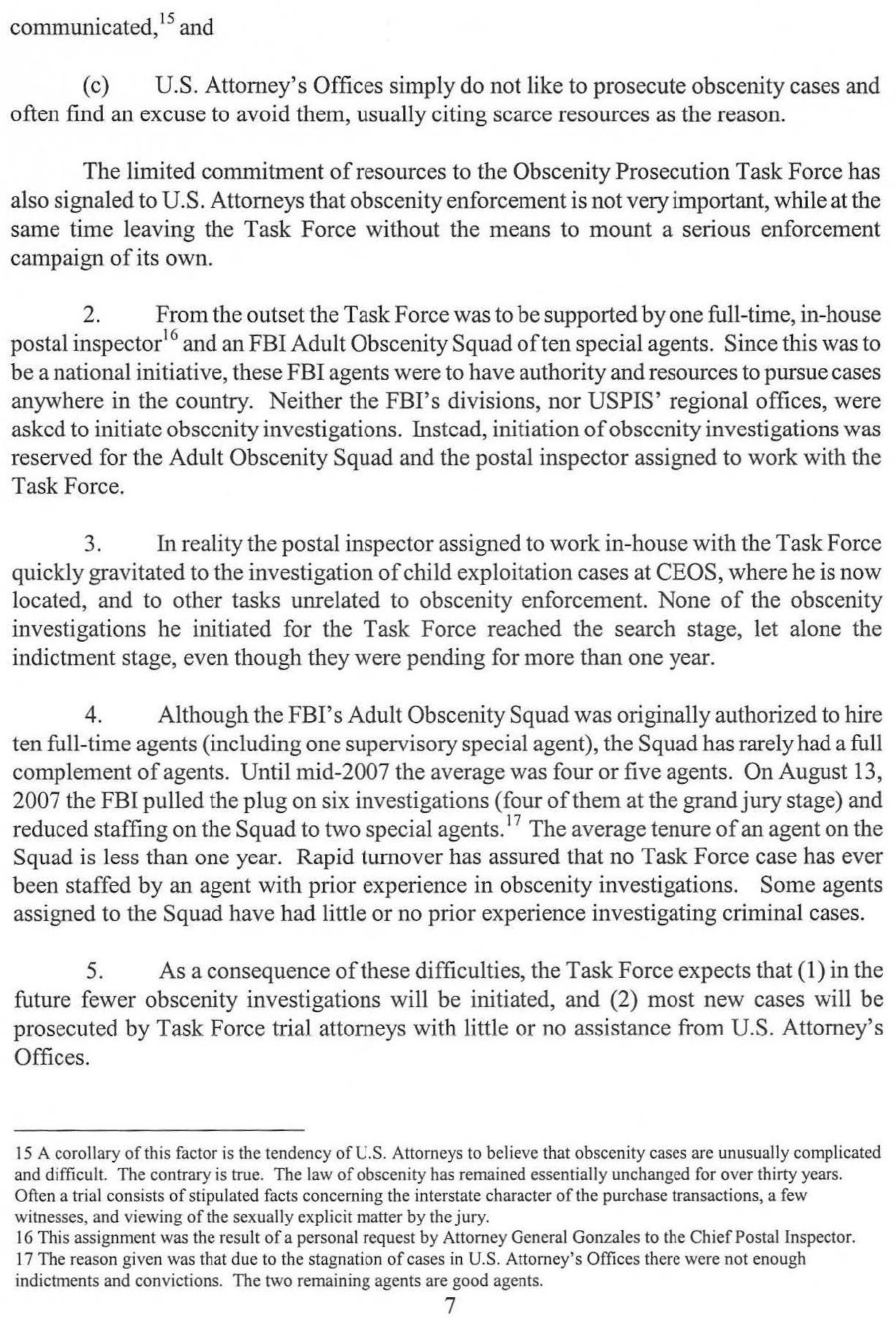
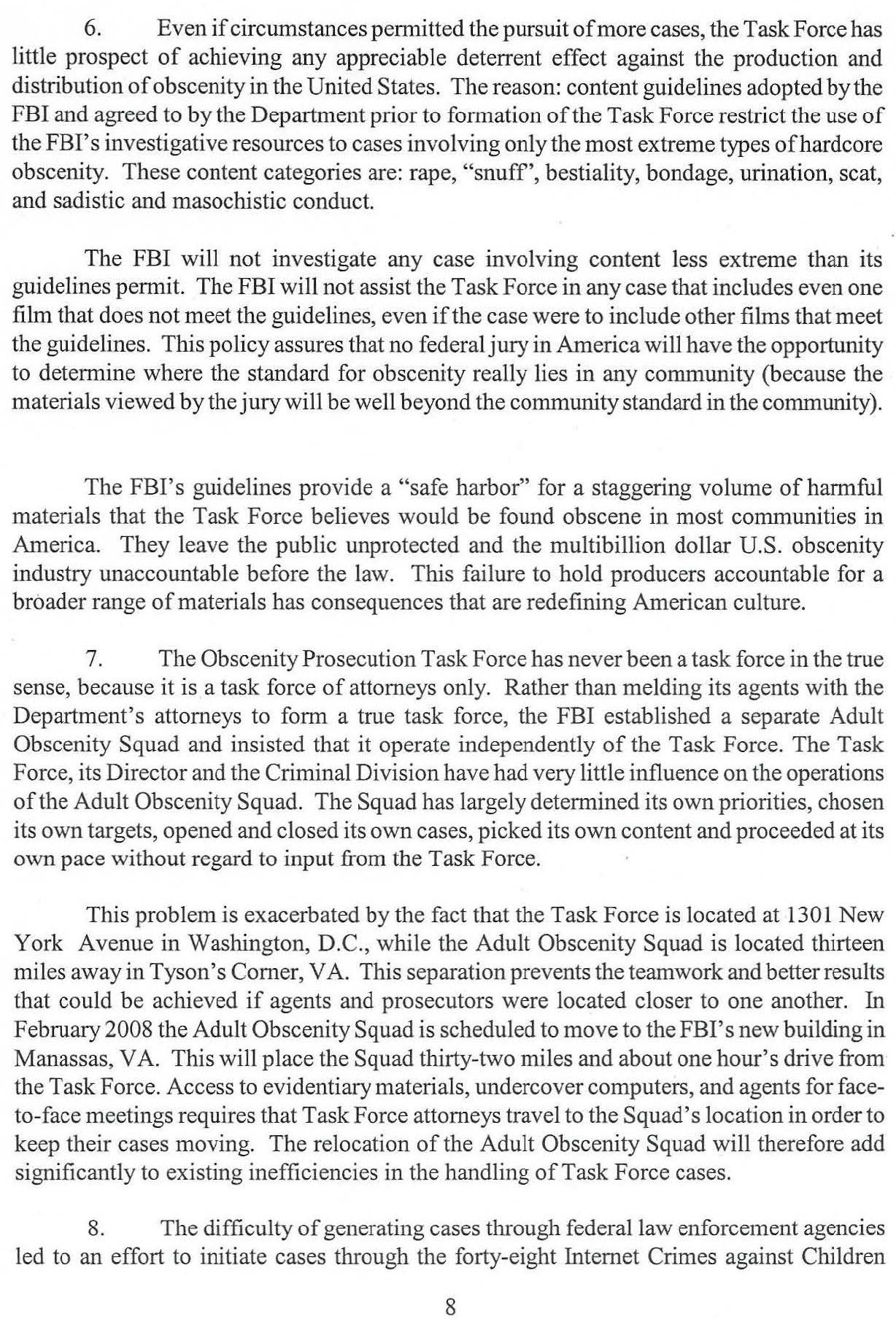
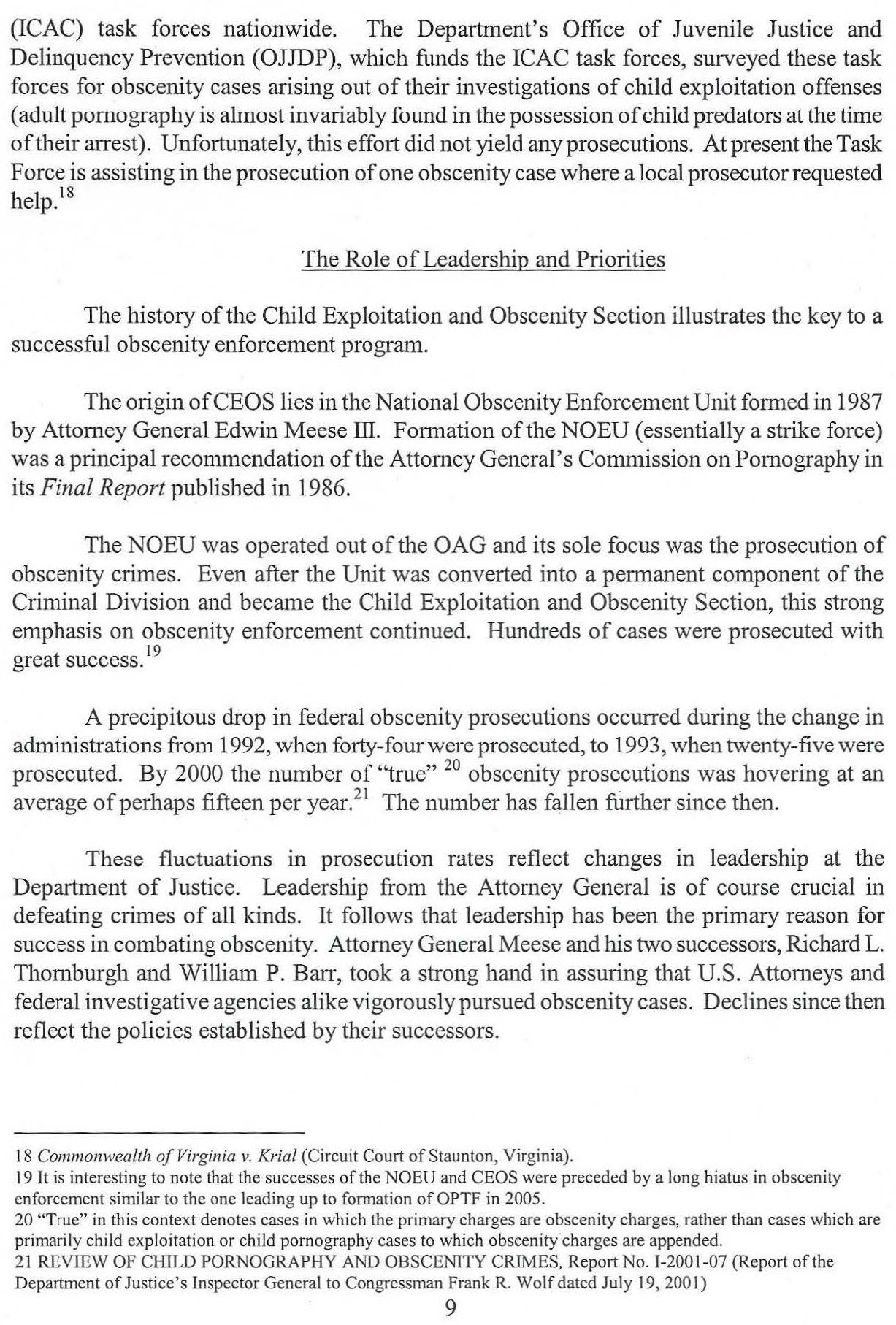
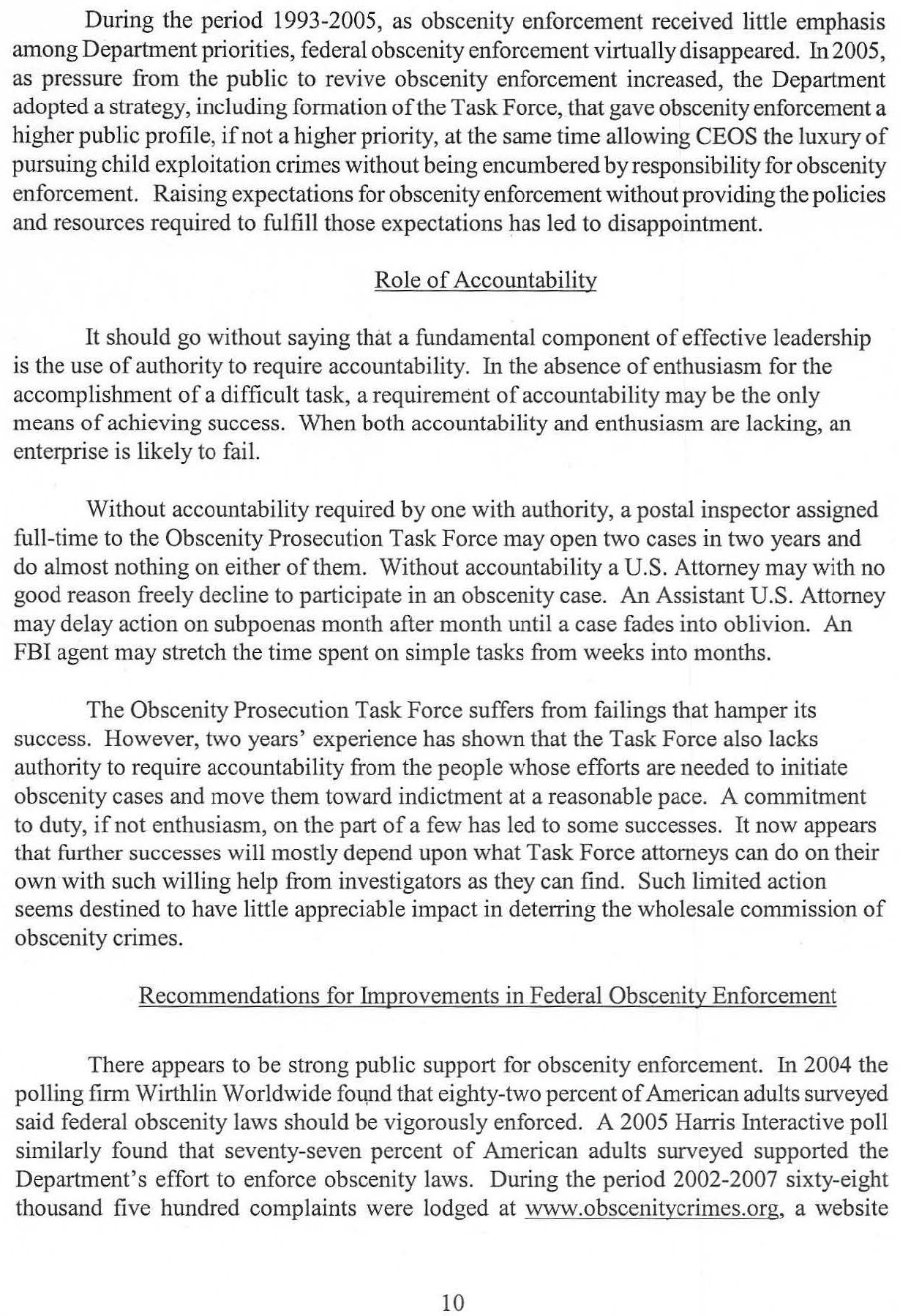
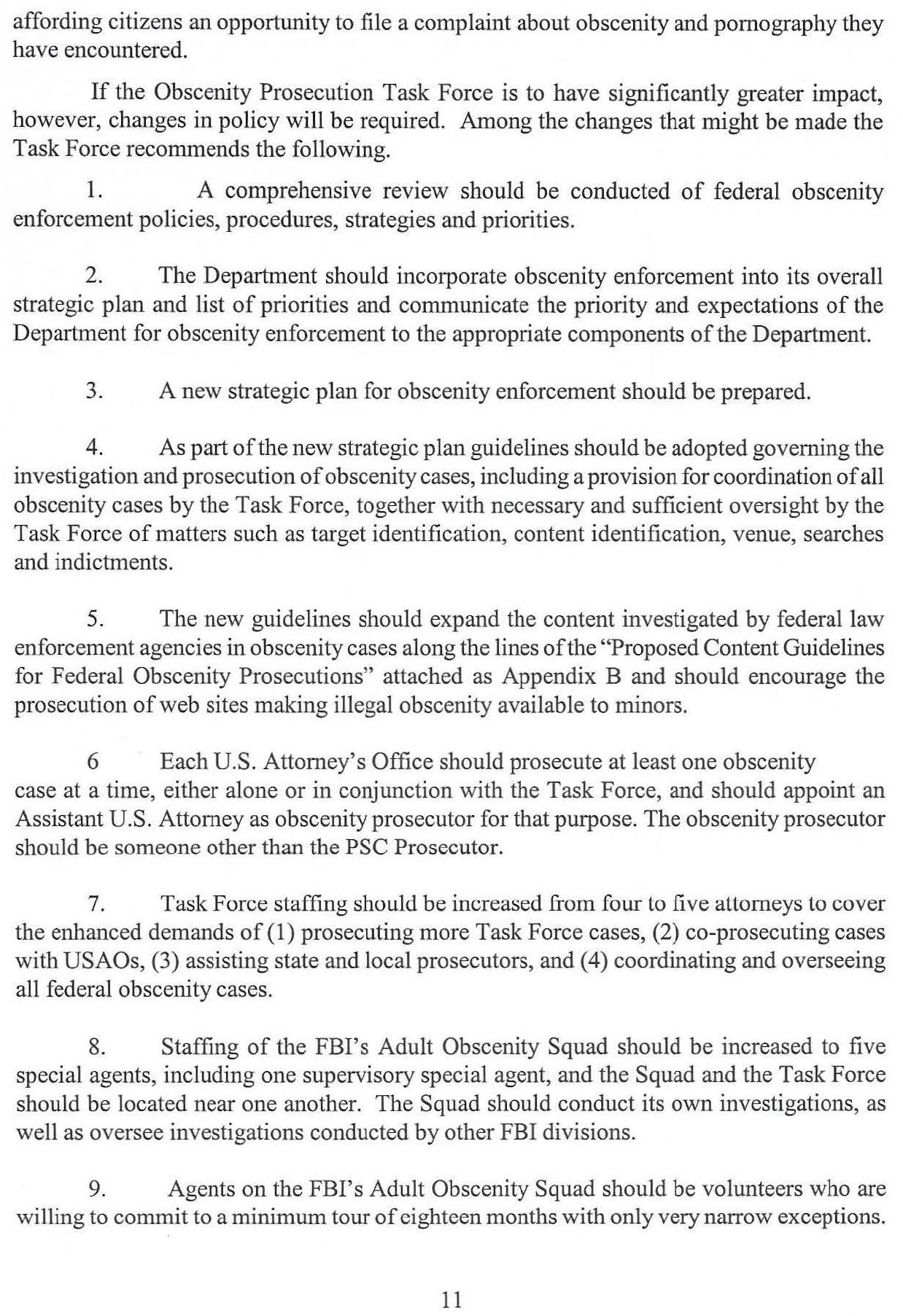
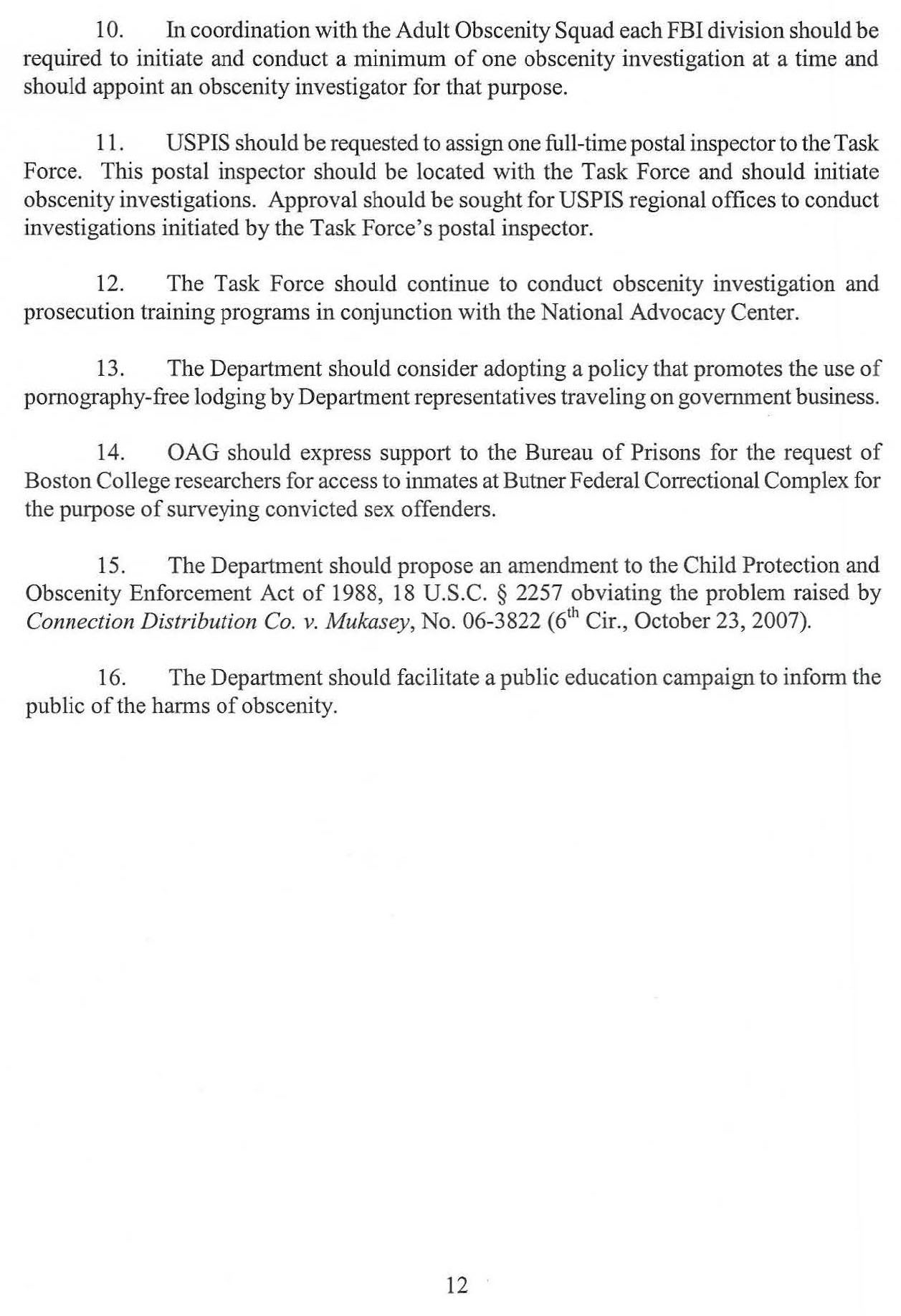
An internal memorandum from OPTF Director Brent Ward to Attorney General Michael Mukasey provides a postmortem on why the OPTF failed. (See the appendix.) While Ward describes institutional obstacles to scaling the OPTF, he concludes that the OPTF fizzled due to a failure of nerve and a lack of political will. Federal prosecutors and even Department of Justice leadership did not want to be seen as modern-day Comstocks. As Ward concludes, the OPTF was “calibrated so as to render obscenity enforcement only minimally effective.”
The end of the OPTF caused many to believe that the era of governmental obscenity regulation was over.[REF] Pornographers got the message, and internet pornography spread as if it were impossible to regulate. As then-Senator Orrin Hatch (R–UT) wrote, citing congressional testimony by Officer Steve Takeshita of the Los Angeles Police Department, “a hiatus in federal prosecution of obscenity has brought forth the courage in the adult industry to produce…extreme sexually explicit product[s].”[REF] Federal obscenity laws and regulations remained on the books and viable, but without people willing to conduct obscenity prosecutions, general obscenity was de facto deregulated.
In retrospect, the OPTF arose at a most inauspicious time to undertake a national fight against obscenity. Community standards were roiled. The law seemed most hostile to prosecutions. Faith in internet technology was at a high. Americans knew little about internet pornography, much less pornography conveyed through smartphones.
If the OPTF operated under inauspicious conditions, a revival of prosecutions could, in some ways, be more easily conducted today. The laws remain on the books. Critics of social media are gaining momentum. The terrible consequences of internet pornography are much more widely understood. Nearly every state has task forces for obscenity related to children. The legal environment as seen in judicial opinions, such as Free Speech Coalition v. Paxton (2025), suggests a new openness to obscenity regulation at the highest level. Perhaps the time is ripe for a rebirth of obscenity enforcement and regulations.
A postmortem on the OPTF is necessary to understand how to stem the tide of pornography in contemporary America.
The Legal Foundations for Federal Obscenity Law
Federal obscenity law still rests on statutes enacted in 1948. The law criminalizes the production, distribution, mailing, importation, and sale of obscene material.[REF] (The Miller test defines “obscene” as a work that, taken as a whole, and applying contemporary community standards, appeals to a prurient interest, depicts sexual conduct in a manner that is patently offensive under state law, and lacks serious literary, artistic, or scientific value.) Other statutes require record-keeping and labeling for producers of sexually explicit material.[REF] All such statutes apply both to physical and digital distribution of obscene materials by mail or interstate commerce. All are felonies. Penalties include enhancements for financial gain, computer use, or sadomasochistic content. As Jennifer Kinsley shows in her article, “The Myth of Obsolete Obscenity,”[REF] prosecutors can still bring cases and juries convict under these statutes.
Before 1993, Attorneys General prosecuted hundreds of obscenity cases within the National Obscenity Enforcement Unit (renamed Child Exploitation and Obscenity Section) of the Department of Justice.[REF] After 1993, federal enforcement of general obscenity statutes declined to the point of vanishing for several reasons.
Federal Enforcement Declines. First, the Supreme Court’s Miller v. California (1973) made identifying obscenity reliant on “community standards,” among other things. Community standards are moving targets.[REF] As communities tolerate more pornography, standards devolve, lowering the standards yet further. In such an environment, discovering community standards proves both difficult and risky for prosecutors. Obscenity prosecutions fell off gradually after Miller, partly because of this uncertain legal environment. Periodic efforts to maintain standards arose under Attorneys General Edwin Meese, Richard Thornburgh, and William Barr during the 1980s and early 1990s. From 1994 to 2002, however, U.S. Attorneys and the Justice Department prosecuted fewer than 20 individuals for obscenity (and almost none after that).[REF] Reviving prosecutions after such a hiatus would be difficult.
Second, the availability of internet pornography, beginning in the late 1990s, raised thorny legal questions about enforcement. Identifying which community’s standards would govern on the internet proved elusive. Some circuits held that there is only a national community when it comes to the internet;[REF] others have applied local community standards.[REF] Without prosecutions for violating the law, prosecutors would be unable to show that internet pornography violated any community standards. Further, the internet reduced the cost of making and distributing pornography while complicating efforts to identify who was legally responsible for violating obscenity law. Mail-order pornographers could be prosecuted for sending pornography through the mail. Porn shop operators could be prosecuted for selling porn videos, and customers could be prosecuted for buying. How would people be prosecuted on the internet? Would those who made it or posted it be prosecuted? Or those who hosted it? Or those who consumed it? And what happened when the pornography was, essentially, free?
Third, the Supreme Court of the United States seemed to signal a full-scale retreat from obscenity prosecutions. Congress passed laws to protect children from internet pornography. The Communications Decency Act of 1996 made it illegal to distribute indecent or patently offensive material online to children, as did the Child Online Protection Act of 1998. In Reno v. ACLU (1997), the Court struck provisions of the Communications Decency Act that criminalized the knowing transmission of “indecent” or “patently offensive” materials to minors over the internet as overbroad and vague.[REF] When Congress expanded the definition of child pornography to include not only images of actual minors but also virtual or computer-generated images that “appear to be” minors engaged in sexually explicit conduct, the Court struck that law as overbroad in Ashcroft v. Free Speech Coalition (2002).[REF] In 2004, the Supreme Court yet again intervened and struck a modest congressional effort to require age verification for children on obscene websites in Ashcroft v. ACLU.[REF] If basic measures to protect children and defend childhood innocence violated the First Amendment, few efforts to regulate obscenity on the internet would pass muster with the Court. Or so it seemed. The Bush Administration organized the OPTF just after the Supreme Court signaled hesitation toward laws designed to protect children from internet pornography, which prompted prosecutorial energy to shift elsewhere.
Fourth, efforts to “regulate” the internet were bound to raise the ire of techno-optimists, who were riding high in the late 1990s and throughout the 2000s. Taxing the internet was a non-starter. Many techno-optimists worried that efforts to police internet content—even the hardest of the hardcore pornography—would unduly stifle the internet’s creativity and promise. Techno-optimism informed the Supreme Court’s reasoning in the 2004 Ashcroft decision. When Congress required age verification, the Court struck it down in favor of what it considered flexible, market-driven technological solutions on the user’s side. Producers were free to circulate. Platforms were free to host. Filters would allow parents to block harmful content, according to the Court, while adult freedom would remain unaffected. Federal courts also interpreted Section 230 of the Communications Decency Act to allow large platforms, such as Pornhub, OnlyFans, or Google, to host obscene material without being held liable for the content.[REF]
As a result of these developments, the OPTF had few real legal options. The “harmful to minors” standard, enshrined in the 1997 Child Online Protection Act (COPA) and in previous Supreme Court decisions, stood on shaky ground after the hostile Supreme Court decisions of the late 1990s and early 2000s. Only hardcore pornography would be easy to prosecute under the Miller test, which itself stood on increasingly shaky ground under the pressure of changing community standards. The task force marked a creative, intelligent adaptation to this challenging environment.
The Promise and Pitfalls of the OPTF
The OPTF was designed to combat obscenity “by bringing prosecutions against high value targets to achieve maximum deterrent effect.” It became fully operational in January 2006, led by Ward with two experienced trial attorneys transferred from the Child Exploitation and Obscenity Section in the Department of Justice. The FBI’s Adult Obscenity Squad in Falls Church, Virginia, would conduct most investigations with occasional help from inspectors temporarily on loan from the U.S. Postal Inspection Service. At its peak, in 2006 and 2007, it had at most five investigators and four total attorneys, including Ward.
The OPTF would coordinate and support national prosecutions, first developing cases and then referring them to willing U.S. Attorneys’ offices for prosecution. This structure spread the enforcement burden across multiple districts and allowed some forum shopping to find localities with stricter community standards. Attorney General Alberto Gonzales supported the structure. At a training conference for Assistant U.S. Attorneys in late summer 2006, Gonzales declared that he intended to “take names and kick butt” on obscenity enforcement, signaling a renewed priority at the highest levels of the department.[REF] He would spend much political capital convincing U.S. Attorneys to cooperate.
As Ward reported to Attorney General Mukasey, the task force’s trial attorneys “secured convictions in every case that has reached a disposition thus far.” Between 2006 and 2008, OPTF attorneys secured guilty verdicts or pleas in several federal districts, including successful jury trials in the Northern District of Texas and Arizona.
First Bucket of Cases. The first bucket of cases that the OPTF pursued consisted of traditional obscenity cases involving especially hardcore pornography being transferred through the mail and over the internet. The task force targeted producers. In United States v. Extreme Associates (2005), the OPTF prosecuted Robert Zicari (a.k.a. Rob Black) and Janet Romano (aka Lizzy Borden) for distributing extremely violent and degrading fetish films under 18 U.S. Code § 1461 (mailing obscene matter); § 1462 (importation or transportation of obscene matters); § 1465 (production and transportation of obscene matters for sale or distribution); and § 1466 (engaging in the business of selling or transferring obscene matter). The district court initially dismissed the charges relying on the court-determined right to privacy then recently expanded under Lawrence v. Texas (2003).[REF] The Third Circuit reversed a district court dismissal. The defendants pled guilty to nine counts of obscenity.
With this success in hand, the OPTF could prosecute more traditional cases with some confidence. It did so under the same core statutes. In U.S. v. Ragsdale (2005) a short jury trial led to the convictions of mail-order distributors of two exceptionally violent foreign rape films titled Brutally Raped 5 and Real Rape 1. West Virginia District Court case U.S. v. Loren Jay Adams (2008) brought jury convictions for mail-order films depicting bestiality, fisting, and extreme fetish sex acts, as did the 2008 case U.S. v. Paul Little (Little was known as Max Hardcore), which involved both digital downloads and mail-order DVDs.[REF]
Defendants pled guilty in U.S. v. Harb (2008) and U.S. v. Right Ascension (2010) to mail-order distribution of extreme content.[REF] U.S. v. Kilbride (2007) led to a jury conviction for a large-scale e-mail spam operation that sent violent pornography to e-mail addresses. Karen Fletcher (who called herself Red Rose) pled guilty to violating § 1465 for written stories describing sexual molestation, rape, and murder of children distributed on a members-only website in United States v. Fletcher (2008).[REF]
Second Bucket of Cases. The second bucket of cases involved strategic enforcement of the record-keeping and labeling requirements under 18 U.S. Code § 2257. The OPTF’s investigation of Girls Gone Wild, a California company, produced four indictments in 2006—the first significant prosecutions of adult pornography producers under the statute.[REF] Three of the cases resulted in guilty pleas and $2.1 million in fines, while the fourth led to a deferred prosecution agreement requiring a court-appointed monitor to oversee compliance for three years.
Ward believed that this enforcement action affected the adult pornography industry more than any prior federal obscenity prosecution. Within months, commercial producers hired lawyers and compliance officers, purchased software, reorganized production and distribution activities, and otherwise brought themselves into compliance. The threat of enforcement dramatically reduced the risk that underage performers would appear in sexually explicit materials.
Results of the OPTF. It is remarkable how much such a small OPTF achieved. None of these cases really took on the principal expressions of internet pornography. The first bucket involved people buying pornographic materials, either through the mail or from the internet. Investigators could simply order obscene materials through the mail in a jurisdiction with higher community standards and file charges. In this sense, the OPTF was targeting the vestiges of the old pornography industry rather than the novel free internet pornography common today. The second bucket concerned working conditions for pornographic video production. Such prosecutions raised costs on pornographers and distributors of all stripes but did not shut them down.
Despite early successes and a nearly flawless execution of the task, the OPTF never achieved the scale or the deterrence required to complete the mission. When Ward retired at the end of 2007, his memorandum to Attorney General Michael Mukasey exposed the OPTF’s shortcomings. The FBI’s content guidelines limited investigations to the worst of the worst—pornographic depictions of rape, incest, bondage, bestiality, urination, and sadomasochism. As a result, most pornography available in most communities enjoyed what Ward called a “safe harbor.”
Impediments to Success. The task force suffered from severe organizational shortcomings, too. Its success depended on voluntary participation of U.S. Attorneys. But most U.S. Attorneys had other priorities. They often declined to take on cases, slow-walked investigations, or refused to participate, citing how “community standards” in their area would not support prosecutions. U.S. Attorneys have limited time and bandwidth, and few wanted to expend resources on cases less likely to secure convictions.
In addition, the OPTF was chronically undermanned and under-resourced. The postal inspector, according to Ward’s memo, assigned to assist the task force “quickly gravitated to the investigation of child exploitation cases” in another division and he never initiated any searches for the OPTF. Investigators and prosecutors were officed in separate locations too, undermining their ability to coordinate action. The task force lacked real authority to execute its own mission. As Ward concluded in a 2026 interview, the OPTF was “calibrated so as to render obscenity enforcement only minimally effective.”[REF]
Hostile Context. Such structural issues masked the deeper problem related to the hostile context. The poor resourcing was an effect, not a cause, of the OPTF’s broader failure. Few people believed in the cause of regulating obscenity. The original district court opinion in the Extreme Associates case (one that protected obscenity under the right of privacy) may have expressed a spirit of the times. If Lawrence stood for freeing people to do what they want in their own bedrooms, it seemed logical to conclude that what people did with pornography was their own business, too. Obscenity prosecutions seemed to be on the wrong side of history.
U.S. Attorneys feared being labeled joyless scolds or wearers of a “scarlet A for anti-free speech,” as Ward said in a 2026 interview with the authors. U.S. Attorneys would win little honor among other attorneys for fighting obscenity and, perhaps, much shame for undertaking the task with any enthusiasm. Especially crucial in this respect was the techno-optimism of the early 2000s, which hypothesized that technological improvements would solve the problem of obscenity without the need for law, perhaps through the invention of filtering software. No one wanted to stifle the promise of the internet with regulations.
As Ward argued, the very act of fighting pornography can corrupt the sensibilities of attorneys. “The material is just so offensive that people do not want to deal with it,” Ward said in the interview. “They don’t want to look at it, which they have to do if they’re going to prosecute it. They don’t want to have to show it to a jury.” Like leaving pornography unpunished, punishing pornography comes at a cost.
Attorney General Gonzales’s leadership helped launch the OPTF, and his attempt to get U.S. Attorneys to prosecute obscenity cases had something to do with his resignation. According to a later Senate report,[REF] U.S. Attorneys in Nevada and Arizona declined to bring obscenity charges in their districts, despite repeated requests from the OPTF and directives from the Justice Department. Gonzales eventually fired these two attorneys along with seven others for failing to carry out department priorities. Democrats accused Gonzales of politicizing the Department of Justice and, after a series of related Senate hearings, he resigned.[REF]
Prosecutorial defiance against obscenity prosecutions was thus, in a sense, rewarded when Gonzales resigned in September 2007. Ward resigned shortly thereafter. Gonzales’s successor, Michael Mukasey, never responded to Ward’s memorandum. The OPTF’s efforts fizzled but did not immediately vanish. Most of the new cases involved child pornography or exploitation. President Obama’s Attorney General Eric Holder quietly dissolved the OPTF in spring 2011.
Even the OPTF had not really tried to touch internet pornography. No one has—no doubt because of cultural, technical, and legal obstacles:
- The volume of internet pornography (with millions of pages of user-generated content and international hosting) is likely orders of magnitude larger than pornography in the mail-order era;
- Community standards are hard to enforce with a global medium;
- Prosecutors would face the ultimate whack-a-mole problem, as new pornographers pop up immediately to replace prosecuted pornographers;
- Younger generations are increasingly tolerant of and even blasé about pornography, viewing it as a harmless private activity;
- Protection for online platforms like Pornhub or even Google is so entrenched in law as to negate any attempt to regulate; and
Given such impediments, prosecutors spent their time on other priorities that did not invite accusations of viewpoint discrimination.
Prospects for Reviving the Obscenity Prosecution Task Force
The OPTF may have been the last sustained public effort to regulate general obscenity, but it was a more desultory effort than those undertaken from 1986 to 1988 under Attorney General Meese. Since 2011, almost all federal and state regulation attempts have centered on child pornography and child sex trafficking. Every state has a task force to combat internet crimes against children—that is, to stop the production and distribution of online child pornography. Nearly every state has a designated task force for child sex trafficking to stop people from recruiting children to participate in porn productions.[REF] Federal crimes in these areas are also routinely prosecuted.
In the early 2000s, the Supreme Court hampered Congress’s attempt to regulate pornography involving minors at the national level. This seemed to presage the end of general obscenity regulation. The death of the OPTF did little to dispel the drift of opinion.
In 2025, the legal winds changed direction. In Free Speech Coalition v. Paxton, the Supreme Court blessed new state regulations for internet pornography. With Paxton, the Court opened the way for states to pass and implement age verification for websites containing obscene material.
This, of course, presumes an enforceable definition of obscene material that involves minors. The Texas law at issue in Paxton pursued the “important interest in shielding children from sexual content.”[REF] Perhaps Congress can expand childhood protections. A bipartisan group of Senators is interested in applying childhood protections for use of artificial intelligence.[REF]
As a result, America has developed a modified two-track system of pornography regulation. States and the federal government prosecute some pornography featuring trafficking in children. States can regulate access to other pornography with age-verification systems. Within those limits, anything goes for adults; and there are few prosecutions of adults under general obscenity regulations.[REF]
A Changed Context. The renewed effort to protect children from internet pornography shows that today’s context differs, at least somewhat, from the context within which the Bush-era OPTF operated. Paxton points to a more favorable legal environment than the Ashcroft decision of 2004. When Ashcroft was decided, internet pornography research was in its infancy. Paxton reflects an environment that is more open to obscenity regulation and, therefore, more concerned about the harms of pornography on children, at least.
Thirty years of internet pornography have also moved the needle against techno-optimism on the promise of porn and filters. Before the internet, the social science on pornography use was mixed. And, as one of the authors (Scott Yenor) has documented,[REF] the arguments from opponents of pornography have not always been realized in practice. Simply put, the pornography of Playboy magazine and difficult-to-get films had a smaller viewership and a lesser impact on the minds of people, especially children. Shame was still attached to the purchase of pornographic materials in a very overt way.
Proven Negative Effects of Pornography. The internet era has brought change. Many more people watch porn without shame. Porn is often free and can be acquired and watched entirely in private. Social science studies of the problems of internet pornography—both for children and for adults—have increased since Ward left the OPTF in 2007, the year the first iPhone was released and ever more pornography was consumed. Viewing pornography:
- Fuels brain changes similar to addiction;[REF]
- Compromises marriages and romantic relationships;[REF]
- Desensitizes men to sexual violence and lowers their general ambition;[REF]
- May contribute to sexual violence against women;[REF] and
- May serve as a gateway to ever more extreme types of pornography, including choking and child pornography.[REF]
The more that is known about the personal and societal harms of pornography, the stronger the case for regulation. The presence of so much easily accessible pornography has made the scientific case against pornography much stronger today than it was 30 years ago.
Yet, post-Miller enforcement against general obscenity has virtually disappeared since the OPTF speed bump. What is not prosecuted, over time, tends to become the community standard. Community standards have, in all likelihood, sunk farther. But standards have not disappeared. Television and streaming services refuse to show certain sex scenes. Apple and Android do not allow porn apps on their app stores. Billboards do not have sexually explicit material on them. Sexual acts in movies can still go too far. Clearly, some pornography violates some standards.
Techno-optimism has changed silos, but it has not disappeared. Today, people put faith in large language model AI the same way they put confidence in “the internet” in the early 2000s. It is much more socially respectable today, however, to be critical of the tech giants and social media. People worry more about how internet technologies undermine personal relationships, decrease social skills, and cause loneliness and anomie. Internet porn critics will likely not encounter the same buzzsaw they encountered in the early 2000s.
Lessons Learned and the Path Forward
An assault on obscenity is now much more promising. Today’s porn critics should learn several lessons from the Bush-era OPTF.
Prioritize Enforcement. An Attorney General can make general obscenity enforcement an institutional priority.
Consolidate OPTF Power. A dedicated task force, properly staffed and resourced with investigators, can and should consolidate power within itself, instead of relying on U.S. Attorneys to conduct trials. Obscenity prosecutions will run risks. Prosecutors, worried about losing cases and wasting resources, may not want to take them on. Focusing power in a task force that knows the best way to prosecute such cases would pay the greatest dividends, though help from sympathetic U.S. Attorneys could be sought. A new task force might also cooperate with sympathetic county prosecutors or state task forces.
Apply Existing Law to the Internet. Applying existing law to the internet should be the centerpiece of a revived OPTF.
Work to Remove Immunity from Civil Liability for Platforms. The OPTF should, with attorneys in the Justice Department, tackle the issue of Section 230, which, as currently interpreted, immunized ostensibly “neutral” platforms from civil liability for third-party content they host. Against this view, the department should show that many, if not all, platforms are anything but neutral. They are all curated by algorithms, which actively promote content. Section 230(c) (1) was only meant to shield platforms from liability for passively hosting third-party content. It did not grant platforms a sweeping immunity for algorithmic promotion, active curation of content, and deliberate amplification of ever-more obscene content.[REF]
Align State Attorneys General to Jointly Prosecute Pornographers. A new OPTF could work with aligned state Attorneys General to identify and jointly prosecute pornographers who violate both state and federal obscenity law. Combining federal and state resources would increase deterrence measures and greatly expand prosecutorial capacity.
Conclusion
Of course, no task force in a free society can police every dark corner of that society. A new OPTF should be focused and concentrated. It should mostly go after the worst of the worst of internet pornography. It should show how patently offensive adult content leads to the consumption of child pornography, too. It should be combined with legal action on larger hosting platforms. And it should prosecute cases aggressively. With renewed commitment, American officials can once again wield existing law to protect society from the spread of porn to the young and old alike.
Scott Yenor is Chair of the American Citizenship Initiative at The Heritage Foundation. Caleb Pirc is General Counsel and Director of the Idaho Family Policy Center’s Legal Center.
Appendix: Memo to Mukasey