
Annie Chestnut Tutor
As our phones, tablets, and computers become constant companions, the line between healthy digital engagement and harmful overuse is vanishing faster than we realize. Most alarmingly, the percentage of children who spend more than three hours daily behind screens as they get older has increased since 2018. Three hours daily exceeds the limits for all age groups—no screen time for babies under two years old, no more than one hour for children 2–5 years old, and no more than two hours for older children—recommended by the American Academy of Pediatrics.[REF]
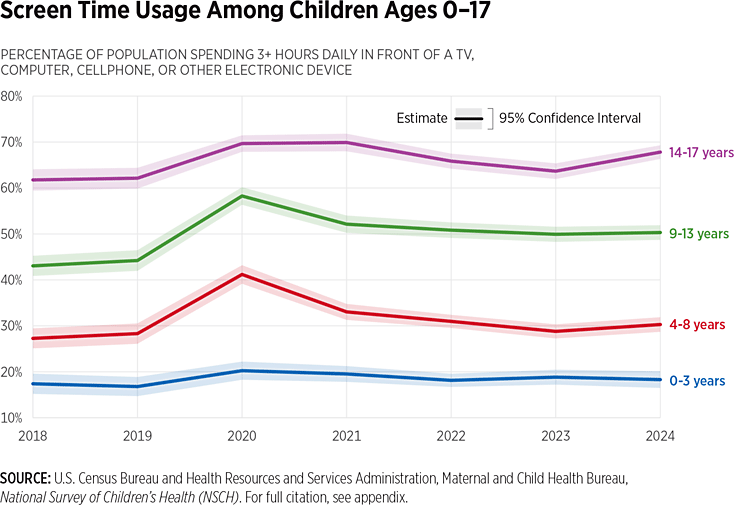
Data from the National Survey of Children’s Health, which is conducted by the Census Bureau in the U.S. Department of Commerce and the Maternal and Child Health Bureau in the U.S. Department of Health and Human Services, show a clear age-related progression in heavy screen use among children 0–17 years old throughout 2018 and 2023. More than 17 percent of babies and toddlers (0–3 years old), more than 25 percent of young children (4–8 years old), and more than 40 percent of children 9–13 years old spent more than three hours daily behind screens throughout this six-year period. Teenagers (14–17 years old) consistently exhibited the highest rates of excessive screen time at more than 60 percent. This progression among age groups remained constant.
In addition, all age groups experienced a notable spike in heavy screen time usage in 2020. The COVID-19 pandemic began early in 2020, and state and local governments issued mandatory lockdowns. Schools replaced in-person instruction with virtual, remote learning, and many sports and extracurricular activities ceased. During this period, approximately 70 percent of teenagers aged 14–17 reached peak usage levels of three or more hours daily spent on screens, the 9–13 age group climbed to 58 percent, the 4–8 age group reached 41 percent, and infants and toddlers reached just over 20 percent. This universal increase across age groups suggests that pandemic-related school closures, remote learning, and social distancing measures led directly to increased screen time for children.
The data for the years after 2020 show a gradual decline in heavy screen usage across most age groups through 2023, except for a slight increase for infants and toddlers between 2022 and 2023. Teenagers aged 14–17 maintained the same level with 70 percent spending three hours or more behind screens through 2021 before usage began to decrease. Infants and toddlers fell to 18 percent in 2022 but rose to 19 percent in 2023. The other two age groups saw a more significant decrease in percentages between 2020 and 2021. Children aged 9–13 fell from 58 percent to 52 percent, and 4-year-olds through 8-year-olds dropped to 33 percent from 41 percent.
The percentages of children who used screens more than three hours daily did not decline to pre-pandemic levels even by 2023. Despite the lifting of pandemic restrictions and resumption of in-person education and activities, the data suggest that some behavioral changes in 2020 were not temporary and led to more lasting changes for children. This shift raises questions regarding children’s dependence on screens, their ability to decrease screen use, and the long-term effects of increased screen exposure throughout their development.
Endnotes
- American Academy of Pediatrics, Council on Communications and Media Policy Statement, “Media and Young Minds,” Pediatrics, Vol. 138, No. 5 (November 2016), https://publications.aap.org/pediatrics/article/138/5/e20162591/60503/Media-and-Young-Minds (accessed April 6, 2026). See also subsequently revised version, “Digital Ecosystems, Children, and Adolescents: Policy Statement,” Pediatrics, Vol. 157, No. 2 (February 2026), https://publications.aap.org/pediatrics/article/157/2/e2025075320/206129/Digital-Ecosystems-Children-and-Adolescents-Policy (accessed April 6, 2026). ↩
Sources
- U.S. Department of Commerce, Census Bureau, and U.S. Department of Health and Human Services, Maternal and Child Health Bureau, “National Survey of Children’s Health (NSCH),” 2018–2024, https://www.census.gov/programs-surveys/nsch.html (accessed May 11, 2026).
