
Annie Chestnut Tutor
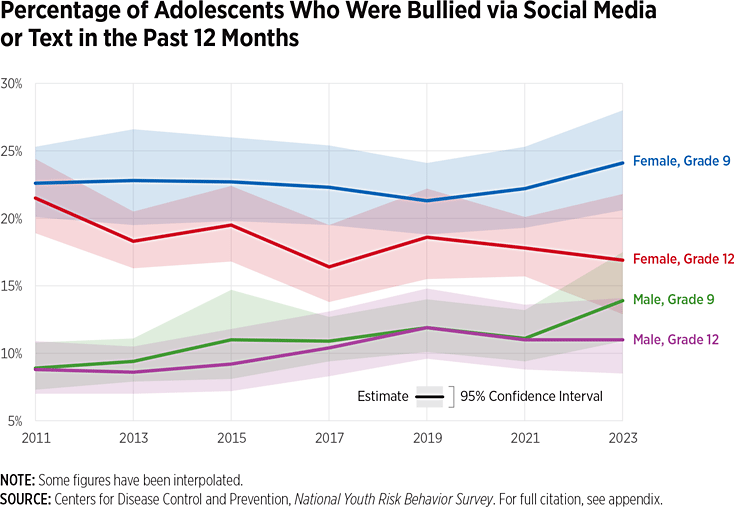
Cyberbullying among freshmen in high school has increased during the past decade and generally is more prevalent than cyberbullying among senior high school students. This trend suggests that cyberbullying decreases with age, brain development, and maturity. Younger teens are more vulnerable to cyberbullying and thus need greater protection from these harms. Parents and policymakers should tailor rules, oversight, and policies accordingly.
For girls, bullying was consistently higher in 9th grade than in 12th grade between 2011 and 2023. For boys, bullying occurred the same or more in 9th grade compared to 12th grade throughout the 12-year period.
Overall, bullying for 9th grade girls rose from 23 percent in 2011 to 24 percent in 2023, but in 12th grade it decreased from 22 percent in 2011 to 17 percent in 2023. The overall trend for boys showed an increase in bullying for 9th graders and 12th graders from 2011 to 2023. Bullying among 9th grade boys rose from 9 percent in 2011 to 14 percent in 2023, and bullying among 12th grade boys rose from 9 percent in 2011 to 11 percent in 2023.
High school freshmen are typically 14–15 years old, and high school seniors are typically 17–18 years old. These findings support raising the minimum age for social media from 13 to 16 as suggested previously by The Heritage Foundation.[REF] They also support providing more parental tools and oversight through the Kids Online Safety Act[REF] and the Children and Teens’ Online Privacy Protection Act.[REF]
Cyberbullying comes in many forms, but the rise of deepfake images generated by artificial intelligence (98 percent of which are pornographic) is particularly damaging for victims.[REF] Current federal legislation would criminalize publishing or threatening to publish non-consensual intimate images (real or fake) and require platforms to remove the images within 48 hours of a request from the individual in or depicted in the image.[REF]
As technology advances, methods and opportunities for cyberbullying also advance. Teens—especially younger teens—need more oversight and other protections to mitigate cyberbullying.
Endnotes
- Chestnut Tutor, “Age Verification: What It Is, Why It’s Necessary, and How to Achieve It.” ↩
- S. 1748, Kids Online Safety Act, 119th Congress, introduced May 14, 2025, https://www.congress.gov/119/bills/s1748/BILLS-119s1748is.pdf (accessed April 6, 2026). ↩
- S. 836, Children and Teens’ Online Privacy Protection Act, 119th Congress, introduced March 4, 2025, https://www.congress.gov/119/bills/s836/BILLS-119s836es.pdf (accessed April 6, 2026). ↩
- Alena Birrer and Natascha Just, “What We Know and Don’t Know About Deepfakes: An Investigation into the State of the Research and Regulatory Landscape,” New Media & Society, Vol. 27, No. 12 (2025), pp. 6819–6838, https://journals.sagepub.com/doi/pdf/10.1177/14614448241253138 (accessed April 29, 2026). ↩
- S. 146, Tools to Address Known Exploitation by Immobilizing Technological Deepfakes on Websites and Networks Act (TAKE IT DOWN Act), Public Law 119-12, 119th Congress, May 19, 2025, https://www.congress.gov/119/plaws/publ12/PLAW-119publ12.pdf (accessed April 29, 2026). ↩
Sources
- U.S. Department of Health and Human Services, Youth Risk Behavior Surveillance System (YRBSS), “National YRBSS Datasets and Documentation by Year,” 2011–2023, https://www.cdc.gov/yrbs/data/national-yrbs-datasets-documentation.html (accessed May 10, 2026).
