
Jonathan Butcher
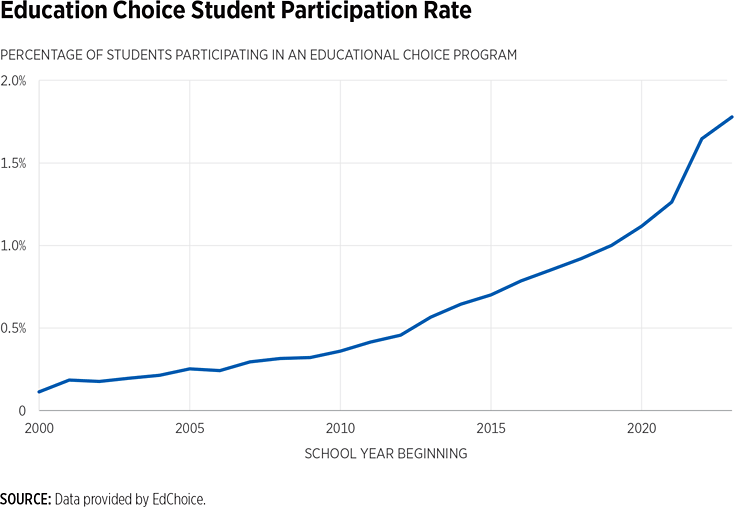
America’s K–12 education system is in the early stages of a dramatic transformation. Over the past 25 years, participation per capita in private education choice programs—vouchers, tax-credit scholarships, and K–12 education savings accounts—has increased more than tenfold.[REF] This surge in participation has been accompanied by the adoption of robust education choice policies by growing numbers of states, particularly in the wake of COVID-related school closures and increasing awareness of the politicization of the district school classroom and “woke” policies that put males into girls’ locker rooms and on girls’ sports teams.[REF] Since 2020, 18 states have adopted policies that make every one of their K–12 students eligible for education choice programs.[REF] By the end of 2025, more than half of K–12 students nationwide were eligible to participate in a private education choice program.[REF]
However, much remains to be done. Students participating in these choice programs represent less than 2 percent of the total K–12 student population nationwide. Moreover, universal eligibility does not imply universal access. Even among the states that make every K–12 student eligible for education choice, only a handful tie their programs to the state funding formula to ensure that every eligible student has access to a scholarship or education savings account.
Every child should have access to the learning environment that best meets his or her individual needs. States should enact education choice policies that not only make every K–12 student eligible to participate, but also ensure that every eligible child is funded through the state’s education funding formula or a similar funding mechanism. As more states adopt universal education choice policies and more families learn about them, participation rates will likely continue to climb rapidly for the foreseeable future.[REF]
Endnotes
- Jonathan Butcher and Jason Bedrick, “Giving Every Child an Excellent Future with Education Savings Accounts,” Heritage Foundation Backgrounder No. 3734, November 21, 2022, https://www.heritage.org/sites/default/files/2022-11/BG3734.pdf; EdChoice. The ABCs of School Choice: The Comprehensive Guide to Every Private School Choice Program in America, 2026 Edition, https://www.edchoice.org/wp-content/uploads/2025/12/The-ABCs-of-School-Choice-2026-WEB.pdf (accessed April 7, 2026). ↩
- See Jay P. Greene and James D. Paul, “Time for the School Choice Movement to Embrace the Culture War,” Heritage Foundation Backgrounder No. 3683, February 9, 2022, https://www.heritage.org/sites/default/files/2022-02/BG3683.pdf; Jonathan Butcher and Mike Gonzalez, “Hey Hey, Ho Ho, Ethnic Studies Have Got to Go,” Heritage Foundation Backgrounder No. 3853, September 13, 2024, https://www.heritage.org/sites/default/files/2024-09/BG3853.pdf; Jay Greene, Madison Marino [Doan], and Kathrine Bedard, “Equity Elementary Extended: The Growth and Effects of ‘Diversity, Equity, and Inclusion’ Staff in Public Schools,” Heritage Foundation Backgrounder No. 3791, October 4, 2023, https://www.heritage.org/sites/default/files/2023-10/BG3791.pdf; Jay P. Greene and Ian S. Kingsbury, “Empowering Parents with School Choice Reduces Wokeism in Education,” Heritage Foundation Backgrounder No. 3735, November 15, 2022, https://www.heritage.org/sites/default/files/2022-11/BG3735.pdf; Daniel Buck and Jay W. Richards, “Gender Ideology as State Education Policy,” Heritage Foundation Backgrounder No. 3879, December 18, 2024, https://www.heritage.org/sites/default/files/2024-12/BG3879.pdf. ↩
- Jonathan Butcher and Jason Bedrick, “2023: The Year of Education Freedom,” Heritage Foundation Backgrounder No. 3788, September 11, 2023, https://www.heritage.org/sites/default/files/2023-09/BG3788.pdf. ↩
- Jason Bedrick, “Texas Tips the Scales: School Choice Now Covers Half of US Kids,” The Daily Signal, April 17, 2025, https://www.dailysignal.com/2025/04/17/texas-tips-scales-school-choice-now-covers-half-u-s-kids/. ↩
- The Heritage Foundation, “Education Freedom Report Card: State Rankings for Parents,” https://educationreportcard.heritage.org. ↩
