Preston Brashers
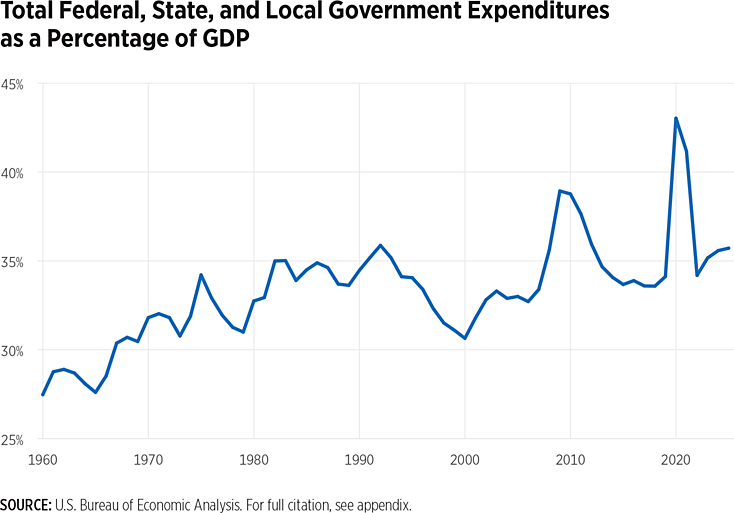
The chart above depicts total federal, state, and local government spending as a percentage of GDP, which captures the size of government in the broader context of the nation’s economic output.
Governments and businesses operate very differently from one another because they face very different constraints. A business, for example, can stay afloat only if it produces goods or services that customers will voluntarily purchase at prices that at least cover its costs.
Unlike a business, a government does not depend on voluntary payments from customers; it has the power to compel taxpayers to pay for its activities without regard for the willingness of individual taxpayers to pay for the services it is rendering. The constraint faced by a government is therefore very different from the constraint faced by a business: Spending is limited to what a government can raise by levying taxes, borrowing (future taxes), or simply creating new money (the root of inflation).
One way or another, however, Americans must pay the full price of government. As Milton Friedman once said, “Keep your eye on one thing and one thing only: how much government is spending. Because that’s the true tax.” Spending reflects the full burden of the cost of government; current taxes may reflect only part of that burden.
As the chart above illustrates, the total size of government has risen dramatically since 1960, but growth in the relative burden of government expenditures (as a share of the economy) has risen less consistently, with private economic growth occasionally outstripping the expansion of government. Federal, state, and local government expenditures accounted for 27.5 percent of gross domestic product (GDP) in 1960. By 1982, government expenditures had grown to 35.0 percent of GDP. There were significant reductions in government’s share of the economy in the 1980s and 1990s, especially in the latter half of the 1990s. After the implementation of the 1994 “Contract with America” legislative agenda (led by Speaker of the House Newt Gingrich), total government expenditures fell from 34.1 percent of GDP to 30.6 percent of GDP by 2000. However, government spending has ratcheted up with each successive recession since 2000. During recessions, government’s share of the economy spikes; during economic recoveries, government’s share declines from the peaks of the recession but tends to settle above pre-recession levels. As of 2023, total government expenditures were at 35.1 percent of GDP, down from a peak of 43.0 percent during and in the aftermath of the COVID-19 pandemic and the 2008–2009 recession but still very high by America’s historical standards.[REF]
America’s aging population will continue to put upward pressure on the size of the government in the coming decades. The Congressional Budget Office projects that rising federal spending will be driven primarily by Social Security, Medicare, and interest on the debt.[REF]
Endnotes
- Table 3.1, “Government Current Receipts and Expenditures,” in U.S. Department of Commerce, Bureau of Economic Analysis, “National Data: National Income and Product Accounts: NIPA Tables, Section 3: Government Current Receipts and Expenditures,” and Table 1.17.5, “Gross Domestic Product, Gross Domestic Income, and Other Major NIPA Aggregates,” in U.S. Department of Commerce, Bureau of Economic Analysis, “National Data: National Income and Product Accounts: NIPA Tables, Section 1: Domestic Product and Income,” https://apps.bea.gov/iTable/?reqid=19&step=2&isuri=1&categories=survey (accessed April 3, 2026). ↩
- See, for example, Congressional Budget Office, The Budget and Economic Outlook: 2025 to 2035, January 2025, p. 3, https://www.cbo.gov/publication/61172 (accessed April 3, 2026). ↩
Sources
- U.S. Department of Commerce, Bureau of Economic Analysis, National Income and Product Accounts, “Table 3.1. Government Current Receipts and Expenditures,” last revised March 13, 2026, https://www.bea.gov/.
- U.S. Department of Commerce, Bureau of Economic Analysis, National Income and Product Accounts, “Table 1.17.5. Gross Domestic Product, Gross Domestic Income, and Other Major NIPA Aggregates,” last revised March 13, 2026, https://www.bea.gov/.
