
Jennifer Galardi
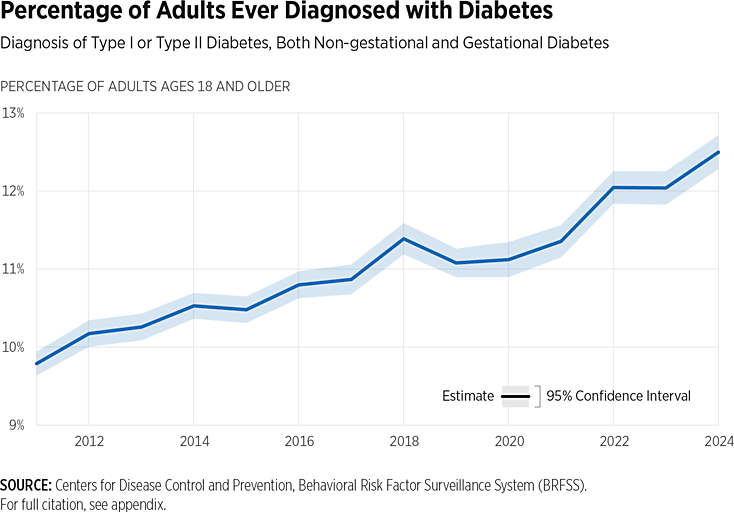
Diabetes or hyperglycemia (high blood sugar) is a chronic disease that affects millions of American adults every year. With little exception, rates have climbed steadily since 2011 when 9.5 percent of adults were diagnosed with the disease. The Centers for Disease Control and Prevention now estimates the rate of diabetes to be 14.7 percent or 38.1 million among adults, up from its leveling off point of approximately 12 percent in 2023.
Diabetes is an expensive disease. A 2022 American Diabetes Association report found the annual cost to be almost $413 billion, including $306.6 billion in direct medical costs and $106.3 billion in indirect costs.[REF] People with diagnosed diabetes now account for one of every four health care dollars spent in the U.S. The American Diabetes Association report also found that national health care costs attributable to diabetes increased by $80 billion from 2012 to 2022.[REF]
This is an unsustainable path for health care in the United States. While some cases of diabetes, like Type 1,[REF] are hard to prevent, they represent less than 6 percent of overall cases. Most reported cases of diabetes are Type 2,[REF] which can be reversed with diet and lifestyle changes. These changes typically also contribute to better health outcomes with respect to such other problems as heart disease and obesity, also outlined in this report. In fact, many studies demonstrate that insulin resistance is a root cause of many metabolic disorders.
A diet high in refined carbohydrates, particularly one that includes a lot of sugar, is the easiest path to diabetes. The astronomical rise in the consumption of highly processed foods,[REF] which are almost always high-glycemic foods, and the decrease in whole food diets are directly correlated to the rising rate of diabetes.
Gestational diabetes (GDM) is defined as any degree of hyperglycemia that is first recognized during pregnancy.[REF] While its cause has been described as “multifactorial,” GDM can be affected by the dietary habits of the mother. One study showed that women who developed GDM had erroneous knowledge regarding nutrition.[REF]
The Biden Administration liked to tout the fact that it capped the cost of insulin for patients at a $35 copay. A more constructive change in the long run would be to help people get off their insulin medications completely by promoting dietary changes and an exercise program. Whether it is the patient or the taxpayer, everyone pays for diabetes, and it will continue to impose a heavy burden on all Americans until we break our addiction to sugar and processed foods.
Endnotes
- Press release, “New American Diabetes Association Report Finds Annual Costs of Diabetes to Be $412.9 Billion,” American Diabetes Association, November 1, 2023, https://diabetes.org/newsroom/press-releases/new-american-diabetes-association-report-finds-annual-costs-diabetes-be (accessed April 8, 2026). For the full text of the report, see Emily D. Parker et al., “Economic Costs of Diabetes in the U.S. in 2022,” Diabetes Care, Vol. 47, No. 1 (January 2024), pp. 26–43, https://diabetesjournals.org/care/article/47/1/26/153797/Economic-Costs-of-Diabetes-in-the-U-S-in-2022 (accessed April 8, 2026). ↩
- Press release, “New American Diabetes Association Report Finds Annual Costs of Diabetes to Be $412.9 Billion.” ↩
- U.S. Department of Health and Human Services, Centers for Disease Control and Prevention, “Diabetes: Type 1 Diabetes,” May 15, 2024, https://www.cdc.gov/diabetes/about/about-type-1-diabetes.html (accessed April 8, 2026). ↩
- U.S. Department of Health and Human Services, Centers for Disease Control and Prevention, “Diabetes: Type 2 Diabetes,” May 15, 2024, https://www.cdc.gov/diabetes/about/about-type-2-diabetes.html (accessed April 8, 2026). ↩
- Filippa Juul et al., “Ultra-Processed Food Consumption Among US Adults from 2001 to 2018,” The American Journal of Clinical Nutrition, Vol. 115, No. 1 (January 2022), pp. 211–221, https://doi.org/10.1093/ajcn/nqab305 (accessed April 8, 2026). ↩
- AbdelHameed Mirghani Dirar and John Doupis, “Gestational Diabetes from A to Z,” World Journal of Diabetes, Vol. 8, No. 12 (December 15, 2017), pp. 489–511, https://doi.org/10.4239/wjd.v8.i12.489 (accessed April 8, 2026). ↩
- Alba Yuste Gómez, Maria del Pilar Ramos Álvarez, and José Luis Bartha, “Influence of Diet and Lifestyle on the Development of Gestational Diabetes Mellitus and on Perinatal Results,” Nutrients, Vol. 14, No. 14 (July 19, 2022), article no. 2954, https://doi.org/10.3390/nu14142954 (accessed April 8, 2026). ↩
Sources
- U.S. Department of Health and Human Services, Centers for Disease Control and Prevention, Behavioral Risk Factor Surveillance System, “Annual Survey Data,” 2011–2024, https://www.cdc.gov/brfss/annual_data/annual_data.htm (accessed May 10, 2026).
