
Charles D. “Cully” Stimson
A government’s first duty is to protect its citizens. The federal government plays a key role in fighting crime, but states and localities prosecute 90 percent of crimes across the country. The 50 state legislatures, 3,000-plus sheriffs, 18,000 police departments, and 2,300 elected district attorneys all play a major role in protecting us.[REF]
Many of us take public safety for granted, largely because most of us have not been the victims of violent crime. Violent crime is geographically and demographically concentrated in the inner cities across this country.[REF] Minorities suffer the brunt of violent crime.[REF] Nonviolent crime like shoplifting and theft is spread more evenly across the country.
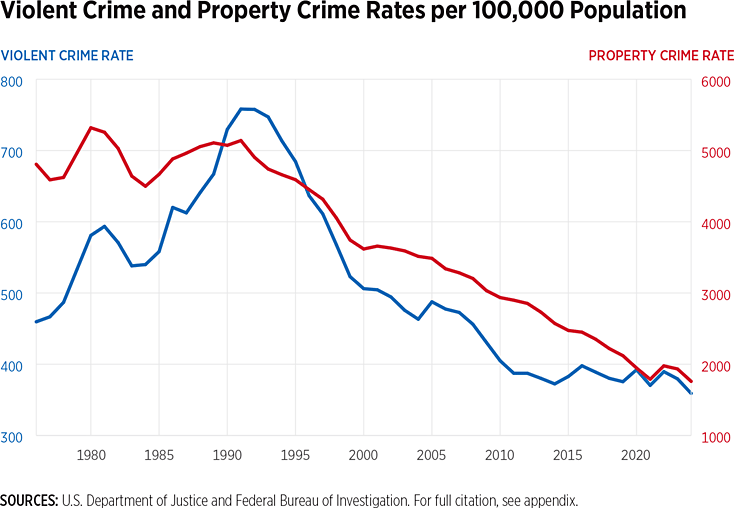
As the chart above shows, violent and nonviolent crime rates in our country have fallen dramatically since the last crime peak in 1992. That happened because states (1) passed stronger laws holding violent and recidivist criminals accountable and (2) at the same time created alternative courts and programs to provide services that keep offenders from reoffending. The essential ingredient is accountability.
The reason for the uptick in crime in 2018 in cities like (among many others) Chicago, Los Angeles, and Philadelphia was simple: It was the toxic trio of the “progressive” rogue prosecutor movement funded by George Soros, the defunding of police departments’ budgets, and the demonization of the police in general. Rogue prosecutors refused to prosecute misdemeanors, watered-down felonies, and implemented other pro-criminal policies that emboldened criminals and undercut accountability. Crime exploded in those blue cities and peaked in 2022. (See chart.)
The rogue prosecutor movement is fizzling out in large part because residents of blue cities want public safety, accountability, safe streets and communities, and thriving businesses: Simply put, they want their cities back. They ousted Soros rogue prosecutors Chesa Boudin, George Gascón, and Marilyn Mosby from office because all three failed to keep law-abiding citizens safe and hold criminals accountable. Protecting our streets and communities requires fully funded police departments and elected district attorneys who will hold all criminals accountable.
Endnotes
- See Zack Smith and Charles D. Stimson, Rogue Prosecutors: How Radical Soros Lawyers Are Destroying America’s Communities (Brentwood, TN: Post Hill Press, 2023). ↩
- Rafael A. Mangual, Criminal [In]Justice: What the Push for Decarceration and Depolicing Gets Wrong and Who It Hurts the Most (Nashville, TN: Center Street, 2022), p. 28. ↩
- Barry Latzer, The Myth of Overpunishment: A Defense of the American Justice System and a Proposal to Reduce Incarceration While Protecting the Public (New York: Republic Books, 2022), p. 88. ↩
Sources
- Table, “National Crime, Rate, and Percent Change,” in U.S. Department of Justice, Federal Bureau of Investigation, Crime in the United States 1976: Uniform Crime Reports for the United States, p. 35, https://www.ojp.gov/pdffiles1/Digitization/135546NCJRS.pdf (accessed May 10, 2026).
- Table, “National Crime, Rate, and Percent Change,” in U.S. Department of Justice, Federal Bureau of Investigation, Crime in the United States 1977: Uniform Crime Reports for the United States, p. 35, https://www.ojp.gov/pdffiles1/Digitization/51706NCJRS.pdf (accessed May 10, 2026).
- Table, “National Crime, Rate, and Percent Change,” in U.S. Department of Justice, Federal Bureau of Investigation, Crime in the United States 1978: Uniform Crime Reports for the United States, p. 35, https://www.ojp.gov/pdffiles1/Digitization/61947NCJRS.pdf (accessed May 10, 2026).
- Table, “National Crime, Rate, and Percent Change,” in U.S. Department of Justice, Federal Bureau of Investigation, Crime in the United States 1980: Uniform Crime Reports for the United States, p. 38, https://www.ojp.gov/pdffiles1/Digitization/81134NCJRS.pdf (accessed May 10, 2026).
- Table 1, “Index of Crime, United States, 1981–2000,” in U.S. Department of Justice, Federal Bureau of Investigation, Crime in the United States 2000: Uniform Crime Reports for the United States, https://ucr.fbi.gov/crime-in-the-u.s/2000 (accessed May 10, 2026).
- Table 1, “Crime in the United States by Volume and Rate per 100,000 Inhabitants, 1991–2010,” in U.S. Department of Justice, Federal Bureau of Investigation, Crime in the United States 2010: Uniform Crime Reports for the United States, https://ucr.fbi.gov/crime-in-the-u.s/2010/crime-in-the-u.s.-2010/tables/10tbl01.xls (accessed May 10, 2026).
- U.S. Department of Justice, Federal Bureau of Investigation, “Crime Data Explorer: Documents and Downloads: Crime in the United States Annual Reports, 2024: CIUS Estimations, 2005–2024,” https://cde.ucr.cjis.gov/LATEST/webapp/# (accessed May 10, 2026).
