Paul J. Larkin
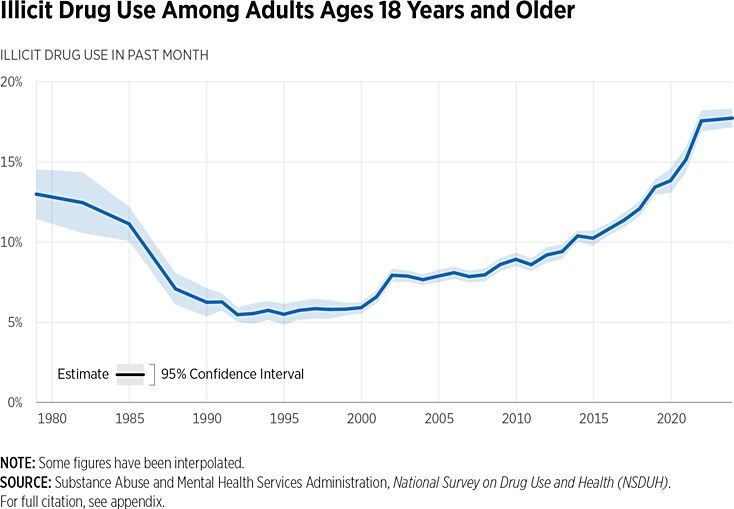
Despite the widespread knowledge that illegal drugs are addictive, life-worsening, and potentially deadly, their use by adults has been increasing for more than two decades. (See chart above.) Part of the problem is that American culture does not treat illicit drug use with the same disregard (to say nothing of contempt) that we now regularly and widely attribute to smoking tobacco. We have known since the mid-1960s (if not earlier) that smoking burning carbon compounds can cause emphysema, lung disease, cancer, and preventable deaths.[REF]
Ironically and dangerously, however, our nation has not yet widely adopted the same disapproving or contemptuous attitude toward smoking botanical cannabis. On the contrary, since 1996, a majority of states—willing to be duped into believing that cannabis is a harmless divertissement or potential pain-relieving drug, or hungering for promised tax revenues that cannabis legalization is supposed to deliver—have adopted medical or recreational cannabis programs that allow individuals to purchase that drug at local stores.[REF]
This phenomenon has arisen even though federal law continues to treat the cultivation, sale, and possession of cannabis as a federal crime; even though some cannabis users will “drive while stoned” and thereby put at risk the safety and lives of innocent third parties; and even though scientific research has shown increasingly that smoking cannabis—particularly today’s version, which is far more powerful than grandaddy’s ganja—is harmful physically and psychologically. The message that this sends to minors and adults is that we are not serious about protecting their health and are willing to be hypocritical when it is profitable to do so. That attitude is proof of the aphorism that hypocrisy is the tribute that vice pays to virtue.
But we have a problem even if we put cannabis aside. The Mexican Drug Trafficking Organizations use pill presses illicitly to manufacture “look-alike” drugs that resemble lawfully manufactured and sold pharmaceuticals with legitimate uses.[REF] For example, Adderall is used to treat Attention Deficit-Hyperactivity Disorder, but it is also used at times by students who need to remain awake to cram for a final exam or write a term paper. Sadly, students who obtain those drugs over the internet might be getting a pill that resembles a legitimate pharmaceutical but is full of fentanyl, a synthetic opioid 50–100 times more powerful than morphine. As a result, students who would never knowingly take a nonprescription opioid wind up unknowingly ingesting an exceptionally powerful one that can cause a fatal overdose.[REF]
Supply-side approaches to illicit drug use, such as law enforcement and border protection, are necessary to fight our drug problem, but they need to be combined with demand-side efforts.[REF] For example, we need to change the culture from one of approbation or professed ignorance of (or hypocrisy toward) illicit drug use to one of dissuading minors from even starting down that road. As Dr. Robert DuPont, a former “Drug Czar” and expert on all things involving drugs, has found, people who do not use tobacco, alcohol, or illicit drugs before age 21 are very highly unlikely to do so thereafter.[REF] This is not to say that anyone who does is destined to become a 21st century Julian Wells,[REF] but it does mean that your chances of succumbing to that fate are far less likely. We need well-known figures to endorse opposition to drug use. Just persuading Denzel Washington and Taylor Swift to oppose it would save thousands, if not millions, of lives because drugs that you do not take cannot cause an overdose and cannot kill you.
The era of recreational drug use is over: Fentanyl killed it.[REF] We shouldn’t let it do the same to us.
Endnotes
- See, for example, U.S. Department of Health and Human Services, Centers for Disease Control and Prevention, “Smoking and Tobacco Use: Health Effects of Cigarettes: Cancer,” September 17, 2024, https://www.cdc.gov/tobacco/about/cigarettes-and-cancer.html (accessed April 9, 2026). ↩
- Paul J. Larkin, “Cannabis, Justice, Race, and Politics,” Georgetown Journal of Law & Public Policy, Vol. 22, Special Issue (2024), https://www.law.georgetown.edu/public-policy-journal/in-print-2/volume-22-special-issue/cannabis-justice-race-and-politics/ (accessed April 9, 2026). ↩
- See Paul J. Larkin, “Twenty-First Century Illicit Drugs and Their Discontents: The Scourge of Illicit Fentanyl,” Heritage Foundation Legal Memorandum No. 313, November 1, 2022, pp. 12–13 and notes 128–133, https://www.heritage.org/sites/default/files/2022-11/LM313.pdf (collecting authorities). ↩
- Ibid. ↩
- See Paul J. Larkin, “Twenty-First Century Illicit Drugs and Their Discontents: The Challenges Posed by Novel Psychoactive Substances (NPSs),” Heritage Foundation Special Report No. 282, May 17, 2024, pp. 13–20, https://www.heritage.org/sites/default/files/2024-05/SR282_0.pdf (describing various responses). ↩
- See, for example, Robert L. DuPont et al., “Drug Use Among Youth: National Survey Data Support a Common Liability of All Drug Use,” Preventive Medicine, Vol. 113 (2018), pp. 68–73, https://d1r9bdsrv6vekg.cloudfront.net/images/Drug_use_among_youth_-_National_survey_data_support_a_common_liability_of_all_drug_use2017.pdf (accessed April 9, 2026). See also Institute for Behavior and Health, “Priority Areas: One Choice: A Clear Public Health Standard for Youth,” https://www.ibhinc.org/one-choice-prevention (accessed April 9, 2026). ↩
- Less Than Zero (20th Century Fox, 1987) (the character played by Robert Downey, Jr.). ↩
- See Larkin, “Twenty-First Century Illicit Drugs and Their Discontents: The Challenges Posed by Novel Psychoactive Substances (NPSs),” p. 20: “One point that we do need to emphasize—everywhere and repeatedly—is that NPSs like fentanyl and their illegitimate offspring like the nitazenes have brought an end to the era of drug experimentation. Recreational drugs used in the 1960s, 1970s, and 1980s like marijuana could generate short-term and long-term harms but were not likely to produce immediate death, at least not on a widespread basis. Fentanyl can do so and has done so. ‘There is no safe amount of fentanyl, and unlike with heroin, no long-term users.’ Fentanyl is sold as a stand-alone powder, as a secret ingredient in other illicit drugs, or sometimes in counterfeit pills. That fact is a particularly important one to bring to the attention of people in their 20s and 30s because they are the primary clientele for NPS traffickers. That generation might bewail the loss of their opportunity to pursue the same recreational drug experimentation as their fathers and grandfathers pursued. At the end of the day, however, Millennials and Generation Zers need to realize that more important than cursing the darkness is finding a light.” Footnotes and punctuation omitted. ↩
Sources
- U.S. Department of Health and Human Services, Substance Abuse and Mental Health Services Administration, “National Survey on Drug Use and Health (NSDUH),” https://www.samhsa.gov/data/data-we-collect/nsduh/datafiles (accessed May 10, 2026).
