
Rachel Sheffield
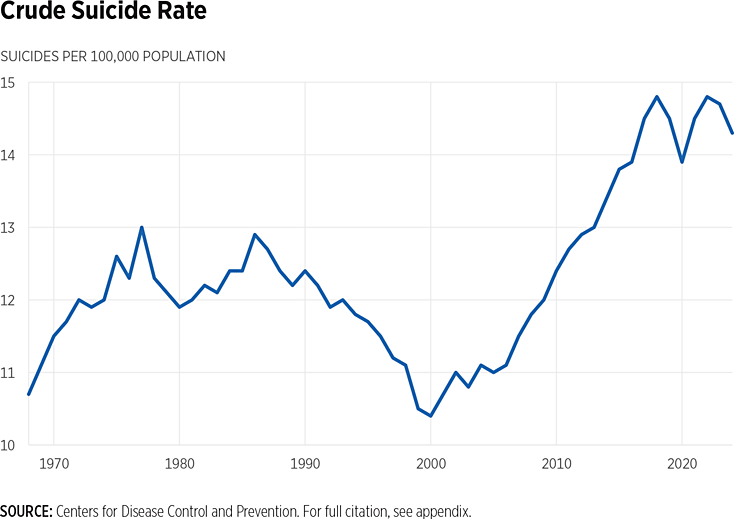
Suicide rates have increased dramatically during the past couple of decades in nearly every age group with a particularly large spike among teens. Suicide also has increased substantially among middle-aged adults, especially since the Great Recession. On a more positive note, suicide rates among many older age groups are lower than they were in the 1980s and 1990s, although suicides among the most elderly (ages 85 and older) have spiked since the time of the COVID-19 pandemic.[REF]
During the COVID pandemic, something interesting occurred. Overall, people’s reported feelings of depression and thoughts of suicide increased, but actual suicides declined noticeably.[REF] Coming out of the pandemic, suicide rates returned to their upward climb, particularly among teens, but for a short period, things had taken a turn for the better.
Scholars have pointed out that suicides likely dropped during the pandemic because people had fewer opportunities to carry out their self-demise. More people were at home with family members or roommates and thus were under closer surveillance. Even though overall mental health declined during the pandemic, simply being around others more of the time seemed to decrease the likelihood of suicide.
On the other hand, among the oldest adults, rates of suicide jumped during COVID. This group is the most likely of any age group to live alone and thus may have been more socially isolated during the pandemic. Opportunities for interaction with people outside the home decreased for everyone during the pandemic, but decreased social interaction likely impacted the elderly more than it did other groups because of their frequency of living alone and greater reliance on people outside the home for care.[REF]
The natural experiment of the pandemic shows how people being together (or in some cases not being together) may affect suicide rates. Today, Americans spend less time together than they did in previous generations, and social capital has frayed, particularly in the most vulnerable communities.[REF]
Less time together obviously is not the only factor driving suicide. Scholars point to the rise of smartphone use and social media as a potential cause of the drastic rise in teen depression and suicide rates in the past several years.[REF] Technology can also play into poorer mental health because of increased social comparison and more negative interactions.[REF]
Suicide rates among middle-aged adults accelerated over a longer period that began around the time of the Great Recession (although they had already been increasing for a few years before the recession).[REF] The decline in labor force participation among prime-age men has been on a downward trend for decades, but the Great Recession dealt a further blow, indicating that unemployment may be a contributing factor.[REF]
Another factor contributing to suicide rates may be the increased momentum for legalization of assisted suicide.[REF] This movement undermines the value of human life and teaches the falsehood that allowing people to end their lives is compassionate and dignifying. These types of cultural messages may increase acceptance of suicide even if people don’t avail themselves of assisted suicide.
The U.S. has a long way to go in addressing its suicide crisis. Increasing opportunities for families and neighbors to have meaningful interaction, appropriately monitoring and limiting screens and social media use for youth, helping people to reconnect to the workforce, and pushing back against assisted suicide can all be effective in fighting the tragedy of suicide.
Endnotes
- Author’s calculations using data from U.S. Department of Health and Human Services, Centers for Disease Control and Prevention, CDC WONDER online databases, https://wonder.cdc.gov/ (accessed April 10, 2026). ↩
- Charles Fain Lehman, “COVID, Closeness, and the (Possible) Causes of Our Suicide Crisis,” Manhattan Institute Commentary, June 23, 2021, https://manhattan.institute/article/covid-closeness-and-the-possible-causes-of-our-suicide-crisis (accessed April 10, 2026). ↩
- U.S. Department of Commerce, Census Bureau, “Historical Living Arrangements of Adults,” page last revised December 2, 2025, https://www.census.gov/data/tables/time-series/demo/families/adults.html (accessed April 10, 2026). ↩
- SCP Report No. 1-17, What We Do Together: The State of Associational Life in America, U.S. Congress, Joint Economic Committee—Republicans, Social Capital Project, May 15, 2017, https://www.jec.senate.gov/public/_cache/files/6f670ee8-74de-497a-85f6-4cf6502d52d4/1-17-what-we-do-together.pdf (accessed April 10, 2026). ↩
- Annie Chestnut Tutor, “Age Verification: What It Is, Why It’s Necessary, and How to Achieve It,” Heritage Foundation Backgrounder No. 3895, March 6, 2025, https://www.heritage.org/sites/default/files/2025-03/BG3895.pdf. ↩
- Elia Abi-Jaoude, Karline Treurnicht Naylor, and Antonio Pignatiello, “Smartphones, social media use and youth mental health,” Canadian Medical Association Journal, Vol. 192, Issue 6 (February 10, 2020), pp. E136–E141, https://pmc.ncbi.nlm.nih.gov/articles/PMC7012622/pdf/192e136.pdf (accessed April 10, 2026). ↩
- Kaushal Mehta et al., “Depression in the US Population During the Time Periods Surrounding the Great Recession,” The Journal of Clinical Psychiatry, Vol. 76, No. 4 (April 2015), pp. e499–e504, https://www.psychiatrist.com/wp-content/uploads/2021/02/12414_depression-population-during-periods-surrounding-great.pdf (accessed April 10, 2026). The U.S. also saw major spikes in suicide during the Great Depression. See SCP Report No. 4-19, Long-Term Trends in Deaths of Despair, U.S. Congress, Joint Economic Committee—Republicans, Social Capital Project, September 2019, https://www.jec.senate.gov/public/_cache/files/0f2d3dba-9fdc-41e5-9bd1-9c13f4204e35/jec-report-deaths-of-despair.pdf (accessed April 9, 2026). ↩
- Chart “Infra-Annual Labor Statistics: Labor Force Participation Rate Male: From 25 to 54 Years for United States,” Federal Reserve Bank of St. Louis, updated December 15, 2025, https://fred.stlouisfed.org/series/LRAC25MAUSM156S (accessed April 10, 2026). ↩
- Death with Dignity, “In Your State,” current as of April 8, 2026, https://deathwithdignity.org/states/ (accessed April 10, 2026). ↩
Sources
- U.S. Department of Health and Human Services, National Center for Health Statistics, “Mortality Data on CDC WONDER: Underlying Cause-of-Death, Compressed Mortality, 1968–2024,” https://wonder.cdc.gov/mortsql.html (accessed May 10, 2026).
