Jonathan Abbamonte
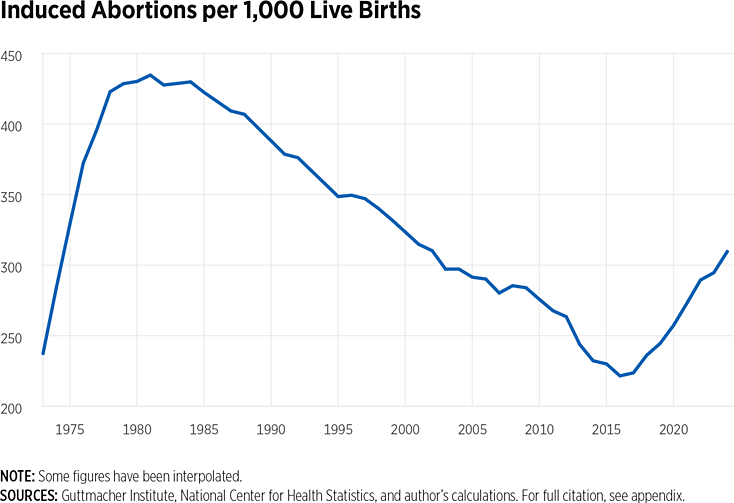
After declining consistently for most of the past 40 years, the incidence and prevalence of abortion in the United States are tragically on the rise again. Between 1983 and 2017, the number of induced abortions nationally fell almost every year. The abortion rate and abortion ratio also fell consistently over this period. Since 2017, however, the prevalence of abortion has been on the rise.
The chart above shows the abortion ratio in the United States since 1973 when Roe v. Wade legalized abortion in all 50 states.[REF] The abortion ratio is the number of abortions per 1,000 live births. It tells us approximately how common abortion is relative to the level of fertility in any given year. Ratios for the years between 1995 and 2022 when the Guttmacher Institute did not conduct an Abortion Provider Census are estimated using a cross-validation selected least angle regression using state-level data reported by the U.S. Centers for Disease Control and Prevention (CDC) as predictors.[REF]
According to the Guttmacher Institute, there were an estimated 1,123,700 abortions in the United States in 2024,[REF] the highest count on record since 2009. The abortion ratio in 2024 was 310, which means that there were 310 abortions for every 1,000 babies born alive that year. The last time the abortion ratio was that high was in 2002. National vital statistics show that the number of stillbirths per 1,000 live births has declined since 2016,[REF] and birth rates have continued to fall every year except in 2021. As a result, it is likely that the rise in the abortion ratio since 2016 is an indication that women are increasingly opting for abortion when they become pregnant.
The incidence of abortion has risen in recent years even as many states have increasingly adopted robust laws protecting the unborn. In 2022, the U.S. Supreme Court overturned the central holding of Roe v. Wade in its decision in Dobbs v. Jackson Women’s Health Organization, returning to the states the ability to legislate on abortion.[REF] By the end of 2023, 15 states had banned abortion completely at some point, and an additional five states had restricted abortion to six to 12 weeks gestation. Numerous studies have found clear evidence that pro-life laws are effective in reducing abortions and saving lives.[REF] Why, then, is the prevalence of abortion nationally rising when so much progress has been made at the state level?
There appear to be two main reasons. The first, hyped by the fearmongering of the media and politicians, is that many Americans have bought into the lie that women would die if Roe v. Wade were overturned and abortion were made illegal. The Left had been hammering this message for years before Dobbs because abortion advocates could read the writing on the wall as states enacted more and more robust laws protecting the unborn. The most recent polls show that the percentage of Americans who think abortion should be legal under any circumstances is at an all-time high,[REF] and a majority of Americans now believe that abortion is morally acceptable.[REF] But despite the alarmism about women dying as a result of abortion bans, maternal mortality in the U.S. has declined every year since Dobbs.[REF]
The second reason for the recent rise in abortions is that the U.S. Food and Drug Administration (FDA) has significantly loosened access to mifepristone (the “abortion pill”). Before 2016, the FDA had required abortionists to dispense the abortion pill in person in a clinic setting, and abortionists were required to follow up with in-office visits both three and 14 days later to ensure that there were no serious or life-threatening complications. After 2016, the number of required office visits was reduced from three to one. During the COVID-19 pandemic, the FDA further permitted mifepristone to be dispensed through the mail and eliminated any requirement that the woman seeking abortion have in-person contact with the abortionist. Abortion pills can now easily be sent anywhere in the United States, making it easier than ever before to obtain an abortion. The Comstock Act prohibits the mailing of any drugs or devices with the intention of inducing an abortion via the U.S. Postal Service,[REF] but the Biden Administration failed to enforce this law. Until states and the federal government can stop the mailing of abortion-inducing drugs and reinstate the FDA’s former safety restrictions on the abortion pill, the prevalence of abortion is not likely to decline significantly anytime soon.
Endnotes
- Roe v. Wade, 410 U.S. 113 (1973), https://tile.loc.gov/storage-services/service/ll/usrep/usrep410/usrep410113/usrep410113.pdf (accessed April 10, 2026). ↩
- Jonathan Abbamonte, “Estimating Abortion Incidence in the United States: An Imputation of Missing Data Using Regression,” forthcoming paper. ↩
- Isaac Maddow-Zimet et al., “Monthly Abortion Provision Study,” Guttmacher Institute, data released March 24, 2026. ↩
- U.S. Department of Health and Human Services, National Center for Health Statistics, “Fetal Death Records 2005-2022,” CDC WONDER Online Database, https://wonder.cdc.gov/ (accessed February 27, 2025). ↩
- Dobbs v. Jackson Women’s Health Organization, 597 U.S. 215 (2022), https://www.supremecourt.gov/opinions/21pdf/597us1r58_gebh.pdf (accessed April 9, 2026). ↩
- Daniel Dench, Mayra Pineda-Torres, and Caitlin Myers, “The Effects of Post-Dobbs Abortion Bans on Fertility,” Journal of Public Economics, Vol. 234 (2024), article no. 105124, https://www.sciencedirect.com/science/article/pii/S0047272724000604 (accessed April 1, 2026); Stefanie Fischer, Heather Royer, and Corey White, “The Impacts of Reduced Access to Abortion and Family Planning Services on Abortion, Births, and Contraceptive Purchases,” National Bureau of Economic Research Working Paper No. 23634, July 2017, revised December 2017, https://www.nber.org/system/files/working_papers/w23634/w23634.pdf (accessed April 1, 2026); Michael J. New, “Analyzing the Impact of US Antiabortion Legislation in the Post-Casey Era: A Reassessment,” State Politics & Policy Quarterly, Vol. 14, No. 3 (2014), pp. 228–268; Kari White et al., “Association of Texas’ 2021 Ban on Abortion in Early Pregnancy with the Number of Facility-based Abortions in Texas and Surrounding States,” JAMA, Vol. 328, No. 20 (2022), pp. 2048–2055, https://jamanetwork.com/journals/jama/fullarticle/2798216 (accessed April 1, 2026); Theodore Joyce, Stanley K. Henshaw, and Julia DeClerque Skatrud, “The Impact of Mississippi’s Mandatory Delay Law on Abortions and Births,” JAMA, Vol. 278, No. 8 (1997), pp. 653–658, https://jamanetwork.com/journals/jama/article-abstract/418044 (accessed April 1, 2026); Ushma D. Upadhyay et al., “Evaluating the Impact of a Mandatory Pre-abortion Ultrasound Viewing Law: A Mixed Methods Study,” PLoS ONE, Vol. 12, No. 7 (2017), article no. e0178871, https://journals.plos.org/plosone/article?id=10.1371/journal.pone.0178871 (accessed April 1, 2026). ↩
- Gallup, “Abortion,” https://news.gallup.com/poll/1576/abortion.aspx (accessed April 10, 2026); Pew Research Center, “Broad Public Support for Legal Abortion Persists 2 Years After Dobbs,” May 13, 2024, https://www.pewresearch.org/politics/2024/05/13/broad-public-support-for-legal-abortion-persists-2-years-after-dobbs/ (accessed May 22, 2026); Knights of Columbus/Marist Poll, January 12–13, 2026, Poll Crosstabs, https://www.kofc.org/resources/news/press-releases/polls/marist-poll-a-consistent-consensus-supports-legal-limits-on-abortion22/ (accessed May 22, 2026). ↩
- Gallup, “Abortion.” ↩
- Donna L. Hoyert, “Health E-Stat 100: Maternal Mortality Rates in the United States, 2023,” U.S. Department of Health and Human Services, National Center for Health Statistics, Health E-Stats, February 2025, https://www.cdc.gov/nchs/data/hestat/maternal-mortality/2023/Estat-maternal-mortality.pdf (accessed April 1, 2026). ↩
- 18 U.S. Code § 1461, https://www.law.cornell.edu/uscode/text/18/1461 (accessed April 10, 2026). ↩
Sources
- Isaac Maddow-Zimet et al., Pregnancies, Births and Abortions in the United States: National and State Trends by Age, Guttmacher Institute, data created September 23, 2020, updated October 3, 2024, https://osf.io/kthnf/overview (accessed May 10, 2026).
- Jonathan Abbamonte, “Abortion Incidence in the United States: An Imputation of Missing Data Using Least Angle Regression,” working paper, forthcoming.
- Isaac Maddow-Zimet et al., “Monthly Abortion Provision Study,” Guttmacher Institute, data created August 31, 2023, updated March 23, 2026, https://osf.io/k4x7t/overview (accessed May 10, 2026).
- Joyce A. Martin et al., “Births: Final Data for 2015,” U.S. Department of Health and Human Services, National Center for Health Statistics, National Vital Statistics Reports, Vol. 66, No. 1 (January 5, 2017), https://www.cdc.gov/nchs/data/nvsr/nvsr66/nvsr66_01.pdf (accessed May 10, 2026).
- Michelle J.K. Osterman et al., “Births: Final Data for 2022,” U.S. Department of Health and Human Services, National Center for Health Statistics, National Vital Statistics Reports, Vol. 73, No. 2 (April 4, 2024), https://www.cdc.gov/nchs/data/nvsr/nvsr73/nvsr73-02.pdf (accessed May 10, 2026).
- Joyce A. Martin, Brady E. Hamilton, and Michelle J.K. Osterman, “Births in the United States, 2024,” U.S. Department of Health and Human Services, National Center for Health Statistics, NCHS Data Brief No. 535, July 2025, https://dx.doi.org/10.15620/cdc/174613 (accessed May 10, 2026).
