
Delano Squires
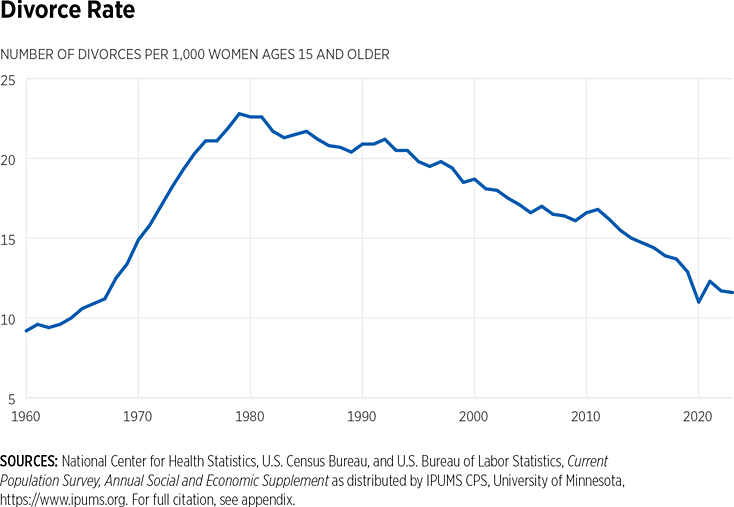
One of the most common beliefs about American family life is that half of all marriages end in divorce. This idea likely began when divorce rates increased dramatically in the 1970s after the passage of no-fault divorce laws.[REF] There is no denying that divorce has become more common since then, but rates have actually decreased since their high in the 1980s. The chart above shows that the rate of women experiencing a divorce was 9.2 per 1,000 married women in 1960.[REF] It reached 23 per 1,000 married women in 1980 but decreased to approximately 12 per 1,000 married women by 2022.[REF]
Divorce rates have declined since the 1980s partly because marriage is on the decline. In 1970, married couples comprised 70 percent of all American households.[REF] Today, married couples comprise less than half of American households (47 percent).[REF]
The most common reasons that people cite for divorce include lack of commitment, infidelity, high levels of conflict, drinking and drug use, growing apart, and domestic abuse.[REF] Research suggests, however, that about half of divorces are to couples who were in low-distress marriages.[REF] Factors associated with a reduced likelihood of divorce include not cohabiting before marriage (or at least not before engagement), being actively involved in a religious community, and having children only after marriage.[REF]
Any news suggesting that marriages are becoming more stable is a positive sign for families and policymakers. Given the self-selecting nature of marriage today, however, divorce data must be analyzed within the context of broader cultural changes in American family life.
Endnotes
- Table 1, “Divorces and Annulments and Rates: United States, 1940–90,” in Sally C. Clarke, “Advance Report of Final Divorce Statistics, 1989 and 1990,” U.S. Department of Health and Human Services, Public Health Service, Centers for Disease Control and Prevention, National Center for Health Statistics, Monthly Vital Statistics Report, Vol. 43, No. 9, Supplement (March 22, 1995), p. 9, https://stacks.cdc.gov/view/cdc/112483/cdc_112483_DS1.pdf (accessed April 1, 2026). ↩
- Jaden Loo, “Divorce: More than a Century of Change, 1900–2022,” Bowling Green State University, National Center for Family and Marriage Research Family Profile No. 11, 2024, https://www.bgsu.edu/content/dam/BGSU/college-of-arts-and-sciences/NCFMR/documents/FP/fp-24-11-century-of-change-div-c_2024-10-25.pdf (accessed April 1, 2026). ↩
- Ibid. ↩
- Table HH-1, “Households by Type: 1940 to Present,” supra note 1. ↩
- Ibid. ↩
- Scott Stanley, “Reasons People Give for Divorce,” Institute for Family Studies Blog, April 10, 2017, https://ifstudies.org/blog/reasons-people-give-for-divorce (accessed April 1, 2026). ↩
- Paul R. Amato and Bryndl Hohman-Marriott, “A Comparison of High- and Low-Distress Marriages That End in Divorce,” Journal of Marriage and Family, Vol. 69, No. 3 (August 2007), pp. 621–638, https://fhjfactcheck.wordpress.com/wp-content/uploads/2011/10/hi20and20lo-distress20marriages20and20divorce1.pdf (accessed April 1, 2026). ↩
- Scott Stanley, “How to Lower Your Risk of Divorce: Advice to Singles,” Institute for Family Studies Blog, February 11, 2015, https://ifstudies.org/blog/how-to-lower-your-risk-of-divorce-advice-to-singles/ (accessed April 1, 2026). ↩
Sources
- Sally C. Clarke, “Advance Report of Final Divorce Statistics, 1989 and 1990,” U.S. Department of Health and Human Services, National Center for Health Statistics, Monthly Vital Statistics Report, Vol. 43, No. 9, Supplement (March 22, 1995), https://stacks.cdc.gov/view/cdc/112483 (accessed May 9, 2026).
- U.S. Department of Health and Human Services, National Center for Health Statistics, “Annual Summary of Births, Marriages, Divorces, and Deaths: United States, 1992,” Monthly Vital Statistics Report, Vol. 41, No. 13 (September 28, 1993), https://stacks.cdc.gov/view/cdc/111974 (accessed May 9, 2026).
- U.S. Department of Health and Human Services, National Center for Health Statistics, “Annual Summary of Births, Marriages, Divorces, and Deaths: United States, 1993,” Monthly Vital Statistics Report, Vol. 42, No. 13 (October 11, 1994), https://stacks.cdc.gov/view/cdc/112329 (accessed May 9, 2026).
- U.S. Department of Health and Human Services, National Center for Health Statistics, “Births, Marriages, Divorces, and Deaths for 1995,” Monthly Vital Statistics Report, Vol. 44, No. 12 (July 24, 1996), https://www.cdc.gov/nchs/data/mvsr/mv44_12.pdf (accessed May 9, 2026).
- U.S. Department of Health and Human Services, National Center for Health Statistics, “Births, Marriages, Divorces, and Deaths for 1996,” Monthly Vital Statistics Report, Vol. 45, No. 12 (July 17, 1997), https://www.cdc.gov/nchs/data/mvsr/mv45_12.pdf (accessed May 9, 2026).
- U.S. Department of Health and Human Services, National Center for Health Statistics, “Births, Marriages, Divorces, and Deaths for 1997,” Monthly Vital Statistics Report, Vol. 46, No. 12 (July 28, 1998), https://www.cdc.gov/nchs/data/mvsr/mv46_12.pdf (accessed May 9, 2026).
- U.S. Department of Health and Human Services, National Center for Health Statistics, “Births, Marriages, Divorces, and Deaths: Provisional Data for 1998,” National Vital Statistics Report, Vol. 47, No. 21 (July 6, 1999), https://www.cdc.gov/nchs/data/nvsr/nvsr47/nvs47_21.pdf (accessed May 9, 2026).
- U.S. Department of Health and Human Services, National Center for Health Statistics, “Births, Marriages, Divorces, and Deaths: Provisional Data for 1999,” National Vital Statistics Report, Vol. 48, No. 19 (February 22, 2001), https://www.cdc.gov/nchs/data/nvsr/nvsr48/nvs48_19.pdf (accessed May 9, 2026).
- “Table 78. Live Births, Deaths, Marriages, and Divorces: 1960 to 2008,” in U.S. Department of Commerce, U.S. Census Bureau, Statistical Abstract of the United States: 2012, p. 65, https://www2.census.gov/library/publications/2011/compendia/statab/131ed/2012-statab.pdf (accessed May 9, 2026).
- U.S. Department of Commerce, Census Bureau, and U.S. Department of Labor, Bureau of Labor Statistics, Current Population Survey, Annual Social and Economic Supplement, as distributed by Sarah Flood, Miriam King, Renae Rodgers, Steven Ruggles, J. Robert Warren, Daniel Backman, Etienne Breton, Grace Cooper, Julia A. Rivera Drew, Stephanie Richards, David Van Riper, and Kari C.W. Williams, IPUMS CPS: Version 13.0 [dataset], Minneapolis, MN: IPUMS, 2025, https://doi.org/10.18128/D030.V13.0 (accessed May 11, 2026).
- Tables, “Provisional Number of Marriages and Marriage Rate: United States, 2000–2023” and “Provisional Number of Divorces and Annulments and Rate: United States, 2000–2023,” U.S. Department of Health and Human Services, National Center for Health Statistics, https://www.cdc.gov/nchs/data/dvs/marriage-divorce/national-marriage-divorce-rates-00-23.pdf (accessed May 9, 2026).
