The Douglas and Sarah Allison Center for National Security
Executive Notes and Key Judgments
Like the U.S. Indo-Pacific fuel system, the munitions system is vulnerable to the People’s Liberation Army’s (PLA’s) doctrine of “systems-destruction warfare,” explicitly designed to break American combat endurance by striking the logistics nodes, including ports, airfields, and depots that are essential to sustaining the Joint Force. This system encompasses five critical vulnerabilities. The United States fields finite and mismatched stockpiles of key precision-guided munitions and torpedoes. For instance, the U.S. has fewer than 250 operational Long-Range Anti-Ship Missiles (LRASMs) against a requirement exceeding 1,000. Also, naval magazines cannot be reloaded at sea, forcing multi-week, pier-side vertical launching system (VLS) reloads that reduce much of the surface fleet to “single-sortie” platforms. U.S. posture also depends on a handful of concentrated forward bases such as Guam and Kadena, which could suffer up to 90 percent attrition in the opening wave of PLA strikes. Still, even if platforms survive, logistics flow remains brittle. Sealift and underway replenishment (UNREP) or replenishment at-sea (RAS) capacity can move only ~500 units per day and airlift only ~50—insufficient to sustain a high-intensity fight. Meanwhile, the defense industrial base cannot backfill losses, with replenishment cycles measured in years due to bottlenecks that include, but are not limited to, insufficient rocket-motor production.
These weaknesses collide with extraordinary wartime demand. In our modeled scenarios, as soon as combat escalates to high intensity, demand exceeds available inventories for many of our most critical munitions risking cascading failure in two phases. Forward stockpiles rapidly collapse under extreme consumption. Eventually, the system enters full systemic failure as platform attrition, throughput constraints, and peak munitions demand converge to paralyze operational endurance contributing to culmination. The problem is not merely running out of weapons; it is the convergence of attrition, supply-chain ceilings, and industrial lag that makes sustained U.S. combat power untenable under current conditions.
Key Judgment 1: U.S. Precision Munitions Exhausted in Days
Heritage judges that the U.S. logistics timeline for a high-intensity conflict very likely follows two distinct phases of operational failure, with an initial stock depletion in the first ~25 days, driven by rapid forward-stock depletion, followed by a protracted collapse through day 120, driven by insufficient throughput and catastrophic platform attrition. This cascading failure means U.S. forces will almost certainly be forced to enter the main phase of combat around Day 30 in a logistically degraded state, ultimately leading to systemic operational failure as platform losses, fuel bottlenecks, and munitions demand converge.
This judgment is made with moderate confidence based on the strong convergence between multiple independent wargames regarding rapid initial munitions depletion, combined with the detailed, internally consistent dynamics revealed by the TIDALWAVE simulation regarding throughput constraints and attrition impacts over time. However, uncertainty stems from the reliance on simulation modeling for future conflict dynamics, including assumptions about combat initiation and fixed replenishment rates, the unproven effectiveness of PLA strike capabilities against U.S. defenses and repair efforts, and the classified nature of exact U.S. stockpile levels and platform availability.
Key Judgment 2: Munitions Logistics Network Is a Prime Target
Heritage judges that the PLA is very likely to target the U.S. munitions logistics network—spanning forward storage depots, airfields, ports, and sea lines of communication—as a critical center of gravity in an Indo-Pacific conflict, employing coordinated kinetic and non-kinetic attacks designed to rapidly deplete forward stocks and sever replenishment flows. This strategy aims to cripple U.S. combat endurance by exploiting known vulnerabilities in concentrated basing and brittle supply lines, very likely exacerbating the rapid munitions depletion observed in wargames and creating systemic operational failure for U.S. forces within weeks.
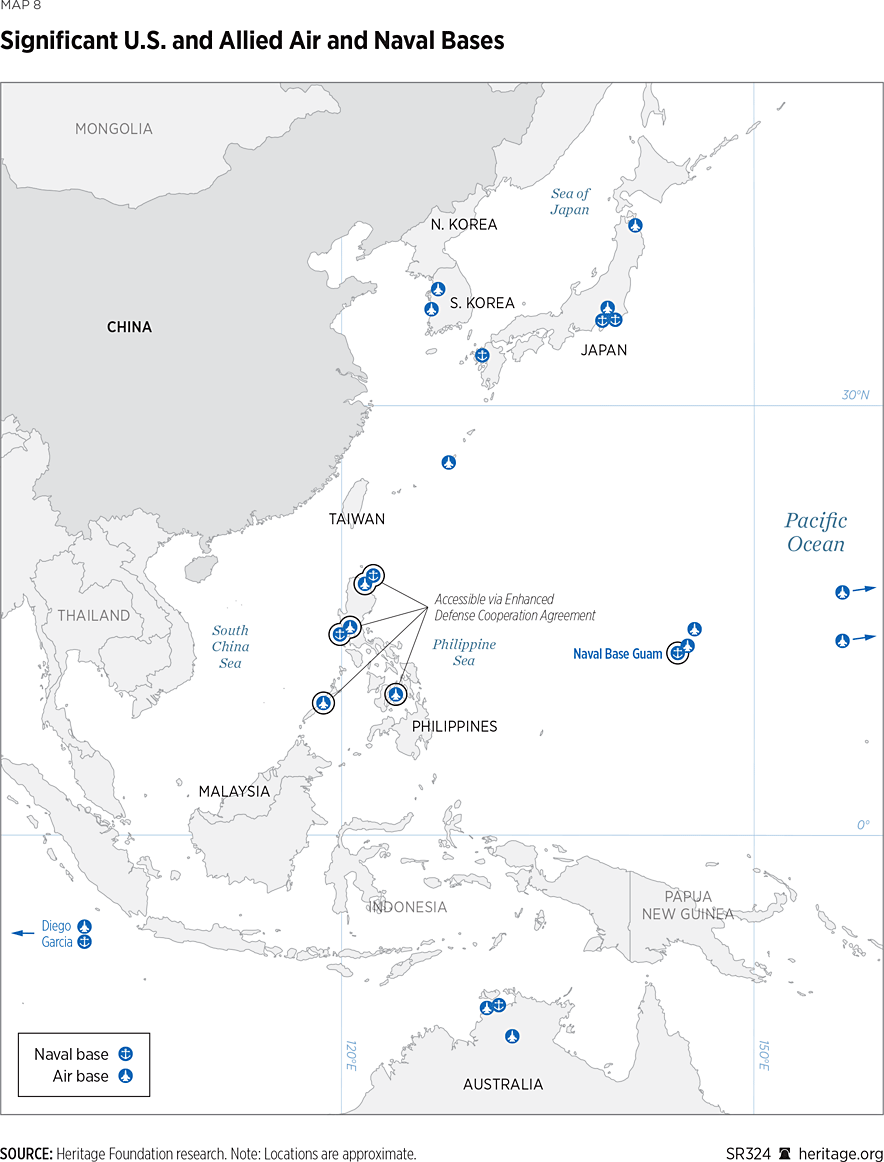
This judgment is made with high confidence based on authoritative analysis of PLA doctrine emphasizing “systems-destruction warfare,” convergence across multiple wargames demonstrating the effectiveness of anti-logistics strikes, detailed PLA capability assessments, and specific simulation outputs showing the catastrophic impact of base attacks and interdiction on U.S. munitions availability. Uncertainty stems primarily from the precise sequencing and operational effectiveness of PLA strike capabilities against hardened or defended U.S. targets.
Key Judgment 3: Platform Attrition, Fuel and Munitions Demand Converge
Heritage judges that U.S. munitions system capacity is almost certainly insufficient to meet projected wartime demand in a high-intensity conflict with China. This mismatch means that critical precision-guided munition (PGM) stockpiles will very likely be exhausted within the first weeks of combat, rendering U.S. forces incapable of sustaining the high operational tempo required to defeat the PLA.
This judgment is made with high confidence based on a strong, multi-source convergence from numerous independent wargames, authoritative think tank analyses, and official government data that all conclude demand far outstrips existing inventory and production capacity, a finding reinforced by the TIDALWAVE simulation’s dynamic analysis. Significant uncertainty stems from the classified nature of exact U.S. stockpile inventories and the unknown real-world effectiveness of the defense industrial base’s surge capabilities.
Key Judgment 4: U.S. Munitions Posture Concentrated in Vulnerable “Super-Hubs”
Heritage judges that the U.S. Indo-Pacific munitions posture is dangerously concentrated in a few “super-hubs,” which represent a systemic vulnerability to PLA “systems-destruction” strikes. Thus, PLA strikes on such hubs will very likely sever logistics flows and catalyze operational failure within a ~120-day timeline.
This judgment is made with high confidence based on the strong convergence between PLA doctrine prioritizing logistics strikes,1 extensive external wargaming projecting catastrophic ground attrition of about 90 percent and airfield closures lasting nearly 11 days at these specific nodes,2 and our own node matrices confirming this asset concentration.3 Uncertainty stems primarily from limited visibility into the classified, real-world effectiveness of U.S. Integrated Air and Missile Defense (IAMD) systems and hardening measures in blunting a saturation-level PLA strike.
Diagnosing Critical Vulnerabilities
This section synthesizes the adversary threat and U.S. Indo-Pacific munitions system shortfalls to diagnose the five critical, interdependent vulnerabilities that lead to systemic operational failure.
- CV 1: Finite Stockpiles
- CV 2: Naval Reload Bottleneck
- CV 3: Concentrated Forward Basing
- CV 4: Brittle Logistics Flow
- CV 5: Slow Industrial Base Response
System Vulnerabilities
Critical Vulnerability 1: Finite and Mismatched Stockpiles
Problem: U.S. munitions inventories, particularly for critical long-range precision-guided munitions (LR-PGMs) and heavyweight torpedoes, are almost certainly insufficient to meet the consumption rates projected for a high-intensity conflict.
Constrained Metric: Days of supply for key munition types such as LRASM, JASSM, SM-6, and Mk 48. Also, total VLS munitions inventory versus single fleet reload requirements.
Capacity Lever: Increased stockpile depth and mix, especially for LR-PGMs. Forward pre-positioning density, allied munitions contributions, and industrial base surge capacity also play a significant role.
Why It Breaks: Analysis and wargaming consistently show that key PGMs like LRASM are depleted in about one week,4 far faster than strategic resupply is possible. The total estimated inventory of ~17,000 VLS munitions is insufficient for even one full fleet reload.5 The ~1,300 Mk 48 torpedo inventory faces a projected wartime use of 60-120 per week, implying potential exhaustion in months with negligible replacement. In fact, with production estimated at about 79-120 per year, local shortfalls could occur in under 90 days.6
Critical Vulnerability 2: Naval Reload Bottleneck
Problem: The U.S. Navy’s reliance on pier-side-only VLS reloading creates a critical operational bottleneck, almost certainly forcing surface combatants off-station for multi-week periods.
Constrained Metric: Total time off-station for rearmament can take days and sometimes weeks. The VLS reload rate, as well as the number and availability of VLS reload-capable ports and ships, are also important factors.
Capacity Lever: Transferrable Reload At-sea Method (TRAM) and expeditionary reload concepts, such as tenders and barges. Increased number and hardening of reload ports and distributed VLS launch platforms.
Why It Breaks: Current policy requires transit, which can take up to two weeks, to limited, vulnerable ports such as Guam, Japan, Hawaii, and even in the contiguous United States (CONUS). The reload process then takes about two to five days resulting in ships being off-station for weeks or more.7 Nascent at-sea reload (TRAM) is almost certainly not operationally viable in the near term, having only conducted initial demonstrations with empty canisters as of late 2024.8
Critical Vulnerability 3: Concentrated and Vulnerable Forward Basing
Problem: U.S. reliance on a small number of large, concentrated bases, especially Guam and Kadena, in the forward area makes critical airpower assets and munitions stockpiles vulnerable to catastrophic PLA missile strikes in the opening hours and days.
Constrained Metric: Percentage of aircraft lost on the ground, airfield closure time in days, sorties lost due to base unavailability, and percentage of munitions stockpile losses.
Capacity Lever: Agile Combat Employment (ACE), hardening of shelters and infrastructure, IAMD, Rapid Airfield Damage Repair (RADR) capability, and distributed logistics nodes.
Why It Breaks: Major hubs like Guam (with the largest U.S. Air Force munitions storage9) and Kadena are within range of hundreds of PLA ballistic missiles.10 Wargames project that 90 percent of allied aircraft could be destroyed on the ground initially.11 Analysis indicates key airfields could be closed for about 2–12 days post-strike, severely limiting sortie generation.12 While dispersal (ACE) is policy, its effectiveness against the scale of the PLA threat, especially regarding logistics sustainment, remains unproven.13
Critical Vulnerability 4: Brittle Logistics Flow and Throughput
Problem: The capacity of U.S. strategic sealift, intra-theater airlift, and UNREP is very likely insufficient to meet surge demand in a contested environment, creating critical bottlenecks in moving munitions forward.
Constrained Metric: Replenishment rate, percentage of unserved demand in forward zones, sealift fleet readiness rate, airlift sortie rate under threat, and UNREP cycle time.
Capacity Lever: Recapitalization and expansion of sealift (Ready Reserve Force/TSP) and CLF fleets, pre-positioning afloat or ashore, contested logistics doctrine and capabilities, and commercial augmentation contracts or authorities.
Why It Breaks: The TIDALWAVE simulation modeled fixed rates—about 500 units per day UNREP and about 50 units per day for airlift—that result in 30 percent to 50 percent unserved demand in forward zones. The strategic sealift fleet suffers from low readiness (at less than 60 percent to 65 percent) and age (average 45 years), limiting surge capacity.14 Vast Pacific distances including a 14-to-21-day CONUS transit, only amplify latency. Also, interdiction is expected to reduce effective throughput by 20 percent to 50 percent.15
Critical Vulnerability 5: Slow Industrial Base Response
Problem: The U.S. defense industrial base almost certainly cannot produce key munitions at the rate required to replace wartime expenditures or surge production within an operationally relevant timeframe.
Constrained Metric: Production lead time in months or years, projected wartime consumption rate, and identified supply-chain bottlenecks.
Capacity Lever: Multi-year procurement contracts, investment in “hot” production lines, supply-chain resilience initiatives, allied co-production agreements, and advanced manufacturing techniques.
Why It Breaks: Production lead times for critical PGMs are measured in years. For instance, LRASM and Tomahawk lead times are about two years.16 Annual production rates—115 LRASMs and 79 to 120 MK 48 torpedoes—are orders of magnitude below projected weekly or monthly wartime consumption.17 Specific bottlenecks like rocket motors constrain output across multiple missile lines.18 This means initial stockpiles are effectively the only supply available for much of the conflict.
Cross-Cutting Insights
While numerous authoritative wargames and analyses have established significant U.S. vulnerabilities in munitions stockpiles, logistics capacity, and basing posture, TIDALWAVE provides crucial new insights into the dynamic interactions between these factors over a protracted scenario. Moving beyond static “days-of-supply” estimates, our model quantifies how fuel throughput, munitions flow, and platform attrition converge under varying intensity levels, revealing critical failure points:
The Launcher Paradox. The simulation elevates attrition to the ultimate governor of endurance over time. It reveals the “Launcher Paradox”: Munitions shortfalls appear to lessen later only because the platforms needed to fire them have been destroyed. This phenomenon shifts focus from solely inventory depth to platform survivability.
Distinguishing Stock vs. Throughput Failures. The simulation clarifies fuel constraints. F-76 is an immediate stock risk, exhausted by Day 30 while JP-8 is primarily a throughput risk that hits daily delivery caps.
Quantifying Zone-Level Failure. Forces in forward zones deplete munitions and suffer attrition two to three times faster, leading to ~30 percent to 50 percent unserved demand and localized collapses masked by theater-level averages.
These dynamic interactions reinforce the urgency of addressing known shortfalls, emphasizing that solutions must consider timing, throughput, and survivability, not just stockpile volume.
System Chokepoints
Heritage judges that approximately 10 non-substitutable imported materials and components almost certainly constrain U.S. munitions surge production, creating critical chokepoints across the industrial base through at least 2028. This dependency on highly concentrated foreign suppliers—principally the People’s Republic of China (PRC) for minerals and precursors, and Taiwan for microelectronics—grants the PRC direct leverage via export controls, extends import lead times to six to 12 plus months, and exposes the U.S. defense supply chain to deliberate disruption and geopolitical coercion.
Systemic Atrophy Creates Structural Foreign Dependency
Decades of underinvestment and manufacturing offshoring have almost certainly created systemic weaknesses and a structural reliance on foreign sources for the U.S. defense munitions industry.
According to an official U.S. Army assessment from the command with direct oversight of production facilities, the munitions industrial base suffers from “three decades of underutilized infrastructure, outdated facilities layouts and machining, reduced workforces, unmappable supply chains, and a growing reliance on foreign sources of materials.”19 Corroborating this statement, analysis in a defense industry trade publication states that “the movement of manufacturing outside of our borders, the expansion of supply chains, and strategic maneuvering by foreign adversaries have strained US access to critical ammunitions components.”20
Energetic Materials and Precursors Are Dependent on Foreign Supply
The U.S. almost certainly faces acute production constraints in energetics due to a near-total reliance on imported precursor chemicals and explosives, primarily from China and allied nations acting as a bridge solution.
- ███████████████
█████████████████████████████████████████████████████████████████████████████████████████████████████████████████████████████████████████████████████████████████████████████████████████21████████████████████████████████████████████████████████████████████████████████████████████████████████████████████████████████████████████████████████████████████████████████████████████████████████████████████████████████████████████████████████████████████████████████████████████████████████22███████████████████████████████████████████████████████████████████████████████████████████████████████████████████████████████████████████████████████████████████████████████████████████████████████████23█████████████████████████████████████████████████████████████████████████████████████████████████████████████████████████████████████████████████████████████████████████████████████████████████████████████████████████████████████████████████████████████████████████████████████████████████24█
████████████████████████████████████████████████████████████████████████████████████████████████████████████
████████████████████████████████████████████████████████████████████████████████████████████████████████████████████████████████████████████████████████████████████████████████████████████████████████████████████████████████████████████████████████████25█
████████████████████████████████████████████████████████████████████████████████████
- Trinitrotoluene (TNT)
Criticality: The U.S. has no domestic TNT production, a vulnerability stated unequivocally by a trade association representing commercial explosives manufacturers.26 This is underscored by the nonpartisan Congressional Research Service (CRS), which identifies TNT as a “shortfall material” for the National Defense Stockpile.27 The U.S. Army is reestablishing domestic production, a plan announced in an Associated Press wire report,28 but until it is operational, the U.S. is bridging the gap with allied imports.
Country of Origin: Poland (primary allied supplier).
Import/Lead Time: The U.S. has a multi-year contract for 18,000 tons of TNT over three years with Poland’s Nitro-Chem, with deliveries planned through 2026, as reported by Reuters, a global wire service with rigorous editorial standards.29
PRC Leverage: Third-country coercion (potential pressure on allied suppliers or shipping).
- ███████████████████████
████████████████████████████████████████████████████████████████████████████████████████████████████████████████████████████████████████████████████████████████████████████████████████████████████████████████████████████████████████████████████████████30██████████████████████████████████████████████████████████████████████████████████████████████████████████████████████████████████████████████████████████████████████████████████████████████████████████████31█████████████████████████████████████████████████████████████████████████████████████████████████████████████████████████████████████████████████████████████████████████████████████████32█
███████████████████████████████████████████████████████████████████████████
█████████████████████████████████████████████████████████
Critical Minerals for Projectiles and Warheads Face Chinese Chokepoints
China’s dominance over the mining, and especially the processing, of key hardening agents and specialty metals, particularly antimony and tungsten, very likely creates a systemic vulnerability for a wide range of U.S. munitions from small arms to advanced missiles.
- █████████
█████████████████████████████████████████████████████████████████████████████████████████████████████████████████████████████████████████████████████████████████████████████████████████████████████████████████████████████████33████████████████████████████████████████████████████████████████████████████████████████████████████████████████████████████████████████████████████████████████████████████████████████████34█
█████████████████████████████████████████████████████████
███████████████████████████████████████████████████████████████████████████████████████████████████████████████████████████████████████████████████████████████████████████████████████████████████████████████████████████████████████████████████████████████35█████████████████████████████████████████████████████████████████████████████████████████████████████████████████████████████████████████████████████████████████████36█████████████████████████████████████████████████████████████████████████████████████████████████████████████████████████████████████████████████37█
████████████████████████████████████████████████████████████████████████████████
- █████████
███████████████████████████████████████████████████████████████████████████████████████████████████████████████████████████████████████████████████████████38████████████████████████████████████████████████████████████████████████████████████████████████████████████████████████████████████████████████████████████████████████████████████39██████████████████████████████████████████████████████████████████████████████████████████████████████████████████████████████████████████████████████40█
█████████████████████████████████████
█████████████████████████████████████████████████████████████████████████████████████████████████████41█
████████████████████████████████████████████████████████████████████████████████
- Broader Mineral Landscape and Scale
These specific dependencies exist within a larger context of foreign reliance. The Department of the Interior’s final 2025 List of Critical Minerals identifies 60 minerals essential to U.S. national security and supply chains.42 According to a USGS news release, the United States was 100 percent import-reliant for 12 of 50 listed critical minerals in 2024.43 Analysis from a critical minerals intelligence firm notes the U.S. lacks domestic production for 14 critical minerals and is import-reliant for more than 50 percent of 31 others.44 This includes other defense-critical materials, such as bismuth, which is at risk of supply-chain disruption.45 The challenge is compounded by the scale of surge production; for example, analysis from a U.S. Military Academy’s Modern Warfare Institute notes the DOW’s plan to increase annual production of copper-containing 155-millimeter shells from 93,000 to 1.2 million, requiring a massive and secure copper supply.46
Advanced Components for Precision Guidance Depend on Asia
Precision-guided munitions almost certainly depend on highly concentrated overseas supply chains for rare earth magnets, foundational semiconductors, and specialty metals, creating acute single-region failure risks centered in China and Taiwan.
- Rare Earth Elements (for Permanent Magnets)
Criticality: Rare earth elements (REEs) are essential to virtually every major weapons system, including PGM, as noted by a bipartisan defense and security policy research institution.47 A 2010 GAO report, an authoritative government assessment, provided a specific finding that fin actuators in guided munitions are designed around neodymium-iron-boron magnets.48
Country of Origin: China (dominant for mining and processing).
Import/Lead Time: China supplied 70 percent of U.S. REE imports from 2020-2023, a figure reported by data journalism platform Visual Capitalist and corroborated by the USGS’s official Mineral Commodity Summaries.49 China controls about 90 percent of global REE refining and 98 percent of heavy REE processing, according to an Australian public research university analysis.50
PRC Leverage: Direct supply, upstream chokepoint (refining/processing), export controls.
- ██████████████████████
███████████████████████████████████████████████████████████████████████████████████████████████████████████████████████████████████████████████████████████████████████████████51██████████████████████████████████████████████████████████████████████████████████████████████████████████████████████████████████████████████52█
█████████████████████████████████████
██████████████████████████████████████████████████████████████████████████████████████████████████████████████████████████████████████████████████████████████53█████████████████████████████████████████████████████████████████████████████████████████████████████████████████████████████████████████████████████████████████████████████54█████████████████████████████████████████████████████████████████████████████████████████████████████████████████████████████55█
██████████████████████████████████████████████
- Advanced Microelectronics
Criticality: The U.S. military relies on high-quality systems underwritten by advanced microelectronics, creating a profound dependency on overseas manufacturing, according to strategic analysis in The Diplomat.56 A recent GAO assessment, an independent government audit, found that overseas suppliers perform 88 percent of production and 98 percent of the assembly, packaging, and testing for all microelectronics.57 While the DOW has begun targeted mitigation, such as a $25.8 million award to Honeywell to sustain domestic trusted radiation-hardened microelectronics,58 the scale of this dependency remains a critical vulnerability.
Country of Origin: Taiwan (leading-edge), South Korea, China.
Import/Lead Time: Taiwan and South Korea account for 100 percent of the installed capacity for mass-producing high-end semiconductors below 7 nanometers, according to the U.S.-Taiwan Business Council.59 Taiwanese firm TSMC produces about 90 percent of the world’s most advanced chips, a critical technology chokepoint identified by CSIS strategic analysis.60
PRC Leverage: Maritime/insurance pressure (blockade of Taiwan), third-country coercion.
Single-Point Failures Exist in Propellants and Binders
Beyond Chinese-dominated supply chains, the U.S. very likely faces critical single-point failure risks from sole-source foreign suppliers for essential propellants and binders required for artillery and solid rocket motors.
- M31A2 Propellant
Criticality: This propellant is specifically required for the 155mm M232A1 modular artillery charge, a key component for modern artillery systems.
Country of Origin: Canada (sole source).
Import/Lead Time: The propellant comes primarily from Valleyfield in Canada, according to the Army acquisition chief quoted in Defense News, a specialized industry publication.61 Project Ploughshares, drawing on U.S. contracting records, confirms that GD-OTS Canada’s Valleyfield plant is the sole source of this propellant for the U.S. Army.62
PRC Leverage: Third-country coercion (diplomatic or economic pressure on Canada).
- Hydroxyl-Terminated Polybutadiene (HTPB)
Criticality: HTPB is a critical binder for solid rocket motors, used in a wide array of U.S. missile systems.
Country of Origin: Primarily foreign-sourced (specific countries not detailed in open source).
Import/Lead Time: Military-grade HTPB is a critical risk, as identified by DOW’s internal Critical Energetic Materials Working Group, a specialized technical body, indicating that second-source domestic capacity is not yet mature and that reliance on imports continues.63
PRC Leverage: Upstream chokepoint (potential control of chemical precursors).
Munitions Logistics Timeline
The following timeline synthesizes data from established external wargaming with the specific dynamics revealed in the TIDALWAVE simulation to illustrate the cascading failure of the U.S. munitions and logistics system in a high-intensity conflict. The timeline reveals two distinct phases of failure: first, an immediate depletion of stocks based on existing wargames; second, a protracted collapse of throughput and platforms as revealed by the simulation’s dynamic modeling over 365 days.
Initial Salvo and Rapid Stock Depletion
This phase is characterized by high-volume PLA strikes and the rapid expenditure of U.S. initial, in-theater, PGMs.
Early Days of Conflict. PLA strikes will almost certainly inflict catastrophic losses on forward-deployed U.S. airpower and cripple naval fuel lines from the outset in scenarios lacking pre-positioned reserves.
- Naval Fuel: According to our model and analysis, naval forces (F-76 fuel) stock face potential immediate operational collapse on Day 1 in scenarios with no pre-positioning. Still, the same model shows that pre-positioned stock can buy only marginal time, meaning F-76 collapse is likely well before PLA culmination.
- Airpower: A comprehensive wargaming series by CSIS, concluded that in most scenarios Chinese missile attacks would destroy 90 percent of allied aircraft on the ground.64
- This finding is corroborated by specialized secondary analysis from Naval News, a publication focused on maritime and defense affairs, which reiterated that the 90 percent ground attrition rate was a key, surprising finding from the 24-iteration wargame.65
Fighting China’s Invasion of Taiwan. Key U.S. PGM stockpiles will very likely be exhausted with the onset of high-tempo conflict, while logistics timelines show that meaningful resupply is almost certainly not possible within this window.
- Munitions: U.S. forces exhaust key LR-PGMs rapidly. A seven-to-14-day fixed reload latency is a co-dependent, primary driver of local failure, according to our analysis of the TIDALWAVE simulation.66
- Industrial Base: Reinforcing this finding, a detailed industrial base assessment from CSIS calculated that U.S. forces would run out of key long-range, PGM in less than one week.
67 A 2023 analysis from The Heritage Foundation, synthesizing multiple wargame results, found a repeated outcome where the U.S. ran out of critical munitions in just eight days.68 Likewise, analysis from active-duty officers in the U.S. Naval Institute’s peer-reviewed professional journal, Proceedings, states that the transit time alone for warships to reach a secure port to rearm can take “up to two weeks,” establishing this as a baseline reload latency.69 - Air Power: Reporting from Reuters cites a Stimson Center analysis indicating that Chinese missile salvos “could close airfields in Japan for a minimum of 11.7 days,” halting all air operations from those nodes.70
The Reload and Resupply Gap
This phase is defined by logistics latency. Initial forward stocks are gone, and the system’s replenishment capability is tested. At-sea VLS reload (TRAM) remains developmental— demonstrated in October with an empty canister; wide availability unlikely before 2027, so near-term planning must assume pier-side cycles.
First Reload Cycles. The first strategic sealift assets will likely be arriving in theater just as the last forward-deployed naval fuel reserves are very likely being depleted.
- Logistics: Based on TIDALWAVE analysis, which is, in part, derived from platform specifications and operational logistics timelines, the first CONUS-based sealift (T-AKEs) would only begin arriving in theater after a 14 to 21-day transit.
- Transit Time: This transit time is corroborated by the U.S. Navy’s official doctrinal UNREP Manual, which confirms that T-AKE transit times from the West Coast to the Western Pacific are 14–21 days at 20 knots.71
- Offload Process: These vessels then require an additional five-to-seven days at port for the offload process to be completed, based on TIDALWAVE logistical calculations, which are based on doctrinal timelines and platform constraints.
- Ports and Regulation: Even with pre-decided military-priority berths and indemnity, baseline delays of ~1–7 days and dangerous-goods pre-notification windows of 12–48 hours persist; these measures mitigate administrative friction but do not clear queues once systemic risks (kinetic, cyber, sealift shortfalls) bite. 72
- Fuel: Even in scenarios with pre-positioned stock, F-76 (naval fuel) reserves possibly collapse even prior to Day 30, according to analysis of TIDALWAVE’s model.
- Naval Magazines: Without at-sea reload, a three-to-seven-day extension to the already lengthy VLS rearm cycle reduces most DDG/CG to a single AAW combat sortie by Day 18; the baseline pier-side process runs ~30 min per cell and two–three days per ship, with off-station cycles measured in weeks.
Degraded Stocks by Day 30. U.S. forces will almost certainly be forced to enter the main phase of combat in a logistically degraded state, lacking several key munitions and facing critical fuel shortfalls.
- TIDALWAVE’s core design, which provides the scenario framework for this study, models Day 30 as the start of major, sustained combat (e.g., Kadena attack, SCS push). This means that U.S. forces are forced to begin this main phase of combat in some cases after their key LR-PGM stockpiles are already gone and their forward-deployed naval fuel reserves are collapsing.
The Main Fight and Throughput Collapse
This phase, based on the simulation, shows how fixed replenishment rates are overwhelmed by the high tempo of the main fight, leading to localized collapses. Apparent stock sufficiency can mask unavailable firing capacity as launch platforms attrit (the “Launcher Paradox”). Under interdiction, effective delivery falls to about 20 percent to 40 percent, yielding 30 percent to 50 percent unserved demand at forward nodes during surges.
First 10 Days of High Intensity. Sustained high-intensity air combat will very likely exhaust several local air-to-air missile stocks at forward nodes within 5–10 days of engagement.
- Munitions (AAMs): Once major air combat begins at Day 30 in the simulation, critical air-to-air munitions like AIM-120 and AIM-9X in forward zones are depleted in just 5–10 days and aligns with the external Week-1 LR-PGM depletion judgments for the broader stock mix, according to day-by-day projection of expenditures in the TIDALWAVE simulation.
- Precision Guided Munitions: High-end PGMs such as LRASM, SM-3 and SM-6 are exhausted within five to 10 days of sustained operations, leaving naval forces with little ability to defend themselves or engage in combat operations. Assuming Patriot PAC-3 MSE interceptors, and THAAD interceptors are optimally deployed (likely dependent upon significant indications and warning and significant constraints on strategic airlift), they are likely to be exhausted after two to three salvoes from the People’s Liberation Army Rocket Force (PLARF), even if no launchers or interceptors are destroyed.” The longevity of high-end ground-attack munitions inventory such as JASSM-ER is highly dependent on substitution effect.
Sustained Demand. Modeled logistical throughput rates will very likely be insufficient to meet surge demand, leading to significant unserved munitions requests in forward areas where combat intensity is highest.
- Under interdiction, these fixed rates drive effective delivery down to about 20 percent to 40 percent of unconstrained levels and produce 30–50 percent unserved demand at forward nodes during surges, according to the simulation.
Attrition Dominance
The simulation reveals Days 30 to 60 as the critical window where attrition quickly determines the outcome of the war when the Joint Force fully engages the PLA.
Depending on PLA and U.S. force employment, massive attrition can mask munitions and fuel deficiencies.
- Destruction of platforms leads to a “launcher paradox,” where massive attrition limits munition and fuel usage within 60 days.
- TIDALWAVE’s simulation of daily demand against fixed delivery caps found that JP-8 fuel demand consistently exceeds the ~150k barrels per day throughput cap during this high-tempo phase, causing localized shortages even when aggregate stocks remain.
Day 60–120. The convergence of platform losses and munitions shortfalls, fuel bottlenecks, and high-demand PGM depletion will very likely lead to systemic operational failure typically between Day 60 and Day 120.
- The simulation identifies this period as the “Triple Bind”: a critical window where fuel throughput caps, peak munitions demand, and maximum platform attrition converge to cause systemic operational failure across the board.
Wartime Demand and China’s Strategy
Heritage judges that U.S. munitions system capacity is almost certainly insufficient to meet projected wartime demand in a high-intensity conflict with China. This means critical PGM stockpiles will very likely be exhausted within the first weeks of sustained combat, rendering U.S. forces incapable of sustaining the high operational tempo required to defeat a PLA invasion.
This judgment is made with high confidence based on a strong, multi-source convergence from numerous independent wargames, authoritative think tank analyses, and official government data that all conclude that demand far outstrips existing inventory and production capacity, a finding reinforced by the TIDALWAVE simulation’s dynamic analysis. Uncertainty stems from the classified nature of exact U.S. stockpile inventories and the unknown, real-world effectiveness of the defense industrial base’s surge capabilities.
Rapid Depletion of Long-Range Precision-Guided Munitions (LR-PGMs)
Demand: Peak wartime demand, driven by the necessity for standoff strikes against PLA naval forces and mainland targets in an A2/AD environment, is exceptionally high in the initial phase. Wargames show U.S. forces expending over 5,000 LR-PGMs in the first three weeks of conflict.73 And the TIDALWAVE model shows that LR-PGM use spikes dramatically after Day 30, when major combat operations begin.
Capacity: U.S. capacity is severely limited by small initial inventories and slow production. The entire global inventory of LRASMs, a key anti-ship PGM, is estimated at fewer than 450 missiles,74 against a requirement assessed by congressional wargaming at 1,000 to 1,200.75 Production rates are negligible relative to wartime consumption, with FY 2025 procurement aiming for only 115 LRASMs76 and production lead times estimated at ~2 years.77 A key industrial bottleneck across multiple PGM families is rocket-motor production.78
Analysis: The LR-PGM problem is a catastrophic race between extremely high initial consumption and a finite, slow-to-replenish stockpile. Wargames consistent with our analysis show that key LR-PGMs like LRASM are exhausted in less than one week,79 long before CONUS resupply—requiring a 14-to-21-day transit plus offload—could arrive. The TIDALWAVE simulation reinforces this, showing LR-PGMs are among the first munitions to cause zone-level collapse after Day 30. This shortfall means that U.S. forces almost certainly lose their preferred standoff strike capability within the first several weeks.
Forward Zone Collapse of Air-to-Air Munitions (AAMs)
Demand: Sustained air superiority operations, particularly after Day 30 in the TIDALWAVE simulation, drive intense AAM demand in forward zones.
Capacity: While aggregate U.S. AAM stockpiles are larger than LR-PGMs, forward zones rely on limited initial allocations and constrained replenishment flows. The TIDALWAVE simulation modeled fixed airlift replenishment at only ~50 units/day theater-wide, with forward zones receiving only a small percentage.
Analysis: The AAM challenge is first one of distribution and forward endurance. Probably localized collapse occurs because consumption of AAMs outpaces the low modeled replenishment rate, highlighting a critical failure to rapidly push munitions to the point of need. This very likely means that U.S. air superiority in critical forward areas will degrade rapidly once major combat begins.
Reload Latency Bottleneck of Naval Munitions (VLS-Launched)
Demand: High-intensity naval combat, particularly anti-air warfare engagements and potential land strikes, drives rapid VLS cell expenditure. CSBA analysis estimated that demand could reach ~360 VLS cells per day in a large conflict with our analysis indicating it could even be higher.80 Red Sea operations provide a real-world, lower-intensity baseline, showing significant SAM expenditure (e.g., 120 SM-2, 80 SM-6 over months).81
Capacity: Aggregate inventory is a concern. For instance, the estimated ~17,000 total VLS munitions in stock are insufficient for even one full fleet reload.82 However, the primary capacity constraint is reload latency. Standard policy requires pier-side reload,83 involving up to two weeks transit plus two to three days (or more) for the reload itself,84 resulting in ships being off-station for weeks to a month.85 At-sea rearming (TRAM) remains developmental and almost certainly not operationally available in the near term.86
Analysis: Naval munitions capacity is crippled by the reload cycle. Even if aggregate stocks exist, the multi-week delay between emptying magazines and returning to the fight means surface combatants very likely function as single-use assets in the initial, decisive phase (first 30 to 60 days). Even conventional replenishment struggles to keep pace, leading to zone-level collapses for naval munitions in the simulation, particularly in forward-deployed carrier strike groups (CSGs). This latency bottleneck almost certainly prevents sustained naval firepower.
Inventory and Production Shortfall of Undersea Munitions (Torpedoes)
Demand: Anti-surface and anti-submarine warfare are expected to be intense, particularly for U.S. submarines engaging PLA naval forces. Wargame analysis consistent with TIDALWAVE projects demand at 60 to 120 heavyweight torpedoes per week.87
Capacity: U.S. inventory is estimated at only ~1,300 MK 48 torpedoes.88 Annual production capacity is extremely limited, estimated at only 79 to 120 torpedoes per year, constrained by industrial base factors.89
Analysis: The U.S. undersea advantage is severely threatened by a critical mismatch between projected wartime demand and available inventory and production. At projected consumption rates, the entire MK 48 inventory could be expended as soon as Day 70, with negligible replenishment possible. This shortfall almost certainly limits the duration and intensity of submarine operations, a key U.S. asymmetric advantage.
Chinese Targeting Strategy
Heritage judges that the PLA is very likely to target the U.S. munitions logistics network—spanning forward storage depots, airfields, ports, and sea lines of communication—employing coordinated kinetic and non-kinetic attacks designed to rapidly deplete forward stocks and sever replenishment flows. This strategy aims to cripple U.S. combat endurance by exploiting known vulnerabilities in concentrated basing and brittle supply lines, very likely exacerbating the rapid munitions depletion observed in wargames and creating systemic operational failure for U.S. forces within weeks.
The PLA is very likely to follow campaign doctrine that prioritizes paralyzing an adversary’s operational system by striking critical logistical nodes early in a conflict.
Authoritative PLA sources, as interpreted by U.S. defense analysts, explicitly direct commanders to strike the enemy’s logistics system to paralyze its operational capability. This doctrine identifies major munitions hubs like Andersen AFB in Guam—housing the USAF’s largest munitions storage area according to official USAF base public affairs90—as vital targets alongside fuel depots for initial strikes.91 PLA doctrine also links wartime pacing and sustainability directly to logistics flow—not just platform numbers—recognizing that severing the supply of munitions can cripple combat power even if platforms survive, a concept derived from authoritative interpretations of PLA strategic writings. This aligns with the TIDALWAVE simulation finding that attrition becomes the ultimate constraint because logistics cannot keep pace with losses and consumption, based on the simulation’s quantitative modeling.
Multi-Domain Attack Plan
Kinetic Campaign: Striking Nodes and Flow
The PLA is very likely to open a conflict with coordinated missile and air strikes on concentrated U.S. munitions depots, airfields, ports, and potentially vulnerable CLF ships to induce immediate throughput collapse. Because forward stocks are hub-concentrated and intra-theater resupply under fire is limited, node-level endurance is measured in days, not weeks.
PLA Rocket Force (PLARF) capabilities almost certainly enable strikes against key U.S. nodes. Intermediate-range ballistic missiles (IRBMs) like the DF-26, with a 4,000 kilometer range, can reach Guam.92 Shorter-range systems threaten bases in Japan like Kadena.93 Analysis integrating PLA targeting methodology with Target System Analysis scoring techniques identified key hubs like Andersen AFB and Kadena as “Very Likely” targets for PLA IRBMs, based on project-specific threat modeling using PLA doctrine and capabilities.
The objective is very likely to achieve rapid, catastrophic effects. Documented wargames have shown such strikes destroying 90 percent of aircraft on the ground initially.94 Analysis by the Stimson Center concludes that missile strikes could close key airfields for days to weeks directly halting sortie generation and munitions consumption and resupply.95 A single PLARF salvo could potentially destroy 50 percent or more of munitions in a targeted zone according to TIDALWAVE project estimates, though this represents an internal assessment of potential impact rather than a verified PLA capability.
Kinetic strikes extend to sea lines. The U.S. Navy fact file, an official source providing authoritative data on fleet composition, lists only 12 active T-AKE dry cargo and ammunition ships providing multi-product support.96 These unarmed, commercially built CLF vessels are vulnerable, and their loss could sever at-sea replenishment, according to analysis in official Navy budget documents and related CRS reports which highlight their limited self-defense capabilities.97
Non-Kinetic Campaign: Amplifying Disruption
The PLA will likely amplify kinetic effects with cyber, political-access, and potentially other non-kinetic measures aimed at slowing port operations, denying base access, and disrupting logistical command and control.
Cyber attacks likely represent a significant threat to port and logistics C2 systems. It has been indicated that Chinese hacking efforts, such as Volt Typhoon, targeting critical infrastructure are part of a broad campaign to develop ways to paralyze logistics systems.98 Major cyber incidents like NotPetya demonstrate the potential for widespread disruption, having previously shut down 76 global port terminals, according to LRQA, a recognized assurance firm with incident documentation providing verifiable real-world impact data.99
Political and diplomatic pressure on allies likely aims to restrict or delay U.S. access to critical ports and bases. Legal frameworks and analysis conclude that host nation domestic political factors can override pre-existing legal access agreements including SOFAs and ACSAs, particularly if the host nation fears direct Chinese retaliation.100 This political risk is explicit, as seen in official statements like a Japanese Ministry of Foreign Affairs press conference transcript affirming that U.S. base use requires prior consultation (“If Japan says no, of course the United States cannot use them”).101 Similarly, Reuters, reported that the Philippine president stated having “no plans” to grant access to more U.S. bases, indicating current political limitations.102
Items of Decision-Making Value
Rapid Munitions Collapse Is the Decisive Failure
The U.S. almost certainly exhausts its critical munitions stockpiles within days of high-intensity combat starting. This finding is consistent across models. TIDALWAVE’s simulation confirms this rapid expenditure rate, projecting that critical forward-deployed air-to-air missiles are exhausted within five to 10 days of use in combat, at about Day 35 or Day 40, given the start of
Concentrated Basing Is the Primary Catalyst
This rapid depletion is enabled by the foundational vulnerability of “super-hub” bases (CV3). PLA strikes on a few concentrated nodes are projected to cause catastrophic ground attrition up to even 90 percent and close airfields for up to ~12 days, preventing airpower from even employing its munitions.
The Naval Reload Bottleneck Prevents Recovery
The U.S. Navy’s pier-side-only VLS reload policy (CV2) ensures there is no rapid recovery from initial expenditure. The multi-week cycle time, including transit, forces combatants off-station for weeks or more, rendering most of the surface fleet as single-sortie assets in the first 30 days.
Logistics Flow Fails Before Aggregate Stocks Run Out
The TIDALWAVE model and simulation analysis confirms that the system fails due to throughput before total inventory shortfalls. Fixed, insufficient replenishment rates of about 500 units per day in UNREP and 50 units per day for airlift, are quickly overwhelmed, resulting in 30 percent to 50 percent unserved demand in forward zones, even while large stockpiles remain stranded in the rear.
Platform Attrition Is the Ultimate Constraint
The TIDALWAVE simulation’s primary insight is that attrition, not inventory, governs long-term endurance. Munitions stockpiles become irrelevant if the platforms needed to fire them have already been destroyed, a finding supported by simulation data showing catastrophic losses like ~73.1 percent for the F/A-18E.
The “Triple Bind” Is the Point of Systemic Failure
The TIDALWAVE simulation identifies a critical failure window where fuel throughput caps, peak munitions demand, and maximum platform attrition converge (the “Triple Bind”), causing systemic operational paralysis even if aggregate stocks appear sufficient. This can occur in the first 30-60 days of conflict leading to U.S. culmination.
Endnotes
- Mark F. Cancian, Matthew Cancian, and Eric Heginbotham, “The First Battle of the Next War: Wargaming a Chinese Invasion of Taiwan,” Center for Strategic and International Studies, January 9, 2023, https://www.csis.org/analysis/first-battle-next-war-wargaming-chinese-invasion-taiwan (accessed October 25, 2025).↩
- Peter Ong, “CSIS Wargame: China’s Invasion of Taiwan in 2026,” Naval News, January 30, 2023, https://www.navalnews.com/naval-news/2023/01/csis-wargame-chinas-invasion-of-taiwan-in-2026/ (accessed October 25, 2025).↩
- Seth G. Jones, “Empty Bins in a Wartime Environment: The Challenge to the U.S. Defense Industrial Base,” Center for Strategic and International Studies, January 23, 2023, https://www.csis.org/analysis/empty-bins-wartime-environment-challenge-us-defense-industrial-base (accessed October 24, 2025), and Wilson Beaver and Jim Fein, “The U.S. Needs More Munitions to Deter China,” The Heritage Foundation, December 29, 2023, https://www.heritage.org/defense/commentary/the-us-needs-more-munitions-deter-china.↩
- Jones, “Empty Bins in a Wartime Environment.”↩
- Jim Fein, “It’s Past Time to Re-Supply Our Munitions-Depleted U.S. Navy,” The Heritage Foundation, June 17, 2024, https://www.heritage.org/missile-defense/commentary/its-past-time-re-supply-our-munitions-depleted-us-navy.↩
- Megan Eckstein, “Supplier Bottlenecks Threaten US Navy Effort to Grow Arms Stockpiles,” DefenseNews, February 6, 2024, https://www.defensenews.com/naval/2024/02/06/supplier-bottlenecks-threaten-us-navy-effort-to-grow-arms-stockpiles/ (accessed October 28, 2025), and William Toti, “You Can’t Win Without (More) Submarines,” U.S. Naval Institute Proceedings, December 2023, https://www.usni.org/magazines/proceedings/2023/december/you-cant-win-without-more-submarines (accessed October 28, 2025).↩
- Anna Hoang, “Improving At-Sea Missile Rearming,” U.S. Naval Institute Proceedings, June 2024, https://www.usni.org/magazines/proceedings/2024/june/improving-sea-missile-rearming (accessed October 27, 2025); Aaron-Matthew Lariosa, “U.S. Navy Holds First TRAM At-Sea VLS Loading Test,” Naval News, October 12, 2024, https://www.navalnews.com/naval-news/2024/10/u-s-navy-holds-first-tram-at-sea-vls-loading-test/ (accessed October 28, 2025); Nathan R. Carpenter, “USS Lake Champlain Completes Ordnance Onload,” U.S. Navy, January 16, 2018, https://www.navy.mil/Press-Office/News-Stories/Article/2250205/uss-lake-champlain-completes-ordnance-onload/ (accessed October 28, 2025); and Gidget Fuentes, “Navy Conducts First Successful Tests Reloading Missiles and Rearming Warships at Sea,” USNI News, October 15, 2024, https://news.usni.org/2024/10/15/navy-conducts-first-successful-tests-reloading-missiles-and-rearming-warships-at-sea (accessed October 28, 2025).↩
- Thomas McMahon, “Navy Demonstrates First At-sea Reloading of Vertical Launching System,” U.S. Navy, October 15, 2024, https://www.navy.mil/Press-Office/News-Stories/Article/3935108/navy-demonstrates-first-at-sea-reloading-of-vertical-launching-system/ (accessed October 28, 2025), and Fuentes, “Navy Conducts First Successful Tests Reloading Missiles.”↩
- Aaron Spray, “Andersen Air Force Base: The US Air Force’s ‘Unsinkable Aircraft Carrier’ In Guam,” Simple Flying, October 27, 2024, https://simpleflying.com/andersen-air-force-base-guam-guide/ (accessed October 28, 2025).↩
- Luke A. Nicastro, “U.S. Defense Infrastructure in the Indo-Pacific: Background and Issues for Congress,” Congressional Research Service Report No. R47589, June 6, 2023, https://www.congress.gov/crs-product/R47589 (accessed October 28, 2025).↩
- Cancian et al., “The First Battle of the Next War.”↩
- Gerry Doyle, “US Military Airfields in Indo-Pacific Too Easily Taken Out of Action, Report Says,” Reuters, December 11, 2024, https://www.reuters.com/world/us-military-airfields-indo-pacific-too-easily-taken-out-action-report-says-2024-12-12/ (accessed October 25, 2025).↩
- Luke A. Nicastro, “Defense Primer: Agile Combat Employment (ACE) Concept,” Congressional Research Service In Focus No. IF12694, June 24, 2024, https://www.congress.gov/crs-product/IF12694 (accessed October 28, 2025).↩
- Timothy A. Walton, Harrison Schramm, and Ryan Boone, “Sustaining the Fight: Resilient Maritime Logistics for a New Era,” Center for Strategic and Budgetary Assessments, April 23, 2019, https://csbaonline.org/research/publications/sustaining-the-fight-resilient-maritime-logistics-for-a-new-era (accessed October 24, 2025), and Andrew Rolander, “The dangerous collapse of US strategic sealift capacity,” Australian Strategic Policy Institute, March 26, 2025, https://www.aspistrategist.org.au/the-dangerous-collapse-of-us-strategic-sealift-capacity/ (accessed October 28, 2025).↩
- Cancian et al., “The First Battle of the Next War.”↩
- Seth G. Jones, “The U.S. Defense Industrial Base Is Not Prepared for a Possible Conflict with China,” Center for Strategic and International Studies, February 22, 2023, https://features.csis.org/preparing-the-US-industrial-base-to-deter-conflict-with-China/ (accessed October 28, 2025), and Joe Gould, “US Defense Industry Unprepared for a China Fight, Says Report,” DefenseNews, January 23, 2023, https://www.defensenews.com/industry/2023/01/23/us-defense-industry-unprepared-for-a-china-fight-says-report/ (accessed October 24, 2025).↩
- Kristyn Jones and Mike A. Greiner, “Air Force Officials Hold a Press Briefing on President Biden’s Fiscal 2025 Air Force Budget,” U.S. Department of Defense, March 11, 2024, https://www.defense.gov/News/Transcripts/Transcript/Article/3705330/air-force-officials-hold-a-press-briefing-on-president-bidens-fiscal-2025-air-f/ (accessed October 24, 2025); Hope Hodge Seck, “Navy Wants a Cheap Heavy Torpedo That Can Be Stockpiled Fast,” The War Zone, April 10, 2024, https://www.twz.com/sea/navy-wants-a-cheap-heavy-torpedo-that-can-be-stockpiled-fast (accessed October 28, 2025); and Jones and Greiner, “Air Force Officials Hold a Press Briefing on President Biden’s Fiscal 2025 Air Force Budget.”↩
- Eckstein, “Supplier Bottlenecks Threaten US Navy Effort to Grow Arms Stockpiles.”↩
- Office of the Assistant Secretary of the Army (Acquisition, Logistics and Technology), “Surge Capacity in the Defense Munitions Industrial Base,” Army Science Board, September 14, 2023, https://asb.army.mil/Portals/105/Reports/2020s/ASB%20FY%2023%20DMIB%20Report%20(E).pdf (accessed November 13, 2025).↩
- James Marks, “To Counter China, the US Must Strengthen Ammunition Production,” Breaking Defense, May 17, 2024, https://breakingdefense.com/2024/05/to-counter-china-the-us-must-strengthen-ammunition-production/ (accessed November 13, 2025).↩
- ███████████████████████████████████████████████████████████████████████████████████████████████████████████████████↩
- █████████████████████████████████████████████████████████████████████████████████████████████████████████████████████████████████████████████████████████████████████↩
- ███████████████████████████████↩
- ██████████████████████████████████████████████████████████████████████████████████████████████████████████████████████████████████████████████████████████████████████████████████████████████↩
- ██████████████████████████████████████████████████████████████████████████████████████████████████████████████████████████████████████████████████████████████████↩
- Institute of Makers of Explosives, “State of the Explosives Industry,” 2024, https://ime.org/resources/state-of-the-explosives-industry/ (accessed November 13, 2025).↩
- Nina M. Hart, Erica A. Lee, and Brandon S. Tracy, “2022 Invocation of the Defense Production Act for Large-Capacity Batteries: In Brief,” Congressional Research Service Report No. R47124, May 27, 2022, https://www.congress.gov/crs-product/R47124 (accessed November 13, 2025).↩
- Bruce Schreiner, “Army Says the US Will Restart Domestic TNT Production at Plant to Be Built in Kentucky,” Associated Press, November 8, 2024, https://apnews.com/article/army-tnt-production-kentucky-a21c6bd112e5951d848bab4e288035db (accessed November 13, 2025).↩
- “Poland’s Nitro-Chem Signs $310 mln Deal to Supply TNT for US Military,” Reuters, April 9, 2025, https://www.reuters.com/business/aerospace-defense/polands-nitro-chem-signs-310-mln-deal-supply-tnt-us-military-2025-04-09/ (accessed November 13, 2025), and “Poland’s Nitro-Chem Signs Deal to Supply TNT to US-Based PEI,” Reuters, April 24, 2024, https://www.reuters.com/business/energy/polands-nitro-chem-signs-deal-supply-tnt-us-based-pei-2024-04-24/ (accessed November 13, 2025).↩
- █████████████████████████████████████████████████████████████████████████████████████████████████████████████████████████████████████████████████████████████████████████████████████████████████████████████████████████████████████████████████████████████████████████████████↩
- ███████████████████████████████████████████████████████████████████████████████████████████████████████████████████████████████████████████████████████████████████████████████████████████████████████████████████████████↩
- ███████████████████████████████████████████████████████████████████████████████████████████████████████████████████████████████████████████████████████████████████████████↩
- ████████████████████████████████████████████████████████████████████████████████████████████████████████████████████████████████████████████████████████████████████████████████████████████████████████████████████████████████████████████████████████████████████████████████████████████████████████████████████████████████████████████████████████████████████████████████████████████████████████████████████████████████↩
- ███████████████████████████████████████████████████████████████████████████████████████████████████████████████████████████████████████████████████████████████████████████████████████████████████████████████████████████████████████████████████████████████████████████████████████████████████████████████████████████████████████████████████████████████████████████████████████████████↩
- ████████████████████████████████████████████████████████████████████████████████████████████████████████████████████████████████████████████████████████████↩
- ███████████████████████████████████████████████████████████████████████████████████████████████████████████████████████████████████↩
- ███████████████████████████████████████████████████████████████████████████████████████████████████████████████████████████████████████████████████████████████████████████████████████████████████████████████████████████████████████████████████████↩
- ███████████████████████████████████████████████████████████████████████████████████████████████████████████████████↩
- ██████████████████████████████████████████████████████████████████████████████████████████████████████████████████████████████████████████████████████████↩
- ███████████████████████████████████████████████████████████████████████████████████████████████████████████████████████████████████████████████████████████████████████████████████████████████████████████████████↩
- █████████████████████████████████████████████████████████████████↩
- U.S. Department of the Interior, “Interior Department Releases Final 2025 List of Critical Minerals,” press release, November 7, 2025, https://www.doi.gov/pressreleases/interior-department-releases-final-2025-list-critical-minerals (accessed November 13, 2025).↩
- Communications and Publishing, “USGS: Value of U.S. Mineral Production Edged Up in 2024,” U.S. Geological Survey, January 31, 2025, https://www.usgs.gov/news/national-news-release/usgs-value-us-mineral-production-edged-2024 (accessed November 13, 2025).↩
- Christian Purefoy, “US Military and Critical Minerals: The New Arms Race,” The Oregon Group, June 14, 2023, https://theoregongroup.com/commodities/us-military-and-critical-minerals-the-new-arms-race/ (accessed November 13, 2025).↩
- Christopher Hernandez-Roy, Henry Ziemer, and Alejandra Toro, “Mining for Defense: Unlocking the Potential for U.S.-Canada Collaboration on Critical Minerals,” Center for Strategic and International Studies, February 18, 2025, https://www.csis.org/analysis/mining-defense (accessed November 13, 2025).↩
- Gregory Wischer, Morgan Bazillian, and Macdonald Amoah, “As America’s Military Rearms, It Needs Minerals—and Lots of Them,” Modern War Institute, November 29, 2023, https://mwi.westpoint.edu/as-americas-military-rearms-it-needs-minerals-and-lots-of-them/ (accessed November 13, 2025).↩
- Jake Kwon and Benjamin Jensen, “Deterrence Runs on Rare Earths,” Center for Strategic and International Studies, June 24, 2025, https://www.csis.org/analysis/deterrence-runs-rare-earths (accessed November 13, 2025).↩
- U.S. Government Accountability Office, “Rare Earth Materials in the Defense Supply Chain,” GAO-10-617R, April 14, 2010, https://www.gao.gov/assets/a96655.html (accessed November 13, 2025).↩
- Bruno Venditti, “Charted: Where the U.S. Gets Its Rare Earths From,” Elements by Visual Capitalist, May 1, 2025, https://elements.visualcapitalist.com/charted-where-the-u-s-gets-its-rare-earths-from/ (accessed November 13, 2025), and U.S. Geological Survey, “Rare Earths,” Mineral Commodity Summaries, January 2025, https://pubs.usgs.gov/periodicals/mcs2025/mcs2025-rare-earths.pdf (accessed November 13, 2025).↩
- “China Has Moved to Curb Supply of Critical Minerals. Can Australia Seize the Moment?,” University of Technology Sydney, April 17, 2025, https://www.uts.edu.au/news/2025/04/china-has-moved-to-curb-supply-of-critical-minerals-can-australia-seize-the-moment (accessed November 13, 2025).↩
- ████████████████████████████████████████████████████████████████████████████████████████████████████████████████████████████████████████████████████████████████████████████████████████████████████████↩
- ██████████████████████████████████████████████████████████████████████████████████████████████████████████████████████████↩
- ████████████████████████████████████████████████████████████████████████████████████████████████████████████████████████████████████████████████████████████████████████↩
- ███████████████████████████████████████████████████████████████████████████████████████████████████████████████████████████████████████████████████████████████████████████████████████████████████████████████████████████████████████████████████████████████████████████████████████████████████████████████████████████████████████████████████↩
- ███████████████████████████████████████████████████████████████████████████████████████████████████████████████████████████████████████████████████████████████████████████████████████↩
- Eric Lee, “How Taiwan Underwrites the US Defense Industrial Complex,” The Diplomat, November 9, 2021, https://thediplomat.com/2021/11/how-taiwan-underwrites-the-us-defense-industrial-complex/ (accessed November 13, 2025).↩
- U.S. Government Accountability Office, “Defense Industrial Base: Actions Needed to Address Risks Posed by Dependence on Foreign Suppliers,” GAO-25-107283, July 2025, https://files.gao.gov/reports/GAO-25-107283/index.html (accessed November 13, 2025).↩
- U.S. Department of Defense, “Department of Defense Awards $25.8 Million to Sustain the U.S. Domestic Strategic Radiation-Hardened Microelectronics Supply Chain,” press release, September 6, 2024, https://www.defense.gov/News/Releases/Release/Article/3897343/department-of-defense-awards-258-million-to-sustain-the-us-domestic-strategic-r/ (accessed November 13, 2025).↩
- The Project 2049 Institute and US-Taiwan Business Council, “U.S., Taiwan, and Semiconductors: A Critical Supply Chain Partnership,” US-Taiwan Business Council, June 21, 2023, https://www.us-taiwan.org/resources/us-taiwan-and-semiconductors-a-critical-supply-chain-partnership/ (accessed November 13, 2025).↩
- William Alan Reisch and Jack Whitney, “Silicon Island: Assessing Taiwan’s Importance to U.S. Economic Growth and Security,” Center for Strategic and International Studies, January 10, 2025, https://www.csis.org/analysis/silicon-island-assessing-taiwans-importance-us-economic-growth-and-security (accessed November 13, 2025).↩
- Jen Judson, “Army Races to Widen the Bottlenecks of Artillery Shell Production,” DefenseNews, October 14, 2024, https://www.defensenews.com/land/2024/10/14/army-races-to-widen-the-bottlenecks-of-artillery-shell-production/ (accessed November 13, 2025).↩
- Kelsey Gallagher, “Canada under Contract to Supply the IDF with Artillery Propellant,” Ploughshares, March 26, 2025, https://ploughshares.ca/canada-under-contract-to-supply-the-idf-with-artillery-propellant/ (accessed November 13, 2025).↩
- Small Business Innovation Research, “Establishing a Second Domestic Manufacturing Source for Hydroxyl-Terminated Polybutadiene,” award record, https://www.sbir.gov/awards/211102 (accessed November 13, 2025).↩
- Cancian et al., “The First Battle of the Next War.”↩
- Ong, “CSIS Wargame: China’s Invasion of Taiwan in 2026.”↩
- Hoang, “Improving At-Sea Missile Rearming.”↩
- Jones, “Empty Bins in a Wartime Environment.”↩
- Beaver and Fein, “The U.S. Needs More Munitions to Deter China.↩
- Ensign Anna Hoang, “Improving At-Sea Missile Rearming,” Proceedings (U.S. Naval Institute), June 2024, https://www.usni.org/magazines/proceedings/2024/june/improving-sea-missile-rearming.↩
- Doyle, “US Military Airfields in Indo-Pacific too Easily Taken Out of Action.”↩
- U.S. Navy, Underway Replenishment (UNREP) Manual, January 1, 2023, https://www.navsea.navy.mil/Portals/103/Documents/SUPSHIP/UNREP_Manual.pdf (accessed October 25, 2025). ↩
- Jones, “The U.S. Defense Industrial Base is Not Prepared for a Possible Conflict with China.”↩
- Zhan4Zheng1 You2Xi4, “CSIS Wargame Analysis,” Vermilion China, January 19, 2023, https://www.vermilionchina.com/p/csis-wargame-analysis (accessed October 28, 2025).↩
- Bryant Harris, “Pacific Fleet Commander to Brief China Committee on Taiwan Defense,” DefenseNews, May 10, 2023, https://www.defensenews.com/congress/2023/05/10/pacific-fleet-leader-asks-to-go-before-china-committee-to-talk-taiwan/ (accessed October 28, 2025).↩
- Jones and Greiner, “Air Force Officials Hold a Press Briefing on President Biden’s Fiscal 2025 Air Force Budget,” and Jones, “The U.S. Defense Industrial Base Is Not Prepared for a Possible Conflict with China.”↩
- Jones, “The U.S. Defense Industrial Base Is Not Prepared for a Possible Conflict with China.”↩
- Eckstein, “Supplier Bottlenecks Threaten US Navy Effort to Grow Arms Stockpiles.”↩
- Jones, “Empty Bins in a Wartime Environment”; Beaver and Fein, “The U.S. Needs More Munitions to Deter China”; and Harris and Robertson, “Soaring US Munitions Demand Strains Support for Israel, Ukraine, Taiwan.”↩
- Alex Hollings, “The Navy’s Plan to Keep Its Warships in the Fight: Rearming at Sea,” Sandboxx, April 8, 2024, https://www.sandboxx.us/news/the-navys-plan-to-keep-its-warships-in-the-fight-re-arming-at-sea (accessed October 27, 2025).↩
- Konstantin Toropin, “Navy’s Fight in Red Sea Used 220 Missiles, But Officials Say That’s Changing,” Military.com, January 15, 2025, https://www.military.com/daily-news/2025/01/15/navys-fight-red-sea-used-220-missiles-officials-say-thats-changing.html (accessed October 24, 2025).↩
- Fein, “It’s Past Time to Re-Supply Our Munitions-Depleted U.S. Navy.”↩
- Brent D. Sadler, “Rearming US Navy Ships at Sea Is No Longer an Option, But a Necessity,” DefenseNews, March 5, 2024, https://www.defensenews.com/opinion/2024/03/05/rearming-us-navy-ships-at-sea-is-no-longer-an-option-but-a-necessity/ (accessed October 28, 2025).↩
- Hoang, “Improving At-Sea Missile Rearming,” and Lariosa, “U.S. Navy Holds First TRAM At-Sea VLS Loading Test.”↩
- Fuentes, “Navy Conducts First Successful Tests Reloading Missiles,” and Geoff Ziezulewicz, “Navy Warships Have to Leave Red Sea Fight for Weeks to Reload Their Missiles,” The War Zone, January 16, 2025, https://www.twz.com/news-features/navy-warships-have-to-leave-the-red-sea-fight-for-weeks-to-reload-their-missiles-navy-secretary-says (accessed October 24, 2025).↩
- Thomas McMahon, “Navy Demonstrates First At-Sea Reloading of Vertical Launching System.”↩
- Toti, “You Can’t Win Without (More) Submarines.”↩
- Eckstein, “Supplier Bottlenecks Threaten US Navy Effort to Grow Arms Stockpiles.”↩
- Seck, “Navy Wants a Cheap Heavy Torpedo That Can Be Stockpiled Fast,” and Erik Raven and Ben Reynolds, “Navy Officials Hold a Press Briefing on President Biden’s Fiscal 2025 Navy Budget,” U.S. Department of Defense, March 11, 2024, https://www.defense.gov/News/Transcripts/Transcript/Article/3704491/navy-officials-hold-a-press-briefing-on-president-bidens-fiscal-2025-navy-budget/ (accessed October 28, 2025).↩
- Mila Cisneros, “Air Force moves forward with $28.9M contract award at Andersen AFB,” Andersen Air Force Base, January 7, 2022, https://www.andersen.af.mil/News/Article-Display/Article/2913792/air-force-moves-forward-with-289m-contract-award-at-andersen-afb/ (accessed October 24, 2025).↩
- Kevin Pollpeter, “Ten Takeaways from the Russia-Ukraine War and their Implications for a Taiwan Conflict,” China Aerospace Studies Institute, September 2025, https://www.airuniversity.af.edu/Portals/10/CASI/documents/Research/CASI%20Articles/2025-09-29%20Ten%20Takeaways%20From%20the%20Russia-Ukraine%20War%20and%20Their%20Implications%20for%20a%20Taiwan%20Conflict.pdf (accessed October 17, 2025).↩
- Missile Defense Project, “DF-26,” Center for Strategic and International Studies, April 23, 2024, https://missilethreat.csis.org/missile/dong-feng-26-df-26/ (accessed October 28, 2025).↩
- Nicastro, “U.S. Defense Infrastructure in the Indo-Pacific: Background and Issues for Congress.”↩
- Cancian et al., “The First Battle of the Next War.”↩
- Doyle, “US Military Airfields in Indo-Pacific too Easily Taken Out of Action.”↩
- Military Sealift Command Public Affairs, “Dry Cargo/Ammunition Ships T-AKE,” U.S. Navy, September 29, 2021, https://www.navy.mil/Resources/Fact-Files/Display-FactFiles/Article/2211797/dry-cargoammunition-ships-t-ake/ (accessed October 28, 2025).↩
- Donald O’Rourke, “Navy John Lewis (TAO-205) Class Oiler Shipbuilding Program: Background and Issues for Congress,” Congressional Research Service, https://crsreports.congress.gov/product/pdf/R/R43546 (accessed October 17, 2025).↩
- “China’s Hackers Are Positioning on U.S. Infrastructure in Case of a Taiwan Conflict,” The Washington Post, December 11, 2023, https://www.washingtonpost.com/technology/2023/12/11/china-hacking-hawaii-pacific-taiwan-conflict/ (accessed October 28, 2025).↩
- LRQA, “Notpetya Ransomware Attack on Maersk - key learnings,” https://www.lrqa.com/en/insights/articles/notpetya-ransomware-attack-on-maersk-key-learnings/ (accessed October 28, 2025).↩
- Jeffrey W. Hornung et al., “Fighting Abroad from an Ally’s Land,” RAND Corporation, September 16, 2024, https://www.rand.org/pubs/research_reports/RRA1985-1.html (accessed October 28, 2025).↩
- Ministry of Foreign Affairs of Japan, “Press Conference by the Press Secretary 12 March 1996,” March 12, 1996, https://www.mofa.go.jp/announce/press/1996/3/312.html (accessed October 28, 2025).↩
- Mikhail Flores and Karen Lema, “Philippines’ Marcos Has No Plans to Grant U.S. Access to more Bases,” Reuters, April 15, 2024, https://www.reuters.com/world/asia-pacific/philippine-president-trilateral-agreement-with-us-japan-not-directed-anyone-2024-04-15/ (accessed October 28, 2025).↩
