
Iran has achieved a singular statistic in its current front against Israel. After firing more than 400 missiles over nearly a month, Tehran apparently hasn’t hit a single Israeli military target. That leaves the Islamic Republic with a 100% civilian casualty ratio—a benchmark of the number of civilian casualties relative to combatant ones.
Not long ago, civilian casualty ratios were at the heart of discussions of the Israel-Gaza war, with Israel’s critics claiming that “disproportionate” levels of civilian casualties were evidence of war crimes. In reality, Israel’s infliction of 30% to 40% military casualties on an adversary hiding behind civilians was impressive by the standards of urban warfare. Now that Iran is batting a consistent .000, commentators seem less focused on casualty ratios.
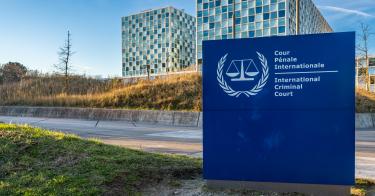
The International Criminal Court has been conspicuously quiet on the Iran conflict. While Israel fought Hamas after its Oct. 7, 2023, massacre, ICC officials repeatedly criticized Israel’s conduct of the war and eventually issued arrest warrants for top Israeli officials. Hamas’s current leadership hasn’t been charged. And as Iran lashes out in all directions, The Hague is silent.
>>> Politics Behind Herzog Denying Pardon for Netanyahu
Some might say the ICC isn’t involved because Iran, like its Arab neighbors, hasn’t joined the organization. The ICC is supposed to have jurisdiction only over member states. But Israel doesn’t belong to the court either. The ICC invented a “State of Palestine” in 2015 and allowed it to join the court—a legal fiction used to justify investigations of the Jewish state.
Last month an Iranian missile killed four Palestinian women at a bridal salon near Hebron. According to the ICC’s principles, this attack in “Palestine” gives the court jurisdiction over the responsible Iranian officials as well. The court can investigate this and other missile strikes in what it regards as Palestinian territory. It can also look into Iran’s continuing attacks on civilian ships, many of which are flagged in ICC member states. In recent weeks, several civilian sailors have been killed in attacks by Iran on Marshall Islands-flagged vessels in the Persian Gulf.
Strikes on disparate vessels may seem a thin reed for an ICC investigation, but the court has been moved to act by less. When Israel boarded a “flotilla” of vessels seeking to break its blockade of Gaza in 2010, they faced resistance from the crew, resulting in the deaths of nine people on board, in addition to 10 wounded soldiers. The ICC used the fact that one of the boats had been reflagged to Comoros—an archipelago off Africa and ICC member—to open a case against Israel that lasted for seven years.
The ICC appears to be sitting this one out not because it lacks jurisdiction, but because it lacks political will or perhaps interest. Iran has a track record of trying to assassinate its critics abroad and sponsoring bombings of buildings abroad. Would a country enforce an ICC warrant against Iranian leaders fearing it would lead to terror attacks? The Hague’s jurists may recall the 2015 murder of Alberto Nisman, the Argentinian prosecutor investigating Iran’s 1994 bombing of a Jewish center in Buenos Aires.
An ICC investigation wouldn’t necessarily change Iran’s conduct. After massacring thousands of their own people in response to this year’s protests, Tehran’s leaders will do whatever they can to survive. But the court’s irrelevance here also demonstrates its structural flaws. It can at most deter liberal democracies, thus tilting the playing field against such states when they confront despotic regimes.
The ICC’s prosecutors and judges take their cues from the international legal profession from which they are recruited. Prominent international-law publications have published theories about how the court might exercise jurisdiction over Trump administration officials, including based on attacks against drug boats from member states.
>>> Investigate the International Criminal Court’s Prosecutor
The ICC’s current silence underscores its politicization and the danger it presents to America and its allies—especially to members of the Trump administration after the president’s term ends. Last month, a panel of outside judges demurred on taking employment action against the ICC’s chief prosecutor, Karim Khan. Mr. Khan has been on leave since May following sexual-assault allegations by a subordinate. Mr. Khan has denied any sexual misconduct. In an email to staff, he wrote that he would go on leave “until the completion of the investigation.” An investigation by a team from the United Nations found evidence of “non-consensual sexual contact,” but the judges determined that it failed to meet a “beyond a reasonable doubt” standard, though this wasn’t a criminal proceeding. The ICC uses a lower legal threshold for bringing an arrest warrant against a democratically elected leader of a nonmember state than it does for firing an employee.
Mr. Trump has imposed sanctions on certain ICC officials but refrained from targeting the court itself. Now it seems Mr. Khan will return to his post. He has threatened to prosecute American politicians who impose sanctions on the court. If the administration doesn’t take broader and stronger action soon, Mr. Trump has a higher likelihood of becoming an ICC defendant than the massacring mullahs he is fighting.
This piece originally appeared in The Wall Street Journal on April 1, 2026



