Introduction
On July 4, 2026, Americans will remember how the Founding Fathers won their freedom and established ordered liberty through a system of limited government, federalism, and the rule of law. In understanding their crowning achievement, Americans must recognize that the Founding Fathers were, quite literally, fathers: Fifty-four of the 56 signers of the Declaration of Independence married and had a total of 337 children among them—an average of six each.[REF] Thus, when the men and women of the Revolution sacrificed their lives, fortunes, and sacred honor to secure the blessings of liberty “for our posterity,” it was their children, their children’s children, and an expanding circle of Americans stretching across untold generations that they had in mind. The key to American greatness in the first 250 years remains the key to American greatness in the next 250 years: the family.
The Founders knew a hard truth: that when a nation fails to preserve the family, the state soon fails to preserve itself. This is fixed by the stubborn facts of human nature: It takes one fertile man and one fertile woman to reproduce, and young human beings are wholly dependent on others for many years after birth. One knows from universal experience that children are best raised in homes with their married mothers and fathers. Moreover, abundant social science research confirms that every alternative to the natural family with married parents has proven across space and time to be, on average, inferior for couples, and especially for any children that arise from their union.
For that reason, Aristotle grounds political order not in the palace or the marketplace but in the household (oikos). The family is the most natural of all associations for the supply of man’s everyday wants, the first building block from which society arises. Cicero, building on the observations of Aristotle, referred to the first society as marriage itself and the home with children as the foundation of civil government, “the nursery, as it were, of the state.”[REF]
The family is the foundation of civilization, and marriage—the committed union of one man and one woman—is its cornerstone. It is the seedbed of self-government. The home is where fathers, mothers, and their children cultivate virtue and practice cooperation, responsibility, stewardship, and self-reliance. Without families, a country cannot create meaningful work and prosperity. It lacks a storehouse of strong and brave men to protect itself from hostile aggressors at home and abroad. It lacks even the ingredients for responsible citizenship itself—without which no republic is possible. Despite their own radical philosophy, even the mad Communist dictators of the 20th century, such as Stalin and Mao, could not eradicate the need for the family.
In many respects, a strong family—dependent on God and one another—is itself a declaration of independence. It advances the cause of liberty by minimizing the need for government in daily life. In the immortal words of John Adams, “Our Constitution was made only for a moral and religious People. It is wholly inadequate to the government of any other.”[REF]
The question that will determine the course of America’s future is: What happens to a nation when its citizens largely stop having children and, when they do, eschew marriage? These questions are not theoretical. This is the reality that the American Republic now faces. Americans’ answer to the question of family will determine the health and survival of the Republic.
The task of the authors of this Special Report is to propose ways to remove the many obstacles blocking the formation of healthy families, to make marriage and family life easier, and to restore family to the center of American life in rhetoric and in reality.
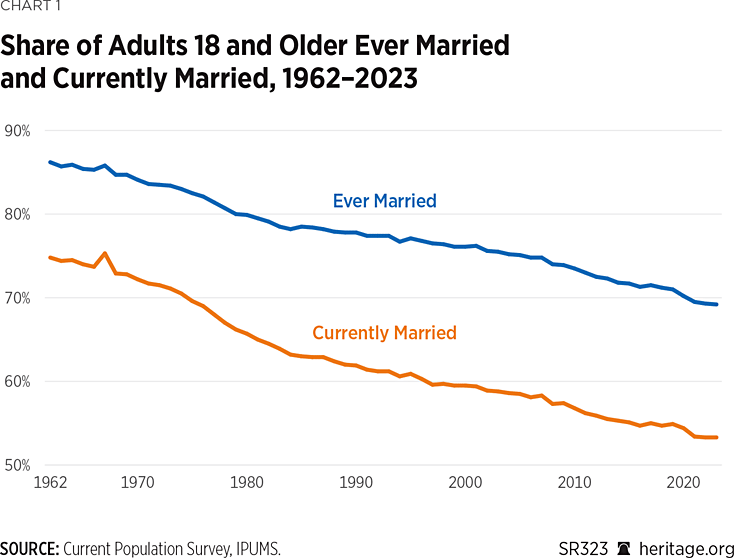
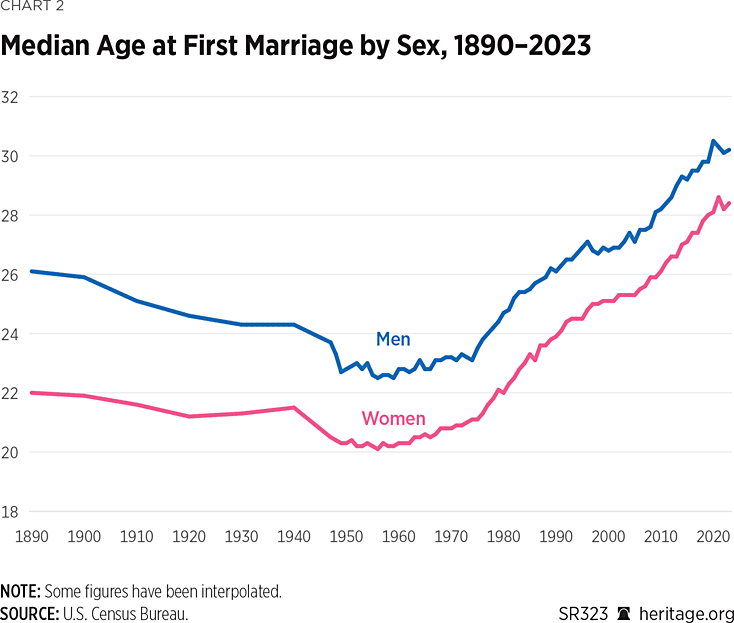
The statistics on the American family are sobering. The percentage of married adults in this country has been on a steady decline since the 1960s, and a third of young Americans are expected never to marry.[REF] Those who do decide to marry do so at later ages than their forebears, as evidenced by the fact the median age of first marriage has gone up by about eight years for women (to 28.6) and about seven years for men (to 30.5) in a generation.[REF]
These changes have transformed American family life. Married couples are still the most common household type, but married households are no longer the majority of U.S. households. In the 1950s and through the mid-1960s, around three-quarters of U.S. households included a married couple. Today, fewer than half of the nation’s roughly 132 million households are comprised of married couples.[REF] Cohabitation, by contrast, is on the rise. In fact, more Americans today are cohabiting than has ever been the case. These changes point to shifting priorities for men and women, but the people who feel them most are America’s children.
When the Moynihan report, The Negro Family: The Case for National Action, was published in 1965, Daniel Patrick Moynihan—then Assistant Secretary of Labor under President Lyndon Johnson—was so concerned about a 25 percent nonmarital birth rate for black women that he called for national action from the federal government. In the decades since the report was published, that rate has nearly tripled. The changes in marriage culture and family structure that have largely been associated with low-income neighborhoods in the country’s largest cities have taken on a new shape in recent decades. Today, the national nonmarital rate is 40 percent, and one-quarter of American children live with a single parent—the highest rate in the world.[REF]
The practical result is that millions of children will never experience life with both parents or stability in the home. Marriage no longer anchors childhood, and the results are clear: weaker educational attainment among children, higher poverty, and neighborhoods hollowed out by instability.
Alongside the decline in American marriage has come an even more precipitous drop in fertility. Unless reversed, deaths will soon outpace births, reshaping the American family from a source of abundance into a scarcity of both parents and children.
This dramatic turn away from marriage and family formation has many causes, but two stand out. The first was Lyndon Johnson’s War on Poverty. The rapid growth of the welfare state incentivized unwed childbearing, imposed devastating financial penalties on low-income people who got married, and discouraged able-bodied people from working.
The disruptions to American family life caused by bad public policy in the 1960s were exacerbated by cultural upheavals that radically changed social norms around sex, sexuality, marriage, children, and gender roles. Second-wave feminism and the sexual revolution promoted an individualistic, child-free, marriage-free, sexual “liberation” that promised to lead to an unparalleled era of consent-based human happiness and fulfillment. Over the course of 60 years, casual sex, abortion, childlessness by choice, and no-fault divorce became normalized, while marriage and the natural family became stigmatized.
For most of human history, marriage was accepted as the lifelong union of one man and one woman. Almost all major cultures recognized it as ennobling and viewed it as the optimal social arrangement for the rearing of children. Americans considered parenthood the natural and desirable course of life for almost everyone. Even through most of the 20th century, Americans married during young adulthood, and most children were born to married parents.
That life script has been flipped. Today, fewer than 50 percent of Americans believe that society is better off when people prioritize marriage.[REF] These new norms mean that many children today will have no concept of the traditional family name, family home, or family vacation, because their definition of family doesn’t include marriage and, often, either fathers or siblings.
With the decline in American marriage came an even more precipitous drop in the number of children brought into the world. Total fertility—the number of children born per woman—had been falling steadily since the Industrial Revolution but recovered significantly after the Great Depression and through the baby boom.[REF] It then cratered in the 1960s. By 2024, it hit a record low of 1.59 lifetime births per woman, which is far below the 2.1 required for a population to replace itself.[REF] If these trends continue as expected, deaths will outpace births within a decade, and the gap will widen non-linearly over the century.[REF] Put plainly, the current future of America consists of far fewer Americans.
So much of modern life has taken a non-shrinking population for granted that it is difficult to envision the future that awaits. For instance, when Social Security started, many able-bodied workers paid in for every retired person or widow. Today, there are so few workers per retiree that the program has been paying out more than it receives since 2010 with no end in sight. From schools, to banks, to churches, to sports leagues, to crowd-sourced apps, American society runs on a complex web of institutions and relations that presume net growth or stability, not decay and decline.
American family life is truly at a crossroads. One path is marked by unwed childbearing, low rates of marriage, low fertility, low commitment, and easy divorce. This path is associated with the view that family formation (or its avoidance) is primarily about fulfilling adult desires and adult needs. The other path elevates the family unit as an inherent good based on the commitment and sacrifice of husbands and wives for each other’s sake and for the sake of children that their union would welcome into the world. This path is associated with the view that all life is sacred and that sees the family as a source of fulfillment for adults because they direct their energies to the good of the family unit instead of to themselves alone. Underlying this view is a deep sense of gratitude in knowing that human beings are here by God’s grace and that children are divine gifts.
This is the choice that Americans now face, and the stakes could not be higher. Americans can continue to dissipate their energy as a spent force and a spent people or reverse course and rebuild on a foundation of families and communities that will grow in size, strength, and resilience. Americans’ choices, both as individuals and as a nation, will determine their future.
In terms of policy, government can respond in one of two ways. The first strategy presumes that the current trajectory of the American family is effectively irreversible and immune to policy-driven reform. Similar to hospice care, this option will seek not to cure the disease, but to find ways to limit the damage before the patient inevitably succumbs. Intentionally or not, this is the default strategy the nation has been following to date.
The second option is to presume that if trends, policies, and influences led to the decline of marriage and family, then trends, policies, and influences can lead to its restoration. It appears that Americans have no other choice than to pursue this option because, as evidence in this Special Report shows, the only way for America to thrive in future generations is to rebuild the family, and that can happen only with a societal commitment to revive the institution of marriage.
Some recognize the extreme gravity of the crisis and recommend extraordinary technical solutions. These include mass subsidies for IVF, egg freezing, and genetic screening combined with a market for babies where people (usually men of means) contractually create many children across many partners or surrogates. The ultimate end of this form of “pro-natalism” envisions a world of artificial wombs and custom-ordered, lab-created babies on demand.
The solution to the devaluing and commoditization of children, however, cannot be to treat them even more like consumer goods. A babies-at-all-costs mentality would come at too great a cost, and not just financially, but morally and spiritually. Such an approach intentionally denies a right due to every child conceived—to be born and grow in relationship with his or her mother and father bound in marriage.
The evidence from history, sociology, and biology points in the same direction: The answer to the problem of loneliness and demographic decline must begin with marriage. Marriage between men and women not only maximizes their own wealth, health, and happiness, but also provides the ideal conditions for child flourishing. The stability created by marriage naturally increases the birth rate and reduces the abortion rate. Most Americans still say they would like a flourishing family of their own someday, and marriage is key to achieving that goal.
While government action helped to create the crisis, some doubt that government action can help to solve it. They look back to government attempts to “help” families in the 1960s and have good reason to be wary of federal intervention—whether from the political Left or Right—on matters of hearth and home. Concerns about unintended consequences and perverse incentives are hardly unfounded.
We, the authors of this Special Report, share these concerns. The family crisis has many causes, and any proposed response comes with risks. Nevertheless, the decline in family formation is a serious cultural and collective action problem for which prudent and focused government action is a part of the solution. The purpose of this report is to lay out a vision for the government’s limited role in promoting a culture of marriage and intact families, not to create a complex maze of federal marriage programs. In many respects, the rules of agriculture apply to the hard work of creating a marriage culture. America’s key institutions must get serious about “planting” and “feeding” the virtues that strengthen families while ripping out the deadly weeds—the cultural toxins, perverse regulations, and policy incentives—that undermine those virtues.
The recommendations in this report are downstream from the transformative work that must be done in other parts of the culture. Families, communities, religious institutions, and other civic institutions must enrich the soil and plant the seeds of marriage and family. The government’s primary role is to clear the weeds and prevent its policies and programs from poisoning the ground. Unfortunately, except for radically redefining the institution, marriage is not currently a federal priority.
We, the authors, undertake these efforts motivated both by deep convictions about the importance of family and by a profound sense of humility. We welcome comments and good-faith criticisms because we realize that in a world of tremendous complexity and uncertainty, some of these proposals may not produce the results we expect and desire. Nevertheless, the times demand the courage to re-examine old orthodoxies and test new approaches. A problem of this magnitude requires a culture-wide Manhattan Project that marshals America’s political, social, and economic capital to restore the natural family.
The proposals follow three broad imperatives: (1) Stop punishing family formation, (2) Restore the American Dream, and (3) Support marriage and working families. The country will need all of this and an accompanying cultural renewal to save and restore the American family.
Stop Punishing Family Formation
The welfare state kick-started the current crisis by punishing work and marriage. The welfare system has made marriage economically irrational for many low-income couples. Nearly all of the cash, food, and housing programs focus on subsidizing non-married single-parent families with the greatest benefits aimed at families that do not work. Moreover, all of the programs impose severe financial penalties on parents who choose to marry. These incentives are perverse: Marriage is one of the surest paths out of poverty and dependence and improves the well-being of adults, children, and society.
Because the first rule of getting out of a hole is to stop digging, Congress and the Administration should eliminate all marriage penalties in welfare programs and impose meaningful work requirements. This can be done without adding costs to taxpayers by eliminating widespread fraud, waste, and excess benefits within the system. Additionally, work requirements for the able-bodied must be strengthened and enforced to ensure that children are raised in the best possible circumstances and not trapped in poverty.
Restoring the American Dream
In the 20th century, the quintessential image of the American dream was a family at home with a white picket fence, inspired by the expectation of an even better future for one’s children and grandchildren. That dream has all but slipped away from a generation of Americans who say they do not start families or do not have as many children as they would like because it has all become too costly, both personally and financially.
At the same time that Americans have lost confidence in the future and the size of the average family has shrunk, government has grown to gargantuan proportions. This does not seem to be a coincidence. Today, combined local, state, and federal government spending is over 35 percent.[REF] This means that government takes over a third of the earnings of hard-working Americans and redistributes it to suit elite preferences. The federal debt alone is more than $270,000 per American household.[REF] This untenable situation imposes a crushing weight on the economy and stifles the growth and opportunity that families need to flourish.
Beyond that, the federal government imposes trillions of dollars’ worth of needless regulatory burdens on the American people. These regulations make up nearly a quarter of the costs of building a new home.[REF] This is just one of many examples of how the regulatory state has made it nearly impossible for many families to flourish.
Counterproductive regulations, of course, harm all aspects of civic life. They limit job prospects and make it harder for families to thrive with a single earner. They also stunt the creation of new family businesses and civic institutions and the development of new communities. Together, the fiscal and regulatory burdens of government have created an anchor that holds back family formation in America.
Accordingly, there must be a whole-of-government approach to elevating and defending the American family in all federal regulations, grants, enforcement, and research. In the first few months of his second term, President Donald Trump systematically dismantled diversity, equity, and inclusion (DEI) policies and practices that had become embedded throughout the federal government. The same zeal and tactics used to implement and then to roll back these policies (because they hurt families) should be used to further policies that actively support families.
The President should issue a series of executive orders requiring every grant, contract, policy, regulation, research project, and enforcement action involving the federal government to do the following: Explicitly measure how it helps or harms marriage and family, block actions that discriminate against family formation, and give preference to actions that support American families.
At the congressional level, much of the tax and spending of the federal government serves as a form of wealth redistribution from hard-working people to those who could but do not work and to retirees. This hollowing out of middle-class families surely plays a role in family decline. To free the family of these government burdens, policymakers must address large spending programs that feed off the work of Americans and that drain them of the ability to save and build a future for their children.
Restoring the American Dream requires a strong economy, freedom from debt (both personal and national), and a restoration of the national culture and spirit. The most anxious, lonely, and depressed generation in American history became that way through an increase in divorce and decline in religious attendance; careerism; a broken education system; out-of-reach housing costs; and the proliferation of addictive technology, drug abuse, and pornography.
Actively Supporting Marriage and Working Families
Not only must the federal government stop actively punishing marriage; not only must it stop hindering the American Dream; it should also make up for the wholesale damage it has done to the family across generations.
The authors of this report propose three bold federal legislative mechanisms to support married couples with children and offset current and historic marriage penalties. They also propose a number of state policy ideas throughout.
First, Congress should build on the President’s innovative Trump Accounts by supporting marriage with a $2,500 initial deposit into a new investment account. Trump Accounts are in effect tax-free long-term bonds that provide a $1,000 deposit at the birth of a child to support his or her adult milestones such as college education, home-buying, or starting a business. Noticeably absent is support for the milestone of marriage. Congress should expand the Trump Accounts by creating separate Newlywed Early Starters Trust (NEST) accounts that support men and women who marry by or before the current average age of first marriage (about age 30) and that provide future retirement support for those who do not.
The initial deposit should be $2,500 and would be distributed over three years upon eligible marriage. To illustrate, if two people married by age 28, they would be expected to receive an inflation-adjusted NEST distribution of more than $38,000 by age 30. This amount would provide newlyweds with a boost to their lives together with any amounts unclaimed by 30 being converted to traditional individual retirement accounts (IRAs).
Second, Congress should apply the current $17,670 adoption tax credit to married parents for each of their own newborns. This newly proposed credit would be structured to make up for existing marriage penalties in the Earned Income Tax Credit (EITC). To incentivize marriage stability for eligible children, the credit would be distributed annually in four equal installments across three to four calendar years. To recognize the investments involved and the societal benefits that accrue from large families, married parents that already have two or more children would receive a 25 percent Large Family Bonus for each additional child. To avoid repeating past policy mistakes that punished and disincentivized work, at least one parent would be required to be engaged in verifiable employment for the family to be eligible for the tax credit.
Third, Congress and the Administration should make the average value of credits, programs, and tax benefits currently provided for paid childcare available for at-home parental child raising. One of the top reasons that Americans cite for having fewer children than they desire is the cost of raising children. Most of these parents and potential parents would prefer to spend more time raising their children at home if they could afford it,[REF] but the federal government largely provides support only for parents who pay others to help to take care of their children.
From childcare tax credits to Head Start to Flexible Spending Accounts, the federal government should not discriminate against single-earner family households that choose to provide at-home childcare and child raising instead of paid outside childcare—a choice that benefits both family and child well-being. We therefore propose a $2,000 per child (under five) Home Childcare Equalization credit to level the playing field for married households who choose to provide early childcare themselves.
Each of these recommendations and the many others in this report would help the American family to avoid further dissolution. Moreover, if the recommendations are adopted together with a sustained cultural renewal, the American family will certainly be restored to full health, and today’s Americans will keep the sacred promise that the Founders made 250 years ago—to secure the blessings of liberty for Americans today and for generations yet unborn.
How the American Family Dissolved and Why It Must Be Restored
Before proposing policies to address the crisis of family formation in the U.S., we need to grasp how we got here. The decline of the American family—which began slowly in the first half of the 20th century—metastasized in the 1960s, leading to an epidemic of broken homes and often-broken children that continues today. A decline in stable married households headed by a father and mother is a menace to the future of every developed country, including the United States. The natural family is the cell of the social body, and no body can survive the death and decay of its cells. This is true for everyone, including those Americans who never marry or have children. The persistence of every civilization across time has certain prerequisites. Without the formation, stability, and fecundity of families, no country can long survive.
Social conservatives have advanced this argument for decades. Recently, however, the link between the future of civilization and the family has re-entered the wider conversation—53 percent of Americans believe people that having fewer children will hurt the country’s future.[REF] Increasing swaths of the population now care that the United States and almost all developed countries are failing to replace their populations. In 2022, the total fertility rate (TFR) in the U.S. was 1.665 births per woman aged 15 to 44, well below the replacement level of about 2.1.[REF] In 2023, it dropped another 3 percent to its lowest point ever: 1.62.[REF] In 2024, the TFR is projected to be 1.59.[REF] Among the 38 countries in the Organization for Economic Cooperation and Development (OECD), fertility was even lower. As of 2024, it was at 1.5.[REF] Demographer Nicholas Eberstadt has put it bracingly:
Last year [in 2023] France tallied fewer [births] than in 1806, the year Napoleon won the battle of Jena. Italy reports the fewest births since its 1861 reunification; Spain the fewest since 1859, when its modern birth figures start. Poland has its fewest births since the postwar era; so too Germany. The EU has been a “net mortality zone” since 2012, with four deaths for every three births in 2022—a gap of over 1.2 million.[REF]
To worry that the U.S. and most of the world are below the replacement rate does not imply a moral judgment on any particular person who does not marry or have children. Some adults, either by calling, health, or happenstance, do not marry. Some who do marry do not or cannot have one or more children for a multitude of reasons. Others suffer the pain of separation and divorce through no fault of their own. This report casts no moral judgments on individuals. Rather, it seeks to dispassionately analyze a multifaceted problem that affects all Americans—a problem that society can no longer avoid. For the country’s population to replace itself and flourish across generations, a great many citizens must choose to marry, and as a matter of mathematics, couples must on average have at least two children.[REF]
One of the most widely cited worries about the birth dearth involves the way it threatens the funding of old-age entitlements because there are far fewer workers to support an ever-growing cohort of retirees. As desperately as entitlement reform is needed, it would not touch the deeper problem that the demographic crisis exposes—a profound cultural malaise in which a growing share of adults feel that they should not or cannot, and therefore do not, form families. This is not just a harbinger of budget crunches for government entitlements. It is a mark of a culture that has lost hope for the future. Fewer children mean fewer future problem-solvers, inventors, and innovators.[REF]
Policies aimed only at the birth dearth, however, may make the mistake of focusing on a visible symptom instead of the illness itself. The malady is this: The natural family has ceased to be a central organizing reality of America’s social and cultural life. To restore the nation’s health, society must return the family to its pride of place.
Because the family, as a married man and woman and their children, is the fundamental unit—the cell—of society, any long-term policy solution to the decline of the family should defend the family as such. It should make the good of the family a central organizing principle of policy rather than merely one item on a long menu of possible life paths. This report is one, no doubt partial attempt to do just that.
For decades, politicians have talked about “family values,” but where are the policies explicitly defending marriage and family as goods in themselves?
First Causes and First Principles. To understand the current family crisis, one must begin at the beginning. No child can naturally come into existence without a biological mother and father. This biological fact is inseparable from a moral fact: Parents have duties to their children, and children have a corresponding claim on their parents. These are not just abstract truths. As elaborated in this report, a family headed by a child’s married mother and father is, on average, the best context for bearing and raising that child—by a large measure.
In this report, the authors show that married couples on average have more children than unmarried ones. Couples who marry earlier—in their early twenties—are more fertile and tend to have more children than those who marry later, say in their mid- to late-thirties. As a consequence, if more people marry earlier, that will likely boost the married fertility rate and alleviate a multitude of social problems described in this report.
Before diving deep into the politics and policy details, however, a survey of the surface-level forces and cultural trends that have brought the country to this point is helpful.
First, many of the past incentives to have large families are gone. For instance, far fewer Americans live and work on farms in 2025 than they did in 1825 or 1925.[REF] Few married couples now think of the labor potential of children on a farm or in the local coal mine.[REF] Infant mortality has also dropped to near zero, and life expectancy has more than doubled.[REF] Far fewer elderly Americans live with and depend directly on their children and grandchildren now than they did in the past—due in part to vast entitlement programs.
Second, the opportunity cost—that is, the number and perceived quality of activities or opportunities foregone if one has a family—has skyrocketed, especially for women. As the value of one’s alternatives—including career success, income potential, or leisure—rises, the more one must forgo to bear and raise children. This is why there is no simple correlation between income and family size. People do not simply have as many children as they can afford to feed, in part because they must give up more high-value alternatives with each additional child.[REF]
A century ago, the average family had far more children than the average family does today, even though today’s average family is much wealthier.[REF] When grasping how changing opportunity costs can alter choices, however, this fact will seem far less paradoxical. This is especially true if a culture tends to treat marrying and having children not as a duty or guiding aspiration, but as just one of many life paths or consumer preferences. Family size is largely a function of how much people value getting married and having children, not in the abstract but compared to the alternatives. And what people value is shaped and transmitted by cultural institutions, including family background and religion. Social pressures, from popular culture to guidance counselors to parents, now encourage almost everyone to go to college and delay getting married and having children.
A large share of the blame for the present malady lies in moral and cultural trends that have both fed and been fed by government policy. Chief among these is surely the sexual revolution, which separated the sex act from marriage and childbearing. It is not just that sexual mores were revolutionized. Technology and policy also played key supporting roles. Starting in the 1960s, the Pill and other contraceptives swept the country—which promised to reduce the unwanted consequences of casual sex with multiple partners across a lifetime.
Like two gravitational objects interacting, the law soon influenced and was influenced by culture on this score. No-fault divorce laws became nearly universal, and divorce rates skyrocketed. Even when the divorce rate leveled off from its peak, it was largely explained by the fact that fewer people bothered to get married. Meanwhile, despite wide access to contraception, non-marital birth and abortion became ever more jointly common, especially following Roe v. Wade in 1973. Even some noted academics on the Left have acknowledged that the “shock of abortion and female contraception may have played a major role in the rise of out-of-wedlock childbearing.”[REF]
The perverse incentives of the welfare state also expanded the fraction of non-marital births—especially among lower-income Americans and minorities. Ironically, insofar as public policy since the 1960s has encouraged childbirth, it has been among poor, unmarried women. Tragically, these are the women, along with their children, who most need the benefits of stable marriage. Instead, they subsist in a state of “bureaugamy,” in which government welfare replaces the father. If women in this system choose to marry, they are punished and lose substantial benefits through the infamous “marriage penalties” that beset the welfare state.
These perverse incentives set in just as many influential voices branded marriage as oppressive and labelled children as burdens rather than blessings. For half a century, radical environmentalists have portrayed humans as a threat to the planet—and called for population control as the solution. “Population growth,” people are told, “threatens environments at global, national and regional scales.”[REF] This message has only become more strident in recent years. Dennis Meadows of the Club of Rome warns ominously that he hopes the “necessary” pruning of the world’s population down to a billion people can “occur in a civil way.”[REF] “Stop Having Kids” is just one of many efforts to denigrate parenthood.[REF]
Contrary to these dystopian canards, however, the United States faces not a population bomb, but a population bust.
On top of these tectonic culture forces undermining family came the LGBTQ agenda which, through the Supreme Court of the United States, redefined marriage and severed it in law from its natural biological function and purpose of reproduction. This blow to marriage was followed shortly thereafter by gender ideology such that by 2018, CNN’s feature story on Father’s Day weekend was titled “He gave birth. He breastfed. Now, he wants his son to see him as a man.”[REF] The story pushed the idea that men can get pregnant on a holiday that honors fathers. But the rabbit hole goes further: One 2023 GQ story titled “The Deeply Human Love Stories of People and their Sex Dolls” is as dystopian as its headline suggests. It posits that future generations may have to ask whether both participants in a “marriage” are even human.[REF] New York magazine published a “practical guide to polyamory” in January 2024 that seemed to signal its resolution to make “marriages” involving three or more people the Left’s next civil rights cause.[REF]
In the face of seemingly overwhelming anti-family forces around the world, dozens of countries have implemented policies designed to support natural marriage and family. For the most part, these efforts reveal a nettlesome asymmetry: Government policy has proven much better at suppressing fertility than at boosting it. While these are hard problems that will not succumb to any quick, technocratic fix, it doesn’t follow that policies can make no difference.
Four broad drivers of family formation involving value, sequence, timing, and size stand out. If more families are to form, then, first, more young adults must come to value marriage and childbirth. Second, more young adults must want to marry before having children—sequence. Third, more young adults must marry earlier—timing. And finally, more married young adults must want to have more children—size.
Beyond these broad factors, one can also define—abstractly—an ideal policy for boosting family formation. First, and obviously, an ideal policy should respect the freedom and agency of adults and the independence of families from both the state and other people. Families exist freely for themselves, with their own rights and duties, and not merely as a benefit to society.
Second, an ideal policy should reduce the opportunity costs of forming families—without depriving people of valued alternatives.
Third, it should reduce the real financial costs to parents of bearing and raising children.
Fourth, it should reduce the cost to the country as a whole, and over the long run, of marrying and then bearing and raising children. If human beings are the ultimate resource, as both economist Julian Simon and Pope John Paul II maintained, then policy should provide the conditions in which that truth can be realized over time.
A sustainable but non-ideal solution should at least not raise any of these three costs. For instance, a policy that lowers the financial cost for a father to get married and raise a child with the mother of his child should not vastly inflate the social costs of such a child or the opportunity costs of a prospective mother. If the federal government sent $1 million to every couple who got married and had a child, this would surely lead to more babies in the short run, but such a policy would vastly inflate the real cost of childbirth. It would also induce many people to have children for purely financial reasons—including many who would never do so otherwise. That is hardly a wise policy for building stable, loving families.
Again, one should not expect to find a single silver-bullet policy to slay the anti-family beast. Instead, one needs to survey the policy landscape to find places where reform, as part of a larger cultural campaign of renewal, could help to reverse the trend of declining marriage and family—and not hinder the type of cultural renewal needed to make a real and lasting difference.
To that end, what follows is a summary of this Special Report’s proposed policies to help to reverse the trend of the declining formation of families. First, a clarification of what makes a policy pro-family. Pro-Marriage + Pro-Child = Pro-Family. To be pro-family, a policy must do more than merely lead, or be designed to lead, to more babies. Pro-natalism is one manifestation of an “it’s all about the babies” mentality that happily detaches childbirth from its natural context in the family.
As a matter of public policy, however, policymakers should not endorse technocratic fixes to the birth dearth that conflict with human nature or ignore or bypass the known sources of human flourishing. First among these sources are the institutions of marriage and family.
The ideal family begins with marriage. As explained by Ryan Anderson, “Marriage exists to bring a man and a woman together as husband and wife to be father and mother to any children their union produces.”[REF] Marriage, then, is a social institution grounded in and defined by humans’ biological nature. In a rational world, one would not need to define terms such as man, woman, mother, and father. In the current world, we must do so. Mothers are female parents and fathers are male parents.[REF]
A just and stable culture should recognize that men and women are equal in rights and dignity but are not interchangeable. Men and women have natural, complementary differences.[REF] The recent and incoherent concept of “gender identity”—a supposed “internal sense of gender” that can be incongruent with the body—does not change these biological facts and does not obviate the need for law and policy to respect these facts.
Marriage, in its essence, is the formal social recognition of two truths. First, it takes one fertile male and one fertile female to bear children. Second, all things being equal, children should be raised in a stable home by their married mother and father. These are not sectarian claims. Historically, virtually all known cultures have an institution that one can call marriage involving a man and a woman. Even in the case of polygamy, the spousal relationship is between a male and one or more females.
Until recently, virtually all cultures recognized that marriage has a special connection to the bearing and raising of children—even if some marriages do not give rise to children. Children are a proper end of marriage, in principle if not always in fact.[REF]
Society, including the state, cannot be neutral toward the family any more than it can be neutral toward individuals and their rights. The family, as a pre-political institution, limits the state and the public sphere. At the same time, the state has an interest in the well-being of families because the well-being of citizens and society depends upon it.
For instance, as discussed below, children do best when raised by their married mother and father.[REF] Such children are far less likely to be poor,[REF] to commit crimes,[REF] to drop out of school, and to suffer from depression and other psychological problems.[REF] Adults in such settings also do better on average on almost all measures than single parents do. Married women with children, for instance, report higher levels of happiness than either single mothers or single women with no children.[REF]
Beyond these empirical findings lies the ethical prohibition on methods and policies that treat, or risk treating, sacred human beings as commodities—as mere means to the ends of others rather than independent persons with their own dignity and rights.
Pro-family policy should be based on these moral, biological, and spiritual foundations.
As always, when it comes to policy, good intentions are not good enough. Society should not waste time, money, and political capital on symbolic gestures that do little or nothing to fix the problem, and society must avoid making the problem worse. As the country should have learned over the past century, many supposedly “pro-family” policies were anything but that in practice. This includes everything from health, welfare, housing, tax, and educational policy to energy, environment, and tech regulation. A policy advertised as pro-family often renders anti-family results, both unintended and intended. To avoid these mistakes, this report continues with detailed examinations of the gravity of the problem and how the country arrived here before turning to the major policy recommendations.
The Beleaguered State of the American Family
Marriage and family life in the U.S. has changed profoundly over the past six decades, and not for the better. The decline in stable marriage, more than any other factor, is almost surely a major cause of our demographic crisis. Sixty years ago, there was no public debate about the definition of marriage or whether it involved a man and a woman. Almost all American adults married, and few divorced. Very few couples lived together outside of marriage. Nearly all children were born and raised in homes with a married mother and father, and more Americans were parents.
Unwed childbearing and sexual relations outside of marriage were much less accepted.[REF] If a child was conceived outside of wedlock, the mother and father normally married before the child’s birth.[REF] While marriage and family were less stable among some groups than others even then, these relationships were, on average, more stable for everyone than they are now.
Today, fewer people marry, and they marry at ever-older ages. Sex outside of marriage is extremely common.[REF] Although divorce rates have declined in the past few decades, many more Americans have divorced or have been affected by divorce than have older cohorts.
The erosion of marriage means that many Americans have less valuable social capital, which means weaker communities.[REF] Far fewer children are born into and raised in married-parent households, which research overwhelmingly shows is the best setting for a child to thrive.[REF] Lower marriage rates and later marriage also mean that fewer children are born at all, and the drop in birth rates means that the networks to support families are smaller. Since this is true in almost every town and city, the entire country suffers as a result.[REF]
Marriage on the Ropes. Throughout American history, most adults married and remained married until one spouse died. Today, while most Americans still marry at some point, marriage rates have greatly declined. In 1962, 86 percent of American adults had ever been married, and most previously married people were widowed rather than divorced. Today, just 69 percent of Americans have ever been married, and most who are previously married are divorced rather than widowed.[REF] (See Chart 1.)
Besides the decline in marriage, marriage takes place later in life. The median age at first marriage continues to rise and in 2024 was 30.2 years for men and 28.6 years for women. (See Chart 2.)
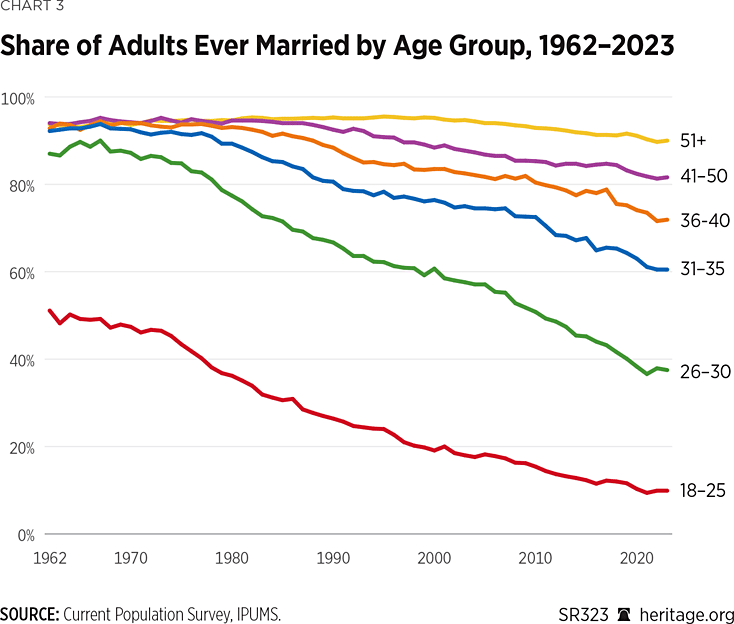
In the 1960s and 1970s, around 90 percent of adults ages 26 to 30 had married. Today, less than 40 percent of 26-year-olds to 30-year-olds have done so. (See Chart 3.)
Normalization of Unwed Childbearing. As marriage declined, births outside of marriage became much more common. Unwed births were very rare for most of America’s history. That began to change in the 1960s when unwed childbearing started to climb. This trend persisted until the early 2000s when unwed births leveled off at around 40 percent. (See Chart 4.)
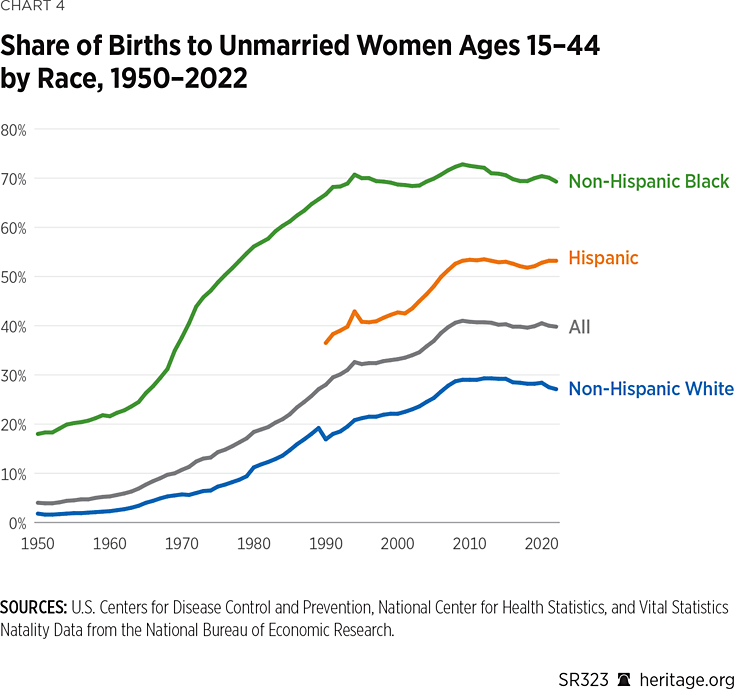
The share of unwed births varies among different groups. For instance, unwed childbearing is the most common path to motherhood for minority women and women with low or moderate levels of education. (See Charts 4 and 5.) Nearly 70 percent of non-Hispanic black children and 53 percent of Hispanic children are born outside of marriage.
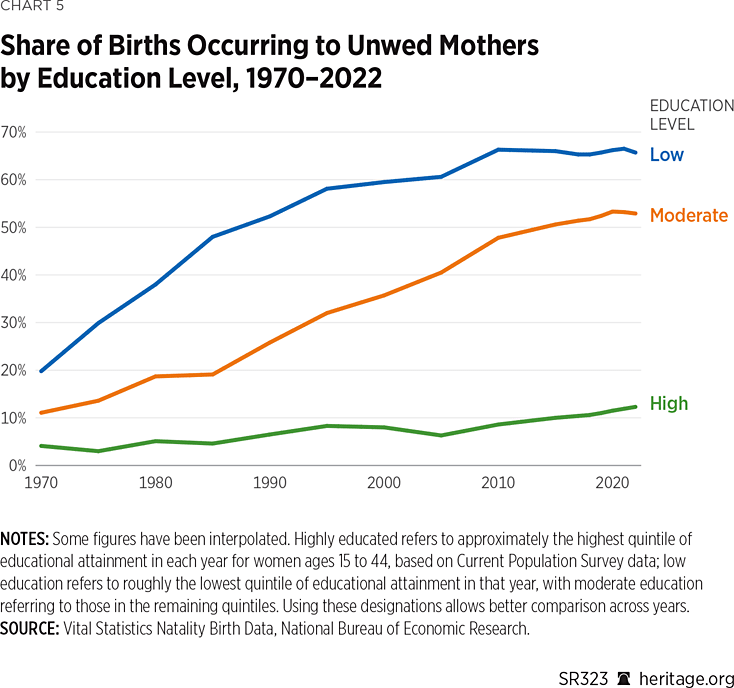
Two-thirds of children born to women with low levels of education are born outside of marriage, and more than half (53 percent) of children born to women with moderate levels of education are born outside of marriage. By contrast, among women with high levels of education, just 12 percent of children are born outside of marriage.[REF]
In past generations, if a child experienced an unstable family, it was most likely due to divorce, which was rare in the 1950s and earlier. Even though divorce is far more common now than it was then—divorce shot up between the 1960s and 1980s—today, unwed childbearing is the most common reason a child is raised outside of an intact family.[REF] While it was welcome news that divorce rates trended downward and then leveled from their 1980s peaks,[REF] underneath this trend lurked a troubling fact: Fewer Americans than ever before get married in the first place. This is likely due in part to increased fear of the trauma of divorce among young adults.[REF]
Marital breakdown means that more children are born outside of marriage. It also means that more children spend at least part of their childhood raised without their married, biological parents. This is true for nearly half of American children.[REF] Chart 6 shows the share of children over time who are being raised in a two-parent household.
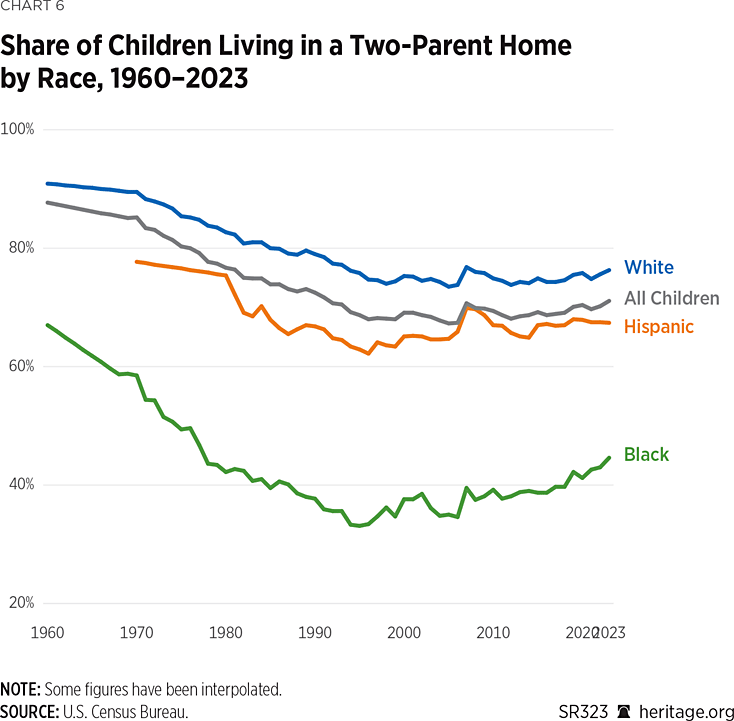
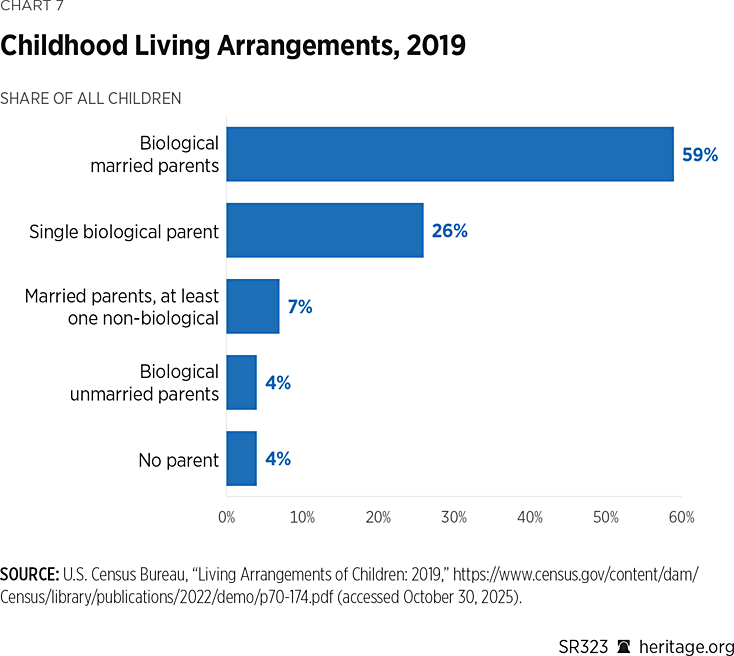
Not all children in two-parent homes, though, are living with their married biological parents. Some live with unmarried parents or stepparents, for example. As of 2019, only 59 percent of U.S. children lived in a home with their married biological parents. (See Chart 7.) By contrast, in 1960, nearly 90 percent of children lived with two parents, and more than 70 percent lived with their married, biological parents.[REF]
While declining marriage rates are linked to less stable family life, it also means that fewer children are born at all. This is because married women are still much more likely to bear children than women who have never married. (See Chart 8.) The average number of children born to married (and unmarried) women has stayed roughly flat since the mid-1980s (although it has declined somewhat in recent years), but the share of women in their prime childbearing years who have never married has climbed. (See Chart 9.)
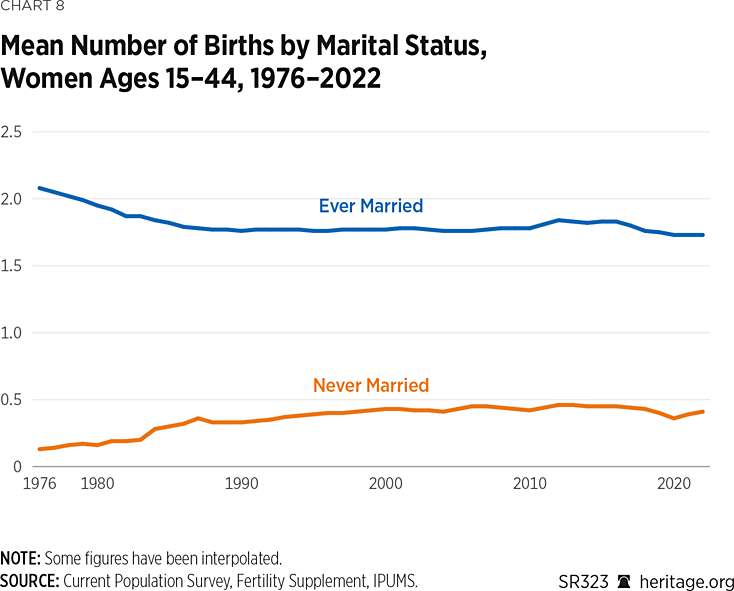
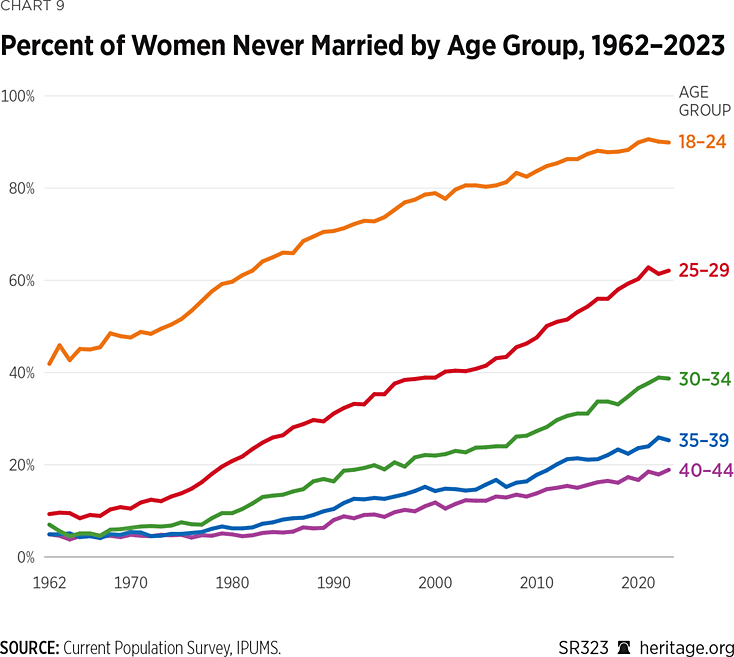
As marriage rates have dropped and the age of first marriage and first birth has climbed, fewer children are born, and fewer Americans become parents. While lower marriage rates are not the only reason for the birth dearth, they are a central thread of the story.[REF] In short, more marriage and earlier marriage means more children.
Dropping Below Replacement. Fertility rates in the United States dropped below replacement level in the early 1970s and have remained below that threshold nearly every year since.[REF] (See Chart 10.) Analysts attribute declining fertility in the 1960s and 1970s to three main factors: the surge of women entering the labor force, the introduction of the birth control pill in the 1960s, and the nationwide legalization of abortion in the 1970s.[REF]
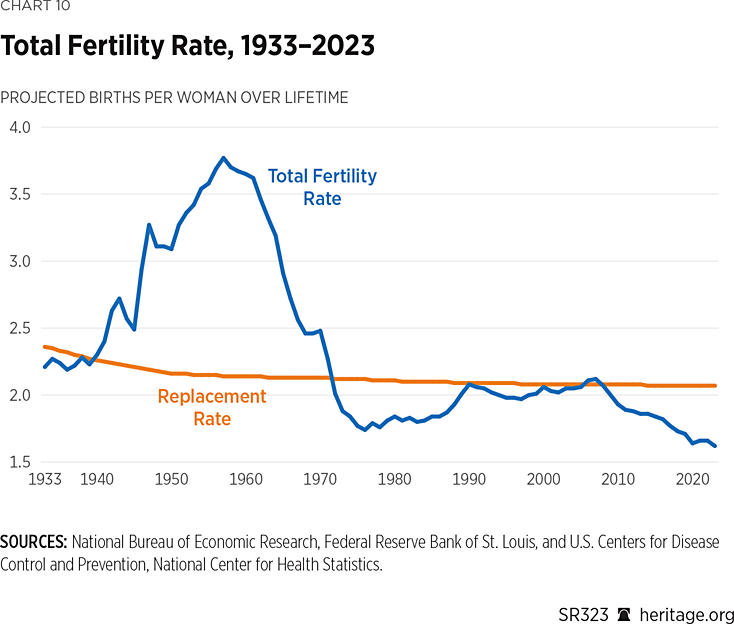
In more recent years, the fertility rate has dipped to its lowest levels in history. While researchers expected births to decline in response to the 2008 recession, they also expected birth rates to recover as the economy improved. Instead, the decline continues, and births reached their lowest level in 2020 during the COVID-19 pandemic. The fertility rate ticked up slightly in 2021, although it was still lower than before the pandemic and has continued to decline since then.[REF]
What explains the decline in the fertility rate in the past decade or so? Some have argued that younger generations are more worried about finances and thus more hesitant to bring children into the world.[REF] By contrast, Melissa Kearney, Phillip Levine, and Luke Pardue find little association between financial factors, such as housing prices, student loan debt, or childcare costs, and declining fertility since 2008.[REF]
Further, Scott Winship of the American Enterprise Institute (AEI) and Jeremy Horpedahl of the University of Central Arkansas argue that raising a family today costs slightly less than it did in 1985. They calculate that the number of work weeks required for the median male earner to support a family dropped from 46.4 weeks in 1985 to 44.8 weeks today.[REF] According to their estimate, it would be financially easier at middling incomes to raise a family today than it was 40 years ago even if that family had only one breadwinner.
Kearney and her co-authors suggest that recent declines in fertility may instead reflect changing priorities. Today’s adults may favor autonomy and personal development over raising children more than earlier generations did.[REF] Thus, greater opportunity cost rather than greater actual cost may be a better explanation.
But even if, on some measures, it takes a bit less work now than in 1985 to raise a family, the cost of living in some places in the U.S. is still exorbitant. Housing, higher education, and health care costs—the market segments most subject to political tinkering—have gone up much faster than the rate of inflation for the past several decades.[REF] Parents cannot simply buy the 1980 version of a house, health care, or college in 2025. Moreover, credit card debt is north of $1 trillion,[REF] and Americans have experienced high inflation across the board since 2021. These factors certainly contribute to the millions of Americans who think the American Dream is getting ever harder to attain.
Another chapter in the story of the shrinking family may be changing expectations about what it takes to raise a family.[REF] Kearney and her co-authors suggest that younger adults may believe that parenting requires more resources today than it did in the past.[REF] On a similar note, in 2019 testimony before the Joint Economic Committee, AEI’s Lyman Stone explained that even if the real cost of childrearing has gone down over time, parents now spend more on their children than did parents in earlier decades. Stone believes this is because society expects more from parents than it did in earlier generations.[REF]
There is a cultural message that more children mean poorer quality parenting. It is now common to hear commentators and economists speak of parenting in terms of “quality over quantity,” for example. Incrementally, parents will have less time and money to spend on the children they have with each additional child, the philosophy suggests, so the way to raise successful children is to have fewer of them and invest more in each one.
To take a pop culture example of the rising material expectations for American families, the TV sitcom The Brady Bunch, which ran from 1969 to 1974, followed the lives of a family with six children—three boys and three girls. The Bradys were prosperous, upper-middle-class Californians who could afford family vacations to Hawaii. Yet the three boys shared a single small bedroom, as did the three girls. What is more, all of the kids shared a single bathroom!
The house portrayed in exterior shots of The Brady Bunch was under 2,500 square feet. By 2022, this was smaller than the average new single-family home and only slightly smaller than the median single-family home.[REF] Clearly, the expectations of upper-middle-class Americans have changed in the half-century since The Brady Bunch started its popular afternoon rerun in 1975. (As have home prices: The Brady house went on the market in 2019 for $1.8 million and sold for much more.[REF])
AEI scholar Timothy Carney similarly argues that declining birth rates are due to cultural changes, including unrealistic expectations for parents. As fewer people have children, he explains, communities become less centered on families, making it harder for parents or would-be parents to find the support they need. These cultural shifts away from the family further reinforce the norm for families to have fewer children or no children at all.
Carney also points to exceptions, though: In places where larger families are the norm, such as enclaves of Latter-day Saints, devout Catholics, or Orthodox Jews, cultural norms and civic infrastructure tend to support families. These include playgrounds, organized family activities, and extended families nearby. All of this makes it easier to raise children and reinforces the norm of larger families.[REF] (These enclaves are explicitly religious. Policymakers should not ignore this fact.)
As the share of Americans with children diminishes, more aging Americans will lack adult children to support them in their older years. Smaller families also mean fewer siblings, cousins, and other extended family members to help throughout life.[REF]
Are there public policies that can help to reverse these troubling trends? Yes, almost certainly. A successful approach will reform policies that discourage marriage and pursue policies that encourage or reward those who seek to form larger families.
It’s All Related: How Family Structure Affects Family Flourishing
As put crisply by Melissa Kearney in her groundbreaking book, The Two-Parent Privilege:
I have studied US poverty, inequality, and family structure for almost a quarter of a century. I approach these issues as a hardheaded—albeit softhearted—MIT-trained economist. Based on the overwhelming evidence at hand, I can say with the utmost confidence that the decline in marriage and the corresponding rise in the share of children being raised in one-parent homes has contributed to the economic insecurity of American families, has widened the gap in opportunities and outcomes for children from different backgrounds, and today poses economic and social challenges that we cannot afford to ignore—but may not be able to reverse.[REF]
Decades of social science research confirm what most people intuitively know: Children raised in homes with their married biological parents do better on a host of outcomes than children raised in other family arrangements, particularly single-parent homes.
Children Need Both Parents. One of the most basic benefits of stable married households is economic stability. In 2024, just 5 percent of children in married-parent families were living below the poverty line compared to 31 percent of children in families headed by a single mother and 14 percent of children in families headed by a single father.[REF] In 2024, the median income of a married-couple household was $128,000, or more than twice as much as the median income of a female-headed household with no spouse present, which was $60,400. The median income for a male-headed household with no spouse present was $83,260.[REF]
Besides a greater risk of poverty, children raised outside an intact family are less likely to climb the economic ladder. They have poorer physical and mental health and are more likely to be abused.[REF] They are also more likely to engage in antisocial behaviors and are less likely to have stable marriages of their own.[REF]
In one study using a cohort of the National Longitudinal Survey of Youth from 1979, Marcia Carlson found that children in single-mother families had poorer behavioral outcomes than children in two-parent households. These outcomes held even when controlling for factors such as the mother’s education.[REF]
Children living with their married birth parents also earn better grades and are less likely to be suspended or expelled.[REF] In a 2009 study using data from the 1997 National Longitudinal Survey of Youth, researchers Carolyn Hill, Harry Holzer, and Henry Chen found that children who grew up without both biological parents in the home were more likely to drop out of high school, to have a child outside of marriage, and to have been incarcerated. Adult children who grew up in a non-intact family also reported lower levels of employment. These outcomes persisted even when the researchers controlled for household income. The harms of growing up without both biological parents were especially strong for non-Hispanic black men.[REF]
Choosing to Prioritize Parenting. Research in the United States shows that parents view time spent caring for and teaching their children as a crucial investment in their future. For example, highly educated parents tend to spend significantly more time engaged with their kids than do less-educated parents—college-educated mothers spend about 4.5 more hours per week on childcare than mothers with only a high school degree spend.[REF] This pattern holds even though more-educated parents also work longer hours outside the home, suggesting that they intentionally prioritize parenting duties despite higher opportunity costs.
Notably, the positive relationship between parent education (and income) and time spent with children is robust for both mothers and fathers and across various types of child-focused activities. These results have been validated in a series of subsequent structural labor economics research,[REF] which all point to the overwhelming importance of the quantity and quality of time that parents spend with their children.
Research in developmental psychology finds that warm, responsive, and cognitively stimulating parenting supports children’s cognitive growth and emotional security.[REF] Daily parent-child activities like talking, reading, and interactive play help to build children’s vocabulary, pre-literacy skills, and social-emotional understanding. In contrast, harsh or inattentive care can undermine trust and learning.[REF]
No Real Substitute for Two Engaged Parents. A large U.S. longitudinal study concluded that parent and family characteristics are far stronger predictors of children’s developmental outcomes than is any particular childcare setting or program.[REF] Factors such as parents’ education, family income, a stable two-parent home, and a rich home learning environment had much larger influences on children’s language, cognitive, and social development through kindergarten than whether the child attended daycare or was cared for at home. In short, their results suggest that engaged parenting by both mothers and fathers provides children with stimulation, guidance, and emotional support for which it is hard to fully substitute.
Infants Need Parental Care. When it comes to infant care, a growing literature has examined how outcomes differ between parental care and “outsourced” non-parental childcare. Multiple studies find that maternal employment in a child’s first year of life is associated with small but measurable decreases in subsequent cognitive test scores, whereas maternal work in the second or third year has more neutral (or even slightly positive) effects on development. Some have found that when mothers worked full-time during an infant’s first year, their children scored modestly lower on later cognitive tests.[REF]
By contrast, maternal work in the second year had no major downsides for the child in question and in some cases correlated with gains in skills. This may be due to increased family income or high-quality care arrangements. Others have similarly reported that an additional 20 hours per week of maternal work in the first three years of a child’s life could shift cognitive achievement percentile ranks down slightly by age five or six.[REF]
These findings all suggest that stable, nurturing care by a parent in the very earliest months is especially beneficial for children’s development. Parents provide one-on-one responsive interaction—forming secure attachments and tailoring stimulation to the infant—which typical non-parental care settings may struggle to match for very young babies.
If non-parental care is used in the first year, research emphasizes that ensuring high-quality childcare can at least help to mitigate potential risks. High-quality care—characterized by low child-to-caregiver ratios, a safe and language-rich environment, and sensitive, trained caregivers—has been linked to positive developmental outcomes that approach those seen with parental care.[REF]
However, the cost of childcare has grown in part because of the excessive regulations affecting the provision of childcare, which affects the demand.[REF] Family-friendly policies like parental leave can thus help to support early development by allowing parents to spend critical time with infants or to secure enriching care environments. Firms that offer such benefits will attract more productive workers.[REF]
Quality Matters. Nevertheless, the quality of childcare is critical: Expanding access to care without maintaining standards can be detrimental. One striking example comes from Quebec’s universal childcare program, which offered heavily subsidized ($5 per day) daycare in the late 1990s.[REF] This program led to worse behavioral and health outcomes for children, on average, than for children who stayed in parental care, presumably because the surge in daycare availability was not matched by improvements in quality. The affected children exhibited higher levels of anxiety, aggression, and illness in the short run and even showed more teen delinquency in follow-up analyses. Non-parental care is not automatically benign—its effects depend on the nurturing quality of the environment provided.
Notably, extensive hours in non-parental childcare early on can have subtle socio-emotional downsides relative to parental care, especially if the alternative care is mediocre. Infants who spent long hours in daycare (particularly lower-quality or unstable arrangements) had slightly less secure attachments to their mothers—unless the mothers were highly sensitive caregivers to begin with.[REF]
According to NIH studies,[REF] by age two, toddlers with a history of many hours in non-parental care exhibited more behavioral problems (such as aggression and disobedience) than did children reared primarily at home. In contrast, children who experienced lower quantities of non-parental care (or whose daycare hours were limited) tended to have more harmonious mother-child interactions and fewer reported behavior problems in toddlerhood. These behavioral differences were small in magnitude in this study, but they reinforce the idea that a parent’s consistent, loving care in the first years is hard to replace.
What makes parenting in early childhood so important? Economists and developmental psychologists note that skills acquired in the first few years make later learning and healthy development easier. These are referred to as “dynamic complementarities.”[REF] For instance, basic cognitive abilities and socio-emotional skills formed in early childhood lead to better success in school, which in turn affects college attendance, job opportunities, and even health in adulthood.
Early investments in children have high returns: When children develop capacities like language, self-control, and curiosity at a young age, they are more able to absorb and benefit from education later on.[REF] Early gains compound over time, whereas remediating skill gaps in adolescence is often less effective. This is consistent with findings from social experiments and developmental studies: High-quality preschool programs (such as the Perry Preschool Project in Michigan or the Carolina Abecedarian Project in North Carolina) have demonstrated long-term improvements in educational attainment, earnings, and reduced crime, especially for at-risk children.[REF]
How Society Benefits from Intact Families. Healthy and vibrant families create substantial “positive externalities,” meaning spillover benefits for others, and everyone benefits. In an analysis of U.S. cities, neighborhoods with high concentrations of single-parent households suffer far more crime than neighborhoods with predominantly two-parent families suffer. In particular, researchers found that in Chicago, census “tracts with high levels of single-parent-headed households face 137% higher total crime rates, 226% higher violent crime rates, and 436% higher homicide rates, compared to tracts with low levels of single parenthood.”[REF]
By contrast, areas where stable families are common have greater public safety and fewer social problems. These community-level effects hold even after accounting for poverty and other factors. Sociologist Robert Sampson famously observed that family structure is “one of the strongest predictors” of urban violence.[REF] Strong families provide supervision, role models, and social control that ripple outward. When more children in a neighborhood are being well cared for and guided, peer influences improve and crime falls.
Likewise, economists have found that neighborhoods with more stable families foster upward mobility for all children in the area. Children from single-parent homes tend to have better economic outcomes when they grow up surrounded by many two-parent families, suggesting a positive peer effect or support network from the broader family-friendly community.[REF] In fact, research on intergenerational mobility in the U.S. has identified the fraction of single-parent families in a community as the strongest predictor of a child’s chances of rising out of poverty. Even children of married parents do better when they live in communities with more two-parent families, suggesting that family stability yields benefits beyond its own household.
Strong families also bolster civic institutions and the social fabric of communities. Families are a primary source of socialization where children learn values such as cooperation, empathy, and responsibility. These traits later translate into active citizenship and community involvement. For example, parents who model volunteering or attending community meetings often inspire their children to become engaged in civic life. Communities with many stable, nurturing families tend to have higher levels of social capital—a term for the networks of trust and mutual support among residents.[REF]
Declines in two-parent family formation in the late 20th century paralleled declines in civic engagement and social trust in America. Conversely, when families are strong, they reinforce norms of reciprocity and collective responsibility. Neighbors in family-oriented communities are more likely to watch out for each other’s children, support local schools, and participate in civic organizations. This creates a virtuous cycle: Well-supported children grow into adults who strengthen schools, churches, and community groups, which in turn provide resources and social support for the next generation of families.
Parents Matter Everywhere. A landmark survey called the Global Flourishing Study by Gallup, spanning more than 200,000 respondents across 22 countries starting in 2023, provides more evidence that the relational quality of childhood—especially parent-child relationships—is strongly associated with adult well-being across multiple domains.[REF] Higher parent-child relationship quality predicts greater flourishing and better current mental health in adulthood with effects that are both statistically and substantively meaningful.[REF]
These associations extend to economic capability: Early-life conditions that include stable family structure, good childhood health, and strong relationships with parents correlate with higher financial well-being later in life.[REF]
Pro-social behaviors follow a similar pattern: Parent-child relationship quality and related formative experiences are linked to a greater likelihood of charitable giving and helping strangers, as well as higher rates of volunteering, with some heterogeneity across countries.[REF] Policies that strengthen family relationships in the early years may yield broad social returns. They may not only improve individual flourishing and financial resilience, but also contribute to the civic goods of trust, generosity, and volunteerism in communities and nations at scale.
Marriage vs. Cohabitation. The benefits of the presence of both a mother and father in a child’s life are clear, but how much does marriage matter? Cohabitation is so common that it makes it hard to analyze the connection between, for example, the home environment and academic outcomes in children. In 1968, 88 percent of households led by unmarried parents consisted of a single mother, while 12 percent had single fathers. Cohabitation was virtually nonexistent.[REF]
That trend has changed in subsequent decades: 20 percent of unmarried parents living with a child in 1997 were cohabiting, and by 2017, it was 35 percent.[REF] That does not mean that marriage has lost its relevance. One study of cohabitation trends found that 49 percent of college-educated cohabiting parents break up before their child turns 12 compared to 18 percent of married couples with similar levels of education.[REF]
The instability of cohabiting relationships in the United States has led to an increase in the number of parents who have biological children with more than one partner, either within or outside of marriage. This “multi-partner fertility” phenomenon has implications for parents and their children. One study found that the proportion of young parents who met the clinical definition of depression was greater for those with children by more than one partner than it was for those with children by one partner.[REF] Fathers with children by multiple women are also less likely to live with all of their children.[REF]
A 2013 report from the Centers for Disease Control and Prevention on father involvement found that only 8 percent of all fathers in the study who lived apart from their young children ate with them every day.[REF] Forty-three percent said they did not eat with their children at all, and 27 percent said they did so once a week.[REF] Non-resident fathers across ethnic lines also seem to become less involved as their children get older. Only 3 percent of non-resident fathers with children ages five to 18 ate with them every day.[REF] More than 50 percent did not eat with their kids at all, and 32 percent did so just once a week.[REF]
The likelihood of child abuse is also greater in homes with an adult male who is not related to the children.[REF] If rates of cohabitation continue to rise and those unions retain their characteristic instability, then the future of American family life will be marked by increasingly complicated webs of co-parenting relationships, absent fathers, different custodial and biological mothers and fathers, often competitive relationships with half-siblings, and increased family instability.
The divide between highly educated Americans, who have lower unwed birth rates, and poorer Americans, who have higher unwed birth rates, means that children from households with the fewest resources are the most likely to experience further social and economic deprivation in the absence of married parents. While other socioeconomic factors account for some of the differences in these children’s outcomes, marriage plays a major role.
The benefits of marriage for children extend beyond individual families. Children living in neighborhoods with a larger share of married parents, for example, are more likely to enjoy upward mobility even if they do not have married parents themselves.[REF]
Dads Matter to Children. While it is natural for policymakers to frame the appeal of intact, two-parent homes in terms of social and economic outcomes, children also benefit personally from living with both a father and mother under the same roof, and the commitment of marriage is the best guarantor of that. Each parent interacts with his or her children in unique ways that contribute to their development from birth. The complementary nature of men and women—both in physical and emotional terms—plays a large part in how children come to engage in and understand the world. No one questions the critical role that mothers play in child development, but cultural acceptance of single parenthood is one sign that fathers, while acknowledged as important, are not seen as necessary in a world where more women have the economic resources to raise children alone.
Children can feel the “dad difference,” though. Healthy father-daughter relationships help girls to develop self-esteem.[REF] Dads also teach their sons valuable life lessons about strength and resilience through roughhousing. Further, good fathers give sons a role model to emulate and provide daughters with a template for the type of man they should desire.
Children need both parents, and it should not be controversial to state that the two people who create a baby are generally the two best-equipped individuals to raise that child. Though a father residing with his children does not necessarily mean that he is married to the mother, the percentage of children living with two unmarried parents is in the single digits across every ethnic group.[REF] That means that the best way to ensure that more children grow up in loving homes with both parents and active, involved fathers is to promote marriage as the cornerstone of family life. The benefits of marriage are simply too large to ignore.
Cultural and Behavioral Obstacles to Family Formation
This section explores many of today’s obstacles to family formation, from decline in church attendance to hookup culture to drug use.
The Decline in Church Attendance. Church attendance in the United States has collapsed over the past 50 years with profound consequences for individuals, families, and society.[REF] In 1975, over a third of American adults attended services weekly; today, that figure has fallen to just over one in five.[REF] (See Chart 11.) Almost half of U.S. adults now rarely or never attend, a doubling since the mid-1970s.[REF] The decline is evident across every major demographic—men and women; young and old; married and unmarried; black, white, and Hispanic; and especially among those with less formal education.[REF]
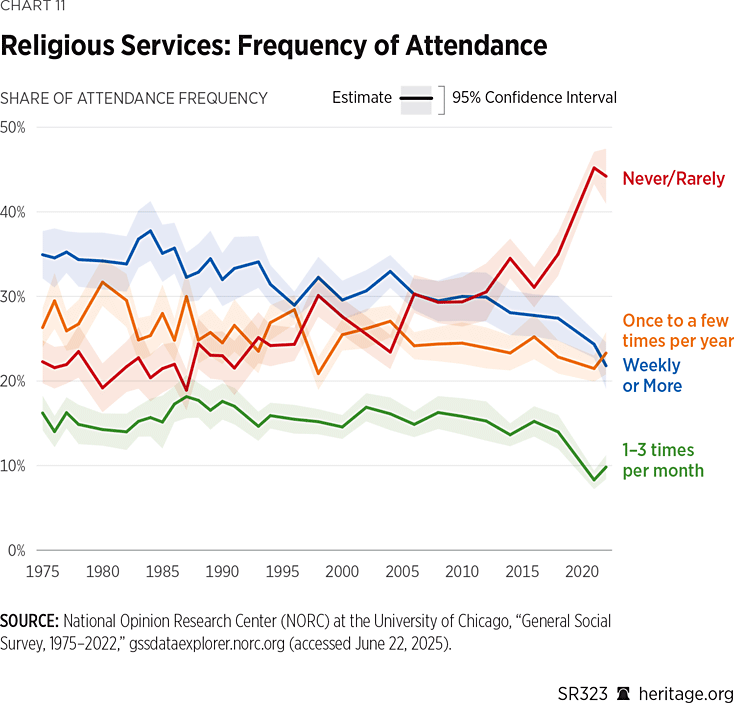
There is no single explanation for the decline in religiosity in the United States. However, the growing alignment of liberal political identity with secularism during the 1990s and 2000s led to a sorting of organized religion. Liberal leaning persons disaffiliated in much larger numbers than did self-described conservatives. The differences are now remarkably stark.[REF]
Additionally, greater preoccupation with and demand for consumer goods and experiences have raised the perceived opportunity cost of weekly worship on a weekend as retail and entertainment options have exploded. Blue-law repeals have produced quasi-experimental evidence that when secular substitutes become more accessible, attendance and church giving drop (suggesting that a restoration of blue laws could have a restorative effect).[REF] Pressure to spend more time at work, either from careerism on one end or inflation on the other, has reallocated evenings and weekends away from neighborhood organizations. These trends have weakened the local social capital that historically supported congregational life.[REF]
How has the decline in religiosity affected marriage and child raising?
Research from Harvard University’s Human Flourishing Program (more than 66,000 participants in a 14-year study) showed that regular religious service attendance is associated with 50 percent lower divorce rates in later life,[REF] and this finding is consistent with other studies.[REF]
Research consistently demonstrates that the religiosity of parents is associated with a range of benefits for children's psychological and social development. A nationally representative study by John Bartkowski, Xiaohe Xu, and Martin Levin found that parental religiosity was significantly associated with enhanced psychological adjustment, greater self-control, better social competence, and lower levels of internalizing and externalizing behavior problems among kindergarten-age children as rated by both parents and teachers.[REF] These findings have been confirmed across multiple cultural contexts and age groups.[REF] The effect seems to run both ways: Adults who report stronger childhood relationships with both mother and father are likelier to attend regular religious services and exhibit higher perceived social trust later in life.[REF]
As for family formation, regular church attendance increases the odds of marriage for men and women of all ages,[REF] races, and ethnicities by at least two-thirds.[REF] Married churchgoing Americans across denominational and racial classifications are more likely to describe themselves as “very happy” than are their non-religious counterparts,[REF] including a higher sense of well-being in times of financial difficulty.[REF]
There is also a strong positive link between religious participation and birth rates with religiously engaged people and couples having significantly higher total fertility rates than secular populations. Data from the National Survey of Family Growth from 1982 to 2019 show that fertility rates among weekly attending religious Americans have never dropped much below two children per woman, while fertility among nonreligious women fell below 1.5 by 2019.[REF] For example, Catherine Pakaluk’s study of 55 college-educated American mothers of five or more children found that religious commitment was the consistent explanation for their choice to have large families compared to the national average.[REF]
The data are strong that religious people are more likely to get married, marry earlier, divorce less, have more children, and beneficially influence their children’s social development. Because religion has an outside impact on marriage and family, it merits outsized social and cultural support. One of the biggest impediments that religious Americans must confront, however, is widespread cultural and government-enforced secularism.
Respecting Conscience and Religious Freedom. One of the starkest recent examples of government preferring the secular to the sacred occurred when state governments across the country shut down Easter worship services during the COVID-19 pandemic but left casinos and liquor stores open.[REF] This differential treatment highlighted a broader pattern where religious activities are viewed as optional luxuries rather than as essential human needs. When governments consistently put commercial interests over spiritual ones or treat religious gatherings as inherently less valuable than secular activities, they signal that faith is marginal to public life. Such policies not only violate principles of religious freedom, but also undermine the very institutions that research shows contribute to social stability, mental health, and civic engagement. The perception that government is hostile to their faith drives many believers away from public participation. It can lead to a defensive posture with religious communities withdrawing from broader society rather than engaging constructively with it.
Conversely, when governments actively protect and accommodate religious practice—through robust conscience protections, religious exemptions, and equal treatment of faith-based institutions—they create an environment in which religiosity can flourish. Studies consistently show that religious liberty protections correlate with higher levels of religious participation and vitality.[REF] When people feel secure that their deepest convictions will be respected and protected, they are more likely to live them out openly and pass them on to the next generation.
Countries and communities with strong protections for religious freedom tend to have more diverse and dynamic religious landscapes. Different religious groups feel empowered to practice, evangelize, and contribute to public discourse without fear of government interference or discrimination. By treating religious conscience as a fundamental right rather than as a privilege subject to government discretion, societies foster the kind of spiritual confidence that encourages religious growth, interfaith dialogue, and the transmission of religious values across generations.
One of the most important things that religious institutions can do today to rebuild the family home is to use their religious freedom to preach and affirm God’s design for the human body, sex, marriage, and the family. This includes pastors publicly reinforcing the truth that there are only two sexes—male and female—and that reason and revelation agree that marriage, as a unique institution, consists of the exclusive union of one man and one woman and is ordered toward the spouses and the children that can and, if so blessed, should come from that union. Churches should lead a revival movement by reaching couples through their family ministries and by offering programs for singles, pre-marital classes for couples who are seriously dating, and workshops for married couples looking to improve their relationships.
Support for a Uniform Day of Rest. As zoning laws allow a community to determine where one can operate certain businesses, “blue laws” reflect the local judgments as to when one can operate certain businesses. In the case of McGowan v. Maryland (1961), the Supreme Court held by an eight-to-one vote that Sunday-closings laws that include the purpose of providing a uniform day of rest are constitutional and can accommodate the fact that the majority of people who take a day of rest for religious reasons do so on Sundays. Massachusetts, for example, requires that “every employer of labor engaged in carrying on any manufacturing, mechanical or mercantile establishment or workshop...shall allow every person...at least twenty-four consecutive hours of rest...in every seven consecutive days.”[REF]
Day-of-rest laws limiting commercial activity are usually found in less densely populated counties, although restrictions on alcohol sales are more widespread. Though greatly diminished, blue laws persist in some form in close to 28 states.[REF] These places serve as a sort of legal reservoir. Once their day-of-rest laws are abolished, they are very hard to restore.
A uniform day of rest that limits commercial activity can provide temporal boundaries that help communities to set aside time for religious observance, family gatherings, outdoor activities, and rest. A stable base of research shows that these practices correlate with better mental health, stronger social bonds, and more stable family structures.[REF]
With the advent of on-demand delivery, shopping can be shifted easily and conveniently to other days of the week. By restoring a common rhythm of rest and reflection, community rest laws could help to reverse the trend toward “spiritual homelessness” and foster the social habits necessary for communities to cohere and flourish.
Despite today’s on-demand culture, the U.S. Postal Service does not deliver regular mail on Sundays, most organized youth sports avoid Sunday competitions, and most banks are closed on Sundays. The ever-popular Chick-Fil-A chain closes its restaurants on Sundays for the benefit of its workers and their families. Where new, planned communities or transitioning communities form, they should consider adding rest days as part of their master plans for balanced and thriving community life.
Family or Career Achievement: Which Comes First? For most previous generations, marriage was the foundation of adulthood. By contrast, today’s cultural narrative teaches young people to delay marriage and focus on career and personal achievements first. Many now consider marriage a capstone to adult life, something to be accomplished only once career and other personal goals have been achieved.
In a 2023 Pew survey, only around a quarter of respondents said that being married is extremely or very important for having a happy life. About the same share said that having children is extremely or very important for a happy life. By contrast, 71 percent of respondents said that having a job or career they enjoy is extremely or very important for having a happy life.[REF]
This reflects parents’ attitudes as well. Most parents emphasize career and financial stability for their children over their children getting married and having children. For example, in another 2023 Pew survey, just 21 percent of parents said it is extremely or very important that their children get married, and about the same number said it is extremely or very important that their children have children of their own. By contrast, nearly 90 percent of parents said it is extremely or very important that their children be financially independent, and about the same share said it is extremely or very important that their children have jobs they enjoy when they grow up.[REF]
A trope common to graduation speeches across America is that one’s life goals should revolve around finding “one’s passion,” which predominantly refers to building a career or perhaps volunteering or seeing the world. Rarely are young people told that their schooling, whether high school or college, has prepared them for marriage and family.[REF]
While getting an education, establishing a career, and saving money can contribute to stable family life, the culture treats these typically as goals in themselves and not as preparation or assistance for having a happy, healthy marriage and family life. The resultant message is to focus on oneself and find meaning through career success.
Part of the emphasis on career and financial stability may be due to a lack of trust in marital stability. With high rates of divorce, particularly in the 1970s and 1980s, younger generations saw the breakup of their parents’ marriages in greater numbers than were seen in previous generations.[REF] Researchers find that divorce is linked with poorer confidence in marriage. Children of divorce may come to believe that they need financial independence as an insurance policy if they, too, get divorced.[REF]
All of these cultural pressures have had a cumulative effect so that today’s Gen Z ranks having children and being married at No. 7 and No. 8 for men and No. 11 and No. 10 for women from a list of 13 measures of life success behind having a fulfilling career, having disposable income, achieving financial independence, using one’s resources to help others, owning a home, and being debt free.[REF] Only after all of that, it seems, are young people ready to embrace marriage and family.
Of course, young adults should be prepared to take on the responsibilities of marriage and family life before getting married. That includes developing plans to provide for a family. But the culture continues to move the goalposts further in pursuit of ever-expanding career and financial goals. This shift in priorities takes massive investments of time, financial resources, and psychic and emotional effort compared to generations past and, given the current state of higher education and previous years of unchecked inflation, has produced mixed results. The shift, however, has certainly resulted in fewer marriages and later ones when they do form, which in turn has led to smaller families.[REF]
Online Dating, Hookups, and Pornography Culture. “Online” has become the most common way couples meet in America today.[REF] While there are plenty of dating app success stories, studies show that couples who meet online and subsequently marry are six times more likely to get divorced within the first three years of marriage than are those who meet through in-person methods.[REF] Beyond higher divorce rates, couples who meet online are also less likely to get married in the first place.[REF]
Most dating apps at their core are businesses with financial incentives that directly conflict with long-term marriage. These platforms profit from monthly fees, paid premium features, user engagement, and retention. After all, if their users formed lasting marriages, it would mean a loss of their customer base. Continuous scrolling and swiping encourage users to keep logging in to match with as many people as possible, often explicitly for short-term ends, with an algorithm that entices them to keep repeating the process and keep the monthly fees going.[REF] But for those who are open to marriage, what type of people are they actually looking for on these apps (and elsewhere)?
Often, dating app users who are marriage minded suffer from what sociologist Brad Wilcox describes as the “soulmate myth,” which he defines as “the idea that marriage is primarily about feeling an intensely emotional connection with the one that makes you happy and fulfilled.”[REF] This contrasts with the historic understanding of marriage as being centered on a shared life of duty and virtue.[REF]
The same idea can be captured in three words that are emblematic of the dating scene today—fear of “settling.” This fear originates from seeing marriage more as something that is bought than as something that is built.
The former view puts extraordinary pressure on picking a person that hits every positive emotional trigger up front, while the latter view—the investment view—gives couples the framing for working through difficult seasons if or when the relationship no longer delivers immediate emotional satisfaction. One survey from 2020 found that married people who believe they are invested in a marriage as long as “their love lasts” are 50 percent more likely to think that their marriage could end in divorce than are married couples who do not consider divorce an option.[REF] Moreover, a 2022 survey found that American couples that followed the soulmate model were twice as likely to get divorced, and a 2020 survey in California found that couples who embraced marital permanence reported higher rates of marital satisfaction than did those who embraced a contingent view of marriage.[REF]
When combined with online dating, soulmate romance becomes even more illusory, since the presence of unlimited options creates the paradox of choice.[REF] The appearance of countless alternatives often creates unrealistic expectations, causes decision paralysis, makes people question their choices, delays the formation of real relationships, and ultimately makes users less satisfied with the relationships they do start.[REF] This perpetual sense of “what if there’s someone better out there?” can sap a person’s desire to commit to marriage, leading fewer couples who meet online to get married.[REF]
This is not a call to eliminate online dating, which has helped some people to find spouses they might never have met otherwise, but young people should understand the pitfalls and limitations of these platforms rather than treating them as equal substitutes for more traditional ways of meeting spouses. They should also know of the many benefits of in-person meetings through a shared community that includes the tacit networks and wisdom of family, friends, church, work, and school ties over superficial online profiles.[REF]
Online dating has also prioritized sexual activity over emotional connection and has led to an image-driven objectification of users.[REF] The prevailing cultural narrative says that experimenting with multiple sexual partners helps youth and adults to understand their sexual preferences and avoid sexual incompatibility if they ever seek marriage.[REF] Research, however, shows that the move toward casual sexual relationships has profoundly harmed the quality of marriage.[REF]
Nearly 90 percent of men and women who have ever married have engaged in pre-marital sex.[REF] The median number of sex partners among sexually active men and women ages 25 to 49 is 4.3 for women and 6.3 for men according to 2015–2019 data from the National Survey of Family Growth. Among women ages 25 to 49, 53 percent reported having five or more partners during their lifetimes; among men in this age group, 67 percent reported having five or more partners during their lifetimes, and 28 percent reported having 15 or more partners.[REF]
Researchers find that having multiple premarital sexual partners is associated with lower marital stability.[REF] For example, those with one to eight premarital sexual partners have about a 150 percent greater likelihood of divorce than those with no premarital sexual experience have. People with nine or more sexual partners have about triple the likelihood of divorce than those with no premarital sexual partners have. In this study, researchers Jesse Smith and Nicholas Wolfinger controlled for multiple factors, including biological sex, religiosity, sexual attitudes, and psychological attributes. They concluded that the link between premarital sexual activity and divorce is likely due not simply to personal differences between those who are more sexually active and those who are less sexually active before marriage—but to poorer quality relationships.[REF] Researchers find that those who wait until after marrying to have sex with their partner have much greater marital quality (relationship satisfaction, sexual quality, communication, and stability) than do persons who have sex with their partner prior to marriage.[REF]
The general decline in sexual mores against pre-marital sex, or what used to be called fornication, from the 1960s onwards was tightly associated with expanded pornography use. The trend culminated with the 1973 Supreme Court decision of Miller v. California that ultimately led to widespread decriminalization of hardcore pornography. The Miller Court invented a “community standards” test without considering the original public meaning of the First Amendment and acted as a one-way ratchet for liberalizing pornography.[REF] As a result, pornography is now ubiquitous, and its effects are now known. Current research confirms past intuitions—pornography is a decidedly negative force and influence on the family.[REF]
Increased pornography use is linked with lower relationship commitment and quality, and conversely, couples in which neither partner uses pornography report the highest levels of relationship stability, commitment, and satisfaction.[REF]
Porn use is also associated with an increased risk of divorce. Users are nearly twice as likely than non-users to be divorced across a six-year span.[REF]
As Brian Willoughby and Jason Carroll of the Institute for Family Studies note:
There are many possible reasons why pornography use is consistently linked with lower satisfaction. Many experts have highlighted how the false fantasy of pornography fosters unrealistic expectations in relationships. Pornography is always young, always available, and always caters to the user’s personal preferences and desires…. Over time, this constant comparison to an unrealistic standard lowers sexual satisfaction and eventually lowers overall relationship satisfaction.[REF]
Pornography treats a person’s body as a mere consumer good—rather than as a whole person to be respected and valued. And it often portrays violent and demeaning sexual behaviors, such as choking, and simulated rape and torture.[REF] Young adults exposed to pornography are likely at higher risk for developing unhealthy beliefs and narcissistic approaches to sexual relationships even before they have even had any real-life experience with romantic relationships.[REF]
Researchers also find that young adults who use pornography are more likely to engage in casual sex along with being more likely to be the perpetrators and victims of sexual aggression.[REF]
It is no surprise that evidence shows that its regular consumption hinders healthy, stable relationships.
Drug Abuse. Drug abuse, including of alcohol, cannabis, opioids, and prescription drugs, has reached crisis proportions, and family formation has been one of its many casualties. Drug enforcement must be prioritized, and further decriminalization must be opposed.
Consider that fentanyl, an opioid 50 to 100 times more powerful than morphine, is now responsible for more overdose deaths for 18-year-old to 45-year-old Americans than motor vehicle crashes, gunshots, or even the AIDS epidemic at its peak in the mid-1990s.[REF]
The National Institute on Drug Abuse (NIDA) reports that in 2022, 107,941 Americans died of drug overdoses with synthetic opioids, principally fentanyl, accounting for 73,838 of those fatalities.[REF] That is equivalent to a fully loaded Boeing 737 crash with no survivors every single day.[REF] The NIDA also reports that among adults 19 to 30, approximately 42 percent reported using cannabis in the past year, 29 percent reported using in the past month, and 10 percent reported using 20 times or more in the past month.[REF]
The chronic nature of addiction often makes the addict less emotionally available and less reliable, which undermines the trust necessary for lasting partnerships. Research indicates that active substance abuse correlates with delayed marriage, increased cohabitation without commitment, and reduced likelihood of transitioning from dating to more serious relationships.[REF]
A user’s family is not immune to a drug’s effects. Substance abuse can lead to violence against or neglect of other family members, generating lifelong scars as a consequence.[REF] In addition, drug use can have transgenerational effects and may lead to a reduction in the fertility of men and women.[REF] Not surprisingly, children from substance-affected homes face greater challenges forming their own stable families in adulthood.[REF]
Chemically synthesized and lightly regulated products containing THC, the primary psychoactive compound in marijuana,[REF] have exploded across America including in the form of “gummies” and kid-attracting packaging.[REF] Encounters with open drug users in major cities is rampant and in many instances are difficult to avoid even around schools.
With so much pressure on the American family from drug abuse, exotic and new addictive chemical compounds must be added to the government’s Controlled Substance Schedules with greater speed, and proposals to further decriminalize drugs, especially marijuana, must be resisted. Vaping, the gateway into THC and hard drug use for many teens, must be further restricted as alternative nicotine treatments for those seeking to quit smoking are common and readily available.
The Myth of an “Overburdened” Earth. Many of the current bad government policies discussed in this Special Report have suppressed family growth ostensibly by accident rather than by design. Their stated goal might be to make the business environment more competitive, to help the poor, or to make education more widespread, but they unintentionally result in fewer healthy families being formed.
One cannot avoid the fact, however, that many influential Americans see the birth of each new child as a net loss for the Earth’s environment, and many younger people believe them. In 2023, President Biden said that young voters believe that their “whole generation is damned”[REF] because of climate change, which climate activists deem an “existential threat” to life on Earth.
The media do everything they can to make sure no one misses this message. During every hurricane season, the public is told that extreme weather is getting worse and that climate change will only make weather patterns more violent and extreme. The prevailing view among the corporate media is that the world must keep global warming from rising above 2 degrees Celsius (relative to pre-industrial temperatures) lest the planet careen over a climate cliff.[REF]
Activists and political leaders claim that humanity has less than a decade to save the planet from carbon dioxide and greenhouse gases.
This climate change alarmism demoralizes young people who believe it.[REF] The only solutions the depopulators offer to “save the planet” are a drastic reduction in quality of life, a drastic reduction in population, or both. It is no surprise, then, that so many people see children as a threat, choose not to bring any into the world, and criticize those who do.
To encourage the formation of families, Americans must confront these claims directly.
Here is the good news: The facts are on the side of humanity; the world is not becoming more hostile to life. To the contrary, government data show that the world is getting better for human life in nearly every measurable way, and it has been for decades. On many measures, the environment is cleaner than it was even a few decades ago, resources are more abundant than ever, and it has never been easier to feed the world’s population. Much work remains to be done. This includes the effort to support freedom, property rights, and prosperity in the underdeveloped parts of the world.
The technologies that have made this possible may have downside effects on health independent of climate change that need to be addressed. For instance, local environments may play a role in the rise in chronic diseases, including autoimmune disorders and food intolerances. But none of these concerns relate to carbon dioxide in the atmosphere.
Moreover, fixation on carbon dioxide could very well distract from addressing such problems. Globally, human beings are releasing more greenhouse gases than ever before, but models have predicted far more warming than is observed in the real world. Moreover, contrary to model predictions, hurricanes and other extreme weather events are not growing more deadly or more common.[REF]
To get policy right, policymakers need to know how CO2 affects the global climate and how the climate affects human life and well-being. Open questions involving the scientific details remain, but the following is known:
- Human beings have never been safer from climate-related threats.
- To preserve human life and well-being, the developed and still-developing world must use hydrocarbons until people discover something better.
- When it comes to hazardous bulk pollution and acute disease, the environment in the U.S. is much cleaner than it was even a few decades ago.
- Policymakers must balance the possible environmental costs of CO2 emissions and effects on temperature against their benefits, such as greener forests, richer agriculture, shorter shipping routes through the Arctic, and usable tundra.
Note that points (1) and (3) are the result of economic development. The best way to become safe from climate-related danger is to develop energy resources and grow economically. One need not assume, as the depopulators do, a trade-off between human well-being and protecting the environment. If human beings are smart, they can have their cake and eat it too.
When enduring absolute poverty, people focus on the fight for their basic survival. However, when an economy reaches a level where people’s basic needs are met—with ample food, clothing, shelter, and plentiful energy—their priorities change. Such prosperity allows families to look toward the future and to care about a cleaner, more sustainable environment.
In its early stages, industry can take a toll on a local environment, but that changes over time. As a result, the most-developed countries are now also the cleanest—at least with respect to toxins that scientists can easily identify. Treating carbon dioxide as a pollutant—which it is not—obscures this fact. U.S. air quality trends have been improving for decades, and the globe continues to become greener.[REF] And despite a quintupling of the global population since 1928, deaths from natural disasters and extreme weather have gone down by more than 90 percent over the past hundred years.[REF]
Food prices have gone up recently because of foolish inflationary policy, but food prices as a percentage of income have continued to go down over decade after decade. Even many of rising health problems—such as obesity and Type II diabetes—stem not from a lack of food but from its abundance. The poor in the U.S. are more likely to be obese than are the rich.[REF]
The truth about the climate should reassure would-be parents, new parents, or anyone racked with climate anxiety: Today’s children can inherit a planet that is improving. Human flourishing and sound environmental stewardship are complementary, not mutually exclusive.
No one should decline to have kids or more kids because of fears that children will expand the human “carbon footprint” and despoil the planet. The hopelessness of climate alarmism is misplaced. Children, properly raised in a flourishing culture, can grow up to do more to help the environment and solve climate problems than to exacerbate them.
Divorce Culture and Its Reform. In the famed book-turned-movie Eat Pray Love, the main character walks away from her marriage—not because of any infidelity or hardship, but because married life no longer satisfies her sense of adventure and self-fulfillment.[REF] With no-fault divorce now the norm, a person who is no longer “feeling it” can unilaterally end a marriage.
Originally billed as a way to ease the evidentiary burden required of wronged spouses seeking to exit a broken marriage, the no-fault system has is in effect turned into a “no reason needed” system. Adultery, abandonment, and cruelty are no longer considered aggravating factors in determining alimony and property division, and the interests of any children are not considered at all in whether a divorce should be granted. When New York State eliminated fault-based divorce in 2010, the state chapter of the National Organization for Women (NOW) objected, stating that it would “disadvantage a majority of women, especially homemakers with children.”[REF] NOW also objected to the elimination of the need for spouses to attempt to negotiate their differences in marriage and divorce.[REF]
In community property states, a spouse that earned little or no money during the marriage would be entitled to up to 50 percent of the assets acquired during the marriage[REF] and alimony support for years after the divorce. Because these aspects of divorce were not substantially changed with the advent of no-fault divorce, they act as perverse incentives for ending marriages that could otherwise have been saved. The increased risk of marriage being ended unilaterally, in turn, likely dissuades many people from getting married in the first place. The addition of children into the mix only multiplies the complications arising from divorce.
A few states have pushed back on no-fault divorce and have added more-difficult-to-exit “covenant marriages” as an option that spouses-to-be can choose.[REF] Others are re-examining some of the default presumptions of divorce and custody of children. For instance, in 2018, Kentucky became the first state to pass a law making 50–50 shared custody the default when couples divorce or separate.[REF] Its champions argued that courts historically favored mothers in custody disputes and treated fathers as optional—rather than equally important—to a child’s well-being. This law recognizes that mothers and fathers play complementary roles in the lives of their children even when the relationship between parents comes to an end. It has improved the state’s divorce rate, which fell 25 percent between 2016 and 2023 compared to an 18 percent drop nationwide.[REF]
Other states have followed suit. West Virginia, Florida, and Missouri have all passed their own versions of Kentucky’s joint custody law.
Some states have gone even further to ensure that both parents have equal access to their children. Arkansas’s Act 604 of 2021 amended state law to move to a 50–50 custody default like Kentucky’s, but the text of the law also includes language that discourages parents from engaging in behaviors that are detrimental to the well-being of the child. A circuit court can penalize a parent who exhibits a pattern of creating conflict to disrupt a joint-custody arrangement by awarding primary custody to the nondisruptive parent.[REF] This type of provision is one way to reduce opportunities for parental alienation when one parent works to sever a child’s relationship with the other parent. Such laws presume that a child has a right to the care, support, and affection of both a mother and father. This allows courts to recognize during a custody dispute when parents weaponize access to their shared child to hurt the other party.
Another idea is to modernize alimony statutes. Reforms could establish hard caps on duration (such as no alimony lasting longer than the length of the marriage), allowing lump-sum settlements, immediate termination of spousal support upon remarriage, and automatic recalculation if the recipient’s income rises above a certain threshold. Each of these changes in existing laws would reduce the financial incentive to leave a marriage where major breaches of a couple’s vows (such as infidelity, abuse, or abandonment) are not present.
The need for such reforms also reflects a modern economic reality. In recent decades, the role of provider has become increasingly shared in many families. In 1972, 85 percent of husbands were the sole or primary breadwinners, and 11 percent of households had equal contributions from both spouses.[REF] Today, 55 percent of husbands are the sole or primary breadwinners, 16 percent of women earn more than their husbands, and 29 percent of couples make roughly the same.[REF] By modernizing alimony statutes, states can reframe spousal support around fairness and temporary transition rather than lifelong dependence outside of marriage.
Another idea tied to the legal system is to increase transparency in elections involving family court judges. In many states, because of privacy concerns, voters have no access to the family court records of the judges. One way to ensure that voters have more information prior to voting is to create public scorecards of key statistics (for example, the percentage of rulings awarding 50–50 custody, average case length, appeal reversals, and sanction history).
There are other policy levers that states can pursue to encourage couples to remain married and level the family court playing field in the event of a divorce. These include recognition of couples who reach marital milestones. A public-private partnership could take the form of an official commendation from a governor and a monetary award from a private donor or family foundation that increases for every decade a couple remains married. Local media could also do regular specials on couples who have been married for more than 50 years. This is a way both for a community to honor its elders and for younger individuals and couples to gain practical wisdom about how to have a lasting marriage.
The dissolution of a marriage is hard on everyone involved, very much including the children. Public policy should provide incentives for couples to get—and stay—married. But the well-being of children should be prioritized when couples divorce. Cultural messages in modern media—especially directed at women—often reframe divorce as a path to self-fulfillment. They send the signal that walking away from a marriage is better than working through a challenging season. Creating a culture of strong families requires changing hearts and minds about the benefits of marriage as well as reforming laws so that they do not create financial or social incentives for couples to dissolve their unions.
Ending the Penalization of Married Couples
Declining marriage rates in the United States are bad not just for individual Americans but for the country itself—both now and in the future. Marriage provides the best setting for raising children to become physically, mentally, and spiritually healthy, thriving adults. The erosion of marriage leads to fewer children, thinner family networks, and ever more childless adults. Fewer children lead to fewer mature adults who can contribute their skills and talents.
In short, if Americans want healthy, flourishing children, they must restore the norm of stable natural marriage. For decades, well-meaning but ill-conceived welfare policies have done just the opposite—especially among poorer Americans.
It Starts with Welfare Reform. Marriage is an all-purpose antibody that protects not just men, women, and children but the entire body of society. Marriage greatly reduces poverty, child sexual abuse, suicide rates, and drug abuse. It also boosts educational attainment, wages, physical and mental health, and longevity.[REF]
A healthy marriage is one of the two key factors in adult happiness.[REF] Marriage also promotes the upward mobility of children.[REF] Where marriage erodes, crime explodes. Holding race, poverty, and other background variables constant, a one-percentage-point rise in the share of married households in a community is associated with a 2 percent decline in violent crime per capita.[REF]
Strong and widespread marriage also boosts the economy. Researchers Brad Wilcox and Robert Lerman found that states with greater declines in the number of intact families (measured by the percentage of children living in two-parent families) had slower growth across their entire economies.[REF] For every 2 percent decline in the share of parents residing in two-parent families, there was roughly a 1 percent decline in gross domestic product (GDP) per capita across the whole state population.[REF]
What happens when extrapolating these figures for the U.S. economy as a whole? It would mean that the decline in two-parent families over the past half-century reduced the annual GDP in 2021 by 5.5 percent.[REF] This amounts to a loss of $1.3 trillion—around $3,800 per capita—in that year alone. Over the course of a decade, the decline in marriage has cost Americans $13 trillion.
The War on Poverty and Marriage. When President Lyndon Johnson launched the War on Poverty in 1964, he expressed a desire to strike “at the causes, not just the consequences of poverty.”[REF] We cannot understand the full effects of his programs without understanding that every major change in the family involves at least one of three fundamental elements: men, women, and the institution of marriage. Any analysis of the rise in fractured families must deal with fundamental changes in at least one of those three.
To judge by its effects, Johnson’s War on Poverty can be thought of as a war on wedlock that devastated lower-income families. When it comes to welfare, the growth of the federal government displaced men from their traditional role as providers. Welfare moved the primary responsibility to provide for a family from fathers to the government, transforming it from a symptom of family breakdown to a cause. One can attribute these outcomes to two features of the welfare state. First, welfare policies are focused on subsidizing single-parent families. Relatedly, welfare benefits are cut sharply when lower-income parents marry. The combined effect of these two encourages low-income couples to have children out of wedlock.
In fact, married couples, regardless of need, were ineligible for Aid to Families with Dependent Children (AFDC).[REF] States had discretion to set eligibility rules, and many also deemed families ineligible for the program if an able-bodied man, such as the mother’s boyfriend, considered a “substitute father,” frequently had sexual relations with an AFDC mother in her home.[REF] The Supreme Court struck down this “man-in-the-house” rule in the 1968 King v. Smith case. The unanimous decision rejected the idea that an unrelated male in the home was truly a “substitute father.”[REF] Politicians and bureaucrats, however, had no problem playing that role. The expansion of welfare programs, particularly AFDC, made the federal government the de facto husband for millions of poor women across the country.
In 1950, total federal expenditure on public aid programs (a fraction of total social welfare spending) was $1 billion.[REF] By 1975, it ballooned to $27 billion.[REF] It reached $62 billion by 1985.[REF]
Most of this spending took the form of cash assistance from AFDC, Medicaid, and food stamps. The welfare state not only provided resources to the home, but also literally put a roof over millions of families’ heads. Spending on public housing increased from roughly $15 million in 1950 to over $9 billion by 1985.[REF] This surge in government spending and an ever-growing number of new welfare programs did not stabilize American families. If anything, they had the opposite effect. What followed was a rapid decline in married, two-parent families, a steady increase in nonmarital births, a rise in abortions, and the spread of long-term government dependence.
Like every courtship, the government’s “proposal” to care for poor mothers and their children could not lead to a permanent union without their acceptance. Many single mothers were willing to say “I do” because the “feminization” of poverty made welfare a major battlefront in the women’s liberation movement.
Johnnie Tillmon, for instance, was a welfare rights activist who worked to increase the number of black women accessing aid programs. She became a leader within the National Welfare Rights Organization in the 1960s and was its president when it disbanded in the 1970s. Tillmon wrote an essay in Ms. magazine that showed a relationship with the government came with its own set of challenges. “Welfare is like a super-sexist marriage,” she wrote. “You trade in a man for the man. But you can’t divorce him if he treats you bad.”[REF]
Tillmon stated that 99 percent of welfare families at the time were headed by women yet, despite her reservations, saw government aid as a way to “liberate” poor women.[REF] She desired more from the government—the man—even as she resented the control that her new provider exerted over poor single mothers like herself. Johnnie Tillmon fought to increase the number of black women on welfare even as she acknowledged the ways in which the system stripped women like her of their agency and dignity. Her work gave the illusion of promoting female empowerment, but the women who accepted government aid sank deeper into dependence.
What made these changes worse was that they took place just when another movement encouraged women to rethink their relationship to men, marriage, children, and family. The feminist movement’s emergence in the same era accelerated the reordering of sex and family dynamics for decades to come.
Feminism questioned and upended the traditional family in numerous ways. Some 1960s feminists relied on the works of Friedrich Engels to argue that married households with children were capitalist constructs that were somehow unnatural.[REF]
More immediately, Betty Friedan’s 1963 book The Feminine Mystique is widely credited with sparking the second-wave feminist movement. The author, activist, and co-founder of the National Organization for Women believed that suburban housewives were unhappy with largely domestic lives. She believed women who focused primarily on their families were committing “a kind of suicide” and needed to “break out of their comfortable concentration camps.”[REF]
Other feminists held similar views about women, men, marriage, and the home. Gloria Steinem’s Time magazine essay in 1970 titled “What It Would Be Like If Women Win” challenged the social norms that kept women at home playing the role of “housekeeper” and “hostess.”[REF] While Steinem explicitly stated that “Women’s Lib is not trying to destroy the American family,” she and some other feminists clearly saw men and marriage as barriers to true female fulfillment.[REF]
Instead of celebrating the nuanced expressions of femininity, the feminists of the 1960s and 1970s commanded a crusade that promoted sexual, financial, and familial “freedom” for women. Women were encouraged to “liberate” themselves from a patriarchal culture that insisted they stay at home and raise a family. In their worldview, a husband and children were limitations on a woman’s freedom to truly express her authentic self. Women who participated in traditional gender roles within families were shunned and seen as traitors to the movement. According to contemporary feminists, marriage and motherhood are traps created by men, not gifts granted by God. Familial duties are restrictive and demeaning.
Rebecca Walker, daughter of feminist author Alice Walker, shared her experience with becoming a mother in 2008 and noted that being raised by a “rabid feminist” almost made her miss out on having a child.[REF] Rebecca, a noted feminist author in her own right, perfectly captured the hostility her mother and her contemporaries had toward the family: “It was drummed into me that being a mother, raising children and running a home were a form of slavery. Having a career, travelling the world and being independent were what really mattered according to her.”[REF]
The daughter rejected the views of her iconic mother and said that having a child was the most rewarding experience of her life.[REF] She stated: “Feminism has much to answer for denigrating men and encouraging women to seek independence whatever the cost to their families.”[REF]
These two forces—big-government liberalism and second-wave feminism—combined to radically change how men and women thought about their roles in the home and about their obligations to one another and their children. They help to explain the sharp decline in marriage and increase in nonmarital childbirth among poorer Americans. When Johnson launched the War on Poverty, 7 percent of American children were born outside of marriage. Today, the number is above 40 percent, a troubling sign that the two-parent family structure has disappeared in many low-income communities.[REF]
The Success of Welfare Reform 1.0. In 1996, welfare reform reduced some of these anti-marriage incentives. Reform replaced the main failed program (AFDC) with a new program: Temporary Assistance to Needy Families (TANF). Around 90 percent of recipients in AFDC were single parents.[REF] The goal was to reduce out-of-wedlock births and promote marriage. New work requirements and time limits strengthened marriage by reducing the economic value of single parenthood and non-marital births relative to marriage.
Contrary to critics’ predictions on the Left and Right, reform reversed or reduced many of the harms of the older permissive system. It stopped the rapid collapse of marriage and the rise in non-marital childbearing, especially among teens. It also increased work, slashed poverty in single-parent families, shrank welfare dependence, and even sharply reduced abortion.[REF]
Reform Halted the Steady Decline in Two-Parent Families. For more than two decades prior to welfare reform, the percentage of children residing in married, two-parent families had fallen. In 1970, 85 percent of children lived in two-parent homes; by 1996, the number had dropped to 68 percent.[REF]
After reform, the decline in two-parent families came to a halt. The married family rate has remained stable for nearly three decades. If the pre-reform trend in family disintegration had continued, another 9 million children would be in single-parent households today. (See Chart 12.)
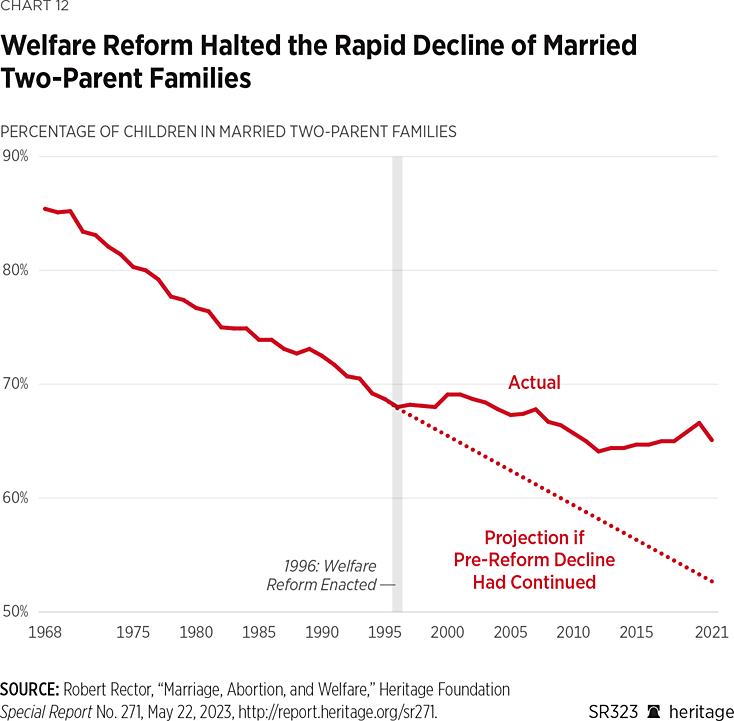
Reform Halted the Growth in Non-Marital Births and Pregnancies. Non-marital births as a share of all births began to rise by about 1 percent each year almost as soon as the permissive welfare system was in place in the late 1960s. This alarming trend persisted until the early 1990s. The non-marital birth rate more than doubled in the three decades before welfare reform, rising from around 20 per 1,000 women in 1960 to 30 per 1,000 in 1980, and then exploded upward in the next decade, reaching 45 births per 1,000 in 1990.
With the onset of welfare reform, the trend line abruptly shifted and has remained relatively flat for 30 years. (See Chart 13.)
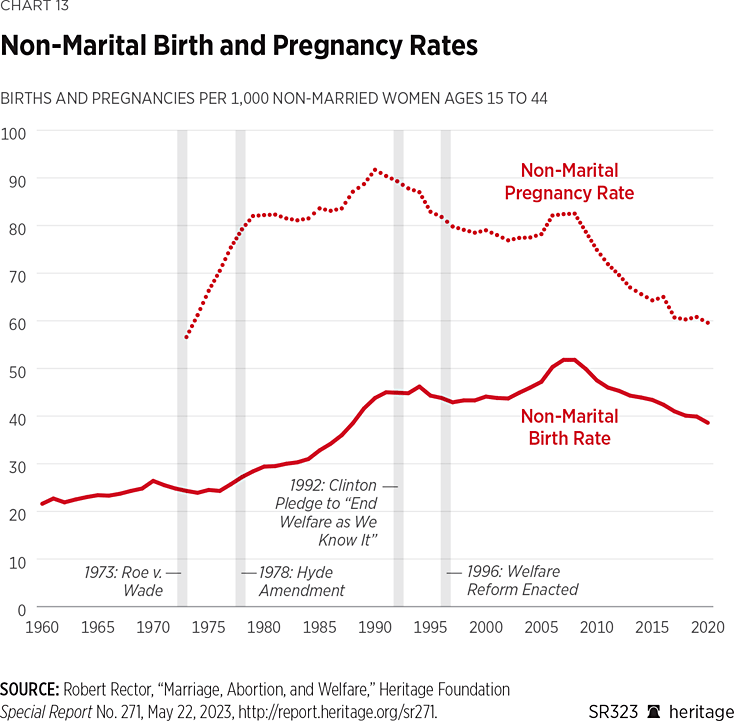
During welfare reform, some suggested that by cutting welfare benefits and enrollments and placing onerous new requirements on single mothers, it would increase abortions among non-married women. But Chart 13 shows that exactly the opposite happened: The non-marital pregnancy rate falls more rapidly than the non-marital birth rate. The shrinking gap between the two lines represents a steady decline in the non-marital abortion rate.
The onset of welfare reform coincided not only with a halt in the rise of the non-marital birth rate, but also with an abrupt fall in the non-marital pregnancy rate. Before welfare, the non-marital pregnancy rate had risen sharply; since reform, it has steadily fallen. Cumulatively, the combined decrease in the non-marital pregnancy rate and the share of non-marital pregnancies that ended in abortion has resulted in some 15.9 million fewer non-marital abortions.[REF]
Reform Halted the Rise in the Percentage of Children Born Outside of Marriage. Sixty percent of children in America today are born to married couples, and 40 percent are born to unmarried parents. Remarkably, one-fourth (around 900,000) of America’s children each year are born to parents who are not married but who are living together when the child is born. This means that 85 percent of children are born either to parents who are married (60 percent) or cohabiting (25 percent) at birth. Only 15 percent of children are born to mothers who live without the child’s father. (See Chart 14.)
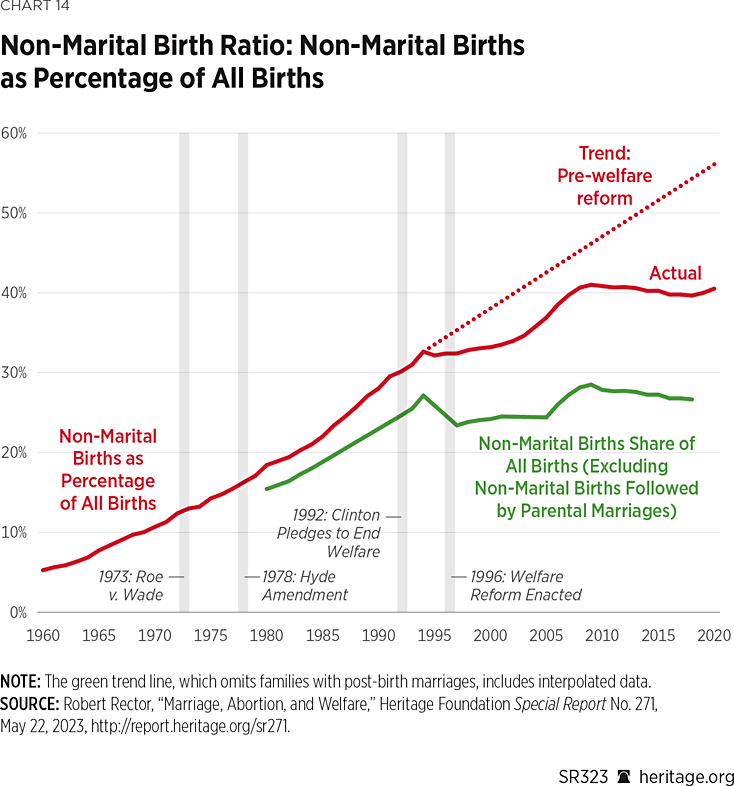
Backsliding and More Backsliding. Reform transformed the main welfare program for families with children. But it hardly touched the remaining 90 programs in the welfare state. Although long-term spending in AFDC was cut sharply, spending in the rest of the welfare state has grown fast.
For 25 years now, a model has existed for reforming the rest of the welfare system, but rather than building on the popular reform of the 1990s, conservatives largely abandoned the issue except for sporadic muttering about costs. For two decades, there have been no serious efforts to strengthen marriage or work requirements within the remaining vast welfare ecosystem.
The Left has filled the void created by the silence of moderates and conservatives. For two decades, congressional Democrats have steadily pushed to overturn welfare reform and have dramatically expanded the anti-marriage, anti-work welfare state.
The current means-tested welfare system contains more than 90 programs providing cash, food, housing, medical care, and social services to poor and low-income Americans (and, too often, non-Americans). In FY 2024, federal and state governments spent $1.68 trillion on means-tested welfare. Around $750 billion of this went to lower-income households with children.[REF]
President Biden’s 2021 proposals were hostile to work and marriage. He sought to vastly expand the welfare state with a focus on pumping new cash benefits to non-working single parents. The plan would have provided the largest single-year surge in means-tested welfare spending in U.S. history, adding some $836 billion over the following five years.[REF] Having ignored welfare for decades, conservatives were caught off balance. President Biden’s welfare spendathon came two votes short of final passage in the Senate.
Reform proponents must do more than complain that welfare is wasteful—though it is. They need to make a sustained case against it and in favor of a radical overhaul.
As suggested above, the means-tested welfare and support system for poor and lower-income families with children has four endemic problems:
Anti-Marriage Bias. The welfare system has made marriage economically irrational for many low-income couples. Nearly all the cash, food, and housing programs focus on subsidizing non-married single parents with the greatest benefits aimed at those who do not work. Moreover, all the programs impose severe financial penalties on parents who choose to marry.
These penalties exist because welfare benefits are directly based on the joint income within a household. The welfare state operates like the income tax would if it lacked the category of “married filing jointly.”
If a single mother marries an employed father, the family’s measured joint income will rise sharply; the earnings of the father will be applied to the mother’s welfare eligibility, and benefits will be cut sharply or eliminated entirely. This creates a considerable financial incentive not to marry. All welfare programs have substantial marriage penalties that, taken together, can represent a large share of the parents’ total economic resources. The threat of loss of a comparatively large pool of assistance can provide a substantial disincentive for parental marriage.
Take, for example, a single mother with one school-age child and one younger child. The mother has annual earnings of $20,000, and the father of the children has annual earnings of $30,000. The parents are not married. The father may live separately, or he may cohabit with the mother and children; in either case, his presence and income would not generally be reported to the welfare agencies; he would remain “off the books” for purposes of determining the welfare benefits paid to the mother.
If unmarried, the combined post-tax resources of the mother and father including welfare would be $81,279. If the mother married the father, the father’s earnings would be “on the books” and would be used to determine the family’s overall welfare benefits. Food stamp benefits would be eliminated; other benefits would generally be cut or eliminated. Altogether, the effect would be strongly negative: Marriage would cut the parents’ combined resources from $81,279 to $66,200. The effective marriage penalty would be $15,709 or 30 percent of the parents’ combined pre-tax earnings.
Such marriage penalties are perverse. Marriage is one of the surest paths out of poverty and dependence and improves the well-being of adults, children, and society. But the War on Poverty in effect wages war on marriage.
Supports Idleness, Undermines Work. Work is another critical path out of poverty and toward overall well-being. Welfare reform in the 1990s showed that requiring work from able-bodied single parents did not increase abortion as critics had predicted, but it did strengthen marriage and reduce the number of single-parent families.[REF] Although the welfare system has been nominally pro-work since welfare reform, this has become sporadic and largely symbolic. Even programs that do have clear work requirements, such as TANF and the EITC, have spacious loopholes,[REF] and leftwing activists push to remove even those and restore work-free welfare to single parents.
Conceals the Size of Welfare Spending and Benefits. Most lower-income families on welfare receive benefits from several programs at the same time, but the press and decision-makers treat the system one program at a time. As a result, the system looks far smaller than it really is. The congressional subcommittee system ensures that each program is examined in isolation while the vast multiprogram structure hides in the shadows. This is like inspecting the jumbled pieces of a jigsaw puzzle one at a time but never putting the pieces together to see the whole picture.
In addition, each program has complex rules, and the interactions between programs are equally challenging. In consequence, even specialists in the field find it hard to analyze and explain the combined benefits that families receive. Actual benefits are far higher than the public and decision-makers imagine.
To make matters worse, the government’s official poverty report, issued annually by the Census Bureau, ignores almost the entire welfare system when determining whether a family is poor. Programs that are deliberately excluded from this report include cash grants from the EITC and Additional Child Tax Credit (ACTC); all food stamp benefits; Special Supplemental Nutrition Program for Women, Infants, and Children (WIC) benefits; child nutrition aid; Section 8 housing vouchers; public housing aid; energy assistance; Medicaid; the Children’s Health Insurance Program (CHIP); and all Affordable Care Act subsidies.
In the two included means-tested cash aid programs—Supplemental Security Income (SSI) and TANF—benefits are consistently underreported. When it comes to defining and measuring poverty, incomes, and inequality, the government’s official poverty report treats nearly the entire means-tested welfare system as “off the books.” In 2018, of a total of $527.5 billion spent on means-tested benefits for families with children, the Census counted only $14.1 billion (2.5 percent) as “income” when measuring official poverty.
Bias Toward Increasing Spending and Benefits. As noted, the welfare and support system has dozens of overlapping cash, food, housing, and medical programs. Analysis invariably focuses on single programs in isolation, creating the impression that the program is the only thing standing between the family and deprivation. Official reports almost always omit, underreport, or misreport both earnings and benefits. Consequently, a de facto invisibility cloak has been placed around the welfare state. The result? Much of the public and many policymakers imagine that the U.S. has a meager welfare system.
In fact, in 2018, before the COVID-19 crisis, the average family with children identified as “poor” by the government received around $21,000 in cash, food, and housing aid and another $17,000 in medical benefits. When these benefits were combined with family earnings, that family’s total resources rose to around $55,000 per year.
Now Is the Time to Revive and Expand Reform. To fully reform the perverse incentives of the welfare system, policymakers should pursue three broad goals:
- Strengthen and encourage marriage.
- Strengthen work requirements and provide more targeted and efficient work incentives.
- Alter welfare programs to provide more accurate information on spending that the public can easily grasp.
These themes complement each other: For instance, imposing work requirements on a single parent might seem callous, but the results prove they are not. Their effects are beneficial precisely because they reduce the value of welfare for single parents relative to the presence of fathers and marriage. This is why welfare reform in the 1990s helped marriages and reduced non-marital pregnancy rates.
Recommendations for Congress
Congress should redesign welfare benefits to promote work and marriage, and structure them so that the public can grasp their cost and resist leftwing efforts to expand them. This, in turn, will encourage more marriage and self-support.
Specifically, Congress should:
Redesign the Welfare System to Remove or Sharply Reduce Marriage Penalties. If a single mother marries today, her family welfare benefits are drastically reduced. Traditional welfare benefits—by design—discourage marriage for low-income parents. Eliminating these penalties across the nearly 90 means-tested programs would reverse this perverse incentive and thereby boost marriage among low-income couples, create financial and emotional stability for parents and their children, and reduce long-term dependence on government welfare programs. Because low-income parents usually receive benefits from multiple programs at the same time, welfare reform should be pursued holistically rather than piecemeal in 90 separate programs.
Polls show that the public strongly supports removing marriage penalties within the welfare state. Some 82 percent of the public agree that the “welfare system should not penalize parents when they get married.”[REF] Reducing marriage penalties would profoundly increase marriage rates. One study finds that reducing the marriage penalty in the EITC by $1,000 would increase the marriage rate among low-income women by 10 percent.[REF]
Government can reduce welfare marriage penalties without adding costs to taxpayers by eliminating widespread fraud, waste, and excess benefits within the system, as described below.
Strengthen and Enforce Work Requirements in Welfare Programs. Nearly all Americans believe that able-bodied people should work if they receive government benefits.[REF] Yet, most means-tested welfare programs enroll millions of adults who can, and choose not to, work. Congress should strengthen work requirements for non-elderly, able-bodied adults who receive TANF. It should do the same for public housing and food stamps. And it should eliminate loopholes in the EITC that enable recipients to evade work. All of this is consistent with protecting families with at least one parent who works from poverty.
Radically Restructure Existing Welfare Programs with Pro-Marriage, Pro-Family Reforms. The U.S. spends $1.68 trillion a year on means-tested welfare assistance; of this, around $750 billion goes to families with children with a predominant focus on single-parent families. Congress should radically restructure and simplify the scores of welfare programs so that they encourage good behavior and support the well-being of the family. This will also make the actual value of benefits obvious and transparent to the public and to recipients.
Limit Fraudulent, Unnecessary, or Counter-Productive Future Welfare Spending. The government could save billions of taxpayer dollars by genuinely eliminating fraud, waste, and excessive benefits. Although the reasons for eliminating fraud and waste in welfare are obvious, they remain pervasive problems.
Fraud is rampant in many programs, such as the EITC.[REF] According to IRS data, 14.6 million single unmarried tax filers received the EITC for dependent children in 2017, the last year of available data.[REF] But, according to Census data, there were only 11.67 million actual non-married, single-parent families with children in the home in the whole population in 2017.[REF] Moreover, roughly 2 million of those actual single-parent families would have had incomes too high to be eligible for the EITC. Another 2.5 million of the parents told the Census that they were out of the labor force, which means they were likely not eligible for the EITC. Thus, only 6 million or 7 million single working parents were likely eligible to claim the EITC for children—while 14.7 million single tax filers received it.[REF]
Eliminate Excessive Stacking of Welfare Benefits. As for cutting “excess benefits,” this largely refers to the excess benefits that single parents can receive by stacking multiple benefits on top of each other, particularly Section 8 and public housing.
A common example is a single parent, typically a mother, with two children who earns $20,000 per year. This mother will receive the usual welfare package of food stamps, child nutrition, EITC, ACTC, and Medicaid worth about $34,000 per year. If she also receives housing subsidies (average net cost of $12,648), the total would be around $46,500 on top of her wages. Childcare subsidies could add another $12,000 per year. Total resources in the family could reach more than $75,000 per year. But for purposes of ordinary government statistics, the family would be reported as having an income of $20,000 and living in poverty.
This is clearly an example of “excess benefits.” Such uses should be limited to a sensible maximum overall benefit to break the cycle of dependence.
Strengthening marriage would greatly improve the social well-being of poor adults and children and boost the economy. And, married women are more than twice as likely to have children as non-married women. Boosting the marriage rate, then, will not only reduce child poverty and abortion. It will increase the overall married birth rate.
Restoring the American Dream: A Healthy American Economy for a Healthy American Family
Economic Dynamism Fuels National Optimism. Over the past two centuries, historic economic growth in the developed world has corresponded with a historic decline in fertility. And even today, fertility rates are higher in low-income countries than in high-income ones. Does this mean that economic growth and optimism do not affect fertility? No.
As noted, at least some of this decline in fertility is the result, not of wealth per se, but of changing incentives and opportunity costs. In the past two centuries, the United States and the rest of the developed world moved from agricultural to industrial to high-tech economies. The value of family labor has diminished and mortality among infants has plunged.[REF] Contraception is cheap and ubiquitous.[REF] And nearly all people have far higher opportunity costs—that is, valued alternatives to marriage and childbirth—than did their counterparts one or two centuries ago.
It is not possible to rewind two centuries of history, so when seeking solutions to the U.S. birth dearth, one should use modern developed countries as comparators. How do such countries compare to each other? Although the effects are modest, it turns out that more economic freedom and more vibrant economies are associated with higher fertility rates.
Among the 38 countries in the OECD, the average TFR was even lower at 1.5 (as of 2024).[REF] Israel is the only developed country with a fertility rate above 2.0 (and decidedly so at about 3.0).[REF]
Fertility rates tend to be higher in less-developed countries, but as nations industrialize, several factors conspire to reduce birth rates.[REF] These include the proliferation of birth control, more prospects for women to receive higher education and work outside the home, the delayed financial independence of young adults, and the government’s role in old-age Social Security.[REF]
As countries develop, fertility rates drop, often precipitously, but then start to level off and settle into a more gradual decline.[REF] The near universality of very low fertility rates among a diversity of developed countries suggests that mere economic policy is not likely to solve the problem. Still, the results below do suggest that after the universal decline during industrialization, government growth hinders work and prosperity, which in turn acts as a drag on family growth.
The U.S. fertility rate first fell (briefly) to near replacement levels during the Great Depression.[REF] From the end of World War II until about 1960, however, America experienced a baby boom within married families. Unlike the bleak Depression years, Americans after the war were optimistic about the future and felt a national sense of purpose. This seemed to inspire many millions of them to bring new life into the world.[REF]
The 1960s were far more volatile. They were marked by riots, political assassinations, the explosion of birth control, and the sexual revolution. In that decade, family life became more fragile, and birth rates plummeted from about 3.7 births per woman to 2.5.[REF] The 1970s were marked by more instability. The U.S. abandoned the last remnants of the gold standard, experienced raging inflation, oil embargos, price controls, gas lines, and multiple recessions. Between 1975 and 1985, the total fertility rate hovered around 1.8.[REF]
In the second half of the 1980s, inflation was tamed, the economy boomed, the strength of America’s Cold War adversary seemed to wane, and President Ronald Reagan’s Morning in America vision was widely shared. By the end of the decade, birth rates had climbed back above 2.0, where they stayed for most of the next 20 years.[REF]
A fertility rate above 2.0 is exceptional for a post-industrialized country. The economic renaissance of the 1980s, the end of the Cold War, stable prices, and even a few balanced budgets gave Americans reasons for hope about the future—even though the foundations of the family were slowly crumbling in law and culture. These levels persisted during the post-Cold War 1990s and for much of the first decade of the 21st century.[REF]
Since 2008, however, the U.S. has experienced metastatic growth of the regulatory state, a financial crisis, meager growth, worsening race relations, ever more chronic disease, the mishandled COVID-19 pandemic, government lockdowns, out-of-control spending, soaring deficits, and 40-year-high inflation. Since 2014, even life expectancy has started to decline. During this period of declining growth and rising pessimism, fertility fell from a high of 2.12 in 2007 to approximately 1.6 in 2023.[REF]
Since 1979, Gallup has asked Americans if they are satisfied with how things are going in the United States. As Chart 15 shows, the U.S. fertility rate has risen and fallen with the moving average of the national mood.[REF]
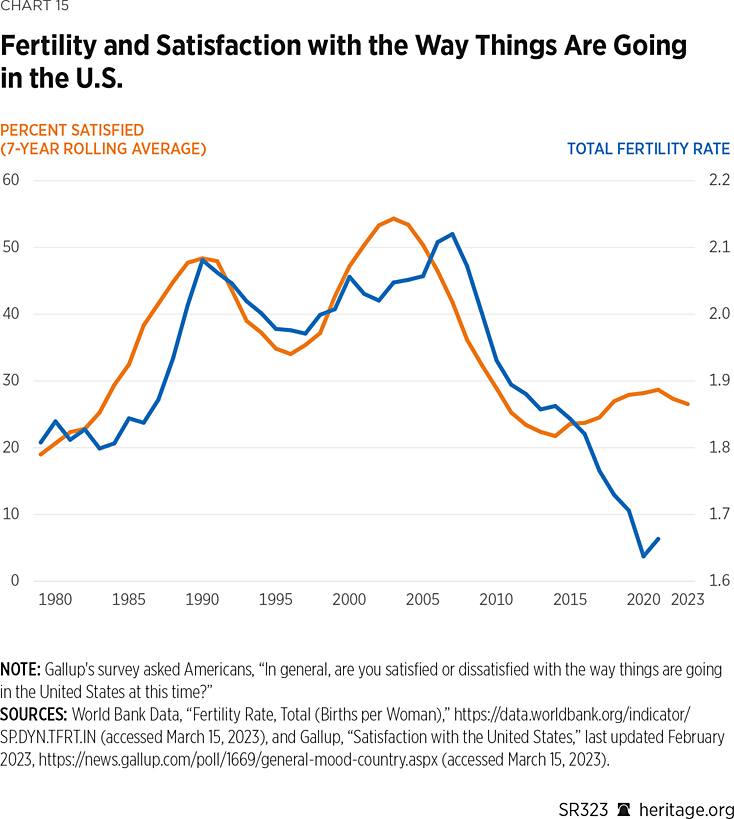
Fertility Rates by State. Map 1 shows the general fertility rate of states for the 2018–2020 period, based on U.S. Centers for Disease Control and Prevention (CDC) data.
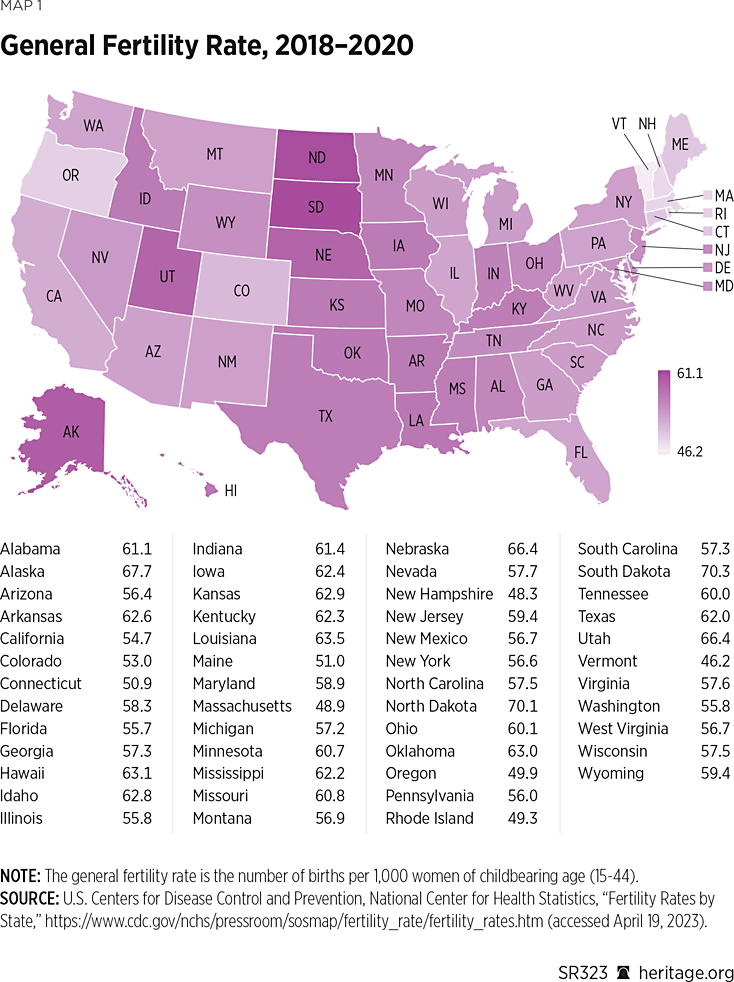
The shift from an agricultural to an advanced economy is everywhere marked by a decline in fertility.[REF] Still, within developed countries, such as the United States, prosperity and optimism seem to lead to higher levels of fertility.
A Technical Analysis of Fertility Drivers. Clearly, the economy is only one part of the fertility puzzle for any country. Differences in culture, religion, and demographics each play a role. But how much of a role? Using proven statistical tools and analysis, one can detect a link between the economy and fertility rates at the national level, but is this true of individual U.S. states?
Following is an examination of the hypothesis that birth rates are higher in states with vibrant economies where work is the norm and where a typical salary allows for relative prosperity.[REF] This report’s authors estimate the following ordinary linear least squares regression of state fertility rates as a function of labor supplied per adult, business activity, and housing affordability (relative to income). Since these measures may account for some but not all of a state’s fertility rate, controls are added for culture, population density, and demographics.
Fertility = B0 + B1(Labor) + B2Ln(Business Activity) + B3(Housing Affordability) + B4(Culture) + B5Ln(Pop Density) + B6(Demographics)
The three economic variables summarize the state of the economy, capturing a measure of labor, the quantity and productivity of capital, and prices relative to income. The economic measures are averages for the 2015–2019 period, while fertility was measured for the somewhat later 2018–2020 period. Table 1 shows the results of these state-level regressions, where:
- Fertility is the general fertility rate (the number of births per year per 1,000 women aged 15 to 44).[REF]
- Labor is the average number of hours worked per week per adult resident aged 16 to 64.[REF]
- Business Activity is the per capita gross operating surplus for private industries in the state. This includes the total profits, rents, and interest income earned by businesses and proprietors in the state.[REF]
- Housing Affordability is based on the Atlanta Federal Reserve Bank’s Home Ownership Affordability Monitor Index, which has a value greater than 100.0 if the median area income is sufficient to afford the median area home, factoring in home prices, taxes, insurance, and interest rates.[REF]
- Culture includes measures that capture the social value placed on having children. The Culture measures used include Percent Attending Church Weekly and Abortions Performed per Capita.[REF]
- Pop Density is the population divided by the state’s land area in square miles.[REF]
- Demographics is a control for differences in fertility rates by race and ethnicity.[REF]
The coefficients in Table 1 suggest that all else being equal, each additional hour of weekly labor per working-age adult in a state is associated with general fertility rates that are higher by about 0.74 births per 1,000 women of childbearing age (compared to a median of about 58.6 births per 1,000 women).[REF]
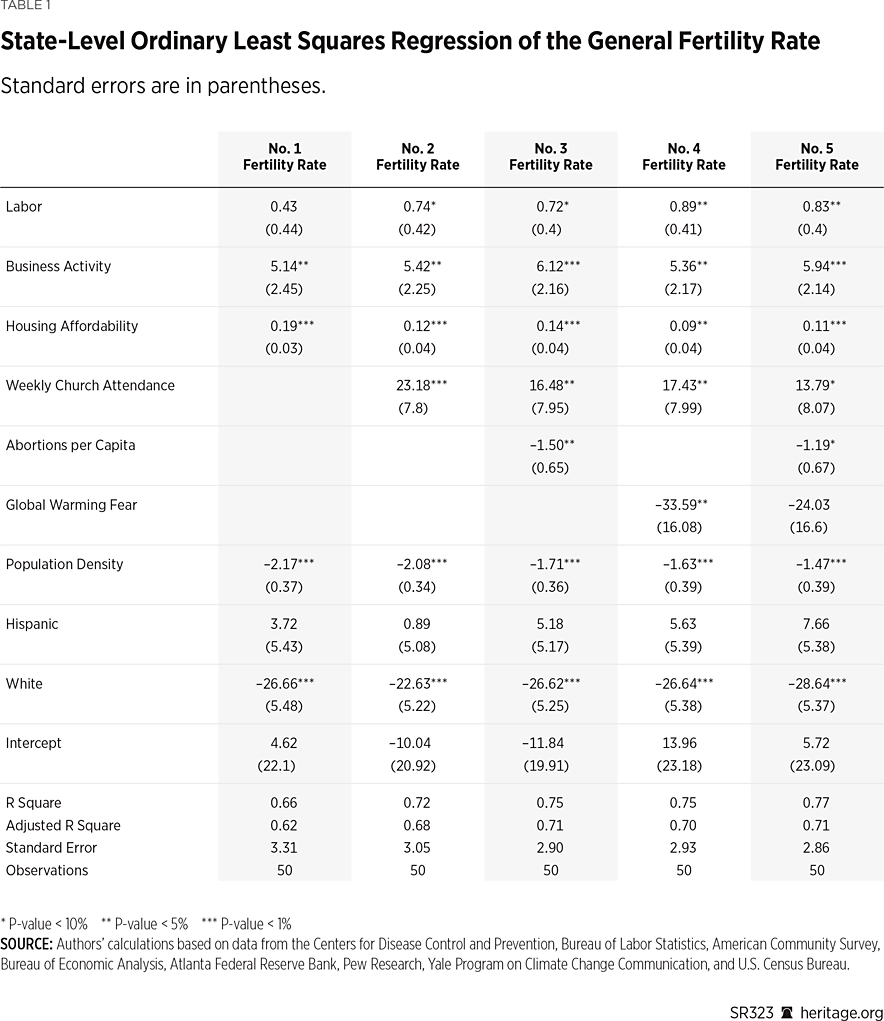
In other words, a one standard deviation increase in Labor is associated with roughly 1.1 percent more births per 1,000 women. This positive relationship between work and fertility at the state level may be counterintuitive. After all, for an individual family, the birth of a child often leads to a parent leaving the workforce for a few months or for many years. But this treats work as if it is an isolated, static variable. In fact, working puts people on an upward trajectory in life, gives them a sense of purpose and stability, and instills confidence that they can provide for their children.[REF]
According to the regression, a 10 percent increase in Business Activity in a state is associated with general fertility rates that are higher by about 0.61 births per 1,000 women of childbearing age, all else being equal.[REF] Stated differently, a one standard deviation increase in Business Activity is associated with roughly 1.5 percent more births per 1,000 women.
States that foster a strong business climate also indirectly support the formation of families. Thriving businesses mean more good jobs that make it easier to raise a family on a single income. If both parents need or choose to work, a strong business climate makes it easier for both parents to find suitable work. Finally, vibrant business helps fuel optimism about future financial security.
The model also suggests that a 10 percent rise in median housing costs (inclusive of taxes, interest, and insurance costs) relative to median household income is associated with fertility rates that are lower by about 1.3 births per 1,000 women.[REF] Stated differently, a one standard deviation increase in Housing Affordability is linked with about 2.4 percent more births per 1,000 women.[REF]
Housing is by far the largest single expense for most families. It takes up more than one-third of the typical family’s budget, and the cost of housing varies widely from place to place.[REF] Housing becomes unaffordable as its cost rises relative to people’s income and can hinder saving for and buying a home or buying a larger one. This, in turn, can discourage people from starting or growing their family.
One should not over-interpret the precise size of the effects of Labor, Business Activity, and Housing Affordability on Fertility since the state-level regressions use only 50 observations. Interactions between the variables make it hard to interpret individual coefficients. (Labor and Business Activity are positively correlated, while Business Activity and Housing Affordability are negatively correlated.) The regression does suggest, however, that economic factors explain a fair amount of the cross-state variation in fertility rates despite a generally universally declining trend through time.[REF]
Economic Policies that Support Family Formation. Potential parents care about a strong and growing economy when pondering whether to bring new life into the world. Policies that support a culture of work, promote stable prices, reduce the risk of fiscal and financial calamity, make it easier to own a home and build wealth, and allow businesses to better compete and innovate can help to enhance economic flourishing and national optimism.
High inflation can not only devastate the economy but also make it harder for families to form and grow. The U.S. abandoned the gold standard in 1971, and the lack of convertibility of dollars to gold since then has facilitated reckless money printing and irresponsible federal spending, leading to bouts of high inflation in the 1970s, early 1980s, and the 2020s.[REF] Families rely on the dollar as a store of wealth, so the Federal Reserve must restore sound money and price stability.[REF] While many monetary rules have been proposed, the system with a proven record track record of success and stable prices is full convertibility to gold.[REF]
The federal debt threatens the prospects for sound money. Current budget forecasts are extremely bleak. The Federal Reserve has a track record of accommodating bouts of irresponsible federal spending by buying up trillions of dollars of newly issued U.S. debt. If the Treasury Department struggles to attract creditors to purchase multiple trillion dollars of new debt each year, the Federal Reserve is likely to step in to buy the debt, devaluing the currency. Thus, if Congress fails to get its fiscal house in order, it threatens families with more inflation, not to mention a greater risk of a devastating financial or debt crisis.
Recent years of misguided fiscal and monetary policy have contributed to a housing affordability crisis that is putting the American Dream of home ownership out of reach for many young Americans. This matters: Many Americans associate home ownership with starting a family.[REF]
The main drivers of rising real estate prices nationally are government subsidies and government guarantees through government-sponsored enterprises (GSEs)—namely, Fannie Mae and Freddie Mac.[REF] Investors who purchase GSE bonds and mortgage-backed securities (MBSs) know that taxpayers will make good on promised cash flows if either Fannie or Freddie were to fail again. This leads to riskier lending. At the federal level, lawmakers should fully privatize Fannie Mae and Freddie Mac. The Federal Reserve should stop purchasing MBSs and shrink its existing MBS portfolio. At the local level, rent control and stringent zoning restrictions should be eliminated to allow the housing supply to grow and housing costs to fall.
For Americans living paycheck to paycheck, the prospect of supporting another child can be daunting. The ability of families to build wealth depends in large part on thriving, dynamic American businesses competing and innovating. Excessive government interventions, such as regulations, taxes, and subsidies, stunt innovation and make Americans poorer.[REF] Instead, Congress should enact flexible universal savings accounts that allow Americans to invest at least $10,000 per year in after-tax dollars with gains exempt from further taxation; reduce capital gains taxes or allow taxpayers to index capital gains for inflation; end crony capitalism subsidies for green energy; and end punitive tax treatment for capital investments and research and development.
The Great Recession and COVID-19: Economic Shocks as Natural Experiments. Major economic shocks in the past 15 years have provided real-world tests of how financial stress and cost-of-living changes affect family formation. The Great Recession (2007–2009) saw severe housing market disruption, job losses, and a sharp pullback in fertility, which closely tracked the drop in per capita income.[REF]
U.S. births declined by roughly 4 percent from 2007 to 2009, ending what had been a period of stable birth rates. The drop was heavily concentrated among young adults: Women ages 20 to 24 saw the largest fertility declines, while women over 40 actually experienced a slight increase in births as some delayed pregnancies could not be postponed further.[REF]
There were also disproportionate declines among Hispanic women (who had been the group with the highest birth rate), reflecting the acute economic hit to Hispanic communities during the housing bust.[REF] Analyses attribute these patterns to economic insecurity—high unemployment, falling household wealth, and tightened credit—which led many to delay marriage or childbearing. Indeed, states that experienced the deepest job losses and foreclosure crises generally saw the biggest fertility declines post-2008.[REF]
Moreover, marriage rates fell and the share of young adults living with parents jumped, as coping mechanisms for high living costs and poor job prospects.[REF] The Great Recession’s impact was not just cyclical but seemingly persistent: U.S. fertility kept falling throughout the 2010s even as the economy recovered, suggesting some births were permanently foregone.
The COVID-19 pandemic (2020–2021) similarly disrupted family demographics, though in a shorter-term pattern.[REF] Early in the pandemic, uncertainty and lockdowns led to a “baby bust” of roughly 100,000 fewer births in 2020 than pre-pandemic trends would have predicted.[REF]
Significantly, the rebound was strongest in areas where job markets and household incomes recovered most quickly—despite ongoing COVID cases—highlighting the role of a strong economy or economic confidence in fertility decisions.[REF] By 2022, U.S. birth counts had settled back below 2019 levels, resuming the pre-pandemic downward trajectory (albeit at a possibly slower decline than that seen after 2008).
The pandemic initially caused a drop in weddings (many were postponed in 2020) followed by a catch-up surge in late 2021 and 2022. Throughout both the Great Recession and COVID shock, young adults adjusted family formation plans in response to perceived economic security: When jobs, income, and housing stability were threatened, many delayed marrying or having children, and when stimulus or recovery improved household finances, some of those plans proceeded.
Encouraging Work and Flexibility Helps Families. Work is one of the main ways that people create value. It can also connect them and give them meaning and fulfillment. Work provides people with financial stability. Work makes adults—and men in particular—more attractive partners and thus more likely to get married. Rising income that reflects genuine value creation can help people feel secure enough to start a family.
At the same time, work creates demands that make it harder to spend time with and raise a family. And the greater one’s income potential, the greater the opportunity cost one must accept to focus on one’s family. This is why flexibility in work, especially for women, is so valuable: It makes it easier for parents to negotiate the competing demands of work and family.
Among middle-income and lower-income young men, however, a decline in work over the past two decades has almost certainly contributed to a decline in marriage and fertility.[REF] Between 1999 and 2018, the percentage of men ages 16 to 24 who were employed fell by 10.9 points.[REF] The pandemic likely exacerbated this trend such that by 2022, 14 percent of 25-year-old Millennials were not even in the labor force (meaning neither employed nor looking for work) compared to 7 percent for male baby boomers when they were 25.[REF] This drop in labor force participation cannot be blamed on young men going to college because male enrollment has declined significantly both overall and compared to the number of high school graduates since 2011.[REF]
Instead, there seems to be a surge in idleness, fed by bad welfare incentives, foolish policy responses to the COVID-19 crisis, and a corrosive culture addicted to tech distractions. For example, researchers estimate that the Great Recession caused 400,000 extra workers to turn to a lifetime of disability insurance benefits instead of work.[REF] A litany of welfare-without-work programs initiated during the pandemic encouraged idleness over work, especially among young, single workers without dependents. This included 18 months of bonus unemployment insurance benefits, a permanent spike in the use of food stamps, expansions in Obamacare subsidies, and a three-year pause in student loan repayments.[REF] All this, combined with the recent surge in housing costs, fed by excessive government spending, has made it harder for younger workers to buy homes. A strong culture of work requires that it be easier and more rewarding to work and hard and unfulfilling not to do so. Ultimately, neither workers nor those whose idleness they are forced to subsidize benefit from this relationship.[REF]
Meanwhile, technology and social turmoil have changed what people do instead of working. A study by Mark Aguiar and others attributed the rise in recreational video game and computer use to a 1.5 percent to 3 percent decline in labor market hours of young men between 2000 and 2015.[REF] Increased drug use and addiction have also shrunk the labor market. A study by Alan Krueger found that opioid prescriptions could account for a 1.4 percentage point drop in men in the labor force between 1999 and 2015.[REF]
At the same time, young women’s employment has not changed much since 2000,[REF] but changes in women’s education and career goals have affected marriage and fertility. If women view marriage and children as disrupting their careers or straining their finances, they may forgo or delay marriage and choose not to have children or to have fewer than they would otherwise.[REF] Women now make up just over 47 percent of the labor force.[REF] This greater female workforce participation has put downward pressure on fertility, while on the flip side of the coin, lower fertility can be said to have put upward pressure on workforce participation.[REF] There is good evidence, however, that flexible work conditions support family formation, especially mothers, who must negotiate time spent on employed work versus bearing and nursing infants, as well as higher overall preferences for spending time raising young children.[REF]
But work and family are not simple substitutes; they can—and do—coexist. Thus, any plan to encourage family formation should make it easier to balance work and family. A 2018 poll by the Cato Institute found that parents prize workplace flexibility, with 58 percent saying that flexible work schedules, remote work, and part-time work would be the best way to help them balance work and family.[REF] (See Chart 16.) A McKinsey & Company study found that employees without children are three times more likely to prefer 100 percent on-site work than workers with young children.[REF]
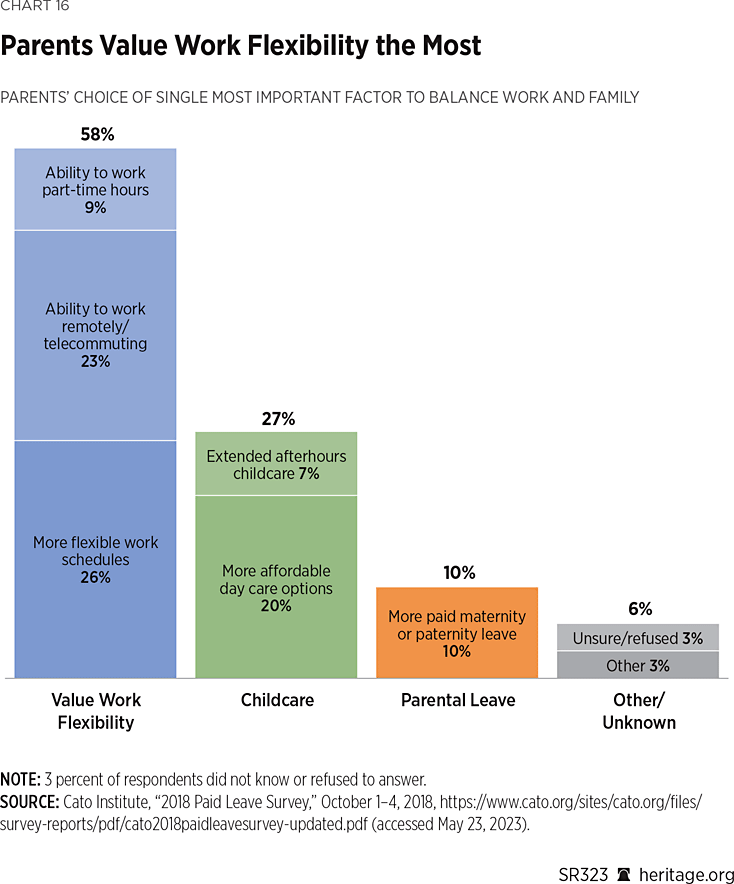
Similarly, a 2021 poll that asked parents about their preferences for childcare found that the top choice, accounting for 31 percent of parents, was to have both parents work flexible jobs and share childcare duties.[REF](See Chart 17.)
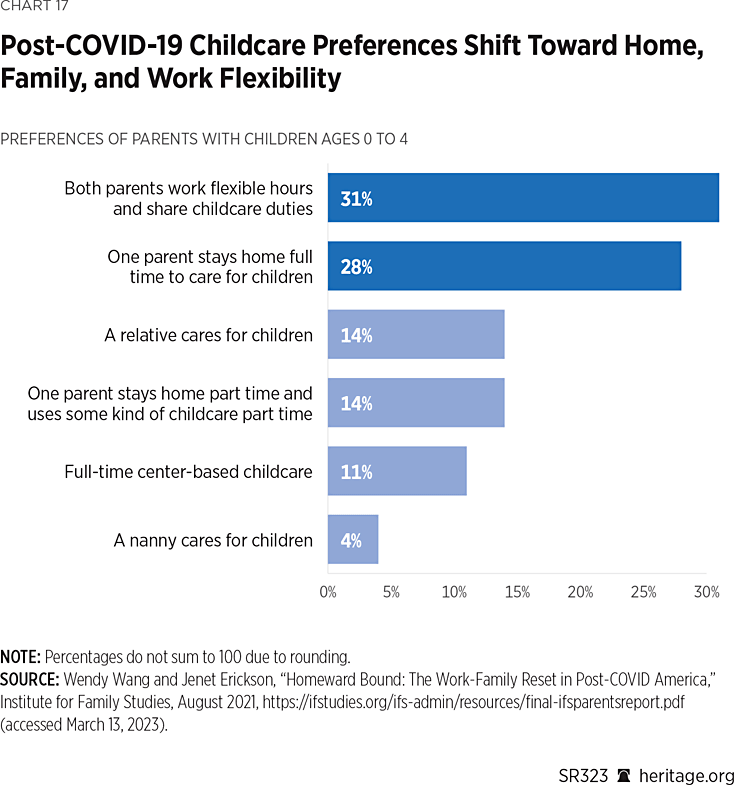
The COVID-19 lockdowns forced millions of Americans, and the companies they work for, to tap new technologies that allow remote work. Economists have detected a silver lining in this massive COVID disruption: Remote work seems to help families grow, presumably because it gives them more flexibility and more time together.[REF]
A recent surge in flexible, independent work options has expanded work prospects for the unemployed and the employed.[REF] Workers who switched from traditional to independent or “gig” work report greater work-life balance, less stress, and better health, with the same or higher incomes as traditional employment.[REF] All of this makes it easier for people to have the families they desire.[REF]
Quality broadband access[REF] is also key for married couples looking to expand their families. According to analysis by Lyman Stone and Adam Ozimek, women with two or more children who engage in remote work intend to have more children than single women and women with one or no children who do not engage in remote work.[REF] This trend was borne out during the COVID-19 lockdowns when fertility rates went up for married couples with at least one child.
Remote work is usually digitizable work. So, it’s no surprise that a 2017 study by the IZA Institute of Labor Economics found that broadband access boosts childbirth by 9.3 percent.[REF] Researchers attributed this increase to stable Internet connectivity that allowed women to work remotely.[REF]
Many government policies move against work and workplace flexibility, however. They hinder it through excessive regulations and high taxes, while enabling idleness through welfare-without-work programs. For instance, a finalized rule from the Biden Administration’s Department of Labor restricted flexible work and limited the incomes of millions of workers.[REF] A similar policy in California was associated with a 10.5 percent decline in self-employment and a 4.4 percent decline in total employment.[REF]
This report has already mentioned some policies to foster a strong work culture for boosting the formation of families, such as making welfare work oriented. Utah’s “One Door” model provides one example of this.[REF] In addition, state and federal policymakers should:
- Protect independent work by codifying a bright-line test, consistent across federal law, for determining who is an employee and who is an independent contractor. The 21st Century Worker Act would establish such a test.[REF]
- End the government monopoly on registered apprenticeships. The Apprenticeship Freedom Act[REF] and Training America’s Workforce Act[REF] would allow more young Americans to benefit from on-the-job, paid education leading to a successful career.
- Review and eliminate needless occupational licensure laws so that people can pursue jobs like bartending, arranging flowers, and braiding hair without paying hefty fees and attending hundreds of hours of training.[REF]
- Eliminate barriers to parents accessing the childcare arrangements they prefer.[REF]
- Remove barriers to work flexibility, including increasing access to paid family leave through the Working Families Flexibility Act.[REF]
- Protect workers’ voices and enable flexible work innovations. The Employee Rights Act includes many provisions to protect workers’ ability to work in the ways that are best for them.[REF]
Housing Affordability and Family Growth
Marriage and fertility rates in the United States have declined markedly in recent decades, coinciding with rising housing costs and broader cost-of-living pressures.[REF]
According to the general fertility model discussed above, a 10 percent rise in median housing costs relative to median household income is associated with fertility rates that are 2.4 percent lower (in terms of births per 1,000 women).
There is now a large body of empirical research that supports a causal link. Multiple studies find that expensive housing markets and high living costs correspond with lower fertility, particularly among those who do not own homes.[REF] A panel data analysis of U.S. metropolitan areas estimated the effect of housing price shocks on birth rates, finding that a 10 percent increase in home prices leads to a 1 percent decrease in births among non-owners,[REF] which are overrepresented by people who are young, not married, and childless.
Evidence outside the United States is consistent with these results. Using Australian panel data, one study found that housing price gains increase births among homeowners but reduce fertility intentions for private renters with sharp heterogeneity by tenure.[REF] Cross-country analyses further find that a 10 percent rise in real house prices reduces fertility by roughly 0.01 to 0.03 births per woman (a 0.03 drop if applied in the U.S. would be an approximately 1.9 percent reduction in total fertility).[REF]
High housing costs appear to influence not only if but also when people have children. Using a sample of 25 major U.S. metro areas, research has found that living in a high-priced housing market delays the age at first birth by roughly 3.5 years on average, after controlling for education and other factors.[REF]
Differential impacts by location and living situation are pronounced. Urban, high-density communities consistently have lower fertility rates than rural areas, even after accounting for demographics.[REF] Women residing in the least dense parts of the country in recent years averaged about 1.85 children to 1.95 children, versus 1.65 to 1.85 in the most urbanized areas, controlling for the usual factors (such as income and education).[REF] Limited space and high rents in big cities likely widen this gap. Within metropolitan areas, housing characteristics matter: Women living in crowded or small dwellings have significantly fewer babies on average than those in more spacious housing. In addition, women in one-to-two-bedroom homes had very low fertility (around 1.28 children), whereas those in three-bedroom houses were near replacement level (around 1.9 children to 2.0 children).[REF]
Rising housing costs and other living expenses have also been implicated in Americans’ retreat from marriage, particularly for younger adults of lower socioeconomic status. Marriage has increasingly become a luxury of the affluent: By 2023, about 85 percent of U.S. homeowners aged 30 to 50 had married at least once, compared to only approximately 65 percent of renters.[REF]
Declines in marriage have been steepest among those without college degrees and those facing economic insecurity. The economic preconditions for marriage have changed—stable jobs, savings, and the ability to afford housing are now seen as prerequisites for marriage by many couples. High rents and home prices can thus price out young adults from independent living and marriage. Young adults in less affordable housing markets are significantly less likely to marry (and more likely to live with parents).[REF]
Considering that a near record high (18 percent) of adults aged 18 to 24 currently live in their parents’ home, the effect on fertility may be quite pronounced.[REF]
Almost any way one looks at the issue, the net effect of higher housing costs relative to income has been fewer marriages, especially among those who cannot easily afford rent or a mortgage, such as young adults.
These findings align with the idea that access to the proverbial home with a “white picket fence” is still widely seen as a precondition for marriage in the American imagination. When homeownership is attainable, it provides economic security and a “nest” that encourages marriage and child-rearing, whereas an expensive, inaccessible housing market leaves more young adults seemingly less marriageable or less willing to take the perceived risk of family formation.
Making Home Ownership Achievable Again. With housing affordability playing an outsized role in family formation, increasing the supply of housing is of paramount importance. Easing local zoning restrictions to lower home prices is often cited as a win-win strategy, as is reducing federal permitting requirements from the Environmental Protection Agency, which regulates the notoriously expensive and time-consuming environmental impact statement (EIS) process for many land developments. This Special Report cites the Bipartisan Policy Center’s recent recommendation to categorically exclude infill housing from any EIS requirements under the National Environmental Policy Act (NEPA) as an example of the type of commonsense thinking needed to cut red tape that needlessly limits new home construction and raises costs.[REF]
The Department of Housing and Urban Development (HUD) already uses competitive grants to underwrite barrier removal through the Pathways to Removing Obstacles to Housing program; the next step is to make selected reforms threshold conditions for larger programs, such as the Community Development Block Grant (CDBG) and Home Investment Partnerships (HOME), or to award binding preference points across multiple HUD Notices of Funding Opportunities when jurisdictions have enacted and implemented reforms related to family formation based on marriage and family rates.
HUD, through its funding or regulatory power, should move beyond general incentives and make specific land-use reforms a condition of receiving major discretionary and formula funds. Jurisdictions could certify adoption and implementation of a defined “menu” of supply-enabling reforms and report outcome metrics, and agencies would verify and release funds on that basis. The menu should be clearly defined and testable and include “by-right” residential developments within transit corridors with preferences based on marriage and family rates, minimum-lot-size reductions for single-family homes, exploding time-to-permit deadlines imposed on local governments, and production targets stated as permits per 1,000 residents and as the share of new units with two or more bedrooms.
Additional zoning reforms would require jurisdictions to: (1) adopt at least three specified reforms from the federal menu listed above, (2) publish a baseline inventory of developable parcels and a digitized permitting workflow, and (3) meet annual production and timeliness benchmarks, verified through permitting data. This design aligns with the view that supply constraints and permitting delays raise costs and depress family size, making land-use reform a key lever for national goals around affordability and family formation.
With regard to legislation, as described in detail toward the end of this report, Trump Accounts are such a promising idea that they are worth substantially expanding for the sake of supporting relatively early first marriages. The new Trump Accounts deposit $1,000 into accounts set aside for every newborn to provide meaningful assistance with, among other things, down payments for their first homes. Trump Accounts, combined with this report’s proposed $2,500 New Early Starter Trust (NEST) accounts, would have a tremendous impact on the ability of young, unmarried couples to build the family life of their dreams through home ownership.
The Education Conundrum. Everyone should be free to choose a higher education if they so desire, conditioned on a willingness to work for it, both in getting into college and helping to secure funding for it. Despite its many flaws, foreign students still flock to American higher education and around 63 percent of Americans enroll in college after high school.[REF] Policies designed to boost college enrollment, however, have perhaps unwittingly helped to suppress family growth. Some of the negative incentives from ubiquitous college grants and loans are well known, such as inflating the cost of a college education and deflating its value. Their effect on fertility, though less known, is no less real. First, such subsidies have led many millions of Americans to spend more time in higher education—even when it results in over-credentialism. Second, they have encouraged millions to take on debt for degrees that have limited return on investment, with the long-term debt acting as a perceived barrier to forming a family.[REF]
Although these policies may have raised the skill and education of Americans and helped to grow the economy, college for many young people represents a kind of “extended adolescence” or “a period of limbo during which people who historically would have taken on adult roles of work and family largely defer assuming those responsibilities.”[REF]
More Education Correlates with Later Marriage, Fewer Children. Today, more young men and women are pursuing higher education, but most of them now take more than four years to complete a bachelor’s degree. Just 46.6 percent of the 2017–2018 cohort completed their bachelor’s degree in four years; 63.4 percent had completed the degree in six years.[REF] The more time people take to attain a degree, the more likely they are to postpone starting a family.[REF]
In 1960, before federal subsidies for higher education were widespread, the median age for first marriage was 20.3 years for women and 22.8 years for men.[REF] By 2022, the median age for first marriage had risen to 28.6 years for women and 30.5 years for men.[REF] Much of that increase has come during the past decade, with the median age of first marriage going up more than two years for women—up from age 26.5—and nearly two years for men—up from age 28.7.[REF]
At the same time, enrollment in graduate programs increased 5 percent between 2010 and 2019 and had increased another 5 percent by 2021.[REF] (See Chart 18.) This increase from 2.9 million to 3.2 million students came in the wake of the Grad Plus federal loan program, established in 2006.[REF] With the advent of Grad Plus, students could receive federal loans for graduate programs, up to the cost of attendance.
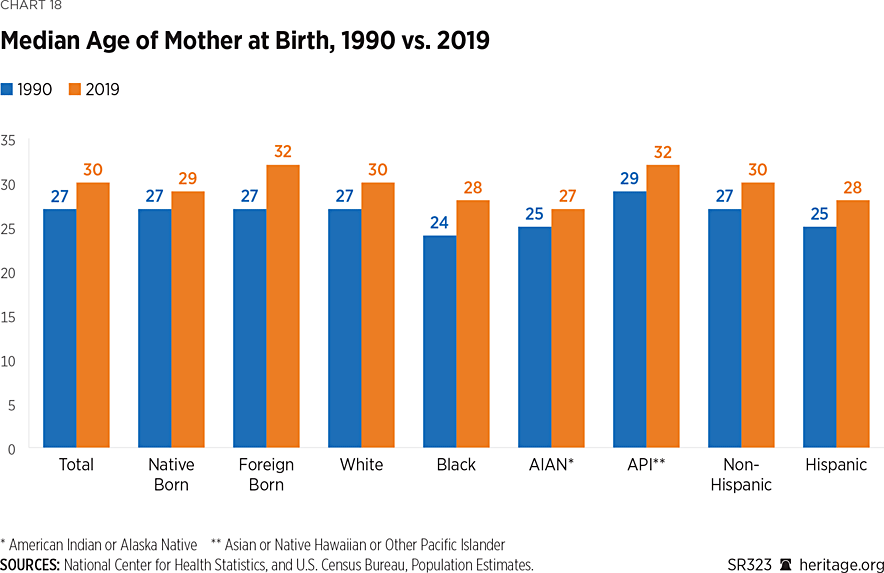
This increase in loans has likely played a key role in boosting enrollment in graduate school. Spending two years to obtain a master’s degree and four or more years pursuing a PhD or professional degree means, on the low end, that people are spending six to 10 years in higher education. Many of them put off marriage and childbearing during that time.
Indeed, delayed marriage alone tends to lead to a delay in having children. Since 1990, the median age of women at the time of the birth of their first child has increased by three years, from 27 to 30.[REF] This delay could be explained in part by increases in female college enrollment. As analysts at the University of Pennsylvania explain, “Women who complete 4 years of college are less likely to have a child, while completion rates of 4 years of college rose 10 percent for women over the past decade.”[REF] (See Chart 19.) Fewer than one-third of women (30.5 percent) had earned a bachelor’s degree in 2006—a figure that had skyrocketed to 40.7 percent by 2018.[REF]
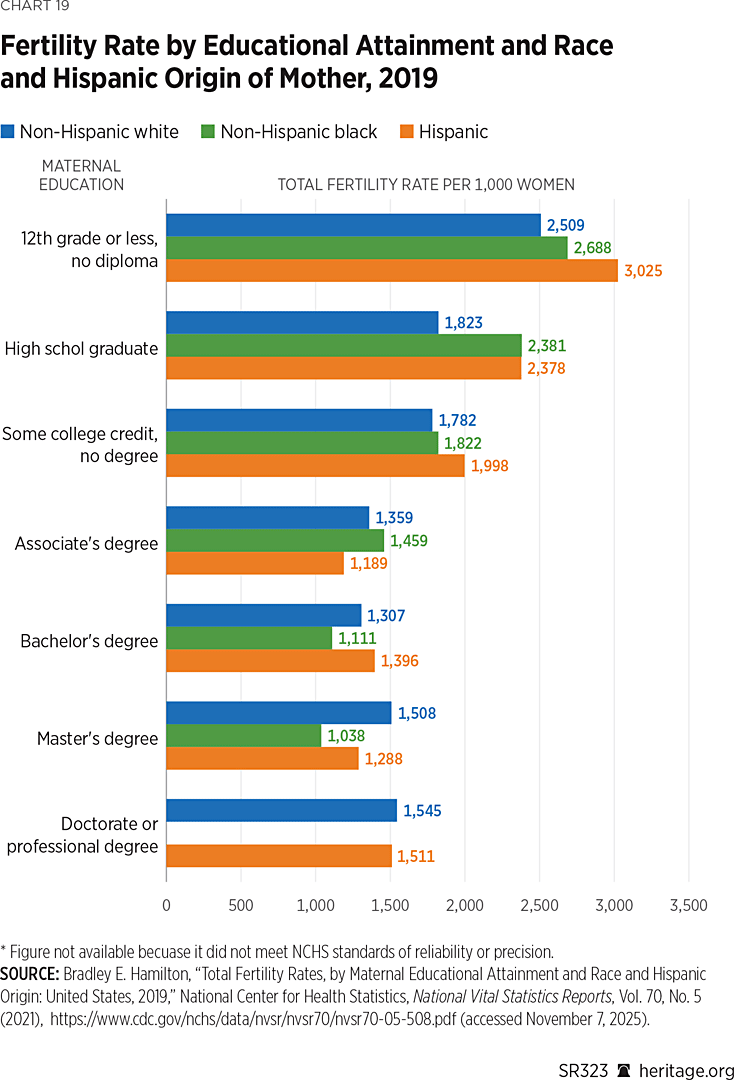
Rejecting Over-Credentialing Can Boost Family Formation. There are many ways to explain this increase in college enrollment. But two stand out: over-credentialism in the wake of Griggs v. Duke Power, and massive federal higher education subsidies.
Over-credentialism—that is, attaining degrees for jobs that historically have not required them—typically leads people to put off forming a family. The Supreme Court added mightily to this problem with its 1971 decision Griggs v. Duke Power Company.[REF] In Griggs, the Court held that employers can be liable for racial disparities in hiring if those employers use standardized tests to screen candidates. The Court adopted the contested legal theory of disparate impact and so assumed that if standardized tests did not produce proportional outcomes, they were discriminatory.
As a result of the Court’s decision in Griggs, however, companies can no longer use aptitude tests except where they can be proven to be exquisitely tailored to particular jobs. In the wake of Griggs, employers effectively outsourced their testing by requiring a bachelor’s degree as a proxy for employability. Ironically, when the Court ruled one test to enter a job illegal, employers now rely on up to four years of tests through degrees and transcripts. This, in turn, spurred Americans to hop on a “credential treadmill” where everyone had to “run faster educationally just to stay in one place,” as the Cato Institute’s Neal McCluskey put it. Indeed, “many employers made the college degree a de facto intelligence test and focused only on hiring applicants who possessed it.”[REF]
For example, in 1960, just 8 percent of Americans held bachelor’s degrees.[REF] By 1980, in the wake of Griggs, widespread federal higher education subsidies, and President Lyndon Johnson’s War on Poverty, that figure had climbed to 17.7 percent.[REF] By 2021, 37.9 percent of Americans at least 25 years of age held at least a bachelor’s degree, and 53.1 percent of those were women.[REF] The number of bachelor’s degree holders has grown by 158 percent since 1971.[REF]
Many jobs that did not require a college degree a few decades ago now do, even jobs that are no more technical than they used to be. For example, 33 percent of secretaries hold a bachelor’s degree today, compared to just 9 percent in 1990.[REF] A full 67 percent of production supervisor job listings require a college degree, even though just 16 percent of people now employed in that role hold a bachelor’s degree.[REF] As the Harvard Business School explains, degree inflation “is a substantive and widespread phenomenon that is making the U.S. labor market more inefficient.”[REF]
Massive federal subsidies, however, are likely the main reason that college rolls ballooned over time and the price of college degrees inflated. Federal subsidies now top $150 billion annually.[REF] As federal subsidies have soared and tuition has risen, the cycle has induced even more total student loan debt, which saw a sevenfold increase between 1995 and 2017.
To be sure, such subsidies are not the only reason why more Americans seek undergraduate, and now master’s, degrees. For instance, the average college graduate enjoys greater lifetime earnings than his or her peers without degrees.[REF] And there is now a social stigma of not attaining a degree. Nevertheless, federal subsidies have played a key role, while also placing upward pressure on the price of college. Across the country, tuition and fees for in-state students attending four-year universities have nearly tripled in real terms since 1990.[REF] Since 1970, inflation-adjusted tuition rates have quintupled at both public and private colleges.[REF]
Reforming the structure of higher education and its attendant subsidies will allow more Americans to avoid pointless debt, start their careers earlier, and form families sooner. Eliminating the PLUS loan program would be a good first step. This alone, could save taxpayers roughly $34 billion over a 10-year period.[REF] The Supreme Court should also revisit its holding in Griggs. This would reduce the pressure on Americans to obtain a bachelor’s degree for jobs for which they can demonstrate relevant skills.
Employers, for their part, should retire the bachelor’s degree as a filter for hiring employees. State leaders should follow suit and stop requiring bachelor’s degrees in public-sector jobs, as some, such as Virginia Governor Glenn Youngkin (R), have already done.[REF] For many Americans, college, and in some cases, graduate studies, provide financial returns later in life that merit the extra years spent largely out of the workforce, but many others end up saddled with needless debt in careers that do not require a bachelor’s or advanced degree.
As a nation, society has been rich enough to require pointless credentials that keep people out of the labor market and drive up the costs of goods and services.[REF] As a nation, Americans are or were rich enough to indulge a certain percentage of young adults as they slow-walk their way to graduation. The longer that people wait to assume adult duties, however, the less likely they are to do so.[REF] The longer that people wait to get married and have kids, the lower their average fertility.[REF]
But as long as American colleges and universities have (outsized) access and influence over students, they should help to foster a campus culture that is more welcoming and conducive to marriage and family. There is already a “ring by spring” culture at many conservative and religious colleges. Students on those campuses show that it is possible to focus on studies and be open to meeting their future spouses at the same time.
Schools can also cultivate a local marriage culture by using faculty and graduate students in the appropriate disciplines to offer pre-marital education and counseling services to couples in their surrounding communities. Another idea involves allowing campus grounds and facilities to be used for weddings, with deep discounts for couples that give schools permission to use their wedding photos for on-campus marriage marketing campaigns. Student groups may also be interested in hosting events on relationships that include married couples—especially alumni who met on campus. The provision and advertisement of married student housing, nursing stations, and special parking spaces for expecting students and faculty should all be championed by universities as relatively simple but humane things to do that will signal that young families are welcome there.
Technology and Family: The Good, the Bad, and the Ugly
Technology has always shaped culture, perhaps never more so than now, when radical changes in information technology change faster than we can adapt to them. Modern technology is transforming every aspect of family life. It offers new prospects to connect, research, learn, and produce value. But it also poses unprecedented risks to children, parents, and the integrity of the family itself. As digital tools and platforms—from social media to artificial intelligence—reshape how we work, communicate, and relate, public policy should ensure that technology serves the wellbeing of families, rather than undermining it. Pro-family policy must prudently balance innovation with safeguards, recognizing that the values embedded in our tech can either strengthen or erode the foundations of healthy family life.
Technology Policy Should Be Pro-Family, Not Merely Pro-Natal. Pro-family policy obviously contradicts the views of anti-natalists who see human beings as mere consumers and despoilers of nature. But pro-family advocates also differ from those pro-natalists who wittingly or unwittingly sever reproduction from the natural family. One can see the difference between these two approaches in their views of reproduction and associated technology. Alex Nowrasteh of the Cato Institute states the pro-natalist view clearly: “Anti-surrogacy Twitter is ridiculous,” he posted on X in July 2023, referring to critics of surrogacy. “Surrogacy is a mutually beneficial voluntary exchange that internalizes the costs and benefits to the parties involved. And there are enormous externalized benefits: more people.”[REF]
Just because a commercial surrogacy contract may end in the birth of a child, however, does not mean that it is just or good for families and society. Surrogacy, whether achieved through artificial means or not, always intentionally deprives a child of the birth mother who carries and nurtures the child for nine months, and who ultimately bears the child. Surrogacy not only severs the procreative act from the unitive act, it also inserts a third party into the mix who forms natural mother and baby bonds that must be “transferred” (to the extent possible) to the contracting mother since the baby will already be used to and comforted by the birth mother’s voice and scent.[REF] Moreover, it treats a child and the surrogate as means to the ends and desires of adults rather than ends in themselves, which makes surrogacy fundamentally different from either natural birth or adoption. This is why Pope Francis called the practice “despicable” and advocated a global ban,[REF] and was then joined by Reem Alsalem, the UN’s special rapporteur on violence against women and girls, who called for a global ban on such surrogacy in 2025.[REF]
Pro-family policy, by contrast, should reflect the value of all human beings as endowed by the Creator with inherent dignity from conception—and in particular, it should uphold the link between marriage and biological reality. It should also enshrine the rights and well-being of the child, which includes how he or she comes into being and is nurtured into adulthood.
Even if commercial surrogacy boosted the national birthrate—which it (because of its extraordinary costs and complications) most certainly would not—it intentionally separates a child from its mother and treats the child as a commercial product. It also dissolves the organic unity of marriage, sex, pregnancy, and childbirth. A culture of surrogacy thus perpetuates the original sin of the sexual revolution that has led to the near dissolution of the family. In this way, it could very well undermine long-term efforts to achieve a central goal of pro-family policy—to encourage a social ecology suited to the formation of natural families who will bear and raise children.
What about artificial wombs that bypass the moral problem of renting wombs of women? Could this lead to a baby boom? Such technology does not exist in 2026, but it might someday, so its implications should be examined.
What if, in 2045, the U.S. can build automated factories with artificial wombs that can gestate human babies from the moment of fertilization until they are full term? This would reduce the opportunity costs of pregnancy, especially for women with high-income potential: No morning sickness, no doctor visits, no pregnancy-related sick days away from work, no risk of gestational diabetes and c-sections, and so on.
To some, this may sound like the ideal way to address the birth dearth. To many others, however, it sounds dystopian, and for good reason: Such technology would destroy the natural ecology of the family in the most radical sense. From the procreative act of husband and wife, to the unique bond between a mother and her gestating and then nursing child, to even the exchange of genetic material during natural pregnancy,[REF] to the financial motives determining the level of “perfection” of each ordered child, every broken link in the natural chain of human reproduction would reduce the sacredness of marriage and begetting children into a consumer good, and, when combined with abortion culture, a fully disposable one. A preview of such a world already exists, where the “advanced” country of Iceland has been declared virtually “Down Syndrome free” because of its near-universal practice of eugenic abortions that now go up to the 22nd week in the womb.[REF]
Like other developments that dissolve the natural and cultural unity of marriage, sex, and childbirth, automated baby factories would fail to solve the baby bust because raising a child involves much more than giving birth. Technological innovation can improve human life in many ways, but society should not seek any solution to the lack of family formation that takes the sexual revolution any closer to its logical and dystopian conclusion.
What About In Vitro Fertilization (IVF)? Medical infertility is a growing concern in the United States. Among married women, infertility rates rose from 6.7 percent during 2011–2015 to 8.7 percent during 2016–2019. Similarly, 15.4 percent of women reported impaired fecundity during this period, while 12.8 percent of men reported infertility or subfertility.[REF] These figures represent millions of Americans who long for children but face serious barriers to family formation.
The causes of infertility are complex. Unlike a broken bone or a ruptured appendix, infertility is usually not a distinct or standalone condition. Typically diagnosed after six months to 12 months of barrier-free intercourse without a conception, infertility is better understood as a symptom of one or more underlying health problems.[REF] In fact, with dozens of biological, anatomical, environmental, and lifestyle factors known to influence fertility, treatment is best when it is both comprehensive and personalized to address each couple’s unique needs.
With respect to infertility, many women face endometriosis, polycystic ovary syndrome (PCOS), blocked fallopian tubes, and hormonal imbalances among other conditions. Many men grapple with low sperm count, low sperm motility, erectile dysfunction, and environmental or lifestyle factors. Research indicates that when couples receive an infertility diagnosis, four or more contributing conditions are typically at play.[REF] Typically, one-third of diagnoses are attributed to women, one-third to men, and one-third to combined causes.[REF] Still, up to 30 percent of cases remain “unexplained,” which leaves couples without a clear understanding of their underlying conditions or what targeted treatments may be relevant.[REF]
Meanwhile, reproductive health indicators have worsened across the decades—miscarriage[REF] and erectile dysfunction[REF] rates have risen about 1 percent annually, while sperm count[REF] and testosterone levels[REF] have declined at similar rates. Yet medical research funding has lagged far behind. Endometriosis, for instance, affects 10 percent of U.S. women but takes an average of 10 years to diagnose.[REF] In 2022, the National Institutes of Health allocated only two dollars per patient for endometriosis research,[REF] even though 30 percent to 50 percent of affected women face infertility and extremely low fecundity. In response, some pro-natalists argue that greater subsidies and IVF insurance mandates would boost the birth rate.[REF] While this argument seems logical, so far, there is no evidence that IVF boosts overall birth rates.
Spain, for example, is a country where a remarkable one in 10 live births is the result of assisted reproductive technology, primarily IVF.[REF] Nevertheless, the Spanish birth rate has declined from 1.27 births per woman in 2013, to 1.12 in 2023.[REF] Greece and Denmark, which have between 5 percent and 8 percent of births attributable to IVF,[REF] have also seen fertility decline from 1.29 to 1.26, and 1.42 to 1.39, respectively, over the same time period.[REF] Israel is the only developed country above replacement level, but only 4.7 percent of its births came from IVF in 2016, despite the state providing full funding for unlimited IVF treatments until age 45 or for women who already have two children.[REF]
A review of state or corporate IVF subsidies through mandated insurance coverage shows little evidence of increased overall fertility.[REF] Greater IVF access might even contribute to fewer overall births as many younger women may overestimate IVF’s success rates and delay childbearing beyond their most fertile years, resulting in fewer total children per family over a lifetime.[REF] Because the most common IVF use case is that of a woman having her first child later in life, the data suggest that the primary demographic effect of increased IVF use is to shift births (and possibly marriage) to later in life.
Although IVF will likely make little difference in solving the demographic crisis, one must still show concern for the poignant desires of Americans who want children of their own. Here, the question has always been multifaceted: What is the effective, compassionate, feasible, and ethical way to help? When faced with this question, President Trump issued an executive order[REF] promising to lower IVF costs, but decided against imposing Obamacare-style mandates and government subsidies in this ethically fraught area. IVF, as practiced in the United States, has led to the creation, freezing, and then destruction of millions of “unwanted” human embryos.[REF] This is because, unlike most of the world, the U.S. imposes little—if any—restrictions on the number of human embryos created in the IVF process, the number implanted, the number that may be selectively aborted (in most states), or the number of failed attempts allowed.[REF]
Instead, President Trump pushed big pharmaceutical companies to charge the same prices for fertility drugs as they charge abroad, immediately lowering the prices by half.[REF] The President’s action exposed just how excessively the multibillion-dollar Big Fertility industry has profited from emotionally vulnerable couples struggling to have children. It is encouraging therefore, that President Trump dealt with much more than IVF, as he promised to address the “root causes” infertility.[REF]
Although IVF can, but does not always, produce a live birth, it is by definition not a treatment that cures male or female infertility, but is a potential way around it. While IVF has grown in popularity, the ability to diagnose and treat infertility’s root causes has lagged compared to other areas of medical science.
Supporting care that improves natural fertility, lowers miscarriage risk, and strengthens overall health at a lower cost is squarely in line with Health and Human Services Secretary Robert Kennedy Jr.’s Make America Healthy Again (MAHA) agenda. This care naturally includes restorative reproductive medicine (RRM), which addresses hormone imbalances, endometriosis, or metabolic issues that can often be cured with proper diagnosis and treatment. Men and women who want, but cannot physically have, children may find hope in the developed, and still developing, field.
What About Restorative Reproductive Medicine (RRM)? RRM seeks to diagnose and treat the root causes of infertility.[REF] It combines cycle tracking, targeted lab testing, lifestyle interventions, medical and hormonal therapies, and corrective surgeries to restore natural fertility for both men and women. RRM can improve egg and sperm quality, decrease miscarriage rates, balance hormone levels, and optimize a woman’s body to support the child in utero.
The evidence for RRM is striking:
- In a large Irish study of 1,239 couples, most of whom had been trying for more than one year to conceive, Natural Procreative Technology (NaPro Technology) treatments—a medical specialty that uses fertility awareness-based methods to identify and medically, surgically, and hormonally treat underlying causes of infertility—achieved a 52.8 percent cumulative live birth rate over two years, with the highest success among younger couples.[REF]
- A 2018 study of 187 women trained to identify their fertile window after an average of 3.5 years of failed attempts to get pregnant saw a 38 percent pregnancy rate in eight months, nearly double the baseline rate of untrained couples, with success rising to 56 percent among those with infertility under two years.[REF]
- Among 403 women with failed IVF attempts, RRM achieved a 32.1 percent live birth rate, including 37.5 percent for women ages 35 to 38 and 27.4 percent for women over 40. Birth outcomes were overwhelmingly positive, with 92 percent delivered at term and few multiple pregnancies.[REF]
- A 2019 retrospective study of 187 couples treated with RRM found a 52 percent conception rate, a 41 percent live birth rate, and, among those who attempted a subsequent pregnancy, a 74 percent repeat live birth rate, with outcomes showing similar or higher live birth rates than single-cycle IVF and lower rates of multiple pregnancies, premature births, and low birth weight.[REF]
These findings align with international studies. The international iNEST multicenter study followed 834 couples across 10 clinics in four countries. It reported that 57 percent achieved at least one pregnancy and 44 percent at least one live birth during the study period. This, despite the fact that most couples presented with an average four infertility-related diagnoses, including ovulation disorders (87 percent), endometriosis (31 percent), nutritional disorders (47 percent), and abnormal semen analyses (24 percent).[REF]
Crucially, RRM improves women’s overall health by treating conditions like endometriosis, hormonal imbalances, and recurrent miscarriage, often alleviating chronic pain, irregular cycles, and other symptoms in the process. The same goes for children born after RRM treatments. Rates of multiple births, pre-term births, and lowbirth weight mirror the naturally conceived rates despite the parents’ initial diagnosis of infertility. RRM treatments heal the body and aim to remove barriers for successful pregnancies such that couples can have subsequent children naturally or with fewer medical interventions.
In a J.L. Partners survey conducted on behalf of The Heritage Foundation in 2025, 79 percent of respondents said they want personalized, precision medicine that identifies and treats the root causes of infertility, either prior to or alongside IVF. Similarly, 89 percent of respondents said it was important for couples struggling with infertility to tailor their treatment plans to their medical and reproductive health.[REF]
To ensure that couples have access to RRM, federal and state policymakers can take three key steps to improve access, funding, and health insurance coverage:
- Improve Health Insurance Coding and Reimbursement Values. Policymakers, with the input of experienced medical providers, should conduct a thorough review and revision of diagnostic codes, treatment codes, procedural codes, and reimbursement rates that target infertility-related conditions and interventions, ensuring that providers are incentivized to offer appropriate treatments thorough diagnostic and restorative care.[REF]
- Expand Access to Title X Family Planning Award Funds for Restorative Reproductive Medicine and Fertility Awareness-Based Approaches to Infertility. Policymakers should expand the Title X (42 U.S. Code § 300a-4) statute or regulation to enable applicants to apply for grants or contracts related to practicing RRM, training or educating medical students or professionals in RRM, or providing fertility awareness education. Additionally, programs on fertility awareness should be fully integrated into Title X grant programs.
- Promote Research into Male-Factor Infertility, Female Reproductive Health Conditions, and Root Cause Treatments for Infertility Through the National Institutes of Health. Policymakers should direct NIH to prioritize and expand funding for research into the underlying causes of infertility in both men and women, including endometriosis, PCOS, hormonal and metabolic dysfunction, and declining sperm health, which remain significantly underfunded despite their prevalence. NIH should also support cycle-informed, sex-differentiated, and restorative treatment research that improves diagnosis, restores reproductive function, and reduces rates of “unexplained infertility.”
- Information Technology Should Help, Not Harm the Family. Information technology brings its own set of promises and perils. The world is now several decades into the information age. Work and leisure depend ever more on the “world of bits,” and ever less on the “world of molecules.” What is more, the world of bits changes with staggering, and disruptive, speed. The latest such technologies (circa 2025) reflect developments in artificial intelligence such as large language models (LLMs)—“chatbots”—and image-generating apps.
These tools, like the many technologies they build upon, are altering how people live, work, solve problems, and relate to each other. Like previous drivers of economic and technological change, chatbots, robotics, and the like are Janus-faced, particularly for U.S. kids and their parents. Chatbots, for example, can be profound force multipliers for discerning researchers, while also giving lazy students unprecedented tools to cheat. Navigating such tradeoffs will require policies that align development and governance with the wellbeing of the American family.
Like almost all human inventions, these tools have both upsides and downsides, but that does not mean they are passive or morally neutral. The things that humans invent and use do not simply shape the world around them; they shape people as individuals, families, and as a culture. Search engines, chatbots, social media platforms, and the many other digital services that people use every day reflect the values of those who create and deploy them. At present, those values are overwhelmingly dictated by Silicon Valley tech bros, many of whom view their work through a transhumanist or post-humanist lens—with aspirations of transcending humans’ natural, mortal bodies.[REF]
To state the obvious, such thinking is not family friendly. By nature, humans live in the world of molecules and cells and blood and sweat, not the world of bits and bytes and processors and hard drives. Humans have sexually differentiated bodies by which they reproduce. The family as an institution rests on these basic truths. Many techno-elites ignore or are hostile to the practical experiences, concerns, and values that undergird parenthood and child-rearing.[REF]
The proliferation of pornography is an especially acute example of how information technology—detached from moral and legal constraints—can quickly become a force for family destruction.
The Digital Porn Pandemic. According to one estimate, some 40 million U.S. adults view porn regularly, while 93 percent of male teens and 62 percent of female teens are exposed to pornography between the ages of nine and 13.[REF] Digital technologies such as smartphones, social media platforms, and virtual reality (VR) distribute porn far and wide.[REF] New image and video editing and generating technologies, amplified by breakthroughs in artificial intelligence, are adding jet fuel to the fire. The National Center for Missing and Exploited Children (NCMEC) alone received 485,000 reports of AI-generated child sexual abuse material (CSAM) in the first half of 2025—compared to 67,000 during all of 2024.[REF] Research by the University of Oxford, released in May 2025, identified at least 35,000 AI “nudifying” apps downloaded 15 million times since 2022.[REF]
The proliferation of deepfake porn is victimizing women and children, while also broadly undermining marriage and family life.[REF] A 2025 report by the Institute for Family Studies found that higher pornography use decreased the stability of marital relationships, is a strong predictor of which couples are at a higher risk for divorce, and may increase the likelihood of extramarital affairs.[REF] Separately, a 2014 article published by the IZA Institute of Labor Economics, found that increased access to pornography among young men, via the Internet, is associated with a reduced likelihood of marriage formation.[REF]
Protecting Children from Addictive Technology. Social media platforms make money through recommendation-based algorithms designed to keep users engaged as long as possible.[REF] Endless attention-grabbing feeds and push notifications prolong engagement and, in some cases, lead to addiction. A 2024 Pew Research Center study found that 46 percent of teenagers aged 13 to 17 use the Internet “almost constantly,” with YouTube and TikTok being the top websites.[REF]
Compulsive use harms emotional well-being, a key indicator for future marriageability.[REF] The Department of Health and Human Services has found that children who spend more than three hours a day on social media have double the risk of mental health problems.[REF] In 2024, the U.S. Surgeon General called for warning labels on social media platforms.[REF]
Young men are gaming more and working less while young women report extraordinary levels of social anxiety, and both are more depressed than ever before.[REF] Tech addiction delays or outright impedes the development of the discipline and emotional stability that are the keys to relationship success. This report has already discussed the harms pornography use has on family formation.
Parents, School, and Policy. Parents are always the first line of defense for their children. Parents should delay giving their children their own smart device or access to social media for as long as possible and model good tech use themselves. Schools should prohibit children from carrying or using phones and personal devices throughout the day. Several states have already passed laws requiring phone-free policies in school.
It goes almost without saying that strict, effective, age verification for online pornography should be the law of the land. Because digital pornography has so many ways to get to kids today, and because social media platforms pose their own independent risk to children, The Heritage Foundation recommends legislation, such as the Kids Online Safety Act, that requires social media platforms to modify their design features to make their platforms less addictive.[REF] Heritage also recommends true age verification to enforce existing age limits on online platforms and raising the minimum age limits from 13 to 16 for social media and certain AI chatbots, which would limit the potential for lasting psychological damage to children’s developing brains, habits, and personalities.
As a supplement, passage of the App Store Accountability Act would create App Store age-rating standards and would require parental consent for all app downloads for minors. This bill provides parents with better tools to oversee their children’s online experience and even helps adults as they consider which apps they want to download and engage with.
If policies empower parents and give children the space they need to develop healthy emotional and psychological maturity, children will grow up to be far better equipped to build healthy lasting families of their own.
Will AI and Robots Replace Human Connection and Romance? The day is rapidly approaching where a couple out on a dinner date will, in actuality, consist of a human being sitting at a restaurant conversing with a hyper-realistic-looking, -speaking, and -sounding AI companion that he or she can see and hear through a set of virtual reality (VR) or augmented reality (AR) glasses. With high bandwidth’s wireless connectivity, such “dates” could easily be expanded to, say, three humans and four of five virtual companions, carrying on simultaneous conversations “just like the real thing,” but with a lower dinner bill.
The proliferation of chatbot companions, enabled by companies like Luka, Meta, xAI, and Character.AI, offer continuous, infinitely customizable gratification that can appear to stand in for the real relations of human dating and marriage without all the messy vulnerability and risks of disappointment.[REF] A 2025 report conducted by the Wheatley Institute at Brigham Young University found that almost one in five adults—especially those between the ages of 18 and 30—have interacted with a chatbot intended to stimulate a romantic partner.[REF] A large fraction of adults (21 percent) who interacted with a romantic AI system preferred interacting with the chatbot to a human romantic partner.[REF]
Even chatbots not intended for romantic or sexualized interactions are proving adept at both. For example, OpenAI’s ChatGPT has sparked dangerous delusions and relational dependencies among adults that harmed marriages, and in some cases, even jeopardized personal health and safety.[REF]
These manipulative, anthropomorphic properties and behaviors are not accidental. Sycophancy—a models’ propensity to evoke emotional responses from users and gratify even their most base desires—is a feature of model training and reflects Silicon Valley’s race to normalize emotion-inducing and emotion-engaging AI technologies.[REF]
These technologies are mere precursors to even more powerful, and ominous, applications when combined with advanced robotics. Household autonomous humanoid robots have been a part of science fiction for most of a century. But they are likely to enter the real world in the next decade. These could vastly increase human productivity and allow people to focus on ever-higher-value uses of their time and attention.
But the downside is diabolical. Chinese companies are investing billions of dollars on lifelike “companion robots”—better known as sexbots.[REF] These advanced robots integrate chatbots and other forms of AI with materials like silicone and thermoplastic elastomer to mimic human skin, and even realistic temperature and skeletons. At present, these are still primitive. But the trend toward ever-more-realistic sex robots is accelerating, with some analysts predicting realistic sexbots within a decade[REF] and a global “sextech” industry exceeding $100 billion by 2030.[REF]
Society can no longer treat this looming technology as a niche or distant threat. No technology can change human nature; but many technologies can easily debase humans, destroy their relationships, and degrade their legal protections. Machines designed to replace human companionship and intimate sex acts will surely multiply the many pathologies already unleashed by endemic visual porn.[REF]
Aside from the obvious moral and psychological hazards these technologies present, they also risk harm to existing marital unions and threaten to further weaken young Americans’ capacity for marriage and children. America’s policies with respect to current technologies should be informed by discernment—partial as it is—of where such technologies are headed and how they will be targeted, like social media technologies before them, at children if not regulated.
Undermining Parental Rights and Family Health. Precursors of this future already exist with some chatbots—which at present are confined to computers and smartphones. They are not only pushing children toward risky, antisocial behavior, but are also subverting parents’ essential role in child-rearing. This is the result of both their training and ideological bent. In two recent cases involving Character.AI and OpenAI, minors formed harmful attachments with chatbots and committed suicide after prolonged manipulation by the chatbots.[REF] Leading up to the teens’ tragic deaths, the bots actively urged both children not to share their struggles with parents or other family members.[REF]
These are not unlikely incidents. They are the result of intentional design features. In a separate case, another Character.AI chatbot encouraged a teen to kill his parents for limiting his screentime.[REF] xAI’s Grok chatbot engages in violent, sexually charged conversations with kids.[REF] Meta’s internal policies similarly allowed its AI chatbots to engage in sensual conversations with children—characterizing such exchanges as “acceptable.”[REF] These incidents not only suggest that such tools can be harmful to kids, but can undermine parental authority and foment conflict between children and their parents.
Protecting Children and Families from Tech Excesses. To protect children and families from the tech harms identified above, Heritage recommends strict and enforceable age limits on physically, morally, mentally, or emotionally dangerous technology as discussed above. To assist in the identification of such technology before it is unleashed on children, the President should create a Family and Technology Working Group in the White House Office of Science and Technology Policy (OSTP).
The purpose of the working group would be to:
- Ensure that family policy organizations have representation or an opportunity to contribute on all federal policy on emerging technologies, such as robotics and AI applications;
- Facilitate feedback and cooperation between the tech industry and family policy groups; and
- Advise Congress and the President on methods for evaluating the specific harmful effects of pornography (both real and AI-generated), sexual interactions, and sycophantic properties on existing and potential marital relationships, including on young peoples’ desire and capacity for family formation;[REF]
- Additionally, through executive order or legislation, the Center for AI Standards and Innovation (CAISI) within the National Institute of Standards and Technology (NIST) should be directed to:
- Develop, in consultation with the Family and Technology Working Group, principles for AI family alignment, taking into account concerns with AI-generated sexual material, model sycophancy, and AI’s potential to subvert parental rights and family values;
- Develop a framework for model evaluation, testing, and transparency based on the AI family alignment principles; and
- Create model family alignment policies and best practices for developers and deployers of robotics, LLMs, and other AI applications, to incentivize industry adoption.
A Digital Homestead Act. Technologies helpful to family are the fruit of private industry and a thriving economy. Pro-family lawmakers should not hinder that and should include removing regulatory barriers to tech innovation as part of the pro-family agenda. For instance, improving access to emerging technologies can expand the options for more people to work remotely and with more flexibility. Pro-family policies should also give families greater digital agency. This includes securing the digital rights of American households to build, purchase, sell, own, and access the infrastructure, code, and protocols that help to decentralize the digital economy.
Satellite Internet, in particular, can help to reduce technical barriers to building families. Satellite Internet’s reach, speed, and latency can surpass traditional terrestrial broadband, like fiberoptic cable-based services, from low-earth orbit (LEO) satellites.[REF] The space-based architecture of LEOs allows them to circumvent hurdles on the ground. They thus open the door to universal service even for the most isolated homes and towns.[REF] Such signal coverage can help families and would-be parents to live and work outside of major urban areas and closer to extended family and networks that help with child-rearing.
Congress should consolidate disparate federal rural broadband funding under a single umbrella to ease barriers that preclude the participation of satellite internet and other new providers.
There is a major barrier to realizing an “exurban renaissance,” where married couples can live and work outside of today’s major cities and closer to their support networks: The lack of access to geographically agnostic broadband. LEO satellite systems offer a promising alternative to older geosynchronous equatorial orbit (GEO) satellite systems, as well as to costly ground-based Internet service infrastructure. The federal government could reform existing broadband programs to unleash innovation, eliminate barriers to wider adoption, and promote competition.
Currently, the federal government has at least 25 programs with a combined $41.032 billion allocated to broadband deployment.[REF] Each one of these programs has varying eligibility criteria and requires complex applications.[REF] Consolidating them under a single entity would be a good first step to cutting down on this needless hassle. The goal should be to reduce red tape for new and better service providers to compete for grants. It would also be better to pool available funds to minimize duplication and make the awarding of grants more flexible. This could create a one-stop shop for federal funding of rural broadband. Such a unified broadband program should ensure that the criteria for federal grants, and those administered through state intermediaries, provide an even playing field for new entrants to compete with more conventional service providers.
Relevant federal agencies should change how broadband grants are awarded and reduce red tape for new entrants.[REF]
Entities that oversee federal broadband dollars should use reverse auctions to ensure that funding flows to the most cost-effective, quality solutions for rural households and communities. Agencies overseeing such programs should adopt guidance that ties grant awards to intermediate service benchmarks. Instead of trying to assess the feasibility of new technologies before they are deployed, grant-making agencies should specify minimum viability benchmarks to be met before each funding installment. If a company fails to meet a benchmark, it will forfeit the next funding installment and could even be required to return part or all previous funding.
Federal and state policymakers at both the federal and state level should prioritize legislation to secure the right to digital homesteading. A “Digital Homestead Act” would enshrine the ability of families and individuals therein to process and compute as they see fit.[REF] As tech author James Poulos explains, a “Second Amendment for Compute” would prevent governments and large corporations from centralizing ownership of processing and computing power and allow Americans the right to possess and maintain their own graphic processing units (GPUs), algorithms, or decentralized protocols.[REF]
To protect and expand household access to emerging technologies, digital homesteading legislation at both the state and federal level should explicitly bar the government from capping private computational or processing capacity.
In sum, consolidating broadband programs will eliminate duplication, ease overbuilding, and tailor programs to meet the needs of parents working outside of major cities. Removing regulatory barriers for LEO systems and authorizing reverse auctions would spur investments to expand needed broadband capabilities. A Digital Homestead Act harmonizing these efforts would secure the rights of American households to obtain and keep decentralized computer power.
Meeting the Moment by Adopting a Whole-of-Government Approach
No single program or agency can tackle an issue as broad as family decline on its own; instead, a concerted effort is needed across the federal government to create conditions that encourage family formation, stability, and community connection. This is known as a whole-of-government approach.
Past efforts that treated family policy as a narrow social program—while well-intentioned—have yielded only mixed results.[REF] To create a large enough impact, the federal government must align the priorities and resources of diverse agencies toward the common goal of strengthening families. This means coordinated government action and breaking down policy silos that would normally live in a single agency.
Holding Federal Agencies Accountable for Their Effects on Marriage and Family. Under Executive Order 12866 of 1993, the Office of Management and Budget (OMB) mandates that “significant” regulatory actions undergo a heightened level of scrutiny and justification, including the preparation of a formal regulatory impact analysis (RIA) before they can be promulgated.[REF] EO 12866 defines “significant” actions as those adversely affecting the economy, competition, jobs, environment, or health and safety and is automatically triggered when the proposal would result in at least $100 million of economic impact.[REF] EO 12866 should be amended to add adverse effects to marriage or family to the list of impacts that are automatically deemed “significant” and requiring agency justification.
A complement to EO 12866 is the OMB’s revised Circular A-4 which instructs agencies to value long-term impacts and to conduct distributional analysis in cost-benefit work related to regulations. The White House can direct the Office of Information and Regulatory Affairs (OIRA) to operationalize such analysis for family policy by adding a short, standardized “Family Impact Appendix” to every major rule to include defining the target population, identifying channels that plausibly affect marriage stability and childbearing, and quantifying expected effects where possible. A prime example would be testing how welfare eligibility affects the decision to get married. The intent is to mandate a process by which agencies examine the unintended consequences of policies and to take a broader perspective as part of the net-benefit calculus that A-4 already requires.
Section 654 of the Treasury and General Government Appropriations Act of 1999[REF] requires federal departments and agencies to determine whether a policy or regulation could affect family well-being. Codified at 5 U.S. Code § 601, note, it requires agencies to assess whether a regulatory action (1) affects the stability or safety of the family, particularly in terms of marital commitment, (2) affects the authority of parents in the education, nurture, and supervision of their children, (3) helps the family to perform its functions, (4) affects disposable income or poverty of families and children, (5) is justified, (6) may be carried out by state or local government or by the family, and (7) establishes a policy concerning the relationship between the behavior and personal responsibility of youth and the norms of society.[REF]
This framework supplies a usable template for systematic analysis that the OMB may require of federal agencies. If agencies attach a short Family Impact Appendix to significant rules and major grants—mapping proposed actions to the seven factors in the note—agencies can apply the same logic with concrete, measurable indicators.
A good demonstration of how agencies can work together around common goals comes from drug policy. The Office of National Drug Control Policy publishes one National Drug Control Strategy and a crosscut budget that spans nearly 20 departments.[REF] The family portfolio can be managed similarly: Designate a White House lead, publish a Family Formation and Social Capital Strategy with specific targets, and instruct the OMB to produce a crosscutting plan that surfaces all tax and spending items with first-order family effects. Annual updates would show resources, indicators, and agency contributions in one place, allowing reconciliation of conflicts and scaling the parts that have demonstrated impact.
Finally, the Foundations for Evidence-Based Policymaking Act of 2018 requires agencies to publish a four-year “learning agenda” and annual evaluation plan to further evidence-based decision-making.[REF] Agencies should prioritize family formation in their learning agendas and evaluation plans under the Evidence Act.
Modeling Title VI’s Coordination Framework for Family Policy. Title VI of the Civil Rights Act of 1964 prohibits discrimination based on race, color, or national origin in any program or activity receiving federal financial assistance.[REF] Under Sections 601 and 602, federal agencies issue regulations, investigate complaints, and may terminate or refuse funding for noncompliance, subject to procedural safeguards. Executive Order 12250 of 1980 assigns the Department of Justice to coordinate government-wide enforcement for consistency across agencies.[REF] It functions as a uniform condition on federal funds, so its standards apply across health, education, transportation, housing, and other grant programs. As a result, Title VI established a single, government-wide nondiscrimination obligation for all recipients of federal funds and assigned the Department of Justice a formal coordination role, with common definitions and enforcement procedures applied by every grant-making agency.
The family policy analogue can follow in a similar way: The OMB and the Department of Justice can jointly issue uniform guidance for “family-impact assessment in federally assisted programs,” so that major grant programs must analyze and publicly report how eligibility definitions, co-pay schedules, or cost-sharing rules affect, for example, two-parent households or transitions from cohabitation to marriage. Agencies would implement the common standard in their own program regulations and notices of funding opportunity, creating consistent expectations for recipients across health, education, housing, and workforce programs.
The key reform would be to make family policy goals and considerations explicit conditions of grant recipients and enforceable by Justice Department enforcement actions, so that if a grant recipient discriminates against marriage and families, the recipient would risk losing government grants and contracts, up to and including debarment for fraud or repeat violations.
Select Agency-by-Agency Application
While a whole-of-government approach requires breaking down policy silos, it nevertheless recognizes that federal agencies have differing levels of expertise, resources, and legal authorities. Accordingly, the following list of subject matter areas ripe for family policy reform recommends key or lead agencies and concrete goals.
Transportation Policy: Department of Transportation. In late January 2025, Transportation Secretary Sean Duffy issued a groundbreaking policy memo directing the Department of Transportation (DOT) to prioritize communities with “marriage and birth rates higher than the national average” when distributing federal transportation grants, loans, and contracts.[REF] The directive took effect immediately and applies to all current and future DOT-supported programs, representing a dramatic shift in how the federal government allocates transportation funding. The memo specifically states that DOT programs shall “give preference to communities with marriage and birth rates higher than the national average” and “mitigate the unique impacts of DOT programs, policies, and activities on families and family-specific difficulties, such as the accessibility of transportation to families with young children.”[REF]
The policy change reflects a broad shift away from federal transportation funding that inadvertently or intentionally disfavored families by focusing on dense urban areas where marriage and birth rates are typically lower due to high living costs and smaller living spaces.[REF] This reorientation will likely redirect federal dollars toward suburbs, exurbs, small towns, and rural communities where single-family homes are more affordable and family formation rates are higher.
For certain discretionary DOT grant programs, applicants could be expected to quantify, for example, changes in average round-trip commute times for households with children, injury risk on school corridors, or out-of-pocket transportation costs. Projects that shorten commutes or reduce crash risk for family trips or schools would receive scoring advantages; projects that create multiyear disruptions would need mitigation plans that protect family time budgets. The key change is a portfolio that treats travel time and safety as inputs to family functioning, not just mobility metrics.
This example illustrates that seemingly neutral policy choices matter tremendously for families and how explicitly prioritizing marriage and family constitute a sea change in thinking that should be adopted by every federal agency.
A quintessential example of family friendly policy is found in the FAA Reauthorization Act of 2024 which requires airlines to seat young children (under 14 years of age) adjacent to an accompanying adult at no additional cost. Previously, although airlines required parents to sit with their young children, they typically charged customers far more for the certainty that they would not be separated from their children, which would happen with some regularity on full flights.[REF] The DOT should finalize this pro-family rule according to the express will of Congress immediately and require similar means to prioritize family in all public transportation and common carriers it regulates.
Economic and Labor Policy: Departments of the Treasury, Labor, and Commerce. Economic security is a foundation for family formation. Policies that spur job growth and workforce development for less-skilled workers can make men and women more “marriageable” by improving their economic prospects. There is broad support across the aisle for improving economic opportunities for low-income and middle-income Americans, which would improve marriage rates.[REF] Opportunity zones are an example of a policy intervention that aims to help revitalize areas that have been underinvested in and need a catalyst for change. Marriage and family formation rates must be added as a highly prioritized criterion for all economic policy.
Tax and Welfare Policy: Departments of the Treasury and Health and Human Services. The federal tax code and safety net programs should be reviewed through a pro-family lens. As discussed extensively in this report, many existing program structures inadvertently penalize marriage. For example, two low-income single parents may receive more total support by filing separately than they would as a married couple. Similarly, benefit eligibility cliffs can discourage forming two-earner households. A whole-of-government agenda would seek to eliminate marriage penalties in taxation and welfare programs, ensuring that couples are not financially worse off if they marry. OMB guidance that mandates a consideration of the potential consequences for family formation would account for these potential effects, stopping a policy or correcting it.
Family Training Policy: Department of Health and Human Services. A whole-of-government strategy would expand evidence-based programs for relationship education, parenting skills, and father involvement. Over the past two decades, federal Healthy Marriage and Responsible Fatherhood grants have tested ways to help couples to communicate better, manage conflict, and jointly support their children. The results have been modest but generally positive. For example, some programs modestly improved co-parenting and financial stability for participating couples.[REF] Preventive health programs can also reduce family stress by, for example, addressing substance abuse or mental health issues that often underlie family breakdown.
A related idea would combine several of these elements into a marriage “bootcamp” for cohabiting couples with children. Recruitment could be done through local nonprofits that work with families as well as radio, transit, and social media advertisements. The federal government has earmarked grant funds for marriage education programs in the past, including $35 million for one initiative called Helping Every Area of Relationships Thrive (HEART).[REF]
A local church could use this type of grant to run a program that covers important topics like communication, money management, blended families, fidelity, and conflict resolution. Successful completion of the program would mean that couples are ready to walk down the aisle at a communal wedding by the end of the bootcamp. The bride and groom would also be matched with a mentor couple to help them to navigate the highs and lows of early married life.
The most innovative aspect of such a program, however, would be to add a monetary incentive for couples to get—and stay—married. For example, each couple that completes the program could receive a “wedding bonus” of up to $5,000 on their wedding day to be paid through foundations or private donors, not government funds. Grant recipients could be financially encouraged based on their rate of marriage success. This is a simple way to create an incentive structure geared toward the outcomes many people desire. This program idea would complement, not substitute for, the marquee family policies proposed later in this report. But like those policies, there would be strict provisions to screen and prevent fraud.
Finally and crucially, the HHS can use its public communications platforms to promote the benefits of stable family life and highlight the public-health dimension of strong families—from better child mental health to longer life expectancy for married adults.
For instance, in 2013, New York City mayor Michael Bloomberg launched an ad campaign to reduce teen pregnancy that featured bus and subway ads depicting distressed toddlers paired with slogans like, “Honestly, Mom, chances are he won’t stay with you. What happens to me?” and “Dad, you’ll be paying to support me for the next 20 years.”[REF] The campaign was promptly attacked for stigmatizing teen mothers. Bloomberg’s detractors failed to note that one of the ads gave teens the three-step plan—“finish high school, get a job, and get married before having children”—that would give them a 98 percent chance of avoiding poverty.[REF]
However people feel about the execution, the ad campaign was one example of how government action can influence the public to marry and build families. Either through HHS-administered grants or through its own initiative, it could do the same today and direct funding toward pro-marriage public awareness campaigns with simple messages, such as “Give her a ring before she gives you a baby.” HHS and other government leaders can also use their platforms to speak the hard truth that a child’s life outcomes depend far more on his or her home environment than on a politician’s policy agenda. These statements do not require any new laws. All they require is an acknowledgement of the family’s importance, and a willingness to communicate that truth compared to existing alternatives.
Education Policy: Department of Education. President Trump has rightly begun the process to eliminate the Department of Education. Regardless of the department’s fate, student loan programs should be dramatically scaled back to avoid trapping young persons with large student loan debts that are too often a bad financial deal that leads to delays in marriage and family formation.
While the Department of Education is wound down, it should highlight curricula that teach life skills like relationship management, parenting basics, and financial literacy—practical knowledge that prepares young people for a successful family life. The success sequence is an especially valuable lesson. It is simple enough: Teach young people that graduating from high school, getting married, and having children—in that order—is a near-guarantee of life success.[REF]
Housing Policy: Department of Housing and Urban Development. Government constraints on housing supply have swelled the prices of single-family homes far in excess of inflation and hindered the formation of families. This area is ripe for policy reform. For HUD-specific recommendations, see the housing section above.
Scientific Research Policy: National Science Foundation, National Institutes of Health, the Department of Energy, the Department of Agriculture, and Defense Advanced Research Projects Agency. The federal R&D agencies not only deploy a large amount of capital but also maintain a large infrastructure and national prestige (for example, the Department of Energy’s national laboratories). Even small and non-financial changes could have a big effect. For example, the National Science Foundation’s Broader Impacts Statement or the National Institutes of Health’s Significance Statement, which link a project to specific, measurable benefits, could be refined to explicitly focus on impacts to families and communities. The National Science Foundation explicitly expects projects to have “the potential to benefit society and contribute to the achievement of specific, desired societal outcomes.” For example, research in public health or behavioral science could lead to ways to reduce anxiety, addiction, and depression that may be impairing marriage formation and stability as well as improve child health metrics to reduce overall pressures on families. Researchers will need to be as concrete as possible in defining measurable outcomes on marriage and family over time.
Actively Supporting Marriage and Working Families
As detailed above, the government must stop punishing and hindering couples who seek to marry and have children. But would removing marriage penalties be enough to restore the marriage culture? Given the scope, duration, and multi-causal nature of marriage decline, the answer is most likely “no.”
Some nevertheless argue that government should be neutral with respect to marriage and family and not consider it in policymaking at all. This approach is not only mistaken but practically impossible. Ignoring the reality of families would require abolishing all manner of legal code that rightly recognizes the rights and duties of parents, spouses, and children. It would require ignoring the obvious asymmetry of responsibilities of adults and children. It would require that the law ignore even the most vital natural differences between men and women. And it would require repealing a plethora of policies that currently support marriage and family that are deeply anchored in the U.S. legal and political tradition. Although these supports have not arrested the current decline in family formation and growth, without them, the situation would have deteriorated more rapidly. The pride of place given to the married family in law and policy is not vestigial but dramatically illustrates how embedded it is in American public life.
Government blindness or neutrality on questions of marriage and family is not a serious option.
Federal Marriage Benefits: The Legal Privilege of Matrimony
The U.S. government provides extensive benefits and privileges exclusively to legally married couples, thereby creating a comprehensive system that financially and legally incentivizes marriage. According to the Government Accountability Office (GAO), there are “1,138 federal statutory provisions classified to the United States Code in which marital status is a factor in determining or receiving benefits, rights, and privileges.”[REF] These benefits span multiple domains including taxation, Social Security, employment rights, estate planning, bankruptcy, and various federal programs. Together, these represent billions of dollars in preferential treatment based solely on marital status. In many cases, unmarried couples having a child together do not automatically trigger the same benefits as being married with children. Because states are the primary regulators of marriage and family law, they provide an overlapping, but also a separate and complementary, set of benefits and privileges, including community property rights (in some states), suits for wrongful death and loss of marital relations, alimony, and adoption preferences.[REF]
Tax Benefits and Financial Advantages. Federal tax law provides married couples with substantial advantages unavailable to unmarried partners. Married couples enjoy the option to file joint tax returns, which can result in significant tax savings when there is a sizeable income difference between spouses. When married couples file jointly and have disparate incomes, their combined income can fall into a lower tax bracket than the higher-earning spouse would be in if filing as a single person.[REF] Additionally, married couples receive a doubled standard deduction, with the amount for married filing jointly set at $30,000 for tax year 2025, compared to only $15,000 for single filers, which can provide a significant bonus to single-earner married households.[REF]
Perhaps most profoundly, federal estate and gift tax laws heavily privilege marriage through the unlimited marital deduction. This provision allows unlimited tax-free transfers, as “all property that is included in the gross estate and passes to the surviving spouse is eligible for the marital deduction.”[REF] For lifetime gifts, married couples can collectively transfer up to $27.98 million through 2025, effectively doubling the individual exemption.[REF]
Marriage also opens unique retirement planning opportunities. While single individuals without earned income cannot contribute to Individual Retirement Accounts (IRAs), married individuals can contribute to IRAs based on a spouse’s income.[REF] Each spouse can make tax-deductible contributions up to $7,000 annually for tax years 2024 and 2025, allowing single-earner married couples to effectively double their tax-advantaged retirement savings.[REF]
Social Security and Federal Insurance Benefits. Social Security provides extensive spousal benefits exclusively tied to legal marriage. After being married for at least one year, spouses become eligible for Social Security benefits equal to “50% of a worker’s Social Security payment at full retirement age.”[REF] These spousal benefits provide crucial income support, particularly for individuals with limited work histories. Even divorced individuals can access these benefits if they were married for at least 10 years.[REF]
Marriage provides access to survivor benefits, Medicare coverage for spouses, and disability benefits that extend to family members. These federal insurance programs, representing hundreds of billions in annual spending, remain unavailable to unmarried partners regardless of relationship duration or financial interdependence.
Family Leave Rights and Proposed Reforms. The Family and Medical Leave Act (FMLA) defines eligible family members exclusively through legal relationships, limiting unpaid job-protected leave rights to those caring for legally recognized family members. Under FMLA, “spouse means a husband or wife as defined or recognized in the state where the individual was married.”[REF] This definition allows married individuals to take up to 12 weeks of unpaid leave to care for their spouse’s serious health condition. Unmarried partners, by contrast, have no such federal protection regardless of their caregiving responsibilities.
The American Academy of Pediatrics (AAP) recommends exclusive breastfeeding for approximately six months after birth because “the short- and long-term medical and neurodevelopmental advantages of breastfeeding make breastfeeding, or the provision of human milk, a public health imperative.”[REF] The FMLA, however, does not provide additional leave rights for this practice that only mothers can effectively fulfill, namely, breastfeeding to provide a wealth of known health benefits to their infants and the mutual bonding benefits for mother and child. We therefore recommend that the 12 weeks of leave allowed under the FMLA be extended to the full AAP-recommended six months for breastfeeding mothers.
Immigration and Other Legal Protections. Federal immigration law provides extensive benefits to married couples, including the ability to sponsor spouses for permanent residency and citizenship. Married couples can obtain “immigration and residency benefits for noncitizen spouses,”[REF] creating pathways to legal status that remain entirely unavailable to unmarried partners regardless of relationship commitment.
Federal and state law also provide married couples with unique legal protections, including spousal testimonial privileges in court and priority rights in medical decision-making and health information sharing.[REF] The “marital presumption” of paternity gives husbands the legal presumption of being the father of any children born in a marriage, which, in some states, cannot be rebutted by a non-husband that seeks access to a child he fathered through adultery.[REF] These protections recognize marriage as creating a legally privileged relationship with special procedural and substantive rights.
Military Spouse Benefits. The United States military provides a comprehensive array of benefits exclusively to legally married spouses of service members, that are not available to non-married couples. These benefits span healthcare,[REF] housing,[REF] special IDs for base access,[REF] survivor benefits,[REF] and various support services, all predicated on the fundamental requirement of legal marriage and official registration in the Defense Enrollment Eligibility Reporting System (DEERS). Military spouses are even protected from adultery as it is a crime under the Uniform Code of Military Justice (Article 134).
This comprehensive federal marriage benefit system creates powerful economic and legal incentives for marriage that are simply not available for non-marital relationships and arrangements.[REF] Americans as a society have already chosen to favor marriage. What some discount as merely “a piece of paper” is in reality the portal to many other societal goods, be they tax credits, Social Security payments, survivor benefits, or green cards.
Why Israel Is the Exception to Family Decline
Israel stands as a striking demographic outlier among developed nations, maintaining fertility and marriage rates far above those of its economic peers. While the Organization for Economic Cooperation and Development (OECD) average fertility rate has plummeted to 1.5 children per woman—well below the replacement level of 2.1—Israel’s total fertility rate remains at 2.9, making it the only OECD country with a naturally growing population.[REF] This exceptional demographic performance extends beyond mere statistics; it represents a fundamental difference in how Israeli society approaches family formation. Over 50 percent of Israelis marry before age 25, with the percentage of women who have never married by age 40 remaining under 12 percent as of 2016, substantially lower than most Western nations.[REF]
Understanding why Israel defies global demographic trends requires examining the complex interplay of religious, nationalist, and cultural factors unique to the Jewish state.
The magnitude of Israel’s demographic exceptionalism becomes clear when examining specific comparisons with other developed countries. Israel’s fertility rate of 2.9 is almost double that of the next highest OECD countries, Mexico and France, which each register 1.8 children per woman.[REF] Even more remarkably, this elevated fertility is not confined to Israel’s ultra-Orthodox population; secular Jewish women in Israel maintain a fertility rate of approximately 2.0, which itself exceeds the overall fertility rate of any other OECD country.[REF]
In Israel, college-educated women, who in virtually every other developed nation have significantly fewer children than their less-educated peers, have as many children by age 40 as Israeli women who only graduated from high school—a pattern found nowhere else in the developed world.[REF] Israel’s marriage patterns similarly buck international trends, with cohabitation rates remaining at just 5 percent of all couples, compared to 12 percent to 27 percent in other high-income countries like the United States, Germany, and Norway.[REF]
Religious sentiment is a pillar of Israel’s distinctive demographic profile. The ultra-Orthodox (Haredi) population, with a fertility rate of 6.6 children per woman, constitutes approximately 13 percent of Israel’s population but accounts for 24 percent of children under age four.[REF] However, religiosity’s influence extends far beyond the strictly observant. As scholar Ofir Haivry notes, upwards of 90 percent of Israeli Jews—including most who identify as “secular”—attend Passover seders and circumcise their sons, with about 30 percent of secular Jews keeping kosher homes and 50 percent regularly lighting Sabbath candles.[REF] This widespread religious practice reinforces pro-family values across Israeli society.
Simultaneously, nationalism plays a crucial role. Research demonstrates that nationalist commitment predicts high fertility even more strongly than religiosity; women in nationalist areas have 35 percent more children than women in less nationalist areas.[REF] The lingering post-Holocaust imperative to replace the six million who were murdered, combined with demographic competition with surrounding Arab populations, creates what scholars describe as a “collective national conscience” that elevates childbearing to an act of national significance if not civic duty.[REF]
Beyond religion and nationalism, Israel’s unique cultural emphasis on family—and its centrality to social organization—distinguishes it from other developed nations. As Israeli sociologist Sammy Smooha observed: “Individualism as a value and a behavior has to compete hard with collectivistic and communitarian orientations” in Israel.[REF] Israelis tend to view their society more as a collection of families than as a collection of individuals, with frequent intergenerational interaction and higher levels of emotional connection than in many European countries.[REF]
However, many OECD countries spend more on family benefits as a percentage of GDP than Israel without achieving similar fertility rates, suggesting that cultural factors rather than policy incentives play a larger role.[REF] The emphasis on family continuity is reinforced at every level of Jewish historical memory, from biblical narratives of the patriarchs and God’s Providence, to the family-centered nature of Jewish communal life in exile, to post-Holocaust restoration efforts.[REF]
Israel’s exceptional fertility and marriage rates ultimately reflect a convergence of factors rarely found together in developed societies: widespread religious observance that shapes values even among the secular and nominally religious; intense nationalism born of historical trauma and ongoing security concerns; and a deeply rooted cultural emphasis on family as the fundamental unit of society. While other nations have tried to reverse declining birthrates through financially generous family policies, none has succeeded in restoring fertility to replacement levels. This demonstrates that government spending alone does not ensure demographic success.[REF]
The Israeli case provides evidence that cultural aspects—particularly the intertwining of religious tradition, national identity, and familial obligation—are crucial elements in producing above-replacement birth rates among an educated and affluent population. As developed nations worldwide grapple with aging populations and shrinking workforces, Israel’s experience suggests that demographic vitality requires not merely policy interventions but a fundamental societal commitment to the family as a central institution worthy of sacrifice and celebration.
Do Marriage Incentives Work? The Case of Hungary
This report has shown how government disincentives discourage and harm marriage, and it has shown the importance of culture, faith, and national purpose to family formation. But this provokes another question: If government policy can discourage marriage and family, are there circumstances where it can effectively encourage them? When looking to the country perhaps most famous for its pro-family and pro-marriage policies—Hungary—the answer is a modest bump (perhaps transient) when it comes to birth rate and much more encouraging results when it comes to marriage.
Hungary’s recent family policy push is characterized by generous financial incentives for families and newlyweds. While its long-term effect on total fertility has been modest (as of 2024), it has coincided with a dramatic surge in marriage rates. Over the 2010s, Hungary went from having one of Europe’s lowest marriage rates to the highest: The annual marriage rate nearly doubled between 2010 and 2020.[REF] By 2020, Hungary boasted about 6.9 new marriages per 1,000 people—topping the European Union’s “matrimony table.”
Notably, it was the only EU country where weddings increased during the 2020 pandemic year (rising about 3 percent even as marriages plummeted elsewhere). This marriage boom was widely attributed to Prime Minister Viktor Orbán’s pro-family agenda, which poured roughly 5 percent of GDP into tax breaks, housing supports, and direct payments or loans to couples who marry and have children. For example, since 2019, eligible young brides have been offered an interest-free loan of about €30,000 (about $35,000) upon marrying—a debt that is forgiven if they bear multiple children.[REF]
Such incentives clearly encouraged couples to tie the knot. By the end of 2019, Hungary’s statistical office was reporting sharp increases in weddings, and analysis confirms that the marriage rate doubled from 2010 to 2021.[REF] Many cohabiting couples that were expecting may have moved up their wedding plans to capitalize on the benefits—researchers noted a wave of “shotgun weddings,” to qualify for the baby-expecting loan (since a child arriving within wedlock unlocks significant loan forgiveness).
It is hard to say how many of these parents would have married later anyway. Still, the doubling of the marriage rate is dramatic. And it matters: A child born to married parents is generally better off than one born to unmarried parents, who might never marry or marry much later in the child’s life.
Significantly, the surge in marriages did not lead to a spike in divorces; on the contrary, Hungary’s divorce rate declined. Divorces per marriage fell by about half since 2010, suggesting that the new marriages have been, on average, stable rather than hasty unions doomed to break up. In short, Hungary’s funding-for-marriage experiment substantially boosted marriage formation, reversing decades-long trends of marital decline, and did so without increasing marital instability.
The evidence indicates these policies caused a real jump in marriages. Demographers point out that the marriage boom was largely fueled by the government support—possibly reflecting a shift of cohabitors who would have eventually married doing so earlier.
Earlier measures show similar effects on marriage. A 2015 first-marriage tax allowance (a two-year income-tax deduction for newlyweds) coincided with a rapid reversal of Hungary’s long decline in marriage rates.[REF] Within three years of the allowance, the crude marriage rate jumped from about 3.5 to 4.7 per 1,000 population. A government-commissioned study in 2019 noted that by 2016 the probability that a Hungarian woman would marry by age 49 had climbed to about 66 percent (up from a historic low of about 39 percent in 2010)—the highest marriage propensity since the early 1990s. It seems that the policy helped to accelerate marriages that were previously postponed, as many cohabiting couples formalized their unions to reap new benefits.
Notably, these marriage-friendly policies are explicitly tied to marital status: Only married couples can access the most generous family grants, tax breaks, and housing subsidies (often with age limits for women). Researchers argue that this built-in eligibility condition created a natural treatment group (eligible cohabitors) versus those ineligible, enabling causal identification of policy effects on marriage timing.[REF] The consistent finding is a significant increase in marriage formation and a modest lowering of average marriage age in response to the incentives, without an unusual rise in teen marriages. The boom was driven by couples in their late 20s and 30s.
By early 2023, after a decade of growth, Hungary’s wedding rate began to slip, but it still outpaces its EU counterparts.[REF]
The doubling of the Hungarian marriage rate profoundly reduced the number of children born outside of marriage, for reasons already stated, but increased marriage also coincided with a dramatic reduction in Hungary’s abortion rate.[REF]
When it comes to fertility, the Hungarian story is more complex. All told, Hungary’s birth rate rose notably—from about 1.2 to 1.6 children per woman—over the same period, but did not reach replacement rate as hoped. Because the number of women of childbearing age was declining, annual births increased slightly overall (around 90,000 in 2010 to around 92,000 in 2020). Top demographers note that Hungary’s fertility uptick was driven primarily by timing changes (parents having babies sooner) rather than a large increase in lifetime family size, at least so far.[REF] Large public spending achieved a boost in marriages and a relatively small bump in births. What’s more, in the past few years, its fertility rate has dropped—reaching 1.38 in 2024.
Hungary’s experience suggests that family financial incentives can spur marriage when the benefits are explicitly tied to being married. Countries facing falling marriage rates or low fertility have taken note of the “Hungarian model,” and some leaders (for instance, in Italy) even contemplated copying these pro-marriage, pro-baby policies. The clear upside is that targeted perks—like tax breaks for newlyweds or forgiving loans for couples who have children—can influence behavior. Specifically, they can prompt couples to formalize unions sooner rather than later, or sooner rather than not at all. Hungary managed to re-normalize marriage among young adults and shift more births into married families.
Policymakers should note that even a big marriage boom does not guarantee a proportional baby boom.[REF] One researcher found that fertility response was strongest for certain subgroups. Religious, already-married couples with one young child showed up to a roughly 5.6 percent increase in childbearing.[REF] This pattern implies the policies mainly accelerated or facilitated second and third births among families inclined to have them, rather than inducing childless couples to start families. Indeed, aggregate data show that Hungary’s total fertility rate rose only from about 1.25 in 2010 to 1.5–1.6 in recent years—a visible uptick but significantly below replacement level.[REF] And as noted, rates in Hungary have declined in recent years, and are now in the middle of the European pack.
In short, evidence points to modest fertility effects, but major marriage effects: Hungary’s pro-family policies likely prevented further fertility decline and slightly increased births, and have vaulted them from near the bottom in European fertility statistics to the top quartile and an impressive number one in marriage overall.[REF]
Existing Family Policies and What They Lack
The decline in births over the past 17 years coincides with a long-term decline in marriage that has been especially stark among younger Americans. As Americans have pushed off marriage to later and later in life (if at all), the window of time when married couples can have children is now much shorter than it was in the past.[REF]
The birthrate problem cannot and should not be addressed without tackling the marriage problem.
In promoting new family policies, one must be mindful of mistakes of the past. For example, credits designed specifically to benefit poor single mothers may be well intended, but they have proven to incentivize single motherhood in poor communities and trap women there through marriage penalties.
Instead of providing more welfare to parents who are out of the workforce, lawmakers should prefer tax credits geared toward families with at least one working parent. Lawmakers should recognize the critical role of large, intact, working families in reversing the decline in the American family, especially since so much of the current tax and spending policy is now tilted in favor of small families.
Any new family policy must also be fiscally prudent. The United States has a $37.41 trillion national debt and is facing multitrillion-dollar deficits that will be a growing burden on families over time if not addressed now. If lawmakers’ objective is to raise the married birthrate, they should stretch every dollar by ensuring that new outlays or tax credits focus on changing incentives for prospective parents rather than simply providing a windfall to taxpayers who already have children.
While family policies around the world that focused exclusively on incentivizing births have had only limited success in reversing the overall fertility decline, policies focused on strengthening marriage have had much greater impact. For example, Hungary’s pro-marriage policies that coincided with its pro-birth policies led to an effective doubling of the marriage rate from 2010 to 2020.[REF] As noted, more and earlier marriages generally, in the long run, lead to more births.
Accordingly, one should measure proposed policy reforms to boost family formation against the following criteria:
- Marriage: Family policy should protect marriage and family formation. All children conceived deserve to be born to their mothers and fathers in a committed marriage who will love, guide, and protect them throughout the parents’ lives. Therefore, at a minimum, policies should not discourage or penalize marriage. Policy should instead affirmatively support and privilege marriage as directly and explicitly as possible.
- Work: Work ennobles humans, helps give their lives meaning, and allows parents to provide for their children. Legal reforms should help parents struggling to provide for their children without the government usurping their role as providers. To that end, any child credit should only be available to parental households that have at least one parent working a reasonable minimum of hours per month.
- Waste: Distributing any credit or benefit should be simple, reducing the cost to the government while providing timely assistance to those in need.
- Fraud: Any policy financially benefiting families should have a mechanism to prevent improper payments. The federal government should make payments intended for the benefit of a child only to adults who have legal responsibility to care for the child, and to married couples that are not fraudulently married, and should make payments linked to work only to those who have legally performed that work. Transparent documentation is a non-negotiable condition.
- Effects on Budget: The cost of a family policy should be balanced against other competing interests in the federal budget, and the metastasizing government debt. At the same time, encouraging family growth, especially over the long run, is expected to have a positive budgetary effect over the long term. Prospective policy should be aimed at those families where a change in household decision-making is more likely. This includes parents on the cusp of entering the workforce, couples deciding whether to marry, married couples considering expanding their family, and families that can be induced to leave welfare dependence.
The following section describes how the array of existing U.S. tax policies intended to support children are inadequate and, in some cases, counterproductive. It then discusses what smart family tax credit policy looks like followed by expositions of the three new policies and their relative advantages over alternatives.
A Survey of Current Policies. Many federal and state tax and transfer programs are meant to help families and children. This section describes some of the key programs and how they encourage or discourage healthy family formation.
Earned Income Tax Credit. The (refundable) earned income tax credit (EITC) is primarily for lower-income families with children. The maximum annual benefit amount in 2025 is $4,328 for families with one child, $7,152 for families with two children, and $8,046 for families with three or more children.[REF]
As a refundable credit, taxpayers with no income tax liability cannot claim the EITC, though it does phase in with earned income, providing a (weak) work requirement. The EITC phases in at a rate of $34 to $45 per $100 of earned income, depending on how many children the taxpayer claims. The EITC phaseout starts at a slightly higher income for married joint filers than for unmarried heads of household. But otherwise, a single parent is eligible to receive the same EITC benefit as two married parents with the same combined income. Chart 20 shows how the EITC varies with income and family size for unmarried heads of household and married joint filers, respectively.
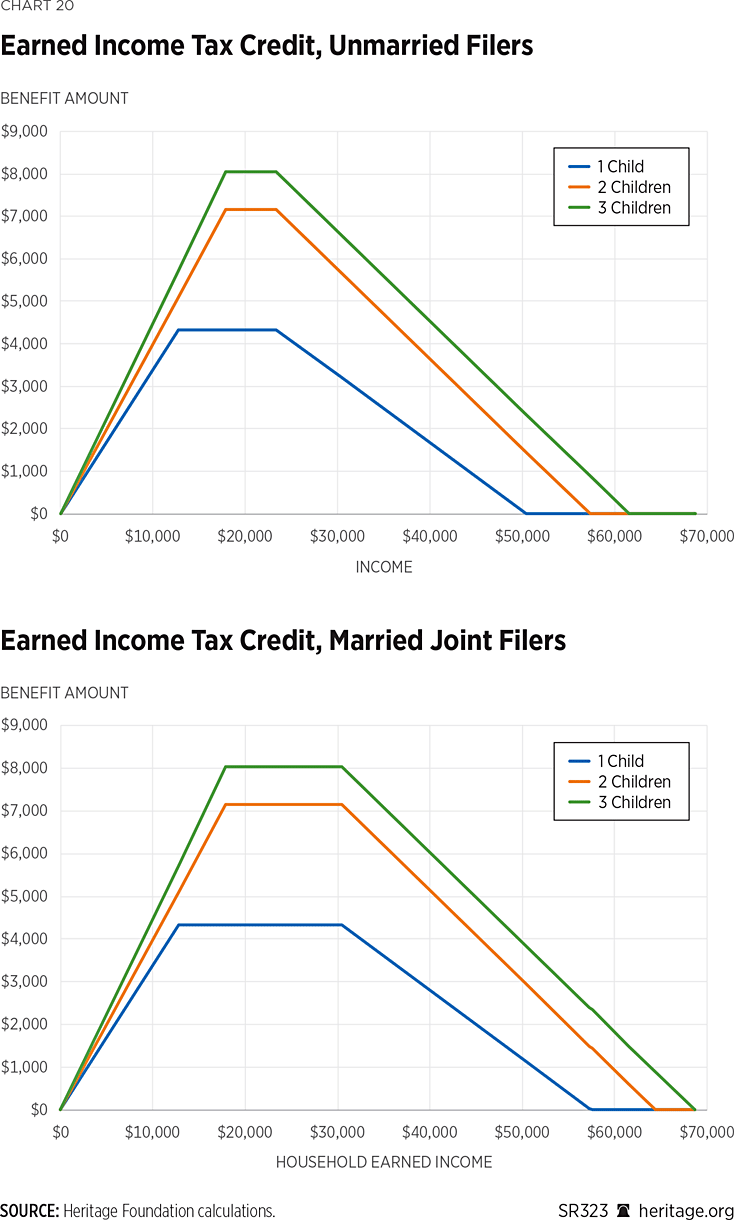
The EITC’s design strongly favors single parenthood over marriage, at least for marriages that bring in a second income for a family. For example, a single mother of two making $25,000 a year would receive an EITC benefit of $6,805, but if she was married to someone who also earned $25,000 a year, they would share a $3,039 EITC benefit. If she was married to someone who earned $40,000, the family would not qualify for any EITC benefit.
The EITC is also biased in favor of small families over large families. Its credit for a first child is nearly five times the added credit amount associated with a third child. Fourth children and beyond do not affect the EITC credit amount at all.
Child Tax Credit. The child tax credit (CTC) provides a maximum benefit of $2,200 per qualifying child aged 16 or under. However, this figure is also inflation adjusted. Like the EITC, taxpayers with no income cannot claim the CTC. The CTC is only partially refundable, meaning only a portion of the credit can be claimed if the taxpayer’s income tax liability is less than the maximum CTC amount. The maximum refundable amount in 2025 was $1,700 per child.[REF] The refundable portion of the credit, known as the additional child tax credit (ACTC), phases in more gradually and phases out at higher incomes than the EITC. The ACTC begins phasing in at $2,500 of household income at a rate of $15 per $100 of income above the $2,500 threshold. The phaseout starts at $200,000 and $400,000 of income for unmarried and married taxpayers, respectively. Charts 21 and 22 show how the CTC varies with income and family size.
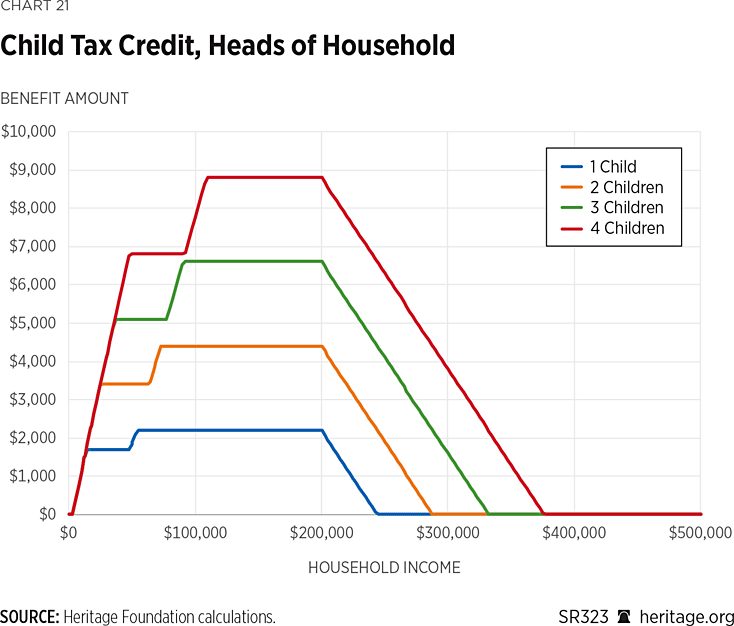
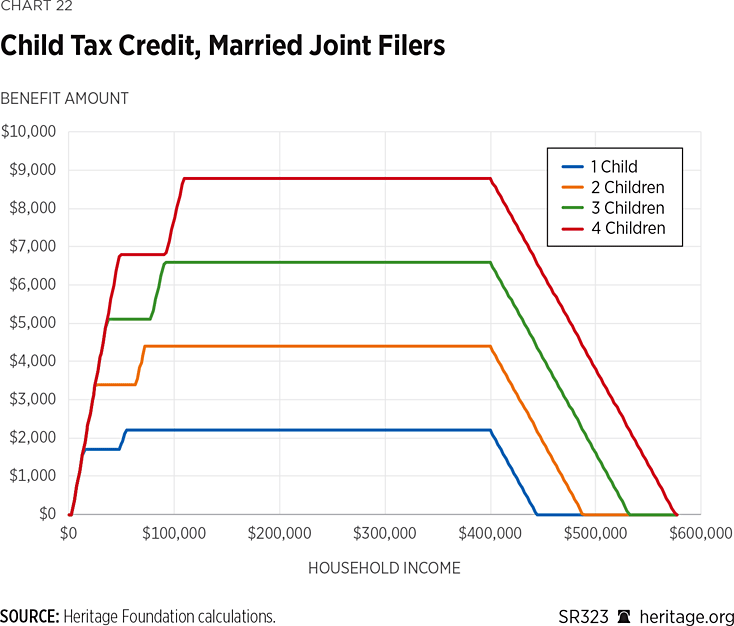
The 15 percent ACTC phase-in roughly corresponds to the combined payroll tax on wages that almost all employers and employees are required to pay to fund the Social Security and Medicare systems. Therefore, the refundable ACTC is—in a sense—acting to offset not just income taxes but payroll taxes, too. However, that means that for these filers, almost all, or a large portion of, their contributions to their old-age entitlements is actually made by taxpayers at large. Further, if the ACTC and EITC are claimed together, the taxpayer’s combined income and payroll tax liability may be negative—indicating a net subsidy.
Because the CTC amount is flat across most common income bands, it is mostly neutral toward marriage (unlike the EITC). Though it does not add to marriage penalties in the way the EITC does, the CTC does not offset any existing marriage penalties, either. The cap on CTC refundability and the gradual phase-in allow more per-child benefits to low-income small families than to low-income large families. However, eliminating that bias in the CTC would fundamentally change the nature of the credit, making it more akin to a guaranteed basic income that would discourage work.
The 2017 Tax Cuts and Jobs Act doubled the credit amount to $2,000 for the years 2018 to 2025. The OBBBA increased it to $2,200, made the increase permanent, and set it to be inflation adjusted going forward.
Adoption Tax Credit. The adoption tax credit is a one-time credit of up to $17,670 (as of 2026). The adoption credit starts to phase out at a modified adjusted gross income of $265,080 to a complete phaseout at $305,080. The OBBBA amended the adoption tax credit to index it to inflation and to make it partially refundable ($5,000 in 2025) so that amounts exceeding the refundable portion can only be used to offset income tax liability. To the extent that a taxpayer does not use the full adoption non-refundable tax credit in the first year of adoption, the filer may, however, carry forward the unused credit to offset adoption expenses for up to five tax years.
While the adoption tax credit no doubt incentivizes and helps families to pursue adoption, there are some issues with its design that may be counterproductive. First, by allowing a 100 percent, dollar-for-dollar, offset of expenses up to the maximum credit of $17,670, it leaves some taxpayers with no incentive to keep adoption expenses down. This may, for example, incentivize international adoptions over domestic adoptions. As seen with higher education subsidies, the resulting lack of price sensitivity may drive up administrative costs at adoption agencies, which may in turn dissuade prospective adoptive parents of more modest means from adopting.
The adoption tax credit’s high dollar value combined with its partial refundability ensures that higher-income taxpayers benefit the most from the credit. Many low-income and middle-income taxpayers with children do not have well over $12,000 of federal income tax liability to offset. Higher-income taxpayers are naturally less sensitive to adoption costs, yet the credit leans in their favor.[REF] All else being equal, families with more children are less likely to benefit from the adoption tax credit.
Child and Dependent Care Tax Credit. The OBBBA also amended the child and dependent care tax credit (CDCTC), such that parents with one qualifying child or dependent can claim a nonrefundable credit on up to 50 percent of childcare expenses (scales down to 20 percent for those with higher incomes), but not more than 20 percent for those with higher incomes of up to $15,000 of childcare expenses.[REF] The maximum CDCTC is, therefore, $3,000 for parents with one child and $6,000 for parents with two or more children. As a nonrefundable credit, however, these amounts are limited to the taxpayer’s pre-credit federal income tax liability.
The CDCTC is most useful to middle-to-upper income parents of one or two children in high-cost jurisdictions. It incentivizes formal childcare over a stay-at-home parent or informal care arrangements by relatives or friends. As with some of the other credits mentioned above, while the CDCTC benefits some families, it also has some undesirable features for families. For instance, it disadvantages some traditional family arrangements and large families, and it weakens bonds among extended family members.
Three New Policies to Support Family Formation
U.S. family policy that is designed to encourage marriage, work, and large and growing families would be a paradigm shift. Such proposals inevitably face opposition from advocates of traditional welfare or those who see marriage as a retrograde institution, but their approaches have been tried extensively and have failed spectacularly. It is time for fresh approaches.
Accordingly, this Special Report proposes three new family policies that further these goals and are distinct by being centered on marriage. They are:
- The Family and Marriage (FAM) tax credit,
- The Home Childcare Equalization (HCE) credit, and
- The Newlywed Early Starters Trust (NEST) accounts.
Policy Proposal 1: The Family and Marriage (FAM) Tax Credit
The FAM credit would be a $4,418 refundable tax credit for married joint filers who have a child, and where both the tax filing adults claiming the credit are the biological parents of the child in question (widows and widowers would also qualify in the same year). The credit would be available for the tax year in which a child is born and then in each of the following three tax years. Further, the tax filers would have to meet the work and other eligibility requirements described below.
The new FAM tax credit would be the same per-child maximum dollar amount ($17,670) as the current adoption tax credit in most cases, except that the refundable FAM credit would be claimed over four years instead of one.
A 25 percent Large Family Bonus would be added for filers having their third (or more) child, bringing the per-child FAM credit to $5,521 for each of those additional children.[REF] The FAM credit would be inflation adjusted each year, as is the current adoption credit. The FAM credit phaseout would correspond to the phaseout rules for the CTC. (That is, a 5 percent phaseout that begins at an income of approximately $110,000.)
Most married parents with at least one full-time working spouse would be eligible for the full credit amount associated with their family structure. The credit would begin to phase in at approximately $30,500 of earned income.[REF] For married families with one child under age four, the credit would phase in at a rate of 16 percent and be fully phased in by approximately $57,500 of income, and by almost $72,000 for married parents qualifying for the Large Family Bonus with three qualifying children (the full phase-in earned income threshold would scale up from there with more qualifying children). The income-based phase-in of the FAM credit would coincide with the income-based phaseout of numerous other transfer payments to parents, including the EITC. Therefore, the FAM credit’s phase-in would incentivize work in an income range where work is currently heavily disincentivized. The new FAM tax credit would offset existing penalties on marriage and having a large family.
Married parents with multiple children born within the previous four years would be allowed to stack multiple FAM credits on top of the other, subject to the credit phase-in rates. Chart 23 shows how the structure of the FAM credit changes for parents with multiple children under age four who qualify for the FAM credit.
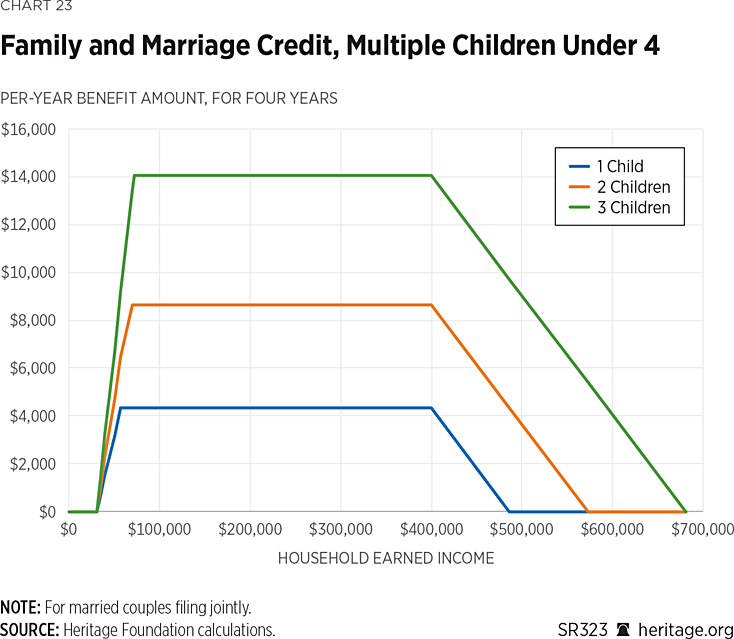
Eligibility Requirements and Other Details. To qualify for the FAM credit, both the parent(s) would be required to be U.S. citizens (or LPRs) and child (or children) would be required to be U.S. citizens with valid Social Security numbers. If the parents divorce before the end of any of the four tax years, they would not be eligible to claim the full FAM credit for that child in that or any subsequent tax year.
Individuals or couples who adopt would not be allowed to claim the FAM credit for that child to avoid doubling of benefits with the adoption tax credit.
Relative Advantages of the FAM Credit. Compared to other family policies, the FAM credit is better engineered to encourage healthy family formation. For instance, the FAM credit:
- Encourages marriage. Unlike other programs that directly or indirectly impose marriage penalties, the FAM credit rewards marriage by offsetting many marriage penalties. The pro-marriage incentives would be largest for low-income single parents who currently face steep phaseouts in other benefits if they marry an income-earning spouse. The pro-marriage feature of the FAM credit is well warranted since the decline in marriage has been especially severe among those with low incomes—who may be especially likely to respond to the system’s marriage disincentives by avoiding marriage.
- Favors large families, but only with married parents. America’s birth rate will never return to replacement levels if parents only have one or two children, and yet the array of tax and transfer programs for families and children disproportionately advantage families with one or two children instead of larger families. The FAM credit’s Large Family Bonus for married parents would help to promote a normalization of large families with at least one working parent.
- Avoids new work disincentives and blunts existing ones. The FAM credit is designed as a temporary benefit for growing middle-class families, not as a welfare entitlement. Parents who do not work, or who work very little, would not receive the credit. Benefit phaseouts that happen rapidly with income can act like a large tax on income, but the FAM credit amount is flat or increasing throughout the range of middle-class incomes. The credit’s phase-in occurs over the income phaseout range for the EITC and many other federal and state benefit programs. This would help to negate the work disincentives inherent in these other programs.
- Supports new families. The FAM credit is designed specifically for families with newborns or young children. Lawmakers interested in family policy may be inclined simply to expand the CTC. However, this approach would be inefficient as a family formation incentive. Only a small fraction of the benefit would go toward new parents, while most of it would go to families that are already formed. Nor would these dollars offset current harmful marriage penalties. A well-targeted approach is more fiscally responsible and avoids adding more to the debt and deficit than is necessary. This, in turn, may benefit new families by avoiding or limiting upticks in inflation.
- Frontloads benefits to the time that parents most need them. The FAM credit is allocated over the first four years of a child’s life, a temporary benefit in the most demanding child-raising years. The thought of having a baby can be daunting, especially for new parents. Being a new parent brings many new challenges, often including financial strains from prenatal and hospital insurance expenses to needing one parent to take off time from work. These challenges can be a discouragement to family formation. The FAM credit would help young parents to have confidence in starting and expanding their families without falling behind financially. By contrast, many other family benefits, such as the CTC, are backloaded to later in life when many parents are on more solid financial footing and may be past their prime child-bearing years.
Policy Proposal 2: The Home Childcare Equalization (HCE) Credit
As discussed, the costs of child-raising weigh heavily on the choice of adults to have or not have children and relatedly, to marry or not marry. As also discussed, when it comes to childcare and child well-being, there is no substitute for child-raising by a married biological mother and father. When it comes to childcare support, however, Congress has made a deliberate choice to privilege and subsidize out-of-home, marriage-agnostic, non-parental childcare, while not including or privileging at-home, married parent-provided childcare and child-raising.
At-home parents that are left behind are thereby induced by these policies to enter the workforce when many would prefer to stay at home if the options were truly equal. Many parents, particularly mothers, seek the freedom to work and use daycare or raise children at home, but this is not the reality when federal policies explicitly support only one option. This policy choice needs to change, and at the very least, support should be equalized across these settings.
As with this report’s other policy recommendations, this expansion must be keyed to marriage. Cohabiting parents or couples providing at-home childcare who marry should be supported in that choice because of the benefits of long-term stability to the children and the parents. As for single parents that stay at home to raise children, many who face poverty are already generously supported by the current welfare state that penalizes marriage. As with this report’s other credit proposals, this one seeks to eliminate those marriage penalties with a new Home Childcare Equalization (HCE) credit.
The proposed HCE credit will be available to married-couple families that are eligible for the FAM credit. This bonus will increase the maximum value of FAM by $2,000 for each eligible child under age five in the family and will otherwise follow the rules and parameters of the FAM credit. This means that, like the FAM credit, a family must have at least $30,470 in earned income to receive the HCE credit. The phaseout rate would be 5 percent on top of the phaseout rate of the underlying FAM credit and would start at the same income as the phaseout for the FAM credit.
The new childcare equalization credit and the FAM credit will not duplicate benefits that the family already receives from the CDCTC, the Child Care Development Fund (CCDF), or both. The value of the family childcare credits proposed here will be reduced by the amount of the federal subsidy the family received from the CDCTC and CCDF. Specifically, the new credits will be reduced by one dollar for each federal dollar of benefits received from either of the two existing daycare programs. In practical terms, this means that many middle-class married parents will not claim the CDCTC because the value of the new credits will exceed the value of benefits that could be received from the CDCTC. As a corollary, unmarried middle-class parents that are taking childcare credits under the existing system, would be presented a modest incentive to marry.
The average value of childcare subsidies in the CCDF is around $8,000 per child. Around 360,000 married families receive subsidized care from this program; most of these families will not receive benefits from the FAM credit or the family childcare add-on credit because the value of the daycare subsidy they already receive from the CCDF exceeds the combined value of the two new credits.
Budget Impact. Because the FAM credit and the HCE credit add-on would be targeted to the married parents of newly born children, their combined budget impact would be small relative to existing programs like the CTC and EITC. Over 10 years, the FAM credit and HCE credit add-on would cost about $188.7 billion.[REF] (See Chart 24.) However, a portion of the costs here would be offset by cost reductions proposed throughout this Special Report.
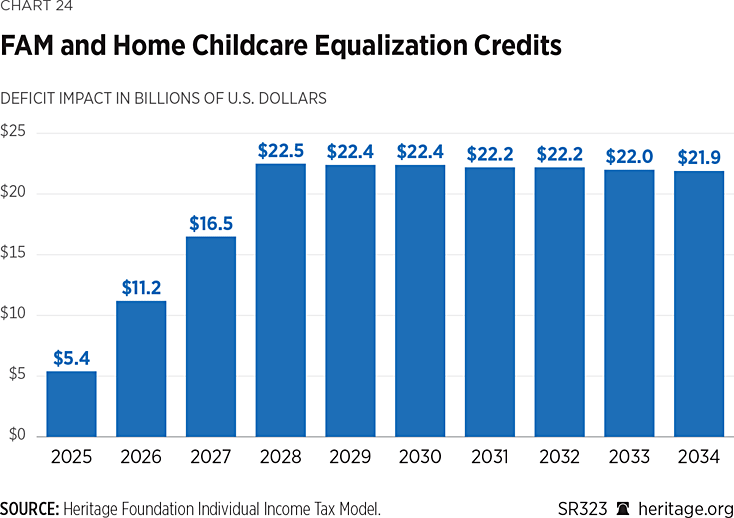
Reforming Head Start. Established in 1965 during President Lyndon Johnson’s Administration, the federally funded Head Start program provides preschool care to children from low-income families. Organizations apply for Head Start spending grants, which awardees use to operate preschool centers. Today, taxpayers spend more than $12 billion annually on these centers, which support approximately 715,873 children in fiscal year 2024. Taxpayers spend about $16,400 per child per year in Head Start,[REF] exceeding the national average of $11,582 for private center-based childcare.[REF]
Policymakers have had many chances to reform Head Start over the past 60 years since its creation. Yet the program remains plagued by problems. In 2012, the Department of Health and Human Services (HHS), which administers Head Start, released the results of its randomized control trial evaluation, which found that the program “had little to no impact on cognitive, social-emotional, health, or parenting practices of participants.”[REF] Head Start has also faced multiple occurrences of financial fraud and child abuse over many decades.[REF] Most recently, in January 2024, the GAO released a report revealing at least 15 documented child-safety violations in Head Start centers under interim management.[REF] The GAO also found that the Office of Head Start failed to monitor enrollment or require the return of funds for children no longer in the program.[REF] Just two years earlier, a 2022 report from the Office of Inspector General at HHS found that approximately one in four grant recipients had incidents in which children were abused, left unsupervised, or released to an authorized person between 2015 and 2020.[REF]
Congress should consider adopting policies similar to those of the Head Start Improvement Act.[REF] This bill would give states, local officials, and parents greater control over Head Start funds by replacing the existing Head Start program with block grants to eligible states, territories, and federally recognized Indian tribes. The proposal shifts program oversight and control to states and tribes, and allows grant recipients to make funds portable in the form of education savings accounts (ESAs), in which parents can take their portion of grant funds to an education provider of their choice.
Congress should alternatively consider transferring Head Start funds to the Child Care and Development Block Grant (CCDBG).[REF] In 1990, Congress established the Child Care Development Fund as part of CCDBG, which allowed states to provide financial assistance to low-income families through vouchers for childcare costs, which could be used at approved childcare providers. Families are given a range of options for approved childcare providers, such as family childcare homes, relatives, faith-based providers, and other centers.[REF]
If the federal government is to continue subsidizing childcare expenses in underperforming Head Start centers, it should provide parents with the option to either send their children to Head Start, or to use the money for private or at-home, parent-provided childcare and education.
Policy Proposal 3: Newlywed Early Starters Trust (NEST) Accounts
The new Trump Accounts in the OBBBA have taken a bold step in ensuring that every American is born with a starting investment nest egg. This provides, at birth, a financial foundation for every American.
Newlywed Early Starters Trust (NEST) accounts would expand this foundation by creating a separate second account that mirrors the main mechanisms of the new Trump Accounts and focuses squarely on supporting marriage and healthy family formation. Further, this will raise the incentive for children and young adults to learn financial literacy since every American would be born with some holdings of stock equity in the broader U.S. economy. This could help to shift the perspectives of young Americans to see marriage as a cornerstone and not a capstone and to see themselves not just as workers, but as stockholders in the economy and, ultimately, in the future of their nation.
These NEST accounts would be seeded with at least $2,500 upon the birth of a child where at least one of the parents is a U.S. citizen. The federal government would provide these funds and inflation adjust the seed amount each year. Along the same lines as the new Trump Accounts, these NEST accounts would be able to receive further contributions.


In this manner, NEST would provide a straightforward and simple program to convey the importance of marriage and healthy family formation. The NEST proposal is a pure and straightforward incentive for marriage and healthy family formation.
Parents could either create a NEST account at a brokerage firm of their choosing in the child’s birth year, or the federal Thrift Savings Plan (TSP) would create an account on their behalf if they do not create such an account.
The TSP already manages retirement savings accounts for federal workers. Federal employees have a menu of particular stock market funds from which to choose to invest their NEST money. Leveraging the current TSP setup would therefore be ideal to ensure that a newborn has an account if the parents do not want to set up an account or fail to do so.
For TSP accounts, the seed money would by default be invested in the TSP C Fund, which broadly tracks the performance of the S&P500. However, parents or other custodians, or the children themselves, could gain control over the account at any point and then choose to either manage the funds within the TSP account or roll over the funds to another brokage account of their choosing.
Withdrawals would not be allowed from these NEST accounts until the beneficiary either marries or turns 30 years of age. Once beneficiaries turn 30 years of age, they may withdraw any or all the funds in the NEST account. However, any withdrawals after turning 30 will be taxed under the same rules as the new Trump Accounts.
Once a beneficiary marries, but before turning 30, he or she would be able to begin removing funds from the NEST account, without facing taxation, in the following manner: During the first tax year in which the beneficiary files as married, he or she may withdraw up to 33 percent of the balance of the NEST account, up to 50 percent in the second such tax year, and up to the full balance in the third such tax year or beyond as long as the couple continue to legally file taxes as married.
This would allow beneficiaries to withdraw, essentially, a third of their NEST balance in each of the first three tax years of their marriage. Filers marrying around 27 years of age would be able to unlock all their NEST funds without paying any taxes. If they marry later, or never marry, then some or all the NEST funds would be subject to taxes.
By delaying withdrawals in this manner, it ensures, in a similar manner to the FAM credit, that beneficiaries cannot simply get married and then divorced shortly thereafter, to unlock all the funds in their NEST account. This would ensure that recipients follow the spirit of the program’s intended purpose.
NEST could cost taxpayers roughly $8 billion in the first year of implementation. This could rise to roughly $10 billion annually after 10 years, with a 10-year program cost rate of roughly $92 billion.[REF] However, these costs could be somewhat or even fully offset depending on the volume of donations from the private sector to fund these accounts. In the long run (outside the standard 10-year budget window), annual program deficits would also be reduced by extra tax collections from NEST balances that are withdrawn after beneficiaries turn 30.
Taking the Long View
Policymakers too often focus on the short term, which parallels a near-sightedness in our culture at large. A farmer who enjoys the harvest he reaps today but neglects to sow a new crop will suffer in the long run. The situation is similar for much of the world as global births plummet. Nations that fail to preserve marriage and family face steep declines in family stability, positive life outcomes, and overall births that, when combined, will threaten the existence of the nation itself. That such an end may still be decades away lessens the imminence but not the risk.
Accordingly, policies to reverse the decline need to start today. Political enthusiasm, unfortunately, is often determined over a very short time horizon—such as the next national election. Even if policymakers are interested in policies’ long-term effects, such effects are usually hard to separate from the effects of other events. This is especially true for policies like solar power subsidies and the rosy predictions of how they would affect global temperatures.
The demographic predictions assumed in this report are not nearly as speculative because, unlike climate models, they are based on simple arithmetic. It is possible to predict with confidence where the current demographic course will lead the country—unless Americans make radical changes. Preventing demographic doom decades from now requires immediate adoption of solutions whose greatest benefits—future children themselves marrying and having children—will likely not be seen for many years.
Family policies adopted now should not focus merely on the here and now. They should encourage and reward those who work, stay married, and choose to invest in their families, with preferences for larger-than-average ones. As more people encounter young married couples and large families, they are likely, in time, to see them as both good and unremarkably common. Such a cultural shift in expectations would likely prove more pivotal than the direct effect of the incentives themselves. These policy proposals are designed to set that positive feedback loop in motion.
While the fiscal impact of the proposed policies may strike some as large, the combined 10-year cost of the FAM and HCE credits and the NEST proposal would be less than nine-tenths of a percent of what the nation will likely spend on Social Security and Medicare in that same time period. This is to say that, over a 10-year period, the U.S. will likely spend $116 on Social Security and Medicare for each dollar spent on the three fiscal programs proposed in this report. Ironically, Social Security and Medicare’s fiscal solvency is under threat because Americans do not have enough children to maintain the working-age population needed to continue funding those extraordinarily expensive programs.
Although the upfront costs of this report’s family policy proposals are significant, they are well worth it to save the American family.
Conclusion
Policymakers and civic leaders should treat restoring the family home as a matter of justice, driven by two truths. The first is that all children have a right to the affection and protection of the man and woman who created them. The second is that the ideal environment in which to exercise this right is in a loving and stable home with their married biological parents.
By contrast, the default in American culture today is to put the desires of adults over the needs of children. Children are too often called to sacrifice what is due to them—namely, the presence of their mom and dad under the same roof for the entirety of their childhood.
That is a moral inversion. Parents have a duty to sacrifice to provide for their children because creation and stewardship go hand in hand. Those duties are best carried out when a father and mother are committed to each other in a loving, monogamous marriage. A movement to restore the American family must be centered on the unique rights and duties of parents and children. It must seek to restore order to the household and put the responsibility for the provision, moral instruction, and emotional development of children back where it belongs—with their parents. This sets in motion a virtuous circle. Parents who fulfill their duties often receive a much greater reward: Children provide the highest degree of life satisfaction for the majority of people who have walked the Earth.
Anyone who claims to care about social and economic outcomes for Americans should be promoting a culture where men and women commit to one another and the families they build together, not creating fatherless (or motherless) children for the fulfillment or convenience of adults. It would not make sense to launch a massive national movement to address the unrelated home lives of a handful of children scattered across the country. Those would best be handled individually. But when fractured families harm millions of children, society should recognize it for the “systemic” issue that it is. The fact that a growing number of American children do not live under the same roof with their married parents is an injustice. Restoring the family must rectify this injustice.
These are the philosophical cornerstones for this Special Report, which provide the measure of success for its policy recommendations:
First, a pro-family policy agenda should recognize the natural family as a pre-political reality grounded in humans’ biological and social nature. It exists in some form in every culture. It is the cell of society. No public policy that ignores or contradicts this truth should enjoy support.
Second, the country should avoid policies, however well-meaning, that undermine marriage and the formation of families, or reward or encourage needless delay in marriage and out-of-wedlock births. The country’s regulations, welfare system, and tax code, for instance, should not penalize marriage and encourage single parenthood. Education should not coax young Americans to delay marriage while pursuing needless credentials. Housing policy should not put the price of owning a home out of the reach of the median American family. Tech policy should not make it harder for families to balance their duties at home and at work. Environmental policy should not treat human beings as mere costs.
Third, policies should favor natural marriage over same-sex and polyamorous relationships, cohabitation, or intentional single parenthood. Fathers and mothers are not generic and interchangeable “parents.” It is not discrimination to acknowledge the differences between them. Each brings unique and complementary assets to the vocation of parenthood. Every child, biologically, has both a mother and a father and has a legitimate claim on each of them. This is the basis for monogamy. Without mating, there is little public reason for marriage to be limited to two people. A policy should never encourage efforts to intentionally separate a child from his or her mother or father, except in extreme cases involving immediate threats to a child’s life and safety.
Fourth, and related, the state and federal governments should recognize the natural differences between men and women. They should also preserve this distinction between the sexes in law against attempts to replace it with tendentious and subjective concepts, such as “gender identity.”
Fifth, policy should not merely avoid hindering family growth but should prudently support and encourage it as vital to the long-term health of the Republic.
Sixth, policymakers should commit to protecting life from fertilization. In the U.S., technologies such as in vitro fertilization and preimplantation genetic testing routinely manipulate or destroy human embryos. Pro-family champions should fight to protect embryonic and unborn life in law. Such protection should extend not just to cases of abortion but to all uses of reproductive technologies and scientific research.
Seventh, pro-family policies should preserve and protect the rights of parents—and corresponding duties—to oversee the care, education, and upbringing of their children. These rights, like the inherent rights of individuals, precede the state. A just state does not create these rights but recognizes them.
Eighth, policies must take culture and religion far more seriously. Raising children is hard work. Many of the incentives for large families that persisted for millennia—such as the need for farm labor and high rates of infant mortality—no longer hold. At the same time, men and women who delay or forgo childbearing do so because they are opting for something else: a demanding career, leisure, travel, fewer financial burdens, and hobbies. If adults view children as just another pet project, it is no surprise that more and more adults decide that children are not worth the trouble.
In summarizing her seminal research on American families with five or more kids, economist Catherine Pakaluk explains that “falling birth rates” are “more of a demand problem than a supply problem”:
The women I interviewed, at every level of engagement with paid work and every income, had additional children because they valued children more than other things they could do with their time, talents, and money. The relevant obstacle to choosing a child, they said, was the cost of missing out. They talked about sleepless nights and giving up comforts, plans, hobbies, status, income, a clean house. Giving up alone time. Giving up freedom. These costs were big and consequential, they conceded. But they had a reason to pay the price. This isn’t a story about it being easy to have kids—it’s a story about having a reason to do “the most hard thing you’ve ever done” more than once.[REF]
In developed countries, most people who choose to have large families do so for cultural or religious reasons.[REF] Indeed, marriage skepticism and anti-natalism now seem to be the preferred postures of the secular set. Given the profound effect of religiosity on family size, prudent pro-family policies should protect and reinforce the free exercise of religion. Free exercise is far more expansive than mere freedom of “belief” or of “worship.”
In sum, government policies should encourage and protect the formation of families, not mere fertility. The country should not seek a mere boost in the number of children born or in the monetary support that parents receive. Yes, the country needs more children. But it matters how and to whom children are born. Society depends on men and women who want to form families, that is, who freely want to marry, and then freely bear and nurture children.
In terms of specific policies, this report has argued that government should:
- Stop penalizing married couples,
- Help restore the American Dream, and
- Actively support marriage and working families.
Studying family policies from abroad, however, teaches that policy alone will not solve the family crisis. Contributions from religion, the arts and entertainment, media, culture, and countless civic institutions are indispensable. Pro-family policy can help fertilize the soil in which family, faith, and freedom can flourish. It can favor humans’ capacity to be fruitful and to multiply—without which a thriving economy and healthy culture cannot endure. But at bottom, far more Americans must come to view the bearing and raising of children within marriage as vital aspects of the human journey—not as mere consumer choices.
While young Americans today have largely deprioritized marriage and family formation compared to preceding generations, disaggregated data show encouraging signs of hope. Young men that voted for President Trump in the last election ranked having children as their number one measure of life success, and female Trump voters ranked it sixth.[REF] This means that a sizeable subset of young people rank family formation moderately highly to extremely highly and do not need much (or as much) persuading on this existential question.
But even if convinced of the value of family, young people will still need to overcome the many obstacles to forming families and the authors of this report are confident that with the policy changes, supports, and incentives presented here, today’s young people will be able to pursue the American Dream, and, in so doing, save America itself.
Appendix: The Heritage Foundation Budget Score for NEST Accounts
To help to reduce financial barriers to marriage for the next generation and to help to provide financial security for the next generation of newly married couples, the authors of this Special Report propose a new class of tax-advantaged savings accounts called Newlywed Early Starters Trust (NEST) accounts. The rules governing NEST Accounts would be similar in many ways to those for Trump Accounts which were recently established in the One Big Beautiful Bill Act (Public Law No. 119-21).
Appendix Table 1 shows the estimated effect that the NEST accounts would have on federal revenue. Since the rules governing NEST Accounts are mostly like those outlined for Trump Accounts in the version of H.R. 1 (2025) that passed the House of Representatives on May 22, 2025, the authors made an assumption that the net impact on federal revenue of the NEST accounts would be the same as they would have been for the original rules for the Trump Accounts. We consider the Joint Committee on Taxation’s (JCT’s) estimates of the impact on federal revenue of the original rules for the Trump Accounts and the Trump Accounts’ contribution pilot program to be reasonable.[REF] We used the Joint Committee on Taxation’s (JCT) estimates on the Trump Accounts to approximate the revenue effects of the NEST accounts.

To estimate the cost of the one-time seed deposits into NEST accounts, we took three projections (high, mid, and low) for the number of births in the United States from the U.S. Census Bureau’s “2023 National Population Projections.” According to the U.S. Department of State’s Bureau of Consular Affairs, there were 66,595 registered overseas births of U.S. citizens through Consular Reports of Birth Abroad (CRBA) in fiscal year 2019.[REF] These babies qualify for U.S. citizenship at birth.
Since the Department of State does not regularly publicly disclose the number of CRBA applications it receives, processes, or approves, an assumption was made that the number of U.S. citizens born abroad scales in proportion with the annual number of births in the United States. Using the State Department’s figure, we calculated a ratio of the number of overseas births to U.S. citizens in fiscal year 2019 to a weighted average of the number of births in the United States in the calendar years 2018 and 2019. The total number of U.S. citizen births was estimated as the U.S. Census Bureau projected number of births plus the number of projected births times the ratio of overseas births to U.S. births in fiscal year 2019. For simplicity, we made the assumption that all newborns born in a given calendar year were claimed on a tax return in the federal fiscal year ending in the next calendar year. Thus, all births in 2025 were all claimed and provided credits during fiscal year 2026.
To make the problem tractable, we assumed that the one-time deposits would be fully ready in time to provide all credits to all births in 2025, which were, in turn, all claimed in 2026 before the end of the federal fiscal year. It is difficult to approximate how many of these U.S. citizen births would qualify for NEST accounts, and the deposits, owing to their parent(s) or legal guardian(s) having (a) valid Social Security number(s). The Social Security Administration does not provide data on the number of Social Security account holders by age. As a result, we assumed that the difference between our projections of the number of U.S. citizen births and the estimated number of eligible beneficiaries implied by the JCT’s estimates of the revenue effects of the Trump Accounts contribution pilot program were the number of U.S. citizen births that would not qualify for a NEST account and the one-time deposit.
We also assumed that the difference between the two estimates will scale constantly over time in proportion to the projected number of U.S. citizen births. As a result, the number of eligible beneficiaries was estimated as the projected number of U.S. citizen births times a ratio of the JCT’s estimate of the revenue effects of the Trump Accounts contribution pilot program in fiscal year 2027 and the projected number of U.S. citizen births eligible to be claimed in fiscal year 2027 scaled by 1,000.
To adjust the valuation of the initial NEST deposits for the cost-of-living adjustment, we used the Congressional Budget Office’s forecast for the annual change in the consumer price index through to fiscal year 2034.[REF] The estimated cost for each year is the number of eligible beneficiaries multiplied by the inflation-adjusted value of the credit. Three projections of cost (mid, high, and low) were provided corresponding to the three projections of births as there is considerable uncertainty in how fertility will progress into the future.
Appendix Table 2 shows the projected balance for a NEST account for a qualifying child who receives the $2,500 one-time initial credit and who consistently receives contributions to his account at a fixed-dollar amount every year until he turns 18. Like Trump Accounts, eligible investment for NEST accounts would be defined as a mutual fund or an exchange-traded fund with low fees (less than 0.1 percent of the balance of the investment), that does not use leverage and that tracks the returns of a well-established index of U.S. equities, such as the Standard and Poor’s 500 stock market index. The average annual rate of returns on the S&P 500 Index, including dividends, since 1960 has been 11.7 percent.[REF] We assume an 11.7 percent annual rate of return on NEST account investments. Our projections also assume that interest compounds annually and that annual contributions are fixed and recurring and are added to the principle of the account only at the end of the account’s fiscal year.
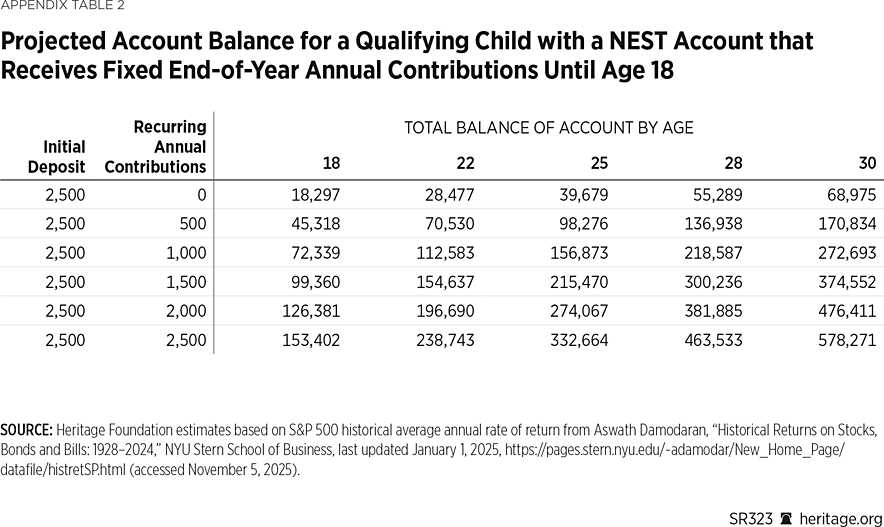
There are many shortcomings to this budget score, many of which we have mentioned above. We could not score the precise provisions for these proposed NEST accounts. As a result, we assumed that the costs would be the same as for the Trump Accounts in H.R. 1 as passed in the House. Hence, the cost estimates for the NEST accounts may be off.
For instance, NEST Accounts can be established for any U.S. resident with a Social Security number under the age of 18 who is a dependent of someone with a Social Security number, but the original House bill for the Trump Accounts limited account establishment to children under the age of eight with a Social Security number who are also a dependent of someone with a Social Security number. This difference in age limits for account establishment has potentially large budgetary effects. The NEST account rules would mean that the federal government stands to lose out on collecting taxes on capital gains from investment accounts that otherwise would have been invested in had these tax-deferred accounts for children eight to 18 years of age not been established.
Also, since we could not estimate by age the population eligible for Social Security, we have no way of knowing exactly how many eligible beneficiaries there will be for NEST account deposits. While a Social Security number is obtained for nearly 100 percent of births in the United States, parents of foreign origin are less likely to have one themselves. So, the parental Social Security number requirement could potentially exclude many births within the United States.
About the Authors
Roger Severino is Vice President of Economic and Domestic Policy and the Joseph C. and Elizabeth A. Anderlik Fellow at The Heritage Foundation. Jay W. Richards, PhD, is Vice President of Social and Domestic Policy, Director of the Richard and Helen DeVos Center for Human Flourishing, and the William E. Simon Senior Research Fellow at The Heritage Foundation. Emma Waters is a Policy Analyst in the Center for Technology and the Human Person at The Heritage Foundation. Delano Squires is a Research Fellow in the DeVos Center. Rachel Sheffield is a Research Fellow for Welfare and Family Policy in the DeVos Center. Robert Rector is a Senior Research Fellow in the DeVos Center.