

The municipal bond market is one of the foundational mechanisms through which American state and local governments finance essential services. With more than $4 trillion in outstanding debt, it enables thousands of jurisdictions—ranging from cities to counties to school districts and even special-purpose authorities—to fund infrastructure projects across the country. These projects are core responsibilities of government. For many communities, particularly in smaller or rural jurisdictions, municipal bonds represent the primary means of raising capital.
What makes this market unique is its tax treatment. Interest earned on municipal bonds is exempt from federal income tax and often from state and local taxes as well, particularly when the buyer resides in the issuing state. This tax advantage creates strong demand from retail investors, especially those in higher income brackets, who dominate this space far more than in other segments of the capital markets. As a result, the market is fragmented not only by geography and issuer size, but also by the types of investors and underwriters it attracts. This makes the municipal bond market an interesting laboratory for researchers to learn from and study.
Municipal bonds are typically sold in one of two ways. In competitive sales, the issuer solicits sealed bids from underwriters and awards the bond to the lowest-cost bidder. In negotiated sales, the issuer selects an underwriter in advance and works directly with the selected underwriter to structure and price the offering. In both cases, the underwriter plays a central role as a financial intermediary, purchasing the bonds from the issuer and reselling them to investors. The terms of the bond, particularly the interest rate, are shaped by this process of intermediation. When the field of underwriters narrows, either due to market conditions or regulatory constraints, the issuer may lose bargaining power, potentially raising the cost of borrowing.
This dynamic has come under increased scrutiny in recent years as several states, most notably Texas (2021) and Oklahoma (2022), have adopted laws targeting financial institutions with environmental, social, and governance (ESG) policies. These “anti-ESG” laws prohibit public entities from contracting with firms perceived to boycott certain industries—chiefly fossil fuels and firearms. The result has been the withdrawal of major municipal bond underwriters, including some of the most active national firms, from state and local bond markets in those jurisdictions.
Critics of these policies argue that restricting access to top-tier underwriters reduces competition and disrupts established relationships between issuers and financial institutions, ultimately leading to higher borrowing costs for taxpayers. Supporters counter that any transitional disruptions are outweighed by the policy goals of promoting energy independence or resisting politicized finance.
The municipal bond market offers an unusually transparent and well-documented setting in which to study these competing claims. Each bond issuance is a discrete, time-stamped event, with detailed information available about the issuer, the bond terms, the underwriters involved, and the final pricing. This allows researchers to construct careful comparisons: across states with and without new policies, before and after their implementation, and between otherwise similar bonds. Few areas of public finance offer such a high degree of empirical clarity.
Literature Review
This Backgrounder builds on a large and evolving literature examining how state-level policy choices shape local economic outcomes. Most prior work in this tradition has focused on labor markets and public health, exploring how policy variation across states—such as minimum wage increases, environmental regulations, or smoking bans—affects employment, wages, and health outcomes. Much less attention has been paid to the role of state-level policy in financial markets, and particularly how these choices influence the cost and structure of municipal borrowing.
In 2025, the author of this Backgrounder and three finance experts—John Hund, Christian Lundblad, and Giang Nguyen—conducted a study—“Do Anti-ESG Policies Hurt Local Governments? Evidence from the Municipal Bond Market”—on the recent wave of anti-ESG legislation passed in several states, including Texas and Oklahoma, that restricts specified public contracts or investments involving financial institutions deemed to boycott energy companies or discriminate against firearm businesses.[REF] One widely discussed consequence was the temporary exit of several major municipal underwriters from Texas after the laws took effect. This change raised concerns that reduced competition could increase borrowing costs for local governments.
The most direct antecedent to this study is the 2024 study by Daniel Garrett and Ivan Ivanov, who estimate that Texas’s anti-ESG legislation led to an increase in borrowing costs for affected municipalities by roughly 10 basis points.[REF] Using a triple-difference (DDD) approach, Garrett and Ivanov compare yield changes in Texas relative to other states, focusing on issuers with high exposure to blacklisted underwriters. Their findings have received significant attention in the policy and media space, in part because of the potential implications for taxpayers and the broader debate over ESG investing.
The 2025 study extends this work using a larger and more recent dataset (spanning 2007–2024), adding Oklahoma, examining bond-level rather than issue-level outcomes, and applying multiple statistical strategies. Garrett and Ivanov provide evidence of short-run effects in Texas, but their estimates are sensitive to the observation window and specification. Our broader analysis finds no consistent increase in borrowing costs or markups over the period studied.
More broadly, this Backgrounder contributes to a growing literature on the structure and performance of the municipal bond market. Recent work has highlighted persistent frictions, including low investor attention,[REF] heterogeneous markups,[REF] and the role of underwriter reputation.[REF] These frictions, coupled with the retail-dominated nature of demand and limited arbitrage across state lines,[REF] make the municipal market uniquely sensitive to changes in the underwriting landscape. At the same time, long-term trends have made the market more efficient in key respects. The 2025 study documents a sharp decline in the probability of uninformed trades and in the markups charged to those investors, while underwriting spreads remain flat. They relate these patterns to changes in market transparency and investor sophistication.[REF] These shifts may explain why the market has proven more resilient to recent policy than some commentators anticipated.
These findings also speak to an adjacent literature on ESG investing, particularly debates over the reliability of ESG metrics and the consequences of ESG-related portfolio constraints. Some studies examine how markets price environmental externalities or investor preferences, while others document substantial divergence across ESG ratings and question whether ESG filters consistently improve out-of-sample portfolio performance.[REF]
For policymakers, two broader lessons emerge. First, ESG ratings themselves are highly inconsistent, often relying on opaque methodologies and data collection that yield contradictory scores across different providers. Making binding financial decisions on the basis of such tenuous metrics requires a level of trust that is not warranted by the evidence, and risks subordinating fiscal prudence to subjective and shifting standards. Second, state sovereignty in financial and investment policy is especially important in light of the growing demands on the U.S. energy grid. As states seek to balance reliability, affordability, and resilience, they are right to ensure that capital markets remain open to all energy producers rather than filtered through contested ESG criteria. In this context, the experience of Texas and Oklahoma suggests that states can defend their policy priorities without sacrificing fiscal health in municipal finance.
Institutional Background
Over the past several years, a growing number of U.S. states have taken explicit steps to limit or reverse the influence of ESG considerations in public investment decisions. These state-level interventions are part of a broader political and financial backlash against ESG frameworks, which critics argue inject non-financial criteria into capital markets and undermine traditional fiduciary standards.
Among the most assertive states in this movement are Texas and Oklahoma, both of which enacted binding restrictions involving financial firms deemed to boycott energy companies. Texas enacted two distinct laws in 2021, both effective September 1. Senate Bill 13 requires certain state entities to divest from listed financial companies deemed to boycott energy companies and restricts specified governmental contracts, subject to statutory exceptions. Senate Bill 19 separately restricts certain governmental contracts with companies that discriminate against firearm or ammunition businesses. The initial underwriting exits occurred as firms assessed the new certification requirements, before the Texas Comptroller published the first Senate Bill 13 list in August 2022. BlackRock was initially listed but was removed in June 2025.[REF]
Oklahoma enacted the Energy Discrimination Elimination Act in May 2022, with an effective date of November 1, 2022. The law established a process requiring state governmental entities to divest from financial companies that the State Treasurer determined were boycotting energy companies. It defines such a boycott to include specified actions, undertaken without an ordinary business purpose, that penalize or limit commercial relations with fossil-fuel companies. On May 3, 2023, the Treasurer issued an initial list of 13 financial institutions, including BlackRock and several large banks. Together, the Texas and Oklahoma measures formalized the states’ position that ESG policies perceived to penalize fossil-fuel investment improperly constrain free enterprise and energy development.
These laws have since faced legal challenges. In February 2026, a federal district court enjoined enforcement of Texas Senate Bill 13, but the Fifth Circuit stayed the injunction in May, allowing enforcement to resume pending appeal. In Oklahoma, the state supreme court held the Energy Discrimination Elimination Act unconstitutional in its entirety as applied to the Oklahoma Public Employees Retirement System and affirmed a permanent injunction to that extent.[REF]
Beyond these legislative bans, several other states have taken softer, though still consequential, measures. These actions primarily involve reallocating state-managed capital away from ESG-promoting financial institutions, often without explicit legislative mandates:
- In July 2022, West Virginia barred five financial institutions—BlackRock, Goldman Sachs, JPMorgan Chase, Morgan Stanley, and Wells Fargo—from bidding on state banking contracts, citing anti-fossil-fuel stances.[REF]
- In October 2022, Louisiana announced that it would withdraw $794 million from BlackRock over ESG-related concerns.[REF]
- Also in October 2022, Missouri followed with a $500 million divestment from BlackRock.[REF]
- In December 2022, Florida removed $2 billion in assets from BlackRock’s management, the largest such divestment by a state at the time.[REF]
- In January 2023, Kentucky published a list of financial companies subject to a notice-and-divestment process for direct holdings by state governmental entities, subject to statutory exceptions.[REF]
These state-level actions are part of a broader and increasingly coordinated backlash against ESG investing that spans legal, regulatory, and political domains. Several state attorneys general have launched investigations or issued subpoenas to asset managers over ESG proxy voting practices, alleging that such strategies violate antitrust law or fiduciary duty. Meanwhile, Republican-led committees in Congress have held hearings scrutinizing ESG disclosures, climate-risk mandates, and the role of shareholder engagement in corporate governance.
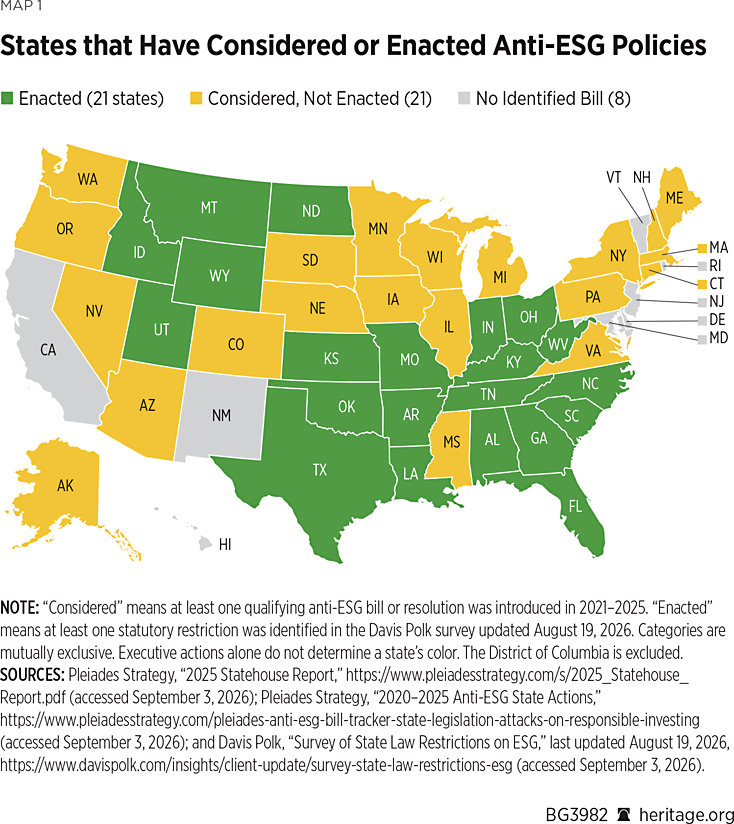
The anti-ESG campaign has also gained traction within think tanks and policy networks that argue that ESG represents a form of politicized investing that displaces shareholder primacy with diffuse social objectives.[REF] Critics contend that ESG ratings are inconsistent, methodologically opaque, and subject to manipulation, and that ESG integration often yields no measurable financial benefit while increasing estimation risk and portfolio noise.[REF] As a result, Texas and Oklahoma stand out not only for their formal legislation (see Map 1), but also for the ways in which their anti-ESG laws have directly affected municipal bond underwriting, offering an empirical setting to test whether limiting ESG-aligned financial institutions materially affects government borrowing costs, investor transaction costs, or overall market efficiency.
Data and Measurement
To examine the financial consequences of state anti-ESG policies, the authors of the 2025 study assembled a comprehensive panel of municipal bonds using the Mergent Municipal Fixed Income Securities database from 2007 to 2024. The database provides bond-level and issue-level characteristics for more than 4 million individual bonds issued across the United States. The final regression sample focuses on 2017 to 2024, while the earlier years are used for matching and pre-trend analysis.[REF]
Each municipal bond offering in the dataset typically comprises several individual securities, each identified by a unique Committee on Uniform Securities Identification Procedures (CUSIP) number. These securities may differ in offering amount, coupon rate, maturity date, credit rating, and structural features, including whether they are insured, callable, or bank-qualified. In addition, the purpose of issuance (such as new project financing vs. refinancing), the type of bond (such as general obligation vs. revenue bond), and whether the bond was issued through a competitive or negotiated sale are observed. Competitive and negotiated sales are defined as follows:
- Competitive sales involve an auction process in which underwriters submit sealed bids, and the bond is awarded to the bidder offering the lowest interest cost.
- Negotiated sales allow the issuer to work directly with a selected underwriter to determine pricing and structure.
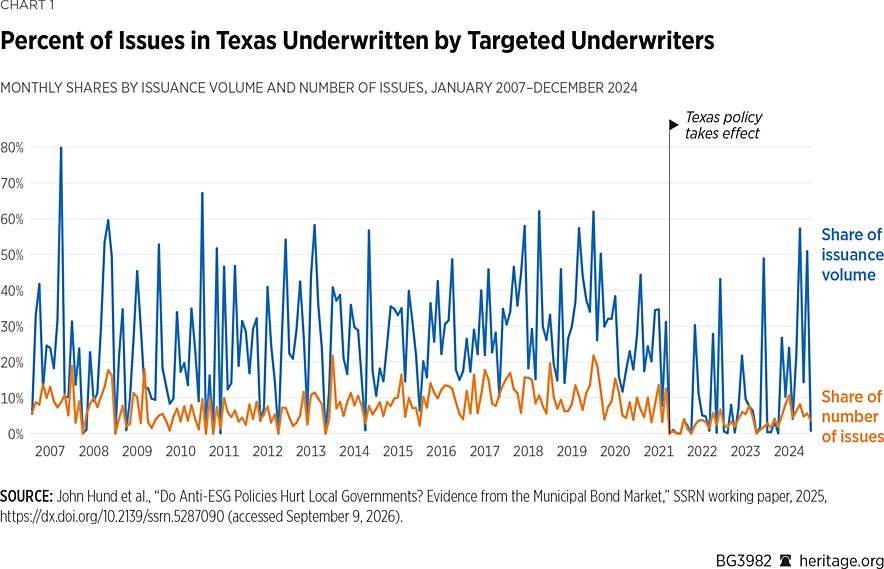
To replicate the statistical model from prior work that found that Texas’s laws raised borrowing costs, the 2025 study also identifies each bond’s underwriters. The study authors manually harmonized variant spellings, abbreviations, and affiliate names to a common firm identifier. Following Garrett and Ivanov, the authors identify five institutions that temporarily exited the Texas market after Senate Bills 13 and 19 took effect: Citi, JPMorgan Chase, Goldman Sachs, Bank of America, and Fidelity. These institutions were not all named on the Texas Comptroller’s later exclusion list.[REF]
As shown in Chart 1, the share of bond issues underwritten by these firms initially declined in Texas following policy implementation but rebounded by 2022 in terms of issuance volume. This pattern is consistent with market adaptation. Estimates of policy impact are sensitive to whether the sample ends in 2022 or extends through 2024.
The economic impacts are assessed along two key dimensions:
- Offering yield: the interest rate at which the bond is issued, reflecting the cost of borrowing to the municipal issuer. A higher yield implies the issuer must pay more to attract investors, making this a direct measure of funding cost.
- Primary-market markup: the spread between the price underwriters pay to the issuer and the price at which bonds are sold to investors in the new-issue market. This markup reflects transaction costs borne by investors and is influenced by competition, market liquidity, and underwriting practices.
To construct markup measures, the 2025 study authors merged Mergent data with transaction-level data from the Municipal Securities Rulemaking Board (MSRB). The merge includes time stamps, trade sizes, prices, and trade types for all bond market activity. Following the literature,[REF] a primary-market trade is a customer buy transaction that occurs within 14 days of the offering date, or until the issue is fully absorbed by investor demand. This window ensures that the markup captures the original distribution of bonds, rather than secondary-market activity.
Then, the markup for each bond is defined as:
Markup (%) = (customer purchase price − offering price) / offering price
The markup is expressed in basis points (bps), where 0.20 percent equals 20 bps. For each bond, the 2025 study takes a trade-size-weighted average across all primary-market transactions.
To ensure data quality, the 2025 study authors dropped observations with implausible or missing offering yields, coupon rates, prices, or offering dates. The authors also restricted the sample to fixed-rate coupon bonds with valid underwriter and transaction data. The final regression sample—focused on the policy evaluation period from 2017 to 2024—includes 815,674 bonds across 72,525 issues, with additional data from 2007 to 2016 used for pre-trend construction and matching. The availability of a longer time series allows us to test rigorously for pre-trends between states.
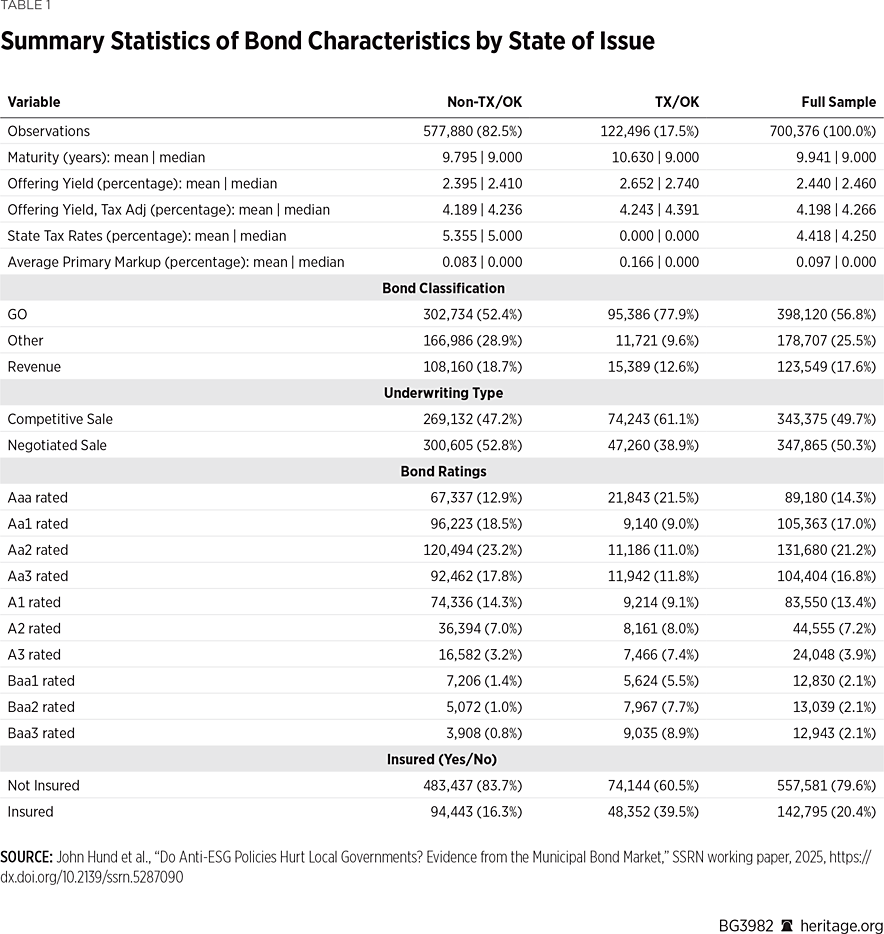
Table 1 provides summary statistics for the full sample and a comparison between Texas and Oklahoma and all other states.
These descriptive statistics underscore important institutional differences between Texas and Oklahoma and the rest of the municipal bond market—differences that the study authors account for in the empirical analysis using matching methods, fixed effects, and robustness checks.
The principal descriptive differences between bonds issued in Texas and Oklahoma and those issued in other states are as follows:
- Maturity: Bonds from Texas and Oklahoma tend to have slightly longer maturities (10.6 years vs. 9.8 years).
- Offering yields: Raw yields are modestly higher in Texas and Oklahoma (2.65 percent) compared to other states (2.39 percent), although tax-adjusted yields—which account for differences in state tax rates—are more similar.
- Markups: Texas and Oklahoma bonds exhibit higher average markups (16.6 bps vs. 8.3 bps), suggesting possible differences in market structure or underwriter dynamics.
- Bond type: A much larger share of Texas and Oklahoma bonds are general obligation bonds (77.9 percent vs. 52.4 percent) and issued via competitive sales (61.1 percent vs. 47.2 percent).
- Credit quality: Texas and Oklahoma bonds are more heavily concentrated in the highest-rated category (21.5 percent AAA bonds vs. 12.9 percent AAA bonds), and a greater share are insured (39.5 percent vs. 20.4 percent), which may mitigate pricing sensitivity to underwriter exclusion.
The Statistical Model
To assess whether anti-ESG laws affected municipal borrowing costs, the 2025 study compares bond outcomes in states that adopted these laws, most notably Texas and Oklahoma, with outcomes in states that did not. The study authors focus on two indicators: (1) the yield on newly issued bonds, which reflects governments’ interest costs, and (2) the markup between what underwriters pay issuers and what investors pay, which reflects primary-market transaction costs. The authors use a difference-in-differences (DiD) approach that compares changes over time between treated and control states. This method identifies the policy effect under the assumption that, absent the laws, municipal bond outcomes in the two groups would have followed parallel trends.
To reduce differences in bond composition and state conditions, the authors include controls for bond-level factors, such as size, maturity, and credit rating, and state-level characteristics, including population density, age, industry composition, and education. The authors also use coarsened exact matching to compare bonds with similar observed characteristics in treated and control states.
Finally, the authors test the results using alternative methods and time frames, including a triple-difference strategy that accounts for variation in underwriter exposure to the policy. Across the principal specifications, they find no consistent evidence that anti-ESG laws raised borrowing costs or markups.
Main Results
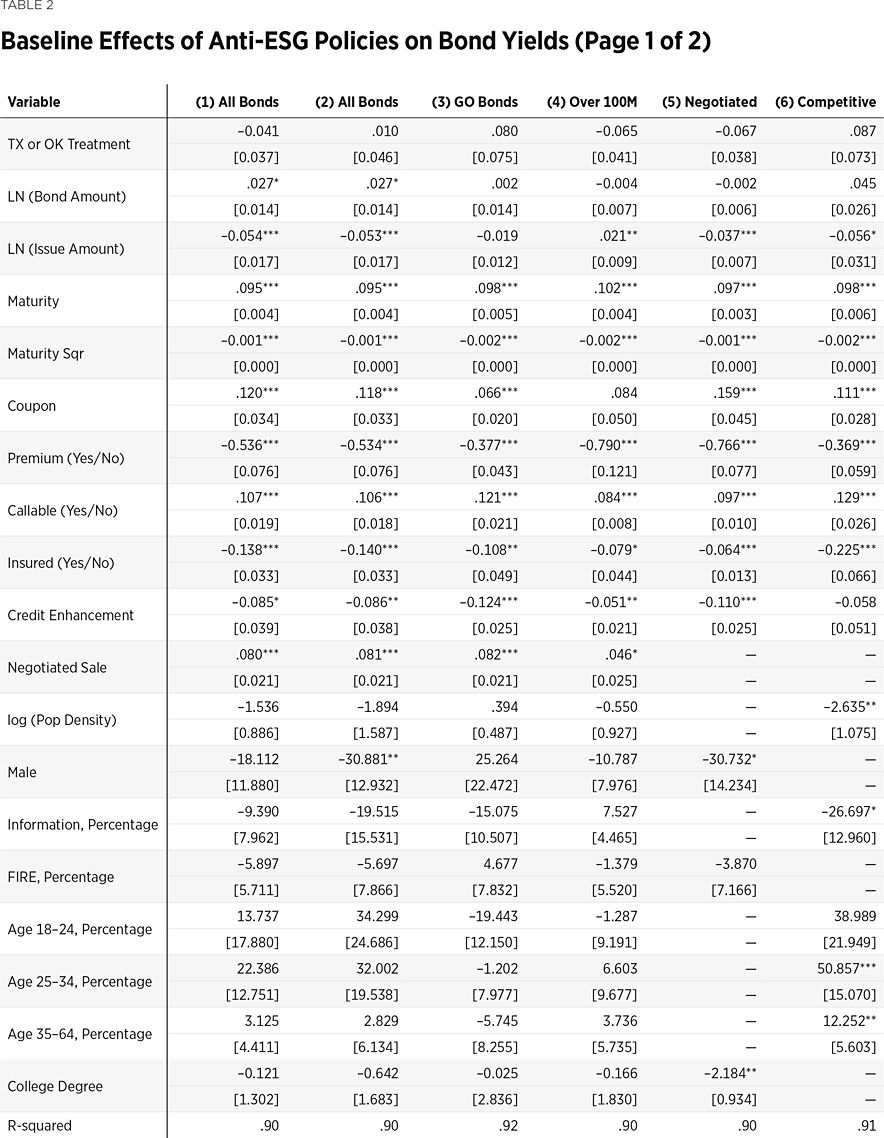
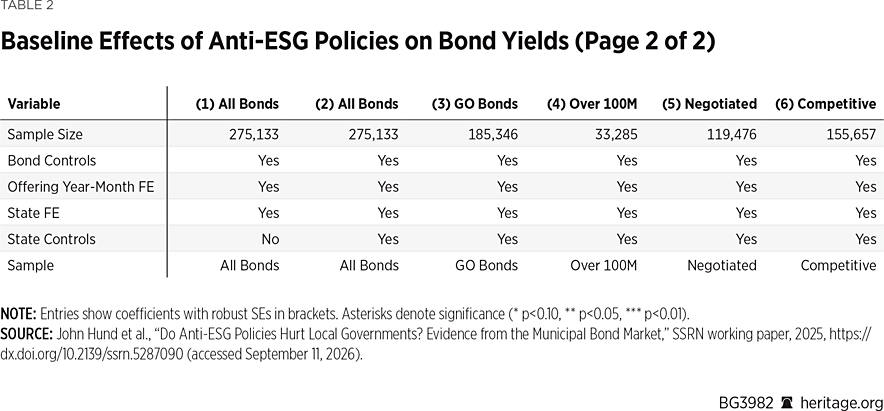
To evaluate whether anti-ESG laws in Texas and Oklahoma have had measurable effects on municipal borrowing, the 2025 study authors begin by estimating a series of DiD models, as reported in Table 2. These models compare bond yields and investor markups before and after the implementation of anti-ESG policies in the treatment states (Texas and Oklahoma) relative to other states that did not adopt similar legislation.
Across the principal DiD specifications, there is no consistent or statistically significant increase in bond yields following implementation of the anti-ESG laws. In the baseline model, the estimated effect on yields is –0.041 percentage points and is statistically insignificant. After controlling for state-level demographic and economic factors (such as population density, age, industry mix, and education levels), the estimated effect shrinks further to –0.01 percentage points. The 2025 study also examined subgroups where theory suggests that the impact of underwriter exclusions might be larger:
- General obligation (GO) bonds, which are backed by the full faith and credit of the issuing government, show a statistically insignificant 0.08 percentage point increase.
- Large issuances (above $100 million), which typically require greater underwriting capacity, exhibit a small decline in yields (–0.065 percentage points), though again statistically insignificant.
- Negotiated sales, where underwriter relationships might be most valuable, show a slightly larger negative yield effect (–0.067 percentage points), but the estimate is noisy and only marginally significant.
- Competitive sales yield a small positive effect (0.087 percentage points), again not statistically distinguishable from zero.
Collectively, these results do not support the view that restricting ESG-oriented underwriters has raised borrowing costs—even in settings where market frictions might plausibly matter more.
Next, the 2025 study analyzes markups, defined as the difference between the price that underwriters pay issuers and the price paid by investors in the primary market. This metric captures transaction costs and market efficiency. There is no broad-based increase in markups following the enactment of anti-ESG laws. The overall pattern is consistent across model specifications. However, when disaggregating by offering type, there are two notable effects:
- For negotiated sales, markups decline by roughly 0.019 percentage points—a statistically significant reduction. This is consistent with long-run trends toward greater pricing transparency and competition in negotiated offerings.
- For competitive sales, there is a modest increase in markups (0.053 percentage points), which is statistically significant but economically small.
Notably, these effects run in opposite directions and do not indicate a consistent aggregate increase in investor transaction costs. These findings remain robust when restricting the sample to rated bonds, when excluding observations after 2023, or when controlling for additional state-level industry and education variables.
If anti-ESG laws had meaningful financial consequences, the largest effects should appear in larger, negotiated, or more complex deals, where issuer-underwriter relationships matter more and fewer underwriters have the capacity to step in. Instead, the estimated yield effects in these segments are small or negative.
The statistically insignificant estimate for GO bonds provides no evidence of a systematic effect in that segment. The estimates for negotiated and large issues are also inconsistent with a sustained increase in borrowing costs during the period studied.
As a robustness check, the 2025 study authors use coarsened exact matching (CEM) to compare bonds in Texas and Oklahoma with bonds in states without anti-ESG laws that have similar observed characteristics, including size, maturity, credit rating, offering type, and bond type. The resulting weights improve covariate balance across the comparison groups. The authors use these weights to estimate changes in yields during and after policy implementation.
For Texas, the authors found that bond yields declined by approximately 17 basis points after the state’s anti-ESG policy went into effect, relative to matched bonds from similar states. This effect is statistically significant and runs in the opposite direction of the claim that ESG-related restrictions raised borrowing costs. In Oklahoma, yields were modestly higher after the policy was enacted, but the difference is not statistically significant, suggesting no clear pattern of increased borrowing costs. Similarly, the authors observed no consistent changes in transaction markups in either Texas or Oklahoma during the post-policy period. These results reinforce the central finding that the market impact of anti-ESG laws appears limited. If there was an initial disruption from the withdrawal of major underwriters, it was either short-lived or offset by market adaptation. Taken together, the estimates are consistent with market adjustment during the sample period, but they do not establish that every anti-ESG restriction is costless.
These results stand in contrast to those of some widely cited prior work, which argued that anti-ESG laws in Texas significantly increased municipal borrowing costs. Garrett and Ivanov’s analysis used a DDD approach, comparing Texas issuers to those in other states before and after the law, while also differentiating between issuers that had previously relied on the targeted underwriters and those who had not.
In Garrett and Ivanov’s preferred specification, they report that bond yields rose by approximately 10 basis points for Texas issuers that had stronger relationships with ESG-targeted banks. However, the 2025 study authors follow a similar strategy using a larger dataset and extended time horizon, finding that these results are not robust to the following specification changes:
- When re-estimating Garrett and Ivanov’s model but omitting a single variable (whether the bond was negotiated), the effect becomes statistically insignificant.
- When adding basic state-level controls—such as population density, industry composition, and demographics—the result also vanishes.
- When extending the post-policy observation window through 2024 (rather than cutting off in April 2022, as in the original study), none of the effects remain statistically or economically meaningful.
In summary, the 2025 results suggest that prior estimates of the unintended consequences for Texas’s bond market are sensitive to modeling assumptions and to the short observation window immediately following policy implementation. Garrett and Ivanov document potential short-run disruptions, while the 2025 bond-level analysis over a longer period finds no consistent evidence that those disruptions produced sustained or systemic increases in borrowing costs.
Policy Implications
The results of this analysis carry immediate implications as the federal government pivots to accelerate AI leadership. The January 2025 executive order “Removing Barriers to American Leadership in Artificial Intelligence”[REF] and the July 2025 “Winning the Race: America’s AI Action Plan”[REF] emphasize deregulation, rapid build-out of AI infrastructure, and export of the U.S. AI technology stack. State and local issuers may finance public-power and enabling infrastructure associated with data-center growth, including transmission, water, roads, and grid upgrades. The bond-level evidence indicates that the studied restrictions did not produce consistent increases in borrowing costs or primary-market markups in Texas and Oklahoma. It does not establish that every financing restriction or infrastructure policy is costless.
Practically, this means that procurement and financing rules should prioritize competition and measurable performance rather than contested and variable third-party ratings. At the state level, officials should avoid making opaque ESG scores binding in underwriting or vendor selection and should require transparent documentation, auditability, and out-of-sample validation for models used in pricing, allocation, or risk assessment. These requirements would allow officials to assess model quality directly while preserving competition among qualified providers.
The AI build-out also heightens the salience of energy policy, including the February 2025 executive order “Establishing the National Energy Dominance Council.”[REF] The AI Action Plan includes a pillar on building American AI infrastructure, including data center development, which will require reliable and scalable power. Given the variability and methodological inconsistency of ESG ratings, using them as binding screens could limit eligible financing channels as load growth accelerates. The 2025 findings show no consistent municipal-finance penalty from the restrictions studied in Texas and Oklahoma, but they do not measure project-level energy investment.
First, while the anti-ESG laws passed in Texas and Oklahoma generated considerable attention and prompted real changes in the composition of municipal bond underwriters, the 2025 study finds no consistent evidence that these policies increased borrowing costs for issuers or transaction costs for investors. Even in submarkets where disruption would be most plausible, such as large or negotiated sales, the estimates do not show a sustained increase in financing costs. This pattern is consistent with separate evidence from Hund and his co-authors that markups charged to uninformed investors have declined while underwriting spreads remain flat. The absence of a consistent increase in borrowing and transaction costs challenges the claim that restricting access to large national underwriters necessarily harms state or local fiscal health and is consistent with, though does not prove, smaller underwriters filling market gaps.[REF]
Practically, these results suggest that municipal bond markets, though decentralized and subject to frictions, can adjust to changes in underwriter participation. New entrants or regional firms may be stepping in to fill gaps left by departing underwriters, and long-term trends in pricing transparency and investor sophistication may be mitigating the risk of reduced competition. Policymakers should recognize this capacity for market adaptation when evaluating the risks and benefits of politically motivated financial restrictions.
What States Should Do
States should do the following to employ evidence-based investment strategies:
- States should consider adopting model-risk standards for public finance comparable in principle to current bank supervisory guidance, with requirements scaled to model risk and institutional complexity. State treasurers, public pension systems, and other state financial authorities should require vendors to disclose their models’ objectives, data lineage, key inputs, performance, and governance, subject to independent validation and periodic back-testing. Where credible nonfinancial considerations are relevant but not directly comparable, public entities should treat them as qualitative inputs rather than binding constraints.[REF]
- State treasurers and debt-management offices should track market-function metrics quarterly, including yields, markups, deal participation, underwriter concentration, and bidding activity, so legislators can determine whether procurement and financing choices are raising taxpayer costs.
- States that are considering similar legislation—either to restrict ESG-driven investment strategies or to promote them—should approach the issue with empirical discipline. Rather than assuming that financial consequences will follow from policy posture alone, state leaders should invest in rigorous evaluation of their own markets, focusing on observable outcomes such as yields, markups, and deal participation. Given the increasing energy demands on the U.S. grid, finding ways to promote many forms of energy as quickly as possible should be a priority.
- State energy offices and infrastructure-finance authorities should keep project eligibility technology-neutral and compare proposed investments using observable measures such as firm capacity value, deliverability, interconnection readiness, and cost per firm megawatt.
In short, while ESG investing remains politically and ideologically charged, its actual effects on public borrowing appear more modest than the rhetoric suggests. Policymakers would do well to separate symbolic or political goals from financial claims—and to ensure that policy interventions in capital markets are guided by evidence, not assumption.
Conclusion
Debates over ESG investing continue to shape how states exercise authority over public funds and pursue energy priorities. Using bond-level data and multiple identification strategies, the four authors of “Do Anti-ESG Policies Hurt Local Governments? Evidence from the Municipal Bond Market” find no evidence that anti-ESG statutes in Texas and Oklahoma produced sustained increases in municipal borrowing costs or primary-market markups. Estimated effects are generally small, inconsistent across specifications, and sometimes run opposite to claims from other studies developed concurrently. The municipal bond market appears to have adjusted to changes in underwriter participation with little measurable effect on issuers or investors.
These findings are relevant as national policy increasingly emphasizes AI infrastructure and energy capacity. State and local issuers may help to finance public-power and enabling infrastructure, including transmission, water, roads, storage, and grid hardening. The evidence from Texas and Oklahoma suggests that changes in the composition of eligible underwriters did not consistently increase financing costs during the period studied, provided that competitive financing channels remained available.
The results do not establish that every anti-ESG restriction is costless or that any particular policy is optimal. They show more narrowly that widely predicted increases in borrowing and transaction costs did not materialize in the two states and period studied. Policymakers should therefore evaluate financial restrictions using observed market outcomes, including yields, markups, underwriter participation, and concentration, rather than assuming financial consequences from a policy’s political orientation.
Christos Makridis is Acting Director of the Center for Data Analysis at The Heritage Foundation.



