

Few features of American economic policy are as sweeping or unquestioned as the federal government’s backing of the mortgage market. Between 70 percent and 80 percent of new mortgage originations and the majority of outstanding mortgage credit ultimately carry some form of federal guarantee, insurance, or federally supported securitization. The Federal National Mortgage Association (Fannie Mae) and Federal Home Loan Mortgage Corporation (Freddie Mac) alone guarantee roughly half of all outstanding U.S. residential mortgage debt—on the order of $7 trillion. Few other countries come close.
This intervention rests on the theory that deep government support expands homeownership by widening access to mortgage credit. The evidence for this view, however, is mixed at best. Despite decades of federal support and trillions of dollars in guarantees, the U.S. homeownership rate remains roughly what it was in 1960, and housing affordability has deteriorated substantially. That disconnect raises a difficult question: If federal mortgage subsidies have not raised homeownership to any meaningful degree, where has their benefit gone?
Much of it has gone into higher house prices. Just as government-backed student loans have driven up the cost of college, government-backed home loans drive up the cost of homes. By subsidizing demand faster than supply can respond, federal backing inflates prices, transfers wealth from future buyers to current owners, and leaves affordability worse, not better. Restoring opportunity therefore requires addressing the demand-side distortions that federal policymakers actually control—beginning with a gradual reduction of the federal footprint in mortgage finance.
How the System Works
The American mortgage-finance system relies on government insurance, guarantees, and federally backed securitization to a degree rarely seen elsewhere in the world. The stated aim is to facilitate homeownership by increasing access to mortgages. Federal support is delivered through two principal mechanisms:
- Mortgage Insurance. Government-insured mortgages allow lenders to extend credit to higher-risk borrowers by shifting a portion of the default risk to the federal government. This can lower borrowing costs and down-payment requirements relative to an unsubsidized private market with the intended goal of expanding access to mortgage credit.
- A Government-Backed Secondary Mortgage Market. Government-sponsored enterprises (GSEs) purchase mortgages from lenders, pool them into mortgage-backed securities (MBS), and then sell and guarantee those securities. This continually replenishes lenders’ cash (liquidity) so they can quickly lend again on the theory that greater credit availability will translate into greater homeownership.
Through these channels, the federal government is exposed to well over $10 trillion in mortgage credit through insurance, guarantees, and federally backed securitization in an effort to increase homeownership.
The Federal Mortgage Landscape
Several federal entities dominate this system, each backing mortgages in a different way.
- The Federal Housing Administration (FHA), housed within the U.S. Department of Housing and Urban Development (HUD), together with the U.S. Department of Veterans Affairs (VA) and U.S. Department of Agriculture (USDA), provides mortgage insurance to approved lenders against borrower default.
- Fannie Mae and Freddie Mac, overseen by the Federal Housing Finance Agency (FHFA), are the GSEs. They purchase mortgages from lenders, pool them, and issue and sell MBS to investors. Both have operated under federal conservatorship since September 2008, when they nearly failed during the financial crisis.
- The Government National Mortgage Association (Ginnie Mae), also within HUD, does not purchase, pool, or issue its own securities. Instead, it guarantees MBS issued by private lenders and only for mortgages already insured by the FHA, VA, or USDA.
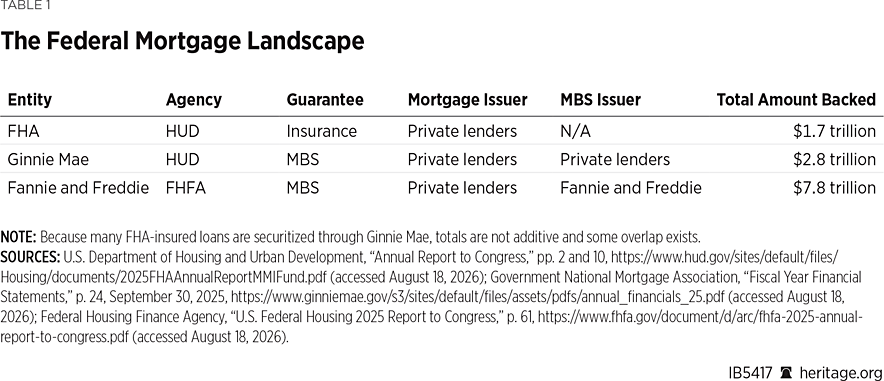
Explicit Versus Implicit Guarantees. Both FHFA securities (Fannie Mae and Freddie Mac) and HUD securities (FHA and Ginnie Mae) are treated by markets as government-guaranteed. Ginnie Mae securities carry an explicit statutory guarantee. Fannie Mae and Freddie Mac securities do not, yet financial markets generally price them as though they benefit from strong federal support—an “implicit” guarantee rooted in the GSEs’ conservatorship and the government’s response to the 2008 crisis. In either case, if the underlying mortgages default, taxpayers are ultimately expected to make lenders and MBS holders whole.
Weak Evidence That the System Works. The central justification for this vast apparatus is that it increases homeownership. The historical record offers little support for this view. Despite decades of extensive federal support for mortgage finance—including trillions of dollars in insurance, guarantees, and securitization—the U.S. homeownership rate remains roughly the same as it was in 1960 even as housing affordability has deteriorated substantially.[REF] Whatever else federal mortgage policy has accomplished, it has not produced the sustained gains in ownership that its proponents promised. That raises a serious question about whether the benefits of federal mortgage subsidies have been worth their costs—and about where those subsidies actually end up.
The Reality: Why the System Raises Prices
The evidence suggests that, rather than increasing homeownership, a substantial share of the benefit of mortgage subsidies is capitalized into higher home prices. Four dynamics explain why this happens.
- Credit Capitalization. When the government intervenes to expand access to credit or subsidize loans, it artificially raises borrowers’ willingness to pay, increasing demand faster than supply can respond. The predictable result is higher prices. The same phenomenon is visible in higher education: Just as government-backed student loans have increased the cost of college, government-backed home loans increase the cost of homes.[REF] More money chasing the same scarce asset means higher prices.
- A Transfer of Wealth, Not Its Creation. Rising prices reward existing owners on paper, but rapid appreciation reduces affordability for prospective buyers by raising the cost of entering the market—especially when wages fail to keep pace. In effect, rapid appreciation functions largely as a transfer of wealth from future buyers to current homeowners and landowners rather than as the creation of new wealth.[REF] It also erodes long-term wealth-building among younger households, who must make larger down payments and devote a greater share of income to housing than they do to retirement savings, business investment, or other productive uses. Higher prices bring a further cost: rising property-tax assessments that burden existing owners, particularly seniors and others on fixed incomes.
- Putting Supply Before Demand. Supply-side reforms remain important, but they are not by themselves enough to carry affordability policy. Housing demand responds far more quickly to federal policy than housing supply does.[REF] Because supply is largely governed by state and local zoning and building codes, federal policymakers have little direct control over it—while they exert enormous influence over demand through mortgage guarantees and monetary policy. Federal policymakers therefore have a far greater ability to affect demand than they do to affect supply, which suggests that affordability policy should pay closer attention to demand-side distortions than it currently does. Yet nearly all new federal housing-affordability initiatives focus almost exclusively on supply.
- Crowding Out. Government backing also makes it difficult for firms without federal support to compete. As private, non-guaranteed lenders withdraw, mortgage risk becomes concentrated in government-backed channels, and taxpayers bear a larger share of the market’s losses during downturns.[REF] Federal guarantees can also encourage greater risk-taking, because lenders know that some of the resulting losses will ultimately fall on taxpayers rather than on themselves.
Policy Solutions to Restore Opportunity in American Homebuying
To restore opportunity and affordability, the federal government should gradually—over a period of years—reduce the artificial housing demand created by government backing. Many have called for the GSEs to be removed from conservatorship and privatized altogether. That is a worthwhile goal and should be supported, but the following recommendations focus on steps that can be taken without such large-scale structural change. Federal policymakers should pursue three complementary reforms.
- Reduce the government footprint. Because government-backed mortgages inflate housing demand and push prices upward, Congress and federal regulators should shrink the federal role in mortgage finance gradually and predictably. Three measures would advance this goal.
- Set maximum limits. Federal policymakers should set a target ceiling for the share of mortgages that are government-backed and lower it through modest annual reductions until the target is reached.
- Reduce loan limits. The government should stop subsidizing the purchase of expensive homes by gradually lowering conforming and jumbo loan limits, tying them to median household income rather than to prevailing house prices.
- Reduce Federal Reserve MBS purchases. The Federal Reserve’s purchases of MBS create additional demand for the mortgages bundled into them, lowering interest rates and in turn raising home prices. The Federal Reserve should accelerate the reduction of its MBS holdings and make that reduction permanent.
- Enhance homebuyer wealth accumulation. Federal policy should also help borrowers build equity faster by encouraging shorter loan terms. A 15-year or 20-year mortgage can save a homeowner hundreds of thousands of dollars in lifetime interest compared with a 30-year loan. Federal mortgage programs could encourage shorter terms by offering lower guarantee fees, more favorable underwriting, or other incentives for 15-year and 20-year mortgages; by requiring lenders to present the monthly payments, lifetime interest costs, and equity accumulation of 15-year, 20-year, and 30-year options side by side; and by directing government-backed entities to increase their purchases of shorter-term loans in the secondary market. Together, these steps would make shorter-term mortgages more attractive to lenders and borrowers alike while preserving consumer choice and allowing a gradual transition.
- Focus first on demand and then on supply. Finally, federal policymakers should concentrate on the tools they actually control. While state and local governments should expand housing supply where appropriate, federal attempts to induce local zoning reform have generally proven difficult, because land-use decisions rest largely with state and local authorities. The federal government should therefore address first the policies that it controls directly—particularly those that artificially inflate housing demand through mortgage subsidies and guarantees.
Common Objections and Answers
Several objections are commonly raised against reducing the federal footprint in the mortgage market. Each merits a direct response.
Post–World War II Homeownership. Critics contend that the federal mortgage system facilitated homeownership for American veterans after World War II. In fact, the best available estimates attribute only a minority portion of the postwar homeownership increase—roughly 25 percent to 40 percent—to the government-backed mortgage system, including the FHA, the VA, and the 30-year loan. The largest portion of the increase—on the order of 60 percent to 75 percent—resulted from income growth and demographic change.[REF]
Working-Class Homeownership. Some argue that reducing federal backing of the mortgage market will reduce homeownership opportunities for working-class people, but homeownership is ultimately determined by the affordability of homes, not merely the availability of credit. When government-backed credit increases demand faster than supply can respond, much of the benefit is absorbed into higher prices. A market with less subsidized credit but lower prices may offer working-class families better opportunities to own than one with abundant credit and unaffordable homes can offer.
Wealth-Building Through Home Equity. A related objection holds that even if the government-backed mortgage system increases house prices, that is a good thing because homeowners will have more wealth. Higher prices may make existing owners feel wealthier on paper, but they largely redistribute housing wealth rather than creating it. For every owner who gains from a higher home value, a prospective buyer must pay more for that same home. Much of the apparent gain is a transfer from future buyers to current owners, not new economic value—and when families must devote more income to housing, they have less for savings, investment, and other wealth-building. A market that depends on ever-rising prices may enrich some owners while making ownership less attainable for the next generation, especially where wages do not keep pace.
The Homebuilding Industry. Others warn that the homebuilding industry would suffer significantly if the federal footprint in the mortgage market were reduced. Homebuilder profit margins are already among the highest in any major American industry. That is not inherently troubling—healthy margins reflect value creation and attract investment—but it is also consistent with the possibility that policies which artificially boost housing demand are being capitalized into higher prices, benefiting incumbent builders and landowners while worsening affordability. With less federal backing, production would shift from larger, more expensive homes toward smaller, more affordable ones, creating new opportunities for builders who serve that market.
Housing Supply. A closely related concern is that homebuilders would produce less supply if the government reduced its backing of mortgages. Reducing federal backing would not eliminate demand for housing; it would shift demand toward less expensive homes. Builders respond to what consumers can afford; therefore, if subsidies no longer supported larger mortgages and higher prices, builders would have stronger incentives to produce smaller, more affordable homes. The likely result would be a different mix of housing, not necessarily less of it.
Too Large a Change. Skeptics object that reducing the federal mortgage footprint is too drastic a change and is therefore infeasible. A gradual, predictable transition over a period of years would give markets ample time to adjust while reducing taxpayer exposure and improving affordability. The genuinely risky course is preserving a system that backs trillions of dollars in mortgage debt, inflates prices, and leaves future generations with fewer opportunities to own.
Liquidity in a Crisis. Some worry that reducing the federally backed secondary mortgage market would harm liquidity during times of crisis. Reducing the federal footprint does not mean eliminating crisis liquidity. A mortgage market that was less dependent on government guarantees would likely be less leveraged, less distorted, and less prone to the boom-and-bust cycles that create the need for extraordinary intervention in the first place. Truly systemic crises are rare, and targeted emergency measures can be deployed when necessary without permanently backing trillions of dollars in mortgage risk during normal times.
Crashing Home Prices. Finally, critics fear that reducing federal backing of mortgages would crash house prices. To the extent that federal guarantees and subsidies increase demand and purchasing power, reducing that support would restrain upward pressure on prices relative to the status quo rather than trigger a collapse. A gradual transition, as recommended here, would give markets, lenders, builders, and households time to adjust. Slower price appreciation is not inherently harmful: Existing owners might see smaller gains, but improved affordability would benefit first-time and future buyers. The goal is a market in which prices are driven more by fundamentals and less by federal subsidies and guarantees.
Conclusion
The federal government backs the majority of American mortgages through mortgage insurance and a secondary market dominated by Fannie Mae and Freddie Mac. This arrangement likely increases housing demand faster than supply can keep up with it, placing continual upward pressure on prices. Affordability is therefore not likely to improve substantially unless government-supported mortgage demand is addressed. Efforts that focus solely on supply are not likely to succeed, because the federal government does not control local zoning and building codes and can influence demand far more readily than it can influence supply. Reducing artificial, government-driven demand must be the starting point.
John Gibbs is Director of the Thomas A. Roe Institute for Economic Policy Studies at The Heritage Foundation.



