The other weekend, I pulled up Woody Allen’s Manhattan (1979) on YouTube because I’ve been starved for the highbrow and the funny, a rare marriage that movies used to achieve with some regularity, but now hardly ever bother to attempt.
Let’s disregard the plot, here, and the characters, for there is a great deal about both that resists easy or simple discussion in the present American climate, and focus instead on the surface: the look of the film, the feel of it, the particular New York it conjures and holds up to the light like a jeweler with a loupe.
My feeling for New York City has always come in a peculiar Southern blend of love and affliction. I don’t care for the rudeness, or the flat, clipped music of the accent, the way a sentence up there lands like a screen door.
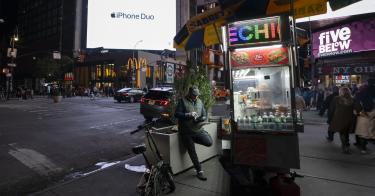
But some years ago—high school, through college, on into my early twenties—my family made a yearly trip north around Christmas, either before the holiday or just after it. Mother, father, sister, brother, and myself. We took rooms near Times Square. We saw the shows. We ate at the restaurants with the heavy menus and the heavier check.
My mother and sister went shopping. The first year, my father, brother, and I made the mistake of going along, and we stood there in Macy’s—the famous one—waiting among the racks like the accused waiting outside a courtroom, until finally we drifted, defeated, to the section where they sell the beds.
And there, without much discussion, the three of us climbed up onto the display mattresses and took our naps in full view of the shoppers, three Southern males asleep in a snowdrift of goose-down pillows while New Yorkers and tourists alike rushed past us toward their purchases. We never went shopping with the women again.
Manhattan opens with a voice reciting its own first sentence, over and over, dissatisfied, revising itself in real time: “Chapter One. He adored New York City. He idolized it all out of proportion…” What we are watching, before a single frame of story unspools, is the composition of New York, its narration into existence by a man who admits, within the first 30 seconds, that his version of it is a romance rather than a record.
Isaac Davis, played by Allen, drafts Manhattan, discards the draft, drafts it again, each revision a further layer of gloss over a city that by the film’s own admission was never quite there to begin with. Gershwin swells. The skyline assembles itself in black-and-white, denuded of the actual chromatic clutter of a real metropolis: no exhaust-brown, no bodega-awning red, no garbage-day green.
The result is not less than New York, but more: a hyperreal locus, a city more New York than New York, purified into its own advertisement. By the time the narration settles on its final version of the sentence, we have watched a myth being built in front of us, brick by adoring brick, and we have watched it happen with the confidence of a myth that knows it will outlast its subject.
Consider, in this light, why the film insists on monochrome: color would have been the honest choice, but the lesser one. The black-and-white suggests a setting already understood as the past. Allen may have shot it that way because that’s how he remembered the city from boyhood. The image does not become nostalgia, but arrives already nostalgic, already a simulation of an image of a city, twice removed from the referent before the referent has even appeared.
The formal choices reward the kind of patient gazing that asks not what a shot means, but what it does: how it organizes the eye, how it withholds and releases. Willis’s camera holds wide and still. And it is Allen—small, voluble, anxious—who is made to cross the frame, dwarfed by the buildings on either side. The city is never made to accommodate the man. The compositions insist on this dynamic with a kind of moral clarity: architecture as fixed, permanent, indifferent; the human figure as transient, comic, and a little absurd against so much stone. There’s no accident in the fact that the funniest lines are often delivered in the widest shots: the humor is small; the buildings aren’t.
The bench scene deserves a word of correction before anything else, since even devoted admirers of the film misremember it: the silhouette behind Isaac and Mary at dawn is not the Brooklyn Bridge, but the Queensboro—the 59th Street Bridge, the one Simon and Garfunkel made feel groovy—shot from a little park at Sutton Place, the bench itself (according to my Internet searches) trucked in by the crew for that single image and trucked out again after.
Which is, in its own way, the whole method of the film in miniature: even the most iconic, most seemingly eternal image of New York on offer here was a temporary prop set down in front of a bridge for one morning’s shoot. The permanence is manufactured.
>>> Mamdani’s $22 Billion Housing Lunacy Proposal Will Socialize the Skyline
The film’s two registers—the melancholy of the story and the euphoria of the imagery—do not cancel each other out so much as run on parallel tracks, and the gap between those tracks is where the picture does its real work. Consider the function of the montage sequences against that of the dialogue scenes. The montages are non-diegetic in feeling even when diegetically grounded: they exist to establish a rhythm of civic wonder, asking nothing of the viewer but admiration.
The dialogue scenes, by contrast, are shot with almost no cutting at all: long, static two-shots, characters talking past each other in real time, the visual monotony forcing attention onto the halting, self-undermining texture of what is actually being said. The film is, formally speaking, telling us two different things simultaneously and daring us to notice the seam: the city as sublime, continuous, orchestral; the people within it as fragmented, hesitant, unable to complete a sentence about their own feelings without doubling back on it, exactly as the opening narration doubled back on itself.
The visual grandeur is never undercut by irony—Allen does not mock the skyline—but it is placed in a kind of formal tension with human smallness that neither element resolves. That unresolved tension, held shot after shot without comment, is the melancholy, and it’s built into the cutting pattern before it is ever spoken aloud.
Now, alas, to the present city—the real one—as it stands to be reorganized, and to the politics of the mayor presently promising to reorganize it.
New York has been bleeding people for years. The arithmetic of it is no longer a matter of dispute: the city and state have shed net domestic migrants every year for over a decade, hundreds of thousands of taxpayers relocating to Florida, Texas, and the Carolinas, taking with them not just households, but the tax base itself, since a disproportionate share of those leaving sit at the top of the income ledger.
Economists have written this story many times over. They generally tell it thus: rent regulation suppressing housing supply, tax rates chasing away the earners who fund the very programs meant to help everyone else, business formation slowing as regulatory and labor costs climb, the tax burden left to redistribute itself across a shrinking and less mobile base.
It is, by now, a familiar and well-documented indictment, and further democratic-socialist experimentation of the kind Zohran Mamdani proposes (price controls, municipal enterprises, steeper taxation of capital) is likely only to accelerate a trend already well underway. What economists rarely pause to mention, in this careful accounting of bad economics, is the bad aesthetics: the fact that a shrinking, flattened, price-controlled city is not only a poorer city, but a less legible one, a city that stops producing the aspirational, ambitious textures that an environment needs to be worth writing a Manhattan about in the first place.
Rent freezes, city-owned grocery stores, free buses, government-run childcare, union-built housing pinned beneath the same frozen rents, higher taxation on the wealthy who have historically financed the city’s theater of distinction: this is a program that wants New York to stop signifying, to stop chasing visual excess, to level unnecessary beauty, and to disappear the glorified aesthetics that defined Manhattan (the film).
The free market is a machine for producing urban variety and diversity. It sorts neighborhoods into strata, forces competition among restaurants and shops and doormen and galleries to distinguish themselves, and out of that sorting comes precisely the texture Isaac Davis fell in love with: the specific bookstore, the specific delicatessen, the specific bench.
Price signals are semiotic: a rent freeze not only caps a number, but also removes the mechanism by which neighborhoods differentiate themselves through investment, turnover, and risk. A city-owned grocery store cannot, by definition, be a particular grocery store as Zabar’s is particular because its entire justification is that it’s the same everywhere, fungible, a public utility rather than a character.
>>> Mamdani’s “Tax First, Think Later” Budget Plan
Today’s Manhattan looks different from Allen’s black-and-white mise-en-scène partly because of the regulations governing its buildings: facade inspection mandates have wrapped whole blocks in sidewalk sheds for years at a time, and emissions caps are pushing owners to retrofit prewar towers with electric heat pumps, through-wall units, and rooftop equipment.
Universal childcare and free buses, worthy as they may sound to the ear of compassion, are administered goods, which, besides being economically harmful to the very communities they purport to help, do not accumulate the patina of specificity, tenacity, drive: the worn brass rail, the eccentric owner, the 40 years of small adjustments to changing taste. These details turn a mere service into a grand milieu that a person can photograph in black-and-white and mean something by it. You can’t rent-control your way to a Rizzoli’s.
The specific aesthetic New York that this film so lovingly constructs was the product of an economy that permitted radical unevenness, permitted some blocks to become Sutton Place and others to remain what they were. The old New York could be ugly in reality and beautiful in art because it left room for artists to look upward, to take its disorder and inequality and noise and transfigure them into myth. The danger of Mamdani’s New York is not merely that it becomes poorer or more regulated, but that it becomes aesthetically downward-looking, a city preoccupied with administering what is wrong with it rather than generating the beauty that makes people want to imagine it as something more.
A politics organized entirely around flattening unevenness in the name of universal provision will tend to produce a city whose surfaces mean less. Mamdani’s New York, should it fully arrive, promises a setting that is more equal and more affordable and, quite possibly, less quotable, a city no future Woody Allen would find himself compelled to open his picture with “Chapter one. Dissatisfied. Starting over.”
Which brings me back to that Christmas Macy’s, my father asleep on a showroom mattress, three Southerners playing hooky from the shopping. I think that’s what I’m partially mourning when I mourn the New York of Manhattan: not the wealth, not even the skyline, but the specificity, the sense that the city was a collection of unique rooms rather than a portfolio of interchangeable services.
The people I know who have left for Texas, for Florida, for the redder counties of this reddening country, will tell you they left the taxes, the crime, the cost. But listen long enough, and what they are really grieving, underneath the ledger, is that the New York which could still surprise you is going, has been going for a while now, and no rent freeze, however kindly meant, will bring it back, because you cannot legislate a city into being irreplaceable. You can only leave it alone long enough, and love it hard enough, to let it become so on its own, the way, once, at dawn, on a borrowed bench under a borrowed bridge, it did.
This piece originally appeared in The Freeman Magazine