
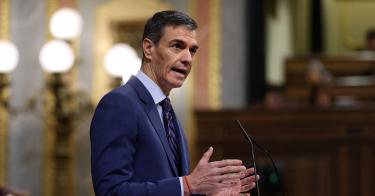
Europe’s governing class has a problem with free speech—especially when that speech comes from conservatives. Nowhere is that clearer than in Spain, where Prime Minister Pedro Sánchez has unveiled a government system to monitor political discourse online.
The program is called HODIO. Officially, it tracks “hate speech” and “polarization” using artificial intelligence. In reality, it represents the latest attempt by Europe’s political elites to place public debate under bureaucratic supervision.
And it should concern anyone who cares about free elections and democratic accountability.
According to the Spanish government, HODIO will collect and analyze vast volumes of public social-media posts. AI models will categorize content, measure political conflict, and identify supposedly harmful narratives. The government will then publish reports assessing online discourse and ranking platforms based on problematic speech.
That is extraordinary power for a government already invested in shaping debate.
>>> Spain’s Crusade Against X Aims To Stamp Out Discussion of “Electoral Engineering”
Spain already criminalizes certain hate speech. HODIO goes further. It treats political discourse itself as something the government should measure and influence.
That is not law enforcement. It is political monitoring.
The problem begins with vague categories like “polarization” and “toxic narratives.” These are not legal standards—they are political judgments. In practice, they often fall on viewpoints challenging progressive orthodoxies on immigration, national identity, or EU integration.
In short, conservative arguments.
Europe already offers clear examples of how speech regulation curbs those views.
Consider Germany’s Network Enforcement Act. The law forces platforms to remove potentially illegal content quickly or face fines up to €50 million. The result has been systematic over-censorship. Companies delete lawful political speech to avoid risk, including posts criticizing migration or asylum policies—core democratic debate.
Officials have acknowledged the incentive: delete first, assess later. In effect, the state has outsourced censorship to private platforms.
The European Union’s Digital Services Act expands this pressure continent-wide. Platforms must conduct “risk assessments” on how content contributes to disinformation or social harm, then adjust moderation and algorithms accordingly.
The outcome is predictable. When regulators define controversial speech as risk, platforms suppress it.
During debates over migration and identity, posts criticizing EU policies or warning about mass migration have been flagged as harmful by networks working with regulators and platforms.
France offers another example. Authorities monitor online discourse during elections to counter disinformation. While framed as security policy, these systems increasingly target domestic narratives that challenge government or EU positions.
Britain’s Online Safety Act follows the same logic. It requires platforms to address broadly defined “harmful” content, incentivizing aggressive moderation of controversial viewpoints.
Taken together, these measures form a European architecture of speech control.
HODIO pushes it further.
Unlike earlier laws, HODIO does not just regulate platforms or enforce statutes. It seeks to monitor the political climate itself, producing official judgments about which narratives contribute to polarization and which are acceptable.
That creates serious risks.
When governments label narratives harmful, the signal to platforms is clear: remove them. Over time, this creates a chilling effect, marginalizing viewpoints—especially conservative ones.
The impact goes beyond debate.
>>> Europe’s Center-Right Turns Censorious Against America
Speech regulation shapes elections. If certain viewpoints are systematically labeled dangerous or toxic, they become harder to express and organize around.
That tilts the playing field.
Europe’s political establishment has long portrayed conservative dissent as a threat to democracy. HODIO institutionalizes that claim, turning disagreement into something to be monitored and managed.
The Sánchez government insists HODIO is merely analytical. That strains credibility. Governments do not build systems like this just to observe.
They build them to influence outcomes.
Americans should take note. European regulations increasingly shape global platform policies, often spilling into U.S. discourse.
The United States has taken a different path. The First Amendment protects political speech—even controversial speech—from government control.
Europe is moving the other way.
Spain’s HODIO system is another step toward treating open debate not as a democratic strength, but as a problem to be managed.
And when governments begin monitoring opinions in the name of protecting democracy, it is usually democracy that ends up in danger.
This piece originally appeared in RealClear World



