

The brazen theft of crown jewels from France’s Louvre museum reveals a significant danger to the extraordinary works of art it contains. Fortunately, the alleged thieves are being apprehended, but that doesn’t change the fact that they were able to penetrate the museum’s defenses and make away with their loot, which has not been recovered. This begs the question: What is the risk to the Louvre’s other treasures, specifically Leonardo da Vinci’s Mona Lisa?
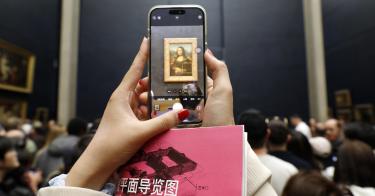
In January, French President Emmanuel Macron announced the 10-year “New Renaissance” plan to renovate the Louvre, including a new location for the Mona Lisa. Clearly, Macron acted not a moment too soon. Security issues aside, Leonardo’s masterpiece has long been disserved by the Louvre, which forces viewers to navigate labyrinthine corridors to find it. When they finally reach it, the small portrait behind bulletproof glass is hard to see clearly, let alone snap a selfie in front of, before the crowd surges on after exhaling more pollutants into the poorly ventilated space.
The Louvre says 80 percent of its visitors come to see the Mona Lisa, so wherever it is placed in the complex structure is bound to become a choke point. Macron’s suggestion that it be moved within the museum to its own exhibition space beneath the courtyard called the Cour Carrée might just shift the problem to another room.
The portrait has been vulnerable in the past. It was stolen in 1911 (and recovered two years later) and has since been the target of several notable attacks, most recently by climate activists who splattered soup on its glass case in the name of sustainable agriculture. Last month’s jewelry theft might embolden other thieves or vandals to try again, which is why the Mona Lisa needs to get out of the Louvre.
One solution might be to put it in a separate structure—climate-controlled, transparent—in the neighboring Tuileries Garden. Time-controlled tickets could be sold at a premium (similar to the system that controls the crowds visiting Michelangelo’s statue of David in Florence), while the general public could view it for free at a distance, through the glass walls.
The Louvre already has friends who have contributed to restoration projects in the past, notably the government of the United Arab Emirates. The UAE also has built a satellite Louvre in Abu Dhabi; if a separate home for the Mona Lisa was approved, the portrait could be displayed there while the new structure was being built. For its part, the Louvre proper would become much more navigable and accessible to visitors interested in the other extraordinary masterworks it contains.
Leonardo’s Mona Lisa was originally commissioned as a portrait of the Florentine merchant Francesco del Giocondo’s second wife, who happened to be named Lisa. It was a somewhat prosaic project for the creator of “The Last Supper,” but Leonardo accepted it and got to work in 1503— perhaps not coincidentally at the same time that Michelangelo was carving his famous David just a few blocks away. When the Mona Lisa was finished, however, Leonardo did not deliver it, but kept the portrait with him until he died in 1519. It was a highly unusual step for an artist during a time when artists were generally considered manual craftsmen, and could indicate that the painting had a deep personal significance to him.
Leonardo continued working on it over the years until it bore only a passing connection to the original Lisa, and instead became widely seen as a reflection of Leonardo’s enigmatic, inspired genius—and, some have speculated, of his own features.
Centuries of art historical scholarship and even infrared and X-ray analysis have defied attempts to unlock all its secrets, which only seems to increase the portrait’s allure. It is comforting to imagine that modern museums are inviolable temples of the arts and masterpieces in their care are as safe as if they are in a bank vault. But the Mona Lisa faces perils ranging from thieves to extremists. The recent jewelry heist is a wake-up call that the portrait needs help from all who value it.
This piece originally appeared in The Washington Post



