

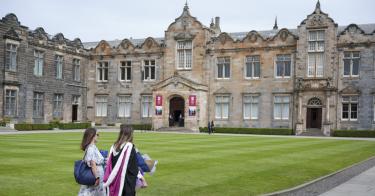
Scotland’s St. Andrews University was founded in 1413, before Columbus set sail for the Americas. They admitted the first woman four centuries later, in 1892. So, it’s an inescapable fact that most of the graduates have been men, and most of them Scottish.
Alumni include religious reformer John Knox, Prince William, and Princess Catherine, as well as many long-forgotten clergymen, businessmen, inventors, and think-tank fellows. Yet in many of the fundraising emails and brochures sent to alumni like me, there is a palpable effort to foreground women and minorities.
A pamphlet I got the other day asking me to support scholarships boasted a photo showing five students, all women. Inside, they featured four more people: a woman with a Polish surname wearing a headscarf, a woman of apparently African or mixed descent, a man from Mexico doing a PhD in “Hispanic Studies,” and a woman who could be either American or English.
It’s not just their promotional materials. Notices for the upcoming General Council meeting show that the Chancellor, Principal, Registrar, President of Union Affairs, and representative from the Students’ Association are all female. In my day, there were no DEI staff at St. Andrews. Today, it has a “Central EDI Team” with a Head, Deputy, and two Advisers—all women.
>>> Campus Graduation Chaos Shows Higher Education Needs a Serious Moral Reset
According to the most recent census, taken in 2022, Scotland was still 92 percent “white” and 77 percent “white Scottish.” You’d never guess this from St. Andrews’ brochures, emails, and website, which show the typical global village ethnic make-up we’ve all been subjected to from television commercials and the media.
Not one Scotsman represented. At Scotland’s oldest and most famous university.
It appears “diversity” at St. Andrews is now a euphemism for “non-European” and “non-male.” And it most definitely does not include diversity of viewpoints.
I graduated in 1991 with a master’s degree in modern history from St. Andrews, one of only five First-Class degrees in my class of 100. I’ve worked as an attorney, U.S. diplomat, educator, speaker, scholar and writer.
Yet when I offered to speak to students in history, politics, or international relations classes on a recent trip abroad, administrators and faculty were not interested, despite my waiving all appearance and travel costs.
My suspicion is that a conservative, with views critical of DEI, mass migration, and other “progressive” views dominant on campuses, is not welcome.
Just look at the visceral student-led cancellation attempt during the last school year, at an event hosted by a St. Andrews student society seeking to support the Reform Party. The students were accosted in a pub and a petition demanded they be rejected.
As for me, the university referred me to the Foreign Affairs Society, a private student group. They graciously asked me to speak, and I did, to an engaged and diverse audience on the same quad I’d attended lectures 40 years ago.
But it’s a small victory against an avalanche.
I am glad women were admitted and wish it had been sooner. Female students now outnumber males 59 percent to 41. Women graduates of St. Andrews have already gone on to do great things, and many more will.
But it’s wrong to correct for 450 years of single-sex history by discriminating against or sidelining a current generation of young men who are innocent of any act or wish to disadvantage women or minorities. Yet that’s what St. Andrews does.
My point is not to rail against diversity, per se. When it arises from fair competition, diversity is wonderful.
What I object to is the willful evasion of viewpoint diversity, as well as attempts to mitigate the effects of mass immigration by declaring a diversity crisis when the newcomers are not instantly represented proportionally in every walk of life.
This piece originally appeared in The College Fix



