

In October 2020, The Heritage Foundation proposed that the Navy focus its limited resources on two maritime theaters critical in peacetime and any modern war in which the United States might find itself.[REF] The concept of maritime decisive theaters is a reframing of the Army’s decisive terrain concept for strategic naval operations in today’s comprehensive rivalry with China that some, including Heritage,[REF] have called out as a dangerous whole-of-society challenge. In short, control of the right decisive maritime theaters enhances deterrence and enables an economy of force for strategic effect in both peacetime competition and wartime.
Decisive theaters in the context of the new reality with China, but not just China, are primarily maritime, and the idea is a reinterpretation of a fundamentally land-based concept. In 1981, the term decisive terrain was introduced in U.S. Army doctrine and further refined in the Army’s 1982 Field Manual. However, the term has origins in Sun Tzu, Carl von Clausewitz, and Antoine-Henri Jomini. Common to all is a locality that affords a marked advantage to a military force that occupies it and its loss means likely defeat in a campaign.
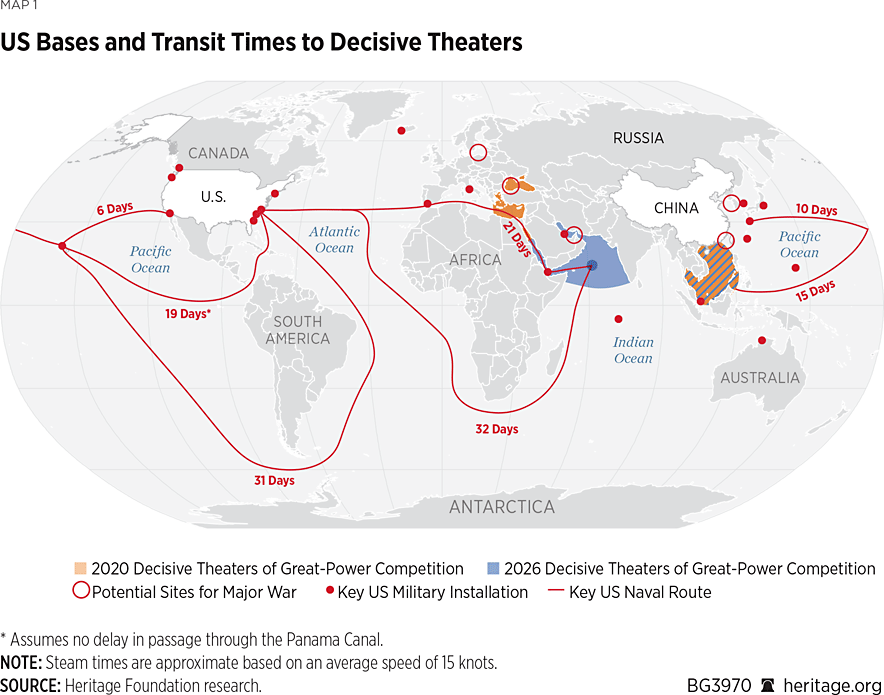
Heritage’s proposed decisive theaters in 2020 were the Eastern Mediterranean (stretching from the Black Sea to the midway point of the Red Sea) and the South China Sea. The rationale then was that adequate naval presence in these two theaters would balance the threat from Russia and China. Moreover, given the strategic imperative of these theaters to both China’s and Russia’s strategic interests (military, economic, diplomatic), it would thereby focus their attention on a theater of America’s choice and advantage.[REF] Since decisive theaters were initially proposed, the geostrategic environment has, through July 2026, changed markedly: Russia has been waging an attritional war on Ukraine that is taking a toll on the Russian military and economy (1 million military casualties, 380 aircraft lost, 29 warships destroyed, over 14,000 tanks and armored vehicles destroyed);[REF] Iran and its proxies since October 7, 2023, have been engaged in a series of debilitating conflicts; Venezuela’s narco-terrorist Maduro regime has been toppled; and dark fleet shipping moving sanctioned cargo is increasingly being interdicted on the high seas. These events will shift the strategic calculus in Beijing, necessitating a reassessment of today’s decisive theaters.
This changed strategic environment, thanks to President Donald Trump, offers new opportunities and risks that necessitate a shift in military operations. Specifically, the Navy will need to adjust its deployment planning and increase overseas posture—naval platforms and their operations focused on specific strategic goals—in the Arabian Sea while accelerating naval efforts in the South China Sea.
South China Sea Remains Top Priority for Naval Presence
In the most recent National Security Strategy (November 2025) and the National Defense Strategy (January 2026), China is the acknowledged principal threat.[REF] As such, understanding its strategic objectives and operational vulnerabilities is key in defining today’s decisive theaters. As in 2020, due to a combination of historical sensitivities, economic realities (shipping routes), and proximity to Taiwan, the South China Sea remains the top priority decisive theater.
Unchanged since the 2020 decisive theaters initial recommendation, China’s main strategic direction remains unification with Taiwan, which informs its military modernization and expansion measured against the U.S. military.[REF] The pace has been remarkable towards a goal of being prepared to prevail against the U.S. in a conflict over Taiwan by 2027—a date first highlighted before Congress by then Commander of Pacific Command, Admiral Philip Davidson.[REF] Since then, the Chinese Navy has shed smaller vessels for today’s fleet of primarily larger, modern warships totaling 332 and deployed invasion-specific platforms, such as a massive offshore bridging system.[REF] This has also engendered a more active military that since August 2021 has sustained high levels of naval and air presence around Taiwan and the normalization of highly provocative median line crossings in the Taiwan Strait.[REF]
As in 2020, an unmistakable U.S. naval presence near China’s rich industrial Pearl River Delta and naval stronghold on Hainan Island would be more than a military deterrent; it would be a force to shape behavior at sea. In addition, Chinese military operations in response to the U.S. presence would afford critical insight into Chinese military operational patterns expected in conflict. It is, of course, important to recognize as well that this force would operate at risk from DF-26 and DF-21D anti-ship ballistic missiles tested in these waters were events to lead to war.
On the other hand, if the U.S. pursues a less disciplined strategic operational approach, it runs the risk of miscommunicating its interests, thereby increasing the risk of miscalculation on China’s part and potentially resulting in a long and costly war. Events of the early post–Cold War era leading up to massive man-made island garrisons of 2015 confirm this view.[REF] Ever since the departure of U.S. forces from bases in the Philippines in 1991, this region has witnessed a notable increase in China’s encroachment and provocations that have turned violent against Philippine forces, most notably in the summer of 2024 and 2025.[REF]
Finally, there is an opportunity to rally Southeast Asian nations for a common cause and complicate Chinese operational planning for a future war. Among key considerations will be Chinese control of the approaches to Taiwan from the South China Sea. Access and familiarity with the waters and ports in the region will be important before the fighting begins and can help to deter a Chinese military adventure this decade. Achieving this will require the leadership and commitment of resources that a numbered Navy fleet can best manage (more in “Recommendations for the United States” below).
The Case for an Arabian Sea Decisive Theater
From Catherine the Great to the Soviets to today, Russia has attempted to secure lasting footholds in the Eastern and Central Mediterranean. Securing such a position would enable Russia to threaten the southern flank of the North Atlantic Treaty Organization (NATO) and implement a counter-encirclement strategy. In line with Czarist Russian thinking, the Soviets maintained the 5th Eskadra (squadron) at Tartus, Syria, as a regional bulwark and to defend their southern flank from NATO.[REF]
Since the December 2024 collapse of the Syrian Assad regime, Russia has no military regional footholds within the theater, and it seems unlikely to have the capacity to secure one given the prolonged war with Ukraine.[REF] This war has greatly diminished its Black Sea Fleet and its capacity to be reconstituted. As such, limitations on Russia’s Black Sea naval capacity should be enshrined in potential peace negotiations.
While Russia’s presence in the Eastern Mediterranean is much reduced, it is not zero and should be expected to remain a presence to contend there—much as Russia’s Pacific Fleet has remained active throughout the current Ukraine war. Significantly, as NATO begins to meet its defense spending goals and rebuilds its naval capacities, allies appear on track to adequately confront this Russian residual or transitory Mediterranean presence. To this end, Russia’s limited naval forces have in recent months been forced to escort its dark fleet of tankers engaged in illicit petroleum trades, thereby having less time to harass NATO navies or threaten American interests.[REF] Unchallenged sanctioned shipping has been a situation until recently that benefited China; long relying on cheap, sanctioned petroleum carried on unregulated commercial shipping flying a national flag of convenience frequently—the so-called dark fleet.[REF] In recent months, the presumably sanction-proof dark fleet has come under increasing multinational direct action. This began with the December 10 capture of M/T Skipper by the United States, with India, Malaysia, France, the United Kingdom, and Belgium having since joined the global effort.[REF]
The early January 2026 toppling of the Maduro narco-regime in Venezuela has begun to unravel illicit petroleum networks and to spur more actions against the dark fleet.[REF] This Caribbean success fed into a confrontation now playing out over Iran’s nuclear ambitions, which shuttered shipping through the Strait of Hormuz—imperiling 25 percent of the world’s energy shipments.[REF] These events are also creating a cascading effect that is seeing former Latin American partners of China teetering, such as the communist Cuban regime facing collapse with the loss of easy energy from its one-time socialist Venezuelan ally.[REF] The net effect is a strategic shock to Beijing, which has created gas lines like those seen in 1970s America during the Organization of the Petroleum Exporting Countries (OPEC)–driven energy crises.[REF]
For Beijing, assuring timely shipments via unavoidable maritime chokepoints to meet its energy needs is no longer just a Malacca dilemma, but a Hormuz and Panama dilemma.[REF] In total, China imported 4.4 percent more petroleum than in 2024, amounting to over 11 million barrels a day in 2025 that include “petro-laundering” illicit petroleum shipments by commingling them in third-party storage sites then reclassifying the source, such as suspected in Malaysia. This illicit energy network has enabled China to secure more than 22 percent of its energy needs from Iran (1.38 million barrels/day), Venezuela (0.389 million barrels/day), and Russian dark fleet tankers (0.8 million barrels/day); an additional 0.9 million barrels/day arrive from Russia via pipelines.[REF] Chinese shipping options are further being constrained ashore.
Under pressure from President Trump and significant debt of Chinese port operator CK Hutchinson, Panama refused to renew any port operations in the Canal Zone with China.[REF] While the Panama Canal is not currently a major thoroughfare for Chinese energy products, its control by friendly U.S. operators places the more than 20 percent of total Canal capacity in cargo and refined petroleum products that China does ship there under scrutiny.[REF] The net effect is a potential reordering of China’s energy imports and strategic calculations in a conflict with the United States as it pursues military ties and market access across Latin America, Africa, and the Middle East.
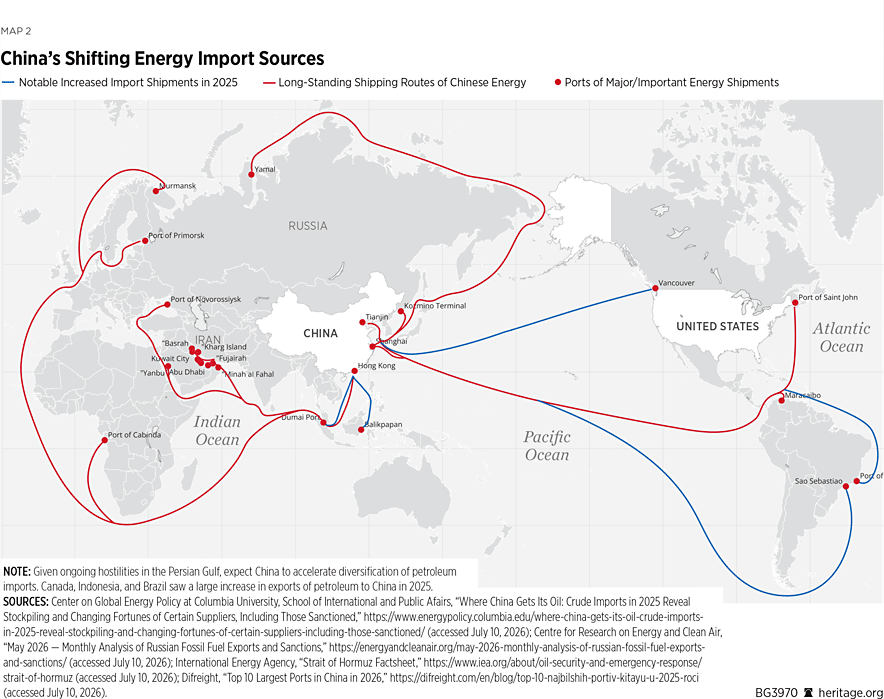
Today, Beijing’s overseas energy reliance overwhelmingly is moved by shipping that is vulnerable to U.S. naval interference, as demonstrated by increasing incidents of dark fleet seizures. However, tardy commitments, and, in July 2026, the absence of allied naval presence to secure shipping in the Strait of Hormuz, demonstrate nagging limitations of NATO and America’s Asian allies to act in an effective manner to protect shipping vital to an American war effort. In April, conflict with Iran seemed to be winding down with a ceasefire agreement, but for weeks, Western allies like France and Japan, despite having nearby naval forces, failed to commit those forces to clear mines or escort neutral shipping through the Strait of Hormuz.[REF]
Despite this, actions taken against the dark fleet and China’s sanctioned sources of energy are presenting a new reality that will force tougher choices on China. In the interim, China will likely have to pay more for petroleum while seeking new petroleum sources—most likely in the Gulf of Guinea and Middle East. In both cases, the loss of assured access through the Panama Canal and increased international scrutiny and capture of dark fleet ships will compel increased Chinese energy shipments through the Indian Ocean. This loss cannot be adequately mitigated given limited Russian pipeline capacity and seasonal pack ice along the Northern Sea Route that blocks access to Russia’s Yamal petroleum terminal which China draws from. In the immediate future, the effect will be an increase in strategic value of the Arabian Sea to China as a source of energy, its growing African trade, and with markets further West.[REF]
Recommendations for the United States
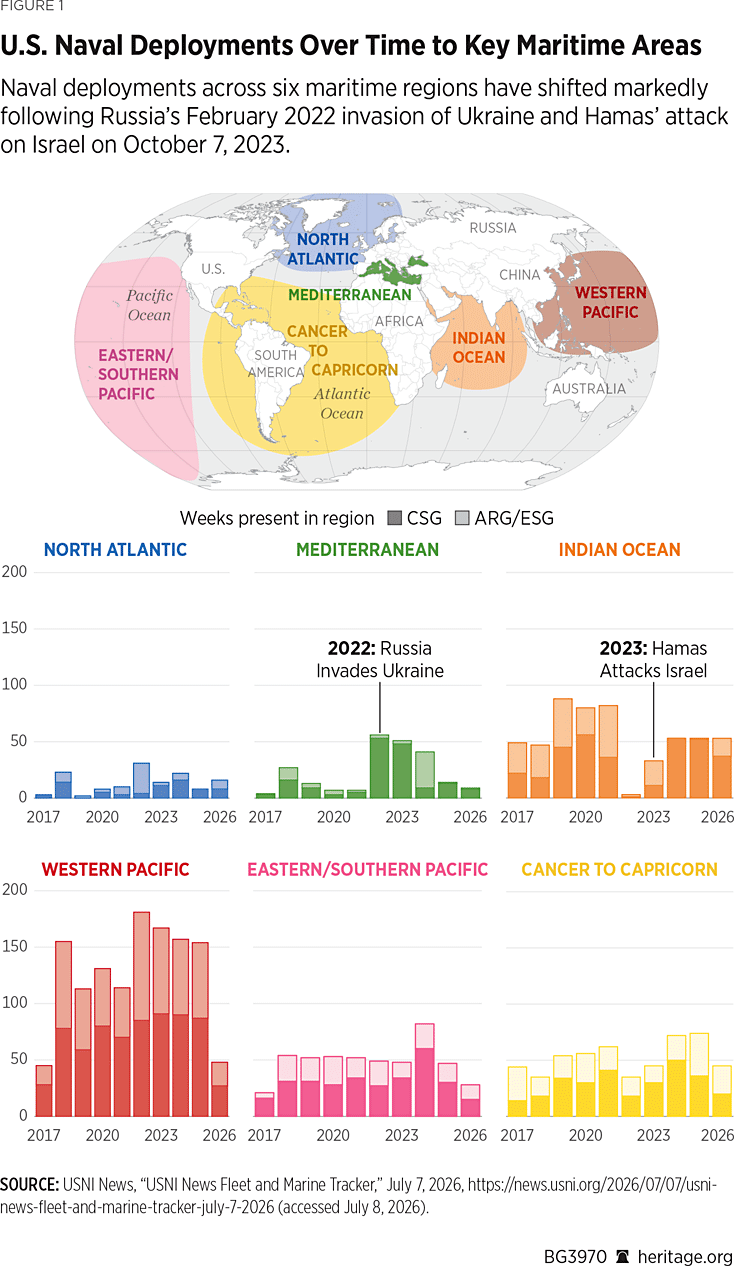
Given the changed strategic realities in 2026, the U.S. Department of War should consider the South China Sea and the Arabian Sea to be the two decisive maritime theaters for the rivalry with China. This would inform the disposition of U.S. forces globally, while prioritizing these two new decisive theaters to enable an economy of force that safeguards national interests at the same time as it seizes the strategic initiative. Determining the balance of effective naval presence is a function of what minimum capability in and outside these decisive theaters in platform numbers is needed to deter and, if needed, respond to opportunistic actions by Russia or other likely threats. In the Arabian Sea, sustaining military pressure on Iran to comply with terms of a future ceasefire, and to hold significant Chinese energy and trade interests at risk, will define the forces required. Similarly, in the South China Sea, deterring China from attacking Taiwan and checking its coercive naval activities will inform the forces needed in this primary decisive theater. To this end, it is recommended:
1. To achieve the needed shift in strategic military focus, the President should stipulate in an executive order the strategic prioritization of the South China Sea, followed by the Arabian Sea. This order should direct the Development Finance Corporation to favorably review proposals for infrastructure development that would enhance forward military presence in these regions. Further, it should direct the Departments of War and State to propose additional forces required in theater and fill vacant regional staff billets. As of July 2026, the role of Ambassador to United Arab Emirates (UAE)—a key ally in the conflict with Iran—has been vacant since January 21, 2025.[REF] The UAE’s importance to regional U.S. interests as a major energy producer is further enhanced since departing OPEC on May 1, 2026.[REF]
2. The Secretary of War, acting on the President’s executive order, should direct the Chairman of the Joint Staff to prioritize deployment planning for the South China Sea and Arabian Sea regions. Specific units and timelines are to be determined via the Global Force Management process, and all service deployments should be considered, such as Marine Corps Littoral Regiments and Army Multi-Domain Task Forces.[REF]
3. The Secretary of the Navy should propose to the President and Congress the establishment of First Fleet and expansion of Fifth Fleet’s area of responsibility. To better align naval forces to regional strategic effects, the Fifth Fleet should be responsible for the entirety of the Indian Ocean. Given the damage done by Iranian missile attacks on Fifth Fleet headquarters in Bahrain during the current conflict, consideration should be given to shifting to an afloat command ship.[REF] To better focus and support naval forces actively engaged in high stakes peacetime operations against Chinese maritime coercion, the First Fleet should focus on the South China Sea.[REF] Specific areas of responsibility, command relationships, headquarters, and staff are discussed in the Heritage Foundation Backgrounder, “An Effective Maritime Campaign Against China Requires a New Fleet-Centered Approach.”[REF]
4. The National Security Advisor should direct actions across the interagency process to encourage and, as necessary, insist on enhanced allied naval activity in the Black Sea, Eastern Mediterranean, Red Sea, and Gulf of Guinea. The intention is to augment and increasingly substitute U.S. naval presence as it is redirected, and to enhance interdiction of dark fleet shipping. As some NATO member nations currently conduct routine deployments to the Gulf of Guinea and Eastern Mediterranean, the impact should be modest. Additionally, deployments by NATO and Asian allies—notably Japan since 2011, when it established a base in Djibouti for counter-piracy operations—and additional allied naval presence in the Red Sea have become more routine but will require a new focus on deploying platforms able to suppress kinetic threats to shipping. This is not a new mission need, as the Houthis began attacking shipping in solidarity with Iran, Hamas, and Hezbollah in November 2023. Such deployments should be viewed as an enhancement to current counter-piracy patrols. That said, allied deployments to the Red Sea must include greater strike capability to re-open the Bab-el-Mandeb Strait as U.S. presence is shifted to other theaters. Finally, once the war in Ukraine is concluded, NATO will need to resume deployments to the Black Sea at a higher level than pre-conflict. Managing this shift of U.S. forces will require intense planning and diplomacy to balance the transition of capabilities and capacities to allies while not providing an opportunity for hostile action against U.S. interests.
Conclusion
During the final stages of the Cold War, naval forces were focused on the high north Atlantic to undermine Soviet military confidence—a decisive theater of its time. Operations like Ocean Venture ’81 shifted the strategic initiative and accelerated the end of the Cold War.[REF] Today the U.S. confronts a China globally present and backed by a massive shipping fleet and an expanding modern navy. With limited U.S. naval forces, a smart approach is required that focuses on two decisive theaters updated to better address today’s changed strategic environment—the South China Sea and the Arabian Sea. Operating in these decisive maritime theaters effectively can deter foes, seize the strategic initiative, and shape the theater to benefit U.S. interests.
Brent D. Sadler is Senior Research Fellow for Naval Warfare and Advanced Technology in the Douglas and Sarah Allison Center for National Security at The Heritage Foundation.



