

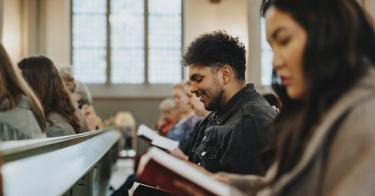
Was your church packed on Sunday? Well, of course it was. It was Easter, and the world is full of C&E Christians: people who flock to services on Christmas and Easter, but sleep in late most Sundays.
A better question is, will your church be packed this week?
Evidence is growing that young people, especially young men, are coming home to God, especially the Roman Catholic faith. This is good news as we come out of the holiest of weeks in the Christian calendar and as secularizing trends appear to halt or at least plateau.
Some of it is also happening among some Protestant denominations. With Judaism, the shift seems to be happening, at least toward more observant and traditional expressions.
For those of us who think that the United States’s biggest problems are not economic or political, but more profound—having to do with Americans’ relationships to God, family, and country—this is good news indeed.
>>> The Most Telling Moment of Poilievre’s Joe Rogan Interview
The evidence is more than anecdotal, with the church reporting an increase in key indicators. U.S. dioceses from around the country report a sharp spike in adult conversions. And by adults, they mean Generation Z, born between 1997 and 2012, and the previous cohort, millennials, born between 1981 and 1996.
“Something’s happening,” John Helsey, director of communications for the Archdiocese of Oklahoma City, told the National Catholic Register. He said he expected a huge jump in adult baptisms at Easter, to nearly 1,000 from 635 last year.
The Diocese of Newark also expected a jump. “Last year, we had no idea where all the people came from then; 2025 eclipsed every year we had had up to then,” Fr. Armand Mantia, director of the archdiocese’s Order of Christian Initiation of Adults, told the register. “We thought it might be an anomaly. And then, all of a sudden, we had our rituals for 2026, and 2026 blew away 2025, which we didn’t think was possible.”
Robert Barron, bishop of the Diocese of Winona-Rochester in Minnesota, told Fox News, “Last year, we broke the record for the number of adult converts, and then this year—so, we have what’s called the rite of election, that’s when all the people are entering into the church—we broke that record again. So, it’s a trend that’s visible all over the church, and it’s certainly been true in my diocese.”
The Rev. Conrad Murphy, chaplain at the University of Maryland’s Catholic Student Center, told the Washington Post in late December that the number of students who converted to Catholicism in 2025 was higher than at any time in the preceding 15 years. The paper, citing center data, reported that weekly Mass attendance doubled to more than 500 over the previous five years.
Murphy told the Washington Post that now “there’s always a line” at the campus center. What there is, he added, is “a desire for deeper meaning, more authentic community [especially as compared to the online communities they have been exposed to] and a desire for truth.”
The many reports that conclude a revival of some sort is underway all mention a version of this rationale: that young men and women are looking at life around them—the pornography, the gaming, the sports betting, the emptiness of virtual connections that by definition lack a human touch—and are seeking Plato’s inseparable fundamentals of the True, the Good and the Beautiful.
Even the poisoned relations between the sexes that bedevil younger generations and send them to Tinder in desperate searches for a suitable partner may be leading Gen Zers and some millennials back to church, in the hope of finding someone normal.
“The joke is that St. Joe’s is the ultimate place to date Catholic in New York because it’s all the young, beautiful people that go there,” a 24-year-old parishioner at the church in the Village told the Washington Post, in Gallup data do buttress the perception of a revival. Asked, “At the present time, do you think religion as a whole is increasing its influence on American life or losing its influence?” an astonishing 38% of the public said yes, double the 19% who responded in the affirmative in 2019.
Demographically, and taking all age groups into account, the drop-off in overall religious observance has come almost completely from the Left of the political spectrum, according to a separate Gallup study.
Comparing the periods 2001-05 to 2021-25, Republicans dropped by only 2 percentage points, 66% from 64%, in answering the question, “How important would you say religion is in your own life—very important, fairly important or not very important?” Democrats saw a collapse, going from 60% to 37% in that time.
Even Pew Research, which is more ambivalent about a revival, said in a massive survey of 36,908 published last year that, “After many years of steady decline, the share of Americans who identify as Christians shows signs of leveling off—at least temporarily—at slightly above six-in-ten.”
>>> Creed and Culture: “Self-Evident” Truths and the Formation of the American Mind
But a more recent report by the respected Barna Group, an institution established more than 40 years ago to study the intersection of religion, culture, and politics, shows a more positive trend. Barna’s survey of 132,030 adults last year yielded results that something is underway.
It reported a boom in church attendance among the young. “For the first time in decades,” Barna Group said in September, “younger adults—Gen Z and millennials—are now the most regular churchgoers, outpacing older generations, who once formed the backbone of church attendance.”
It said its data revealed “a surprising shift: Millennials and Gen Z are driving a resurgence in church attendance.”
Of course, church attendance is one thing, but living out your faith outside of church is another.
David Kinnaman, Barna CEO, says the “the influx of new generations represents a massive opportunity for congregational leaders, but this renewed interest must be stewarded well. Our research clearly shows that churchgoing alone does not in itself create devoted disciples. Even with the increasing participation of younger generations, there is still the challenge of shaping hearts and minds to live out their faith beyond church participation.”
This piece originally appeared in the Washington Examiner



