

The 2025 conflict between India and Pakistan highlighted just how deeply Chinese defense technology is woven into Pakistan’s armed forces.
President Trump famously suspended all security assistance to Pakistan in his first term, declaring the country had “given us nothing but lies & deceit” while providing “safe haven to the terrorists we hunt in Afghanistan.”[REF] In his second term, however, President Trump has utilized Pakistan to meet certain foreign policy goals.[REF]
Pakistan is a fragile partner, mired in persistent economic, political, and security crises.[REF] Its economy needs regular injections of cash from multilateral lenders and Gulf donors simply to stay afloat.[REF] Its political system is a democracy in name only, and the security environment is plagued by a roster of terrorist groups, many of which were raised and trained by the Pakistani state itself.[REF]
An Intimate Defense Relationship with China
Pakistan’s fragility is compounded by its intimate defense relationship with China. Following the latest India–Pakistan conflict, Lieutenant General Rahul R. Singh, India’s Deputy Chief of Army Staff, called the war a “live lab” for the Chinese to test their weapons, and reports indicate that more than 80 percent of the hardware Pakistan fielded in the conflict was Chinese in origin.[REF]
The 2025 Report to Congress from the U.S.-China Economic and Security Review Commission similarly identified how “the PLA’s fighter jets and air-to-air missiles received their first combat use as Pakistani forces successfully flew Chinese-made fighters during a four-day conflict with India.”[REF]
This may have marked the first live combat use of these systems, including the HQ-9 air defense system, PL-15 air-to-air missiles, and J-10 fighter aircraft.
Beyond defense, Pakistan–China cooperation also extends to the space sector, with Pakistan being a signatory to the China-led International Lunar Research Station. Chinese state-owned companies are also the main commercial providers “of international satellite services, offering launch, construction, and operational support.”[REF]
The Scale of Chinese Arms Transfers
While the partnership is decades old, the China–Pakistan defense nexus is accelerating at an unprecedented pace. China remains Pakistan’s largest defense supplier; between 2019 and 2023, 82 percent of Pakistani defense imports were from China.[REF] Data from the Stockholm International Peace Research Institute (SIPRI) on arms transfers and import and export values demonstrate the sheer volume of Chinese-origin platforms and weapon systems in Pakistani service and bring the underlying trends into focus.
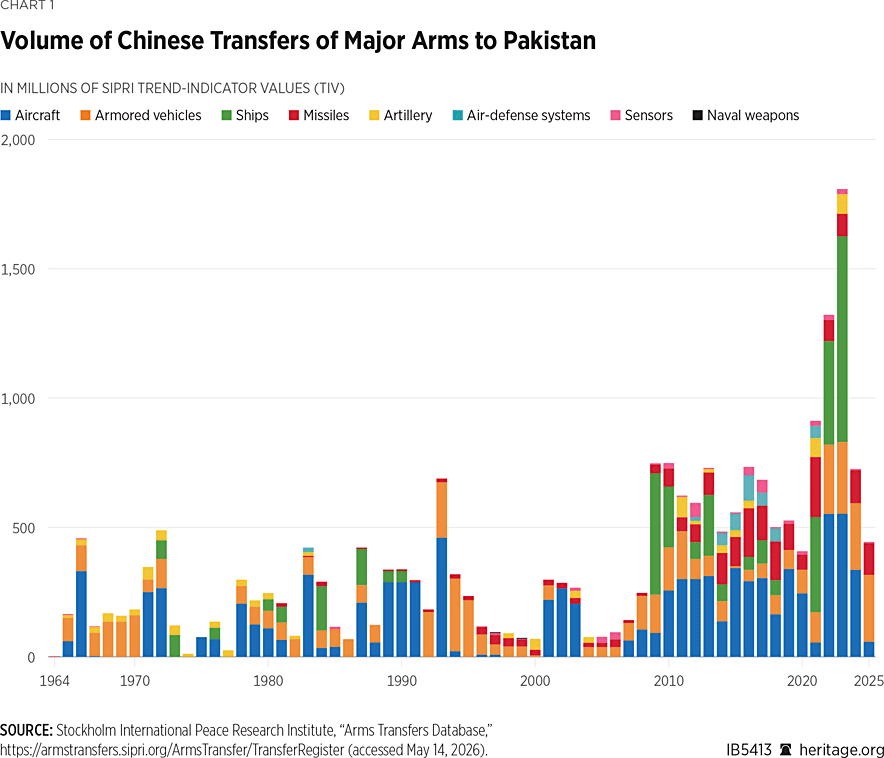
These data reveal four distinct phases of Chinese arms exports to Pakistan, each corresponding to a decisive shift in the strategic environment of South Asia:
- 1965–1972: China’s Initial Provision of Arms to Pakistan. This opening phase coincided with the India–China wars in 1962 and 1967[REF] and the India–Pakistan war of 1965.[REF] It also coincided with the 1963 agreement between China and Pakistan in which Pakistan ceded control of the Shaksgam Valley to China.[REF]
- 1990–1996:A Pronounced Surge in Chinese Transfers. This phase coincided with the 1990 invocation of the Pressler Amendment,[REF] which substantially curbed U.S. arms exports to Pakistan.
- 2009–2013:First Major Wave of Qualitative Modernization. Chinese exports in these years shifted from quantity toward quality, including frigates, JF-17 fighter jets, and guided munitions.
- 2021–2023:An Unprecedented Acceleration Across Multiple Domains. This most recent phase extended Chinese exports beyond discrete platforms toward integrated capabilities spanning the air, naval, and missile domains, reflecting a maturing defense-industrial partnership rather than a series of transactional sales.
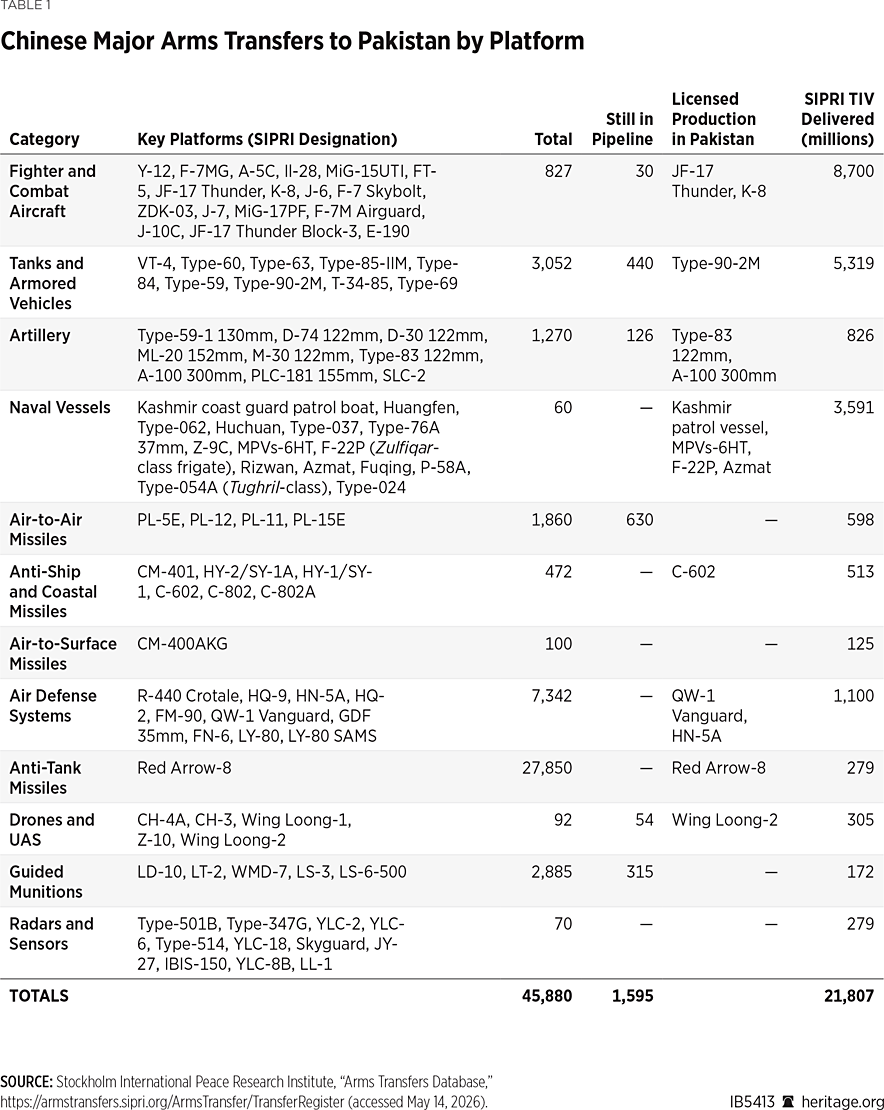
Table 1 and the SIPRI data show that China has been Pakistan’s largest arms supplier in every five-year period since 1990, with the scale and sophistication of transfers increasing throughout, notably since 2020. Between 1950 and 2026, SIPRI records nearly 46,000 pieces of Chinese military hardware delivered to Pakistan across every warfighting domain: land, air, and sea.
Eight of the 12 platform categories include systems now manufactured under Chinese license on Pakistani soil, embedding Chinese military technology into Pakistan’s own defense industrial base. An additional 1,595 systems remain in the delivery pipeline, and that figure excludes the first of eight Hangor-class air-independent propulsion (AIP) submarines—the largest single naval export contract in China’s history. The first of these boats was commissioned in April 2026, and the remaining seven are to follow.[REF]
What It Means for U.S. Policy
For the United States, Pakistan’s entanglement with China carries concrete risks: sensitive technology or intelligence shared with Islamabad could find its way to Beijing, and any U.S. security assistance would effectively subsidize a military that China has spent decades equipping. Washington should therefore proceed deliberately: condition cooperation on clear, verifiable limits, safeguard sensitive systems and intelligence, and treat Pakistan’s dependence on China as a permanent fact of the relationship.
Kriti Upadhyaya is Visiting Fellow for India Policy in the Asian Studies Center at The Heritage Foundation.



